
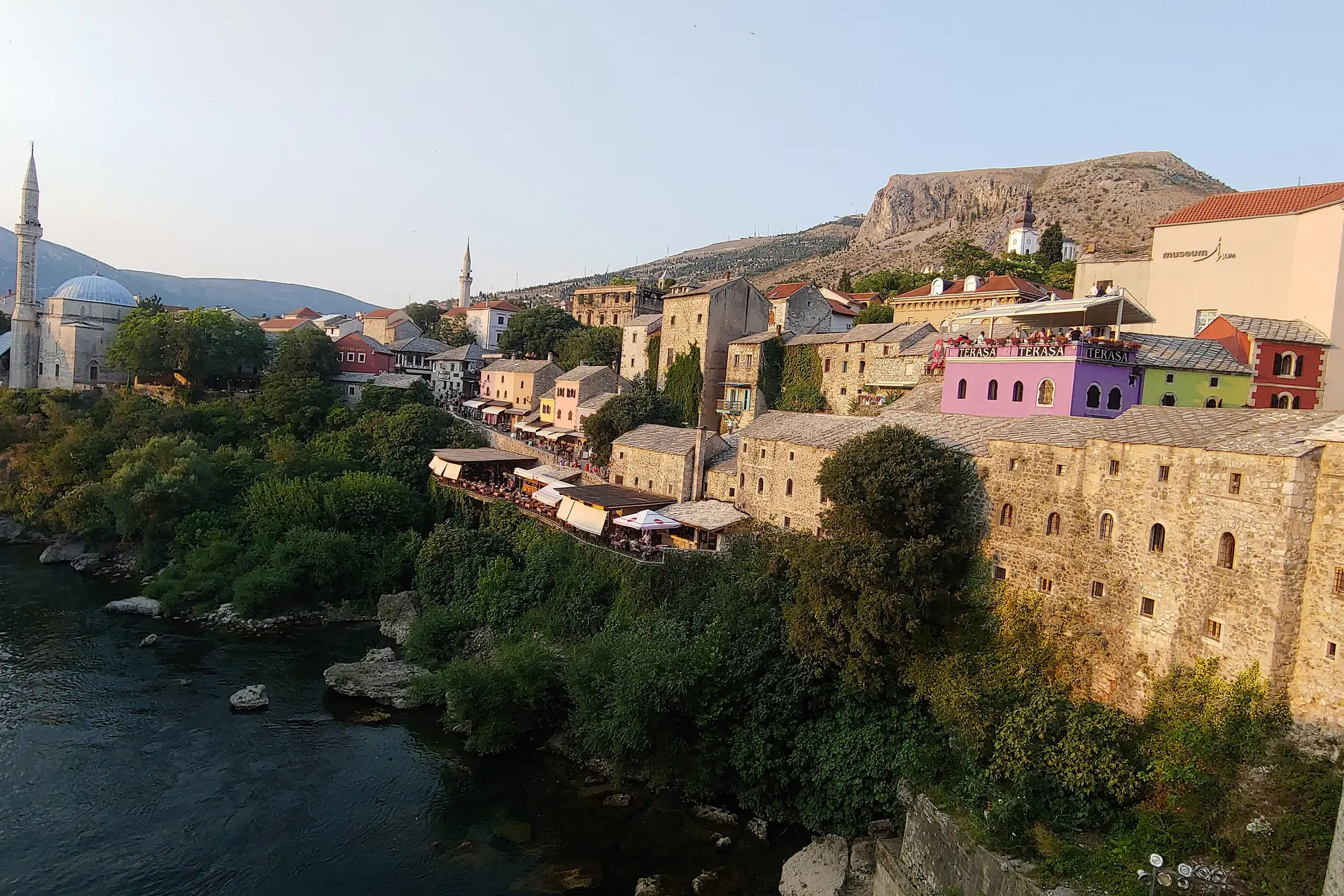
A bridge that survived four centuries and then a war
Mostar is the historic capital of Herzegovina, and it is named after the bridge-keepers (mostari) who once guarded the crossing over the Neretva. The Old Bridge, Stari Most, was completed in 1566 as a single stone arch about 24 metres above the river. It was destroyed on 9 November 1993 during the Croat–Bosniak war, reconstructed, and inaugurated again on 23 July 2004. In 2005 the bridge and its surrounding old town were inscribed on the UNESCO World Heritage List.
Mostar is also widely described as one of the country's most visited destinations, although there is no audited visitor count. The director of the Mostar Tourism Board said in October 2024 that the city had hosted more than a million tourists that season, and local reporting in August 2025 noted that no one can say precisely how many visitors the city receives. Treat the figure as a strong estimate. The practical effect is real: the old town is crowded in the middle of the day, calm at the edges of it, and a lot more rewarding if you plan around the groups.
The honest complications
Mostar was divided in 1993 into a Croat-held west and a Bosniak-held east, with the front line running through the city, and the scars are still visible: shell-damaged buildings stand within a few streets of the polished old town. The old-town restaurants are aimed squarely at tour groups, summer is hot (July averages about 26 °C).
The main tourist trap is timing, not a single street. Between late morning and mid-afternoon the old town fills with day-trip groups from the Croatian coast and Sarajevo. Visit early or after the groups leave, and eat one street away from the bridge rather than on the terraces directly above it.
Three areas that matter
Mostar's visitor core is small and walkable and sits on both banks of the Neretva around the Old Bridge. Beyond it, the main boulevard and the modern city show the part of Mostar that day-trippers usually miss.
The Old Town around Stari Most
Both ends of the bridge are guarded by fortified towers, Halebija on one side and Tara on the other, and the cobbled lanes between them hold the bazaar, restaurants and souvenir stalls. Kujundžiluk, the old bazaar, takes its name from the goldsmiths who once worked there. This is the best place to stay if atmosphere matters more than quiet, and the lanes are noticeably calmer early in the morning and after the day trippers leave.
Onešćukova and the Radobolja
Close to the old town, the small Radobolja stream runs under the Crooked Bridge (Kriva Ćuprija), built around 1558, and past a row of restaurants and terraces. Onešćukova street is lined with restaurants and is where Hotel-Restaurant Kriva Ćuprija and Tima-Irma are found.
The Boulevard and Spanish Square
A few minutes' walk from the old town, the Bulevar was the front line in the early 1990s. Spanish Square, named in honour of the Spanish UN peacekeepers who served in the area, sits on it, with shell-damaged buildings still standing around it. It is not a pretty part of the city, and it is the quickest way to understand what the old town was rebuilt after.
Close to the bridge, or close to the road
Mostar has a large stock of guesthouses and apartments close to the old town, and a smaller number of full hotels. Rates change by season and are not listed here; check them on the booking pages linked below, and book ahead for the summer weekend of the diving competition.
Hotel-Restaurant Kriva Ćuprija sits on Onešćukova street, at Onešćukova 23, combining hotel rooms with a restaurant in the mill-house stretch beside the Crooked Bridge, within walking distance of the Old Bridge.
Hotel Bristol is on Mostarskog bataljona, in the modern part of the city rather than the old town, and is listed as a hotel of the Herzegovina wine route. It suits travellers who want a conventional hotel rather than a room in the old lanes.
Many visitors also rent private apartments directly in the old town. The same rules apply as anywhere: confirm the exact street, ask about noise from the terraces below and, if you arrive by car, ask where to park.
Grilled meat, Bosnian coffee and a terrace with a view
Mostar's food is the Bosnian and Herzegovinian standard: grilled meat, bread, stews and pastries, with Adriatic influence in the fish. Prices are not listed here because menus change; look at the menu board before you sit down, especially on the terraces with a direct bridge view.
Traditional Bosnian
Šadrvan, at Jusovina 11 in the old town, is a long-standing traditional restaurant where staff dress in old-fashioned costume, and is known for kebabs and mixed grill platters. Hindin Han, in a renovated family home across from the Crooked Bridge, concentrates on regional classics and has a large outdoor seating area.
Grills
Tima-Irma, at Onešćukova 7, is a family-run grill that local guides describe as a fixture of the old town for more than three decades, known for grilled platters and local classics.
Bosnian coffee
Bosnian coffee is brewed unfiltered in a copper džezva and served in a small cup with a sweet on the side, and it is meant to be a slow break, not a to-go order. Any of the small cafes in the old town's side lanes serves it; sit down, and pick one a street or two away from the bridge.
A bridge, a minaret and a museum in its tower
Mostar's sights are compact and mostly on foot. Entry fees and opening hours for the paid sights are not fixed in this guide because published figures disagree; check at the door.
The Old Bridge and the diving tradition
Stari Most is the reason most people come: a single arch, about 24 metres above the Neretva, built under Ottoman rule and completed in 1566. Young men have jumped from it for centuries; the first written record is in the 17th-century travelogue of Evliya Çelebi, and a formal diving competition has run since 1968, held each year around the end of July. Watch from the banks and leave the jumping to the club divers.
The bridge towers and museum
The fortified Halebija and Tara towers guard the ends of the bridge. The Tara tower holds the Old Bridge Museum, run by the Herzegovina Museum, which presents the reconstruction of the bridge between 1999 and 2004 and the archaeological finds from the work, with a view over the old town from the top floor. Check the museum's page for current hours before you go.
The Koski Mehmed Pasha Mosque
Built in the early 17th century, the Koski Mehmed Pasha Mosque stands a short walk from the bridge, right on the river bank. Visitors can climb the minaret for one of the best views of the Old Bridge; the stairs are narrow and steep, an entry fee applies, and modest dress is expected.
Kujundžiluk and the Crooked Bridge
The old bazaar, Kujundžiluk, is named after its goldsmiths and is now mostly souvenirs, copperware and cafes; it is worth a slow walk early in the day. A few minutes away the small Crooked Bridge, built around 1558 over the Radobolja stream, is a quieter photo stop than the Old Bridge.
The other side of Mostar
Walk the Boulevard to Spanish Square to see the front line of the 1990s. You will pass the ruined, graffiti-covered tower often called the Sniper Tower; do not go inside, because it is a dangerous structure and entry is treated as trespassing.
One, two or three days, planned around the crowds
The old town is best early and late; the middle of the day is for the minaret, the museum or a day trip out of town. These routes are on foot and need no car except for the day-trip stops.
- Morning
The Old Bridge before the groups. Walk across, then through Kujundžiluk while the lanes are quiet.
- Midday
Minaret and museum. Climb the Koski Mehmed Pasha minaret, then visit the Old Bridge Museum in the Tara tower.
- Afternoon
The Crooked Bridge and lunch. Eat a street or two back, for example at Hindin Han or Tima-Irma.
- Evening
The bridge at dusk. After the day-trip groups have gone, with a Bosnian coffee on a side-lane terrace.
- Day 1
The one-day route: Old Bridge, Kujundžiluk, minaret, museum, Crooked Bridge and dinner at Šadrvan.
- Day 2 morning
The Boulevard and Spanish Square. The front line of the 1990s and the modern city, on foot.
- Day 2 afternoon
Blagaj. The Tekke at the source of the Buna, southeast of Mostar, then back for the bridge at dusk.
- Days 1-2
The two-day route above, at an easier pace.
- Day 3
Počitelj and Kravice. The walled Ottoman village on the Neretva, then the waterfalls on the Trebižat. A car or a guided tour is the practical way to link them.
Walk the old town; use buses and cars for everything else
The old town is walkable end to end. Mostar International Airport (OMO) lies at Ortiješ, a few kilometres southeast of the city, and handled more than 72,000 passengers in 2025; service is limited and partly seasonal, so most visitors arrive by road from Sarajevo or from the Croatian coast.
From Sarajevo, the drive or bus is roughly 2 to 2.5 hours. From Dubrovnik and Split, allow roughly 3 to 4 hours and 3 to 4.5 hours respectively, with extra time for border queues in summer. A railway line also links Sarajevo and Mostar through the Neretva valley; confirm the current timetable with the operator, Željeznice Federacije BiH, because the seasonal weekend Sarajevo to Ploče train ran only from 26 June to 27 September 2026.
Best time to visit and a SIM before you land
May-June and September-October are the best months: warm without the peak-summer heat or crowds. July averages about 26 °C and January about 5 °C, and the diving competition around the end of July is the city's busiest weekend.
Practical prep: Bosnia and Herzegovina is not in the EU roaming zone, so an eSIM before landing avoids roaming charges and the airport queue.
Mostly cheap, with a few small fees at the door
The currency is the convertible mark (KM, code BAM), fixed to the euro at 1.95583 KM per euro. Published prices for Mostar's paid sights and restaurants disagree across sources, so this guide lists what is free and what is not, and leaves the figures for you to check on arrival.
- The Old Bridge and the old town lanes
- Watching divers from the river banks
- Crooked Bridge and the Boulevard
- Spanish Square
- Koski Mehmed Pasha minaret
- Old Bridge Museum
- Blagaj Tekke
- Kravice waterfalls
- Bus or car from Sarajevo or Croatia
- Car or tour for Počitelj and Kravice
- Parking if you drive
- Cash for small fees
A Level 2 country with one rule that matters
The US State Department rates Bosnia and Herzegovina Level 2, Exercise Increased Caution (advisory issued 27 August 2026), citing crime, landmines and terrorism risk. In Mostar's tourist areas the practical advice is normal city awareness: watch your bag in the crowded old town and use official taxis.
The rule that matters is the landmine one. Landmines and unexploded ordnance from the 1992-1995 war remain in parts of the country, and the advisory recommends staying on hard-surfaced roads and out of abandoned buildings; Switzerland's foreign ministry adds that visitors should not enter unmown meadows, fallow fields or ruined houses. For Mostar that means two things: keep to paved roads and marked paths on day trips, and never enter the ruined buildings left from the war, including the Sniper Tower. The emergency number is 112.
Three stops in Herzegovina
Mostar is the base for Herzegovina's best-known stops. A car makes the loop easy; a guided tour does it without the planning. Entry fees at these sites vary by source, so check them locally.
Blagaj Tekke
A Sufi lodge built against a cliff at the source of the Buna River, a powerful karst spring, the ensemble dates to the early Ottoman period, around 1520 at the latest. Cover shoulders and knees. Guided tours combine it with the other stops.
Počitelj
A fortified village on the left bank of the Neretva, taken by the Ottomans in 1471, with a 16th-century mosque, a medresa and a clock tower. It is a National Monument of Bosnia and Herzegovina and has been on UNESCO's tentative list since 2007.
Kravice waterfalls
A wide tufa cascade on the Trebižat River, roughly 40 kilometres south of Mostar and 10 kilometres south of Ljubuški. Public transport does not stop at the site, so most visitors come by car or on a tour; entry fees differ between sources, so confirm on arrival.
Mostar FAQ
Is Mostar worth visiting?
Yes. The Old Bridge and the Ottoman-era old town are a UNESCO World Heritage Site, and the city is the base for Blagaj, Počitelj and Kravice. It is easiest to enjoy with one night, so you see the bridge before and after the day-trip groups.
Can I visit Mostar as a day trip from Sarajevo, Split or Dubrovnik?
Yes. Sarajevo is roughly 2 to 2.5 hours away by road, and Dubrovnik and Split are roughly 3 to 4.5 hours each way depending on border queues. Day trips work, but they leave only a few hours in the old town at midday, when it is busiest.
How many days do I need in Mostar?
One full day covers the Old Bridge, the old town and the main sights. A second day is useful for Blagaj, Počitelj and Kravice. Staying one night is the simplest way to see the bridge in the quieter morning and evening hours.
When is the best time to visit Mostar?
May, June, September and October are the best months: warm without the peak-summer heat and crowds. July and January average about 26 °C and 5 °C. The traditional bridge-diving competition is held around the end of July.
When is the Mostar Old Bridge diving competition?
A formal diving competition has been held at the Old Bridge since 1968, every year around the end of July. Local divers also jump for tips outside the competition; treat it as a spectacle to watch, not something to try.
Is Mostar safe for tourists?
The US State Department rates Bosnia and Herzegovina Level 2, Exercise Increased Caution, citing crime, landmines and terrorism risk. In the tourist areas of Mostar the practical advice is normal city awareness. Landmines remain a risk away from main roads, so stay on paved roads and marked paths and keep out of ruined buildings.
What currency is used in Mostar?
The convertible mark (KM, code BAM), which is fixed to the euro at 1.95583 KM per euro. Cards are accepted in many old-town restaurants, but carry some cash for small entry fees and cafes.
How do I get from Sarajevo to Mostar?
By road it takes roughly 2 to 2.5 hours by bus or car. A scenic train through the Neretva valley also serves Mostar; confirm the current timetable with the railway operator ŽFBH, because the seasonal weekend Sarajevo to Ploče train ran only from 26 June to 27 September 2026.
Can I climb the minaret of the Koski Mehmed Pasha Mosque?
Yes, visitors can climb the minaret for a view over the Old Bridge. The spiral staircase is narrow and steep, an entry fee applies, and modest dress is expected. Check the current fee and opening times on arrival.
Do I need to speak Bosnian or Croatian in Mostar?
No. English is common in the old town's restaurants, shops and hotels. A few words of Bosnian or Croatian are appreciated, and you will hear both in Mostar.
What Stays With You
Mostar is easy to treat as a photo stop, and it rewards a slower look. The bridge you cross today was built again between 2001 and 2004, a few streets from buildings still pitted by shell fire; both are part of the same city.
Stand on the east bank in the evening after the day-trip buses have gone, and watch the old town light up one terrace at a time.