
What Travellers Should Know About Bosnia and Herzegovina
Bosnia's urban tourism scene — concentrated in Sarajevo and Mostar — is safe, welcoming, and increasingly sophisticated. The tourist traps are those common to a rapidly growing European destination: taxi overcharging, inflated restaurant bills in the most-photographed streets, and aggressive souvenir selling. Away from the cities, the landmine legacy requires simple but non-negotiable awareness.
Common Scams in Bosnia and Herzegovina
Bosnia's tourist traps are those of a rapidly growing Balkan destination — modest in scale, predictable in location, and entirely manageable with awareness.
Sarajevo Airport taxi overcharging is the country's most consistently reported tourist scam. The airport is approximately 12km from the city centre; the correct metered fare is BAM 25–35. Unofficial drivers and some registered taxis quote BAM 60–100 to arriving tourists who don't know the local rate. The approach: drivers meet arrivals in the hall with placards or verbal solicitation offering a "fixed price" that is presented as convenient — it is simply two to three times the actual fare. Within the city, drivers sometimes claim meters are "broken" or quote fixed prices rather than using the meter.
- Use Bolt — widely available in Sarajevo, provides upfront pricing and driver identification.
- Call a radio taxi: Yellow Cab Sarajevo (+387 33 663 555) and Sarajevo Taxi (+387 33 660 666) are established operators with metered pricing.
- The airport has an official taxi desk inside the terminal — use this and confirm the metered fare before accepting.
- Never accept rides from drivers who approach you in the arrivals hall — always initiate contact yourself.
- Insist on the meter being used for all city journeys — if a driver refuses, exit the vehicle.
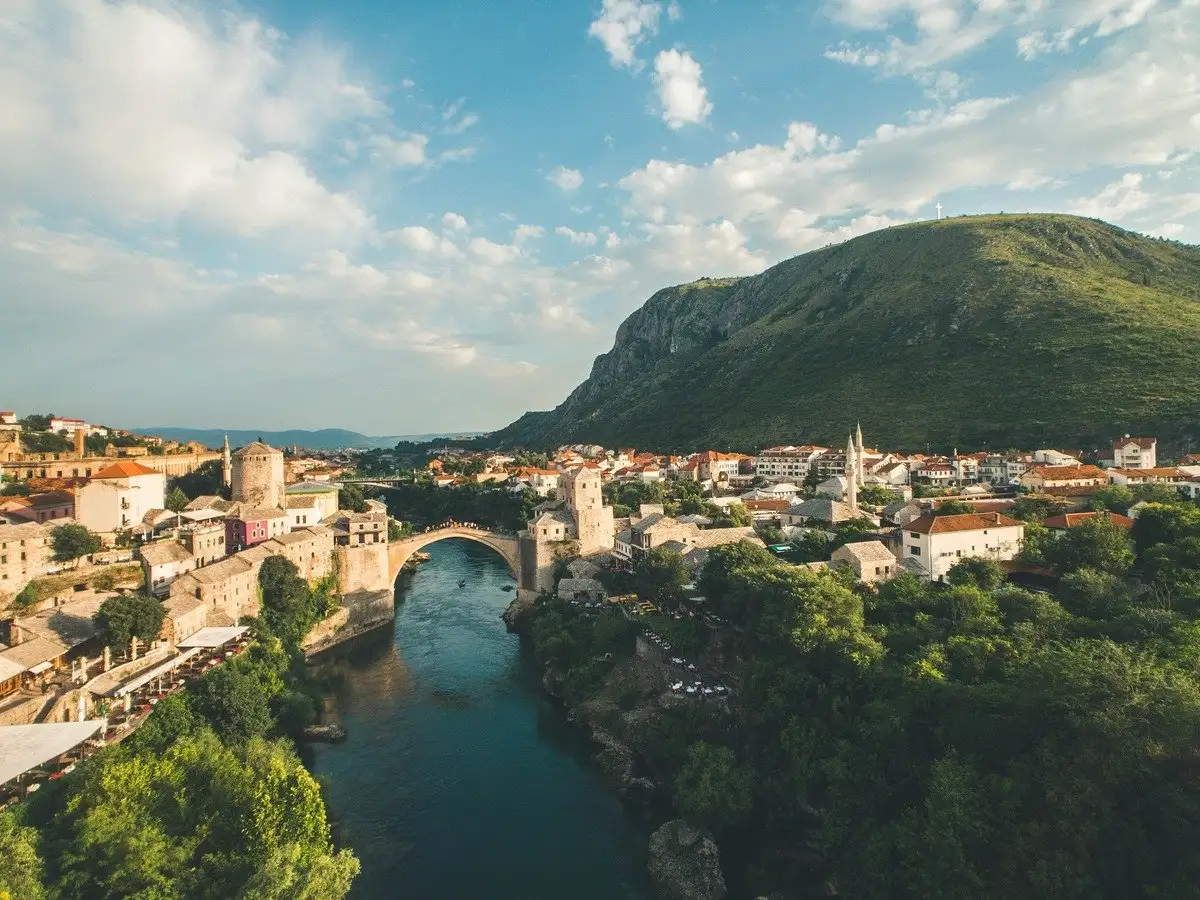
The restaurants with terraces directly overlooking Stari Most are Mostar's most prominent tourist trap. The view is genuinely extraordinary — the 16th-century Ottoman bridge (destroyed in 1993, rebuilt in 2004) over the turquoise Neretva is one of Europe's most beautiful sights. The food, however, is identical to the restaurants one street back, while prices are two to three times higher. Bill padding — extra items added that weren't ordered, covers charged without mention, or rounding errors — is also reported at the most tourist-facing establishments. Aggressive waiters at street level who physically block passage and describe menus at passing tourists are a Mostar old-town constant.
- Walk one street back from the bridge in any direction — prices drop immediately and food quality is equivalent or better.
- Mostar's best restaurant areas are in the old town streets away from the bridge terrace cluster.
- Check the bill carefully — compare against what was ordered before paying. Disputed items should be challenged politely but firmly.
- The grilled meat restaurants (čevabdžinica) in the side streets serve some of the best food in Bosnia at local prices — seek these out.
Baščaršija is one of Europe's oldest and most atmospheric bazaars — and its tourist-facing souvenir shops sell a mix of genuine Bosnian handicrafts (hand-beaten copper, silver filigree, hand-painted traditional items) alongside mass-produced imports from China presented as Bosnian. The main tells: copper items that are too perfectly finished and uniform are machine-made; genuine hand-beaten copper shows individual hammer marks. "Bosnian" jewellery with no visible workshop nearby is imported. Prices on the main drag start high expecting bargaining; side-street craftsmen workshops set fair initial prices.
- Seek the actual workshops — the Kazandžiluk (coppersmiths' street) has working artisans whose products are genuinely hand-made; you can watch the work in progress.
- Genuine Bosnian copper shows tool marks and slight irregularities — machine-produced items are too uniform.
- The Sarajevo craft cooperative shops (zadrugas) sell certified locally produced items without inflated tourist pricing.
- Bargaining is expected in souvenir shops but the initial offer is typically 30–50% above the real price; counter at half and settle somewhere between.
Sarajevo's wartime history — the 1425-day siege (the longest of any capital city in modern warfare), the Tunnel of Hope, the Sniper Alley, the Holiday Inn where war correspondents sheltered — is one of the most important historical narratives of the late 20th century and Bosnia genuinely deserves to tell it. A small number of tour operators offer packaged "war tours" that are commercially driven rather than historically rigorous, with guides reading from scripts without personal connection to the period. Srebrenica — site of the 1995 genocide — warrants particular sensitivity; poorly guided visits can feel exploitative rather than commemorative.
- Book war history tours through operators with documented local guides who have personal or family connection to the siege period — their testimony is irreplaceable.
- The War Childhood Museum and Srebrenica Memorial Gallery in Sarajevo are self-guided, free or low-cost, and curated with extraordinary care.
- For Srebrenica, book through the Srebrenica Memorial Centre directly for officially supported guided visits.
- GetYourGuide listings for Sarajevo war history tours include reviews — prioritise operators with years of reviews and specific mentions of guide quality.
Sarajevo's bar and café scene is genuinely excellent — one of the great café cultures in Europe, with a tradition of sitting for hours over Bosnian coffee (served in a džezva with a sugar cube, never with milk). The evening nightlife area around Ferhadija and the streets below Baščaršija has some bars with inconsistent billing practices — drinks not fully itemised, rounds counted incorrectly, or additional "service" charges appearing on the bill without prior mention. This is relatively uncommon but clusters around venues catering primarily to foreign visitors.
- Ask for a written menu before ordering — verbal price quotations in busy bars are harder to dispute at billing.
- Track rounds ordered and compare against the bill before paying.
- Bosnian coffee culture is extraordinary — cafés frequented by locals have completely honest pricing and are often better than tourist-facing venues.
This is not a scam — it is Bosnia's most serious physical safety risk. Landmines and unexploded ordnance from the 1992–1995 war remain in an estimated 2% of Bosnia's territory, concentrated in rural, forested, and mountain areas that were former front lines or strategic zones. The risk to tourists is specific: those who hike or walk off marked paths in mountain areas, enter abandoned buildings (particularly rural ones near former conflict zones), or explore away from established routes. Tourist sites, towns, main roads, and ski resorts are completely safe. The mountain areas around Sarajevo (Trebević, Igman, Bjelašnica) were extensively mined — ski runs and marked trails are cleared and safe, but off-piste movement requires specific local guidance.
- Never leave marked paths when hiking or walking in rural Bosnia — this is the single most important rule.
- Heed all warning signs — skull and crossbones on yellow background means a known mined area.
- Do not enter abandoned or derelict buildings in rural areas.
- Do not approach, touch, or pick up any unusual objects in fields, forests, or rural areas.
- For mountain hiking, use licensed local guides who know which areas are cleared — the Sarajevo Hiking Club and local outdoor operators organise safe guided hikes.
- Current BHMAC affected area maps: bhmac.org
Risk by Region
Bosnia and Herzegovina has a complex administrative structure — the Federation of Bosnia and Herzegovina and Republika Srpska — but for tourists the practical distinction is between the main urban centres and the rural areas.
The capital is the heart of the Bosnian tourist experience — a city where a ten-minute walk crosses from Ottoman to Austro-Hungarian to Socialist Yugoslav to post-war contemporary. The Baščaršija, the Latin Bridge (where Franz Ferdinand was assassinated in 1914), the Yellow Fortress, the War Childhood Museum, the Tunnel of Hope, and the city's extraordinary café culture make it one of Europe's most rewarding capitals. Crime is low; the tourist traps are financial and modest.
- Airport taxi overcharging — use Bolt or call radio taxi
- Baščaršija souvenir touts and imported craft fraud
- Bar bill inflation in tourist-facing nightlife venues
- Low-quality war tour operators — use War Childhood Museum for self-guided history
- Tram pickpocketing at peak hours — keep bags front-facing on line 3 (main tourist tram)
Mostar is Croatia's closest Bosnian destination (2.5 hours from Split or Dubrovnik) and receives vast numbers of day-trippers, creating a concentrated tourist economy around Stari Most. The old town is genuinely beautiful but heavily commercialised in the bridge zone. Staying overnight — the crowds thin dramatically after the day-trippers leave — transforms the experience. The city's division (Bosniak west, Croat east) is still visible in the urban fabric; Stari Most itself is the most powerful symbol of reconciliation in the Balkans.
- Bridge-adjacent restaurant premium and bill padding
- Aggressive waiter touts blocking pedestrian streets
- Souvenir shops with imported items priced as local crafts
- Day-tripper overload July–August — stay overnight to experience the real city
- Stari Most bridge divers — the cliff diving tradition is genuine; "donations" are requested for performances
Jahorina and Bjelašnica — the 1984 Winter Olympics venues — are excellent, affordable ski resorts 30–45 minutes from Sarajevo. The skiing is genuinely good and the prices are a fraction of Western European equivalents. The landmine caveat applies specifically here: ski runs and marked trails are fully cleared and safe; off-piste movement on mountain terrain outside marked areas carries residual risk and should be discussed with local ski guides before attempting.
- Marked ski runs: fully safe, excellent value by European standards
- Off-piste: discuss with local ski guides — some mountain terrain outside marked runs has residual mine risk
- Ski equipment rental: honest pricing, pre-book to confirm availability in peak season
- Transport from Sarajevo: shared minibuses available, pre-arrange return or book hotel package
The administrative centre of Republika Srpska — a city with a completely different character from Sarajevo, with Orthodox churches rather than mosques, the impressive Kastel fortress on the Vrbas River, and the country's best whitewater rafting on the Vrbas. Very few foreign tourists, almost entirely safe, and a genuine insight into the other half of Bosnia's complex identity. The Serbian-character café culture here is excellent.
- Very few tourist-targeting scams — genuinely off the tourist circuit
- Vrbas River rafting — arrange through established outdoor operators with safety equipment
- Taxi overcharging at the bus station for arrivals — agree metered fare before boarding
Srebrenica is one of the most important sites of remembrance in contemporary Europe — the location of the 1995 genocide in which over 8,000 Bosniak men and boys were killed. The Srebrenica-Potočari Memorial and Cemetery is a place of profound importance. Visiting requires respectful, well-informed engagement — it is not a conventional tourist attraction. The route from Sarajevo through eastern Bosnia passes through mountain landscapes of great beauty alongside former conflict zones.
- Visit through the official Srebrenica Memorial Centre for guided access — srebrenicamemorial.org
- Eastern Bosnia mountain roads: rural landmine awareness applies on unmarked terrain
- Very limited tourist infrastructure — accommodation and transport must be pre-planned
The turquoise waterfalls of Kravice (near Ljubuški), the Hutovo Blato nature reserve, and the wine region of Herzegovina (Blatina and Žilavka grapes from the Neretva valley are excellent) complete a southern Bosnia itinerary perfectly. The Herzegovina wine road is authentic and relatively unknown to non-regional visitors. Kravice Waterfalls sees heavy summer crowds; visit early morning or out of peak season.
- Kravice parking and entry fees — official and modest; unofficial collectors occasionally operate; use the official site entrance
- Summer overcrowding (July–August) — arrive before 9am or visit in May/June/September
- Herzegovina wine road: direct winery purchases are honest; roadside sellers less reliable
Safety Tips for Bosnia and Herzegovina
- ✓ Never leave marked paths in rural and mountain areas — the landmine legacy from the 1992–1995 war requires this as a non-negotiable habit. Tourist sites, towns, and main roads are completely safe.
- ✓ Use Bolt or call a radio taxi for all Sarajevo journeys — never accept rides from drivers who approach you at the airport arrivals hall. The correct metered airport fare is BAM 25–35.
- ✓ In Mostar: walk one street back from Stari Most for food — prices drop by half and quality is equivalent. The bridge view restaurants are the premium you pay for the terrace, not for better čevapi.
- ✓ In Baščaršija: seek the Kazandžiluk coppersmiths' workshops for genuine hand-beaten copper — the artisans working in the street are the real thing. Main-drag shops sell imports at inflated prices.
- ✓ The War Childhood Museum is one of the best museums in Europe and costs almost nothing — do not skip it. For Srebrenica, book through the official Memorial Centre.
- ✓ Bosnian coffee is served in a džezva (small copper pot) with a sugar cube — you pour it yourself and let the grounds settle. Ordering it correctly and sitting for an hour is one of the great experiences of the Balkans. Asking for "Turkish coffee" is technically correct but slightly impolitic — Bosnians prefer "Bosnian coffee."
- ✓ The Bosnian Convertible Mark is pegged at 1 EUR = 1.95583 BAM — an easy mental conversion. Euros are not widely accepted as payment despite the peg; carry BAM for local use.
- ✓ Inter-city buses between Sarajevo and Mostar (approximately 2.5 hours, BAM 15–20) are reliable and the standard way to travel. The route through the Neretva canyon is spectacular.
- ✓ For skiing at Jahorina or Bjelašnica: marked runs are completely safe; discuss any off-piste intentions with local ski guides before leaving marked terrain.
Book Smart, Travel Deep
Pre-booking eliminates Sarajevo's taxi trap and secures the best guides for Bosnia's extraordinary history.
Emergency Numbers & Contacts
Bosnia and Herzegovina uses the EU emergency number 112. English is widely spoken in tourist areas and by emergency services in Sarajevo.