
The capital of Europe that never quite acts like one
Brussels hosts the European Commission, the European Council and NATO headquarters, yet it doesn't carry itself with the polish of a capital that knows it. It's a patchwork city: Art Nouveau townhouses next to 1970s office blocks, a gilded medieval square two minutes from a comic-strip mural, a French-speaking majority inside officially bilingual Flanders. That patchwork quality is exactly what rewards a slow visit rather than a highlight-reel one; the city's charm is granular, found in specific streets and specific chip shops rather than a single skyline view.
What changed in the last decade is less about Brussels itself and more about how well it now connects: the rail network to Bruges, Ghent and Antwerp got faster and cheaper, and international visitors increasingly treat Brussels as a hub rather than a one-off stop. That's the right way to use it. Two focused days cover the city's own sights properly, and from there every other must-see town in Belgium is under an hour away.
The honest complications
Brussels' weather is grey and rainy more often than postcards suggest, in any season. The area immediately around Gare du Midi, the Eurostar/Thalys hub, has a rougher edge after dark than the rest of the centre. And the city's federal, multilingual governance, three regions, three language communities, six governments for 11.8 million Belgians, is a genuine source of friction locals will happily explain to you at length if asked.
Rue des Bouchers, the restaurant row two minutes from the Grand Place, is the single biggest tourist trap in the city. Menus the size of phone books, staff pulling you in off the street, and moules-frites that arrive in a small, mediocre portion for a tourist-menu price. It photographs well and delivers little. Skip it entirely; better food is a five-minute walk in almost any direction.
Six neighbourhoods that matter
Brussels' neighbourhoods are defined by their distance from the Grand Place and their relationship to the EU institutions, and where the good food actually is, which is rarely the same place. Where you base yourself for sleeping and where you eat dinner don't have to be the same neighbourhood.
Grand Place & City Centre
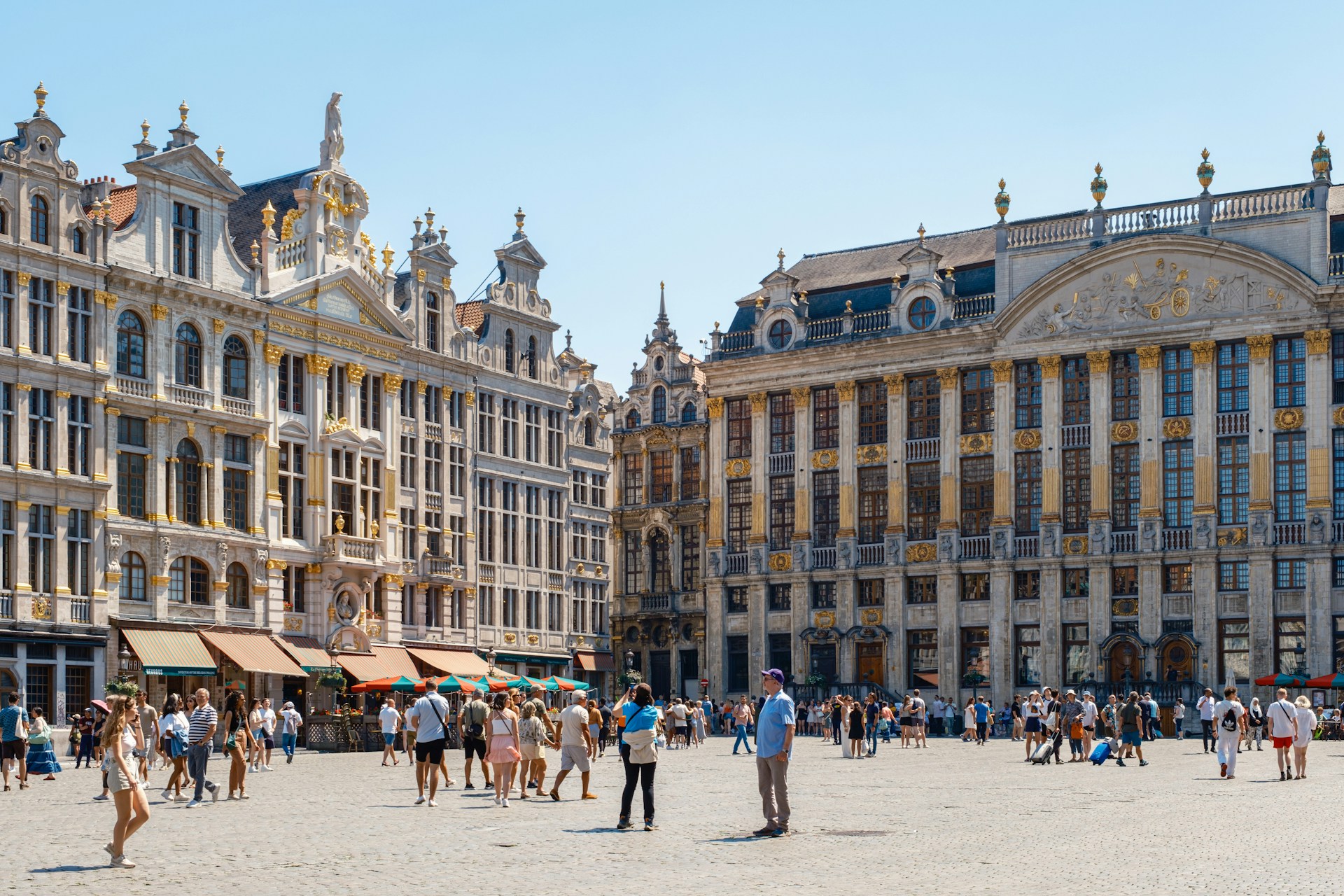
The historic core inside Brussels' ring road, called the Pentagon for its shape, is the Brussels of the postcards: the gilded Grand Place, the Galeries Royales Saint-Hubert arcade, and narrow lanes packed with chocolate shops and frituurs. It's genuinely beautiful, UNESCO-listed at its centre, and also the most tourist-saturated part of the city. Staying here means everything is walkable and also that restaurant prices climb the closer you get to the square itself.
European Quarter
East of the centre, modern boulevards, the European Parliament and the green space of Parc du Cinquantenaire define this district. It's quieter at night than the Pentagon, extremely well served by metro, and puts Maison Antoine's frituur and Place Jourdan's restaurant scene on your doorstep. A practical, slightly less atmospheric base.
Ixelles
South of the centre, two universities give Ixelles a youthful energy, and its restaurant and bar scene, centred on Flagey Square and Avenue Louise, is the most varied in the city. The Horta Museum and the Ixelles Ponds add a residential, lived-in pace that the tourist centre lacks. If dinner matters more than the view from your window, stay here.
Sainte-Catherine
A former fish market district just northwest of the Grand Place, still marketed as Brussels' seafood strip. The restaurants lining the water at Quai aux Briques trade on the pretty canal-side setting rather than the food itself, and aren't worth it despite the reputation. The neighbourhood is still a calm, fashionable place for a drink away from the Pentagon's crowds, just don't plan dinner around it.
Saint-Boniface
The single best area for dinner in Brussels isn't in the historic centre at all. A few streets around the Church of Saint-Boniface, between Ixelles and Matonge, hold a dense cluster of small, independent restaurants with none of the inflated tourist-menu pricing found near the Grand Place. If you take one piece of local advice from this page, it's this: don't plan your restaurant nights around the centre.
Marolles
A historic, unpretentious quarter below the Palace of Justice, home to the daily Vossenplein flea market and, uphill, the antique shops of the Sablon. Less polished than the centre, and better for it if you want a Brussels that isn't performing for visitors.
From a former bank to design-led budget rooms
Brussels' hotel scene runs from grand 5-star addresses right on the Grand Place to design-forward budget chains that punch well above their price. These picks cover every budget and each earns its place.
At the top, Rocco Forte Hotel Amigo sits directly across from the Grand Place, the most prestigious address in the city and the top choice for a genuinely opulent stay in the historic centre, from around €350 a night. In the boutique bracket, Stanhope Hotel by Thon Hotels (from €180) brings English-manor-house charm and a full English breakfast, while Hotel des Galeries (from €170) puts you inside the 1847 Galeries Royales Saint-Hubert arcade itself, exposed brick and minimalist white interiors behind Europe's oldest covered shopping gallery.
For something with real character, Hotel Fleur de Ville (from €250) occupies a former bank building blending historic architecture with fashion-inspired interiors. At the value end, The Hygge Hotel Brussels (from €95) is a genuinely charming mid-range pick, and Motel One Brussels (from €80) delivers a design-led stay that feels well above its price point, both within easy walking or metro distance of the centre.
Moules-frites, Trappist beer and chocolate, taken seriously
Brussels eats better than its reputation suggests, and cheaper than the Grand Place's tourist menus imply once you walk a couple of streets back. The best meals are often at unpretentious frituurs and neighbourhood bistros, while the beer and chocolate scenes are genuinely world class at every price point.
Moules-frites
Mussels steamed in white wine with shallots and celery, served with crisp double-fried chips. Taverne du Passage, virtually unchanged since it opened in 1928 inside the Galeries Royales Saint-Hubert, serves them in a beautiful Art Deco setting. De Hooch, a 10-minute walk from Grand Place, is the no-nonsense 19th-century version. Whatever you do, skip Rue des Bouchers: the restaurant row just off the Grand Place looks like the obvious choice and is the opposite, oversized menus, staff pulling tourists in off the street, and moules that arrive in a small, mediocre portion for a tourist-menu price.
Where locals actually eat Belgian food
Le Rendez-Vous des Artistes in Ixelles is exactly the kind of place the centre doesn't really have anymore: a proper neighbourhood address doing traditional Belgian dishes without a tourist menu in sight. Worth the short trip out of the Pentagon on its own.
Trappist beer
Only six breweries on earth can legally label their beer Trappist, and all six are Belgian. Delirium Café, a multi-level beer hall near the Grand Place, stocks over 2,000 beers and holds the Guinness World Record for the largest beer selection anywhere, an energetic, sometimes chaotic way to taste widely in one sitting.
Belgian waffles
Maison Dandoy, baking since 1829, does both Brussels-style (light, crisp, rectangular) and Liège-style (dense, caramelized, round) properly, and is the most reliable name in the city for either. Eat it warm, standing up, the way locals do.
Chocolate
Neuhaus, inventor of the praline in 1857, Pierre Marcolini's single-origin haute chocolaterie, and Royal Warrant holder Mary Chocolatier all have flagship shops within walking distance of the Grand Place and the Sablon, covering everything from classic to serious.
A city best explored slowly, on foot
Brussels rewards wandering more than a checklist. A few sights need timed tickets or advance booking, and this chapter walks through the city roughly the way a good two days would.
Grand Place and the historic centre
Start at the Grand Place itself, ideally once in daylight and once after dark when the guild-house facades are floodlit. Two minutes away, the tiny Manneken Pis statue is worth five genuinely curious minutes, no more. Duck into the Galeries Royales Saint-Hubert, the 1847 arcade that claims to be Europe's first covered shopping gallery, for a coffee or a chocolate stop. The Comic Strip Route, a self-guided walk past building-facade murals of Tintin, the Smurfs and other Belgian comic characters, is free and a good way to see streets beyond the tourist centre; the Belgian Comic Strip Center, housed in a restored Art Nouveau building, covers the "ninth art" in depth.
The Atomium and the north
The Atomium, built for the 1958 World's Fair and shaped like an iron crystal magnified 165 billion times, is easily reached by metro or tram from the centre. Tickets cost around €19 and include skip-the-line access plus the temporary and permanent exhibitions inside the spheres; it's open daily except 1 January, 24 and 25 December.
The EU Quarter and museums
The Parlamentarium, the European Parliament's free visitor centre, is a genuinely good primer on how the institution works and doesn't require advance booking for most visits; a guided European Parliament tour runs about 90 minutes and includes the hemicycle chamber. Back in the centre, the Magritte Museum near the Royal Palace holds the world's largest collection of René Magritte's surrealist work, and the adjoining Royal Museums of Fine Arts cover six centuries of Belgian and European painting.
Sablon and Marolles
The upscale Sablon district, antique shops and chocolate boutiques around a Gothic church, sits directly above the working-class Marolles quarter and its daily Vossenplein flea market, one of the best contrasts in the city walkable in a single afternoon.
One, two or three days, planned street by street
Two full days covers Brussels itself properly; a third is best spent on a day trip. These routes are walkable and metro-friendly, sequenced to dodge the worst queues.
- Morning
Grand Place and the Galeries. The square itself, Manneken Pis, coffee and a chocolate stop inside the Galeries Royales Saint-Hubert.
- Midday
Frites, but not from the centre. The frituurs right around Grand Place are only average; if your route takes you toward the EU Quarter, Maison Antoine is worth the detour and is the real benchmark.
- Afternoon
Atomium. Metro or tram north, skip-the-line ticket, the view over the city from inside the spheres.
- Evening
Delirium Café and dinner. Beer near the Grand Place, then moules-frites at Taverne du Passage or De Hooch.
- Day 1
The one-day route: Grand Place, Manneken Pis, the Galeries, Atomium, Delirium Café and moules-frites.
- Day 2 morning
EU Quarter. The free Parlamentarium, a European Parliament tour if booked ahead, then Maison Antoine for lunch.
- Day 2 afternoon
Magritte Museum and the Sablon. Surrealist art, then antique browsing above the Marolles.
- Day 2 evening
Dinner in Saint-Boniface. Skip the centre entirely and eat where locals do, a short trip from Ixelles' Flagey Square.
- Days 1-2
The two-day route above, at a gentler pace, adding the Belgian Comic Strip Center and Vossenplein flea market.
- Day 3, option A
Bruges by train. 60 minutes each way; the Belfry, a canal cruise and Rozenhoedkaai fill a full day comfortably.
- Day 3, option B
Ghent by train. 35 minutes each way; the Gravensteen, Graslei and the Ghent Altarpiece, with time to spare for a slower pace than Bruges.
Compact, flat by Belgian standards, and easy on public transport
Brussels' historic centre is compact enough to walk end to end in under half an hour. From Brussels Airport (BRU) in Zaventem, the airport train reaches Brussels Central in about 17 minutes for roughly €11, including the mandatory Diabolo supplement; the STIB Bus 12 gets to the EU Quarter directly in about 30 minutes for €7 and is the cheaper option. A taxi from BRU runs €45-55, and Uber or Bolt typically comes in at €35-50 with a dedicated pickup zone at the airport.
Within the city, the STIB/MIVB network covers metro, tram and bus on a single ticket type: €2.60 for a single ride, cheaper with a 10-trip Jump card if staying a few days. The metro is the fastest way to the Atomium or Ixelles from the centre; trams and buses cover everything else. Eurostar from London reaches Brussels-Midi in about two hours, and Thalys/high-speed rail connects Paris, Amsterdam and Cologne directly into the same station.
Best time to visit and the Christmas markets
Brussels has a mild but rainy climate year-round. May-June and September-October are the sweet spots: comfortable temperatures, manageable crowds, lower prices than peak summer. July-August draws more visitors and can feel humid; winter is cold and grey but genuinely redeemed by the December Christmas markets around the Grand Place and Place Sainte-Catherine.
Practical prep: pack for rain regardless of season, and an eSIM before landing saves the airport queue; EU roaming rules mean the same SIM works seamlessly if continuing on to France, the Netherlands or Germany.
Western Europe's better-value capital
Brussels runs noticeably cheaper than Amsterdam, Paris or London for a comparable trip, roughly 20-25% below Amsterdam day to day. The main cost trap is eating directly on the Grand Place, where tourist-menu restaurants charge a real premium for average food.
- Hostel dorm €18-35
- Frituur and bakery meals €8-15
- Single-ticket metro/tram/bus €2.60
- Free Grand Place, comic murals and churches
- 3-star or boutique hotel €95-180
- Restaurant meals with beer €30-50
- Atomium, Magritte Museum, a day trip
- Occasional Uber for late nights
- Rocco Forte Hotel Amigo or equivalent
- Tasting menus and fine dining
- Private guided city or EU institution tours
- First class rail to Bruges, Ghent or Antwerp
A Level 2 city, same as most of Western Europe
Brussels shares Belgium's Level 2 "Exercise Increased Caution" advisory (updated July 2026), the same tier as Paris, London or Berlin, reflecting general petty crime and terrorism risk rather than anything targeting tourists specifically. Violent crime against visitors is rare. The practical, everyday concern is pickpocketing, concentrated at the Grand Place, Manneken Pis, Gare du Midi and on crowded metro and tram lines, so keep bags zipped and in front of you in exactly those spots.
Brussels experienced coordinated attacks on the airport and the Maalbeek metro station in March 2016; security across transport hubs has increased substantially since, and current risk assessments treat it as background rather than elevated. The one area worth genuine caution after dark is the immediate streets around Gare du Midi, which get rougher at night than the rest of the centre; arrive and depart via the well-lit main station exits and use a licensed taxi or Uber/Bolt rather than walking with luggage late at night. Emergency number is the EU-standard 112 from any phone, non-urgent police is 101.
Three of Belgium's best cities, all under an hour away
Brussels' position at the centre of Belgium's rail network makes it an outstanding base rather than a one-stop destination. Four trips are worth a day each, all frequent and inexpensive on SNCB/NMBS from Brussels Central, Midi or Nord.
Bruges
A medieval canal city frozen since its port silted up in the 15th century. The 366-step Belfry, a canal cruise and the Rozenhoedkaai viewpoint fill a satisfying day; go early to beat the tour buses, or stay overnight to see it after they leave. Book a Bruges guided day trip if you'd rather not plan the train connections yourself.
Ghent
Everything that makes Bruges beautiful, guildhalls, canals, a medieval skyline, plus a university population that keeps it lived-in rather than preserved. The Gravensteen castle, the Graslei quay and the Ghent Altarpiece inside St Bavo's Cathedral are the core stops, with noticeably fewer crowds than Bruges.
Antwerp
Belgium's fashion capital and the world's largest diamond trading hub. The Cathedral of Our Lady's Rubens altarpieces, the Diamond District, and the MAS museum's free rooftop terrace at sunset are the highlights of a full day.
Waterloo
The site of Napoleon's final defeat in 1815, an easy half-day trip. The Memorial 1815 visitor centre and the 226-step Lion's Mound put the battle in context without needing a full day away from the city.
Brussels FAQ
Is Brussels safe for tourists?
Brussels carries the same Level 2 Exercise Increased Caution rating as the rest of Belgium. Violent crime against tourists is rare; the real risk is pickpocketing around Grand Place, Manneken Pis and Gare du Midi. Standard city awareness covers nearly all of it.
How many days do I need in Brussels?
Two full days covers the city itself well: one for Grand Place, Manneken Pis and the Galeries, one for the Atomium, EU Quarter and a museum. A third day is best spent on a day trip to Bruges, Ghent or Antwerp.
How much does Brussels cost per day?
Budget travellers manage on €60-80 a day with hostels and frituur meals; mid-range runs €120-180. Brussels is noticeably cheaper than Amsterdam or Paris for a comparable trip.
When is the best time to visit Brussels?
May-June and September-October: mild weather, manageable crowds, lower prices than peak summer. December adds genuinely good Christmas markets despite the cold.
Is Brussels worth visiting or just a stopover?
Worth two full days on its own, and it doubles as the best base in Belgium: Bruges, Ghent and Antwerp are all under an hour away by train, so Brussels works as both a destination and a hub.
How do I get from Brussels Airport to the centre?
The airport train runs to Brussels Central in about 17 minutes for roughly €11 including the Diabolo supplement. Bus 12 reaches the EU Quarter in about 30 minutes for €7. Uber or a taxi costs €35-55.
What is the best area to stay in Brussels?
Grand Place and the city centre for first-timers who want everything walkable. The European Quarter for a quieter, well-connected stay. Ixelles for the best restaurant and nightlife scene with strong metro links.
Do I need to speak French or Dutch in Brussels?
No. English is widely spoken in hotels, restaurants and tourist areas, and roughly a fifth of the city works in EU or international institutions. A few words of French, merci and bonjour, are appreciated.
Is Brussels walkable?
Yes, the historic centre is compact and flat by Belgian standards. The metro, tram and bus network (STIB/MIVB) covers longer trips to the Atomium, EU Quarter or Ixelles on a single ticket type.
Can I day trip to Bruges, Ghent or Antwerp from Brussels?
Yes, easily. Ghent is 35 minutes by train, Antwerp 45 minutes, and Bruges 60 minutes, all frequent and inexpensive on the SNCB/NMBS network. Any of the three works well as a single day out from Brussels.
What Stays With You
Brussels doesn't perform for visitors, and that's exactly why it works. The city gets on with its life: a chip shop that's fed the same neighbourhood for over 75 years, gold leaf catching the last light on a square that's been the political heart of the city since the Middle Ages, a beer list that took decades and 2,000 bottles to build. None of it was staged for you, which is why it sticks the way a more polished capital sometimes doesn't.
Stand in the Grand Place after dark on your last evening, once the day-trip buses have gone, and understand why a city this unassuming ended up running an entire continent's paperwork.