
The Mother City, and why the nickname sticks
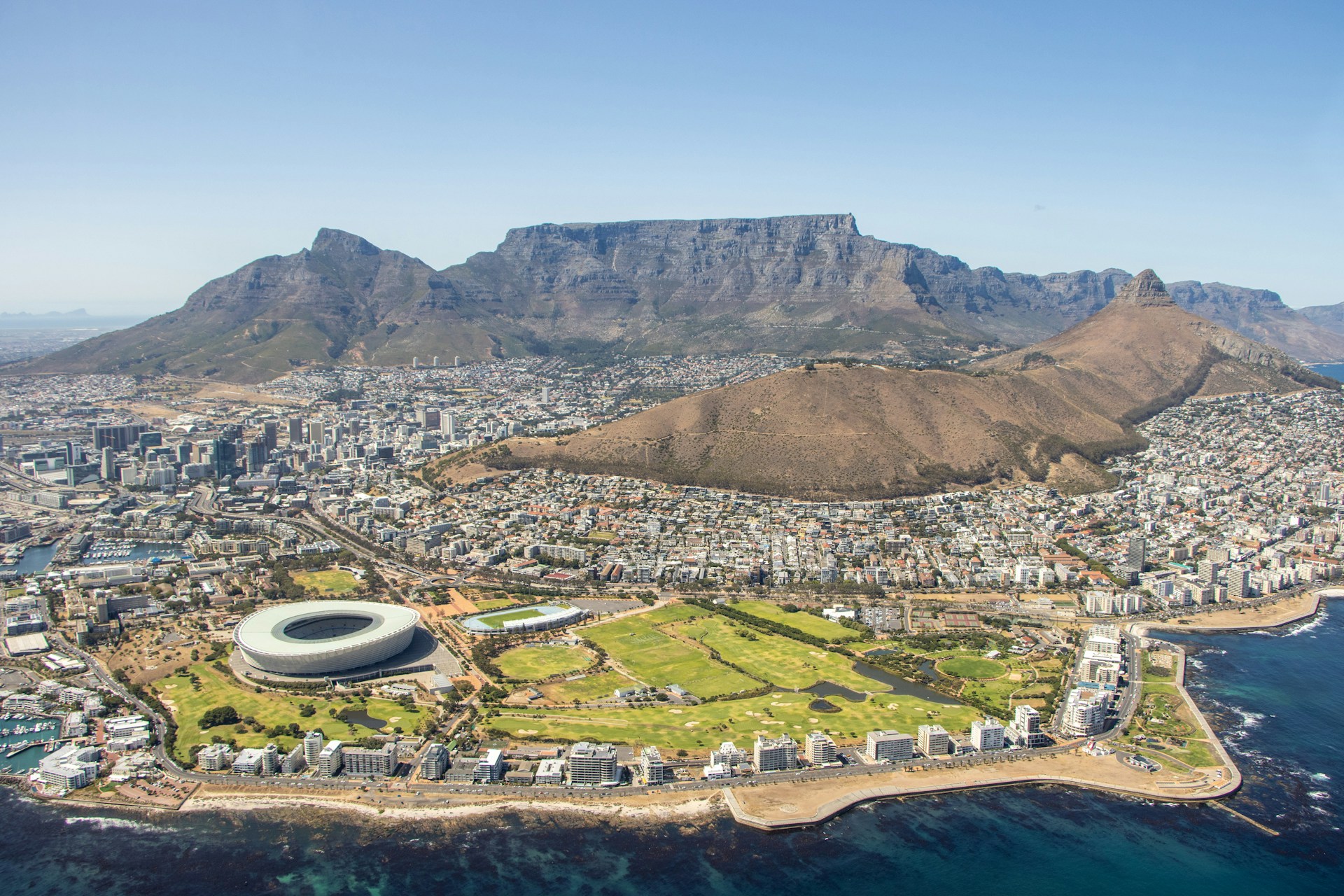
Cape Town sits on a peninsula where Table Mountain's flat basalt top, often capped by a rolling cloud locals call the tablecloth, drops almost directly into the Atlantic on one side and the city bowl on the other. It's the kind of geography that makes even a routine walk to dinner feel staged, except it isn't: the mountain is simply there, at the end of most streets, every day. The city is South Africa's legislative capital, its oldest, and its most internationally visited, with a tourism infrastructure, English-language ease and food and wine scene that regularly draws comparisons to European capitals, at a fraction of the price.
What the postcard shots leave out is the city's layered, difficult history, still visibly present rather than tucked into a single museum. Bo-Kaap's brightly painted houses sit on land assigned to the Cape Malay community under apartheid-era race laws. District Six, once a vibrant multiracial inner-city neighbourhood, was bulldozed under those same laws and remains largely undeveloped decades later, its museum keeping the memory of the community alive. The drive in from Cape Town International Airport passes directly through the Cape Flats townships that same history produced. None of this should keep a visitor away; it should inform how they see the city they're in.
The honest complications
Cape Town's weather is genuinely two-sided: the same wind that keeps the Atlantic Seaboard cool and clear can also shut down the Table Mountain cableway with no warning, so build a flexible day or two into any itinerary rather than a single fixed slot. The city is also spread out for a place with a compact-feeling centre: Camps Bay, Cape Point and the Winelands all require a car or a booked transfer, public transport doesn't reliably reach them. And while the main tourist areas are safe with normal precautions, Cape Town sits inside a country with a genuinely high crime rate, and the gap between the two realities, tourist-safe city centre, high national crime statistics, confuses first-time visitors more than almost anything else about planning the trip.
Six areas that cover the city
Cape Town's neighbourhoods sit between the mountain and the sea, and where you base yourself trades off between atmosphere, safety profile and how far you'll travel each day.
City Bowl
The downtown wedged between Table Mountain and the harbour: Company's Garden, the District Six Museum, Long Street's nightlife and Kloof Street's cafes are all within walking distance of each other. Safe and busy by day; take an Uber rather than walking after dark, standard advice for any big-city downtown.
V&A Waterfront
A working harbour turned shopping, dining and hotel district, and the departure point for the Robben Island ferry. Consistently rated the city's safest tourist area, with security visible throughout, though also the most expensive and least "local" feeling base.
Sea Point & Green Point
A long Atlantic-facing promenade popular with joggers and dog walkers, with crime levels comparable to affluent suburbs anywhere in the world. Quieter than the City Bowl at night, walkable, and generally better value than the Waterfront for similar quality.
Camps Bay & the Atlantic Seaboard
Palm-lined beachfront with the Twelve Apostles mountain range as a backdrop, the city's most glamorous and expensive stretch. Beautiful for a sunset dinner, but a 15-20 minute drive from the City Bowl and Waterfront sights, worth knowing before booking a stay here as a first-timer.
Bo-Kaap
Cobbled streets of brightly painted houses on the slopes of Signal Hill, the historic home of Cape Town's Cape Malay community and South Africa's first mosque, Auwal Masjid. A living neighbourhood, not a museum piece, best visited with a local guide who can explain what the colours and the history actually mean.
Woodstock & Constantia
Woodstock, east of the City Bowl, has become the city's street-art and independent-food quarter around the Old Biscuit Mill market. Constantia, 20 minutes south, is Cape Town's own wine valley within the city limits, home to some of the Cape's oldest estates and its most acclaimed restaurant.
From a converted grain silo to a harbour-front backpackers
Cape Town's top hotels are genuinely world-class and priced well below equivalent European or American cities, while the City Bowl's hostel scene gives budget travellers a safe, social base within walking distance of the sights. These picks cover the full range, each earning its place.
At the top, Ellerman House on a Bantry Bay hillside has just 13 rooms, an extraordinary private South African art collection, and was named Best City Hotel in Africa at Travel + Leisure's 2024 World's Best Awards, a genuine private-residence feel over a conventional hotel one. The Silo Hotel, built inside the V&A Waterfront's former grain silo complex, pairs striking industrial architecture with penthouse suites looking straight out over the harbour to Table Mountain, while Cape Grace, on its own private quay at the Waterfront, has the Bascule Bar, the city's best-regarded whisky bar, and rooms from around R4,500 a night.
The InterContinental Table Bay, also at the Waterfront, delivers reliable five-star comfort with some of the most photographed Table Mountain views from any hotel in the city. At the budget end, Big Blue Backpackers in the City Bowl has an outdoor pool, café and terrace within walking distance of everything, Urban Hive Backpackers is a well-reviewed, social City Bowl alternative, and 91 Loop Street Boutique Hotel sits between the two, private rooms at a hostel-adjacent price, right in the city centre.
Cape Malay spice, harbour-fresh fish, and some of the world's best-value wine
Cape Town's food scene draws on Cape Malay spice traditions, British and Cape Dutch influence, and a coastline that still lands fish a few hundred metres from where it's served. It ranges from a R78 plate of fish and chips at a harbour shack to a table at one of the World's 50 Best restaurants, often on the same day, and the wine, produced within an hour of the city since the 1600s, is exceptional at every price point.
Cape Malay cuisine
Bo-Kaap Kombuis, high on the Signal Hill slopes with views over the City Bowl to Table Mountain, is run by Yusuf and Nazli Larney and serves genuine, from-scratch Cape Malay curries, samosas and roti; Nazli has taught the cuisine to Michelin-starred chefs and been featured on international food television. It's halal and alcohol-free, and the food itself is the draw.
Harbour fish and chips
Kalky's, a cash-only shack on the working harbour at Kalk Bay, about 30km from the centre, is a genuine Cape Town institution: hake, snoek or crumbed calamari and chips for R78, or grilled line fish for R105, eaten a few steps from the fishing boats that caught it that morning.
Fine dining
La Colombe in Constantia, chef proprietor Scot Kirton with head chef James Gaag, is ranked among the World's 50 Best Restaurants and was named Best Restaurant in Africa, French technique with Asian accents in a wine-valley setting. In the City Bowl, FYN succeeded the influential Test Kitchen and pairs Japanese-influenced technique with African ingredients in a condensed kaiseki-style tasting menu.
Braai & the Gatsby
aMadoda Bar and Braai in Woodstock serves the De Big Mix platter of beef, pork and chicken for R100, or a DIY braai pack with coals and seasoned meat for eight people at R450. The Gatsby, a footlong sandwich stuffed with fries, meat and sauce, is a genuine Cape Town institution best sought out at a township or Cape Flats takeaway rather than a tourist-area imitation.
The mountain, the island, and the streets between them
Cape Town's essential sights are spread across the peninsula, and a few need advance booking to avoid a wasted trip. This chapter walks through them roughly the way a good five days would.
Table Mountain
The Table Mountain Cableway is the easy route to the 1,085-metre summit, a rotating cable car with 360-degree views over the city, the Atlantic and the Cape Flats; book a specific time slot online, go early to beat both the crowds and the cloud cover that can close the cableway with little notice, and keep a backup day free in a longer itinerary. Hikers can walk up via Platteklip Gorge (2-3 hours, steep) and ride the cable car down, a genuinely rewarding alternative for anyone reasonably fit.
Robben Island
The ferry from the V&A Waterfront to Robben Island, where Nelson Mandela spent 18 of his 27 years imprisoned, runs a roughly 3.5 to 4-hour all-inclusive tour: the ferry crossing, an island bus tour and a guided walk through the prison itself, often led by a former political prisoner. Tickets run around R825 for international visitors and sell out days ahead in peak season, book as early as your dates allow.
Bo-Kaap & District Six
A guided Bo-Kaap walking tour (many run as tip-based free tours, roughly 90 minutes) covers the neighbourhood's Cape Malay history and its first mosque, Auwal Masjid, with the option to add a Malay cooking class. The District Six Museum in the City Bowl documents the multiracial inner-city community bulldozed under apartheid's Group Areas Act, its floor covered in a hand-annotated map made by former residents marking exactly where their homes stood.
Kirstenbosch & the Cape Peninsula
Kirstenbosch National Botanical Garden, on Table Mountain's eastern slopes, includes the Boomslang canopy walkway at no extra charge (international adult entry around R270, with lower rates for South African and SADC residents) and hosts open-air summer concerts. Further south, Boulders Beach's African penguin colony (international entry roughly R190-215) and Cape Point and the Cape of Good Hope Nature Reserve make a full, worthwhile day combined, about 45 minutes to an hour's drive via the scenic False Bay coast.
The free viewpoints
Signal Hill and Lion's Head (a popular full-moon hike) both give sweeping city and Atlantic views without a ticket, and Bo-Kaap's own streets double as a viewpoint over the City Bowl. These cost nothing and are where a lot of Cape Town's best evenings actually happen.
Three, five or seven days, planned by area
Five days covers the city and one Winelands day trip properly; three days hits the unmissable core. These routes group sights by area to minimize backtracking across a spread-out city.
- Day 1
Table Mountain & City Bowl. Cableway at a booked morning slot, Company's Garden and the District Six Museum in the afternoon, dinner in the City Bowl.
- Day 2
Waterfront & Robben Island. Morning ferry and prison tour, afternoon at the V&A Waterfront, sunset drinks at the Bascule Bar or similar.
- Day 3
Bo-Kaap & Cape Point. Morning Bo-Kaap walking tour and lunch at Bo-Kaap Kombuis, afternoon drive to Cape Point and Boulders Beach penguins.
- Days 1-3
The three-day route above, at a slightly gentler pace.
- Day 4
Kirstenbosch & Constantia. Morning at the botanical garden and Boomslang walkway, afternoon wine tasting and a La Colombe lunch (book well ahead) in Constantia.
- Day 5
Winelands day trip. Stellenbosch, or Stellenbosch and Franschhoek combined, tastings and a long estate lunch.
- Days 1-5
The five-day route above, unhurried.
- Day 6
Hermanus. Whale watching (June-December, peak September-October) or the coastal drive if outside season, back to Camps Bay for sunset.
- Day 7
Kalk Bay & the Atlantic Seaboard. Morning at Kalky's and browsing Kalk Bay's antique shops, afternoon at Camps Bay or Clifton beaches, final dinner with a Twelve Apostles view.
A car for the Winelands and Cape Point, Uber for the rest
From Cape Town International Airport (CPT), Uber or Bolt to the City Bowl costs roughly R150-250, generally cheaper than a metered taxi; the official e-hailing pickup point is signposted through the Parkade 1 skybridge from arrivals. The MyCiTi Airport bus (Route 100) runs to the City Bowl for about R120 with a MyConnect card, every 20-30 minutes. Avoid anyone approaching you inside the terminal offering a taxi, an unlicensed-operator scam at nearly every airport; use the official queue or book through an app.
Within the city, Uber and Bolt are the default and are widely considered safer than hailing an unmarked minibus taxi. For the Winelands, Cape Point and the Atlantic Seaboard at your own pace, rent a car: South Africa drives on the left, and roads on these routes are well-maintained and easy for visitors. Avoid driving after dark outside the main tourist areas.
Best time to visit and the December-January peak
Cape Town has a Mediterranean climate, the reverse of Europe's: November to March is warm and dry, June to August is the cool, rainy winter. December and January are also when South African schools break for summer, so Cape Town's beaches, restaurants and accommodation prices all peak simultaneously; book well ahead if traveling then. April-May and September-October offer good weather with noticeably fewer crowds and lower prices.
Wind. The notorious "Cape Doctor" southeaster can blow hard enough in summer to close the Table Mountain cableway for a day or more with little warning. If your itinerary is tight, put the cableway near the start of your trip rather than the end.
Excellent value, with two costs that add up fast
Cape Town is inexpensive for Western visitors thanks to a favourable exchange rate, but a rental car and Winelands estate lunches are the two line items that push a budget trip toward mid-range fastest. Restaurant meals and hotels, by contrast, are genuinely cheap relative to comparable quality in Europe or North America.
- Hostel dorm or budget guesthouse
- Kalky's, tascas and self-catering
- Uber & the MyCiTi bus
- Free viewpoints plus one paid sight
- Boutique hotel or B&B
- Restaurant meals, one Winelands lunch
- Rental car for two to three days
- Robben Island, Kirstenbosch, Cape Point
- Ellerman House or Silo Hotel-level stays
- La Colombe or FYN tasting menus
- Rental car for the full trip
- Private guided tours
Safe where visitors actually go, with real limits
Cape Town's tourist core, City Bowl by day, the V&A Waterfront, Sea Point, Green Point and Camps Bay, is genuinely safe with normal city awareness; crime levels in these areas are comparable to affluent neighbourhoods anywhere in the world. The realistic risk for a typical visitor is opportunistic theft, phone snatching, pickpocketing and car break-ins, not violent confrontation, and it's concentrated in predictable situations: crowded markets, cars visibly loaded with luggage, and walking alone late at night outside the main areas.
Three specific things to know: don't drive into a township or unfamiliar area unguided, a reputable local tour is both safer and a far better experience; use Uber door-to-door rather than walking after dark, even in generally safe areas like the City Bowl; and avoid solo hikes on Table Mountain or Lion's Head, go with a group or a guided trail, since isolated trail sections have seen occasional muggings. None of this should overshadow the fact that millions of visitors have straightforward, incident-free trips here every year by following exactly these precautions.
Emergency numbers
The Western Cape Tourism Safety and Support line above covers Cape Town, the Winelands and the West Coast specifically; save it alongside the national numbers.
The Winelands alone justify the trip to Cape Town
Cape Town's position at the foot of the Cape Peninsula makes it an outstanding base for day trips in every direction. Three are worth planning around; a rental car or a booked tour covers all of them.
Stellenbosch & Franschhoek
South Africa's second-oldest European settlement, Stellenbosch has oak-lined streets, Cape Dutch architecture and more than 150 wine estates within a 30km radius; Franschhoek, 25km further, adds French Huguenot heritage and some of the Winelands' best estate restaurants. Tastings run R80-200 per estate, premium experiences R300-500, and a guided day combining both regions with lunch runs roughly R1,200-2,500 per person. The Franschhoek Wine Tram, a hop-on hop-off tram-bus visiting eight estates, is a sociable way to taste without designating a driver.
Hermanus
Southern right whales migrate to Walker Bay to breed and calve, close enough to shore that Hermanus employs an official "whale crier" to announce sightings. September and October, coinciding with the Hermanus Whale Festival, are peak season; visits outside June-December will likely miss the whales entirely.
Cape Point & the Cape Peninsula
The scenic drive down the False Bay coast to Boulders Beach's penguin colony and on to Cape Point and the Cape of Good Hope Nature Reserve makes a full and genuinely spectacular day, combining wildlife, coastal cliffs and one of the more dramatic drives in the country. Combine it with lunch in Kalk Bay on the way back for the harbour fish-and-chips experience.
Cape Town FAQ
Is Cape Town safe for tourists?
The main tourist areas, the V&A Waterfront, City Bowl by day, Sea Point, Green Point and Camps Bay, are safe with normal city awareness. The realistic risks are opportunistic theft, phone snatching and car break-ins, not violent crime; avoid unguided township visits, solo hikes and driving after dark outside the centre.
How many days do I need in Cape Town?
Five days covers the city and one Winelands day trip well: Table Mountain and the City Bowl, the V&A Waterfront and Robben Island, Bo-Kaap and District Six, Cape Point and Boulders Beach, and Stellenbosch or Franschhoek. Three days hits the essentials; seven adds Hermanus or a second Winelands day.
How much does Cape Town cost per day?
Budget travellers manage on $80-100 a day (roughly R1,300-1,600) with hostels and casual meals; mid-range runs $150-250. A rental car and Winelands lunches are the two costs that push a budget trip toward mid-range fastest.
When is the best time to visit Cape Town?
November to March, the southern hemisphere summer: warm, dry, long days. December-January is also the South African domestic holiday peak, so prices and crowds spike then; April-May and September-October are quieter shoulder months with good weather.
How do I get from Cape Town Airport to the city centre?
Uber or Bolt to the City Bowl costs roughly R150-250 and is usually cheaper than a metered taxi. The MyCiTi Airport bus (Route 100) runs to the City Bowl for about R120 with a MyConnect card, departing every 20-30 minutes.
What is the best area to stay in Cape Town?
The City Bowl and V&A Waterfront for first-timers: central, walkable to Table Mountain's cable car, and close to most restaurants. Sea Point and Green Point are quieter and still very safe. Camps Bay is glamorous but removed from the main sights.
Do I need a car in Cape Town?
Not for the city itself, Uber and Bolt cover it well, but a rental car is close to essential for the Winelands, Cape Point and the Atlantic Seaboard at your own pace, since public transport doesn't reliably cover those routes.
Is Table Mountain worth the cable car price?
Yes for most visitors; check the official Table Mountain Cableway site for current pricing, which varies seasonally. Book a specific time slot online, go early to beat both crowds and the cloud cover locals call the tablecloth, and have a backup day in mind since the cableway closes in high wind.
How far is Stellenbosch from Cape Town?
About 45 minutes by car. Franschhoek is roughly 75 minutes. Both are doable as a single day trip, and a combined Stellenbosch-and-Franschhoek tour is the most common way to see both without renting a car yourself.
What Stays With You
Cape Town doesn't let you enjoy the mountain and ignore the history that sits underneath it, and the trips that work best don't try to. The cable car up Table Mountain and the walk through Bo-Kaap's painted streets, the harbour view from Robben Island's ferry and the map on the District Six Museum's floor, all belong to the same few square kilometres, and all of it is worth your attention.
Book Robben Island the moment your dates are set, keep a flexible day for the cableway's wind closures, and give the Winelands a full unhurried day rather than a rushed half. Most visitors leave saying the same thing: they underestimated how much city this actually was.