
What You're Actually Getting Into
Guinea-Bissau is one of the smallest, poorest and least-visited countries in West Africa, and also one of the most quietly extraordinary: the Bijagós Archipelago off its coast is a UNESCO Biosphere Reserve of 88 islands where hippos wade into the Atlantic and several islands are run by matriarchal Bijagó councils. Fewer than a handful of thousand foreign leisure travelers make it here in a typical year, and the ones who do come almost entirely for the islands, arranged through specialist operators rather than independent backpacking.
The country's modern history has been dominated by instability: since independence from Portugal in 1974, Guinea-Bissau has cycled through military coups, a civil war and a documented role as a transit hub for cocaine moving from South America to Europe. As of this writing, the country is governed by a military transitional authority that took power in a November 2025 coup, with national elections scheduled for December 2026. None of that erases the Bijagós or Bissau's crumbling, atmospheric old town, but it does mean this guide treats safety and logistics with more weight than usual, and we'd rather you read that section before booking anything.
The honest complications
Tourism infrastructure barely exists outside a handful of Bissau hotels and a few island lodges: expect generator power, intermittent hot water, cash-only transactions, and guides and boat operators who work informally rather than through licensed agencies. The country has no resident US embassy, so anyone in serious trouble is relying on the Embassy in Dakar, Senegal, hours away by air. Political demonstrations, when they happen, are concentrated in Bissau and can turn violent with little warning under the current transitional government. This is a trip for travelers who are comfortable with genuine uncertainty and who book through an established operator rather than improvising.
A History Worth Knowing
Guinea-Bissau's history is inseparable from Amílcar Cabral, the agronomist-turned-revolutionary who founded the PAIGC in 1956 and led one of Africa's most effective independence wars against Portugal, only to be assassinated five months before his country won. What followed independence was four decades of coups, a civil war, and a fragile state that by the mid-2000s had become a well-documented transit point for cocaine trafficking. The short version: colonization, a guerrilla war that actually worked, and then a government that has struggled to hold together ever since.
- 1956
The PAIGC is founded. Amílcar Cabral establishes the African Party for the Independence of Guinea and Cape Verde, which will fight Portugal on two fronts for the next two decades.
- 1959
The Pidjiguiti massacre. Portuguese police kill dozens of striking dockworkers in Bissau, radicalizing the independence movement and turning Cabral toward armed struggle.
- 1963–1974
The war of independence. The PAIGC controls large parts of the countryside years before Portugal concedes; Cabral is assassinated in January 1973, five months before his movement unilaterally declares independence.
- 1974
Independence recognized. Portugal formally recognizes Guinea-Bissau's sovereignty on 10 September, following the Carnation Revolution in Lisbon.
- 1980–1999
Coup, authoritarian rule, civil war. João Vieira seizes power in 1980 and rules for nearly two decades until a 1998-99 civil war forces him into exile.
- 2025–present
Transitional military rule. A November 2025 coup interrupts a disputed election count; a junta under Maj.-Gen. Horta Inta-a governs pending elections set for December 2026.
Read the full history: Cabral, the civil war and the narco-state years
Amílcar Cabral is the figure every Guinea-Bissauan history runs through. Born in Bafatá in 1924 to Cape Verdean parents, trained as an agronomist in Lisbon, he founded the PAIGC in 1956 and built it into one of the most disciplined and politically sophisticated liberation movements in Africa, one that governed liberated zones with schools and clinics even before the war ended. He was assassinated by a rival faction within his own movement in Conakry in January 1973, an event that still shadows Guinea-Bissauan politics. The PAIGC declared independence unilaterally that September; Portugal, reeling from its own 1974 Carnation Revolution, formally recognized it the following year.
Independence did not bring stability. Amílcar's half-brother Luís Cabral became the first president, ruling until 1980, when army commander João Bernardo "Nino" Vieira seized power in a coup. Vieira dominated Guinea-Bissauan politics for most of the next three decades, surviving multiple coup attempts before a 1998-99 civil war, sparked by a military mutiny, forced him into exile in Portugal. Kumba Ialá won the subsequent 2000 election as the country's first non-PAIGC president, only to be removed in a bloodless 2003 coup. Vieira returned and was reelected in 2005, then assassinated by soldiers in 2009, reportedly in retaliation for the killing of the armed forces chief of staff the day before. The pattern repeated: further coups and attempted coups followed through the 2010s.
The narco-state years. From the mid-2000s, Guinea-Bissau's weak institutions, corruptible military and long, unpatrolled coastline, including the Bijagós Islands, made it an attractive transit route for cocaine moving from South American producers to European markets. International agencies and journalists have documented military and political figures' involvement over the years. It is a real and ongoing governance problem, and one reason foreign institutions remain cautious about the country, though it has not historically translated into direct danger for tourists on the well-trodden Bissau-Bijagós circuit.
November 2025 to today. General elections on 23 November 2025 produced dueling victory claims from incumbent President Umaro Sissoco Embaló and opposition-backed candidate Fernando Dias. A day before results were due, the military seized power, installing Maj.-Gen. Horta Inta-a as interim president at the head of a body calling itself the High Military Command for the Restoration of Order. Protests were banned, opposition figures were briefly detained, and the previously dissolved national assembly remains replaced by a junta-appointed transitional council. A transitional charter issued in December 2025 set elections for 6 December 2026 and barred Horta from running, though independent observers note real doubts about voter registration and electoral logistics being ready in time.
Top Destinations
Guinea-Bissau's travel map has two real components: Bissau, the capital and only viable entry point, and the Bijagós Archipelago, the reason most visitors come at all. A handful of northern towns hold colonial history for travelers with extra time and their own transport, but almost no one visits Guinea-Bissau without the islands.
Bissau, the capital
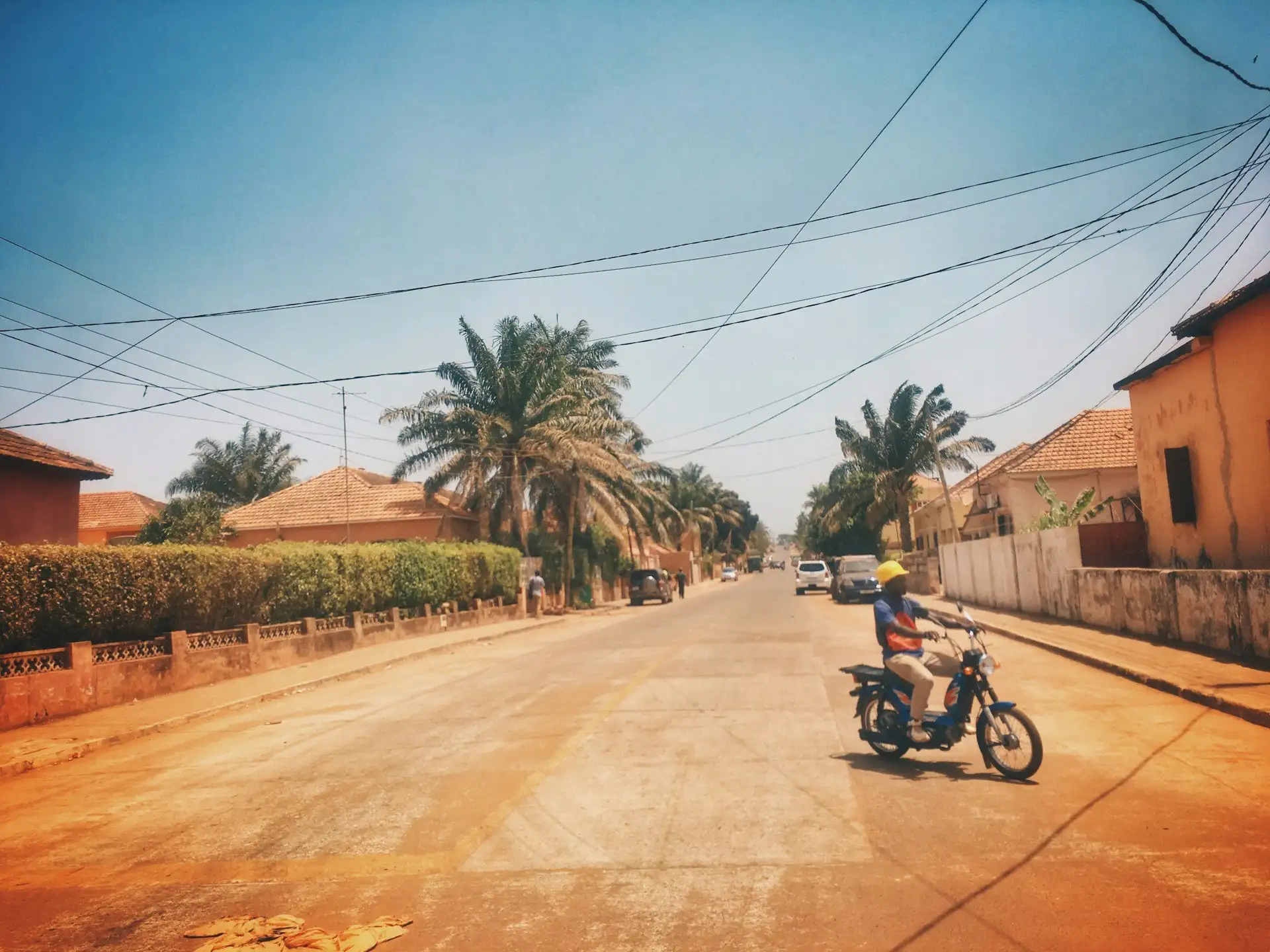
Bissau sits on the Geba River estuary, a low-rise city of Portuguese colonial arcades in various states of collapse, cashew warehouses, and a market that runs the width of a city block. It is not a city with a checklist of sights so much as a place to feel the texture of the country before heading to the islands: the Fortaleza d'Amura, an 18th-century Portuguese fort holding Amílcar Cabral's mausoleum, the sprawling Bandim Market for produce, fabric and daily life, and the old colonial quarter of Bissau Velho for the arcaded facades. Full detail on staying, eating and moving around Bissau is in our Bissau city guide.
Bubaque, the island hub
Bubaque is the Bijagós' most developed island and the transport hub for the archipelago: the weekly public ferry from Bissau arrives here, and lodges like Hôtel Kasa Afrikana and Cajou Lodge arrange onward boat transfers, bike rental and sport fishing. It is the practical base for exploring the other islands rather than a destination in itself.
Orango, the hippo island
Orango National Park protects a population of saltwater hippos that wade into brackish lagoons and tidal mangrove channels found almost nowhere else on earth, alongside traditional Bijagó villages with a matriarchal social structure where women choose their husbands. Cabanas do Orango, the lodge affiliated with the national park, is the standard base for hippo-viewing trips by boat.
Rubane & the smaller islands
Ponta Anchaca on Rubane Island is one of the few Bijagós properties genuinely built for tourism, an eco-lodge on a private stretch of beach reachable by charter boat or light aircraft from Bissau. Beyond Orango and Rubane, dozens of smaller islands are inhabited only by Bijagó communities and are visited, if at all, with a guide who has an existing relationship with the village.
Cacheu, the old slave port
Cacheu, a few hours north of Bissau by road, was one of the earliest Portuguese trading posts on the West African coast and a significant point in the Atlantic slave trade; the ruined fort here predates most colonial architecture in Bissau itself. It sees a trickle of history-focused travelers rather than any organized tourist circuit.
Varela, the northern beaches
Near the Senegalese border, Varela has mainland beaches and mangrove creeks that see essentially no foreign tourism infrastructure. This is genuinely off-map travel, requiring your own vehicle or a hired driver and no expectation of services once you arrive.
Culture & Etiquette
Guinea-Bissau is ethnically diverse, with Balanta, Fula, Mandinka, Papel, Manjaco and Bijagó communities each holding distinct customs, and Guinea-Bissau Kriol functioning as the practical common language across all of them regardless of a person's first language. The Bijagó people of the archipelago are unusual even within West Africa for their matriarchal social structure, in which women hold significant authority over marriage and land, and initiation rites remain central to community life. Religion is a mix of Islam, Christianity and traditional animist beliefs, often practiced together rather than as exclusive categories.
Do
- Greet before asking anything. A greeting and a moment of small talk before any request, directions, a price, a photo, is expected and its absence reads as rude.
- Ask before photographing people, especially in Bijagó villages where initiation sites and certain rituals are considered sacred and off-limits to outsiders entirely.
- Carry cash in small denominations. CFA francs only; card acceptance barely exists outside the largest Bissau hotels.
- Learn a few Kriol phrases. Kuma ku bu sta? (how are you), Obrigadu (thank you). Kriol, not Portuguese, is what most people actually speak day to day.
- Book island logistics through a known operator or lodge rather than improvising boat transport, which is informal and safety standards vary considerably.
Don't
- Photograph government buildings, military installations, or checkpoints. Sensitivities are heightened under the current transitional government and this can draw serious attention.
- Discuss politics with strangers or ask pointed questions about the coup or the junta; this is a live, sensitive situation for the people you're talking to, not a conversation topic.
- Expect English. Portuguese and Kriol dominate; a French phrasebook helps more than an English one if you don't speak Portuguese, since many Bissau-Guineans also work across the Senegalese and Guinean borders.
- Assume ATMs will work. Bring enough CFA or euros for your entire trip; machines are unreliable even in Bissau.
- Wander into demonstrations or crowds if you encounter one in Bissau. Leave the area promptly rather than observing.
Deeper culture: cashews, Kriol, and the Bijagó matriarchy
The cashew economy. Cashew nuts account for roughly 90% of Guinea-Bissau's export earnings, and the harvest season shapes rural life across the country: entire families work the harvest, and cashew wine, fermented from the fruit surrounding the nut, is a genuine part of the culture, not a tourist novelty.
Guinea-Bissau Kriol. A Portuguese-based creole that functions as the country's true lingua franca, spoken as a first or practical second language by the overwhelming majority regardless of ethnic background. Portuguese remains the language of government, education and official documents, but conversation on the street runs in Kriol.
The Bijagó matriarchy. On several Bijagós islands, women traditionally propose marriage and hold significant authority over property and social organization, a structure that has drawn academic interest for decades. Initiation ceremonies for both young men and women remain central and are generally closed to outside observation.
Food & Drink
Guinea-Bissauan food layers Portuguese technique over West African staples: rice, groundnuts, palm oil and fresh Atlantic seafood, eaten mostly at home or at simple street stalls rather than formal restaurants, since the restaurant scene in Bissau is small and largely clustered around a few reliable addresses.
Caldo de Mancarra
A rich groundnut (peanut) stew with meat or fish over rice, the country's most characteristic dish and the one to order first at any local restaurant.
Grilled fish & jollof-style rice
Fresh fish, often caught that morning, grilled whole and served with a tomato-based rice similar to jollof found across the region. The Bijagós lodges build entire menus around the day's catch.
Cana & cashew wine
Cana is a clear sugarcane spirit distilled locally; cashew wine, fermented from the fruit around the cashew nut during harvest season, is milder and genuinely distinctive to the country.
When to Go & Getting There
The dry season, November to May, is the only realistic window: roads outside Bissau become difficult or impassable in the June-October rains, and boat travel to the Bijagós gets rougher and less predictable. December to February is coolest and most comfortable; March to May turns hot and humid ahead of the rains.
Seasons compared, with what actually changes
| Season | Verdict | Temps | What changes |
|---|---|---|---|
| Dec-Feb | Best | 24-30°C | Coolest, driest, calmest seas for island transfers |
| Mar-May | Good | 28-34°C | Hot and humid, still dry, harmattan haze possible |
| Jun-Oct | Avoid | 26-31°C | Heavy rains, many rural roads and some ferries disrupted |
Getting there & around
Osvaldo Vieira International Airport (OXB) in Bissau is the only international gateway. TAP Air Portugal and EuroAtlantic Airways fly year-round to Lisbon, and Royal Air Maroc connects via Casablanca; there is no direct flight from North America, Asia or Oceania. Overland entry from Senegal (via Ziguinchor in the Casamance region) or Guinea is possible for travelers already in West Africa, though border posts are basic and hours are informal.
Inside the country, Bissau's few paved roads give way quickly to unpaved tracks; a hired driver is the practical option for the mainland, and the Bijagós are reached exclusively by boat or light aircraft charter, never by road. The public ferry to Bubaque runs once a week (Friday out, Sunday back, about 4 hours, roughly 2,500 CFA), fills up in advance, and does not take online bookings; most visitors instead book a charter boat or flight through their lodge, which costs considerably more but runs on a schedule that matches the trip.
Budget Planning
Bissau itself is inexpensive by international standards, but the Bijagós Archipelago costs considerably more than the mainland suggests, since lodges run on generators and imported supplies, and boat or light-aircraft charters are the main line item. These figures reflect independent Bissau travel plus a lodge-based Bijagós add-on, gathered from July 2026 research; they are not a budget for the country's essential/NGO travel market, which runs differently.
- Simple guesthouse room
- Local restaurant meals
- Shared taxis around the city
- ~$25-40/day
- Hotel with generator power & a/c
- Hotel restaurant or expat-oriented dining
- Private driver for the day
- ~$65-115/day
- Lodge full-board, boat included
- Charter boat or light-aircraft transfer
- Guided hippo/village excursions
- ~$200+/day, often quoted in euros
Quick reference prices
| Local restaurant meal | 1,500-3,500 CFA (~$2.50-6) |
| Bottled water (1.5L) | ~500 CFA (~$0.85) |
| Public ferry to Bubaque | ~2,500 CFA one way (~$4) |
| Guesthouse room, Bissau | 10,000-20,000 CFA/night (~$17-33) |
| Mid-range hotel, Bissau | 35,000-60,000 CFA/night (~$60-100) |
| e-Visa application fee | ~$50-70, varies by nationality |
Prices reflect July 2026 research and drift over time, particularly the CFA-to-dollar rate and Bijagós lodge rates, which are frequently quoted in euros. Treat them as a planning baseline, not a quote.
Visa & Entry
Guinea-Bissau runs an e-visa system for most nationalities that don't already qualify for visa-free entry. ECOWAS member-state citizens can enter and stay up to 90 days without a visa; most other travelers need to apply online at evisa.gov.gw before arrival, uploading a passport bio-page scan and a yellow fever vaccination certificate, with approval typically issued as a PDF within 3 to 5 working days.
✓ e-Visa approval letter
Apply well ahead of travel; print the PDF approval as some checks at OXB still expect a physical copy.
✓ Yellow fever certificate
Mandatory for every traveler over one year old, regardless of departure country. Carry the physical card, not a photo of it.
✓ Passport validity
At least 6 months validity from date of entry is the commonly requested standard; carry a photocopy separate from the original.
✓ Proof of accommodation & onward travel
Have your first night's address and a return or onward ticket ready; enforcement is inconsistent but can happen.
| Guinea-Bissau | Senegal | |
|---|---|---|
| Safety advisory | Level 3, Reconsider Travel; transitional military government | Level 2, Exercise Increased Caution; stable elected government |
| Flight access | OXB: Lisbon and Casablanca only, no US embassy in-country | Dakar: major hub with direct US, European flights and a full embassy |
| Signature experience | Bijagós Archipelago: saltwater hippos, matriarchal islands, near-zero crowds | Established coastal resorts, Gorée Island, better tourism infrastructure |
| Logistics | Almost everything arranged through specialist operators | Independent travel is straightforward and well-supported |
Safety, Solo Women & Family
The US State Department rates Guinea-Bissau Level 3, Reconsider Travel, with a Civil Unrest indicator, in its most recent advisory (updated December 2025). This isn't boilerplate caution: the country has been governed by a military transitional authority since a November 2025 coup, national elections aren't scheduled until December 2026, and there is no resident US embassy, only limited support from the Embassy in Dakar, Senegal. We're presenting this plainly rather than softening it, because it genuinely changes what a responsible trip here looks like.
Civil unrest
Demonstrations, when they occur, concentrate in Bissau and can turn violent quickly under the current transitional government, which has already imposed at least one nationwide protest ban. Avoid any gathering, political or otherwise, and leave the area if one forms nearby.
Opportunistic crime
Petty theft, pickpocketing and aggressive street vendors target foreigners in crowded markets and specifically travelers exiting Bissau's airport. Arrange airport pickup in advance rather than negotiating with drivers who approach you outside.
Rural areas & health access
Assaults in rural areas are reported more frequently than in Bissau itself, and healthcare outside the capital is extremely limited. Malaria risk is present year-round nationwide; carry prophylaxis and repellent regardless of season.
Two more things worth knowing: no embassy, and the narco-trafficking backdrop
No resident US embassy. Consular services are handled entirely by the US Embassy in Dakar, Senegal (+221 33-879-4000), hours away by air. Anyone traveling here should carry comprehensive travel insurance that explicitly covers medical evacuation, and should register with their embassy's traveler program before departure.
The narco-trafficking backdrop. Guinea-Bissau's documented role as a transit route for South American cocaine reflects weak state institutions rather than a direct threat to tourists on the standard Bissau-Bijagós circuit, but it is part of why foreign governments and insurers treat the country cautiously, and why booking through an established local operator, rather than improvising, matters more here than in most West African destinations.
Solo women travelers
Guinea-Bissau is not a well-established destination for solo female travel, and reliable data is limited. Most visitors, including women, travel through pre-arranged lodges and operators rather than independently, which meaningfully reduces exposure to the crime risks above. Conservative dress and travel with a trusted local guide or driver, especially outside Bissau, are sensible defaults rather than exceptions.
Emergency numbers
Reliability caveat and consular contact
These numbers are inconsistently reported across sources and reliability drops sharply outside Bissau; do not assume an English-speaking operator will answer. For any serious incident, contact the US Embassy in Dakar (+221 33-879-4000) or your own country's nearest mission, and your lodge or hotel, simultaneously, since local staff often know faster informal channels for help than official numbers do.
Family travel & pets
Guinea-Bissau is not set up as a family destination given the current advisory level, limited healthcare access outside Bissau, and year-round malaria risk. Families who do travel typically restrict themselves to a lodge-based Bijagós stay rather than independent exploration, and should confirm pediatric malaria prophylaxis with a travel clinic well before departure. We don't have reliable information on pet import requirements for this country and would rather leave that blank than guess.
Guinea-Bissau FAQ
Is Guinea-Bissau safe to visit right now?
The US State Department rates it Level 3, Reconsider Travel, citing civil unrest and crime. A military junta has run the country since a November 2025 coup, with elections not planned until December 2026. Bissau and the Bijagos Islands see visitors, but this is not a routine leisure destination and conditions can change with little warning.
Do I need a visa for Guinea-Bissau?
Most non-ECOWAS nationalities need an e-visa, applied for online at evisa.gov.gw before travel. ECOWAS citizens enter visa-free for up to 90 days. A yellow fever vaccination certificate is mandatory for all travelers over one year old.
What is the Bijagós Archipelago?
An 88-island UNESCO Biosphere Reserve off Guinea-Bissau's coast, reached by ferry or charter flight from Bissau. Orango Island has saltwater hippos and matriarchal Bijagó villages; Bubaque is the main hub for lodges and onward island transport.
What currency does Guinea-Bissau use?
The West African CFA Franc (XOF), pegged to the euro at about 655.957 XOF. It is shared with seven other West African states and is a cash economy outside Bissau's few hotels.
What language is spoken in Guinea-Bissau?
Portuguese is the official language, but Guinea-Bissau Kriol is the everyday lingua franca spoken by nearly everyone regardless of ethnic background. English is rare outside the largest hotels.
How do I get to Guinea-Bissau?
Osvaldo Vieira International Airport (OXB) in Bissau is the only international gateway, with TAP Air Portugal and EuroAtlantic Airways flying from Lisbon and Royal Air Maroc connecting via Casablanca. There are no direct flights from North America.
Is Guinea-Bissau part of a wider West Africa trip?
Yes, most visitors combine it with Senegal, arriving via Dakar and continuing overland or by air, since Senegal has the region's stronger flight network and consular support for most nationalities.
Why is Guinea-Bissau called a narco-state?
Since the mid-2000s, weak institutions and porous coastlines, including the Bijagós Islands, have made the country a documented transit route for South American cocaine heading to Europe. It's a real governance problem, not primarily a visitor safety issue, but it is part of why the country's institutions are fragile.
What should I know about the 2025 coup?
On 26 November 2025, the military seized power a day before disputed election results were due, installing a transitional junta under Major-General Horta Inta-a. A protest ban followed, and elections are scheduled for 6 December 2026, though logistics remain uncertain.
Is Guinea-Bissau expensive?
Bissau itself is inexpensive by international standards, but organized travel to the Bijagos Islands, lodges, charter flights and guided boat transfers, costs more than the mainland suggests, since almost everything is imported or run on generators.
What Stays With You
Guinea-Bissau will not hand you an easy trip, and it isn't trying to. What it offers instead is something close to actual discovery: islands where hippos still swim in the sea, villages that have run their own affairs by their own rules for longer than the modern state has existed, and a capital that hasn't been smoothed over for visitors because barely any visitors come. None of that cancels out the real instability the country is living through right now, and this guide would be doing you a disservice if it pretended otherwise.
Go if you're the kind of traveler who books through people who actually know the country, who reads the safety chapter before the destinations chapter, and who wants to see the Bijagós before the rest of the world catches up, if it ever does.