
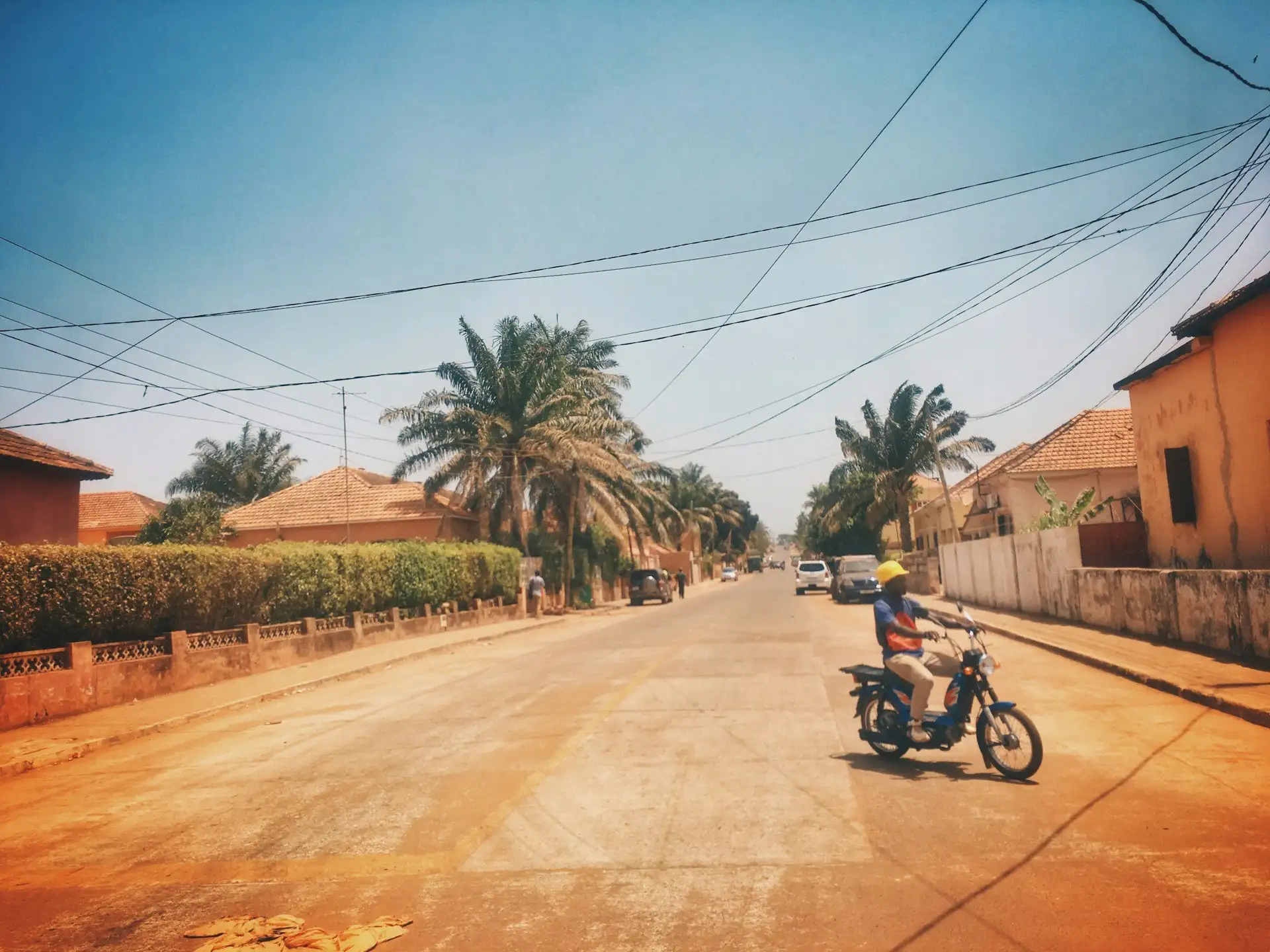
What You're Actually Dealing With
The Risks That Actually Catch People
Guinea-Bissau's risk profile is predominantly institutional — police pressure, taxi overcharging, logistical traps — rather than criminal. The Bijagós itself has almost no tourist scam presence.
No meters in Bissau taxis. The airport to the city centre should cost 2,000-3,000 XOF; drivers quote 5,000-10,000 XOF to arriving foreigners. The gap between foreigner and local pricing is wide. Shared taxis run fixed routes cheaply but require knowing the system. Most guesthouses and hotels arrange airport transfers at honest rates.
- Book airport transfer through your accommodation before landing — the most reliable option and eliminates arrival-hall negotiation entirely.
- If negotiating independently, ask your hotel in advance what the airport-to-city fare should be and use that figure as your opening position.
- Agree the full fare in XOF before getting in the vehicle — not after.
Police and military checkpoints on roads outside Bissau routinely request documents and look for reasons to require informal payments. The amounts are modest — 1,000-2,000 XOF — but stops are frequent on longer journeys. The institutional underpayment of security forces makes shakedowns structural rather than exceptional in Guinea-Bissau, as in other fragile states in the region.
- Carry your passport, visa, and all travel documents at all times — document checks are frequent and legitimate.
- If an informal payment is requested, ask for a written receipt. This sometimes resolves the situation.
- Stay calm, be polite, and don't argue. The goal is to pass through, not to win a principled argument at a checkpoint.
- Travelling with a local guide or tour operator's vehicle changes checkpoint interactions significantly — drivers familiar with the system navigate them more smoothly.
Street changers and informal exchange operators occasionally short-count CFA notes or apply rates different from those quoted. Airport exchange counters offer consistently worse rates than official banks in the city. Since ATMs are unreliable, getting the exchange right matters more here than in most countries — you cannot easily top up from a machine if you run short.
- Exchange at official banks in Bissau (BCEAO-affiliated banks) — Ecobank and BDU are the most reliable.
- Count every note in full view of the person exchanging with you before leaving the counter.
- Exchange enough CFA before departing for the Bijagós — there is no exchange facility on any island.
The Bijagós Archipelago is a UNESCO Biosphere Reserve and national park, and entry requires official permits. The permit system is not always well communicated and individuals near departure points sometimes claim unofficial fees are required. Legitimate permit fees are paid at official offices; anything requested informally at a dock or island entry point is almost certainly not legitimate.
- Arrange all permits through your tour operator or directly with IBAP (Instituto da Biodiversidade e das Áreas Protegidas) before departure from Bissau.
- Carry printed documentation for any permits obtained — informal requests at entry points can usually be deflected by showing legitimate paperwork.
- An established operator handles this entirely as part of their service — the strongest argument for using one.
Bissau's hotel stock is limited and booking platform coverage is sparse. Some online listings have outdated photos or descriptions that don't match current reality. Island camp accommodation in the Bijagós is extremely basic — often hammocks, shared facilities, no electricity — and the gap between what some operators describe and what you find can be significant.
- Email accommodation directly before booking and ask specific current questions — when were photos taken, what is the current power situation, what are the toilet facilities.
- For island camps, calibrate expectations explicitly: most are hammocks and basic shelter, not eco-lodges. Any operator describing a Bijagós camp as anything other than very basic should be questioned.
- The Hotel Malaika and Casa Dora in Bissau are the most consistently recommended reliable options for the capital.
Bissau's Bandim market and port area have higher petty theft rates than the rest of the city. Phone snatching and bag theft are the most common forms. The risk is modest by West African capital standards and doesn't require avoiding these areas — both are worth visiting — but normal awareness applies.
- Keep phones in pockets and bags secured in the Bandim market and port area.
- Don't carry more cash than you need for the day when visiting market areas.
- The Bandim market is the most authentic market experience in Bissau — it's worth a morning visit with standard precautions.
The Destinations — Honest Takes
Guinea-Bissau is essentially two destinations: the capital Bissau and the Bijagós Archipelago. The capital is the gateway; the islands are the reason to come.
Bissau is a small capital of 400,000 people on the Geba River estuary — chaotic, colourful, and not particularly beautiful but with a distinctive Portuguese-Creole culture expressed in music, food, and the daily rhythms of the Bandim market. The ruins of the colonial-era Fortaleza d'Amura and the Museo Nacional are the main cultural sites. Carnival in February or March is genuinely one of the more authentic in West Africa — community troupes, traditional masks, and dancing that is unmistakably Bissau-Guinean rather than a tourist product. Most visitors spend a night or two in Bissau before and after the islands.
- Book airport transfer through your accommodation in advance — eliminates arrival-hall taxi negotiation
- Exchange CFA at official banks before heading to the islands — no ATMs or exchange facilities exist in the Bijagós
- Keep bags secured in the Bandim market area
- The Fortaleza d'Amura and port area at dusk are worth a walk; avoid them late at night
Orango is the largest island in the southern Bijagós and the site of the Orango National Park — home to one of only two populations of saltwater hippopotamuses in the world. These hippos enter the sea regularly, feed on marine vegetation, and are culturally sacred to the Bijagós people, which has contributed to their protection. Orango also has green turtles nesting on its beaches. The island is inhabited by the Bijagós people who maintain matrilineal customs significantly intact — the women control land, marriage, and social organisation in a system that predates any colonial contact.
- No tourist scam presence — Orango sees very few visitors and has none of the hustler infrastructure that develops around high-traffic sites
- Access requires a pirogue from Bissau or Bubaque (2-4 hours depending on conditions) — an operator who knows the crossing is strongly recommended
- The saltwater hippo sightings are not guaranteed on any given visit — go with realistic expectations and let a guide know what you are most hoping to see
Bubaque is the administrative centre of the Bijagós and the most accessible island — a 3-4 hour crossing from Bissau. It has the archipelago's main guesthouse infrastructure (which is to say: a handful of basic options), a small market, and fishing communities that maintain traditional pirogues. It functions as the hub for accessing the more remote islands and most visitors spend at least one night here on the way out or back. The island has good beaches and the reefs immediately offshore have excellent snorkelling.
- Very low scam presence — the small resident visitor community is tight-knit enough that dishonesty would be immediately known
- All accommodation is basic — electricity is limited and hot water is rare; accept this before booking
- The boat connection to Bissau runs on an irregular schedule that depends on weather and demand — don't plan a same-day connection to an international flight
Poilão Island is uninhabited and access-controlled as a protected nesting site for Atlantic green turtles. It has one of the most significant green turtle nesting beaches in the Atlantic — between 100 and 200 nesting females in a single night during peak season (November to February). The density of nesting activity is extraordinary: it can be difficult to walk without stepping around turtles. The island is managed by IBAP and access requires specific permits obtained well in advance. There is no permanent accommodation — overnight camp visits are organised through specialist operators.
- Access requires advance IBAP permits — no walk-up visits are possible
- Any operator offering Poilão visits without discussing permits in detail should be questioned
- The overnight turtle experience here is one of the most extraordinary wildlife encounters available in West Africa — the logistics justify the effort entirely
The Cufada Lagoon Natural Park on the mainland south of Bissau is a freshwater wetland and mangrove system that is among the most important bird migration staging areas in West Africa — more than 200 species including several globally threatened waders. Hippopotamuses, manatees, and West African crocodiles inhabit the lagoon. It is completely unvisited by international tourists and the facilities are minimal, but for serious birdwatchers this is one of the most productive sites on the West African flyway during the northern winter.
- No tourist presence of any kind — the lagoon is visited primarily by researchers and specialist birding operators
- Getting there requires a vehicle and local knowledge of the road conditions in the region
- A specialist birding tour operator based in Bissau or Senegal is the practical access route
Beyond the named sites, the Bijagós rewards visitors who simply move between islands with a good guide and a local pirogue, letting the rhythm of the place establish itself. The Bijagós people have maintained one of the most intact traditional cultures in West Africa — the initiation ceremonies, traditional masks, and the role of women in island governance are living practices rather than cultural performances for visitors. Spending time in island communities, contributing to the local economy through guesthouse stays and hiring local guides, and approaching the culture with patience rather than a checklist is how this specific destination works best.
- Very low scam presence throughout the islands — the visitor numbers are too low for scam infrastructure to have developed
- Go with a local guide who has genuine community relationships — the access to traditional culture this provides is the reason to come
- The pace of the islands is not the pace of organised tourism — build flexibility into your itinerary and accept that weather and boat schedules may change your plans
Before You Go — The Checklist
- ✓ Check your government's travel advisory for Guinea-Bissau within one week of departure — the political situation changes faster than any guide reflects.
- ✓ Bring sufficient euros in cash for your entire trip — ATMs in Bissau are unreliable and completely absent on the islands.
- ✓ Exchange CFA at official banks in Bissau before departing for the Bijagós — no exchange facility exists on any island.
- ✓ Arrange all Bijagós permits through IBAP or your tour operator before departure from Bissau.
- ✓ Buy comprehensive medical evacuation insurance — hospitals in Guinea-Bissau lack basic capacity and serious cases require evacuation to Dakar or Lisbon.
- ✓ Take anti-malarial prophylaxis — malaria is hyperendemic throughout the country and on the islands.
- ✓ Use an established local tour operator for the Bijagós — they handle permits, boat logistics, island guides, and checkpoint navigation as part of the service.