
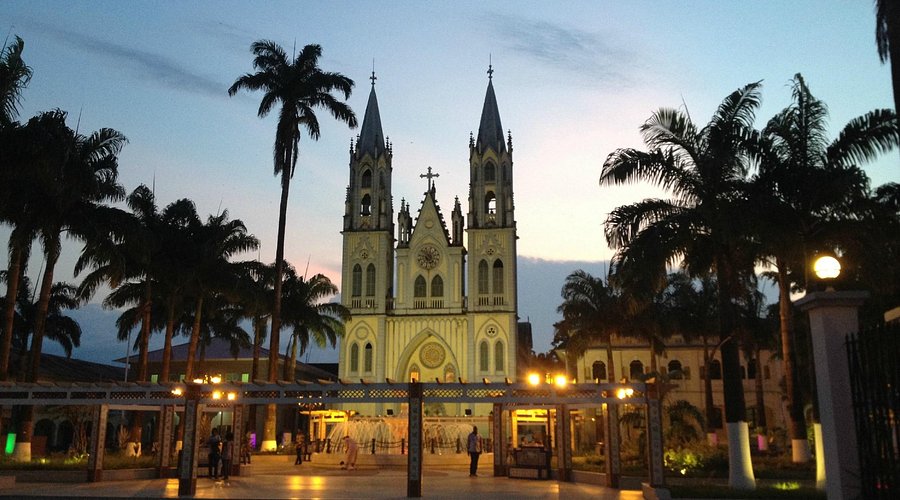
A capital built for oil, not for visitors, that's worth visiting anyway
Malabo sits on the northern rim of an extinct volcanic crater at the tip of Bioko Island, a Spanish colonial port town that independence, a brutal dictatorship, and then oil money have each reshaped in turn without erasing the last layer entirely. The result is genuinely unusual: pastel colonial facades and a Gothic-revival cathedral around a tiled Spanish plaza, a purpose-built resort district with a golf course a short drive east, and cloud forest with primates found nowhere else on Earth less than an hour's drive south.
None of it is set up for casual tourism. Hotel rooms are priced for the oil industry and diplomatic corps, not backpackers, a paid e-visa has to be sorted weeks in advance, and photography, ordinary street-scene photography, is genuinely risky in a way it is not almost anywhere else covered on this site. Visitors who come anyway, deliberately and with a plan, get a compact, walkable colonial center, some of the least-visited cloud forest and turtle-nesting coastline left on the continent, and a city that very few outside the oil and diplomatic world have ever properly seen.
The honest complications
Malabo is expensive relative to almost anywhere else in Central Africa, not because things cost more day to day but because there is so little accommodation built for anyone other than oil contractors and government delegations. Power cuts happen; upper-tier hotels run their own generators, budget options are less reliable. Card acceptance outside the Sofitel and Hilton properties is limited, so plan to carry CFA francs in cash. And the photography restrictions covered in the Safety chapter below are not exaggerated: treat your camera as the single item most likely to cause you a genuine problem here, more than anything else in this guide.
A small colonial core, a resort enclave, and the strip near the airport
Malabo does not have the sprawling multi-district geography of a larger African capital. For a visitor, it breaks down into three practical zones: the historic colonial center where the sights and most restaurants sit, the purpose-built Sipopo resort district along the coast, and the area near Malabo International Airport around Ela Nguema, where several mid-range hotels cluster.
Centro Histórico
The old Spanish colonial quarter is Malabo's postcard image: pastel facades, wrought-iron balconies, and Plaza de la Independencia at its center, flanked by the twin-spired Cathedral of Saint Elizabeth, the presidential palace, and one of the city's Sofitel hotels. It is genuinely walkable, everything worth seeing sits within a ten to fifteen-minute radius, and it holds the highest concentration of restaurants and banks in the city. It is also the area where photography restrictions are enforced most actively, given the government buildings on and around the plaza.
Sipopo
Built for the 2011 African Union summit, Sipopo is a self-contained enclave of conference facilities, a golf course, and the island's cleanest, best-kept beach, anchored by the Sofitel Malabo Sipopo Le Golf. It functions more like a resort campus than a neighborhood: quiet, generator-backed, and a taxi ride from anything else in the city, which is exactly the trade-off guests are making when they choose it.
Near the airport & Ela Nguema
The strip around Malabo International Airport and the Ela Nguema area a few kilometers from the center holds a cluster of more moderately priced hotels, useful for an early flight or a short stopover, with the trade-off of a taxi ride into the colonial center for sightseeing and most restaurants.
A short list, priced for business travelers, that covers every visitor anyway
Malabo's hotel market is small and skews heavily toward international-standard business properties built for oil-sector and government demand; there is very little in the way of budget guesthouses or independent boutique stays. That said, the handful of properties that exist are reliable, well-run, and cover the full range from resort to airport convenience.
At the top end, Sofitel Malabo Sipopo Le Golf in the Sipopo resort district is the most polished option on the island: pools, a golf course, and the coast's best-maintained beach, from roughly $220 to $380 a night depending on season and demand. In the city center, Sofitel Malabo sits directly on Plaza de la Independencia, putting the cathedral, the market and most restaurants on your doorstep, while Hilton Malabo, a 187-room property near the newer DOS business district between the center and the airport, is the other international-standard address, with four restaurants and lounges including its fine-dining room Gusto and the Piano Bar for evening drinks.
For a more moderate rate, Ibis Malabo, a few minutes from Malabo International Airport, offers straightforward air-conditioned rooms, an outdoor pool and a 24-hour bar, and is a sensible base for an early flight or a short stopover. Hotel Anda and Magno Suites, both also near the airport, round out the mid-range options at generally lower rates than the city-center properties.
A small scene, more international than you'd expect
Malabo's dining scene is compact but more varied than the city's size suggests, a byproduct of decades of Spanish, French and, more recently, Chinese business presence layered onto Equatoguinean home cooking. There is no single defining Malabo dish the way there might be in a larger capital; instead, the city's best meals come from picking the right restaurant for the right night.
La Luna
Consistently the most reviewed sit-down restaurant in the city, La Luna does seafood and international dishes on a terrace, with a printed daily menu, and is the reliable choice for a proper dinner without much risk of disappointment.
Bidji Binia
A central, casual spot known locally for having some of the best pizza in the city, alongside a broader Italian menu; a good pick for an easy, unfussy meal between sightseeing stops.
Restaurante Malvaloca
The most straightforwardly Spanish kitchen in central Malabo, leaning on the colonial-era culinary link that still shapes how the city eats, from tapas-style plates to heavier classics.
Bantu Chinese Restaurant
A long-running, brightly lit restaurant with a wide Cantonese menu, popular with both Malabo's Chinese community and the wider expat population, a reminder that the city's food scene extends well beyond Equatoguinean and Spanish cooking.
A short, specific list, best paired with a driver
Malabo itself is a half-day to a day of sightseeing; the reasons to extend a trip lie outside the city, up on the Moka plateau and down on the beaches of Ureca. A driver, arranged through your hotel, is the practical way to see nearly everything on this list beyond the colonial center.
The colonial center
Start at Plaza de la Independencia, the Spanish-style square with tiled benches and a fountain that anchors the old town, framed by the Cathedral of Saint Elizabeth, a Gothic-revival church built between 1897 and 1916 with twin spires and, inside, stained glass and ornate religious carving worth the few minutes it takes to look properly. A short walk away, Mercado Central is the better stop for understanding daily life: produce, dried and smoked fish, and textiles traded much as they have been for generations. Keep your camera in your bag on and around the plaza; see the Safety chapter before you photograph anything here.
Sipopo & Arena Blanca
A short drive east, Sipopo's coastline holds the cleanest, best-maintained beach in the Malabo area alongside the golf course and resort facilities built for the 2011 African Union summit. Closer to the city, Arena Blanca is a white-sand beach backed by palms and, in the dry season, clouds of butterflies along its treeline, a more local and less manicured alternative to Sipopo's resort sand.
Pico Basile
Bioko's highest point is reachable on a half-day 4x4 trip, but only with a permit arranged in advance, typically through the Ministry of Information or your hotel's tour desk, alongside the vehicle and driver. Build the paperwork into your plans a day or two ahead rather than trying to arrange it on the morning you want to go.
Moka's cloud forest
An hour or so up into the mountains on Bioko's south side, the Moka Wildlife Centre shelters rescued native species, crocodiles, birds and primates, and sits at the start of the roughly 45-minute hike to the Ilachi Waterfalls, which drop more than 250 meters through the forest. Travelers willing to commit a full day can push on to Lago Biao, a crater lake on the plateau. This requires a rented 4x4 or an arranged driver; it is not a self-drive rental-car outing.
One, two or four days, built around what actually needs a driver
Malabo's city sights fit into a single unhurried day; what stretches a trip is Moka and Ureca, both of which need advance planning and a vehicle. These routes assume arrangements, drivers, permits, are made ahead of arrival rather than on the ground.
- Morning
Colonial center. Plaza de la Independencia, the Cathedral of Saint Elizabeth, and a walk through Mercado Central.
- Midday
Lunch at La Luna or Bidji Binia. Both are central and easy to combine with an afternoon at the coast.
- Afternoon
Arena Blanca or Sipopo. A swim and a slower pace, with Sipopo the better pick if resort amenities matter more than proximity.
- Evening
Dinner in the center. Restaurante Malvaloca for a Spanish-leaning meal, or Bantu for Cantonese.
- Day 1
The one-day route above: the colonial center, lunch, the coast, dinner.
- Day 2
Pico Basile (permit arranged in advance). A half-day 4x4 trip to Bioko's highest point, weather and permit permitting, with the afternoon free for anything missed on day one.
- Days 1-2
The two-day route above.
- Day 3
Moka. Drive up to the cloud forest, the Moka Wildlife Centre, and the hike to the Ilachi Waterfalls.
- Day 4
Return to Malabo. A slower morning back down, with the afternoon free before an onward flight.
Small enough to walk the center, but you'll want a driver for everything else
Malabo International Airport (SSG) is the only entry point for e-visa holders and sits a few kilometers from the city center; hotel-arranged transfers or official airport taxis, generally in the 10 to 20 USD range depending on the hotel, are the practical way in. Once in the city, the colonial center is compact enough to walk, but Sipopo, the airport strip, Pico Basile and Moka all require a taxi or an arranged driver.
Official taxis and hotel-booked transport are the sensible default; street-hailed transport is less predictable and less advisable given the photography and documentation caveats covered in the Safety chapter. Car rental exists but is uncommon for visitors, and self-driving outside the city is not recommended given road conditions, checkpoints, and the permits required for travel beyond Malabo and Bata.
The e-visa, arriving, and getting to Bata
The e-visa is mandatory, not available on arrival: apply online in advance, pay the 75 USD fee, and expect approval within 24 to 72 hours. Carry a printed copy alongside a passport valid at least six months beyond your arrival date, and a yellow fever vaccination certificate dated at least 10 days before you arrive; both are checked at the border.
To Bata, on the mainland, a roughly three-hour ferry crosses the Gulf of Guinea, alongside short domestic flights on regional carriers. Treat it as its own separate leg of a longer trip rather than a day trip from Malabo.
Cash and cards. Carry Central African CFA francs for anything outside the Sofitel and Hilton properties; card acceptance elsewhere is unreliable, and ATMs in central Malabo exist but shouldn't be counted on exclusively.
One of Central Africa's more expensive capitals, almost entirely because of hotels
Malabo's cost of living is driven overwhelmingly by accommodation: hotel supply is thin and priced for oil-sector and government demand, not tourism, while food, taxis and casual sightseeing are comparatively reasonable. Budget accordingly, and expect the biggest single line item on any trip here to be where you sleep.
- Mid-range hotel near the airport
- Local restaurant meals, $5-15
- Official taxis
- Free sightseeing in the colonial center
- Ibis Malabo or Hotel Anda tier
- Restaurant meals with drinks
- Arranged driver for day trips
- Pico Basile permit and 4x4
- Sofitel or Hilton Malabo
- Private driver and guide throughout
- Sipopo resort access
- Moka or Ureca extension
Level 2, and the risks are specific rather than general
The US State Department rates Equatorial Guinea Level 2, Exercise Increased Caution, as of an October 2025 update. In Malabo that translates less into fear of violent crime, which is not the headline concern, and more into three specific, well-documented risks: photography, thin medical infrastructure, and petty crime.
Photography is the single biggest practical risk in this guide. It is heavily and inconsistently enforced, sometimes by plainclothes police watching buildings that look entirely unremarkable, and Plaza de la Independencia, the port and the airport are all known hotspots given the government buildings nearby. Do not photograph government buildings, the port, the airport, military personnel or infrastructure, and ask before photographing people. The US Embassy has documented cases of travelers detained for weeks or longer with no guaranteed timeline for release, most often tied to exactly this. Medical care is limited, with no reliable trauma or ambulance services, so travel insurance that explicitly covers medical evacuation is not optional. Petty crime is described as common, and local police are often under-resourced to respond effectively even to serious reports; standard precautions, securing valuables, staying alert in markets, apply as they would in most cities. The general emergency number most commonly cited is 114, though sources disagree on specifics and response reliability is inconsistent; your hotel front desk is often the fastest route to help in practice.
Bioko Island's cloud forest and turtle beaches are the reason to stay longer
Malabo's real draw beyond the city is the rest of Bioko Island: cloud forest, crater lakes, and one of the region's most significant turtle nesting coastlines. Two trips are worth building extra days around.
Moka & the Ilachi Waterfalls
The Moka plateau on Bioko's mountainous south side is cool cloud forest above 1,000 meters, home to the Moka Wildlife Centre and, a roughly 45-minute hike away, the Ilachi Waterfalls, dropping more than 250 meters through the forest. Travelers with a full day to spare can continue to Lago Biao, a crater lake further into the plateau.
Ureca
San Antonio de Ureca, on Bioko's remote southern tip, is among the most important nesting sites in the region for leatherback and green sea turtles, with olive ridley and hawksbill also recorded. Guided night walks along the tideline during the dry-season nesting period, arranged through the Bioko Biodiversity Protection Program's conservation camps rather than informal tourism, are the way to see it properly. Reached by boat or a serious hike from Moka, this is an overnight commitment, not a same-day outing.
Bata & Monte Alen National Park
For a longer trip, Bata on the mainland Rio Muni coast is Equatorial Guinea's largest city and the gateway to Monte Alen National Park, one of Central Africa's least-visited rainforests, home to gorillas and elephants. It is a roughly three-hour ferry across the Gulf of Guinea from Malabo, or a short domestic flight, and worth arranging with a specialist operator rather than attempting independently.
Malabo FAQ
Is Malabo safe for tourists?
It rates Level 2, Exercise Increased Caution. Petty crime and thin medical infrastructure are the everyday concerns; the more unusual risk is arbitrary detention, most often triggered by photographing government buildings, the port or the airport.
How many days do I need in Malabo?
Two to three days covers the city and Sipopo comfortably. Add two more for Moka's cloud forest and, in dry season only, a trip to Ureca for the nesting turtles.
How much does Malabo cost per day?
Plan on 150-220 USD a day for a mid-range trip; accommodation is the biggest cost since hotel supply is limited and priced for oil-industry and government demand. A leaner trip is possible closer to 80-110 USD a day.
Do I need a visa to visit Malabo?
Yes, a mandatory e-visa arranged online before you fly, 75 USD, with approval in 24-72 hours. Arrival must be through Malabo International Airport, and a yellow fever certificate is checked at the border.
When is the best time to visit Malabo?
December through February, the dry season. The rest of the year is wet, heaviest from May to October, and Malabo stays cloudy even in the driest months.
Can I take photos in Malabo?
Be careful, especially around Plaza de la Independencia, the port, the airport and any government building. Photography is heavily and inconsistently enforced, sometimes by plainclothes police, and it is the single biggest practical risk for visitors.
What is the best area to stay in Malabo?
The colonial center around Plaza de la Independencia for walkability to the cathedral, market and restaurants, or Sipopo, 8km east, for resort amenities and the best beach, at the cost of a taxi ride for everything else.
How do I get from Malabo airport to the city center?
Malabo International Airport sits a few kilometers from the center; hotel-arranged transfers or official airport taxis are the practical option, generally in the 10-20 USD range depending on the hotel.
Can I see turtles in Malabo?
Not in the city itself. Ureca, on Bioko Island's remote southern tip, is one of the region's most important leatherback and green turtle nesting sites, reachable by boat or a serious hike, and best arranged through a conservation camp in the dry season.
Is Malabo expensive?
Yes, notably so for the region. Hotel rates are set for oil-industry and government travelers rather than tourists, and there is very little budget accommodation to offset it.
What Stays With You
Malabo does not ask to be liked the way most capital cities on a travel itinerary do. It is small, closely watched, and expensive relative to what it offers on the surface. But underneath that is a genuinely rare thing: a Spanish colonial square wrapped around a volcanic crater that almost nobody photographs properly, cloud forest with primates found nowhere else, and a stretch of coastline at Ureca where sea turtles still nest in numbers that most of West and Central Africa lost decades ago.
Go with the e-visa sorted, a driver arranged, and your camera used carefully, and Malabo becomes one of the more specific, unrepeatable stops on the continent rather than a city most visitors simply pass through on the way to somewhere else.