
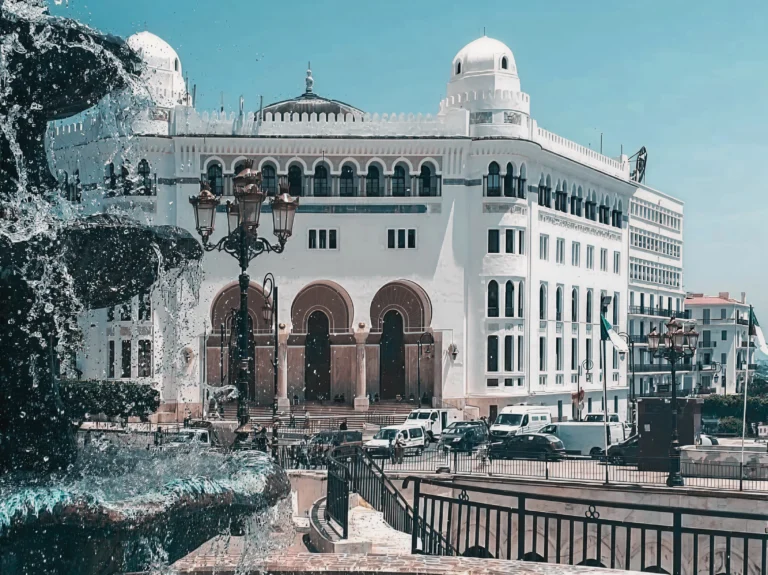
Algeria's capital plays to almost no audience but its own
Algiers rises from its bay in white terraces, French colonial boulevards giving way to the older, denser Casbah above, all of it looking, from a distance, like a city built to be photographed. Up close it's a working capital of roughly three million people going about an ordinary week: markets, traffic, mosques, cafes serving mint tea and dense Algerian coffee to men arguing about football, none of it staged for the visitors who barely show up in meaningful numbers.
That absence of tourism infrastructure is the honest trade a visit to Algiers makes. English is limited, fixed-price tourist menus are rare, and the Casbah rewards a local guide more than independent wandering. What you get in exchange is a UNESCO World Heritage neighbourhood that still functions as a neighbourhood, a clifftop basilica with almost nobody at it, and a capital city that has not yet organized itself around your visit.
The honest complications
Getting into the country in the first place requires a visa arranged well before departure, not something available on arrival for a standard city break. Cash is essential; card acceptance outside international hotels is limited, and Algeria's dual exchange rate situation (see the budget section) adds a genuine wrinkle most first-time visitors don't expect. English speakers are concentrated in hotels and tour operators; French carries you much further. None of this makes Algiers difficult, but it does mean showing up with a plan rather than winging it.
A city stacked in terraces above the bay
Algiers reads in horizontal bands from the water up: the port and colonial centre at sea level, the Casbah rising steeply above it, and residential, upscale districts higher still. Where to base yourself depends on how much you value walkability against quiet.
Alger Centre
The Haussmann-style boulevards around Place des Martyrs and the Grande Poste form the practical heart of the city: French colonial architecture, government buildings, cafes and the shortest walk up into the Casbah. For a first visit, this is the base that makes the essential sights a manageable walk or short taxi ride.
Casbah
The old fortified city climbs the hillside above Alger Centre in a maze of narrow alleys, traditional houses and small mosques, a UNESCO World Heritage Site since 1992. It's a living neighbourhood rather than a museum, best explored with a local guide who knows the alleys and the etiquette; regular police patrols have made it considerably more comfortable to visit than its reputation from decades past suggests.
Bab El Oued
A dense, working-class district on the western edge of the centre, known for its markets and its Mediterranean views, and the most direct approach on foot or by taxi to Notre Dame d'Afrique on the clifftop above. Petty theft is more common here than elsewhere in crowded market moments; ordinary bag awareness is enough.
Hydra & El Biar
Higher on the hillside, these residential districts mix historic villas with modern apartment blocks and host most of the city's embassies, making them a favoured base for business travellers and families who want quiet over proximity to the sights.
Telemly
A connector neighbourhood on the direct taxi corridor between Alger Centre and El Biar, less scenic than the Casbah but genuinely convenient, and a reasonable underrated base for travellers who want easy access to both the centre and the hillside districts.
A small, reliable hotel scene rather than a large one
Algiers doesn't have Marrakech's or Tunis's density of boutique riads and hostels; the hotel scene is smaller and leans toward a handful of established names rather than a wide spread of independent guesthouses. These cover the range that exists.
For the view, El Aurassi is Algiers' iconic hilltop hotel, opened in 1975 and since renovated, with balconies facing the bay from a position on the heights above the city; reviews consistently rank it above the international chain competition in Algiers for its location and breakfast, though rooms can vary in condition. In the centre, Sofitel Algiers Hamma Garden (from roughly $125-195 a night) is the modern, dependable choice: central location near the metro, spacious rooms, and a spa and gym, ranked #3 of Algiers' hotels on Tripadvisor. For historic character, Hotel Albert 1er, a colonial-era building from 1907 near La Grande Poste in Alger Centre, trades some modern polish for genuine atmosphere and a central, walkable location.
Algiers' budget and hostel scene is thin compared with other North African capitals; a handful of small guesthouses have appeared on the major booking platforms in recent years, but the independent hostel culture found in Marrakech or Tunis hasn't developed here yet. Budget travellers should expect simple, functional hotel rooms (4,000-7,000 DZD) rather than a backpacker scene.
Couscous, karantika, and mint tea poured from a height
Algiers eats like a coastal Algerian city: couscous with fish or seafood rather than only the inland lamb version, chickpea-flour street snacks, and a cafe culture built around strong Algerian coffee and sweet mint tea. The best food is not concentrated in a single tourist strip; it's spread across old-school dining rooms and market stalls.
Couscous
Algeria's national dish, and in the capital often made with fish or seafood rather than the lamb version more common inland. Restaurant El Djenina in Sidi M'Hamed, a former Ottoman-style building dating to 1968, serves an old-school, formal version alongside tagines and grilled meats, and ranks among the city's top-reviewed restaurants. In the Casbah itself, Sapori, a couscous bar set under a stone vault facing the port, does a more casual version alongside boureks.
Karantika
Algiers' defining street food: a savory chickpea-flour flan, baked until golden and served inside a baguette with harissa. Found at carts and small stalls across the city, especially busy in the morning and around lunchtime, and the cheapest genuinely good meal available.
Mint tea & Algerian coffee
Offered constantly and central to how the city socializes, whether in a shop, a home or a cafe. Algerian coffee tends to be strong and often sweetened; mint tea is poured with a flourish and expected to be accepted at least in a small glass.
A short list of essentials, each worth the full visit
Algiers doesn't have the density of paid attractions of a European capital; what it has are a handful of genuinely essential sights, each substantial enough to anchor half a day, plus a waterfront that rewards slow walking more than any single monument does.
The Casbah
The UNESCO-listed old city, a maze of narrow alleys, traditional courtyard houses and small mosques descending the hillside toward the port, is the essential Algiers experience and best done with a local guide who can navigate both the physical maze and the etiquette of walking through an inhabited neighbourhood. Regular police patrols have made it considerably more comfortable to explore than its reputation from past decades suggests. Budget half a day, more if you want to linger.
Notre Dame d'Afrique
A Roman Catholic basilica completed in 1872 on a clifftop above the bay, its apse inscribed with a prayer for "Notre Dame d'Afrique, priez pour nous et pour les musulmans," a message of tolerance addressed to Christians and Muslims alike. The views over the Mediterranean from the terrace outside are worth the trip on their own.
Martyrs' Memorial
A monument of three enormous concrete palm-leaf pillars sheltering an eternal flame, commemorating those killed in the War of Independence, with sweeping views over the city from its hilltop site and a museum documenting the independence struggle underneath.
Jardin d'Essai du Hamma
A large 19th-century botanical garden near the waterfront, with avenues of palms that have appeared in international film productions, and a genuinely pleasant, shaded escape from the city's heat and traffic.
The waterfront promenade
The port and seafront below Alger Centre make for an easy, unstructured evening walk, with the White City's terraces rising behind you and fishing boats and ferries working the harbour in front.
One, two or three days, planned realistically
Two to three full days covers Algiers properly; even a single well-planned day delivers the essentials. A guide for the Casbah is worth arranging in advance rather than on the fly.
- Morning
The Casbah with a guide. Start early, before the day heats up, and take the alleys slowly.
- Midday
Couscous in Sidi M'Hamed or the Casbah. El Djenina for a formal sit-down, Sapori for something more casual near the port.
- Afternoon
Notre Dame d'Afrique. A taxi up to the clifftop basilica, then back down toward the waterfront.
- Evening
The waterfront promenade. A slow walk along the port as the White City lights up behind you.
- Day 1
The one-day route: Casbah with a guide, couscous, Notre Dame d'Afrique, the waterfront at dusk.
- Day 2 morning
Martyrs' Memorial and its museum. The monument, the view, and the independence history underneath.
- Day 2 afternoon
Jardin d'Essai du Hamma. A slower afternoon in the botanical garden, then coffee and karantika near Alger Centre.
- Days 1-2
The two-day route above, at a gentler pace.
- Day 3
Tipaza day trip. The Roman ruins on the coast west of the city, a seafood lunch, and the drive back along the Mediterranean.
Compact centre, hillside districts a taxi ride away
Houari Boumediene Airport (ALG) sits about 17 km east of the centre. A direct train runs to Gare Agha, the main railway station, in about 20 minutes for 80 dinars, departing every 30 minutes, the most reliable option outside rush hour. Bus line 100 (aéro-ville) reaches Place des Martyrs in the Casbah's edge in 45 to 60 minutes for 50 dinars. A taxi takes about 25 minutes and costs roughly 1,200 dinars (€8); agree the fare before getting in, since meters aren't always used, and ride-hailing apps like Yassir or Heetch typically run 1,500 to 2,500 dinars for the same trip.
Within the city, Algiers has a functioning metro (19 operating stations, with further extensions including one toward the airport expected by the end of 2026) and a 38-station tramway that opened in 2011, both useful for longer hops between the centre and the hillside districts. For most sightseeing within Alger Centre and up into the Casbah, walking or a short taxi covers it; the hills are real, and comfortable shoes matter as much here as in any hillside Mediterranean city.
Best time to visit and practical prep
Algiers has a Mediterranean climate. March to May and September to November are the sweet spots: mild temperatures and manageable crowds. Summer regularly passes 35°C, and winter brings rain but stays mild by northern European standards.
Practical prep: buy an Algerian SIM (Djezzy, Mobilis or Ooredoo) on arrival, carry cash since card acceptance outside international hotels is limited, and keep a passport photocopy on you; checkpoints are a routine part of city and intercity travel.
Cheap day to day, once you've cleared the visa
Algiers is inexpensive by any Western measure once you're on the ground: hotel rooms, meals and transport all run low in dinar terms. The real cost of a trip here is front-loaded into the visa fee and the flight, not the daily spend.
- Simple hotel room 4,000-7,000 DZD
- Karantika and cheap restaurant meals 600-1,200 DZD
- Metro, tram and city taxis
- Free sights: Casbah, waterfront, Notre Dame d'Afrique
- Sofitel or Hotel Albert 1er (roughly $80-195)
- Sit-down restaurant meals with better service
- A private guide for the Casbah
- Ride-hailing (Yassir/Heetch) for longer hops
- El Aurassi's best bay-view rooms
- Private driver for the day
- A Tipaza day trip with a private guide
- Better dining rooms in Sidi M'Hamed
Safe in the areas visitors actually use
Algiers itself is not the part of Algeria that carries the government-flagged terrorism risk; that concern is specific to the eastern and southern border regions, well outside the capital. Violent crime against tourists in Algiers is rare, there's a heavy and visible police presence throughout the centre, and the Casbah now sees regular patrols and organized guided tours rather than the reputation it carried decades ago.
The three things that actually catch visitors: petty theft, concentrated in crowded markets like Bab El Oued, so keep bags closed and in front of you; photography restrictions, since photographing government buildings, checkpoints, ports and military sites is prohibited and enforced, sometimes strictly; and checkpoints, a routine part of city and intercity travel where a passport (or copy) and a polite, patient attitude are all that's needed. Solo women should not walk alone after dark, a standard worth planning routes around. Emergency numbers are 17 for police, 14 for fire, 061 for medical emergencies, and the EU-standard 112 works as a general line too.
Tipaza alone justifies a day out of the city
Algiers' position on the coast makes it a strong base for one outstanding day trip, with others requiring more time than a single day allows from the capital.
Tipaza
A UNESCO World Heritage Site on the Mediterranean coast, with Roman ruins, an amphitheater, basilica and baths, and well-preserved mosaics, first a Carthaginian trading post before Rome took it over. The Tomb of the Christian, a large Numidian royal mausoleum, sits nearby, and the site pairs a seafood lunch by the water with two to three hours among genuinely uncrowded ruins. Buses run from Algiers to Tipaza town throughout the day, and organized day tours are widely available for those who prefer not to arrange transport themselves.
Constantine & the Roman ruins
Constantine's bridges, and the Roman ruins at Djemila and Timgad further east, are genuinely worth seeing but sit 3 to 4 hours from Algiers; treat these as their own overnight trip rather than a rushed day out of the capital. Full detail is in our Algeria country guide.
Algiers FAQ
Is Algiers safe for tourists?
Yes, in the main areas most visitors use. Violent crime against tourists is rare and there's a heavy police presence, including regular patrols in the Casbah. Petty theft in crowded markets like Bab El Oued and standard checkpoint etiquette are the practical things to know.
How many days do I need in Algiers?
Two to three full days covers the city well: one for the Casbah and the waterfront, one for Notre Dame d'Afrique, the Martyrs' Memorial and the botanical garden, and a third for a day trip to the Roman ruins at Tipaza.
How much does Algiers cost per day?
Budget travellers manage on $30-45 a day with simple hotels and street food; mid-range runs $70-110. Algiers is inexpensive day to day in dinar terms, though the visa cost to get there adds to the overall trip budget.
When is the best time to visit Algiers?
March to May and September to November: mild temperatures and manageable heat. Summer regularly passes 35°C and winter brings rain, though neither rules out a visit.
Do I need a visa to visit Algiers?
Yes. Nearly all nationalities, including the US, UK, EU and Canada, need a visa arranged in advance through an Algerian embassy or consulate before arrival; a US tourist visa costs $160. See our Algeria country guide for full visa details.
How do I get from Algiers airport to the city centre?
A direct train runs from the airport to Gare Agha in about 20 minutes for 80 dinars, every 30 minutes. A taxi takes about 25 minutes and costs around 1,200 dinars (€8); agree the fare before getting in, as meters aren't always used.
What is the best area to stay in Algiers?
Centre-Ville (Alger Centre) for first-timers: central, walkable to the Casbah and the waterfront. Hydra or El Biar for a quieter, more upscale base. The hilltop El Aurassi hotel suits travellers who want a bay view over walkability.
Do I need to speak Arabic or French in Algiers?
French gets you further than English in hotels, restaurants and with taxi drivers; it remains the practical second language of daily life. A few words of Arabic are appreciated but not essential in the capital.
Is the Casbah safe to visit?
Yes, during the day and ideally with a local guide. Once considered risky, the Casbah now sees regular police patrols and organized walking tours, and is one of the highlights of a visit to Algiers.
What Stays With You
Algiers doesn't perform for the small number of outsiders who visit it, and that's exactly why it stays with you. The Casbah is still a place people live, not a stage set. The inscription at Notre Dame d'Afrique, addressed to Muslims and Christians alike, means something because so few visitors ever read it in person. And the couscous at a Sidi M'Hamed dining room that's been serving the same dish since 1968 was never plated for a review.
Walk the waterfront on your last evening, watch the White City catch the last light above the bay, and understand why a capital this striking has stayed this quiet for so long.