
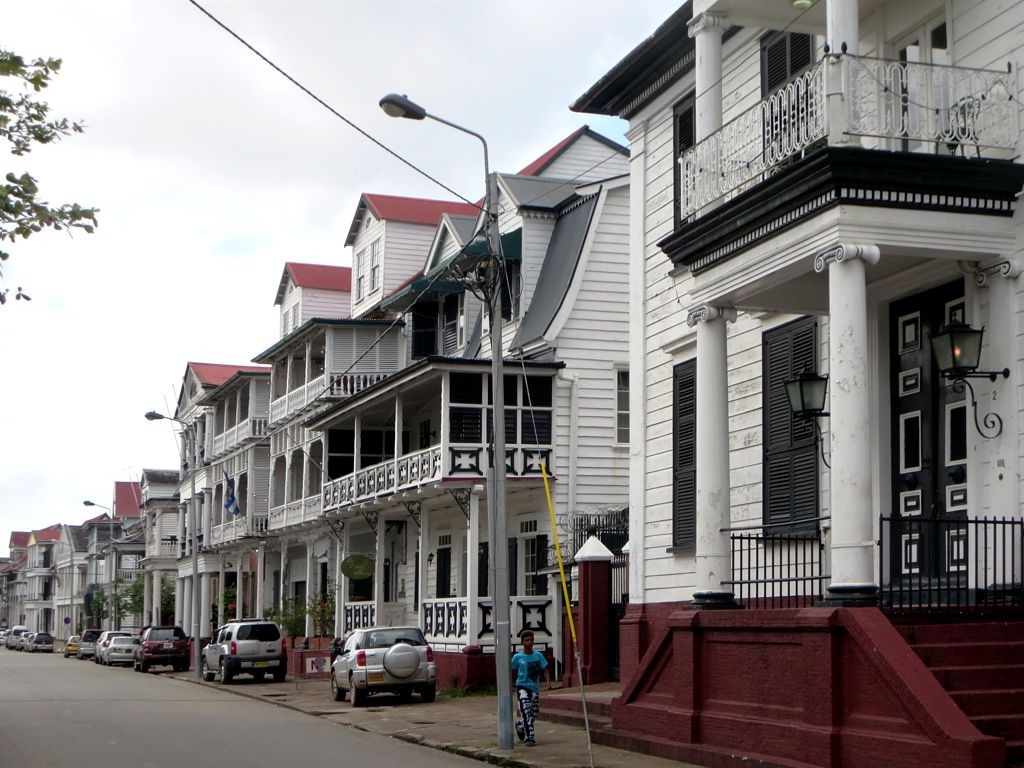
A capital that never bothered to perform for outsiders
Paramaribo sits on the west bank of the Suriname River, about 15km from the Atlantic, its historic core laid out on the same street grid the Dutch drew in the 17th century. White-painted wooden mansions with green shutters, some 300 years old, line broad avenues that converge on Independence Square and Fort Zeelandia, the whole thing UNESCO-listed since 2002 for a colonial townscape that survives almost nowhere else this intact. It is a small, humid, unhurried city, and it makes no attempt to smooth itself into an easy, generic tropical capital for visitors.
What Paramaribo has instead is one of the most genuinely multicultural streetscapes in the hemisphere. Keizerstraat's synagogue and mosque have stood a few doors apart for close to a century. The Central Market mixes Javanese, Hindustani and Creole stalls within smelling distance of each other. English gets you through hotels and tour bookings; everywhere else, Dutch and Sranan Tongo are what's actually spoken, a reminder that this is a working Dutch-speaking capital first and a tourist city a distant second.
The honest complications
Tourist infrastructure is real but thin: a handful of good hotels, a smaller set of restaurants that consistently show up in reviews, and tour operators who need advance notice rather than walk-up bookings. Some of the historic wooden guesthouses in Centrum predate reliable air conditioning, so confirm cooling before booking in the rainy-season heat of May and June. English drops off fast outside the tourist core, so a translation app or a few Dutch phrases genuinely help. And petty theft, pickpocketing and bag-snatching around busy market and shopping streets, plus walking alone at night near the Palmentuin, are real enough concerns to plan around, even though the overall safety picture (Level 1, Exercise Normal Precautions) is good.
A small, walkable core with a few practical outer options
Paramaribo is compact enough that most visitors never leave two adjoining neighbourhoods. Where you base yourself mostly comes down to how much river view and bar noise you want versus quiet.
Centrum
The historic heart of Paramaribo: cream and ochre wooden colonial mansions along broad avenues converging on Independence Square and Fort Zeelandia, with the Saint Peter and Paul Cathedral rising above it all in weathered red-trimmed timber. The Central Market two blocks south carries the persistent smell of smoked fish and fresh-ground spices from early morning. Nearly every landmark in the city is within a 15-minute walk from here, and the streets stay well-lit and actively patrolled after dark.
Waterkant
The riverside promenade just north of Centrum, where palm trees lean over the wide brown Suriname River and fishing pirogues drift past at dusk. This is where Torarica's tropical gardens and pool occupy the best riverside real estate in the city, and where the bar and restaurant scene concentrates. A ten-minute walk covers the UNESCO core; bar noise can carry into street-facing rooms until midnight on weekends.
Tourtonne
A mixed residential and commercial district south of Centrum, with local markets, everyday Surinamese rhythm, and noticeably lower prices at neighbourhood restaurants than the tourist core. A short taxi or minibus ride reaches the main sights; there's little reason to base here on a first visit unless budget is the priority.
Zorg en Hoop
Anchored by the Zorg en Hoop domestic airstrip, the departure point for flights into the rainforest interior. Useful specifically for an early domestic flight to a jungle lodge; otherwise a 20-30 minute taxi ride from the UNESCO sights, with propeller noise from dawn departures a real consideration for light sleepers.
From the riverside resort to converted colonial guesthouses
Paramaribo's hotel scene is small compared to a Caribbean capital of similar size, but it covers every budget, and the mid-range and colonial-guesthouse options genuinely have character rather than chain-hotel sameness.
At the top, Royal Torarica in Waterkant is the city's grandest address, from around $210 a night, with a casino, sauna and the best pool-and-garden setup in Paramaribo, right on the Suriname River. Its sister property Torarica Resort (from about $172) shares the same riverside grounds at a slightly gentler price, with beach volleyball courts and extensive gardens.
In the mid-range, Hotel Krasnapolsky (from roughly $115) is the long-standing name in Centrum, a short walk from Independence Square, while the Courtyard by Marriott Paramaribo (from about $179) on Waterkant offers the most reliably international, predictable stay in the city, with a casino and gym on site. Both offer lower nightly rates for stays of four nights or more if you ask at check-in.
For character on a tighter budget, the converted colonial mansions of Centrum are the city's best value: Spanhoek Boutique Hotel (from about $45) sits inside the old town itself, while Zus & Zo Guesthouse, attached to the well-known cafe of the same name near the Palmentuin, offers simple rooms with a genuinely local, garden-set atmosphere. Confirm air conditioning specifically when booking any of the older wooden guesthouses; some rely on ceiling fans and high ceilings alone.
Roti, saoto soup and a market that proves the point
Paramaribo's food scene is the city's best argument for itself: Hindustani, Javanese, Creole and Chinese cooking all sit within a few minutes of each other, often cheaper and better at a market stall than at a sit-down restaurant.
Roti
Curried chicken, potato and long beans wrapped in Hindustani flatbread, eaten with your hands. Roopram Roti, with several locations across the city, is the name most Surinamers reach for first.
Saoto soup
Shredded chicken, vermicelli, boiled egg and crispy fried shallots in spiced broth, a Javanese breakfast dish sold from around 7am. Warung Renah in Blauwgrond is a genuine, unpretentious address for it, along with bami and nasi and a pink coconut dawet drink to finish.
Zus & Zo
A colonial-building grand cafe with a spacious garden, blending Surinamese, Caribbean and European dishes into an easy, all-day menu; open 8am to 11pm. It's as much a Paramaribo institution as a restaurant, with occasional live music and movie nights in the garden.
Waterside tapas & live music
Roline's de Waag, in one of the old Dutch weigh-house buildings on the Waterkant, pairs tapas-style plates with live music over the river; a good pick for an evening rather than a quick lunch.
A compact old town that rewards slow walking
Paramaribo's sights cluster tightly enough that a good two days on foot, with breaks from the heat, covers essentially everything that matters.
Fort Zeelandia & Independence Square
Fort Zeelandia began as a 1640 French wooden stockade, was rebuilt in stone by the British as Fort Willoughby, and took its current name when the Dutch secured the colony for good in 1667; today it houses the Suriname Museum, covering the colonial and slavery-era history directly rather than glossing over it. Independence Square next door, fronted by the neoclassical Presidential Palace, is the ceremonial heart of the city and the natural starting point for a walking day.
The wooden cathedral and Keizerstraat
The Saint Peter and Paul Cathedral, at 144 feet the largest wooden church in the Americas, was built entirely from Surinamese greenheart and basralocus timber in neo-Gothic and neo-Romanesque style; the interior is open to visitors outside services. A short walk away on Keizerstraat, the Neveh Shalom Synagogue, built around 1843 on a site dating to 1723, stands a few doors from a mosque, the two buildings sharing a wall in places, a genuinely rare arrangement and the single image that best captures Suriname's religious tolerance.
Palmentuin & the Waterkant
The Palmentuin, a palm garden opened to the public in 1685 behind the Presidential Palace, is the best shade in the city and a pleasant place to sit out the midday heat; avoid it alone after dark, per standard local safety advice. The Waterkant promenade along the Suriname River is the spot for an evening walk, with fishing pirogues coming in and the old Dutch warehouse facades lit up after sunset.
Central Market & the ethnic mosaic up close
The Central Market (Waaigat) is where Javanese, Hindustani and Creole vendors set up side by side from early morning, selling everything from smoked fish to fresh spices to prepared roti and pom. It's the single best place to see, and taste, Suriname's multicultural makeup in one visit, and it's at its most atmospheric before 8am.
One, two or three days, planned street by street
Two full days covers Paramaribo's old town and food scene properly; a third day adds Commewijne across the river.
- Morning
Fort Zeelandia and Independence Square. The Suriname Museum inside the fort, then the Presidential Palace and Palmentuin for shade.
- Midday
Roti at Roopram. Walk it off through the Centrum grid toward Keizerstraat.
- Afternoon
Keizerstraat and the wooden cathedral. The synagogue-mosque pairing, then the Saint Peter and Paul Cathedral interior.
- Evening
Waterkant at sunset. Dinner at Zus & Zo or Roline's de Waag, with the river turning gold.
- Day 1
The one-day route: Fort Zeelandia, Independence Square, roti lunch, Keizerstraat, the wooden cathedral, Waterkant at sunset.
- Day 2 morning
Central Market before 8am. Breakfast among the smoked-fish and spice stalls, then a slow walk back through Centrum's less-visited streets.
- Day 2 afternoon
Blauwgrond for saoto soup. Warung Renah and the Javanese neighbourhood, a genuinely different Paramaribo from the colonial core.
- Day 2 evening
Torarica gardens. A drink by the pool and river even if you're not staying there; it's the city's most atmospheric outdoor setting after dark.
- Days 1-2
The two-day route above, at a gentler pace.
- Day 3
Commewijne day trip. Fort Nieuw Amsterdam's open-air museum and Peperpot Nature Park's birdlife, an easy half-day across the river that feels like a different country from Centrum.
Compact and flat, with the airport the main logistics question
Johan Adolf Pengel International Airport (PBM) sits 45km south of the city in Zanderij; a taxi or arranged hotel transfer takes 45-60 minutes and costs roughly $25-35, since there's no public transit connection. Within the city, Centrum and Waterkant are entirely walkable, flat and shaded enough to cover on foot outside the midday heat; taxis (agree the fare before getting in, or use a hotel-arranged transfer) cover longer hops to Tourtonne or Zorg en Hoop.
For the domestic flight into the interior, Zorg en Hoop airstrip on the city's edge is the departure point; these flights are almost always booked as part of a lodge package rather than independently. A rental car is worth it specifically for a Commewijne day trip across the river, at roughly $50-70/day; it isn't useful for the deep interior, which has no roads at all.
Best time to visit and connectivity
Paramaribo runs a hot, humid equatorial climate year-round, around 27°C (81°F) with little seasonal temperature swing; what changes is rainfall. Late August through mid-November is the long dry season and the best window, with February-March a shorter, milder second option. May and June are the wettest months.
A local SIM from Digicel or Telesur at the airport covers the city reliably; Wi-Fi is standard at hotels and cafes in Centrum and Waterkant.
One of South America's most affordable capitals
Paramaribo runs roughly half the daily cost of Georgetown, Guyana, and a fraction of French Guiana's euro-zone prices. The guesthouse scene is genuinely cheap, the mid-range is honest value, and the main splurge is a night or two at Torarica rather than anything in the food or transport budget.
- Guesthouse in Centrum $30-55
- Market and warung meals $2-6
- Walking the old town, free
- Occasional taxi $3-6
- Hotel with pool, Waterkant or Centrum
- Restaurant meals $8-15
- Rental car or regular taxis
- Fort Zeelandia, Suriname Museum entry
- Royal Torarica or equivalent
- Private guided old-town & Commewijne tours
- Casino evenings
- Interior lodge add-on (separate budget)
Genuinely safe, with one clear nighttime rule
Suriname carries the US State Department's lowest advisory level, Level 1, Exercise Normal Precautions, and Paramaribo is no exception. Violent crime against tourists is rare. The concern that actually shows up in security reports is opportunistic pickpocketing and bag-snatching around business and shopping districts, and burglary or robbery risk that's more relevant to residents than short-stay visitors.
The one rule worth internalizing: don't walk alone at night, particularly near major tourist hotels and around the Palmentuin, both areas specifically flagged in security reporting. Take a taxi for evening trips even over short distances. During the day, Centrum and Waterkant are well-patrolled and comfortable to explore on foot, including for solo travelers. Emergency numbers are police 115, ambulance 113, and fire 110.
The rainforest interior is the reason to add extra days
Paramaribo's position at the edge of the interior makes it the only realistic base for reaching Suriname's rainforest, from an easy half-day across the river to multi-day lodge stays that need a domestic flight.
Commewijne
A short crossing east of the city puts you among Commewijne's old cacao and coffee plantations. Fort Nieuw Amsterdam, a star-shaped British-built fortress at the confluence of the Commewijne and Suriname rivers, is now an open-air museum with cannons still facing the water. Peperpot Nature Park, a former plantation reclaimed by forest, is one of the best birdwatching sites near the capital, with old brick chimneys standing among the trees and howler monkeys often audible in the morning.
Brownsberg Nature Park
The standard first taste of real rainforest: a plateau above the vast Brokopondo Reservoir, with trails through primary forest to the Leo waterfall and, conditions permitting, the Irene waterfall. Howler and capuchin monkeys are frequently heard if not always seen. Reachable by road, which is what makes it a genuine day trip rather than a multi-day commitment.
Upper Suriname River & interior lodges
For Saramaka Maroon village culture and deeper rainforest, lodges like Danpaati River Lodge and Jungle Resort Pingpe sit directly on the Upper Suriname River, reached by motorized boat. Further west, Kabalebo Nature Resort, reachable only by chartered flight, and the UNESCO-listed Central Suriname Nature Reserve are the multi-day, higher-budget end of the country's rainforest offering; both require booking an all-inclusive package well ahead rather than showing up independently.
Paramaribo FAQ
Is Paramaribo safe for tourists?
Paramaribo is broadly safe, with Suriname rated Level 1 by the US State Department. The main concern is opportunistic pickpocketing and bag-snatching in busy market and shopping areas, plus avoiding the Palmentuin and streets near major hotels alone after dark. Standard city awareness is enough.
How many days do I need in Paramaribo?
Two full days covers the UNESCO old town, Fort Zeelandia, and the food scene well. A third day fits a Commewijne day trip across the river, and a fourth is worth adding for Brownsberg Nature Park.
How much does Paramaribo cost per day?
Budget travelers manage on $35-50 a day with guesthouses and market food; mid-range runs $75-130. Paramaribo is significantly cheaper than most Caribbean capitals and roughly half the daily cost of Georgetown, Guyana.
When is the best time to visit Paramaribo?
Late August through mid-November, the long dry season, and again in February-March, a shorter dry spell. Both avoid the heaviest rains without sacrificing much else, since temperatures stay around 27°C (81°F) year-round.
What is the best area to stay in Paramaribo?
Centrum, the UNESCO old town, for first-timers who want to walk to everything. Waterkant for the most scenic riverside setting and the best concentration of restaurants and bars. Both are well-patrolled after dark.
Do I need to speak Dutch in Paramaribo?
Not for hotels, restaurants and tour operators, where English generally works. Outside tourism, Dutch and Sranan Tongo run daily life, and a few words of either are genuinely appreciated.
How do I get from Paramaribo's airport to the centre?
Johan Adolf Pengel International Airport (PBM) sits 45km south of the city in Zanderij. A taxi or hotel transfer takes 45-60 minutes and typically costs $25-35; there is no public transit link.
Can I see the rainforest as a day trip from Paramaribo?
Brownsberg Nature Park, two hours south by road, is the closest real rainforest experience and works as a long full day trip. The deeper interior, including Maroon river villages and multi-day lodges, needs a domestic flight or boat transfer and at least two to three days.
Is Paramaribo walkable?
Yes, the UNESCO old town and Waterkant are compact and flat, easily covered on foot in a day. Reaching Tourtonne or Zorg en Hoop is a short taxi ride rather than a walk.
What Stays With You
Paramaribo doesn't dress itself up for visitors, and that's exactly why it stays with you. The wooden facades on Keizerstraat weren't restored for tourism, they're just still there, doing what Dutch colonial buildings do in the tropics: aging slowly, humidly, honestly. The mosque and synagogue sharing a wall, the market vendor who's sold the same spot for thirty years, the roti stand with the longest local line rather than the best signage: none of it was staged, which is why it holds up.
Walk the Waterkant at dusk on your last evening, watch the pirogues come in against the old warehouse facades, and understand why a country this small has never needed to explain itself to the rest of South America.