
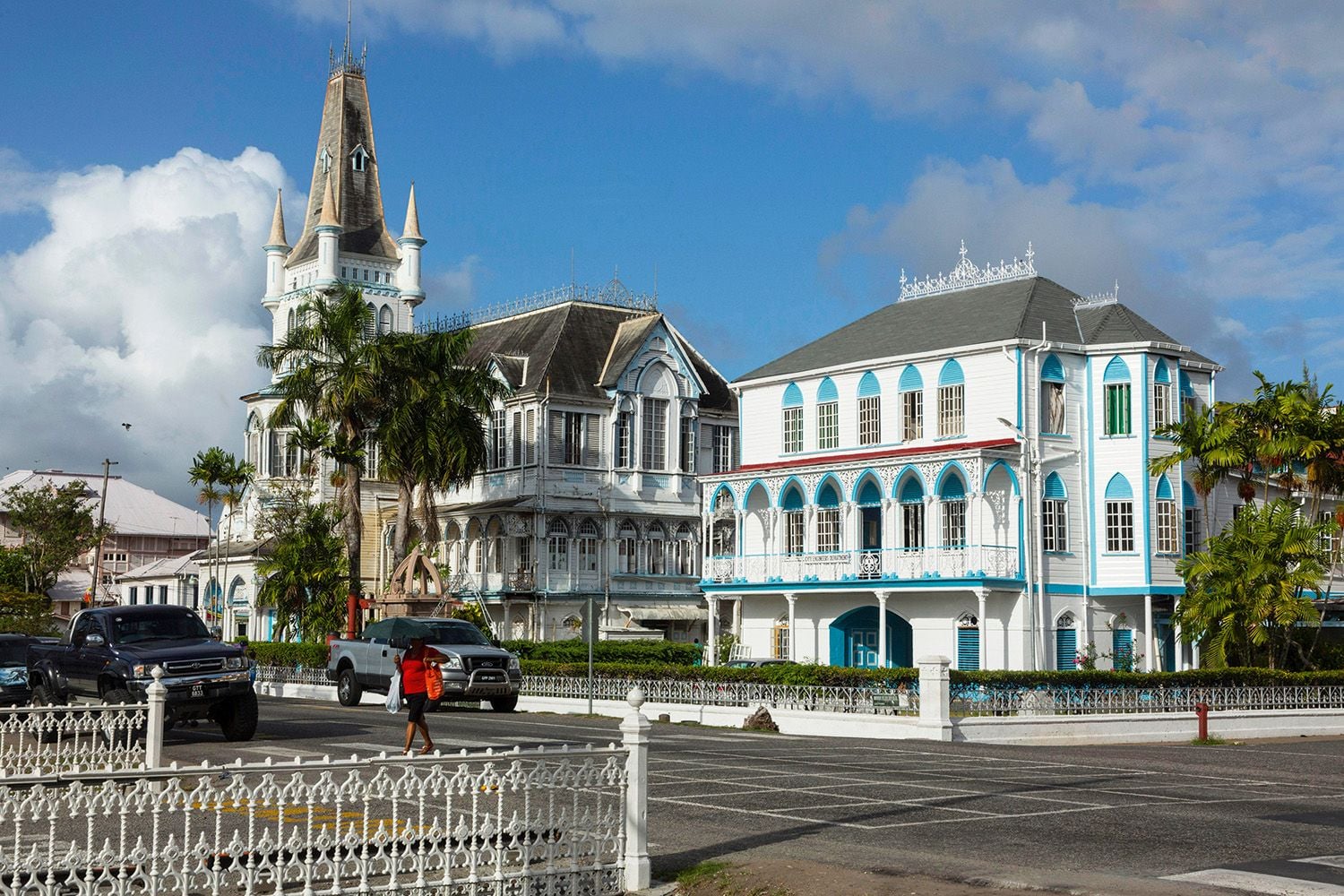
A capital that runs on Dutch engineering and cricket
Georgetown sits almost entirely below sea level on Guyana's Atlantic coast, protected by a seawall the British built in the 19th century and a canal network the Dutch dug well before that, still actively draining the city today. The result is a low, wide, green capital of wooden colonial buildings, painted white and often elaborately fretworked, laid out on a grid that owes more to plantation-era Amsterdam than to anything typically South American.
What's changed fast is the money underneath it. Guyana's offshore oil boom has Georgetown in the middle of a genuine hotel construction wave, international chains breaking ground faster than the city has previously seen, and prices climbing accordingly. The city you're visiting in 2026 is not quite the sleepy Caribbean-adjacent capital it was a decade ago, and it's worth knowing that going in.
The honest complications
Georgetown carries a real, current US Level 3 Reconsider Travel advisory for crime, not a historical footnote, and certain neighborhoods genuinely warrant avoiding after dark. The city is also not set up for casual wandering after sunset the way a typical Caribbean beach town is: taxis don't run on meters, minibuses are fast and not always careful, and the tourist infrastructure, while real, is smaller and less polished than in more established capitals. None of this makes Georgetown not worth two or three days. It makes it a city that rewards a plan over an aimless afternoon.
A small, walkable grid with a few names worth knowing
Georgetown is compact enough that most visitors cover it on foot and by taxi rather than needing to think hard about neighborhoods, but three areas come up repeatedly and are worth knowing before you arrive.
Kingston
Georgetown's coastal district, home to the Seawall promenade and the city's most established higher-end hotels. It's the most central, practical base for a first visit, close to the Botanical Gardens and an easy taxi ride from everything else.
Stabroek
The historic commercial heart of the city, anchored by Stabroek Market and its cast-iron clock tower. It's the most atmospheric part of Georgetown and also one flagged for petty theft; treat it as a daytime destination, not somewhere to linger into the evening.
Bourda
East of Stabroek, Bourda holds its own busy produce market and the historic Bourda Cricket Ground, home of the Georgetown Cricket Club since 1858 and a genuine piece of West Indies cricket history worth a stop even outside match days.
A hotel scene being rebuilt in real time
Georgetown's accommodation landscape is changing fast on the back of the oil boom, with several international chains under construction alongside the city's established properties. Prices are moving up with them, so treat any figure here as a starting point to verify, not a locked-in rate.
At the top end, the Guyana Marriott Hotel on the Kingston seafront is the city's international-standard flagship, with Georgetown's only full-service spa and rooms looking out over the Atlantic. Close by, the long-established Pegasus Hotel on the Kingston waterfront has been a fixture of Georgetown hospitality for decades and remains a reliable, central choice.
In the mid-range, Cara Lodge occupies a restored 1840s house on Quamina Street, one of Georgetown's most atmospheric places to sleep, with its own restaurant in the original building. Grand Coastal Hotel is a solid, well-reviewed mid-range option with its own kitchen worth eating at even if you're not staying there.
At the budget end, independent guesthouses including Rima Guesthouse and Herdmanston Lodge offer simpler rooms at a fraction of the hotel-chain rates; book directly or through a major platform and confirm the current rate, since this segment is where prices have moved the most.
Roti, Chinese-Guyanese cooking, and pepperpot done properly
Georgetown's food scene reflects the whole country's population history on one street: Indo-Guyanese roti shops, a distinct Chinese-Guyanese tradition dating to 19th-century indentured labor, and Afro-Guyanese classics like pepperpot and cook-up rice, often at unglamorous, plastic-chair spots that have been doing one thing well for decades.
New Thriving
Georgetown's best-known Chinese-Guyanese restaurant, and the place to understand how distinct that cuisine is from mainland Chinese food. It does a popular Sunday dim sum service alongside its regular menu, and has built a loyal following over years of consistent reviews.
Shanta's Puri Shop
A no-frills, decades-old roti and puri counter that Georgetown locals point to as one of the city's most reliable everyday meals: dhalpuri roti with curried chicken or goat, made the way Indo-Guyanese families have made it for generations.
Backyard Cafe
Chef Delven Adams runs a market-tour-and-cooking experience out of Backyard Cafe, one of the more considered takes on Guyanese and Caribbean cooking in the city, built around whatever the day's market produce looks best.
Cara Lodge's dining room
Even if you're not staying there, Cara Lodge's in-house restaurant is worth a meal for the setting alone, a restored 19th-century Georgetown house serving a Caribbean, Amerindian and Western-influenced menu.
Colonial wood, Dutch canals, and a genuinely important cricket ground
Georgetown's sights are concentrated enough to cover comfortably in two unhurried days on foot and by taxi, mixing colonial architecture, market life, and a couple of genuinely world-class curiosities that most visitors have never heard of before arriving.
Stabroek Market & the old commercial core
Stabroek Market, with its cast-iron clock tower dating to 1881, is Georgetown's most recognizable landmark and its busiest working market, still the place locals buy produce, fabric and hardware rather than a tourist-facing recreation. Visit in the morning, keep your bag zipped and in front of you, and treat it as a daytime destination rather than somewhere to be after the stalls close.
St. George's Cathedral
St. George's Cathedral, completed in 1899 from Guyanese greenheart wood to a design by the English architect Sir Arthur Blomfield, stands 143 feet tall and was, for over a century, the tallest wooden church building in the world, a record it held until 2003. It no longer holds that title outright, but it remains one of the tallest wooden churches anywhere and a striking, still-active piece of colonial-era craftsmanship.
The Seawall & the Botanical Gardens
The Kingston Seawall Esplanade, the 19th-century flood barrier that keeps the Atlantic out of a city sitting below sea level, doubles as Georgetown's main promenade, popular for evening walks and, at its Kingston end, home to the 1903 Seawall Bandstand, built as a memorial to Queen Victoria. A short taxi ride away, the Botanical Gardens hold mature tropical trees, lily ponds with giant Victoria amazonica water lilies, and canals where resident manatees are a reliable, low-key highlight for families.
History in the Square of the Revolution
The 1763 Monument, a bronze statue of Cuffy (Kofi) with arms raised, stands in the Square of the Revolution and commemorates the 1763 Berbice Slave Rebellion; Cuffy is Guyana's national hero. Nearby, the colonial-era Parliament Buildings on Brickdam and the National Museum on North Street, covering natural history, Amerindian heritage and the colonial period, round out an easy, walkable history circuit.
Bourda Cricket Ground
Bourda, home of the Georgetown Cricket Club since 1858, is a legitimate heritage stop for anyone interested in cricket, not just a functioning local ground: it's cited as the first Test cricket venue on the South American mainland and the only Test venue in the world below sea level, and it hosted the West Indies' first-ever Test match win, a 289-run victory over England in 1930. Guyana National Park, a short loop trail off Camp Road with its own resident manatees, makes an easy add-on nearby.
One, two or three days, city first, Kaieteur second
Two days covers Georgetown properly; a third is the standard add-on for the Kaieteur Falls flight, which most visitors treat as an extension of the city stay rather than a separate trip.
- Morning
Stabroek Market and the old core. The clock tower and market in daylight, then St. George's Cathedral a short walk away.
- Midday
Roti at Shanta's Puri Shop or dim sum at New Thriving if it lands on a Sunday.
- Afternoon
The Square of the Revolution and the National Museum, then the Botanical Gardens for the water lilies and manatees.
- Evening
The Seawall before dark, dinner in Kingston.
- Day 1
The one-day route above: Stabroek Market, St. George's Cathedral, the museum, the Botanical Gardens, the Seawall.
- Day 2 morning
Bourda Cricket Ground and Bourda Market, then Guyana National Park for a quieter walk.
- Day 2 afternoon
A slower Kingston afternoon: the Pegasus or Marriott waterfront, dinner at Cara Lodge's dining room in the 1840s house.
- Days 1-2
The two-day route above, at a gentler pace.
- Day 3
Kaieteur Falls. An early flight from Ogle Airport, roughly two hours at the falls, and back to Georgetown by mid-afternoon. Book this before you arrive; flights depend on group numbers and weather.
No meters, no ride apps, and two different airports
Cheddi Jagan International Airport (GEO) sits about 25 miles south of the city at Timehri; a taxi is the standard way into central Georgetown, and since Guyana's taxis don't run on meters, agree the fare before you get in. Ogle Airport, inside Georgetown itself, is the separate domestic airport used for Kaieteur Falls flights and other interior connections, not the international airport, worth knowing so you don't head to the wrong one.
Within the city, minibuses run fixed numbered routes cheaply but are reported to drive fast and aggressively; they're fine by day but worth avoiding at night or in heavy rain. Taxis are easy to flag down in the central business district; short in-city rides are inexpensive once you've agreed a fare, and it's worth asking your hotel for a rough going rate before your first ride so you have a benchmark. Uber and similar ride-hailing apps are not established in Georgetown, so plan around taxis and hotel-arranged transport rather than assuming app-based rides will be available.
Best time to visit
Guyana's coast is tropical and humid year-round with two rainy seasons, roughly December to January and May through August. February to April and September to November are drier and generally the most comfortable months for city sightseeing and for the more predictable end of interior travel conditions, though Kaieteur Falls itself is at its most dramatic when water volume is highest during the wetter months, a genuine trade-off worth weighing against your other plans.
Rising fast, but still manageable outside the interior flights
Georgetown is not a cheap capital by regional standards, and the oil-boom hotel construction wave is pushing prices up further. Day-to-day costs, food, minibuses, market shopping, remain reasonable; hotels and any interior add-on are where a Georgetown trip gets expensive.
- Independent guesthouse
- Roti shops & market food
- Minibuses around the city
- Free sights: Seawall, museum, gardens
- Cara Lodge or Grand Coastal Hotel
- Restaurant meals
- Agreed-fare taxis
- A guided city tour
- Guyana Marriott or Pegasus Hotel
- Private drivers
- Kaieteur Falls day flight
- Fine dining in Kingston
Figures reflect September 2026 research and drift over time, especially hotel rates given the current construction boom. Treat them as a planning baseline, not a quote, and confirm hotel and tour prices directly before booking.
A real Level 3 advisory, mostly about opportunistic theft
The US State Department rates Guyana Level 3, Reconsider Travel, for crime, an advisory current as of August 2026. In Georgetown that translates mostly into opportunistic theft, pickpocketing, purse-snatching and occasional robbery, rather than organized violence directed at tourists, but it is a real, active advisory and worth planning around rather than dismissing.
Specific neighborhoods are consistently flagged by safety sources as higher-risk, including Tiger Bay, Sofia, Albouystown and Agricola, along with the National Park area and the Seawall after dark. Stabroek Market, despite being a top sight, appears on the same caution lists; visit in daylight with normal market awareness rather than crossing it off. The practical rules: use agreed-fare taxis rather than walking after dark, don't display phones or jewelry in busy areas, and keep bags zipped and in front of you in markets and minibuses. Emergency numbers are 911 for police, 912 for fire and 913 for ambulance.
Embassies in Georgetown
The US Embassy is at 100 Young and Duke Streets, Kingston (+592-225-4900; after-hours emergency +592-225-4126). The British High Commission is at 44 Main Street (+592-226-5881). The Canadian High Commission is at High and Young Streets (+592-227-2081). Australia has no embassy in Guyana; Australian citizens should check Smartraveller for the nearest regional mission.
Kaieteur Falls is the one true day trip; the rest need more time
Georgetown's position works as a launchpad for the Guyanese interior, but it's worth being honest about scale: Kaieteur Falls is genuinely doable in a single day, while the Rupununi savannah, Iwokrama Forest and Shell Beach all require multi-day trips with their own charter flights and lodge bookings, not a quick add-on to a city stay.
Kaieteur Falls
A 226-metre single-drop waterfall on the Potaro River, credited as the world's most powerful single-drop fall by combined height and volume. Small planes fly from Ogle Airport, Georgetown's domestic airport, most days, landing near the falls for a roughly two-hour guided visit before returning. Operators worth knowing include Air Services Limited, Trans Guyana Airways and Wilderness Explorers; flights typically need a minimum group size and fill on a schedule rather than departing on demand, so book several days ahead, more in the December-to-April peak season.
Beyond a day trip: Iwokrama, the Rupununi and Shell Beach
Iwokrama Forest and the Rupununi savannah lodges, Karanambu, Rewa and Surama among them, are reached by charter flight or a long overland drive and need a minimum of several days to be worthwhile, given the transit time alone. Shell Beach's turtle-nesting season, March through August, requires an even longer commitment: multi-night stays in boat-accessed research camps, arranged well in advance through a specialist operator. None of these work as a spontaneous add-on to a Georgetown stay; they're trips in their own right, covered in full in our Guyana country guide.
Georgetown FAQ
Is Georgetown, Guyana safe for tourists?
The US State Department rates Guyana Level 3, Reconsider Travel, for crime. In Georgetown that mostly means opportunistic theft rather than organized violence; avoid Tiger Bay, Sofia, Albouystown and Agricola, especially after dark, and use agreed-fare taxis at night.
How many days do I need in Georgetown?
Two days covers the city's sights properly. A third day is worth adding for the Kaieteur Falls flight, which most visitors do as a day trip from Georgetown.
How do I get from the airport to central Georgetown?
Cheddi Jagan International Airport (GEO) is about 25 miles south of the city at Timehri. A taxi is the standard option; agree the fare before you get in, since Georgetown taxis don't run on meters.
How do you get to Kaieteur Falls from Georgetown?
By small plane from Ogle Airport, a separate domestic airport within Georgetown, not the international airport. The round trip with time at the falls typically runs about six hours door to door.
What is the best area to stay in Georgetown?
Kingston, the coastal district near the Seawall, holds the city's established higher-end hotels and is a reasonable, central first-timer base.
Is tap water safe in Georgetown?
Most visitors stick to bottled or filtered water in Georgetown as a standard precaution; hotels catering to international travelers can advise on their own supply.
Do I need Guyanese dollars or can I use US dollars?
The Guyanese dollar (GYD) is the local currency, and it's what you need for minibuses, markets and small vendors. Some larger hotels and tour operators will quote or accept US dollars, but don't count on it everywhere.
Can you visit Stabroek Market safely?
Yes, in daylight, with the same awareness you'd use in any busy market: keep bags zipped and in front of you, skip flashy valuables, and don't linger after the market winds down in the afternoon.
What Stays With You
Georgetown doesn't announce itself the way a capital angling for tourists usually does. It's a city that quietly kept the Atlantic out for two hundred years with Dutch canals and a British seawall, that built one of the tallest wooden cathedrals on earth out of local greenheart timber, and that hosted a piece of cricket history most fans of the sport have never heard of, all while sitting below sea level on the edge of a rainforest most of the world still can't place on a map.
Spend an evening on the Seawall as the light goes, with a glass of El Dorado rum from a country that makes some of the best in the world and gets almost none of the credit. Then get on the small plane to Kaieteur the next morning, and see why the interior, not the coast, is what people who've actually been to Guyana can't stop talking about.