
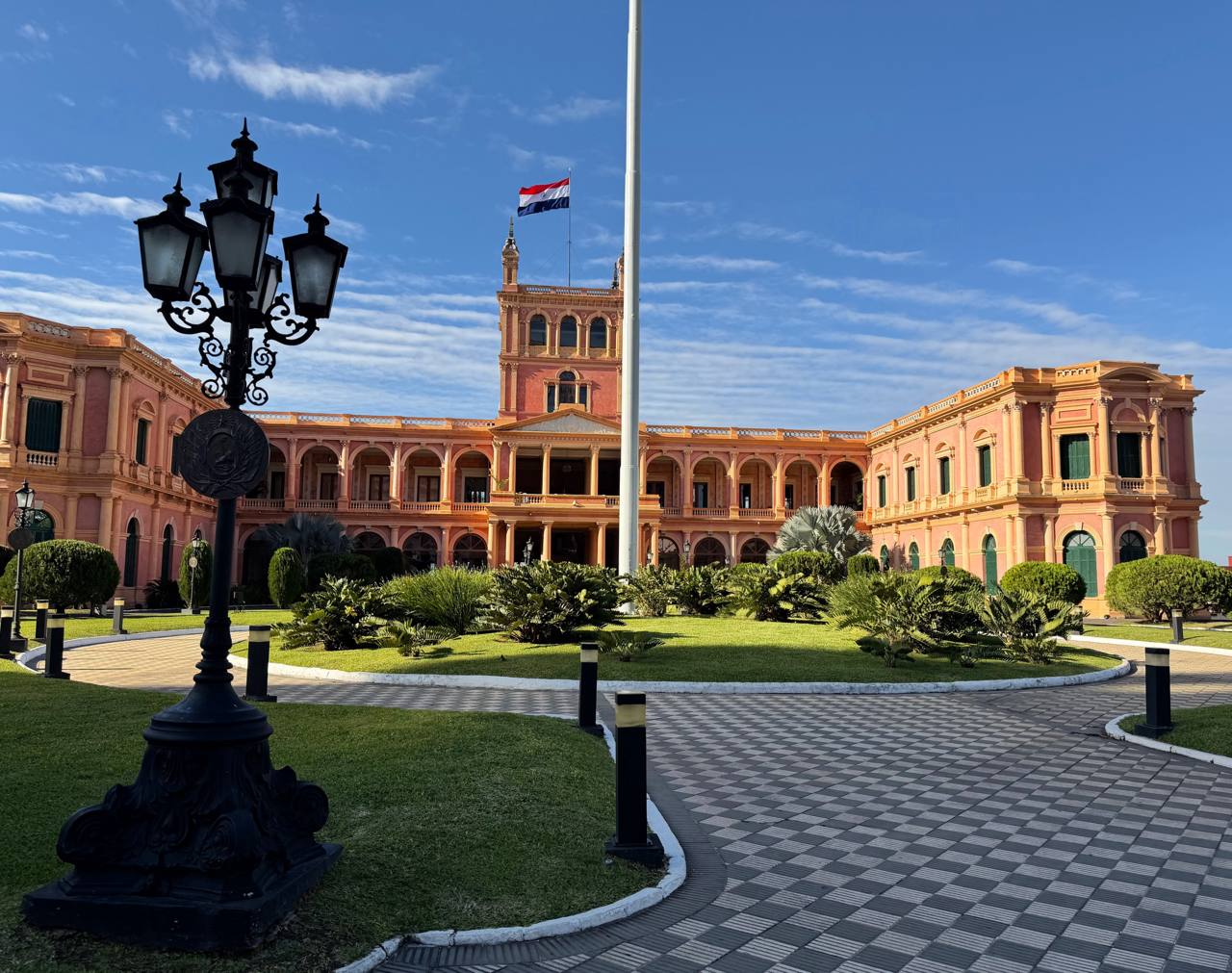
South America's quietest capital
Asunción doesn't get the visitor numbers of Buenos Aires, Santiago or Lima, and it shows in the best way: the Casco Histórico's independence-era buildings aren't roped off behind ticketed queues, the Costanera riverside promenade fills up with locals rather than tour groups, and a full dinner with local wine rarely tops fifteen dollars. Founded in 1537 as a Spanish outpost that launched expeditions across the region, Paraguayans still call it "Madre de Ciudades," Mother of Cities, and the layered history is genuinely everywhere: colonial churches, 19th-century government buildings rebuilt after a catastrophic war, and a National Pantheon of Heroes modeled on Les Invalides in Paris.
What Asunción has going for it beyond the history is scale and price. The Casco Histórico is compact enough to walk between the Palacio de López, the Panteón and the Manzana de la Rivera cultural complex in fifteen minutes each way, and it is genuinely inexpensive even by South American standards: a chipa breakfast costs about a dollar, and a proper restaurant dinner with wine rarely exceeds eighteen. For a first stop in Paraguay or a standalone long weekend, it delivers considerably more than its reputation as merely a gateway to the missions suggests.
The honest complications
Asunción is not a polished, tourist-optimized capital. English is uncommon outside better hotels and upscale restaurants, sidewalks in the older downtown are uneven, and summer heat (regularly above 33-35°C from December to February) with limited shade makes midday sightseeing genuinely uncomfortable. The historic downtown, while safe to visit by day, empties out and is best avoided on foot late at night; this changes how you plan an evening more than it changes whether you should come. None of it is a reason to skip the city, but it rewards a visitor willing to adjust pace to the heat and the after-dark map rather than expecting a fully polished European-style capital.
A small capital, four areas that matter
Asunción rewards choosing a base by what you want your evenings to look like: the historic sights cluster downtown, but the liveliest, best-lit streets after dark sit a twenty-minute drive south in Villa Morra and Carmelitas.
Villa Morra
Asunción's modern commercial heart, home to the city's best restaurants, the Shopping Villa Morra mall, and the leafy residential streets favored by expats and middle-class Asuncenos. It's a short Uber ride rather than a walk from the historic downtown, but it's the neighbourhood most visitors end up basing themselves in for its safety and restaurant density after dark.
Casco Histórico (Downtown)
The colonial and independence-era core: the Palacio de López, the Panteón Nacional de los Héroes, the Casa de la Independencia and the Manzana de la Rivera complex all sit within a few blocks of each other. Genuinely worth basing yourself here for the walkability and budget hostel options, provided you take rides rather than walks once the sun goes down.
Recoleta & Carmelitas
Home to Asunción's national cemetery and many foreign embassies, these adjoining residential neighbourhoods along Avenida Mariscal López are quiet, tree-lined and popular with longer-term expats, a calmer alternative to Villa Morra's buzz with a similar safety profile.
The Costanera
The Costanera de Asunción, a riverside promenade along the Paraguay River, is where the city actually spends its evenings: joggers, families and couples arrive as the heat breaks, with river views back toward the government district. Walkable from downtown but far more pleasant by early evening than under the midday sun.
From a downtown high-rise to a colonial-house hostel
Asunción's hotel scene is small relative to other South American capitals but covers the range well, and prices stay low across every bracket by regional standards.
In the business and upscale bracket, Esplendor by Wyndham Asunción pairs a high-quality breakfast with well-reviewed spa services, from around $83 a night, while Crowne Plaza Asunción by IHG, right in the downtown core on Cerro Corá, adds an outdoor pool and a rooftop terrace with city and river views from roughly $70.
For something with more local character, Hotel Guaraní Asunción, on the corner of Oliva and Independencia Nacional in the Catedral area, is a long-running Asunción landmark with a casino, nightclub and rooftop terrace across its 129 rooms, all with 24-hour room service.
At the budget end, Black Cat Hostel, in a colonial-style house on Eligio Ayala just 100 metres from the Metropolitan Cathedral, has an outdoor pool, a barbecue area and dorm beds from around $20, the pick for backpackers who want a central, social base within walking distance of the Casco Histórico's sights.
Chipa for a dollar, asado for fifteen, tereré in between
Asunción eats well and cheaply, and its best restaurant genuinely competes at a continental level: Tierra Colorada Gastro is the only Paraguayan restaurant to appear on the Latin America's 50 Best Restaurants list, a fact locals bring up with real pride.
Chipa & street food
Warm chipa, cassava-starch cheese bread shaped like a ring, is sold from baskets by street vendors across the city at any hour, and is the default Asunción breakfast alongside cocido, hot sweetened mate with milk. Sopa paraguaya, the country's savory cornbread despite its name, is the other everyday staple worth tracking down at a market stall.
Contemporary Paraguayan
Tierra Colorada Gastro, run by chef Rodolfo Angenscheidt since 2010, reinvents Paraguayan staples like cassava and native ingredients through French-influenced technique, and is the only Paraguayan restaurant to appear on Latin America's 50 Best Restaurants list. Book ahead on weekends.
Traditional & upscale Paraguayan
Maurice de Talleyrand is Asunción's long-standing high-end address for Paraguayan and European-influenced dishes, known for its stuffed surubí (river catfish) and lomito in mustard-brandy sauce, popular for business lunches with a terrace and meeting rooms. For a more traditional, fire-grilled evening, Asado 4A in Villa Morra serves authentic Paraguayan parrilla in a family atmosphere, wood and charcoal-grilled meats front and center.
Tereré & cocido
The Costanera and any Asunción plaza on a warm afternoon is the place to see tereré, cold yerba mate passed communally through a metal straw, in its natural habitat. It's rarely something you order in a restaurant; it's what Paraguayans are doing on every park bench and office break, and joining in if offered is the single best way to feel briefly local.
Independence history, river views and a spiderweb museum
Asunción's sights are compact enough to cover in two focused days, with the independence-era Casco Histórico doing most of the heavy lifting for understanding the country.
Palacio de López & the Panteón Nacional de los Héroes
The Palacio de López, the seat of the Paraguayan government since the 19th century, remains closed to visitors inside, but it's worth seeing from outside both by day and after dark, when it's illuminated against the riverfront. A short walk away, the Panteón Nacional de los Héroes, modeled on Les Invalides in Paris, holds the remains of Paraguay's independence and war heroes and is free to enter.
Casa de la Independencia
Built in 1772 and one of the best-preserved colonial buildings in the capital, this modest house at the corner of 14 de Mayo and Presidente Franco is where a group of Paraguayans met on the night of 14-15 May 1811 to declare independence from Spain. The small museum inside holds period furniture, documents and personal effects, open Monday to Friday and Saturday mornings.
Manzana de la Rivera
A restored city block of colonial and 19th-century houses, including the Casa Viola and Casa Castelvi, converted into a combined museum, library, theatre and café complex with a terrace looking toward the Palacio de López. Open daily (Monday-Friday 8am-9pm, Saturday 10am-8pm, Sunday 10am-7pm), it's an easy, air-conditioned midday stop between outdoor sightseeing.
Museo del Barro
Asunción's best museum for Indigenous and popular art, with an exceptional collection of Guaraní ceramics, textiles and contemporary Paraguayan art in the Itá Enramada area. Entry runs around $7, but it's free on Fridays and Saturdays; closed Mondays, open 2-8pm the rest of the week.
The Costanera & Recoleta Cemetery
The Costanera de Asunción riverside promenade is best walked in the early evening once the heat breaks, with river views back toward the government district. A short ride away, Recoleta Cemetery, established in 1842 on Avenida Mariscal López, holds the graves of numerous Paraguayan presidents and historical figures among elaborate 19th and early 20th-century tombs, open to the public and free to wander.
One, two or three days, planned block by block
Two full days cover Asunción properly; even one focused day hits the essentials. A third day is really the Areguá and Lake Ypacaraí day trip, and worth adding if your schedule allows it.
- Morning
Casa de la Independencia and the Panteón. Independence history and a chipa breakfast from a street vendor.
- Midday
Manzana de la Rivera. Air-conditioned museum time, then lunch at a downtown menú del día spot.
- Afternoon
Palacio de López exterior, then a ride to Villa Morra for coffee and a wander through the shops.
- Evening
The Costanera at sunset, dinner at Asado 4A or a Villa Morra restaurant.
- Day 1
The one-day route: Casa de la Independencia, Panteón, Manzana de la Rivera, the Costanera and dinner.
- Day 2 morning
Museo del Barro. A ride out to the Itá Enramada area for Guaraní ceramics and contemporary art.
- Day 2 afternoon
Recoleta Cemetery and Mercado Cuatro. Presidential tombs, then the market chaos for a completely different pace.
- Day 2 evening
Tierra Colorada Gastro. Reserve ahead for Asunción's best table.
- Days 1-2
The two-day route above, at a gentler pace.
- Day 3
Areguá and Lake Ypacaraí. A car or bus out to the pottery and ñandutí town on the lake, back in Asunción by evening.
Compact, Uber-friendly, and hot on foot at midday
Silvio Pettirossi International Airport (ASU) sits in Luque, about 15km northeast of the centre. Uber and Bolt both operate legally in Paraguay and are the recommended way in, typically $7-10 and 20-30 minutes depending on traffic; both apps also cover getting around the city itself, generally the better choice over unmarked street taxis for cost and GPS-tracked safety.
The Casco Histórico is walkable in the cooler morning hours, with the Palacio de López, the Panteón and the Manzana de la Rivera all within fifteen minutes of each other on foot. Villa Morra and the Costanera are a short, inexpensive ride rather than a walk from downtown. City buses cover the wider metro area cheaply but are not always clearly signed for visitors and are where most pickpocketing incidents happen, so keep bags close if you use them.
Best time to visit
Asunción works as a city break year-round, but May through September, the dry southern-hemisphere winter, is the most comfortable: highs of 22-26°C rather than the 33-35°C-plus heat of December to February, when midday heat and limited downtown shade make sightseeing genuinely uncomfortable. Carry water and plan outdoor time for morning or early evening if you visit in summer.
One of South America's cheapest capital cities
Asunción is noticeably cheaper than Buenos Aires, Santiago or São Paulo, and cheaper than most other South American capitals as well. The main cost trap is the same as everywhere: eating at the handful of tourist-facing spots right on the main downtown squares instead of walking a few blocks into a neighbourhood lunch counter.
- Hostel dorm bed (Black Cat) ~$20
- Chipa and market meals $1-4
- Uber/Bolt rides plus occasional bus fare
- Free sights: Panteón, Recoleta Cemetery, Costanera
- Crowne Plaza or similar 4-star, $67-90
- Restaurant dinners $15-30/person
- Uber/Bolt for all city transport
- Museo del Barro and guided tours
- Esplendor by Wyndham or similar, $83+
- Tasting menu at Tierra Colorada Gastro
- Private day trip to Areguá and Ypacaraí
- Business-class airport transfers
Safe by South American capital standards, with the usual caveats
Asunción is safe for tourists who take normal precautions. Paraguay overall carries the US State Department's Level 1 rating, its lowest risk tier, and Villa Morra, Carmelitas, Recoleta and the Costanera are the areas most visitors and expats favor for their lighting and evening foot traffic. The practical risks are pickpocketing and traffic, not violent crime.
The two things that actually catch visitors: pickpocketing, concentrated on crowded city buses and in the busiest stretches of Mercado Cuatro, so keep bags closed and in front of you; and the historic downtown after dark, which empties out and is best crossed by Uber or Bolt rather than on foot late at night, even though it's perfectly fine to walk during the day. Asunción rates more cautiously than some neighboring capitals for solo women, roughly 3 out of 5 on independent safety trackers: occasional catcalling occurs, generally less intense than in parts of Argentina or Brazil, and sticking to well-lit, populated areas after dark is a sensible default.
Emergency numbers match the rest of Paraguay: 911 police and general emergency, 141 ambulance, 132 fire, and the US Embassy at 1776 Mariscal López Ave (+595 21 248 3000) for consular emergencies.
Areguá, Itauguá and a Franciscan church in Yaguarón
Asunción's central location makes it a workable base for several strong day trips, each reachable in under an hour and a half.
Areguá & Lake Ypacaraí
Areguá, on the shore of Lake Ypacaraí, is Asunción's closest and most rewarding day trip: cobbled colonial streets, pottery workshops, and ñandutí lace sold directly by the families who make it, at noticeably better prices than the souvenir shops downtown. San Bernardino, another 30 minutes around the lake, adds beaches and a livelier restaurant scene, especially in the warmer months.
Itauguá
The recognized home of ñandutí, Paraguay's circular "spiderweb" lace, where family workshops still teach the technique to new generations. A quieter, more workshop-focused alternative to Areguá's day-trip crowds.
Yaguarón
The Templo San Buenaventura, a Franciscan-Guaraní Baroque church built between 1755 and 1772 with elaborate wood carvings by Indigenous artisans, is one of the few colonial mission churches to survive intact and is considered one of Paraguay's finest examples of Barroco-Guaraní architecture. An easy half-day combined with a stop in Areguá on the way.
Asunción FAQ
Is Asunción safe for tourists?
Yes, with normal urban precautions. Villa Morra, Carmelitas, Recoleta and the Costanera are the areas most visitors and expats favor for their lighting and foot traffic; the historic downtown is best avoided late at night, and pickpocketing on crowded buses is the main practical risk, not violent crime.
How many days do I need in Asunción?
Two full days covers the city well: one for the Casco Histórico and independence history, one for the Costanera, Museo del Barro and Recoleta. A third day fits a day trip to Areguá and Lake Ypacaraí.
How much does Asunción cost per day?
Budget travellers manage on $30-40 a day with hostel beds and set-lunch meals; mid-range runs $60-90. Asunción is consistently one of the cheapest capital cities in South America.
When is the best time to visit Asunción?
May through September, the dry southern-hemisphere winter, when highs sit around 22-26°C rather than the 33-35°C-plus heat of December to February.
What is the Casco Histórico?
Asunción's colonial and 19th-century downtown core, home to the Palacio de López government palace, the Panteón Nacional de los Héroes, and the Casa de la Independencia, the house where Paraguay's independence was declared in 1811.
Can I go inside the Palacio de López?
No, it remains the seat of the Paraguayan government and access is restricted. Most visitors view and photograph it from outside, particularly in the evening when it is illuminated.
How do I get from Silvio Pettirossi Airport to the city centre?
Uber and Bolt both operate legally in Paraguay and are the recommended option, typically $7-10 and about 20-30 minutes depending on traffic from Luque into central Asunción.
What is the best area to stay in Asunción?
Villa Morra for first-timers who want restaurants, shopping and good lighting after dark within walking distance; the Casco Histórico centre for budget stays close to the independence-era sights, best paired with rides rather than late-night walks.
Can I do a day trip to Areguá from Asunción?
Yes, easily. Areguá, on Lake Ypacaraí, is about 20km and 40 minutes from Asunción by car or bus, known for pottery, ñandutí lace and colonial cobbled streets. A comfortable half-day or full-day trip.
Is Uber available in Asunción?
Yes, both Uber and Bolt operate legally and reliably in Asunción as of 2026, and are the recommended way to get around the city and to and from the airport over unmarked street taxis.
What Stays With You
Asunción doesn't have Buenos Aires' grandeur or Rio's skyline, and it isn't trying to. What it has is a capital that launched expeditions across a continent, survived a war that erased most of its population, and quietly rebuilt around a river it never stopped needing. The house where independence was actually declared, not just commemorated, the government palace lit up over the water at night, the chipa vendor selling the same bread recipe generations of Asuncenos grew up on: none of it is staged for visitors, because there simply aren't enough visitors yet to stage it for.
Sit on the Costanera on your last evening with a shared tereré, watch the city that most of South America overlooks go about its evening, and understand why the people who do make it here tend to come back.