
What You're Actually Getting Into
Spain is the second-largest country in the European Union by area and the fourth most populous, with roughly 49.1 million residents as of January 2025, and the size shows: a trip that only covers Madrid and Barcelona has seen a real slice of Spain and also missed most of it. Andalusia in the south carries eight centuries of Islamic Iberian civilization in the Alhambra and the Mezquita. The Basque Country in the north has its own language unrelated to any other on earth and a restaurant scene, both fine-dining and pintxo-bar, that rivals anywhere in Europe. Catalonia has a distinct national identity strong enough that a 2017 independence referendum, ruled unconstitutional by Spain's courts, still shapes local politics.
The infrastructure is what makes covering this range realistic. Spain's AVE high-speed rail network is the longest in Europe and the second-longest in the world after China's, and it turns Madrid to Barcelona into a 2.5-hour hop rather than a day's drive. Food, similarly, is not a tourist-facing performance: the menu del día, a two- or three-course lunch with wine for 10 to 14 euros, is how the country actually eats on a weekday, and it is available in the same small restaurants locals use.
The honest complications
Spain runs on a schedule that surprises first-time visitors: lunch after 2pm, dinner rarely before 9pm, and in August a meaningful share of small family-run restaurants and shops close entirely while owners take their own holiday, which can leave a traveler with heat and closed doors at once. Barcelona and, to a lesser extent, Madrid have seen real overtourism friction in recent years, including public protests over housing costs and crowding; this is a genuine local grievance, not a tourist safety issue, and it is worth being a considerate visitor about (quiet in residential streets at night, tipping fairly, not treating Barceloneta like a theme park). Organized pickpocketing in Barcelona's Ramblas, the metro, and around major Madrid sights is a real and well-documented problem, addressed in detail in the safety chapter below. None of this changes the fundamental fact that Spain is a safe, welcoming, extraordinarily rewarding country to visit; it just isn't a frictionless one.
A History Worth Knowing
Spain's history is a layered one: Roman Hispania, nearly 800 years of Islamic rule across most of the peninsula, a Christian reconquest that ended in the same year Columbus sailed, a global empire, a brutal civil war, four decades of dictatorship, and one of modern Europe's more successful transitions to democracy. Almost every region carries visible evidence of more than one of these eras at once, which is why the country reads so differently from north to south.
- 711
Umayyad conquest. Islamic forces cross from North Africa and, within a few years, control most of the Iberian Peninsula, beginning al-Andalus.
- 711–1492
The Reconquista. Roughly 780 years of intermittent Christian campaigns to retake the peninsula, ending with the fall of the Emirate of Granada, the last Muslim kingdom in Iberia.
- 1492
The pivotal year. Granada falls to the Catholic Monarchs Ferdinand and Isabella in January; Columbus sails west in August; Spain's Jewish population is expelled by edict in the same year.
- 16th–17th c.
The Spanish Empire. Silver from the Americas funds a global empire and a golden age of art and literature, alongside the Spanish Inquisition and costly European wars.
- 1936–1939
Civil War. Nationalist forces under General Francisco Franco defeat the Republic after three years of war that killed several hundred thousand people and scattered a generation into exile.
- 1939–1975
Franco's dictatorship. Nearly four decades of authoritarian rule, regional languages suppressed, ending only with Franco's death in 1975.
- 1978–1986
Democratic transition. A new constitution in 1978 restores democracy and devolves power to 17 autonomous regions; Spain joins the European Economic Community in 1986.
Read the full history: al-Andalus, the Catholic Monarchs, empire and Franco
Al-Andalus, the Islamic civilization that governed most of Iberia for nearly eight centuries, was not a single static state but a shifting set of caliphates, taifas and emirates centered at different points on Córdoba, Seville and finally Granada. Its architectural legacy, the Mezquita in Córdoba, the Alhambra and Generalife in Granada, the Giralda in Seville, is arguably the single most distinctive feature of southern Spain's built landscape, and Andalusia's Islamic, Jewish and Christian history is often described locally as convivencia, a coexistence that was real but also uneven and periodically violent.
The Reconquista's completion in January 1492 and Columbus's voyage that August are not a coincidence of timing so much as the same royal project: Ferdinand of Aragon and Isabella of Castile, whose marriage had unified Spain's two largest kingdoms, financed both the final push against Granada and Columbus's westward gamble in the same year, and followed both with the expulsion of Spain's Jewish population under the Alhambra Decree. The following century made Spain the wealthiest and most powerful state in Europe on the back of American silver, funding the Habsburg empire's wars and an artistic golden age (Cervantes, Velázquez, El Greco) even as the crown's finances were repeatedly bankrupted by war.
The 19th and early 20th centuries were unstable: the loss of most American colonies by the 1820s, a series of civil conflicts, a short-lived First Republic, and a fragile constitutional monarchy that gave way to the Second Republic in 1931. That republic's reforms provoked a military uprising in 1936 and three years of civil war that killed an estimated 300,000-500,000 people and ended with Franco's Nationalist victory. His dictatorship, lasting until his death in 1975, suppressed Catalan, Basque and Galician language and identity, kept Spain largely isolated from postwar Europe, and only liberalized economically from the late 1950s onward.
The transition (la Transición). Franco's chosen successor, King Juan Carlos I, oversaw a rapid and largely peaceful transition to parliamentary democracy: legalizing political parties, holding free elections in 1977, and ratifying a new constitution in 1978 that devolved substantial power to 17 autonomous regions, including recognition of Catalan, Basque and Galician as co-official regional languages. EU membership followed in 1986, the 1992 Barcelona Olympics and Seville Expo marked the country's reentry to the world stage, and the euro replaced the peseta in 2002. Catalan independence sentiment, always present, intensified after a 2010 constitutional court ruling and culminated in an October 2017 referendum that Spain's government and courts ruled illegal; the political aftermath, including jailed and exiled Catalan leaders later pardoned, still shapes the region's politics without affecting visitor safety in any way.
Top Destinations
Spain divides into five travel zones that each feel like a different country: the capital and central plateau, Catalonia, Andalusia, the Basque Country and the north, and the islands. Nobody sees all of it in one trip. A week covers two zones properly; three weeks starts to do the country justice.

Madrid, the capital that never fully sleeps
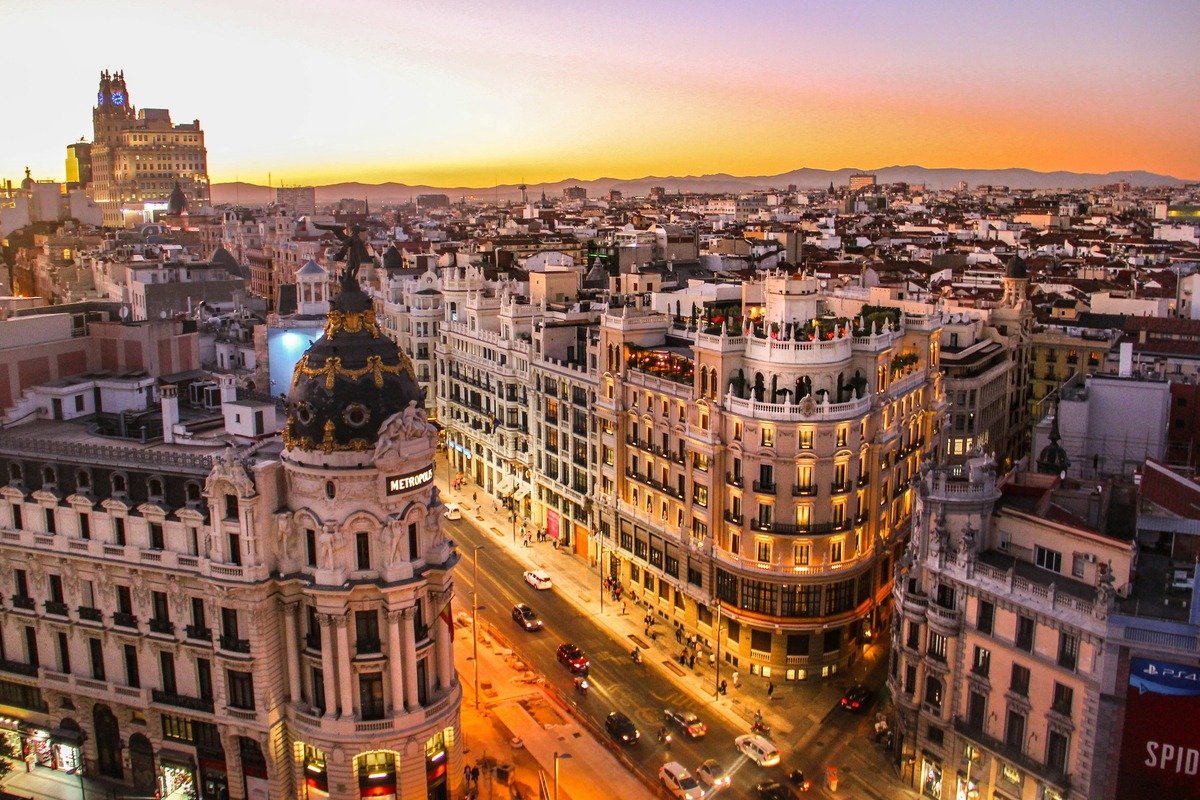
Madrid sits on a high central plateau and carries itself like a capital rather than a tourist destination, which is exactly its appeal. The Prado Museum (from €15, free Sunday 5-7pm and daily 6-8pm Mon-Sat) holds one of the world's great collections of European painting, Velázquez and Goya especially, and sits inside the wider Golden Triangle of Art alongside the Reina Sofía (Picasso's Guernica) and Thyssen-Bornemisza museums. The Royal Palace, Puerta del Sol and Plaza Mayor cover the historic core, and the Mercado de San Miguel near Plaza Mayor is the glass-walled gourmet market for a first taste of jamón ibérico and vermut, though it runs firmly on tourist prices. Madrid's real culture is nocturnal: dinner after 9pm, then the bars of Malasaña and La Latina, where a proper night can run past 3am without anyone thinking it unusual. Budget two to three days.
Barcelona, Gaudí's unfinished city
Barcelona has its own full field guide on this site (linked below); in brief, it pairs Antoni Gaudí's Sagrada Família and Park Güell with a Gothic Quarter that predates Columbus and a beach the city built for the 1992 Olympics. Catalan, not Spanish, is the everyday language on the street and on most signage, and Catalonia's cultural identity is distinct enough that treating it as simply "Spain" undersells the place.
Girona & the Costa Brava
Girona, about 40 minutes from Barcelona by train, packs a Roman-founded old town, an intact medieval Jewish quarter (the Call) and a cathedral with one of the widest Gothic naves in the world into a walkable riverside city, with far fewer crowds than Barcelona. The Costa Brava's coastline north of Barcelona, coves like Calella de Palafrugell and Tossa de Mar, is Catalonia's wilder, less developed answer to the Costa del Sol.
Granada & the Alhambra
The Alhambra (from €21, book weeks ahead as daily entry is capped and sells out) is the single most-visited monument in Spain for a reason: a fortress-palace complex built mostly under the Nasrid dynasty in the 13th and 14th centuries, its Islamic architecture, courtyards and gardens are unmatched anywhere in Europe. Below it, Granada's Albaicín quarter, a maze of narrow streets on the opposite hill, has the best sunset view of the Alhambra from the Mirador de San Nicolás, and the city still runs on the old Andalusian tradition of a free tapa with every drink ordered.
Seville, flamenco's home city
Seville has the Real Alcázar (a still-in-use royal palace with its own Mudéjar architecture), the world's largest Gothic cathedral holding Columbus's tomb, and the Plaza de España, an enormous 1929 exhibition building on a curved brick plaza that has appeared in more films than most cities appear in altogether. Flamenco is genuinely rooted in Seville and neighboring Jerez rather than performed purely for tourists, though telling an authentic peña from a tourist-trap show takes some research.
Córdoba's Mezquita
The Mezquita-Catedral (from €13, free entry most mornings 8:30-9:30am) is the most striking single building in Andalusia: a forest of more than 850 double-arched columns built as one of the largest mosques in the Islamic world, with a Renaissance cathedral inserted directly into its center after the Reconquista. Córdoba's old Jewish quarter and the Roman bridge across the Guadalquivir round out a city that rewards an unhurried day.
San Sebastián & Basque pintxos culture
San Sebastián, on the Bay of Biscay, has one of the best urban beaches in Europe (La Concha) wrapped around a belle-époque old town where pintxo bar-hopping is the primary evening activity: small plates on toothpicks laid out on the counter, a glass of txakoli poured from height, moving to the next bar after two or three. The city has an outsized concentration of Michelin stars for its size, alongside the everyday pintxos scene, and both are worth doing.
Bilbao & the Guggenheim
Bilbao rebuilt its identity around Frank Gehry's titanium-clad Guggenheim Museum, opened in 1997, which is credited with transforming a declining industrial port city into a design and culture destination almost overnight, an effect urban planners now call the "Bilbao effect." The Casco Viejo old town has its own pintxos scene, less polished and cheaper than San Sebastián's.
The Camino de Santiago & Galicia
The Camino de Santiago, the medieval pilgrimage route to the shrine of St. James in Santiago de Compostela, still draws hundreds of thousands of walkers and cyclists a year, religious and secular alike, along several routes across northern Spain. Galicia itself, green, Atlantic-facing and known for octopus (pulpo a la gallega) and Albariño wine, is culturally and climatically closer to Portugal than to Andalusia.
Balearic Islands
Mallorca, the largest of the Balearics, pairs a lively capital (Palma, with a Gothic cathedral on the water) with a mountainous, hiking-friendly northwest coast, the Serra de Tramuntana. Menorca is quieter and less developed, with some of the best beaches in the group. Ibiza has a genuine split personality: superclub nightlife on one side, a UNESCO-listed old town and quiet northern coves on the other. Formentera, reachable only by ferry from Ibiza, is the smallest and least developed.
Canary Islands
The Canaries sit off the coast of North Africa, closer to the Sahara than to mainland Spain, and offer swimmable beaches and mild temperatures essentially year-round, which makes them Spain's default winter-sun destination. Tenerife has Mount Teide, Spain's highest peak and a national park of volcanic terrain that looks more like Mars than Europe; Lanzarote's landscape, shaped by 18th-century volcanic eruptions, is almost as otherworldly and has architecture regulated by the artist César Manrique to blend into it.

Hidden gems beyond the main circuit
The zones above cover a first or second trip well. With extra days, these are the spots that rarely make the standard guides but reward the detour.
Ronda
A town split by a 100-metre gorge, the Tajo, crossed by the 18th-century Puente Nuevo. One of the birthplaces of modern bullfighting and one of the pueblos blancos worth more than a passing photo stop.
Zaragoza
A genuine second-tier city that rarely makes first-time itineraries: a Roman-Mudéjar-Baroque basilica on the Ebro river, and prices well below Madrid or Barcelona.
Consuegra's windmills
The hilltop windmills that inspired Don Quixote's giants, an hour south of Toledo. Empty most of the year, genuinely striking at sunset, and almost nobody stops.
Cáceres & Trujillo
A UNESCO-listed old town in Cáceres and the conquistador birthplace of Trujillo, both Renaissance-stone towns with a fraction of Toledo's crowds.
San Juan de Gaztelugatxe
A tiny hermitage on an islet reached by a stone bridge and 241 steps, familiar to Game of Thrones fans as Dragonstone. A worthwhile detour from Bilbao.
Menorca over Mallorca
Quieter, less built-up, and with some of the best beaches in the Mediterranean, Menorca is the Balearic pick for travelers who find Ibiza and Mallorca too developed.
Culture & Etiquette
Spain's regional identities are not a tourist marketing device: Catalonia, the Basque Country and Galicia each have their own co-official language, and treating the whole country as a single homogeneous "Spanish" culture is both inaccurate and, in Barcelona or Bilbao specifically, a mild social misstep. What does hold across the whole country is the daily rhythm: a late lunch as the main meal, an even later dinner, and long, unhurried meals nobody rushes to end.
Do
- Adjust your clock. Lunch runs 2-4pm and dinner rarely starts before 9pm, later on weekends. Restaurants in tourist zones may open earlier for foreigners, but the food and prices are usually better once locals arrive.
- Greet with dos besos. Two cheek kisses, right side first, is standard between women, and between men and women, in social settings. A handshake is correct for business and formal introductions.
- Learn a few words in the local language. Gracias and por favor work everywhere; in Catalonia, a "bon dia" or "gràcies" is noticed and appreciated.
- Round up rather than calculate a tip. Tipping is not obligatory and many bills already include a service charge; rounding up or leaving 5-10% for good sit-down service is normal and sufficient.
- Dress for the church, not the beach. Cathedrals and monasteries, the Mezquita and Sagrada Família included, expect covered shoulders and knees.
Don't
- Expect an early dinner reservation to feel normal. Showing up at a Spanish restaurant at 6:30pm for dinner will mean an empty room and, often, a kitchen not yet in full swing.
- Call Catalan or Basque "just a dialect." Both are distinct languages with their own grammar and literature, not variants of Spanish, and the distinction matters locally.
- Assume bullfighting is universally embraced. It's banned in Catalonia (since 2012) and increasingly controversial nationally; opinions run strong in both directions, and it's not a safe default conversation topic with strangers.
- Leave bags unattended or hanging open on a chair back, especially on La Rambla, the Barcelona and Madrid metro, or outdoor cafe terraces. See the safety chapter for specifics.
- Assume everyone speaks English outside tourist zones. It's common in Madrid, Barcelona and coastal resorts, much less so in smaller inland towns.
Deeper culture: flamenco, football, siesta and the fiesta calendar
Flamenco. Rooted in Andalusia, especially Seville, Jerez de la Frontera and the Roma communities of the region, flamenco combines singing (cante), guitar, dance and rhythmic hand-clapping (palmas). It is UNESCO-listed Intangible Cultural Heritage. A tourist-oriented tablao show is easy to find in any city; a genuine peña flamenca, a members' club that occasionally opens performances to visitors, is harder to find but a different experience entirely.
Football. Real Madrid and FC Barcelona's El Clásico is one of the most-watched sporting rivalries on earth and carries real political and historical weight tied to Madrid-Catalonia tensions, not just sport. Attending any La Liga match, even a lower-profile one, is a genuine window into Spanish social life.
The siesta, mostly a myth now. The traditional midday nap has largely disappeared from corporate and urban Spain; what survives is the long lunch break, particularly in smaller towns, where shops still close roughly 2-5pm. Don't plan errands for that window outside major cities.
The fiesta calendar. Semana Santa (Easter Holy Week), especially in Seville, involves elaborate religious processions with hooded penitents (nazarenos) that visually startle visitors unfamiliar with the tradition; it predates and is unrelated to any other group associated with similar robes. San Fermín in Pamplona (July, the Running of the Bulls) and La Tomatina in Buñol (last Wednesday of August, a giant tomato fight) are both real, both extremely crowded, and both require booking accommodation many months ahead.
Food & Drink
Spanish food is intensely regional: what's iconic in Valencia (paella) is not native to Madrid or the Basque Country, and treating "Spanish food" as one cuisine misses most of what makes it worth eating. Tapas culture, small shared plates ordered gradually through an evening, is the connective format across regions even where the dishes themselves differ.
Paella €12-22
Valencia's rice dish, traditionally rabbit and chicken (paella valenciana) or seafood (paella marinera), cooked in a wide shallow pan over an open flame until a crust (socarrat) forms on the bottom. Order it for two or more; a "quick" single-serve paella at a tourist restaurant is usually a bad sign.
Jamón Ibérico €18-30/tapa portion
Cured ham from Iberian pigs, the best of it labeled "de bellota" (acorn-fed), sliced paper-thin and eaten on its own or over bread. Not a garnish: a serious food in its own right, and priced accordingly at the top end.
Pintxos €2-4 each
The Basque Country's version of tapas: small toasts or skewers laid out on bar counters, taken and paid for on the honor system in San Sebastián's old town, moving bar to bar through the evening with a glass of txakoli or local cider.
Tortilla Española €3-6
A thick potato and egg omelette, served at room temperature as a tapa or full meal, with or without onion (the "con o sin cebolla" question is a genuine, mostly good-natured national debate).
Gazpacho & Salmorejo €4-7
Andalusia's cold tomato soups: gazpacho thinner and more vegetable-forward, salmorejo thicker and creamier, topped with jamón and hard-boiled egg. Essential in summer heat.
Rioja & Ribera del Duero €3-8/glass
Spain's two flagship red wine regions, both Tempranillo-based; Rioja tends softer and more traditional, Ribera del Duero bolder. Cava, Catalonia's sparkling wine, is the everyday alternative to champagne at a fraction of the price.
When to Go & Itineraries
April through June and September through October are the best months for most of Spain at once: warm without being punishing, manageable crowds, and lower prices than peak summer. July and August bring genuine heat across the southern and central interior, plus the well-known August effect where many small family restaurants, shops and even some museums close entirely while owners take their own holiday. Winter works well in Madrid and Andalusia for city and culture-focused trips, and it's the Canary Islands' peak season for exactly this reason.
All four seasons compared, with temperatures
| Season | Verdict | Temps | Prices & crowds |
|---|---|---|---|
| Apr-Jun & Sep-Oct | Best | 15-28°C most regions | Mid prices, manageable crowds |
| Jul-Aug | Good (hot) | 30-40°C interior/south | Peak prices, busy; many small businesses close in August |
| Mar & Nov | Good | 10-18°C most regions | Low prices, few tourists; Semana Santa (Mar/Apr) is a busy exception |
| Dec-Feb | Regional | 5-15°C mainland; 18-22°C Canaries | Cheapest on the mainland; peak season and prices in the Canary Islands |
Year-round city averages: Madrid 15°C, Barcelona 17°C, Seville 19°C, Bilbao 14°C, Santa Cruz de Tenerife 21°C. Andalusia's interior (Córdoba, Seville) regularly tops 40°C in July-August; the Basque coast rarely does.
Itineraries
One week covers Madrid and Barcelona with a day trip comfortably. Two weeks adds Andalusia. Three weeks is enough to add the Basque Country and either the Balearic or Canary Islands without feeling rushed.
- Days 1–3
Madrid. The Prado, Royal Palace, Plaza Mayor, tapas in La Latina, and a day trip to Toledo or Segovia.
- Days 4–7
Barcelona. AVE train from Madrid (2.5 hrs). Sagrada Família (booked in advance), the Gothic Quarter, Park Güell, and a day trip to Montserrat.
- Days 1–3
Madrid plus Toledo, as above.
- Days 4–6
Seville. AVE from Madrid (2.5 hrs). Real Alcázar, the cathedral, Plaza de España, and an evening of flamenco.
- Days 7–8
Granada. The Alhambra (booked weeks ahead), the Albaicín at sunset.
- Days 9–10
Córdoba, en route or as a day trip: the Mezquita and the Jewish quarter.
- Days 11–14
Barcelona. AVE onward. Sagrada Família, Gothic Quarter, Park Güell, day trip to Montserrat or Girona.
- Days 1–4
Madrid extended, with Toledo and Segovia both as day trips.
- Days 5–10
Andalusia. Seville, Córdoba, Granada, and if time allows, Ronda or the Costa del Sol.
- Days 11–14
San Sebastián & Bilbao. Pintxos bar-hopping, the Guggenheim, and a day trip to the Basque coast.
- Days 15–18
Barcelona, at a gentler pace, adding Girona or the Costa Brava.
- Days 19–21
Mallorca or Ibiza. A short flight from Barcelona for a slower final few days on the coast.
Getting there & around
Madrid-Barajas (MAD) and Barcelona-El Prat (BCN) are the two main international gateways, with budget carriers like Vueling and Ryanair connecting regional airports across Europe. Once inside the country, the AVE high-speed rail network, the longest in Europe, is the best way to move between major cities: Madrid to Barcelona in as little as 2.5 hours, with promotional fares from around €17-30 booked early and walk-up fares running €90-100. Book through Renfe's own site for the best fares; third-party resellers often add a markup.
All transport options with prices: AVE, regional trains, buses, car rental
| Option | Price | Notes |
|---|---|---|
| AVE high-speed rail | €17-100 | Madrid-Barcelona in 2.5 hrs, 20+ daily departures. Dynamic pricing rewards early booking. |
| Regional trains (Media Distancia) | €5-25 | Slower, cheaper connections to smaller towns the AVE skips. |
| Intercity buses (ALSA) | €10-40 | Cheaper than rail and covers routes trains don't, including most of rural Andalusia and the north coast. |
| Rental car | €25-50/day | Essential for Andalusia's white villages, the Basque coast and rural areas; unnecessary and often a liability in city centers. |
| Domestic flights | €30-90 | Fastest option to the Balearic and Canary Islands; Vueling and Ryanair dominate the budget end. |
Practical prep: an eSIM before landing covers the whole country on one plan; Spain's mobile coverage is strong even in rural areas. Standard travel insurance is sufficient for most of Spain; add a policy with hiking or watersports cover if the Camino de Santiago or Canary Islands volcanic trails are on the itinerary. GetTransfer offers fixed-price airport pickups at both Madrid and Barcelona.
Where to stay
Madrid: Malasaña & La Latina
Central, walkable to the Golden Triangle of Art, and inside the neighborhoods with the best independent bars and tapas. Sol and Gran Vía are more tourist-facing and noisier at night.
Barcelona: Eixample & Gràcia
Our full Barcelona city guide covers where to stay neighborhood by neighborhood with named, booked hotels across every budget.
Andalusia: paradores & converted buildings
Spain's state-run Parador network converts castles, monasteries and historic buildings into hotels; the Parador de Granada, inside the Alhambra grounds itself, is the standout, if the priciest, example.
San Sebastián & Bilbao
San Sebastián's old town puts pintxos bars on your doorstep but commands premium prices in summer; Bilbao's Casco Viejo or the area around the Guggenheim are quieter, cheaper alternatives with an easy train link between the two cities.
Budget Planning
Spain sits in the middle of Western Europe on cost, cheaper than France or the UK, comparable to or slightly below Italy, and with real regional variation: Andalusia and inland Spain run noticeably cheaper than Barcelona or San Sebastián. Accommodation is usually the largest lever on total cost, followed by whether dinners happen at tourist-facing restaurants or the neighborhood spots locals use.
- Hostel dorm €18-30
- Menu del día lunch €10-14
- Tapas or bocadillo dinner €8-15
- Regional trains & ALSA buses
- 3-star hotel or boutique guesthouse
- Restaurant dinners with wine €25-40
- AVE trains between cities
- Major sites: Alhambra, Sagrada Família, Prado
- 4-5 star hotels or paradores
- Fine dining and Michelin-tier tasting menus
- Rental car for Andalusia or the Basque coast
- Private guides at major monuments
Quick reference prices: coffee, tapas, entry fees
| Coffee (café con leche) | €1.50-2.50 |
| Menu del día (2-3 courses + drink) | €10-14 |
| Tapas (per plate) | €3-6 |
| Beer or house wine | €2.50-4 |
| AVE Madrid-Barcelona (early booking) | from €17 |
| Alhambra entry | ~€21 |
| Prado Museum entry | ~€15 |
| Sagrada Família basic entry | ~€26 |
| Hostel dorm bed | €18-30/night |
| 3-star hotel double | €90-140/night |
Prices reflect August 2026 research and drift over time, especially accommodation in Barcelona and San Sebastián in peak season and major-site entry fees, which several sites have flagged for a small surcharge later in 2026. Treat these as a planning baseline, not a quote.
Visa & Entry
Spain is a full Schengen Area and EU member. Citizens of the US, UK, Canada, Australia and New Zealand currently enter visa-free for up to 90 days within any 180-day period, the standard Schengen allowance shared across all 30 Schengen countries combined, not 90 days per country. This is expected to change procedurally, not substantively, once ETIAS launches: the Spanish Ministry of Foreign Affairs is the authoritative source for current entry conditions, not third-party paid "visa" sites that rank well in search.
✓ ETIAS from late 2026
The EU's new travel authorization is expected to become mandatory for visa-exempt visitors in Q4 2026: a €20 online application, valid for multiple entries over three years or until passport expiry.
✓ Valid passport
At least 3 months validity beyond your planned departure date from the Schengen Area, issued within the last 10 years.
✓ 90/180-day rule
The 90-day allowance is shared across all Schengen countries combined and calculated on a rolling 180-day window, not reset by crossing a border within Schengen.
✓ Return or onward travel
May be requested at the border, along with proof of accommodation and sufficient funds for the stay.
| Spain | Italy | |
|---|---|---|
| Daily budget | €55-75 covers a comfortable budget trip | Similar range, from around €50/day, with Venice and the Amalfi Coast pushing higher |
| Food scene | Regional and informal: tapas, pintxos, the menu del día | Regional and formal-leaning: trattorias, a stronger set-menu tradition at dinner |
| Iconic architecture | Gaudí's Barcelona, Moorish Andalusia (Alhambra, Mezquita) | Roman and Renaissance: the Colosseum, Florence, Venice's canals |
| Getting around | Europe's longest high-speed rail network, the AVE | Strong high-speed rail too, though the south and islands lean more on ferries and driving |
| Crowds | Barcelona and the Alhambra are the pressure points; Andalusia's smaller cities are calmer | Venice and the Amalfi Coast see the worst of it; Puglia and Le Marche stay quieter |
Safety, Solo Women & Family
Spain is safe. Violent crime against tourists is rare, and the country ranks among the safer parts of Western Europe on most indices. The U.S. State Department rated Spain Level 2, "Exercise Increased Caution," as of August 2026, a rating driven by the general Western European terrorism threat level and, more concretely for day-to-day travel, by organized petty crime: professional pickpocketing networks operating in Madrid, and especially Barcelona, at a level well above what most European capitals see.
Organized pickpocketing
Barcelona has the highest concentration of tourist theft in Spain, with networks operating on the metro, around Las Ramblas, and at Park Güell and Sagrada Família. Madrid's Cercanías trains and Retiro Park see similar, lower-intensity activity. Cross-body bags worn in front, zipped pockets, and no phones left on café tables solve most of it.
Airport & transit theft
Passports and bags going missing at baggage claim, boarding gates, or while waiting for a taxi outside major airports has been reported often enough to name specifically. Keep documents on your person, not in checked or unattended bags.
Heat, not crime
Andalusia and inland Spain in July-August regularly exceed 38-40°C. Heat exhaustion is a more realistic risk than street crime for most visitors; hydrate, avoid midday sun for sightseeing, and reschedule strenuous walking to morning or evening.
One more thing worth knowing: overtourism friction
Barcelona in particular has seen public protests in recent years over housing costs and crowding linked to tourism, occasionally including visible but non-violent demonstrations in tourist-heavy neighborhoods. This is a genuine local political issue, not a personal safety concern for visitors, and being a considerate guest, quiet in residential streets late at night, not blocking doorways for photos, tipping fairly, goes a long way toward being welcome rather than resented.
The 3 scams to actually know about
Spain is not a high-violence destination, and most of what catches visitors is theft or overcharging rather than anything more serious. Three patterns account for most of it. The full country list lives on our Spain travel alerts page.
The fake petition or bracelet
Someone presenting a clipboard petition, a "friendship bracelet," or a football-related game approaches near major sights, especially Sagrada Família, Retiro Park and Seville's cathedral. One person distracts while an accomplice works your bag. Decline firmly, keep walking, and keep a hand on your bag while doing it.
The Ramblas-style overcharge
Restaurants directly on La Rambla and similar tourist strips are known for menu-price switches, undisclosed "table" or bread charges, and inflated drink prices, a simple coffee at €5-8 is a signal you're in one. Check the posted menu price against the bill and walk two streets back for better food at half the price.
Distraction theft on trains
Crowded metro carriages and Cercanías trains are where most Barcelona and Madrid pickpocketing actually happens, often timed to the doors closing. Keep bags in front of you and phones out of back pockets on any crowded platform or carriage.
Solo women travelers
Spain rates well for solo women travelers: street harassment is uncommon relative to much of Europe, and the late-night culture of shared plazas, terrace bars and long dinners means streets stay genuinely populated well past midnight in most city centers, which many solo travelers find reassuring rather than isolating. The practical precaution is guarding belongings in the pickpocket hotspots above, not personal safety in the conventional sense. Standard precautions apply late at night in unfamiliar neighborhoods, particularly parts of Barcelona's El Raval after midnight, but this is a general urban-awareness issue rather than a Spain-specific one. Full detail on our Solo Woman Explorer pages.
Emergency numbers
Embassies in Madrid and the Barcelona consulate
112 is the EU-standard number, staffed with English-speaking operators, and works from any phone including one without a local SIM. Most embassies sit in Madrid's Salamanca and Chamberí districts.
- USA (Madrid)
- +34-91-587-2240
- USA Consulate (Barcelona)
- +34-93-280-2227
- UK (Madrid)
- +34-91-714-6300
After-hours emergencies: the U.S. Embassy Madrid's emergency line (+34-91-587-2200) also covers the Barcelona consulate's after-hours needs. Contact your own country's embassy or consulate for passport loss, arrest, or a serious medical or legal emergency abroad.
Family travel & pets
Spain is a strong family destination: children are welcomed openly in restaurants and public life, meal times flex easily around kids even with the late Spanish schedule, and cities like Barcelona and Seville combine beaches, parks and manageable, walkable sightseeing well for a range of ages.
Kids at major sites, and bringing pets
Kids at major sites: the Alhambra and Sagrada Família both reward older children (8+) who can handle a few hours of walking and architecture; younger kids do better with Madrid's Retiro Park, Barcelona's beaches, or Seville's Plaza de España, which has a boatable moat. Book skip-the-line tickets for major sites when traveling with children to avoid long queue waits in summer heat.
Pets: EU pet passport holders can enter with dogs, cats and ferrets given valid rabies vaccination and a microchip. Non-EU visitors need a veterinary health certificate issued within 10 days of travel, current rabies vaccination, and to enter through a designated Travelers' Point of Entry. Spain is broadly dog-friendly, with pet-friendly terraces common in most cities, though beaches often restrict dogs in the main summer season.
Spain FAQ
Is Spain safe to visit?
Yes. Violent crime against tourists is rare and Spain is one of Europe's safer countries overall. The main risk is organized pickpocketing in crowded tourist areas of Madrid and Barcelona, not personal safety.
How much does a trip to Spain cost?
Budget travelers manage on €55-75 a day using hostels, the menu del día and public transport. Mid-range runs €120-180 a day. Barcelona and San Sebastián run higher than Madrid or Andalusia.
Do I need a visa for Spain?
Citizens of the US, UK, Canada, Australia and New Zealand can enter visa-free for up to 90 days in any 180-day period under the Schengen rules. ETIAS travel authorization becomes mandatory for this group once it launches in late 2026.
When is the best time to visit Spain?
April-June and September-October: warm weather across the country, manageable crowds and lower prices than peak summer. July and August are hot, crowded and see many small family businesses close for the month.
How many days do you need in Spain?
One week covers Madrid and Barcelona with a day trip. Two weeks adds Andalusia. Three weeks fits the Basque Country and the Balearic or Canary Islands as well.
Is it better to take the train or rent a car in Spain?
The AVE high-speed train is the best way to move between major cities: Madrid to Barcelona in 2.5 hours. A rental car is worth it for Andalusia's white villages, the northern coast and rural areas the train network skips.
Is Spain in the Schengen Area?
Yes. Spain has been a full Schengen and EU member since 1986, and time spent there counts against the standard 90-day Schengen allowance for visa-exempt visitors.
What languages are spoken in Spain?
Spanish (Castilian) is the national language, alongside co-official regional languages: Catalan in Catalonia, Basque (Euskara) in the Basque Country, and Galician in Galicia. English is common in tourist areas, less so in small towns.
Is Spain safe for solo female travelers?
Yes, Spain rates well for solo women, with harassment uncommon and a strong culture of late-night street life that keeps cities feeling lived-in after dark. The main precaution is guarding bags and phones in pickpocket hotspots, not personal safety.
Is Spain good for families with kids?
Yes. Spanish culture is openly welcoming to children, meal times are flexible around them, and cities like Barcelona and Seville mix beaches, parks and manageable sightseeing well for families.
Is Spain cheaper than Italy or France?
Generally yes, especially outside Barcelona and San Sebastián. Andalusia and inland Spain run noticeably cheaper than comparable regions of Italy or the French Riviera for food and accommodation.
What Stays With You
Spain rewards the traveler who accepts that it is not one country wearing different hats. Andalusia's Islamic architecture, Catalonia's own language and flag flying from balconies, the Basque Country's food culture built around bar-hopping rather than sit-down formality: none of it is a regional theme park, it's five or six genuinely distinct cultures that happen to share a passport stamp and a high-speed rail network.
Eat dinner at ten. Order the menu del día at a place with no English on the menu. Stay out past midnight in a plaza that's still full of families and old men playing dominoes. That's the Spain that stays with you, not the version built for a tour bus schedule.