
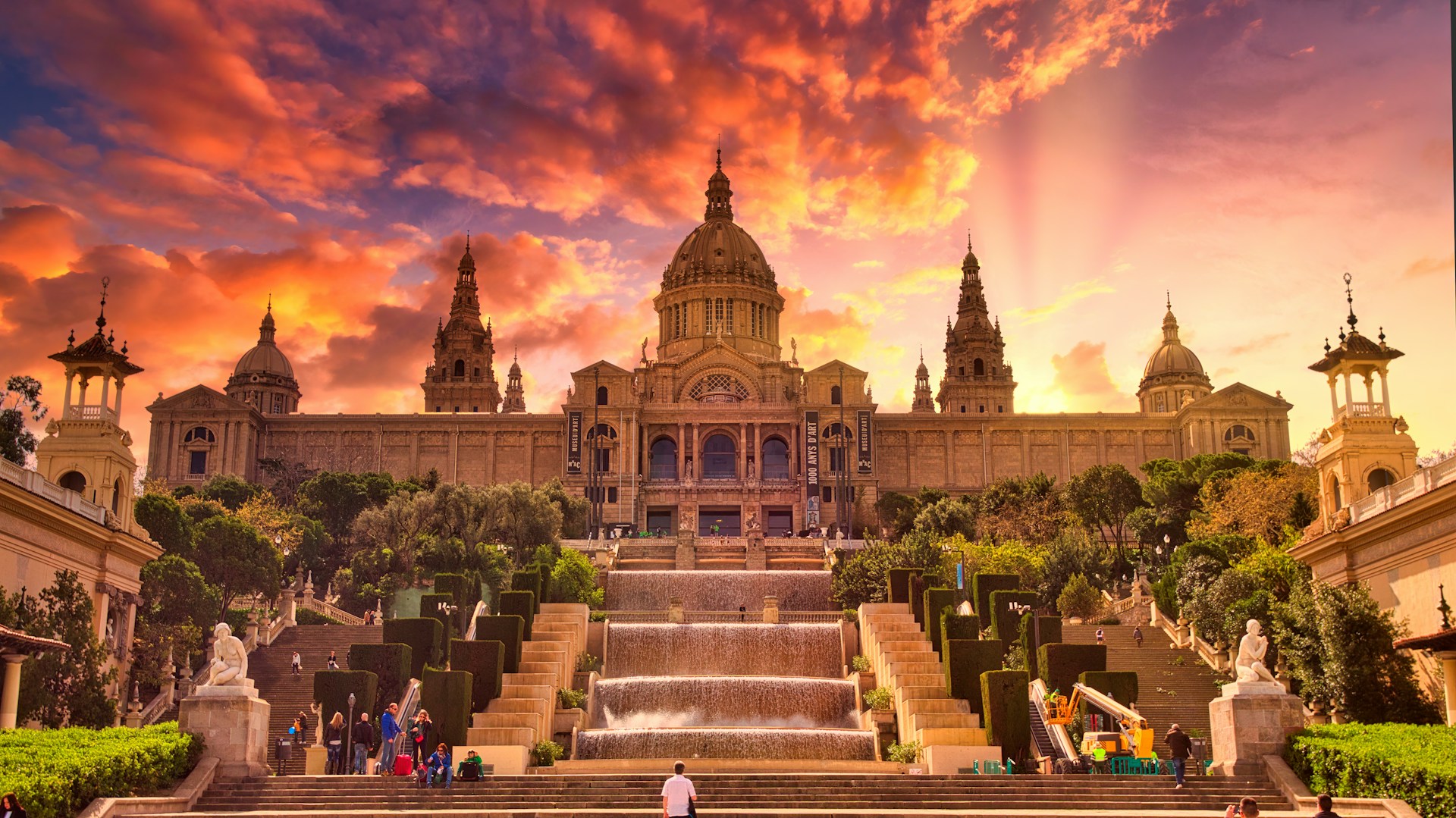
Catalonia's capital, and proudly not just "Spain"
Barcelona sits between the Collserola hills and the Mediterranean, laid out in two very different registers: the tangled medieval lanes of the old town, and Ildefons Cerdà's 19th-century Eixample grid with its chamfered corners and Modernista facades. Antoni Gaudí's buildings, the Sagrada Família above all, are the reason most people book the trip, but the city's real texture is in the everyday: Catalan on every street sign, cava poured from the barrel at a bar that's served it since the 1930s, and a beach that exists because the city rebuilt its waterfront for the 1992 Olympics and simply kept it.
What changed in the last fifteen years is scale. Barcelona is now one of the most visited cities in Europe relative to its size, and the crowding around Las Ramblas, Park Güell and the Sagrada Família is real and worth planning around. Walk two streets into Gràcia or Poble Sec, though, and you're back in a neighbourhood that still runs on its own clock, where lunch is a €10-14 menu del día and nobody's selling you anything.
The honest complications
Barcelona has Spain's most organized pickpocketing problem, concentrated enough around Las Ramblas, the metro, and the approaches to Park Güell and Sagrada Família that it needs its own section below, not a footnote. The city has also seen real public friction over tourism's effect on housing costs and crowding, including visible protests in recent years; this is a genuine local grievance, not a threat to visitors, but it's worth being a considerate guest about, quiet in residential streets at night, not treating Barceloneta like a photo backdrop. And several of the headline Gaudí sites require advance booking that regularly sells out days ahead in summer; showing up without tickets is the single most common way to waste a day here.
Six neighbourhoods that actually matter
Barcelona's districts split roughly between the tangled old town near the water and the ordered Eixample grid above it, with Gràcia, Poble Sec and Barceloneta each adding a distinct character. Where you base yourself comes down to how much old-town noise you want to sleep through.
Barri Gòtic (Gothic Quarter)
Narrow stone lanes that predate Columbus, the Barcelona Cathedral, and Roman wall fragments built directly into later buildings. It's the most walkable base for the old-town sights and genuinely beautiful after dark when the day-trip crowds thin out, but also the most tourist-saturated few hundred metres in the city; noise at night is the trade-off.
El Born
East of the Gothic Quarter, El Born pairs medieval streets with the city's best concentration of small boutiques, the Picasso Museum, and old-school bars like El Xampanyet that have barely changed since the 1930s. Narrow, lively and central, with smaller, pricier rooms than you'd get elsewhere for the same money.
Eixample
Cerdà's 19th-century grid holds Casa Batlló, Casa Milà and the Sagrada Família itself, wide chamfered-corner boulevards, and a noticeably calmer nightly rhythm than the old town. For a first visit, Eixample is the base that puts the Gaudí landmarks and Passeig de Gràcia's shopping within an easy walk while still being a 15-20 minute stroll or short metro ride from the Gothic Quarter.
Gràcia
Once a separate village annexed by Barcelona in 1897, Gràcia keeps its own identity: small plazas, independent bars, a genuinely local feel, and noticeably better prices than the old town or Eixample for comparable quality. If dinner matters more than a view of the cathedral, stay here.
Barceloneta
The former fishermen's quarter, now Barcelona's beach neighbourhood: narrow grid streets, seafood restaurants along the Passeig Marítim, and direct sand access. Genuinely fun for a short stay, though the beachfront gets loud and crowded in peak summer and petty theft on the sand itself is a known issue.
Poble Sec
Wedged between Montjuïc hill and the Paral·lel, Poble Sec has become one of the city's best neighbourhoods for tapas and vermut without old-town prices, and puts Montjuïc's museums, gardens and Olympic sites within easy walking distance.
From a Domènech i Montaner landmark to a €19 hostel bed
Barcelona's hotel scene spans a genuine architectural landmark at the top to some of Europe's best-rated hostels at the bottom, with the Eixample's converted Modernista buildings carrying real character the chains can't match. These five picks cover every budget.
At the top, Casa Fuster occupies a 1911 Lluís Domènech i Montaner building at the top of Passeig de Gràcia where it meets Gràcia proper, all curved stone facade and a rooftop terrace looking down the boulevard toward the sea, from around €300 a night. In the Gothic Quarter, Mercer Hotel Barcelona is built into a medieval building with exposed Roman wall fragments incorporated into the design, from around €650 and squarely for travellers who want the old town's history under the same roof as five-star service.
In the upper-boutique bracket, Ohla Barcelona sits in the historic centre near the Palau de la Música Catalana, from around €220, with a rooftop pool and one of the more striking contemporary facades in the old town. For solid value on Rambla de Catalunya in the Eixample, Praktik Rambla is an art deco townhouse conversion from around €140 a night, walking distance to both Passeig de Gràcia and Plaça Catalunya.
And at the budget end, Sant Jordi Hostels Sagrada Família, from around €19 a night for a dorm bed, is the pick of the Sant Jordi group's several Barcelona locations, with a rooftop terrace and a short walk to the basilica itself.
Cava from the barrel, seafood off the counter, tapas after ten
Barcelona eats late, loud and standing up as often as seated. The city's tapas bars range from century-old institutions that have barely changed their marble counters to a genuinely serious fine-dining scene, and both operate within a few blocks of each other in the old town.
Tapas & seafood
Cal Pep, tucked into a corner of El Born near the Passeig del Born, is Barcelona's best-known tapas counter: no menu, just whatever's fresh that day fired out from an open kitchen while you eat standing at the bar. Expect a queue and eat what's put in front of you. A minute from the Picasso Museum, El Xampanyet has poured house cava from the barrel since 1929, alongside marinated anchovies and cured meats on a marble counter that feels genuinely unchanged by time.
Cava & vermut
Can Paixano, near Estació de França, is a xampanyeria: a loud, packed, wonderful room where locals and visitors alike jostle for glasses of rosado cava and plates of cured meat, standing room only most evenings. In Poble Sec, Quimet & Quimet, a family-run bodega dating to 1914, does montaditos (small open sandwiches) and conservas (tinned seafood) over the counter with a glass of vermut, standing among the wine bottles stacked floor to ceiling.
La Boqueria Market
Just off Las Ramblas, La Boqueria is Barcelona's great produce and food market, open six days a week (closed Sundays), with fresh juice stands, jamón counters, and Bar Pinotxo, the tiny stall by the main entrance that's been a market institution for decades, for a stand-up breakfast or early lunch among the stallholders themselves.
Gaudí, the Gothic Quarter, and the viewpoints nobody books
Barcelona's headline sights need advance tickets more than almost any city in Europe; the free viewpoints and the old town's wandering more than make up for the ones that don't. This chapter walks through the city roughly the way a good three days would.
Gaudí's Eixample
Start with the Sagrada Família itself, under construction since 1882 and still not finished: basic entry runs from around €26, tower access with the elevator from around €40, and booking online at least a few days ahead, longer in summer, is not optional. Ten minutes' walk away, Casa Batlló and Casa Milà (La Pedrera) are Gaudí's two other essential Eixample buildings, an undulating bone-like facade and a rippling stone one, both bookable as combined Gaudí tickets alongside Park Güell to save against buying separately.
Park Güell & the Gothic Quarter
Park Güell, Gaudí's mosaic-tiled public park above the city, needs a timed-entry ticket for the monumental zone and rewards an early morning visit before the tour groups arrive. Down in the old town, the free-to-enter Barcelona Cathedral anchors the Gothic Quarter's tangle of medieval lanes, and the Picasso Museum in El Born, spread across several connected medieval palaces, covers the artist's formative Barcelona years in more depth than any other collection of his early work.
Evenings and music
The Palau de la Música Catalana, a riotously ornate Modernista concert hall a few minutes from El Xampanyet, is worth seeing even without a concert ticket, though a self-guided or guided daytime visit (from around €20) is the easiest way in if nothing's on the evening program. For a regular night out, the bar streets of El Born and Gràcia stay busy well past midnight without the old-town's worst crowding.
The free viewpoints and Camp Nou
Barcelona's best views cost nothing: Bunkers del Carmel, a former anti-aircraft position on top of Turó de la Rovira, gives the most complete 360-degree panorama in the city and is free, open roughly 9am-7:30pm, and genuinely quiet outside sunset. Football fans should book the Spotify Camp Nou stadium tour, from around €28, which currently runs as the Barça Immersive Tour through the museum and stands while the stadium's renovation continues.
One, two or three days, planned street by street
Three full days covers Barcelona properly; even one well-planned day delivers the essentials. Book Sagrada Família and Park Güell tickets before you land, not after.
- Morning
Sagrada Família first. Book the earliest slot you can get, then walk or metro to Casa Batlló for the second Gaudí landmark of the morning.
- Midday
La Boqueria and the Gothic Quarter. Lunch at Bar Pinotxo or a market stall, then wander the Gothic Quarter's lanes to the Cathedral.
- Afternoon
El Born and the Picasso Museum, with a stop at El Xampanyet for cava on the way.
- Sunset
Bunkers del Carmel. The whole city and the Mediterranean laid out below. Dinner back in Gràcia or Poble Sec.
- Day 1
The one-day route: Sagrada Família, Casa Batlló, La Boqueria, the Gothic Quarter, El Born, Bunkers del Carmel at sunset.
- Day 2 morning
Park Güell at opening, booked for the first available slot before the tour groups arrive.
- Day 2 afternoon
Barceloneta and the beach, with a seafood lunch along the Passeig Marítim.
- Day 2 evening
Poble Sec for dinner. Quimet & Quimet for montaditos, then a wander up toward Montjuïc.
- Days 1-2
The two-day route above, at a gentler pace, adding the Palau de la Música Catalana and Casa Milà.
- Day 3, option A
Montserrat. The R5 train and cable car to the mountain monastery, back by early evening.
- Day 3, option B
Girona or Sitges. A 30-40 minute train to either: Girona's medieval old town and Roman walls, or Sitges's beaches and cobbled streets.
Compact, flat in the centre, and easy on the metro
Barcelona's old town and Eixample are dense enough to cover mostly on foot. From Barcelona-El Prat Airport (BCN), the Aerobus runs to Plaça de Catalunya in about 35 minutes, €7.45 one-way or €12.85 return, departing every 5-10 minutes around the clock. The R2 Nord regional train and Metro L9 Sud both connect from the airport too, though the standard T-Casual travel card does not cover the airport leg, a supplement applies.
In the city, buy a T-Casual card (€13 for one zone) at any metro station: ten rides of up to 75 minutes each, valid across the metro, bus, tram and local trains, though it excludes the airport connection. Uber and Bolt are affordable for late-night trips or hauling luggage, and the flat Barceloneta-to-Poblenou seafront makes for one of the city's better casual cycling or walking routes.
Best time to visit and La Mercè
Barcelona has a mild Mediterranean climate. May-June and September-October are the sweet spots: warm days, manageable crowds, lower prices than peak summer. July and August are hot and genuinely crowded, especially around the beach and the main Gaudí sites. Winter is quiet and mild by northern European standards, with the old town largely free of queues.
La Mercè, 23-28 September, is Barcelona's biggest festival, celebrating the city's patron saint with around 500 events: castellers (human towers), correfocs (fire runs), concerts and fireworks over the city. Accommodation tightens up around it; plan to be there deliberately or avoid the dates if crowds aren't your thing. Sant Jordi Day, 23 April, turns the whole city into an open-air book and rose market, one book for one rose exchanged between couples and friends, and is one of the most charming, least touristy days to be in the city.
One of Spain's pricier cities, still reasonable by Western European standards
Barcelona runs higher than Madrid or Andalusia, closer to Rome or Lisbon than to the rest of inland Spain. The hostel scene is excellent at the budget end, and the main cost trap is exactly what you'd guess: eating and drinking directly on Las Ramblas.
- Hostel dorm €19-35
- Market stalls and tapas bars €15-25
- T-Casual card and walking
- Free viewpoints plus one paid Gaudí site
- Boutique hotel or B&B €140-220
- Restaurant meals with wine €35-60
- T-Casual plus occasional Uber
- Sagrada Família + Park Güell combo, a museum
- Casa Fuster or equivalent €300+
- Tasting menus and fine dining
- Private Gaudí or Montserrat guide
- Palau de la Música evening concert
Generally safe, with one well-documented exception: pickpocketing
Barcelona rates around 7.0/10 on our safety scale, good but noticeably behind Porto or smaller Spanish cities, entirely because of theft rather than violence. Violent crime against tourists is rare. What Barcelona genuinely has, more than almost anywhere else in Spain, is organized pickpocketing: professional operators working the crowds on Las Ramblas, the metro (especially during rush hour and around major interchange stations), and the approaches to Park Güell and Sagrada Família. This is well-documented enough that it shapes the whole safety picture here, and it is almost entirely preventable with basic precautions: a cross-body bag worn in front, zipped pockets, no phone left on a café table.
Beyond theft, three things are worth knowing: Eixample and Gràcia are noticeably calmer at night than the Gothic Quarter or Barceloneta; El Raval, especially Carrer de Sant Pau after midnight, is best avoided by anyone walking alone late; and Barceloneta beach itself sees enough bag theft off towels that valuables are better left at the hotel. Emergency number is the EU-standard 112, and the Mossos d'Esquadra (Catalonia's police force) can be reached at 088; a dedicated tourist police office sits at Ramblas 43.
A mountain monastery, a medieval city and two coastlines, all within two hours
Barcelona's position makes it an excellent base for Catalonia. Four trips are worth a day each, all reachable without a car.
Montserrat
A jagged mountain range 50km northwest of the city, home to the Santa Maria de Montserrat Abbey and its revered Black Madonna. The R5 train from Plaça Espanya reaches Monistrol de Montserrat in about an hour, then a cable car or the rack railway (cremallera) climbs the final stretch to the monastery. Organised Montserrat tours bundle the transport and entry if you'd rather not plan connections.
Girona
One of Catalonia's most photogenic medieval cities: Roman walls, the pastel houses lining the Onyar River, and El Call, one of Europe's best-preserved medieval Jewish quarters. Far fewer crowds than Barcelona for a comparable old-town experience.
Sitges
A beach town with a whitewashed old town and a laid-back, LGBTQ+-friendly atmosphere, easily reached by train from Plaça Catalunya. A straightforward half-day or full-day beach escape without leaving the rail network.
Costa Brava
The rugged coastline north of Barcelona, coves and cliffside villages like Tossa de Mar and Calella de Palafrugell, is Catalonia's wilder answer to the more developed Costa del Sol. Best combined with a car or an organised Costa Brava tour for the full coastal route in a day.
Barcelona FAQ
Is Barcelona safe for tourists?
Barcelona is generally safe, but it has Spain's highest concentration of organized pickpocketing, centered on Las Ramblas, the metro, and around Park Güell and Sagrada Família. Violent crime against tourists is rare; theft is the real, well-documented risk.
How many days do I need in Barcelona?
Three full days covers the city well: one for the Gothic Quarter and Born, one for Gaudí's Eixample landmarks, one for Barceloneta and Montjuïc. A fourth day fits Montserrat or Girona and is worth adding.
How much does Barcelona cost per day?
Budget travellers manage on €55-80 a day with hostels and market or tapas-bar meals; mid-range runs €130-190. Barcelona is one of Spain's more expensive cities, pricier than Madrid or Andalusia.
When is the best time to visit Barcelona?
May-June and September-October: warm weather, manageable crowds, lower prices than peak summer. July and August are hot and very crowded. La Mercè, the city's biggest festival, runs 23-28 September and is worth planning around.
Do I need to book Sagrada Família tickets in advance?
Yes, always. Sagrada Família tickets regularly sell out days or weeks ahead, especially in summer. Basic entry starts around €26, with tower access from about €40.
How do I get from Barcelona airport to the centre?
The Aerobus runs from the airport to Plaça de Catalunya in about 35 minutes for €7.45 one-way. The R2 Nord train and Metro L9 Sud also connect, though the standard T-Casual travel card does not cover the airport leg.
What is the best area to stay in Barcelona?
Eixample and Gràcia for first-timers: central, walkable, and calmer at night than the old town. The Gothic Quarter and El Born put you inside the medieval city but are noisier and more tourist-dense. Barceloneta is best for beach access.
Do I need to speak Spanish or Catalan in Barcelona?
No. English is widely spoken in hotels, restaurants and tourist areas. Catalan, not Spanish, is the everyday language on signage and among locals, and a few words of it are genuinely appreciated.
Is Barcelona walkable?
Yes, the old town and Eixample are flat and dense enough to cover on foot. The metro and T-Casual card handle longer hops to Gràcia, Montjuïc or the Sagrada Família area quickly and cheaply.
What is the T-Casual card and do I need one?
Barcelona's 10-trip transit card, €13 for one zone, covering the metro, bus, tram and local trains within 75-minute transfer windows. It does not cover the airport connection. Buy one at any metro station.
What Stays With You
Barcelona doesn't perform for visitors so much as let them stand next to something it was already doing for itself. Gaudí didn't build the Sagrada Família to be finished on a tourist's schedule, and it still isn't. The cava at El Xampanyet cost barely more than a euro before anyone thought to make Barcelona a bucket-list city, and it still does. The beach was reclaimed for the Olympics, and the city simply kept using it. None of it was staged for you, which is why the best parts still aren't.
Go up to Bunkers del Carmel on your last evening, watch the whole city turn gold toward the sea, and understand why Barcelonans never felt the need to call it anything other than home.