
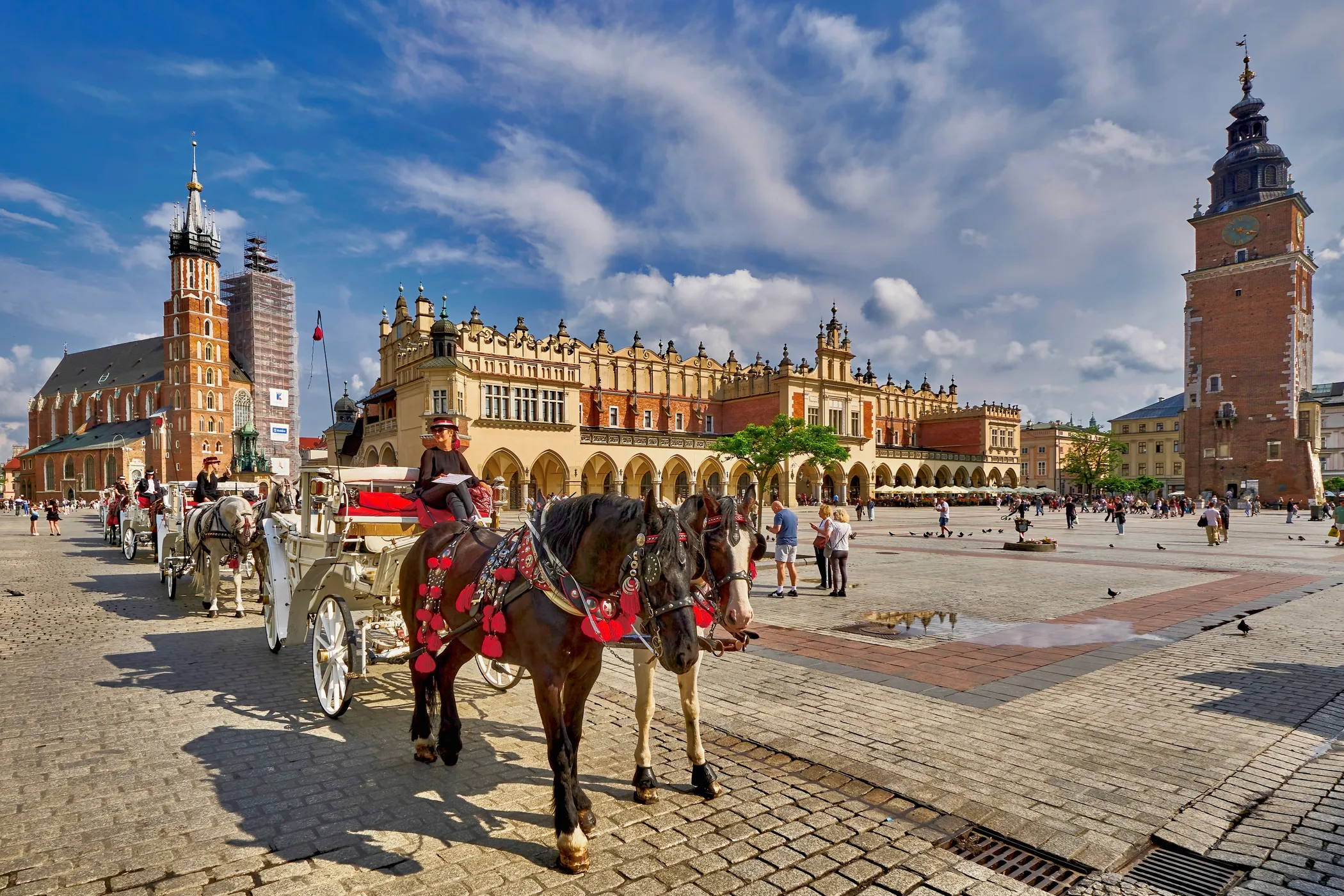
Poland's cultural capital, twice over
Krakow was the royal capital of Poland for over five centuries, until the seat of power moved to Warsaw in 1596, and it wears that history without needing to perform it. The Old Town survived World War II almost entirely intact, spared the deliberate destruction Warsaw suffered, which means Rynek Główny, the Cloth Hall and the streets radiating from them are the genuine medieval article rather than a careful postwar reconstruction. Layer onto that a royal castle, a five-centuries-old university (the Jagiellonian, founded 1364, alma mater of Copernicus), and a Jewish quarter with one of the most interesting nightlife scenes in Central Europe, and you have a city that rewards three unhurried days better than almost anywhere else in the region.
What Krakow cannot be separated from, and shouldn't try to be, is Auschwitz-Birkenau, an hour and a half away by car and the single most visited historical site connected to any city in this guide. Most visitors build a Krakow trip around both things at once: the market square in the morning light, and an afternoon that changes how the rest of the trip feels. Neither cancels the other out.
The honest complications
Rynek Główny and the streets immediately around it are genuinely overrun in July and August, and stag-party tourism has left a real mark on parts of the Old Town's nightlife, aggressive club promoters, inflated bar tabs, the kind of thing a quieter city wouldn't have to deal with. Auschwitz-Birkenau can no longer be a same-day decision: since 1 March 2026 all entry passes must be booked online in advance, and popular dates sell out six to eight weeks ahead. And Krakow's air quality in winter, driven by coal heating in the wider region, is among the worst of any EU city on high-pollution days, worth knowing if you have respiratory sensitivities and are visiting December through February.
Four districts, one flat and walkable city
Unlike hillier European cities, Krakow is largely flat, and its core sights sit within a comfortable 20 to 30 minute walk of each other along the Vistula River. Where you base yourself comes down to whether you want the postcard view or the local pace.
Stare Miasto (Old Town)
The walled medieval center, ringed by the Planty park where the old fortifications once stood, holds Rynek Główny, St. Mary's Basilica, the Cloth Hall and the Jagiellonian University's oldest buildings. It is the obvious first-time base: everything is within walking distance, though the streets immediately off the square get loud with nightlife on weekend evenings.
Kazimierz
Krakow's historic Jewish district, a separate town until 1800, holds seven surviving synagogues, the Old Synagogue among them, alongside Plac Nowy's food stalls and the dense cluster of bars around it that gave Kazimierz its reputation as Krakow's most interesting neighborhood after dark. It's quieter and more residential by day, livelier and more bohemian by night than the Old Town.
Podgórze
Across the Vistula from Kazimierz, Podgórze was where the Nazi occupation forced Krakow's Jewish population into a walled ghetto in 1941, an event now marked by the empty-chair memorial at Plac Bohaterów Getta. Oskar Schindler's enamel factory, now a museum, sits on the district's edge, and the contemporary art museum MOCAK occupies part of the same complex.
Nowa Huta
A purpose-built Stalinist industrial district from 1949, designed as a model socialist city with Plac Centralny at its symmetrical heart. It's a genuinely different Krakow from the medieval core, worth a half-day for anyone interested in 20th-century urban planning and Cold War history, reached easily by tram.
From a Relais & Châteaux canon's house to a hostel between the two old quarters
Krakow's Old Town has one of the best concentrations of characterful, historic hotel buildings in Central Europe, converted merchant houses and clergy residences rather than chain towers, and prices stay well below equivalent properties in Prague or Vienna.
At the top, Hotel Copernicus, a Relais & Châteaux property on Kanonicza Street near Wawel Castle, occupies a Renaissance building that was once home to cathedral canons, with a restored 1500s fresco, a spa and pool built into the medieval cellars, and a Michelin-starred restaurant, from around €350 a night. Nearby, the five-star Hotel Stary pairs contemporary designer interiors with an extensive spa and a Michelin-recommended restaurant inside a converted historic townhouse in the heart of the Old Town, from about €280.
In the boutique bracket, Hotel Wentzl occupies a 15th-century tenement directly on Rynek Główny, with individually furnished antique-style rooms overlooking the square and its own 18th-century Wentzl Restaurant downstairs, from around €140. PURO Kraków Stare Miasto, a ten-minute walk from the square, takes the opposite design approach, light-filled modern rooms with tablets and large windows, at a lower price point from about €90.
At the budget end, Atlantis Hostel sits in the sweet spot between the Old Town and Kazimierz, making it an easy base for exploring both, from around €15 a night for a dorm bed.
Pierogi, milk bars and the best-value eating in Central Europe
Krakow's food scene runs from gothic-cellar fine dining to communist-era canteens still serving the same menu they always have, and the gap between the two in price is smaller than the gap in atmosphere. Most visitors end up eating some of their best meals at the cheapest places.
Pierogi
Pierogarnia Krakowiacy on ul. Szewska, just off the main square, does the full range: ruskie (potato and cottage cheese), meat, and sauerkraut-and-mushroom, at prices well under what the square-front tourist restaurants charge for the same dish.
Milk bars (bary mleczne)
Bar Mleczny Pod Temidą and Bar Mleczny Prasowy are the classic surviving examples: order and pay at the counter, no English menu guaranteed, and a complete traditional meal, soup, a main, a drink, for the price of a coffee elsewhere in the Old Town.
Traditional Polish, sit-down
Pod Aniolami, in a gothic cellar in the Old Town, grills marinated meats over a beechwood fire and serves them in candlelit stone rooms or a courtyard garden; the nobleman's shashlik and venison dumplings are the dishes to order. In Kazimierz, Starka pairs a rustic, terracotta-walled dining room with its own oak-barrel-aged vodka behind the bar, and live music on Wednesday and Friday evenings.
Żubrówka & local vodka
Żubrówka, flavored with bison grass from Białowieża Forest, is the vodka most associated with Poland internationally; drink it neat and cold, traditionally chased with apple juice.
A square, a castle, a factory, and the hourly trumpet that never finishes its note
Krakow's essential sights cluster tightly enough that a well-planned three days covers the city thoroughly on foot, with day trips absorbing anything left over.
Rynek Główny and the Old Town
Start at Rynek Główny, one of the largest medieval market squares in Europe, dating to the 13th century. The Renaissance Cloth Hall splits the square in two and now houses souvenir stalls at ground level and the Gallery of 19th-Century Polish Art upstairs. St. Mary's Basilica, with its two mismatched Gothic towers and Veit Stoss's carved wooden altarpiece, is the square's anchor; every hour, a trumpeter plays the hejnał from the taller tower, a five-note call that breaks off mid-phrase in memory of a 13th-century watchman said to have been struck by a Tatar arrow mid-warning. The noon performance is broadcast nationally on Polish radio.
Wawel Hill
Wawel Royal Castle and Cathedral sit on a hill above the Vistula a short walk from the square; the hill itself is free to enter from early morning until late evening, while the castle interiors, cathedral and Dragon's Den each require separate tickets (roughly 30-89 PLN for combined options). Book ahead in summer, when timed-entry slots for the state rooms sell out by midday.
Kazimierz after dark
Krakow's Jewish quarter is the best nightlife in the city: Alchemia, a candle-lit, shabby-vintage institution with live music and cultural events, and Singer, the bar that started Kazimierz's nightlife reputation, furnished with old sewing machines as tables, both sit within a couple of hundred meters of Plac Nowy. Start early at Singer, move to Alchemia as the evening builds; five bars are within a 200-meter radius if you want to keep going.
Podgórze and Schindler's Factory
Oskar Schindler's Enamel Factory, now a branch of the Museum of Krakow, tells the story of the German occupation and the Kraków Ghetto through the site where Schindler protected over a thousand Jewish workers; full-price tickets run around 60 PLN, and reservations are essential since the museum caps daily visitor numbers (entry is free on Mondays, though expect large crowds and no ability to reserve). The empty bronze chairs of the Ghetto Heroes Memorial at Plac Bohaterów Getta, a short walk away, mark where the ghetto's residents were forced to gather with their belongings before deportation.
One, two or three days, planned street by street
Three full days covers Krakow's city sights and one major day trip properly; even a single well-planned day delivers the essentials of the Old Town.
- Morning
Rynek Główny and the Cloth Hall. Catch the hejnał on the hour, then the Basilica's Veit Stoss altarpiece before the tour groups arrive.
- Midday
Wawel Hill. The castle grounds and cathedral, then a pierogi lunch at Pierogarnia Krakowiacy back toward the square.
- Afternoon
Kazimierz on foot. The Old Synagogue and Plac Nowy, with time to browse before dinner.
- Evening
Starka or Pod Aniolami for dinner, then Singer and Alchemia for a nightcap.
- Day 1
The one-day route: Rynek Główny, Wawel, Kazimierz, dinner and drinks.
- Day 2
Auschwitz-Birkenau. A full day, booked online well in advance; the site deserves unhurried, undistracted attention and nothing else scheduled around it.
- Days 1-2
The two-day route above, at a gentler pace.
- Day 3
Wieliczka Salt Mine or Podgórze. Either the underground salt chambers 15km from the city, or a slower morning at Schindler's Factory and the Ghetto Heroes Memorial, with the afternoon free for Nowa Huta or a return visit to Kazimierz.
Flat, walkable, and easy to get wrong only if you rent a car
Krakow's Old Town is compact and flat, and most of what matters is within a 20-30 minute walk. From John Paul II International Airport (KRK), the train runs to Kraków Główny station in about 20 minutes for roughly 17 PLN (about €4), departing hourly around the clock; buses 300, 209 and 902 are the cheapest option at around 6 PLN but take closer to 45 minutes, and a flat-rate airport taxi costs about 109 PLN (25-30 minutes).
Within the city, trams cover Nowa Huta and other outer districts efficiently; a single ticket costs about 4-6 PLN (roughly €1) from machines or the Jakdojade app. A rental car is actively unhelpful in the Old Town, which is largely pedestrianized and short on parking, and Bolt or Uber (widely available, cheap by Western standards) handle everything a tram doesn't.
Best time to visit and the Christmas market
May-June and September are the sweet spots: mild temperatures (15-23°C), long daylight, and crowds that are present but manageable. July and August are the warmest and busiest months, especially around Rynek Główny and at Auschwitz-Birkenau, where summer reservations sell out fastest. Winter is properly cold, often below freezing from December through February, and regional coal heating means Krakow can have some of the worst winter air quality of any EU city on still, high-pollution days.
The Christmas market on Rynek Główny, typically running from late November through late December, is one of the best in Central Europe and includes the annual szopki (nativity scene) competition, a Krakow-specific folk-art tradition recognized by UNESCO.
One of the best-value city breaks left in the EU
Krakow is significantly cheaper than Warsaw's top hotel tier and noticeably cheaper than Vienna, Prague or Berlin for equivalent quality. Milk bars and public transport keep daily costs low even for travelers who otherwise spend freely on accommodation.
- Hostel dorm €12-20
- Milk bars and market meals €10-18
- Trams and walking €2-4
- Free Old Town and Wawel grounds
- Boutique hotel €90-140
- Restaurant meals with drinks €25-45
- Metro-free city, occasional taxi
- Wieliczka or Schindler's Factory entry
- Hotel Copernicus or equivalent €280+
- Michelin-recommended tasting menus
- Private guided Auschwitz-Birkenau tour
- Driver for Zakopane or Wieliczka
One of Europe's safest cities, with three things to know
Krakow rates 9.2/10 on our safety scale and has been highlighted in 2026 surveys as one of Europe's best cities for solo female travelers. Violent crime against tourists is rare, the city feels safe at night including Kazimierz's bar streets, and public transport runs reliably into the late evening.
The three things that actually catch visitors: pickpocketing, concentrated on trams 1, 6 and 8 and around Rynek Główny and the main train station, where organized teams work busy doors; the "free gift" street scam, where someone presses a flower or bracelet into your hand near the main square and then aggressively demands 20-50 PLN; and currency exchange (kantor) tricks, where booths near the square and airport advertise excellent rates for obscure currencies while burying poor USD/EUR/GBP rates in small print. Use bank ATMs, decline unsolicited street "gifts" outright, and always confirm the exact rate before handing over cash at a kantor. Emergency number is the EU-standard 112 from any phone.
The single most important day trip in Poland leaves from here
Krakow's position makes it the base for the country's two most-visited sites outside its cities, plus a mountain escape when the flat old town starts to feel small.
Auschwitz-Birkenau
The Auschwitz-Birkenau Memorial and Museum, on the site of the largest Nazi extermination camp, is free to enter but since 1 March 2026 requires an online reservation for every visitor, guided or unguided, through the museum's official system at visit.auschwitz.org; on-site ticket sales have been permanently discontinued. Guided tours led by museum educators cost 150 PLN for adults (140 PLN for students under 26 and seniors 75-plus); organized round-trip transfer packages from Krakow start around $60. Book six to eight weeks ahead for spring, summer and early autumn dates. Photography is permitted in most areas but selfies and posed photos are considered disrespectful; the museum asks for quiet, contemplative behavior throughout.
Wieliczka Salt Mine
An underground mine worked continuously since the 13th century, with chapels, chandeliers and sculptures all carved from rock salt by generations of miners. The Tourist Route takes 2-3 hours including an 800-plus-step descent (an elevator brings you back up); reach it from Krakow by suburban train (25 minutes, 4-6.50 PLN) or bus 304 (40 minutes, 4-6 PLN). Book online ahead in summer, when same-day tickets can sell out by mid-morning.
Zakopane & the Tatra Mountains
Poland's mountain resort town, gateway to the Tatra range, makes a full-day escape or an overnight if you want more than a rushed look. Buses run 22-35 PLN one-way in just over two hours; trains cost more (22.50-75 PLN depending on service) but skip road traffic, worth it on summer weekends when the road can back up to 3.5-4 hours each way. Oscypek smoked cheese, grilled and served with cranberry sauce, is the local thing to eat.
Krakow FAQ
Is Krakow safe for tourists?
Krakow is one of the safest cities in Europe and has been rated one of the best for solo female travelers in 2026 surveys. Violent crime against tourists is rare; the main concerns are pickpocketing on trams 1, 6 and 8 and the "free gift" street scam near Rynek Główny.
How many days do I need in Krakow?
Three full days covers the city well: one for the Old Town and Wawel, one for Kazimierz and Podgórze, and one for Auschwitz-Birkenau or Wieliczka Salt Mine. A fourth day fits both day trips or a trip to Zakopane.
How much does Krakow cost per day?
Budget travelers manage on €35-50 a day with hostels and milk bar meals; mid-range runs €80-130. Krakow is noticeably cheaper than Warsaw's top hotels and significantly cheaper than Western European capitals.
When is the best time to visit Krakow?
May-June and September: mild weather, long days and manageable crowds. July and August are warmest and busiest around the Old Town and at Auschwitz-Birkenau. December has an excellent Christmas market on Rynek Główny.
Do I need to book Auschwitz-Birkenau tickets in advance?
Yes, and since 1 March 2026 it is mandatory. All entry passes, guided or unguided, must be booked online through the museum's official reservation system; on-site ticket sales have been discontinued. Book six to eight weeks ahead for spring, summer and early autumn dates.
How do I get from Krakow airport to the Old Town?
The airport train runs from John Paul II International Airport to Kraków Główny station in about 20 minutes for roughly 17 PLN (about €4), departing hourly around the clock. A taxi costs a flat rate of about 109 PLN (25-30 minutes); buses 300, 209 and 902 are the cheapest option at around 6 PLN.
What is the best area to stay in Krakow?
The Old Town (Stare Miasto) for first-timers: everything is walkable and it's the most atmospheric base. Kazimierz for nightlife and a more local feel, a 15-20 minute walk from the main square.
Is Krakow walkable?
Yes, and largely flat, unlike hillier European cities. The Old Town, Wawel Castle and Kazimierz are all within a comfortable 20-30 minute walk of each other; trams cover Nowa Huta and other outer districts.
Should I visit Auschwitz-Birkenau and Wieliczka on the same day?
Not recommended. Both sites deserve a half-day or more of unhurried attention, and combining them makes for a rushed, emotionally jarring day. Most visitors do one per day, with Auschwitz-Birkenau in the morning if combined with anything at all.
Do I need to speak Polish in Krakow?
No. English is widely spoken in hotels, restaurants and tourist areas, especially among younger Poles. A few words, dziękuję (thank you), przepraszam (excuse me), are appreciated but not necessary.
What is a milk bar and should I eat at one?
A bar mleczny is a canteen-style restaurant left over from the communist era, serving full traditional Polish meals for a fraction of restaurant prices. Yes: it's one of the best-value, most authentic ways to eat in Krakow, though menus in smaller ones may not have English translations.
What Stays With You
Krakow does not need the rest of Poland to justify a trip on its own, and most visitors realize that within a day of arriving. The hejnał breaking off mid-note on the hour, the light on the Cloth Hall in the early evening, the first plate of pierogi at a milk bar that costs less than the coffee you had that morning: none of it is staged, and all of it is exactly what a city that survived the 20th century intact should feel like.
Go for the square and the castle and the astonishing value. Give a full, unhurried day to Auschwitz-Birkenau while you're here, book it well before you book anything else, and understand why the city that kept its own history standing takes the responsibility of the one nearby so seriously.