
Europe's least-hurried capital
Chisinau doesn't look like most European capitals, and that's mostly because it isn't old. A 1940 earthquake and heavy WWII damage left little of the pre-war city standing, so what you're walking through today is largely mid-century Soviet reconstruction: wide boulevards, deep street trees, and a genuinely high ratio of park space to concrete for a city its size. It reads less like a monument to visit and more like a place people actually live unhurried lives, which, once you stop looking for a Gjirokastër or a Prague, is exactly the appeal.
What changed in the last few years is the food and wine scene: Chisinau's restaurants have grown up fast, from no-menu tascas serving mamaliga and brinza to chef-driven Moldovan tasting menus that would hold their own in Bucharest or Warsaw, at a fraction of the price. Locals will tell you, correctly, that the real reason to come is what surrounds the city rather than the city itself: two underground wine cellars carved from Soviet-era limestone quarries and a cave monastery on a cliff are all within a day trip, and this guide treats them as core to a Chisinau visit rather than an afterthought.
The honest complications
Chisinau is not a city of blockbuster sights, and travelers expecting a Balkans-style old town will be disappointed; the appeal is the pace, the wine, and the day trips, not a dense historic core. English drops off outside the city center and with older residents, where Russian is often the more useful second language. Taxi pricing has no reliable public tariff, so use an app rather than negotiating curbside. And Chisinau's Soviet-block residential districts, while not unsafe, are a visible, honest reminder of the country's economic reality rather than a photogenic backdrop.
A compact centre and three residential sectors
Chisinau is flat, walkable, and organized around Stefan cel Mare Boulevard running through its centre. Where you base yourself comes down to how central and lively you want to be versus how quiet and budget-friendly.
Centru
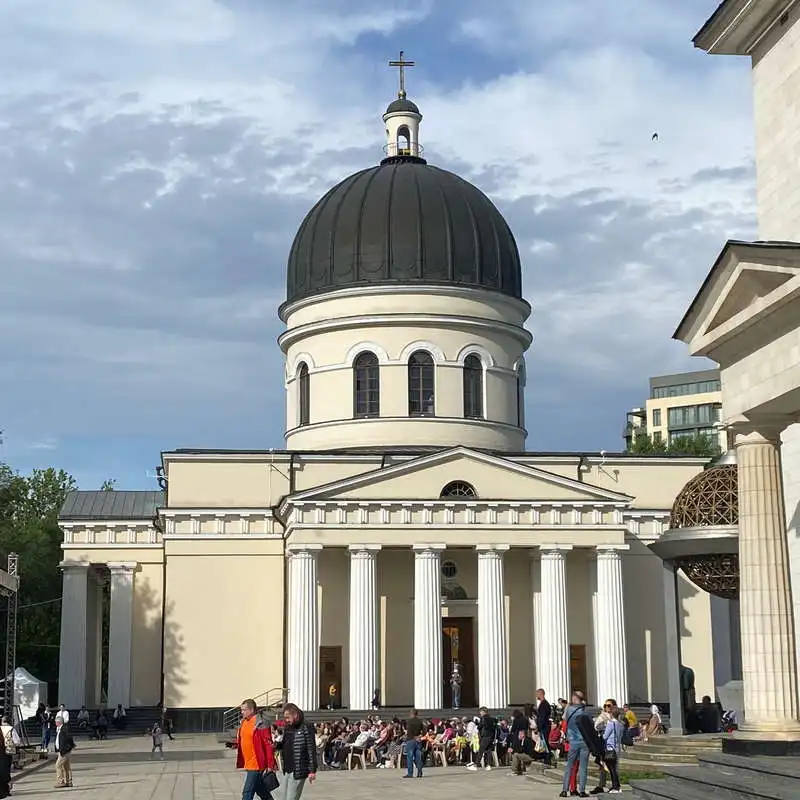
The historic and administrative heart of the city, and the obvious first-time base. Stefan cel Mare Boulevard runs through it, lined with cafes, shops and government buildings, and the Triumphal Arch, Nativity Cathedral and Cathedral Park all sit within a short walk of each other. Nightlife is concentrated here too, with bar streets busy until late on weekends. Prices are moderate for Chisinau, budget options included.
Botanica
Chisinau's largest sector by population, sprawling south of the centre as Soviet-era apartment blocks interspersed with parks, schools and markets. It's the default residential choice for locals and the best neighbourhood for budget accommodation and a genuinely quieter stay, with the city's Botanical Garden as its main green space.
Buiucani
A quiet, spacious residential district northeast of the centre with a family-friendly feel and easy access back into Centru. Less geared toward visitors, more useful if you want a longer, calmer stay away from the bar streets.
From boutique restoration to budget-friendly guesthouses
Chisinau's hotel scene is smaller than a comparable Western European capital but covers every budget well, and prices remain some of the lowest for a European capital city at every tier.
At the top of the market, the Radisson Blu Leogrand Hotel is Chisinau's benchmark 5-star property, with a strong business-traveler reputation, a full spa and fitness setup, and family-friendly touches like free cribs and babysitting on request. In the boutique bracket, the Nobil Luxury Boutique Hotel, in the heart of the city within a ten-minute walk of Cathedral Park and the Triumphal Arch, pairs 40 rooms including Ambassador and Presidential suites with a panoramic rooftop restaurant that's one of the few in the city with genuine skyline views.
For a well-priced mid-range stay, several Centru guesthouses and small hotels sit within easy walking distance of Stefan cel Mare Boulevard, typically 900 to 1,800 lei a night. At the budget end, Botanica's guesthouses and hostels run considerably cheaper, from around 250 lei for a hostel dorm bed, and remain a short taxi or bus ride from the centre.
Mamaliga, placinte and some of Europe's best-value wine
Chisinau's food scene runs from unpretentious, cash-only spots doing home-style Moldovan cooking to genuinely ambitious modern restaurants built around the country's wine, and the gap in price between the two is smaller than you'd expect.
La Placinte
La Placinte is the reliable, budget-friendly chain for the full range of savory and sweet placinte, hearty soups and mamaliga with rustic house wine, served in a warm, folkloric dining room. The most accessible introduction to home-style Moldovan cooking in the city.
Fuior
Fuior is Chisinau's refined, chef-driven take on Moldovan cuisine, pairing elegant presentation with a genuine sense of local terroir, and the staff guide diners through pairings from Moldova's own wine regions rather than defaulting to imports. The place to understand what Moldovan cooking looks like at its most ambitious.
Vatra Neamului
Vatra Neamului keeps an authentic national atmosphere in its dining room and menu, a solid middle ground between La Placinte's casual pace and Fuior's tasting-menu ambition.
Pegas Restaurant & Terrace
Pegas has one of the city's most spacious terraces and a menu spanning European and Moldovan dishes built around fresh, seasonal ingredients, a good warm-weather pick.
A slow city built for wandering between parks
Chisinau's sights cluster along and just off Stefan cel Mare Boulevard, easily covered on foot, with the city's parks doing as much work as any single landmark.
Stefan cel Mare Boulevard & the central square
Start at the Triumphal Arch, built in 1840 to mark a Russo-Turkish War victory, standing beside the Nativity Cathedral, an Orthodox church with striking frescoes set in its own park, both on Piata Marii Adunari Nationale. The Stephen the Great Monument, honoring the country's defining historical figure, anchors the boulevard that carries his name. A short walk away, the National Museum of Ethnography and Natural History, opened in 1906 in an striking oriental-style building, is the oldest museum in Moldova and covers the country's fauna, ethnography and traditional crafts in one stop.
Valea Morilor Park
A short walk or taxi from Centru, Valea Morilor Park covers about 114 hectares around a 34-hectare artificial lake, with a 2.5km path circling the water for walking, jogging or cycling. Rowboats are available for rent on the lake, and the park's cafes make it an easy place to slow down for an afternoon away from the boulevard.
Evenings on Stefan cel Mare
The boulevard and its side streets carry Chisinau's bar and nightlife scene. Covor Speakeasy Bar, on Stefan cel Mare itself, has a hidden speakeasy feel; Drugoe Mesto combines a cafe and club a few doors down; and Piana Vyshnia, right beside Cathedral Park, is small, well-decorated, and spills onto the pavement in warm weather. EscoBar's rooftop adds a view over Cathedral Park to the mix. Between them, a single evening on foot covers most of the city's nightlife without needing a taxi.
One, two or four days, planned street by street
Two days covers Chisinau itself properly; four days adds the two experiences most visitors actually come for, the wine cellars and Orheiul Vechi.
- Morning
Stefan cel Mare Boulevard. The Triumphal Arch, Nativity Cathedral and the National Museum of Ethnography, then coffee in Centru.
- Midday
Lunch at La Placinte. Mamaliga and a full round of savory and sweet placinte.
- Afternoon
Valea Morilor Park. A walk or rowboat around the lake.
- Evening
Cathedral Park & the bar streets. Dinner in Centru, then Piana Vyshnia or Covor Speakeasy Bar.
- Day 1
The one-day route: Stefan cel Mare Boulevard, the museum, La Placinte, Valea Morilor Park, evening in Centru.
- Day 2 morning
Botanica. The Botanical Garden and a quieter side of the city, at a slower pace.
- Day 2 afternoon
A wine tasting in the city. Several Centru wine bars pour flights of Moldovan labels without leaving town, a good primer before a cellar day trip.
- Day 2 evening
Fuior or Vatra Neamului. A proper sit-down Moldovan meal to close out the city portion of the trip.
- Days 1-2
The two-day route above, at a gentler pace.
- Day 3
Milestii Mici or Cricova, booked ahead, treated as a half-day with the tasting doubling as lunch.
- Day 4
Orheiul Vechi. The cliffside cave monastery, with time in the village of Butuceni before heading back to Chisinau.
Compact, flat, and easy on foot
Chisinau International Airport (KIV) sits about 14km south of the centre. A taxi booked through the Yandex Go app is the most reliable option, quoting a fixed fare upfront, roughly 100-160 lei for the 25-minute ride; there's no standardized metered tariff at the rank, so an app quote is your best benchmark before agreeing to anything curbside. Trolleybus route 30, run by Regia Transport Electric, is the cheapest way in at the standard 7-lei city fare, though it doesn't run around the clock and is awkward with luggage. Many travelers also fly into Iasi, Romania, about 100km west, and cross the land border by car or transfer, a well-established alternative given Chisinau's smaller flight network.
Within the city, Chisinau is flat and walkable, and Centru's main sights sit within a 15 to 20 minute walk of each other. Trolleybuses and buses cover the rest of the city at 7 lei a ride, and Yandex Go is the standard app for taxis, cheap by Western European standards for most in-town trips. For the wine cellars and Orheiul Vechi, a rental car or a booked day tour is more practical than public transport, since none of the three sit directly on a convenient bus route.
Best time to visit and the wine festival
Chisinau has a continental climate with warm, sometimes humid summers and cold winters. May-June and September-October are the sweet spots: mild days, green parks, and comfortable conditions for walking and day trips. Winters drop below freezing with limited daylight; the wine cellars stay a steady 12-14°C year-round regardless of the season outside.
Chisinau's wine festival, typically held over a weekend in early October to coincide with the grape harvest, brings tastings, folk music and crowds to the city centre. Worth planning around, either to catch it or to avoid the extra crowds at Cricova and Milestii Mici that weekend.
One of Europe's least expensive capitals
Chisinau is significantly cheaper than any Western or Central European capital, and even a comfortable trip with good restaurants and a rental car rarely feels expensive by comparison.
- Hostel dorm ~250 MDL
- Placinte, market meals 20-60 MDL
- Trolleybus & walking, 7 MDL/ride
- Free parks plus one paid sight
- Centru hotel or guesthouse 900-1,800 MDL
- Restaurant meals 150-300 MDL
- Yandex Go taxis around town
- One wine cellar tour & tasting
- Radisson Blu Leogrand or equivalent
- Tasting menu at Fuior
- Private day trips with a driver
- Multi-winery tour incl. Purcari
A calm capital, with one regional caveat
Chisinau carries the same US State Department Level 2 rating, Exercise Increased Caution, as much of Western Europe. Violent crime against tourists is rare, and the city centre is comfortable to walk in the evening with normal awareness. The three things that actually catch visitors: pickpocketing, concentrated in crowded markets, on trolleybuses and at the central market; unmarked taxis, which sometimes overcharge tourists at the airport and near tourist sites, so use the Yandex Go app instead; and people posing as police demanding on-the-spot fines, who should be asked for ID or directed to a police station rather than paid on the street. Emergency number is the unified 112 from any phone.
On Transnistria: it sits about an hour from Chisinau and is physically easy to reach, but this guide isn't recommending it as a casual day trip right now. The breakaway region carries a separate, higher US State Department advisory given elevated 2026 tensions tied to Russian forces stationed there; the full picture is covered in the Moldova country guide's safety chapter, and it's worth reading before making any plans east of the Dniester.
Two wine cities and a cliff, all within two hours
Chisinau's location makes it an efficient base: the country's two biggest draws, the underground wine cellars and Orheiul Vechi's cave monastery, are both comfortably reachable in half a day, with Purcari's vineyards a longer full-day option to the south.
Milestii Mici
The Milestii Mici winery holds the Guinness World Record for the largest wine collection on Earth, roughly 1.5 to 2 million bottles stored along some 200km of underground streets, complete with their own names and traffic signs, in a former limestone quarry. Tours run by electric cart through the maturation halls and the record-holding collection, ending in a seated tasting with local snacks.
Cricova
Cricova is Chisinau's other great underground winery, 120km of tunnels used since 1952 and toured by electric car through wine maturation sections, a sparkling wine production area, and a national collection that has hosted visiting heads of state. Book ahead for weekends; both Cricova and Milestii Mici run on scheduled group tours rather than casual walk-ins.
Orheiul Vechi
A limestone cliff complex above a bend in the Raut River holding a cave monastery dating to at least the 13th century, still home to a handful of resident monks who hold regular services. Women should bring a headscarf; borrowed scarves are usually available at the base of the stairs. The complex also holds Golden Horde-era ruins and a small medieval church on the same cliff. Staying overnight in the adjacent village of Butuceni is worth considering for travelers who want to see the site without day-tripper crowds.
Purcari
Moldova's oldest winery, founded in 1827 in the Stefan Voda region near the Ukrainian border, with a French-chateau-style estate and wines exported to more than 25 countries. A longer trip than the two cellars closer to the city, usually built around a full day that includes a countryside drive through traditional southern villages.
Chisinau FAQ
Is Chisinau safe for tourists?
Yes. Chisinau carries the same US State Department Level 2 rating as much of Western Europe. The main concerns are pickpocketing in crowded markets and on public transport, and unmarked taxis; standard city awareness covers the rest.
How many days do I need in Chisinau?
Two full days covers the city itself: one for Stefan cel Mare Boulevard's landmarks and museums, one for the neighbourhoods and parks. Add a third or fourth day for the Cricova or Milestii Mici wine cellars and Orheiul Vechi, both easy day trips.
How much does Chisinau cost per day?
Budget travellers manage on 500-800 lei (about 30-47 dollars) a day with guesthouses and market meals; mid-range runs 1,000-1,800 lei. Chisinau is one of the least expensive capitals in Europe.
When is the best time to visit Chisinau?
May-June and September-October: mild weather, green parks, and comfortable conditions for the wine cellars and day trips. Late September brings the grape harvest and the city's wine festival.
Do I need to speak Romanian or Russian in Chisinau?
No, but it helps outside the main tourist spots. English is common with younger people in the centre; Russian is widely understood across generations. A few Romanian phrases go a long way.
What is the best area to stay in Chisinau?
Centru for first-timers: central, walkable, and close to Stefan cel Mare Boulevard's restaurants and nightlife. Botanica for a quieter, more budget-friendly base near the Botanical Garden.
How do I get from Chisinau airport to the city centre?
A taxi booked through the Yandex Go app costs roughly 100-160 lei for the 25-minute ride and gives a fixed price upfront. Trolleybus route 30 is the cheapest option at 7 lei but doesn't run around the clock and is awkward with luggage.
Can I visit Transnistria from Chisinau?
Physically yes, it's about an hour away, but this guide isn't recommending it right now. The US State Department rates the breakaway region Reconsider Travel given elevated 2026 tensions involving Russian forces stationed there, a materially different risk picture from Chisinau itself.
Are the wine cellars worth visiting?
Yes, easily one of Moldova's best experiences. Milestii Mici holds the Guinness World Record for the largest wine collection on Earth, and Cricova's 120km of tunnels have hosted world leaders. Book ahead, especially for weekend visits.
Is Chisinau walkable?
Yes, the centre is flat and compact. Stefan cel Mare Boulevard connects most major sights on foot, and Valea Morilor Park is a comfortable walk from Centru. Trolleybuses and taxi apps cover the rest.
What Stays With You
Chisinau doesn't try to sell itself, and that's most of what makes it work. There's no skyline shot doing the marketing, no old town built for a camera. What you remember is the quiet of Valea Morilor Park on a weekday morning, the particular cold of a cellar a hundred meters underground surrounded by more wine than seems physically reasonable, and a dinner bill that made you check it twice because it seemed too low for how good the meal actually was.
Go for the wine cellars and the cliffside monastery, stay because the city itself, unhurried and unbothered about being noticed, turns out to be worth the extra day.