
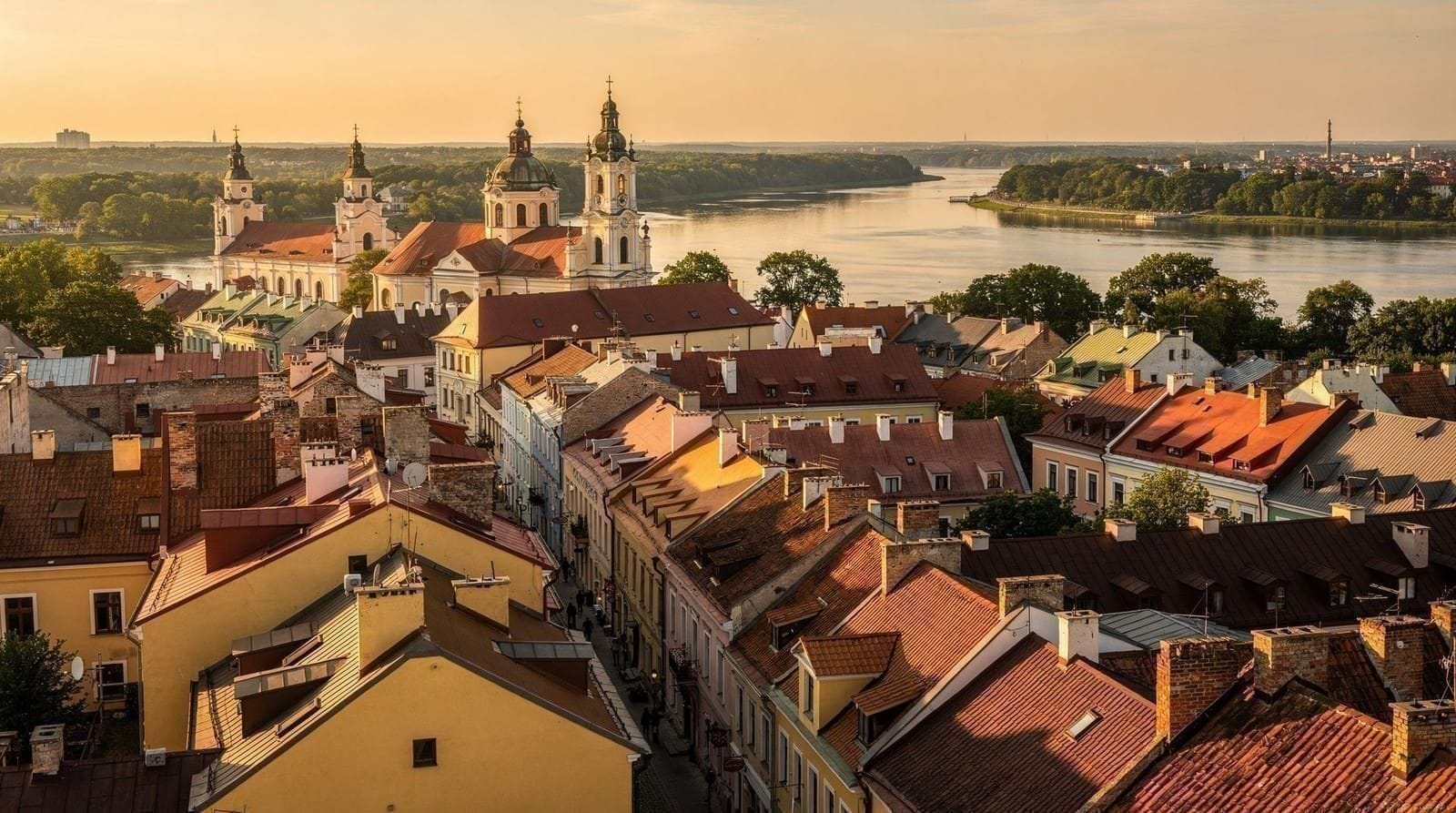
The Baltic capital that took its time being noticed
Vilnius sits in a river valley where the Vilnia meets the Neris, its Old Town one of the largest surviving medieval cores in Northern Europe and a UNESCO World Heritage Site since 1994. Unlike the tidy, single-era old towns elsewhere in the Baltics, Vilnius layers Gothic, Renaissance, Baroque and Classicist buildings on top of each other along the same streets, the product of repeated rebuilding after fires, wars and occupations rather than a single preserved moment. The effect is a city that photographs beautifully but rewards close reading even more: a plaque here, a scarred facade there, a former synagogue foundation marked out in the pavement of what was once the Jewish quarter.
What changed recently is that people started noticing. Vilnius picked up its first Michelin stars in 2026, budget airlines have multiplied routes into VNO, and the city that used to be an afterthought on a Riga-Tallinn itinerary is increasingly the whole trip. Prices have not caught up yet: a proper sit-down dinner with wine still costs less here than a casual lunch in Western Europe, and the hostel scene is excellent.
The honest complications
Vilnius's Old Town streets are cobbled and occasionally uneven, though nothing like the hills of Lisbon or Porto. Winters are genuinely cold and dark, with under 8 hours of daylight in December, so this is very much a spring-to-autumn city for most visitors. Lithuania's 20th-century history sits close to the surface here in a way some visitors find heavy: the Museum of Occupations and Freedom Fights, in the former KGB headquarters, includes intact basement prison and execution cells, and the near-total destruction of Vilnius's prewar Jewish community, once numbering enough to earn the city the nickname "Jerusalem of the North," is not softened for tourists. And in 2026, occasional drone incursions from Belarusian airspace have briefly disrupted flights at VNO, covered in full in the Lithuania country guide's safety chapter; it's worth a pre-departure news check, not a reason to cancel.
Five neighbourhoods, one small, walkable capital
Vilnius is compact by capital-city standards. Almost everything a first-time visitor wants sits within the Old Town or a short walk across the river from it, and where you base yourself comes down to atmosphere versus quiet.
Senamiestis (Old Town)
The medieval and Baroque heart of the city, centred on Cathedral Square and Pilies Street, with Gediminas Tower rising above it on its hill. Everything from the Gates of Dawn to the university is within a 15-minute walk. Staying here means being close to everything at the cost of paying slightly more and hearing more street noise on weekend nights.
Užupis
A former run-down district across a small river from the Old Town, Užupis declared itself an independent republic on 1 April 1998, complete with a mock constitution posted on mirrored plaques in over 20 languages and a trumpet-blowing angel statue in its main square. Now genuinely gentrified, full of galleries, workshop studios and relaxed cafes, and quieter to sleep in than the Old Town proper while still being a five-minute walk from it.
Naujamiestis (New Town)
West and south of the Old Town, home to Vilnius's train station, Halės Turgus market and a growing concentration of independent restaurants and craft beer bars away from tourist pricing. A better choice for longer stays or travellers who'd rather eat where locals eat than sleep directly inside the postcard.
Šnipiškės
Vilnius's modern skyline, across the Neris River from the Old Town: glass office towers, shopping centres and the newer chain hotels. Practical for business travel or families wanting more space, but a 15 to 20 minute walk (or short bus ride) from the historic sights.
Žvėrynas
A quiet, tree-lined neighbourhood of wooden villas and embassies just across the Neris, popular with diplomats and increasingly with visitors wanting a residential pace within a 20-minute riverside walk of the centre.
From a converted Old Town palace to one of the Baltics' best hostel scenes
Vilnius accommodation runs noticeably cheaper than Riga or Tallinn at every tier, and the Old Town's boutique hotels are almost all converted historic buildings rather than purpose-built chains. These picks cover every budget.
At the top, Kempinski Hotel Cathedral Square is Vilnius's grand luxury address, a 96-room property in the heart of the Old Town with an indoor pool, spa and Turkish bath, from around €200 a night depending on season. In the boutique bracket, NARUTIS Hotel (from around €130) occupies a centuries-old Old Town building steps from Cathedral Square, while Grotthuss Boutique Hotel (from around €85) is a highly-rated four-star with individually designed rooms in a historic townhouse.
For character on a mid-range budget, Shakespeare Boutique Hotel (from around €70), steps from Town Hall Square and Pilies Street, gives each room a literary theme and book-filled interiors, and Artagonist Art Hotel (from around €65) pairs contemporary Lithuanian art with consistently excellent guest reviews. At the budget end, Downtown Forest Hostel & Camping is Vilnius's best-known hostel, with a sociable common area and, true to its name, an unusual camping option alongside standard dorms; hostel dorms across Vilnius generally run €15-25 a night.
Potato dumplings, cold pink soup, and a brand-new Michelin scene
Vilnius's food identity is built on hearty, potato- and dairy-based peasant cooking, and the city earned its first Michelin recognition in the 2026 guide without changing what makes it distinctive: foraged ingredients, fermentation and local produce layered onto genuinely traditional dishes rather than replacing them.
Cepelinai
Fist-sized potato dumplings stuffed with minced meat, mushrooms or curd cheese, topped with fried bacon bits and sour cream. Žemaičių ąsotis, decorated with folk art and hanging teapots, does famously huge portions; in the Old Town, Gabi on Šv. Mykolo gatvė and the always-busy Snekutis are reliable, and Bernelių užeiga offers a mini sampler platter for tasting several fillings at once.
Šaltibarščiai
Shocking-pink cold soup made with beetroot and kefir or buttermilk, served with warm boiled potatoes on the side. Available everywhere from May through September; most first-time visitors are skeptical and order it again within the week.
Kibinai
Crescent-shaped savoury hand pies, traditionally filled with minced lamb, originating with Trakai's Karaim community. Halės Turgus, the atmospheric 1906 market hall on Pylimo gatvė near the train station, is the best spot in the city for kibinai and other street food stalls, alongside fresh produce, smoked fish and baked goods.
Michelin-recognized dining
Lithuania's first Michelin Guide, published in 2026, awarded stars to five Vilnius-area restaurants: Nineteen18, Džiaugsmas, Deep Roots, Red Brick and Demo, the last of which also earned a Green Star for sustainability, a café by day that becomes a tasting-menu restaurant in the evening. All lean modern Lithuanian: foraged ingredients, fermentation, seasonal tasting menus built on the same base ingredients as cepelinai and šaltibarščiai, reservations recommended well ahead.
A compact Old Town with one very good detour across the river
Vilnius rewards a slow, mostly on-foot pace. The Old Town's landmarks cluster tightly enough to see on foot in a day or two, and the city's most memorable hour is often an unplanned wander into Užupis or up to one of the free viewpoints at sunset.
Cathedral Square and Gediminas Hill
Start at Vilnius Cathedral, a Neoclassical landmark on the site of a pagan temple, then take the two-minute funicular (€2 one-way, €3 return) or the ten-minute walk up to Gediminas Tower, the last remnant of the Upper Castle and now a branch of the National Museum of Lithuania, with entry around €5-8 and an observation deck delivering the best rooftop panorama of the Old Town. On the way down, the side streets around Pilies gatvė hold the city's densest concentration of amber jewellery shops and cafes.
Užupis on foot
Cross into Užupis and read the Užupis Constitution, 41 tongue-in-cheek articles ("Everyone has the right to be happy," "A dog has the right to be a dog") posted on mirrored plaques in more than 20 languages, then find the Užupis Angel, a statue of the archangel Gabriel blowing a trumpet in the main square, unveiled in 2002 as an unofficial guardian of the neighbourhood. The district's galleries and workshop studios reward slow wandering more than any single sight does.
The Gates of Dawn and Vilnius University
The Gates of Dawn, built between 1503 and 1522 as part of the city's original fortifications, house a revered icon of the Virgin Mary that still draws pilgrims from across the region; the small chapel above the gate is free to visit. A short walk away, Vilnius University, one of Eastern Europe's oldest, has a series of interconnected Renaissance and Baroque courtyards open to wander, plus a bell tower (around €5, including the lift) with a quieter, less crowded viewpoint than Gediminas Tower.
The Museum of Occupations and Freedom Fights
Housed in the former KGB headquarters, this museum (around €6 adult, €3 concession, closed Monday and Tuesday) spans three floors and the basement, where the original prison cells, isolation chambers and execution room have been preserved rather than reconstructed. It is heavy, essential viewing for understanding 20th-century Lithuania, and probably too intense for young children; budget at least 90 minutes.
The free viewpoints
The Hill of Three Crosses, a short climb across the river from Gediminas Hill, has the best sunset view over the Old Town's rooftops and is free, open at all hours and rarely crowded. The Soviet-era Vilnius TV Tower, further out and reachable by tram, has a paid observation deck (€11 weekdays, €14 weekends and holidays) at 165 meters with a bistro-bar, and is also the site of the January 1991 crackdown, marked by a small memorial and exhibition.
One, two or three days, planned street by street
Three full days covers Vilnius properly, including Trakai; even one well-planned day delivers the Old Town's essentials.
- Morning
Cathedral Square and Gediminas Tower. The funicular up, the view down, then a wander along Pilies gatvė.
- Midday
Cepelinai at Gabi or Snekutis, both in the Old Town, then the Gates of Dawn on the walk back.
- Afternoon
Across to Užupis. The Constitution plaques, the Angel statue, and a slow coffee at a gallery cafe.
- Sunset
Hill of Three Crosses. The Old Town turning gold below. Dinner back in the Old Town or Naujamiestis.
- Day 1
The one-day route: Cathedral Square, Gediminas Tower, cepelinai, Užupis, Hill of Three Crosses at sunset.
- Day 2 morning
Vilnius University's courtyards, then the bell tower, and the Museum of Occupations and Freedom Fights.
- Day 2 afternoon
Halės Turgus market for kibinai and a wander, then Naujamiestis for the craft beer bars.
- Day 2 evening
Michelin-recognized dinner if you booked ahead, or a tasca-style Old Town restaurant.
- Days 1-2
The two-day route above, at a gentler pace.
- Day 3
Trakai Castle. Train out in the morning, the Island Castle, lunch on kibinai at the source, a boat on Lake Galvė, back to Vilnius by evening.
Small, flat by Baltic standards, and easy to walk
Vilnius's historic centre is compact and largely flat, a rarity among the hillier cities of Southern Europe. From the airport, the train runs to Vilnius Central Station in about 8 minutes for around €0.70, and buses (lines 88, 88N, 1, 2 and the 3G express) take about 20 minutes for €1, both bought through the Trafi app, which also covers city transit and ride-hailing. A taxi or Bolt from the airport costs around €23.
Within the city, the Old Town, Užupis and Naujamiestis are all comfortably walkable from each other, and buses and trolleybuses cover Šnipiškės and Žvėrynas well. Bolt is cheap and widely used for longer hops or late-night trips, and e-scooters (Bolt, Spin) are common in summer for covering ground quickly, though the Old Town's cobbles make them less pleasant there than on the wider streets of Naujamiestis.
Best time to visit and the Christmas market
May, June and September are the sweet spots: mild temperatures, up to 17 hours of daylight in June, and manageable crowds. July and August are warmest and busiest. Winter is genuinely cold, with lows around -3°C in January and under 8 hours of daylight in December, but Cathedral Square's Christmas market, running from late November, is one of the best in Europe and worth the cold for.
One of the Baltics' best-value capitals
Vilnius is noticeably cheaper than Riga or Tallinn for accommodation, and everyday costs, transit, markets, casual meals, stay low even as the restaurant scene gets more ambitious.
- Hostel dorm €15-25
- Market meals and kibinai €15-25
- City transit and the Trakai train
- Free Old Town wandering, one paid sight
- Boutique Old Town hotel €65-140
- Restaurant meals with wine €30-50
- Trafi transit plus the occasional Bolt
- Gediminas Tower, the KGB museum, Trakai
- Kempinski or equivalent €200+
- Michelin-recognized tasting menus
- Private Trakai or Kaunas tour
- TV Tower dining
One of the Baltics' safer capitals, with three things to know
Vilnius rates 8.3/10 on our safety scale, in line with Lithuania's overall US State Department Level 1 rating. Violent crime against tourists is extremely rare, the city feels safe at night in the Old Town, Užupis and Naujamiestis, and Vilnius is also a strong choice for solo female travellers, scoring 8.0/10 on our solo women's scale.
The three things that actually catch visitors: pickpocketing, concentrated around the busiest Old Town squares and markets, so keep bags zipped and in front of you in crowds; nightlife overcharging, where a handful of bars use touts offering free entry or cheap drinks before presenting inflated bills, so check menu prices before ordering anywhere with a tout outside; and informal taxis, especially around the airport and train station, so stick to the Bolt app or Trafi. Emergency number is the EU-standard 112 from any phone.
An island castle thirty minutes away justifies the trip alone
Vilnius's compact size and central rail hub make it an excellent base for day trips across Lithuania. Two are easy half-days; the coast is a worthwhile extension if you have longer.
Trakai
Trakai's red-brick Island Castle sits on its own island in Lake Galvė, connected by wooden footbridges, and is one of the most photographed sights in the Baltics. Entry runs €10-12 depending on season. Trains leave Vilnius Central Station roughly every 1-2 hours; from Trakai station it's a 15-minute lakefront walk to the castle. Eat kibinai from one of the Karaim-run kitchens on Karaimų gatvė, and rent a rowboat or pedal boat on Lake Galvė if the weather holds. An organised Trakai tour from Vilnius runs €25-45 per person if you'd rather skip the train logistics.
Kaunas
Lithuania's interwar temporary capital, with one of Europe's largest concentrations of Art Deco and Bauhaus-influenced architecture and a quieter, more local-feeling Old Town than Vilnius's. The Ninth Fort, on the city's edge, is a sobering Holocaust memorial and museum on the site of a Soviet-turned-Nazi prison and execution ground, entry around €3.
Kernavė
A UNESCO-listed archaeological site of five grassy hillforts on the Neris River, considered the first capital of the Grand Duchy of Lithuania. Almost nothing has been built on it since; a quiet, contemplative half-day rather than a landmark-dense one.
The Curonian Spit
Too far for a comfortable single day from Vilnius, the UNESCO-listed dune coastline around Nida and Klaipėda is worth a dedicated overnight extension if your trip allows it: covered in full in the Lithuania country guide's destinations chapter.
Vilnius FAQ
Is Vilnius safe for tourists?
Vilnius is one of the safer capitals in Europe. Violent crime against tourists is rare; the main concerns are pickpocketing in crowded Old Town spots and occasional nightlife overcharging. Standard city awareness is all you need.
How many days do I need in Vilnius?
Three full days covers the city well: one for the Old Town's landmarks, one for Užupis and the Museum of Occupations and Freedom Fights, one for Trakai Castle. A fourth day fits Kaunas and is worth adding.
How much does Vilnius cost per day?
Budget travellers manage on €45-65 a day with hostels and market meals; mid-range runs €90-140. Vilnius is noticeably cheaper than Riga or Tallinn for accommodation.
When is the best time to visit Vilnius?
May, June and September: mild weather, long daylight and manageable crowds. July and August are warmest; the Christmas market on Cathedral Square from late November is one of Europe's best.
Is Vilnius worth visiting over Riga or Tallinn?
They're different cities worth combining if you have time. Vilnius has the largest Old Town of the three and the most Baroque architecture; Riga has denser Art Nouveau; Tallinn has the most complete medieval walls. For a first Baltic trip, Vilnius pairs naturally with an easy Trakai day trip.
How do I get from Vilnius airport to the centre?
The train runs from the airport to Vilnius Central Station in about 8 minutes for around €0.70. Buses (lines 88, 1, 2 and the 3G express) take about 20 minutes for €1. A taxi or Bolt costs around €23.
What is the best area to stay in Vilnius?
The Old Town (Senamiestis) for first-timers: central, walkable and full of sights. Naujamiestis for a quieter, more local base near the train station. Užupis for atmosphere if you don't mind fewer nearby shops.
Do I need to speak Lithuanian in Vilnius?
No. English is widely spoken in hotels, restaurants and tourist areas, especially among younger Lithuanians. A few words, ačiū (thank you), labas (hi), are appreciated but not necessary.
Is Vilnius walkable?
Yes, the Old Town and Naujamiestis are compact and largely flat compared to hilly Baltic neighbours. Užupis and the Hill of Three Crosses involve some incline, but nothing that requires special footwear.
Is Trakai Castle worth the day trip?
Yes. Trakai's Island Castle is a 30-minute train ride from Vilnius Central Station, costs around €1.50 one-way, and the castle itself is one of the most photographed sights in the Baltics. Half a day is enough including lunch.
What Stays With You
Vilnius does not oversell itself, and that is exactly why it works. The Old Town gets on with being lived in rather than performed, Užupis takes its own joke of a constitution more seriously than most cities take their actual laws, and the KGB museum's basement does not soften anything for the tour groups filing through it. None of it was staged for you, which is why the plate of cepelinai that outclassed every hyped restaurant back home sticks the way it does.
Go up to the Hill of Three Crosses on your last evening, watch the Old Town turn gold below the river, and understand why the people who've been keeping this one quiet were in no rush to share it.