
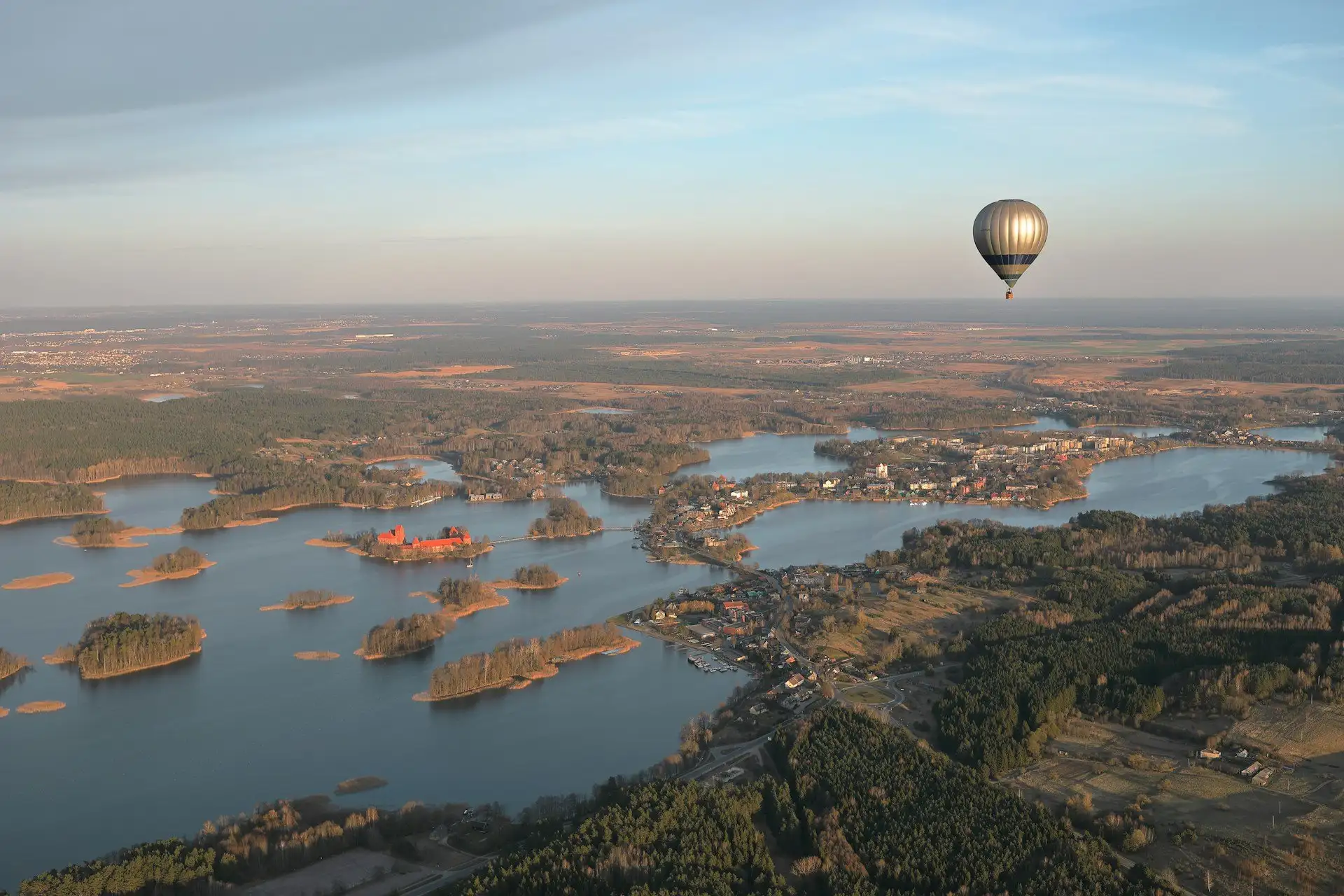
Europe's Last Pagan Country, Fully Caught Up
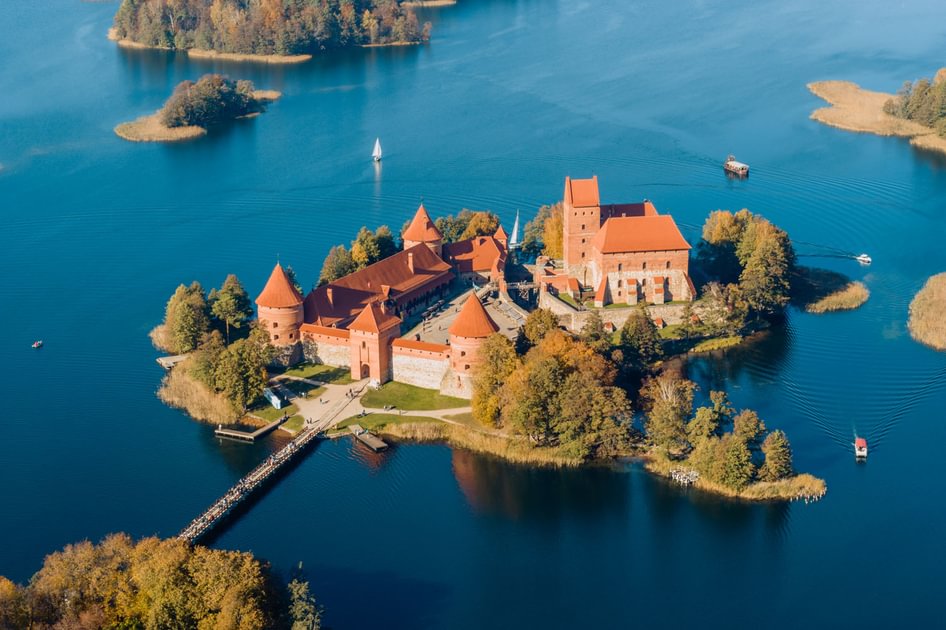
Lithuania is the largest and most populous of the three Baltic states, and for centuries the least visited by outsiders comparing it to Estonia and Latvia. That is changing quickly. Vilnius's Old Town is one of the largest surviving medieval old towns in Northern Europe, a UNESCO World Heritage Site of Baroque church spires, Renaissance courtyards and cobbled lanes, and it comes with an easy day trip to Trakai, where a red-brick castle sits on its own island in the middle of a lake. Lithuania was also, remarkably, the last pagan nation in Europe: the Grand Duchy resisted Christianization until 1387, centuries after the rest of the continent had converted, a fact that still colors the country's relationship to its own folklore and forests.
The 20th century was brutal here. Lithuania lost its independence to the Soviet Union in 1940, was occupied by Nazi Germany from 1941 to 1944, then reoccupied by the Soviets until 1990. Vilnius, once a city with 106 synagogues and a Jewish population so large it was called the "Jerusalem of the North," lost more than 90 percent of that community in the Holocaust, one of the most complete destructions of any Jewish community in Europe. Lithuania was also the first Soviet republic to declare independence again, in March 1990, and paid for it in blood the following January. Understanding this history changes how the cheerful, painstakingly restored Old Town reads today.
The honest complications
Lithuania sits next to Belarus and Russia's Kaliningrad exclave, and 2026 has brought a run of drone incursions into Baltic airspace linked to the wider war next door, including one alert in May that briefly grounded flights at Vilnius Airport. None of this has changed the US State Department's Level 1, Exercise Normal Precautions rating, and the disruptions have so far been measured in hours, not days, but it is a genuinely live regional story rather than a closed chapter, and worth a quick news check before you fly. Closer to the ground: Vilnius is still overshadowed by Riga and Tallinn in most people's mental map of the Baltics, so English-language tourist infrastructure, while good in the capital, thins out fast once you leave it, and rural bus timetables reward some patience.
A History Worth Knowing
Lithuanian is one of only two surviving Baltic languages, alongside Latvian, and is considered one of the most conservative living Indo-European languages, retaining features linguists trace back thousands of years. The short version of how the country you're visiting got here: a medieval kingdom that briefly converted to Christianity and reverted, a Grand Duchy that became one of the largest states in Europe, more than two centuries fused with Poland, a century under the Russian Empire, two decades of interwar independence, half a century of occupation, and a peaceful, sung revolution that ended it.
- 1253
Mindaugas crowned king. The only King of Lithuania in its history, crowned with papal blessing; he and his court later reverted to paganism, and Lithuania remained pagan for over a century more.
- 1387
Christianization. Grand Duke Jogaila accepts baptism, making Lithuania the last pagan nation in Europe to convert, roughly four centuries after most of the continent.
- Early 1400s
Vytautas the Great. Under Vytautas, the Grand Duchy of Lithuania becomes one of the largest states in Europe, stretching from the Baltic to the Black Sea.
- 1569
Union of Lublin. Lithuania and Poland merge into the Polish-Lithuanian Commonwealth, a union that lasts more than two centuries.
- 1795
Partition. The Commonwealth is dismantled; the Russian Empire annexes most of Lithuania, beginning over a century of Russification.
- 1918
Independence declared. The Act of Independence is signed on 16 February; Vilnius is soon lost to Poland, so Kaunas serves as the interwar temporary capital.
- 1940–1990
Occupation. Soviet annexation in 1940, Nazi German occupation from 1941 (during which over 90 percent of Lithuania's Jewish population was murdered), Soviet reoccupation from 1944, and mass deportations to Siberia.
- 1988–1991
The Singing Revolution. Sąjūdis forms in 1988; the Baltic Way human chain links Vilnius to Tallinn on 23 August 1989; independence is restored on 11 March 1990, the first Soviet republic to do so; Soviet troops kill 14 unarmed civilians defending the Vilnius TV Tower on 13 January 1991.
- 2004–2015
EU, NATO, euro. Lithuania joins the European Union and NATO in 2004, the Schengen Area in 2007, and adopts the euro in 2015.
Read the full history: the Grand Duchy, the Commonwealth, and the January Events
The Grand Duchy of Lithuania was, at its medieval peak, a genuine European power, pagan for far longer than its neighbors and ruling territory that today spans Belarus, Ukraine and parts of Poland and Russia. Vytautas the Great, who ruled from 1392 to 1430, is the closest thing Lithuania has to a national hero-king, expanding the realm to its greatest extent and stabilizing relations with the crusading Teutonic Knights after the decisive Battle of Grunwald in 1410, fought jointly with Poland.
The 1569 Union of Lublin bound Lithuania to Poland in the Polish-Lithuanian Commonwealth, one of Europe's largest and most religiously diverse states for its era, until Russia, Prussia and Austria partitioned it out of existence between 1772 and 1795. Lithuania spent the next century under Russian imperial rule, with the Lithuanian language and Latin alphabet banned in print from 1864 to 1904, smuggled in by book-carriers known as knygnešiai who are now honored as national heroes.
Independence in 1918 was immediately complicated by Poland's seizure of Vilnius in 1920, forcing interwar Lithuania to govern from Kaunas with Vilnius as an unrecognized, deeply felt absence, the "Vilnius Question." That independence ended in June 1940 with Soviet annexation, followed by Nazi German occupation from 1941 to 1944, during which Vilnius, once nicknamed the "Jerusalem of the North" for a Jewish population that made up roughly 40 percent of the city and supported 106 synagogues, lost more than 90 percent of its Jewish community, one of the most complete destructions of any Jewish population in the Holocaust. The Soviets returned in 1944 and stayed until 1990, deporting tens of thousands of Lithuanians to Siberia in the postwar years.
The Singing Revolution and the January Events. Sąjūdis, founded in 1988 by a group of Lithuanian intellectuals and artists, evolved quickly from supporting Gorbachev-era reform into leading the drive for full independence. On 23 August 1989, roughly two million people across Estonia, Latvia and Lithuania joined hands in the Baltic Way, a human chain stretching from Vilnius to Tallinn, to mark 50 years since the Molotov-Ribbentrop Pact that had sealed their occupation. Lithuania declared independence restored on 11 March 1990, the first Soviet republic to do so, and Moscow responded with an economic blockade and, on the night of 12 to 13 January 1991, an armed assault on the Vilnius television tower and broadcast center. Unarmed civilians linked arms against Soviet tanks; 14 were killed and more than 700 wounded. Lithuania marks 13 January as Freedom Defenders Day, and the TV Tower still stands, with a memorial and museum inside.
Top Destinations
Lithuania divides naturally into four travel zones: the capital and Trakai on its doorstep, Kaunas and the interwar heartland, the Baltic coast around Klaipėda and the Curonian Spit, and the pilgrimage site north near Šiauliai. The country is compact, roughly the size of West Virginia, so a week covers the core well and ten days to two weeks adds the coast without feeling rushed.
Vilnius, the Baroque capital
Vilnius has its own dedicated Atlas Guide city guide covering neighborhoods, hotels, restaurants and a full itinerary. In short: a UNESCO Old Town built around Gediminas Tower and Vilnius Cathedral, the bohemian self-declared republic of Užupis across the river, and the sobering Museum of Occupations and Freedom Fights in the former KGB headquarters. Budget two to three full days.
Trakai, the island castle
Trakai's red-brick Island Castle sits on its own island in Lake Galvė, connected by wooden footbridges, 28 kilometers and a 30-minute train ride from Vilnius. It is the most photographed sight in the country and, unusually for a medieval castle, was almost entirely rebuilt in the Soviet era on original foundations. The town is also home to Lithuania's Karaim community, a Turkic-speaking minority brought here as royal guards in the 14th century, whose kibinai pastries, savory hand pies of lamb or beef, originated in Trakai before spreading to Vilnius. Half a day is enough, including lunch.
Kaunas, the temporary capital
Kaunas served as Lithuania's interwar capital from 1920 to 1939, while Vilnius was under Polish control, and the result is one of Europe's largest concentrations of Art Deco and Bauhaus-influenced interwar architecture, a UNESCO Creative City of Design. The Old Town is smaller and quieter than Vilnius's, centered on a long Town Hall Square, and the riverfront and student population give the city a livelier, younger energy than its reputation suggests. Kaunas is about an hour from Vilnius by train or express bus on the E85.
The Ninth Fort
On the edge of the city, the Ninth Fort was built as a defensive fortress in the early 1900s and used by both Soviet and Nazi occupiers as a prison and execution site. A 32-meter monument marks the mass grave of an estimated 30,000 people, most of them Jews, murdered here during the Holocaust. The museum, spread across two buildings with the fortress ruins outside, is a sober but essential two hours; a self-guided ticket costs around €3.
Klaipėda & the Curonian Spit
Klaipėda, Lithuania's third-largest city and only seaport, is the gateway to the Curonian Spit, a 98-kilometer UNESCO World Heritage sand peninsula shared with Russia's Kaliningrad exclave. Towering dunes, dense pine forest and small fishing villages sit along a strip of land in places barely 400 meters wide, with the Baltic Sea on one side and the calm Curonian Lagoon on the other. Klaipėda itself is around 3.5 hours from Vilnius by train.
Nida
Nida, the main village on the Lithuanian half of the spit, has preserved its colorful wooden fisherman's houses, a working lighthouse, and the house where Thomas Mann summered before the war, now a small museum. The Parnidis Dune outside the village is one of the highest shifting sand dunes in Europe. This is a genuine extension trip, not a Vilnius day trip: reckon on at least one overnight given the distance.
The Hill of Crosses
Twelve kilometers north of Šiauliai in northern Lithuania, the Hill of Crosses is an extraordinary, ever-growing pilgrimage site: more than 200,000 crosses, crucifixes and rosaries planted by visitors over more than a century, including through repeated Soviet-era bulldozings that never stopped people from rebuilding it. Pope John Paul II visited in 1993. It is a genuinely strange, moving place, best combined with Šiauliai itself or as a stop on the way to or from the coast rather than a dedicated day trip from Vilnius, which is roughly 2.5 hours away.
Hidden gems beyond the main circuit
The zones above cover a first trip well. With extra days, these reward the detour.
Europos Parkas
An open-air contemporary sculpture park in the forest north of Vilnius, marking the geographical center of Europe as calculated by the French National Geographic Institute in 1989, with large-scale works by international artists spread across walking trails.
Kernavė
A UNESCO-listed archaeological site of five hillforts on the Neris River, considered the first capital of the Grand Duchy of Lithuania before Vilnius, with almost nothing built on it since: mostly grassy mounds and river views, genuinely quiet.
Lake District
Lithuania's oldest national park, a landscape of more than a hundred lakes and dense pine forest in the northeast, popular with Lithuanians for canoeing and cabin weekends and almost entirely off the international tourist map.
Culture & Etiquette
Lithuanians are generally reserved on first meeting, polite rather than overtly warm, with genuine hospitality that reveals itself once you're past the initial handshake. Basketball is close to a national religion, a legacy of Soviet-era Lithuanian teams beating the Soviet national side and a source of enormous pride; the men's national team's games are appointment viewing across the country. Baltic amber, washed up on the coast for millennia and worked into jewelry since prehistory, is the closest thing Lithuania has to a national gemstone, and pre-Christian folklore around forests, oak trees and the sun goddess Saulė remains a genuine cultural touchstone rather than a tourist performance, a residue of those extra centuries of paganism.
Do
- Bring an odd number of flowers if visiting a Lithuanian home. Even numbers are reserved for funerals, a superstition still widely observed.
- Take your shoes off when entering someone's home; slippers are often offered.
- Make eye contact when toasting. Skipping it is considered rude or even bad luck by older Lithuanians.
- Learn a few Lithuanian words. Labas (hi), ačiū (thank you), prašau (please). Lithuanian is famously difficult, so any attempt is well received.
- Accept a second helping if offered food at someone's table; refusing outright can read as an insult to the cooking.
Don't
- Shake hands across a threshold. A minor but persistent superstition: step fully into or out of the doorway first.
- Confuse Lithuania with Latvia or Estonia, or assume the three Baltic states are culturally interchangeable. The languages, histories and even alphabets differ; Lithuanian and Latvian are related, Estonian is a completely different, Finnic language family.
- Bring up Soviet nostalgia casually. The occupation is recent enough that jokes or offhand comments about it land badly with older Lithuanians in particular.
- Expect effusive small talk from strangers. Reserve on the street or in shops is a cultural norm, not unfriendliness.
- Jaywalk carelessly. Crossing rules are enforced more strictly than in much of Western Europe, and fines for pedestrians are real.
Deeper culture: the Baltic language family, Sąjūdis, and Užupis
The Baltic languages. Lithuanian and Latvian are the only two surviving members of the Baltic branch of Indo-European, a linguistic family otherwise extinct. Lithuanian in particular is prized by historical linguists for retaining archaic features, including some grammatical similarities to Sanskrit, that vanished elsewhere in the Indo-European family thousands of years ago.
Sąjūdis. The Lithuanian Reform Movement, founded by 35 intellectuals and artists in 1988, began by backing Gorbachev's perestroika and quickly became the organizing force behind the drive for full independence, culminating in the March 1990 declaration and the Baltic Way human chain the previous August.
The Republic of Užupis. Vilnius's bohemian riverside district declared itself an independent republic on 1 April 1998, complete with its own flag, a roughly eleven-person "army," and a tongue-in-cheek constitution of 41 articles displayed on mirrored plaques in over 20 languages, including lines like "Everyone has the right to be happy" and "A dog has the right to be a dog." What started as an artists' joke is now one of the city's most-loved neighborhoods, covered in full on the Vilnius city guide.
Food & Drink
Lithuanian food is hearty, potato- and dairy-heavy peasant cooking, built for a cold climate, with a genuinely lively modern layer on top: Vilnius picked up its first Michelin stars in the 2026 guide, and the craft beer scene is one of the best in the Baltics. The classics are cheap, filling and, once you've had a good one, hard to stop ordering.
Cepelinai €6-10
Fist-sized potato dumplings, named for their zeppelin shape, stuffed with minced meat, mushrooms or curd cheese and topped with fried bacon bits and sour cream. Lithuania's defining dish and a genuine commitment: one plate is a full meal.
Šaltibarščiai €4-7
Cold beetroot soup, shocking pink, made with kefir or buttermilk and served with warm boiled potatoes on the side. A summer staple that looks stranger than it tastes; most first-timers end up ordering it twice.
Kibinai ~€2-3 each
Crescent-shaped hand pies from Trakai's Karaim community, traditionally filled with minced lamb, now also beef, chicken or vegetables. Sold across Vilnius but best at the source in Trakai.
Craft beer €3-6
Lithuania has one of the strongest craft brewing scenes in the Baltics, rooted in a centuries-old farmhouse brewing tradition in the Biržai and Šiauliai regions. Vilnius has a growing number of dedicated craft beer bars pouring local and small-batch brews.
Šakotis €3-5/slice
A distinctive "tree cake," baked on a rotating spit so the batter drips down into spiky branch-like tiers. A celebration cake, sold by the slice in bakeries and whole for special occasions.
Dark rye bread & smoked fish
Dense, sour rye bread underpins most meals, and smoked fish, especially eel and trout from Lithuania's many lakes, is a genuine specialty, sold by weight at markets like Vilnius's Halės Turgus.
When to Go & Itineraries
May, June and September are the sweet spot: mild temperatures, long daylight (up to 17 hours in June), and manageable crowds. July and August are the warmest months and busiest on the coast around Nida and Palanga; locals also head to the coast en masse in summer, so book ahead. Winter is genuinely cold but atmospheric, with Vilnius's Cathedral Square Christmas market and the shortest days of the year around 8 hours of daylight in December.
All four seasons compared, with temperatures
| Season | Verdict | Temps | Prices & crowds |
|---|---|---|---|
| May-Jun & Sep | Best | 14-22°C, long daylight | Mid prices, manageable crowds |
| Jul-Aug | Good (warm) | 18-24°C, up to 28°C peaks | Busiest on the coast; book Nida and Palanga ahead |
| Mar-Apr & Oct | Good | 4-14°C | Low prices, few tourists, shoulder-season light |
| Nov-Feb | Cold but atmospheric | -3 to 4°C, snow likely Jan | Lowest prices; Christmas market in December |
Vilnius averages: July highs around 24°C, January lows around -3°C. Coastal Klaipėda and Nida run a few degrees cooler and windier year-round thanks to the Baltic Sea.
Itineraries
A week covers Vilnius, Trakai and Kaunas comfortably. Ten days to two weeks adds the Curonian Spit and the Hill of Crosses without turning the trip into a series of transit days.
- Days 1–3
Vilnius. Old Town, Gediminas Tower, Užupis, the Museum of Occupations and Freedom Fights, one evening for the Cathedral Square area.
- Day 4
Trakai. Train out in the morning, Island Castle, lunch on kibinai, boat on Lake Galvė, back to Vilnius by evening.
- Days 5–6
Kaunas. Train or bus from Vilnius (about an hour), Old Town and Town Hall Square, the Ninth Fort, the interwar architecture.
- Day 7
Return to Vilnius. A slower final day: Europos Parkas or a repeat visit to whichever neighborhood you liked most.
- Days 1–3
Vilnius, as above, with time added for the Vilnius University bell tower and a day trip to Kernavė.
- Day 4
Trakai, as above.
- Days 5–6
Kaunas & the Ninth Fort, as above, with a slower second day exploring the riverfront and student quarter.
- Days 7–8
Šiauliai & the Hill of Crosses, en route to or from the coast, then on to Klaipėda.
- Days 9–10
Nida & the Curonian Spit, dunes, the Thomas Mann house, and a slow return via Klaipėda's Old Town.
- Days 1–4
Vilnius extended, with day trips to both Trakai and Kernavė and time for the full Museum of Occupations and Freedom Fights.
- Days 5–6
Kaunas & Aukštaitija, the Ninth Fort and interwar Old Town, then a night in the lake district for canoeing.
- Days 7–8
Šiauliai & the Hill of Crosses, with time to explore the town itself before continuing west.
- Days 9–11
Klaipėda & the Curonian Spit, Klaipėda's Old Town, then two unhurried nights in Nida.
- Days 12–14
Palanga & return, Lithuania's main beach resort, then back to Vilnius via Šiauliai or direct.
Getting there & around
Vilnius Airport (VNO) is the main international gateway, with connections across Europe on Wizz Air, Ryanair, LOT and Lufthansa; Kaunas Airport (KUN) handles a growing number of budget routes as well. From VNO, the train into central Vilnius takes about 8 minutes for €0.70, and buses (lines 88, 88N, 1, 2 and the 3G express) take around 20 minutes for €1. Trains connect Vilnius to Kaunas (about 1 hour) and Trakai (about 30 minutes) cheaply and frequently; the coast is better reached by train or bus to Klaipėda (roughly 3.5-4 hours) than by trying to combine it with the capital in a single day.
All transport options with prices: trains, buses, car rental
| Option | Price | Notes |
|---|---|---|
| Vilnius Airport train | ~€0.70 | About 8 minutes to Vilnius Central Station, every 40-60 minutes. |
| Vilnius Airport bus | ~€1 | Lines 88, 1, 2, 3G express; about 20 minutes to the centre. |
| Vilnius–Trakai train | ~€1.50 | About 30 minutes, every 1-2 hours. |
| Vilnius–Kaunas train/bus | €5-10 | About 1 hour on the fast E85 corridor. |
| Vilnius–Klaipėda train | €15-25 | About 3.5-4 hours; book ahead in summer. |
Driving: a rental car (from around €25-35/day) is useful for the Aukštaitija lake district and combining the Hill of Crosses with the coast, but unnecessary for Vilnius, Trakai and Kaunas, which are all well served by train. Roads are generally in good condition by regional standards.
Practical prep: buy a Lithuanian SIM at the airport or an eSIM before landing; Trafi is the local app for public transport tickets and ride-hailing in Vilnius and Kaunas. Standard travel insurance is sufficient for this trip; EU citizens should also carry an EHIC or GHIC card for reciprocal healthcare access. GetTransfer offers fixed-price airport pickups from VNO.
Where to stay
Vilnius hostels
Concentrated in and around the Old Town and Naujamiestis, with sociable common areas and included breakfasts that make the budget tier genuinely pleasant rather than a compromise. Full picks on the Vilnius city guide.
Old Town boutique hotels
Converted townhouses steps from Cathedral Square and Pilies Street, often themed or design-led. Vilnius's boutique tier is noticeably cheaper than equivalent properties in Western European capitals.
Trakai & Kaunas guesthouses
Smaller family-run guesthouses near Trakai's lakes and in Kaunas's Old Town offer good value for an overnight stop, cheaper than equivalent Vilnius accommodation for a similar standard.
Vilnius luxury
A small top tier led by the Kempinski Hotel Cathedral Square, in the heart of the Old Town with a spa and indoor pool, from around €200 a night depending on season.
Budget Planning
Lithuania is one of the more affordable Schengen countries, comparable to or slightly cheaper than Latvia and noticeably cheaper than Western Europe. The gap narrows in central Vilnius restaurants and hotels during peak summer, but everyday costs, transit, markets, casual meals, stay low by EU standards.
- Hostel dorm €15-25
- Market meals and kibinai €3-8
- City transit and regional trains
- Free Old Town wandering, Hill of Crosses
- Boutique hotel or guesthouse
- Restaurant meals €10-20/person
- Museum entries, Trakai Castle
- Occasional taxi or Bolt ride
- Kempinski or equivalent luxury stay
- Michelin-recognized tasting menus
- Private guides and transfers
- Rental car for the lake district
Quick reference prices: coffee, beer, entry fees
| Coffee (cappuccino) | €3-3.50 |
| Draft beer, 0.5L | €4-6 |
| Restaurant meal (mid) | €10-18 |
| Kibinai (each) | €2-3 |
| Vilnius–Trakai train | ~€1.50 |
| Trakai Castle entry | €10-12 |
| Vilnius hostel dorm | €15-25/night |
| Old Town boutique hotel | €65-140/night |
| Museum of Occupations entry | ~€6 |
| Ninth Fort, Kaunas | ~€3 |
Prices reflect August 2026 research and drift over time. Treat them as a planning baseline, not a quote.
Visa & Entry
Lithuania has been a full Schengen Area member since 2007. Citizens of the US, UK, Canada, Australia, New Zealand and most Latin American and East Asian passports can enter visa-free for up to 90 days in any 180-day period, and that time counts against the shared Schengen allowance across all member states, not Lithuania alone. EU/EEA citizens need only a valid passport or national ID. Rules do change; the Lithuanian Ministry of Foreign Affairs is the authoritative source.
✓ Valid passport
At least 3 months validity beyond your planned departure from the Schengen Area. Keep a photocopy separate from the original.
✓ Proof of accommodation
Hotels and most registered short-term rentals log guests automatically; have your first night's address ready if asked at the border.
✓ Return/onward ticket
May be requested at immigration for air arrivals, along with proof of sufficient funds for the stay.
✓ Schengen 90/180 rule
Time in Lithuania counts toward the same 90-day allowance as any other Schengen country; track your days across the whole trip, not just this stop.
| Lithuania | Latvia | |
|---|---|---|
| Daily budget | €45-65, slightly cheaper on average | €35-50, similarly affordable |
| Capital's Old Town | Vilnius: one of Northern Europe's largest surviving medieval old towns | Riga: denser Art Nouveau architecture, over 800 buildings |
| Signature side trip | Trakai's island castle, 30 minutes away | Jūrmala's Blue Flag beaches, 30 minutes away |
| History focus | The last pagan nation in Europe; the Singing Revolution | The Hanseatic League; the same Singing Revolution story |
| Schengen | Yes, since 2007 | Yes, since 2007, same advantage |
Safety, Solo Women & Family
Lithuania is safe for tourists. The US State Department rates it Level 1, Exercise Normal Precautions, crime levels are low by European standards, and violent crime against visitors is rare. Vilnius is considered one of Europe's safer capitals for solo travelers, including women. The most likely problems are petty theft in crowded tourist spots and nightlife-related overcharging, not serious crime.
Pickpocketing
Occurs in crowded parts of the Vilnius Old Town, at markets and around major events. Keep bags zipped and in front of you in crowds.
Nightlife overcharging
A handful of bars, especially around the busier Old Town streets, use touts offering free entry or cheap drinks, then present inflated bills. Check menu prices before ordering anywhere with a tout outside.
Taxi overcharging
Use the Bolt app or Trafi rather than hailing an unmarked taxi, especially from the airport or train station, where informal drivers sometimes quote inflated fixed fares.
The honest context: drones near Belarus and what it means for visitors
Lithuania borders Belarus and Russia's Kaliningrad exclave, and 2026 has seen a run of drone incursions into Baltic airspace tied to the wider war in Ukraine, including incidents in March and May that triggered NATO fighter scrambles and, on 20 May, a temporary suspension of flights at Vilnius Airport along with some train services around the capital. These events have so far been resolved within hours and have not changed the US State Department's Level 1 rating for Lithuania. For a Vilnius-based trip they are a background news story worth a quick pre-departure check, not a reason to reconsider travel; the border regions with Belarus, where military tension is most concentrated, are not part of the standard tourist circuit.
Solo women travelers
Lithuania rates well for solo women, scoring 8.0 out of 10 on our safety scale, with Vilnius regularly cited among Europe's safer capitals for women traveling alone. Street harassment is uncommon in the Old Town and central neighborhoods. Standard precautions apply: stick to well-lit, well-traveled streets late at night, be cautious using standalone ATMs, and use Bolt rather than unmarked taxis after dark. Full detail on our Solo Woman Explorer pages.
Emergency numbers
Embassies in Vilnius
112 works across Lithuania in Lithuanian, English, Russian and Polish, free and available 24/7 from any phone. Most embassies cluster within or close to the Old Town and Žvėrynas neighborhoods.
- USA
- +370-5-266-5500
- UK
- +370-5-246-2900
- Germany
- +370-5-210-8500
- France
- +370-5-212-2979
- Canada
- via Warsaw, +48-22-584-3100
- Australia
- via Warsaw, +48-22-521-3444
Family travel & pets
Lithuania is a comfortable, easy family destination: Trakai's castle and lake boats work well for kids, the Old Town is largely pedestrianized and stroller-friendly once you're used to the cobbles, and portions at traditional restaurants are generous enough to split. The Museum of Occupations and Freedom Fights, including the basement prison cells, is heavy material better suited to teenagers than young children.
Bringing pets to Lithuania
EU pet passport holders can enter with dogs, cats and ferrets given valid rabies vaccination and a microchip, no titer test required. Non-EU visitors need a veterinary health certificate, current rabies vaccination, and entry through a designated travelers' point of entry; unvaccinated pets from non-EU countries are not permitted entry. A maximum of five pets per traveler is allowed for non-commercial travel.
Lithuania FAQ
Is Lithuania safe to visit?
Yes. Lithuania has a low crime rate and the US State Department rates it Level 1, Exercise Normal Precautions. The main risks for visitors are petty theft and nightlife overcharging, not violent crime.
Do I need a visa for Lithuania?
Lithuania is in the Schengen Area. Citizens of the US, UK, Canada, Australia and New Zealand can enter visa-free for up to 90 days in any 180-day period, and that time counts against your overall Schengen allowance.
What currency does Lithuania use?
The euro. Lithuania adopted the euro in 2015, the last of the three Baltic states to do so. Cards are accepted almost everywhere, including small cafes and markets.
How many days do you need in Lithuania?
A week covers Vilnius, Trakai and Kaunas comfortably. Ten days to two weeks adds the Curonian Spit and the Hill of Crosses without feeling rushed.
When is the best time to visit Lithuania?
May, June and September: mild weather, long daylight hours and manageable crowds. July and August are warmest and busiest on the coast; winter is cold but atmospheric, especially around Vilnius's Christmas market.
Is Lithuania cheap?
Yes, one of the more affordable Schengen countries. Budget travelers manage on €45-65 a day; a hostel dorm runs €15-25 and a solid restaurant meal €10-18.
Is Vilnius worth visiting?
Yes. Vilnius Old Town is a UNESCO World Heritage Site and one of the largest surviving medieval old towns in Northern Europe, with an easy day trip to Trakai's island castle and its own bohemian artists' district in Užupis.
What language is spoken in Lithuania?
Lithuanian, one of only two surviving Baltic languages alongside Latvian, and considered one of the most conservative living Indo-European languages. English is widely spoken in Vilnius and tourist areas, especially among younger Lithuanians.
Is Lithuania in the European Union and NATO?
Yes to both, since 2004. Lithuania joined the Schengen Area in 2007 and adopted the euro in 2015.
Is Lithuania safe for solo female travelers?
Yes, Lithuania scores well for solo female travelers and Vilnius is considered one of Europe's safer capitals for women. Standard precautions around nightlife areas and late-night streets apply, as anywhere.
Is Lithuania safe given the war in Ukraine and drone incidents near Belarus?
For visitors, yes. Lithuania has recorded drone incursions from Belarusian airspace in 2026, including one that briefly suspended flights at Vilnius Airport in May, but these incidents have been short-lived and have not changed the US State Department's Level 1 rating.
What is the Curonian Spit?
A 98-kilometer UNESCO-listed sand peninsula shared with Russia's Kaliningrad exclave, reached via Klaipėda, with towering dunes, pine forest and small fishing villages like Nida. It's a worthwhile extension, not a single Vilnius day trip.
What Stays With You
Lithuania asks for a kind of attention the rest of the Baltics don't quite demand in the same way: a country that stayed pagan long after its neighbors converted, that lost and rebuilt Vilnius's Jewish soul within living memory, that stood unarmed in front of tanks at a television tower and won. None of that is packaged for you at the castle gift shop in Trakai, but it sits underneath the cheerful restored facades of the Old Town if you know to look for it.
Go for the island castle and the amber and the potato dumplings the size of a fist. Stay long enough for the older story to catch up with you.