
A capital built to be looked at, not lived in
Ashgabat holds the Guinness World Record for the highest concentration of white marble buildings anywhere on earth, over 500 of them, built along boulevards wide enough for a runway and, at most hours, nearly as empty. It is a genuinely strange place to walk through: gold domes, fountains that run on a schedule nobody seems to watch, and government buildings so uniformly white and symmetrical that photographs of the same street from different visitors are almost interchangeable. None of this reads as a checklist of sights so much as a single, city-scaled architectural statement, and most visitors find it more fascinating the longer they spend in it.
What makes Ashgabat work as a travel destination isn't density of activities, there genuinely isn't much to fill a week, but the specific combination of the marble city itself, the Parthian ruins at Old Nisa just outside town, and its position as the only realistic gateway to the Darvaza gas crater three hours north. Two unhurried days sees the capital properly; most visitors then head out to the desert.
The honest complications
Ashgabat can feel eerie rather than charming to some visitors: wide streets with almost no pedestrians, restrictions on photographing official buildings and their guards that are enforced seriously, and an internet connection that will barely function outside your hotel. There is essentially no independent street life to discover the way you would in most capital cities, no wandering into a neighborhood and stumbling onto something unplanned, because your guide sets the pace and the route. Come expecting a curated, slightly surreal architectural experience rather than a conventional city break, and it delivers exactly that.
A city of wide boulevards, not walkable neighbourhoods
Ashgabat doesn't really divide into distinct visitor neighbourhoods the way most capitals do; distances between the major sights are long, blocks are oversized, and your guide's vehicle does most of the connecting. It's more useful to think in terms of the handful of zones a typical visit actually covers.
Independence Park & the monument core
The area around Independence Park holds the Independence Monument and a cluster of the white marble government buildings that define Ashgabat's image, best seen on foot with your guide in the cooler morning or evening hours.
Around the Alem Center
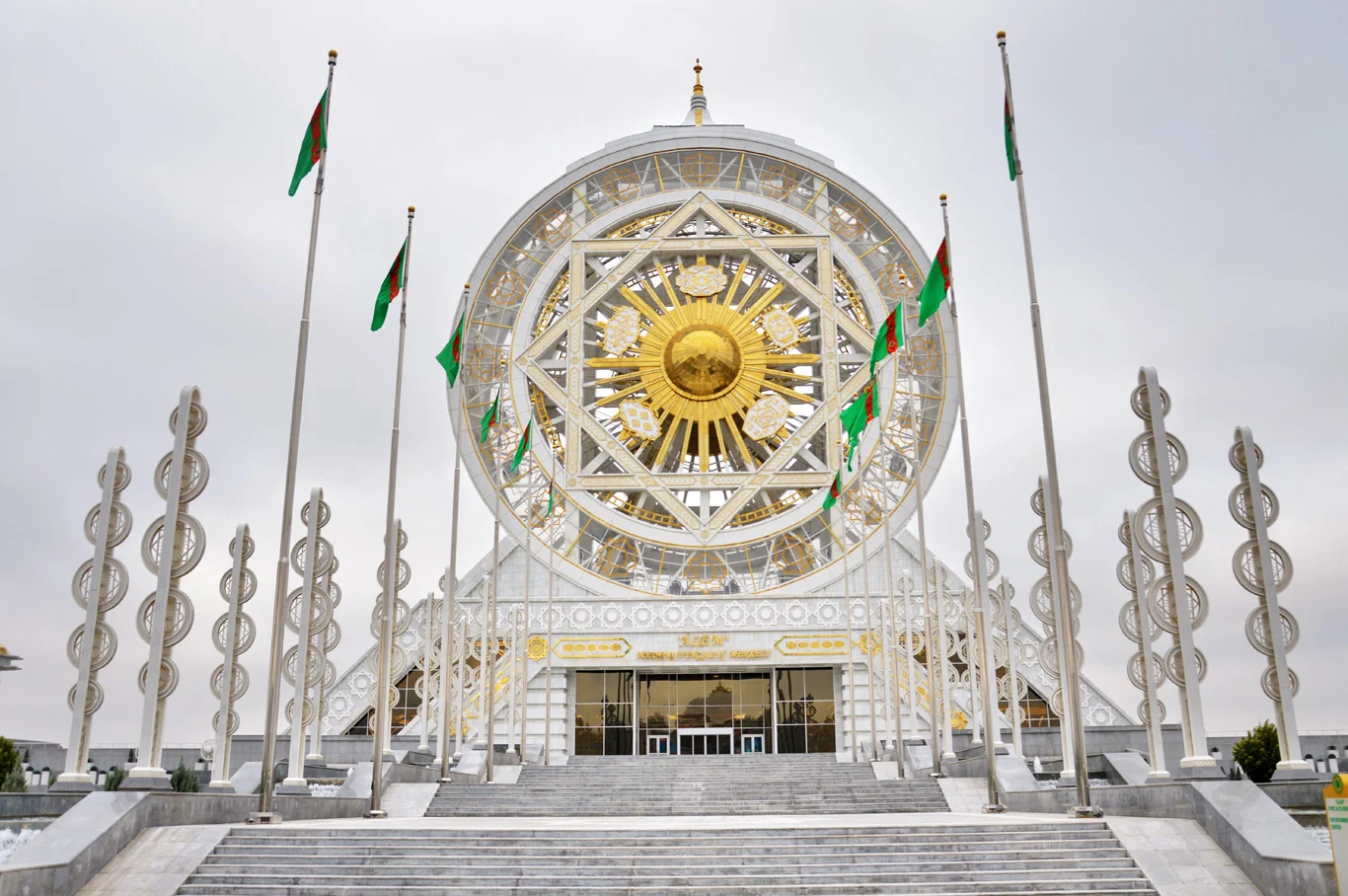
The glass-domed Alem Cultural and Entertainment Center, home to the Guinness-listed world's largest enclosed Ferris wheel, anchors a newer stretch of the city with a more contemporary, less overtly ceremonial feel than the monument core.
Central hotel district
The main international-standard hotels cluster in the central part of the city within reasonable reach of Independence Park, the Turkmen Carpet Museum and the main government buildings, which is where your operator will almost certainly book you.
A short list of marble-and-gold hotels
Ashgabat's hotel scene is small and dominated by a handful of large, formal properties built in the same marble-and-gold aesthetic as the city around them; independent guesthouses and budget hostels essentially don't exist here the way they do elsewhere in Central Asia. Your tour operator typically books your hotel as part of the package, but it's worth knowing the names.
At the top end, the Yyldyz Hotel sits in the foothills of the Kopet Dag mountains with 155 rooms and a revolving restaurant that turns slowly through a 360-degree view of the marble skyline below, one of the more memorable single meals available in the city. Closer to the government district, the Oguzkent Hotel, no longer under its former Sofitel branding but still run to an international standard, sits directly beside the Presidential Palace and is a common choice for business and diplomatic travelers as well as tourists. For a more traditional four-star feel, Hotel Nissa is an established, old-school option that predates much of the newer marble construction around it.
Plov, revolving views, and green tea on arrival
Ashgabat's dining scene is small and largely hotel-centered, mixing Turkmen staples like plov and shashlik with international menus aimed at business travelers and the diplomatic community. Meals on a guided tour are usually arranged in advance, but a couple of spots are worth knowing by name.
The Yyldyz Hotel's revolving restaurant
Set high in the hotel's tower and slowly rotating through a full view of the marble city and the mountains beyond, this is the single most memorable dining setting in Ashgabat, serving a mix of Turkmen dishes like plov and lagman alongside international staples.
CentralPark Restaurant
A rooftop restaurant near Independence Park with sweeping views over the city's neon-lit skyline after dark, serving a similar mix of Turkmen and international dishes and a popular evening spot with both visitors and Ashgabat's small expatriate community.
The marble monuments, the carpet museum, and the world's largest indoor Ferris wheel
Ashgabat's sights cluster into a manageable list that a good two days covers without rushing. Your guide sets the route and the pace, and a few of these need advance notice for tickets or timed access.
Independence Park and the marble monuments
Start at Independence Park, home to the gold-domed Independence Monument commemorating the 1991 break from the USSR, then walk the surrounding boulevards to take in the scale of the white marble government district, all part of the same building wave that earned Ashgabat its Guinness World Record for the highest concentration of white marble structures on earth, more than 500 of them at last count. The relocated Neutrality Monument, its gold statue no longer rotating to face the sun as it once did at its original site, is a short drive away and worth the stop for the story alone.
The Alem Ferris wheel and Turkmen Carpet Museum
The Alem Cultural and Entertainment Center houses the Guinness-listed world's largest enclosed Ferris wheel, a 47-meter wheel inside a glass-fronted white dome, worth riding for the view over the marble city as much as the novelty. The Turkmen Carpet Museum is a genuinely worthwhile stop for the craftsmanship alone: hand-woven carpets with tribal-specific gul patterns, including some of the largest hand-woven pieces ever recorded, laid out across several floors.
Old Nisa, just outside town
A short drive from central Ashgabat, Old Nisa is a UNESCO World Heritage Site: the earthen ruins of an early Parthian Empire capital sitting on a hilltop with views toward the Kopet Dag mountains and the Iranian border beyond. It's a quieter, more contemplative counterpoint to the marble city, and worth a half-day including the drive.
Altyn Asyr Bazaar and the Turkmenbashi Cableway
The Altyn Asyr Bazaar, one of the largest markets in Central Asia with more than 2,000 shops laid out in the shape of a traditional carpet ornament, is the closest thing Ashgabat has to unscripted street life and the best place to see the carpet tradition traded rather than displayed. The Turkmenbashi Cableway, rising into the Kopet Dag foothills just south of the city, gives a panoramic view back down over Ashgabat's white skyline and is a good late-afternoon addition if your itinerary has room.
Two days in the marble city, four with the crater
Because your guide sets the schedule, think of these as the shape a well-run itinerary takes rather than a route to book yourself. Two days covers Ashgabat properly; four adds the Darvaza gas crater overnight that most visitors consider the trip's highlight.
- Day 1
Independence Park and the monuments. The Independence Monument, the relocated Neutrality Monument, and a walk through the marble government district before the midday heat.
- Day 1, afternoon
Turkmen Carpet Museum and the Alem Ferris wheel. Carpets in the afternoon, a ride on the wheel as the light softens toward evening.
- Day 2
Old Nisa in the morning, then Altyn Asyr Bazaar for carpets, spices and Ashgabat's closest thing to street life.
- Day 2, evening
Turkmenbashi Cableway for a panoramic view over the city as the sun sets, dinner at the Yyldyz Hotel's revolving restaurant.
- Days 1-2
The two-day Ashgabat route above, at a slightly more relaxed pace.
- Day 3
Drive to Darvaza. Three hours north into the Karakum Desert, arriving before sunset, settling into a yurt camp near the crater rim.
- Day 3, night
The crater after dark, when the burning gas is at its most visually striking against the desert sky.
- Day 4
Return to Ashgabat for a final night, or connect onward toward Mary and ancient Merv if your trip continues.
Your guide drives; you don't need to think about transport
Ashgabat International Airport (ASB) is the arrival point for nearly every visitor. Turkmenistan Airlines and Turkish Airlines via Istanbul are the most reliable routes, and because your Letter of Invitation and guide arrangement is set up in advance, a driver from your tour operator meets you at arrivals rather than you arranging transport yourself. Within the city, your guide's vehicle is how you get everywhere; there is no metro, and the wide boulevards and long block distances make Ashgabat a genuinely difficult city to explore purely on foot even if you wanted to.
Best time to visit and what the seasons actually feel like in Ashgabat
Ashgabat sits in a rain shadow with a sharply continental climate: April-May and late September-October bring comfortable 18-30°C days, ideal for walking the marble boulevards and for the Darvaza overnight, which can be genuinely cold and genuinely brutal outside those windows. Summer (June to early September) regularly passes 40°C in the city and even higher in the open desert, uncomfortable and at times risky away from air conditioning. Winter brings cold, sometimes below-freezing nights, with clear desert skies that some photographers actually prefer for Darvaza despite the cold.
Priced by the day, not by the hostel bed
There's no independent-budget version of an Ashgabat trip. What you're pricing is your guided tour package, which typically bundles transport, guide, hotel and most meals into a single daily rate. Group tours run cheaper per day than private ones, and private cheaper than fully custom or luxury arrangements.
- Small scheduled group departure
- Shared vehicle and guide
- Central hotel, standard rooms
- Fixed dates, less flexibility
- Private vehicle, driver and guide
- Flexible dates within reason
- Hotels like Oguzkent or Nissa
- Most common choice for first-timers
- Yyldyz Hotel or equivalent
- Private specialist guide
- Off-circuit add-ons on request
- Priority visa and logistics handling
Genuinely low-risk, with a short list of rules to actually follow
Ashgabat rates 8.0/10 on our safety scale, in line with Turkmenistan's overall US State Department Level 1 rating, its lowest risk category. Violent crime against visitors is rare, and the mandatory guide system means you're rarely, if ever, navigating an unfamiliar situation without help nearby.
The things that actually matter here are rules, not risks: never photograph government buildings, military or police installations, the airport, or their uniformed guards, which is illegal and enforced; never change money with an unofficial street changer, which is also illegal and can lead to fines or worse; and expect your internet access to be extremely limited, with most Western apps blocked and VPN use actively detected. None of these are safety issues in the traditional sense, but treating them casually is the most common way a visitor's trip goes wrong. Emergency numbers are Fire 101, Police 102, and Ambulance 103, though in practice your guide is faster and more useful than any of them for almost anything that comes up.
Nothing here is really a same-day trip, and that's the point
Calling this chapter "day trips" would undersell what's actually involved: the crater needs an overnight, and Merv is a genuine journey. Both are worth restructuring your Ashgabat time around rather than skipping.
Darvaza Gas Crater
The single most-requested add-on to an Ashgabat trip: a roughly three-hour drive north into the Karakum Desert to a crater that has been burning continuously since 1971, when Soviet engineers ignited an escaping gas pocket and it never went out. Most operators build this as an overnight, arriving before sunset, camping in yurts near the rim, and walking out to see the flames properly after dark, before driving back to Ashgabat the next morning.
Kow Ata Underground Lake
A warm sulfur lake at the bottom of a limestone cave near the village of Bakharden, reached by descending 362 steps into a cavern that has drawn bathers for over 2,000 years. An easy half-day add-on from Ashgabat and a genuinely different experience from the marble city and the desert alike.
Ancient Merv & Mary
Not a day trip in any real sense: Mary is reached by a short domestic flight or a long desert drive, and the ruins of ancient Merv, a UNESCO World Heritage Site and one of the largest cities on earth in the 11th and 12th centuries, deserve a full day to walk properly. Worth building into a longer Turkmenistan trip rather than an Ashgabat side note.
Ashgabat FAQ
Is Ashgabat safe for tourists?
Yes. Turkmenistan rates Level 1 on the US State Department scale, its lowest risk category, and violent crime against visitors is rare. Your guide handles most day-to-day friction, from checkpoints to currency, which removes a lot of the usual first-time-city stress.
How many days do I need in Ashgabat?
Two full days covers the marble monuments, the Turkmen Carpet Museum and Old Nisa properly. Add a third and fourth day for the Darvaza gas crater overnight, which most visitors combine with an Ashgabat stay rather than skip.
How much does an Ashgabat trip cost per day?
There's no independent budget option. Costs run with your tour package: roughly $150-250 a day on a group tour, $250-450 on a private tour, and $450 or more for custom or luxury arrangements, usually including guide, transport and most meals.
Can I visit Ashgabat without a guide?
No, not on a standard tourist visa. A licensed guide accompanies you for the whole trip as a condition of entry, not an optional add-on, and your itinerary is approved in advance.
When is the best time to visit Ashgabat?
April-May and late September-October. Summer regularly passes 40°C and winter nights can drop below freezing, so the shoulder seasons give the most comfortable walking weather for the marble boulevards and the Darvaza overnight.
How do I get from Ashgabat airport to the centre?
Your tour operator arranges airport pickup as part of the visa and guide process, and a driver will be waiting for you at arrivals. This isn't optional infrastructure to skip, it's built into how entry works.
Can I use WhatsApp, Instagram or a VPN in Ashgabat?
Assume not reliably. Most Western social media and messaging apps are blocked at the network level, and VPN use is actively detected and can get your connection cut. Download what you need offline before you arrive.
Do I need to speak Turkmen or Russian in Ashgabat?
No. Your guide translates throughout the trip, and major hotels have some English-speaking staff. Outside those settings English is limited, which is one more reason the guide system matters practically, not just legally.
What is the Darvaza gas crater day trip like from Ashgabat?
It's really an overnight, not a day trip: about three hours' drive north into the Karakum Desert, arriving before sunset, camping near the rim in a yurt camp, and walking out to see the flames after dark before returning to Ashgabat the next day.
What Stays With You
Ashgabat doesn't try to charm you the way most capitals do. There's no old town to get lost in, no neighborhood bar scene, no version of the city that exists outside the one built deliberately and shown to you on a set route. And yet almost everyone who visits describes the same thing afterward: standing on an empty marble boulevard at dusk, gold domes catching the last light, genuinely unsure they've ever seen anywhere quite like it, and then, a few hours later, watching a hole in the desert burn under the stars at Darvaza.
Go with the paperwork done, cash in hand, and your expectations reset. What's on the other side is one of the most singular capitals left to see.