
A capital that runs on its own confident logic
Seoul is a city of ten million people that somehow still feels legible: the subway is fast, cheap and signed in English, the neighbourhoods have distinct personalities you can feel within a block of arriving, and the food is exceptional whether you're spending ₩3,000 on a market snack or ₩30,000 on a Korean BBQ dinner. It's also a genuinely 24-hour city in the districts that matter, Hongdae and Gangnam stay loud past 3am, while Gyeongbokgung's palace grounds a fifteen-minute walk away close at 6pm like nothing has changed in five hundred years.
What surprises most first-time visitors is how fast the culture they already know from K-pop and K-dramas resolves into something more specific and textured in person: the actual agency buildings in Gangnam, the actual market where the Netflix noodle lady still ladles broth by hand, the actual DMZ that's been a live front line since before most visitors' parents were born. None of it is staged for tourists, and that's exactly why it lands.
The honest complications
Taxi overcharging against foreign tourists rose sharply through 2026, severe enough that Seoul authorities launched a dedicated 100-day crackdown; always confirm the meter is running or use a ride-hailing app instead. Spring and autumn, the best weather windows, are also the most crowded and highest-priced weeks to visit, and Gyeongbokgung's central courtyards can feel genuinely packed by mid-morning in cherry blossom season. And English fluency drops noticeably once you leave the main tourist corridors of Myeongdong, Hongdae and the palace district; a translation app earns its keep in Busan-style local restaurants and anywhere off the well-worn path.
Five neighbourhoods, five different cities
Seoul's neighbourhoods don't blend into each other the way a lot of big cities do; crossing from Insadong into Hongdae feels like changing channels. Where you base yourself shapes the whole trip more than in most cities this size.
Myeongdong
Seoul's ultimate shopping and street-food hub, and the most convenient base for a first visit: Gyeongbokgung, N Seoul Tower and Insadong are all within about fifteen minutes by subway. The pedestrian streets turn into a street-food corridor from late afternoon, and it's the district most geared toward English-speaking visitors.
Hongdae
Named for Hongik University, this is Seoul's nightlife and indie-culture district: bars, clubs, street performers and Asia's strongest hostel scene, with quality hostel beds from around ₩25,000 and guesthouse doubles from ₩50,000. Stay here for the energy and the value; expect noise on weekend nights.
Insadong & Jongno
The district for travellers prioritising history: Gyeongbokgung, Bukchon Hanok Village and Insadong's antique shops and tea houses all sit within walking distance of each other. Quieter at night than Myeongdong or Hongdae, and the most atmospheric base for a culture-focused trip.
Gangnam
South of the river, Gangnam is Seoul's glossiest district: department stores, fine dining, and the entertainment agency buildings that anchor a lot of K-pop tourism. A good base for nightlife and dining rather than historic sightseeing, and well connected by subway to everywhere else.
Itaewon
Seoul's most international neighbourhood, historically built around the nearby US military presence, with the city's best concentration of non-Korean restaurants and a lively, mixed nightlife scene. Useful as a change of pace rather than a first base.
From five-star towers to the best hostels in Asia
Seoul's accommodation scene runs from some of the most talked-about five-star hotels in Asia down to a hostel culture that regularly wins global awards, and the mid-range is full of design-forward boutique properties priced well below equivalent Tokyo rooms. These picks span every budget.
At the top, The Shilla Seoul is Korea's benchmark five-star property, owned by the Samsung family's hospitality arm and blending traditional Korean design with a genuinely serious level of service; expect rates from around $350 a night. Inside Lotte World Tower, Signiel Seoul occupies the upper floors of Korea's tallest building, with panoramic city views that few hotels anywhere can match, while Four Seasons Hotel Seoul near Gwanghwamun offers 317 rooms and suites, a locally inspired spa, and a central location a short walk from Gyeongbokgung.
In the boutique bracket, Hotel28 Myeongdong, a member of Small Luxury Hotels of the World with a cinematic design theme and an excellent breakfast spread, is one of the strongest mid-range picks in the neighbourhood, while Ryse, Autograph Collection in Hongdae leans into the district's art-and-edge identity with bold contemporary rooms and a rooftop bar.
At the budget end, Hongdae's hostel scene is genuinely one of the best in Asia: dorm beds run roughly ₩25,000-28,000 and guesthouse doubles from about ₩50,000, usually with breakfast and a social common area included. Book directly through hostel-focused platforms or Booking.com and read recent reviews, since the scene turns over quickly with new openings.
Market stalls that outclass restaurants, and BBQ smoke everywhere
Seoul's food scene rewards wandering into markets as much as booking restaurants. The best single meal in the city might cost ₩6,000 from a stall that's been in the same spot for decades, while the tabletop BBQ scene delivers a genuinely social, structured dining experience at every price point above that.
Gwangjang Market
Seoul's quintessential food market, over a century old and featured on Netflix's "Street Food Asia," is the single best introduction to Korean street eating: bindaetteok mung-bean pancakes, mayak gimbap, tteokbokki and kimchi dumplings from stalls that have run for generations. The market's best-known vendor, Cho Yonsoon, has hand-stretched kalguksu noodles at her stall for nearly thirty years and was the subject of the Netflix episode that put the market on the international map. Go hungry and share plates between several stalls rather than filling up at the first one.
Korean BBQ
Wangbijib in Myeongdong is one of the most popular Korean BBQ restaurants for first-time visitors: staff communicate in English and Chinese and will grill the meat for you if you'd rather not manage the tabletop grill yourself. For a soup-focused alternative, Myeongdong Kyoja has served kalguksu, hand-cut noodle soup in a rich broth, since 1966 and remains one of the neighbourhood's most consistent addresses.
Korean Fried Chicken & Soju
Double-fried, shatteringly crisp, and usually glazed in soy-garlic or a spicy gochujang sauce, then eaten with beer or soju, a pairing popular enough to have earned its own portmanteau, chimaek. Hongdae and Gangnam have the highest concentration of chicken-and-beer spots that stay open well past midnight.
Bibimbap & Banchan
Rice topped with seasoned vegetables, meat and a fried egg, mixed table-side with gochujang chili paste, arrives everywhere with a rotating, unlimited spread of banchan side dishes, kimchi chief among them. One of the easiest, most approachable first meals in the city.
Palaces by morning, markets by night
Seoul's sights cluster tightly enough that a well-planned day can cover a palace, a market and a viewpoint without much backtracking. A handful of experiences benefit from timing your visit deliberately.
The palace district
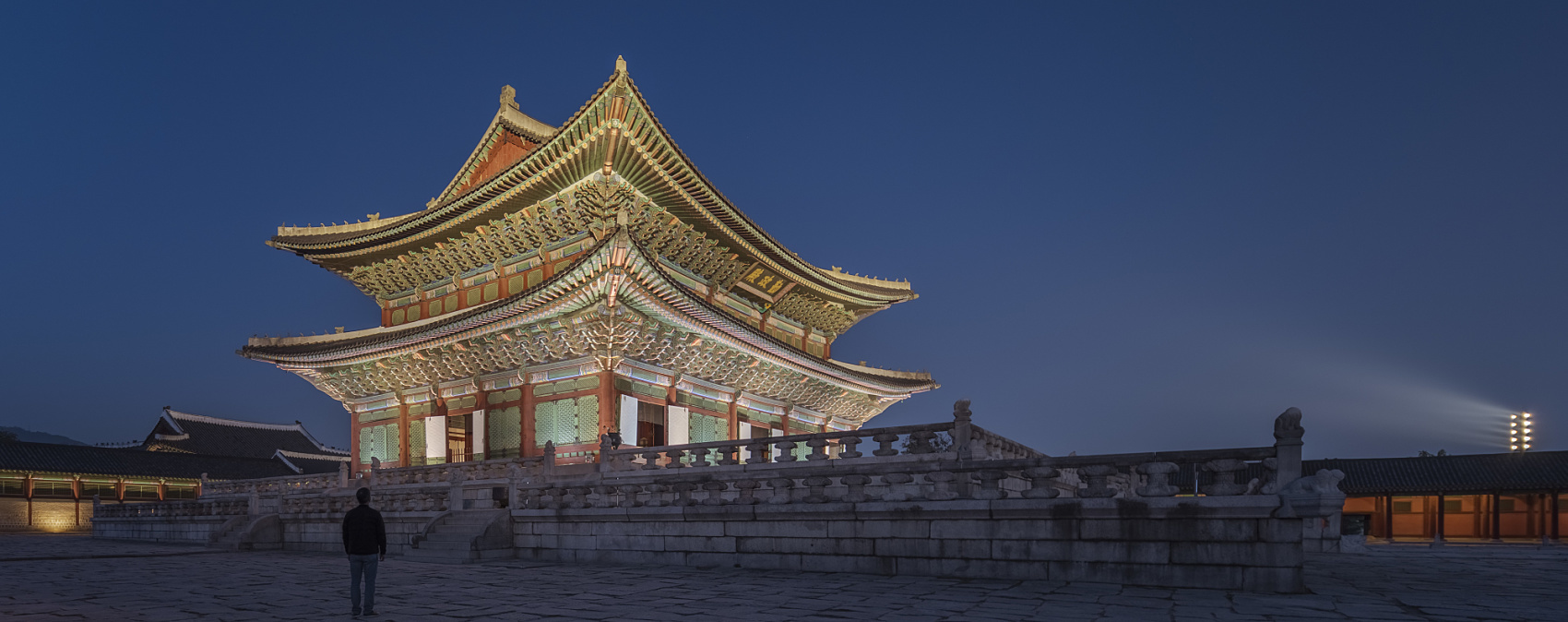
Gyeongbokgung Palace, the largest and grandest of Seoul's five Joseon-era palaces, is the essential first stop: a 40-hectare complex with the Geunjeongjeon throne hall and the Gyeonghoeru pavilion on its man-made island as highlights. Admission costs ₩3,000, but wearing a hanbok, traditional Korean dress rented from one of the shops clustered near Exit 5 of Gyeongbokgung Station for roughly ₩10,000 and up for 2 to 4 hours, gets you in free and is genuinely one of the more memorable ways to see it. Time your visit for the Changing of the Guard Ceremony in the main courtyard. Immediately north, Bukchon Hanok Village's narrow lanes of preserved traditional houses climb a hillside with skyline views that are best at sunset, when the tour groups have mostly cleared out.
Markets and shopping streets
Gwangjang Market earns a slot on any itinerary for the food alone, but it's also worth an hour of pure browsing. Myeongdong's pedestrian streets combine high-street fashion, skincare shops and the city's densest street-food corridor, transforming into a different, livelier place after dark. Insadong's antique shops and traditional tea houses are the calmer counterpoint, good for a slower afternoon between palace visits.
Views and evenings
N Seoul Tower, on Namsan mountain, has the city's definitive panoramic view, especially striking as the lights come on at dusk; observatory tickets run from around $15 and are worth booking online to skip the queue. For evenings, Hongdae delivers Seoul's most concentrated nightlife: bars, clubs, street performers and a genuinely youthful energy that runs until sunrise on weekends, while Gangnam offers a more polished, dressed-up version of the same idea.
One, two or three days, planned neighbourhood by neighbourhood
Three full days covers Seoul properly, including one day trip; even a single well-planned day delivers the core experience. Each route is built around subway connections and ends somewhere worth being after dark.
- Morning
Gyeongbokgung and Bukchon. Palace grounds at opening, the Changing of the Guard Ceremony, then up through Bukchon Hanok Village.
- Midday
Insadong and lunch. A wander through the antique shops, then a bibimbap or noodle lunch nearby.
- Afternoon
Gwangjang Market. Bindaetteok, mayak gimbap and kalguksu from several stalls; leave room for more than one dish.
- Evening
N Seoul Tower at sunset, then Korean BBQ back in Myeongdong.
- Day 1
The one-day route: Gyeongbokgung, Bukchon, Insadong, Gwangjang Market, N Seoul Tower.
- Day 2 morning
Myeongdong shopping and street food, starting before the crowds build.
- Day 2 afternoon
Gangnam. Department stores, cafes and, for K-pop fans, the entertainment agency districts.
- Day 2 evening
Hongdae nightlife. Korean fried chicken and soju, then the bars and street performers into the night.
- Days 1-2
The two-day route above, at a gentler pace.
- Day 3
DMZ day trip. A full or half-day organised tour to the Demilitarized Zone, passport required; back in Seoul by evening for a final dinner in Itaewon or Myeongdong.
One of the easiest big cities in the world to navigate
Seoul's subway network is fast, frequent, English-signed and genuinely one of the best in the world. From Incheon Airport (ICN), the AREX all-stop train reaches Seoul Station in about an hour for roughly ₩5,000; the faster nonstop AREX Express costs more, in the ₩9,000-14,000 range depending on where you book, for a journey closer to 45 minutes. A taxi from the airport takes about the same time in traffic and costs considerably more.
Get a T-money card (₩2,500 for the card plus whatever credit you load, refundable minus a small fee at any convenience store) on arrival: it covers the subway, buses, the AREX train and most taxis nationwide, with free transfers between subway and bus within 30 minutes. Subway rides start around ₩1,400-1,550 with the card. Taxis are cheap by international standards, base fare around ₩4,800 for the first 1.6km, but always confirm the meter is on or use the Kakao T ride-hailing app, which shows the fare upfront and has become the safer default given 2026's rise in overcharging complaints against foreign tourists.
Best time to visit and cherry blossom timing
Seoul has four distinct seasons. April-May and September-November are the sweet spots: mild temperatures, clear skies, and either cherry blossoms or autumn foliage depending on the month, though these are also the city's busiest and most expensive weeks. Summer (June-August) is hot, humid and prone to monsoon downpours; winter (December-February) is cold, sometimes snowy, and by far the cheapest and quietest time to visit, with hotel prices often 30-50% below peak.
Cherry blossoms typically peak in early April, though a few days of "yellow dust" blowing in from Chinese and Central Asian deserts can affect air quality in March-April. Autumn foliage is usually at its most vivid in the last week of October into early November.
One of Asia's best-value capital cities
Seoul is significantly cheaper than Tokyo, Hong Kong or Singapore for comparable quality. The hostel scene is excellent at the budget end, the mid-range boutique hotel market is genuinely affordable, and the main cost trap is tourist-menu restaurants right next to major palace entrances.
- Hostel dorm ₩25,000-28,000
- Street food & markets ₩10,000-20,000
- T-money subway & bus
- Free palace visit in hanbok, plus one paid sight
- Boutique hotel ₩120,000-220,000
- Korean BBQ & restaurant meals
- T-money plus the occasional taxi
- N Seoul Tower, hanbok rental, a museum
- The Shilla or Signiel Seoul
- Tasting menus and premium BBQ
- Private guided tours
- DMZ or Nami Island private day trip
One of the safest capitals in the world, with one real catch
Seoul rates 8.2/10 on our safety scale. Violent crime against tourists is extremely rare, the city is safe to walk at night including the subway and nightlife districts, and Korea's dense CCTV coverage discourages most opportunistic crime. Seoul is also excellent for solo female travellers: harassment is uncommon, streets and subways stay busy and well-lit into the early hours, and solo women routinely walk alone at night without incident.
The one thing that actually catches visitors: taxi overcharging, which rose sharply enough through 2026 that Seoul authorities launched a dedicated 100-day crackdown and expanded a multilingual QR-code reporting system inside licensed taxis. Reported cases have included meters left off and fares many multiples of the correct amount, including a widely reported case of a tourist charged roughly ten times the standard fare between eastern Seoul and Incheon Airport. Always confirm the meter is running before the car moves, or use the Kakao T app, which shows the fare upfront. Beyond that, standard bag awareness in crowded markets and nightlife strips is all the vigilance Seoul requires. Emergency numbers are 112 for police and 119 for fire and ambulance, both with English-speaking operators; the Korea Tourism Organization's 1330 hotline covers everything else in 8 languages.
The DMZ alone justifies a fourth day in Seoul
Seoul's position makes it an outstanding base for a handful of very different day trips, from a sobering look at the world's most fortified border to a lakeside island made famous by a Korean drama.
The DMZ
The Demilitarized Zone, the 4km-wide buffer along the border with North Korea, is Seoul's most-visited day trip and one of the most unusual anywhere in the world: still, technically, a live front line under a 1953 armistice rather than a peace treaty. Entry is permitted exclusively through organised tours booked well in advance, and you must bring your passport. This is the most expensive standard day trip from Seoul precisely because a guide is mandatory, not optional.
Suwon Hwaseong Fortress
A massive, remarkably well-preserved 18th-century stone fortress wall stretching about 5.5km, walkable in its entirety, and easily reached on Seoul Metro Line 1 to Suwon Station followed by a local bus. A good half-day trip that needs no organised tour.
Nami Island
A tree-lined island in the Bukhan River, reached by a short ferry crossing, known for its photogenic avenues and a slower, nature-focused pace than the city. Popular enough as a day trip that combined Nami Island, DMZ and Everland tour packages are widely available for travellers short on time.
Everland
Located in Yongin, reachable via the Everline from Giheung Station or direct buses from Gangnam and Jamsil, Everland is the reliable full-day family outing: rides, a safari zone and seasonal festivals that make it worth planning a specific day around.
Seoul FAQ
Is Seoul safe for tourists?
Seoul is one of the safest big cities in the world for tourists. Violent crime is extremely rare and the subway and streets feel safe well past midnight; the main issue foreign visitors report is taxi overcharging, not crime.
How many days do I need in Seoul?
Three full days covers the essentials well: one for Gyeongbokgung and Bukchon, one for markets and Myeongdong shopping, one for Hongdae and a slower neighbourhood. A fourth day fits the DMZ or Nami Island and is worth adding.
How much does Seoul cost per day?
Budget travellers manage on $40-70 a day using hostels and street food; mid-range runs $100-200. Seoul is noticeably cheaper than Tokyo or Hong Kong for comparable quality accommodation and dining.
When is the best time to visit Seoul?
April-May for cherry blossoms and September-November for autumn foliage are the sweet spots: mild weather and manageable crowds, though also the busiest and priciest weeks of the year. Summer is hot and humid; winter is cold but cheap and quiet.
How do I get from Incheon Airport to central Seoul?
The AREX all-stop train reaches Seoul Station in about an hour for roughly ₩5,000; the nonstop AREX Express costs more (around ₩9,000-14,000) for a 45-minute ride. A taxi runs considerably more and takes about the same time in traffic.
What is the best area to stay in Seoul?
Myeongdong for first-timers: central, well connected, close to shopping and street food. Hongdae for nightlife and the best budget hostels. Insadong or Jongno for palace access and a quieter, more traditional base.
Do I need to speak Korean in Seoul?
No. English signage covers the subway, airports and most tourist areas, and Hangul, the Korean alphabet, is phonetic enough to sound out within a few hours. A translation app helps outside the main tourist zones.
Is Seoul walkable?
Yes, especially the palace district, Myeongdong, Insadong and Hongdae, all connected on foot or by a short subway ride. Some hills exist around Namsan and Bukchon, but nothing like Lisbon or Porto's inclines.
What is a T-money card and do I need one?
Seoul's reloadable transit card: about ₩2,500 for the card plus credit, refundable minus a small fee. It covers the subway, buses, the AREX airport train and most taxis, and pays for itself within a day or two of city travel.
Can I visit the DMZ from Seoul?
Yes, but only through an organised tour booked in advance; independent entry isn't permitted. Tours run roughly ₩55,000-85,000, take a full or half day, and require bringing your passport.
What Stays With You
Seoul doesn't perform its contrasts for visitors, it just lives inside them constantly. A palace guard in five-hundred-year-old dress standing in front of a glass tower, a grandmother running the same market stall for thirty years two streets from a K-pop agency building, a heavily fortified border an hour away that's also, somehow, a normal tour bus stop with a gift shop: none of it resolves into one tidy story, and that's exactly why it's worth the trip.
Get a T-money card on day one, eat at Gwangjang Market before you eat anywhere else, and go in with an appetite for contrast as much as for food.