

What You're Actually Getting Into
South Korea is the country that keeps surprising first-time visitors with how easy it is. The transport is fast and the signage is in English everywhere that matters, the food is exceptional at every price point, and the culture, exported for a decade now through K-pop and K-dramas, turns out to be even more specific and interesting in person than on a screen. It rewards a first trip and a second one differently: Seoul for the palaces, the markets and the pace; Busan and Jeju for the coast; Gyeongju for the thousand-year-old kingdom most visitors never knew was there.
The country is also compact in a way that changes how you plan. The KTX high-speed rail puts Busan, on the opposite coast from Seoul, two and a half hours away. A trip that would take a week of driving in most countries fits into a long weekend here, which is why seven to nine days routinely covers two or three of Korea's best regions rather than just one.
The honest complications
Korea's tourist infrastructure is excellent, but its foreigner-facing service infrastructure has real gaps: taxi overcharging complaints against foreign tourists rose sharply through 2026, and it's the single most common thing that catches visitors off guard. Summer (June to August) is genuinely uncomfortable, hot, humid and prone to monsoon downpours, and spring and autumn, the best travel windows, are also the most crowded and highest-priced weeks of the year. Korea is also less globally fluent in English outside Seoul's tourist core than its reputation suggests; Busan and rural areas require more patience, a translation app, and a willingness to point at a menu photo.
A History Worth Knowing
Korea's modern story is one of the most dramatic national turnarounds of the 20th century: a peninsula annexed by Japan, split in half after liberation, devastated by a war that never formally ended, and rebuilt within two generations into one of the world's largest economies and a global cultural export machine. Understanding the shape of that story changes how the palaces, the DMZ day trips, and even the food make sense.
- 1392–1910
The Joseon Dynasty. Korea's longest and final royal dynasty, 518 years, built Confucian social order, the Hangul alphabet, and the palaces, including Gyeongbokgung, that anchor Seoul's old center today.
- 1910–1945
Japanese colonial rule. Japan formally annexed Korea in 1910; language, culture and identity were suppressed for 35 years until Japan's defeat in World War II.
- 1948
Division. The peninsula splits along the 38th parallel into the Republic of Korea in the south, founded 15 August 1948, and the communist north.
- 1950–1953
The Korean War. Three years of war end in an armistice, not a peace treaty; the two Koreas remain technically at war, and the DMZ that resulted is now one of Seoul's most-visited day trips.
- 1960s–1980s
The Miracle on the Han River. Rapid state-led industrialization transforms a war-shattered economy into a manufacturing and export power within a single generation.
- 1987–present
Democratization and the Korean Wave. Direct presidential elections return in 1987; from the 2000s, K-pop, K-drama and Korean cinema turn Korean culture into one of the country's most effective forms of soft power.
Read the full history: Joseon, colonization, war and the Hallyu wave
The Joseon Dynasty, founded in 1392 by Yi Seong-gye, governed Korea for over five centuries under a strict Confucian order that shaped everything from family hierarchy to architecture. King Sejong the Great, who reigned 1418 to 1450, created Hangul, the phonetic Korean alphabet, specifically so that ordinary people who couldn't read Chinese characters could become literate; it is still considered one of the most scientifically designed writing systems in the world and is a genuine source of national pride.
Japan's 1910 annexation ended the dynasty and began 35 years of colonial rule that suppressed Korean language, forced name changes, and extracted resources and labor for the Japanese war effort, a period Koreans generally remember with lasting bitterness that still surfaces in regional diplomacy today. Liberation in 1945 immediately produced division: Soviet forces occupied the north, American forces the south, along the 38th parallel, and what was meant to be temporary became permanent when the Korean War broke out in 1950. The war killed an estimated 2-3 million people and ended in a 1953 armistice, not a treaty, meaning the two Koreas remain, technically, still at war. The Demilitarized Zone that resulted, one of the most heavily fortified borders on Earth, is now a strange, sobering, and genuinely popular day trip from Seoul.
What followed the war is often called the Miracle on the Han River: under President Park Chung-hee's authoritarian but export-focused industrial policy, South Korea transformed from one of the poorest countries on Earth into a manufacturing powerhouse within about 30 years, building the conglomerates, Samsung, Hyundai, LG, that still dominate the economy. Democratization arrived in 1987 after sustained student and labor protest, and from the 2000s onward the country's cultural exports, K-pop groups, Korean dramas, and films like Parasite, turned Korean soft power into a genuine global phenomenon known as Hallyu, the Korean Wave. Walking through Gangnam or Hongdae today, both the economic transformation and the cultural confidence that followed it are fully on display.
Top Destinations
South Korea divides naturally into four travel zones most first and second trips draw from: the capital region, the southern coast around Busan, the volcanic island of Jeju, and the ancient capital of Gyeongju. The KTX high-speed rail connects all of them well enough that a single well-planned trip can realistically cover two or three.
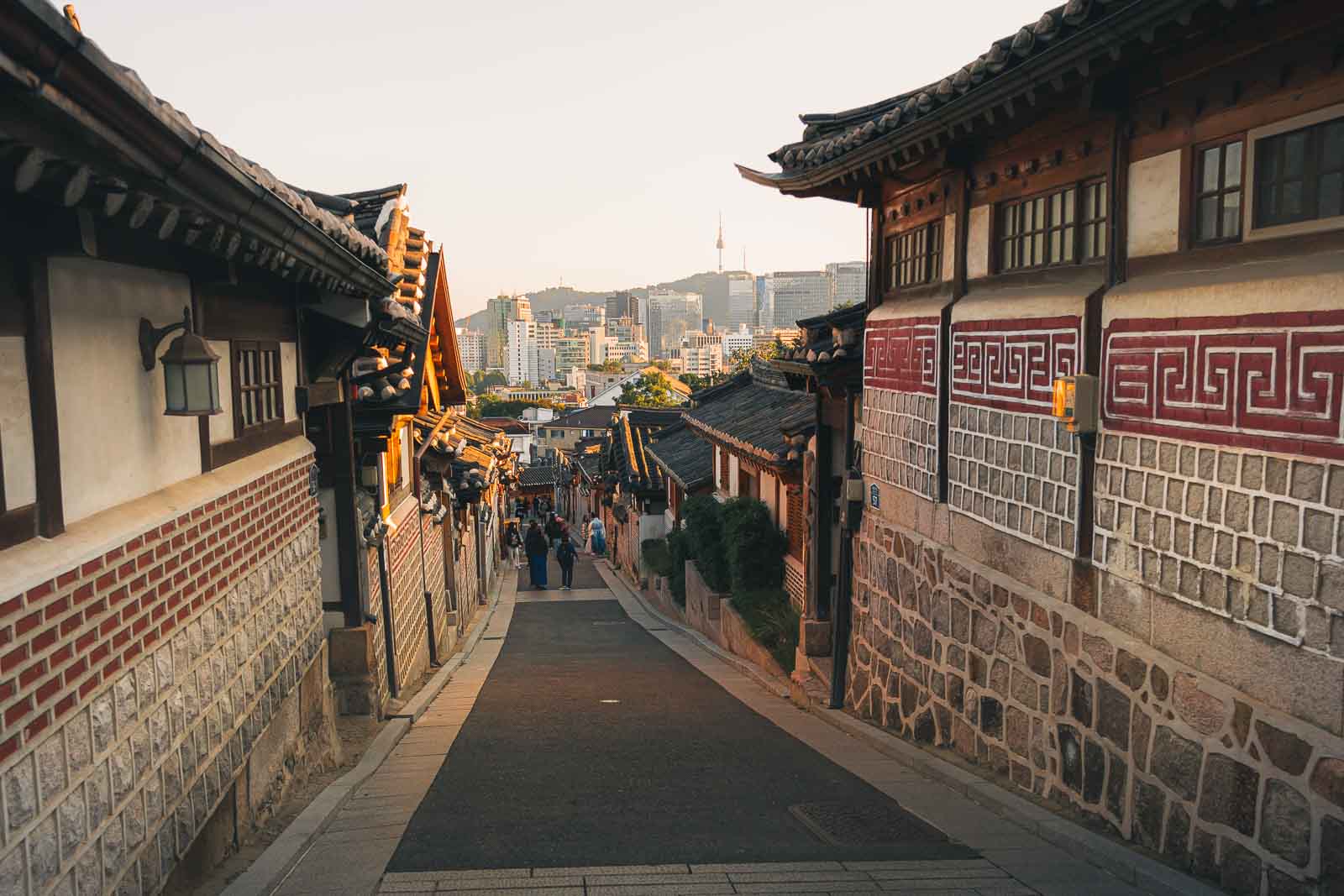
Seoul, palaces and pace
Seoul is the reason most people book the trip and the reason they come back. Five Joseon-era palaces, Gyeongbokgung the grandest among them, sit minutes from Myeongdong's shopping streets and Hongdae's nightlife. It has its own dedicated complete city guide covering neighborhoods, food, a full itinerary and day trips including the DMZ, so this section stays brief: budget at least three full days, more if Gyeongbokgung, Bukchon and a night out in Hongdae are all non-negotiable.
Busan, the coast and the fish market
Korea's second city and its major port sits two and a half hours from Seoul by KTX and feels like a different country: beaches, mountains dropping straight into the sea, and a slower rhythm than the capital. Gamcheon Culture Village, a hillside neighborhood of pastel-painted houses turned into a public art project, has earned its nickname as the "Machu Picchu of Busan" for the way it terraces down toward the water. Jagalchi Market, the country's largest seafood market, is the place to eat what was swimming that morning, cooked to order at the stall you bought it from. Haeundae Beach is the city's most developed stretch of sand and the base most first-time visitors choose.
Jeju, the volcanic island
Jeju Island, a short domestic flight from Seoul or Busan, is South Korea's honeymoon and nature destination, built on an extinct shield volcano and often nicknamed the "Hawaii of Korea." Hallasan, the volcano itself and the country's tallest peak, anchors a national park with hiking trails for a full range of fitness levels. The coastline mixes black volcanic rock, waterfalls and beaches with a genuinely subtropical microclimate compared to the mainland, warm enough for swimming considerably earlier and later in the year than Seoul or Busan.
Gyeongju, the thousand-year capital
Gyeongju was the capital of the Silla Kingdom for close to a thousand years, and it's often described as a museum without walls: royal burial mounds sit in the middle of the modern town, and two UNESCO World Heritage Sites anchor a day or two of unhurried, low-crowd history. Bulguksa Temple, dating to the 8th century, is one of Korea's most significant Buddhist temples, and Seokguram Grotto, a granite hermitage holding a monumental seated Buddha above the temple, was built as its companion site. Neither gets the crowds Seoul's palaces do, which is most of the appeal.
Culture & Etiquette
Korean social life still runs on Confucian ideas of hierarchy, age and respect, even in a country that feels thoroughly modern on the surface. None of it is difficult for a visitor to navigate, and Koreans don't expect foreigners to get it perfectly, but a handful of small habits go a long way toward not looking like you just arrived.
Do
- Take your shoes off indoors. Homes, many restaurants with floor seating, guesthouses and some temple buildings expect shoes off at the entrance; follow whatever the people around you are doing.
- Use two hands for giving and receiving. Handing over money, a business card, or a gift with both hands, or supporting your handing arm with the other, reads as respectful.
- Let elders eat or drink first. At a shared meal, wait for the oldest person at the table to start, and if someone pours you a drink, hold your glass with both hands.
- A polite nod is enough. Foreigners aren't expected to bow deeply; a small nod of acknowledgment when greeting or thanking someone is appropriate and appreciated.
- Get a T-money card immediately. It covers the subway, buses, most taxis and even some convenience stores in every major city, and pays for itself within a day or two.
Don't
- Stick chopsticks upright in a bowl of rice. It resembles incense offered to the dead and is one of the few genuinely strong table taboos.
- Tip. Korea has no tipping culture; leaving cash on a restaurant table is more likely to cause confusion than gratitude, and staff may chase you down to return it.
- Get in an unmetered or unofficial taxi. Confirm the meter is running or agree a fare before you get in; overcharging foreign tourists at airports and tourist sites has become common enough that authorities launched a dedicated crackdown in 2026.
- Assume everyone speaks English outside Seoul's tourist core. A translation app and a pointed finger at a menu photo go further in Busan or rural areas than assumed fluency.
- Write a name in red ink when giving a card or note to someone; traditionally associated with death, it's a minor but real superstition still observed by older Koreans.
Deeper culture: Confucian hierarchy, Hangul, and the Korean Wave
Confucian hierarchy. Age and social position still shape how Koreans address each other, from honorific speech levels in the language itself to who pours whose drink at dinner. Visitors aren't expected to master any of it, but noticing it explains a lot of the small formalities around you.
Hangul. The Korean alphabet, created under King Sejong in the 15th century specifically to make literacy accessible, is phonetic and genuinely learnable: most visitors can sound out signs within a few hours of focused effort, which makes Korea considerably easier to navigate on foot than countries using logographic scripts.
Hallyu, the Korean Wave. K-pop, K-drama and Korean cinema have become one of the country's most visible cultural exports since the 2000s, and neighborhoods like Hongdae and the entertainment agency districts of Gangnam are shaped in part by that industry's presence: themed cafes, agency buildings, and fans making pilgrimages are now a normal part of the streetscape.
Food & Drink
Korean food is built around fermentation, shared grilled meat, and a spice profile that ranges from barely-there to genuinely fierce. It's also one of the best value cuisines in Asia at every price point: a full sit-down meal with side dishes routinely costs less than a fast-food combo would at home.
Korean BBQ ₩15,000-30,000/pp
Tabletop grilling of marinated or plain cuts of beef and pork, wrapped in lettuce with garlic, ssamjang paste and rice. A shared, social meal more than a quick dinner; order in a group and keep the banchan side dishes coming.
Kimchi & Banchan
Fermented, spiced napa cabbage is Korea's defining dish and arrives free and unlimited with almost every meal, alongside a rotating spread of smaller banchan side dishes: seasoned spinach, bean sprouts, pickled radish.
Soju ₩3,000-5,000/bottle
Korea's clear, mild spirit, drunk neat in shots and shared, not sipped alone. Poured for you by others at the table with two hands, in keeping with the age-hierarchy drinking customs, and cheap enough at convenience stores to be a genuine national habit.
Bibimbap ₩8,000-12,000
Rice topped with seasoned vegetables, meat, a fried egg and gochujang chili paste, mixed together at the table. One of the more approachable dishes for a first meal in Korea, and widely available.
Tteokbokki & Street Food ₩3,000-8,000
Chewy rice cakes in a spicy-sweet gochujang sauce, sold from street carts and market stalls everywhere, alongside mung-bean pancakes, gimbap rolls and skewered fish cakes.
Korean Fried Chicken ₩18,000-25,000
Double-fried for a shatteringly crisp skin, glazed in soy-garlic or spicy sauce, and eaten with beer, a pairing popular enough to have its own portmanteau, chimaek. A genuinely different animal from Western fried chicken.
When to Go & Itineraries
April to May and September to November are Korea's best windows: mild temperatures, cherry blossoms in spring, and vivid foliage in autumn, though these are also the busiest and most expensive weeks of the year. Summer (June-August) is hot, humid and monsoon-prone; winter (December-February) is cold, sometimes snowy, and by far the cheapest and quietest time to visit.
All four seasons compared, with temperatures
| Season | Verdict | Temps | Prices & crowds |
|---|---|---|---|
| Apr-May | Best | 5-20°C | Cherry blossoms, peak crowds and prices |
| Sep-Nov | Best | 10-20°C | Autumn foliage, second peak season |
| Jun-Aug | Hot & humid | 25-30°C | Monsoon rain, lower flight prices |
| Dec-Feb | Cold, quiet | -5 to 5°C | Lowest prices, snow, fewest tourists |
Early April typically brings peak cherry blossom season, though a few days of "yellow dust" blowing in from Chinese and Central Asian deserts can affect air quality in March-April. Late October into early November is usually the most vivid autumn color nationwide.
Itineraries
Korea's fast rail network means these itineraries assume no rental car. Seven days is enough for a first, focused trip; two weeks opens up the whole country without feeling rushed.
- Days 1-4
Seoul. Gyeongbokgung and Bukchon Hanok Village, Myeongdong and Insadong, Hongdae by night, and one day trip to the DMZ. Full detail in the Seoul city guide.
- Days 5-7
Busan. KTX from Seoul (2.5 hrs), Gamcheon Culture Village, Jagalchi Market, and a slower pace at Haeundae Beach before flying or training home.
- Days 1-5
Seoul, extended. The full city guide itinerary plus a slower pace, additional neighborhoods, and the DMZ or Nami Island day trip.
- Days 6-7
Gyeongju. KTX to Gyeongju, Bulguksa Temple, Seokguram Grotto, and the royal tombs in the town center.
- Days 8-10
Busan. Gamcheon Culture Village, Jagalchi Market, Haeundae Beach.
- Days 11-14
Jeju Island. Short flight from Busan or Seoul; Hallasan National Park, the volcanic coastline, and a genuinely different pace to close the trip.
- Days 1-6
Seoul extended. Every major neighborhood, both DMZ and Nami Island or Suwon day trips, and time built in for K-pop, shopping, or museum detours.
- Days 7-9
Gyeongju. An unhurried pace through the Silla heritage sites and surrounding countryside.
- Days 10-13
Busan. The city plus a side trip along the southern coast.
- Days 14-18
Jeju Island. A longer stay with time for Hallasan hiking and the island's quieter western and southern coasts.
- Days 19-21
Back to Seoul. A final slow stretch for anything missed the first time, and departure.
Getting there & around
Incheon International Airport (ICN), about an hour from central Seoul, is the main international gateway; Gimpo Airport (GMP), closer to the city, handles mostly domestic and some regional Asian routes. From Incheon, the AREX airport railway reaches Seoul Station: the all-stop service costs roughly ₩5,000 and takes about an hour, while the faster nonstop Express costs more (roughly ₩9,000-14,000) for a journey closer to 45 minutes. Between cities, the KTX high-speed rail is the single best investment: Seoul to Busan in about 2.5 hours, Seoul to Gyeongju in under 2.5 hours, all bookable on the Korail app.
All transport options with prices: T-money, KTX, domestic flights
| Option | Price | Notes |
|---|---|---|
| T-money card | ₩2,500 card + credit | Covers subway, bus and most taxis nationwide; buy at any convenience store or airport kiosk, refundable minus a small fee. |
| Seoul subway | ~₩1,400-1,550/ride | Base fare with free transfers to bus within 30 minutes using T-money. |
| KTX Seoul-Busan | ~₩60,000 one-way | 2.5 hours; book ahead on weekends and holidays via the Korail app or KorailPass. |
| Domestic flights (Seoul-Jeju) | ~₩40,000-100,000 | 45 minutes; one of the world's busiest domestic air routes, frequent departures. |
| City taxis | Base fare ~₩4,800 | Always confirm the meter is running; overcharging complaints against foreign tourists have risen sharply. |
K-ETA and the e-Arrival Card: South Korea's K-ETA electronic authorization is temporarily suspended through 31 December 2026 for citizens of 112 countries including the US, UK, Canada, Australia, New Zealand and the EU. Travelers relying on the exemption must instead file a free digital e-Arrival Card within 3 days before each arrival, replacing the old paper form entirely as of January 2026.
Practical prep: an eSIM before landing gets you online the moment you clear immigration; Korea's WiFi coverage is excellent but having your own data avoids relying on it. Standard travel insurance is sufficient for most trips.
Where to stay
Hostels & guesthouses
Seoul's Hongdae, Myeongdong and Itaewon neighborhoods have Asia's strongest hostel scene: clean, social, and often with free breakfast included. Full named picks are in the Seoul city guide.
Mid-range & boutique
Design-forward boutique hotels cluster in Myeongdong and Hongdae, walkable to everything and priced well below equivalent Tokyo or Hong Kong properties.
Luxury towers
Seoul's five-star scene, Four Seasons, The Shilla and the Lotte World Tower's Signiel, rivals any Asian capital, with skyline and Han River views to match.
Hanok stays
Sleeping in a restored traditional hanok house, floor mattresses on heated ondol floors, is a genuinely different experience available in Seoul's Bukchon area and, more atmospherically, in Gyeongju and Jeonju.
Budget Planning
South Korea runs roughly 20-30% cheaper than Japan across accommodation, food and transport, and it's one of the better value developed-world destinations in Asia. Prices concentrate at the accommodation end; food and local transport stay cheap at every tier.
- Hostel dorm ₩18,000-28,000
- Street food & market meals ₩3,000-8,000
- T-money subway & bus
- Free palaces (with hanbok) & markets
- Boutique hotel or guesthouse
- Restaurant meals & Korean BBQ
- Occasional KTX or taxi
- Palace & museum entries, a tour
- Five-star hotels (Shilla, Four Seasons)
- Fine dining & tasting menus
- Private tours and guides
- Domestic flights, premium KTX
Quick reference prices: coffee, meals, transport
| Coffee (cafe) | ~₩4,500 |
| Street food snack | ₩3,000-8,000 |
| Restaurant meal (mid) | ₩8,000-15,000 |
| Korean BBQ per person | ₩15,000-30,000 |
| Soju (bottle) | ₩3,000-5,000 |
| Subway ride | ~₩1,400-1,550 |
| Hostel dorm bed | ₩18,000-28,000/night |
| KTX Seoul-Busan | ~₩60,000 one-way |
| Gyeongbokgung entry | ₩3,000 (free in hanbok) |
Prices reflect August 2026 research and drift over time. Treat them as a planning baseline, not a quote.
Visa, K-ETA & Entry
South Korea has a permissive entry regime for most Western passports: US, EU, UK, Australian, Canadian and New Zealand citizens can enter visa-free for up to 90 days. K-ETA, the country's electronic travel authorization, is temporarily suspended for citizens of 112 countries through 31 December 2026, but travelers relying on that exemption must file a free digital e-Arrival Card within 3 days before each arrival. Rules change; the official K-ETA site and Korea Immigration Service are the authoritative sources, not paid third-party "e-visa" services that rank well in search but charge for something that's often free.
✓ Valid passport
At least 6 months validity recommended from date of entry. Keep a digital photocopy separate from the original.
✓ e-Arrival Card
Mandatory digital form filed within 3 days before arrival for all travelers without an approved K-ETA, replacing the old paper card entirely since January 2026.
✓ Return/onward ticket
May be requested at immigration or by your airline before boarding.
✓ Optional K-ETA
Exempt travelers can still apply for K-ETA (valid roughly 3 years) if they'd rather skip filing a fresh e-Arrival Card on every trip.
| South Korea | Japan | |
|---|---|---|
| Daily budget | $40-70 budget, 20-30% cheaper overall | Noticeably pricier, especially accommodation |
| Getting around | Hangul is phonetic, learnable in hours | Three writing systems, harder to read cold |
| Vibe | Louder, more spontaneous, big nightlife scene | Quieter, more orderly, temple-and-garden pace |
| Compactness | KTX covers the whole country in hours | Larger, Shinkansen covers more distance |
| Visa | Free 90 days for most Western passports | Similar visa-free access for most Western passports |
Safety, Solo Women & Family
South Korea rates among the safest countries in the world for travelers, roughly 8.2 out of 10 on our safety scale. Violent crime against tourists is extremely rare, streets and subways feel safe well past midnight in every major city, and lost items, famously, tend to come back. The main risk to a visitor's trip isn't crime, it's getting overcharged.
Taxi overcharging
The single most common problem foreign tourists report. Confirm the meter is running before you set off, and know that Seoul's base fare for the first 1.6km is around ₩4,800; anything wildly above that for a short ride is a red flag.
Petty theft
Rare by global standards, concentrated in the busiest nightlife districts and markets. Standard bag awareness is enough; Korea's dense CCTV coverage discourages most opportunistic crime.
Alcohol & nightlife
Korean drinking culture runs late and hard in areas like Hongdae and Gangnam. Watch your own drink and pace as you would anywhere with a heavy nightlife scene; the streets themselves are unusually safe even late at night.
North-South tensions and what they mean for a visit
The two Koreas remain technically at war under a 1953 armistice, and North Korea periodically conducts missile tests that make international headlines. In practice this has essentially no effect on a tourist trip to Seoul, Busan, Jeju or Gyeongju: daily life is unaffected, and the DMZ itself is a tightly controlled, heavily touristed site rather than an active front line. Check your government's current travel advisory before booking, as this section reflects conditions as of August 2026, but there is no pattern of this affecting standard tourism.
The scam to actually know about
South Korea is not a high-scam destination, but taxi overcharging against foreign tourists rose sharply through 2026, severe enough that Seoul authorities launched a dedicated 100-day crackdown. Reported cases have included meters left off, unnecessary detours, and fares many multiples of the correct amount, including a widely reported case of a tourist charged roughly ten times the standard fare from eastern Seoul to Incheon Airport.
Unmetered taxi fares
Insist the meter is on before the car moves, or use a ride-hailing app like Kakao T instead, which shows the fare upfront. Seoul's expanded QR-code system lets you report an unfair fare directly from inside a licensed taxi.
Overpriced "tourist menus"
A minority of restaurants near major sights keep a separate, higher-priced menu for foreign visitors. Cross-check with a translation app photo of the Korean-language menu if a price feels off.
Cosmetics & electronics upselling
Aggressive upselling and inflated "discounts" occur in a handful of Myeongdong and Itaewon shops aimed squarely at tourists. Stick to chain pharmacy and department store counters for skincare and electronics if you want fixed, transparent pricing.
Solo women travelers
South Korea rates strongly for solo women (7.5/10 on our scale) and is regularly ranked among the best countries in the world for solo female travel: crime indices sit roughly a third of major Western cities, streets and subways are busy and well-lit into the early hours, and solo women routinely walk alone at night in Seoul without incident. The main practical advice is the same as any big-city nightlife district: keep an eye on your drink in Hongdae or Gangnam late at night, and use a licensed taxi or ride-hailing app rather than an unmarked car. Full detail on our Solo Woman Explorer pages.
Emergency numbers
Embassies in Seoul and using the tourist hotline
Both 112 (police) and 119 (fire and ambulance) have English-speaking operators available. The Korea Tourism Organization's 1330 hotline runs in 8 languages including English, Japanese and Chinese, and can help with anything from transport questions to reporting a scam. The US Embassy sits at 188 Sejong-daero, Jongno-gu, Seoul (+82-2-397-4114); most other Western embassies cluster in the nearby Jung-gu and Yongsan-gu districts.
Family travel & pets
South Korea is an easy, well-run family destination: public transport is stroller-accessible with elevators in most stations, food is mild and varied enough for picky eaters even before you find the fried chicken, and the country's low crime rate and clean public spaces reduce a lot of the usual travel-with-kids stress. Everland, an hour from Seoul, is South Korea's largest theme park and a reliable full-day outing; Gyeongbokgung's Changing of the Guard Ceremony and the palaces generally land well with kids old enough to sit through a short walking tour.
Traveling with pets
Pets entering South Korea need a valid rabies vaccination, a microchip, and an official health certificate issued shortly before travel; requirements vary by country of origin, so check with the Animal and Plant Quarantine Agency (QIA) well ahead of the trip. Public transport generally requires pets to be in an enclosed carrier.
South Korea FAQ
Is South Korea safe to visit?
Yes, South Korea rates among the safest countries in the world for tourists. Violent crime against visitors is extremely rare, streets and subways feel safe late at night, and the main risks are petty scams like taxi overcharging rather than crime.
Do I need a visa for South Korea?
Most Western passport holders, including the US, EU, UK, Australia and Canada, can enter visa-free for up to 90 days. K-ETA electronic authorization is temporarily suspended for these nationalities through 31 December 2026, but a digital e-Arrival Card must still be filed within 3 days of arrival.
How much does South Korea cost per day?
Budget travelers manage on $40-70 a day using hostels and street food, mid-range runs $100-200, and comfortable trips with boutique hotels and fine dining start around $250. Korea runs roughly 20-30% cheaper than Japan for comparable quality.
When is the best time to visit South Korea?
April to May for cherry blossoms and September to November for autumn foliage are the best windows: mild temperatures, clear skies and manageable crowds. Summer (June-August) is hot, humid and monsoon-prone; winter is cold but quiet with the lowest prices.
How many days do you need in South Korea?
Seven to nine days covers Seoul and Busan comfortably. Two weeks adds Jeju Island or Gyeongju's temples without feeling rushed, and three weeks allows a genuinely unhurried loop of all four.
Is South Korea safe for solo female travelers?
Yes, South Korea consistently ranks among the best countries in the world for solo female travel. Streets, subways and nightlife districts are busy and well-lit at almost any hour, and solo women routinely walk alone at night in Seoul without incident.
What is K-ETA and do I need it?
K-ETA is South Korea's electronic travel authorization. It is temporarily suspended through 31 December 2026 for 112 nationalities including the US, UK, Canada, Australia, New Zealand and the EU, who instead file a free digital e-Arrival Card within 3 days of each trip.
Do I need to speak Korean in South Korea?
No. English signage is extensive in Seoul's subway, airports and tourist areas, and the Korean alphabet, Hangul, is phonetic and can be learned well enough to sound out signs in a few hours. A few basic phrases go a long way outside major cities.
Is South Korea cheaper than Japan?
Generally yes. South Korea runs roughly 20-30% cheaper than Japan across accommodation, food and transport, particularly for alcohol and mid-range dining, though flights and top-tier hotels can be comparable.
What is the best way to get around South Korea?
The KTX high-speed rail connects Seoul, Busan, Gyeongju and most major cities in 2-3 hours at reasonable prices, and a single T-money card covers subways, buses and most taxis in every city. A rental car is rarely necessary and mainly useful for rural Jeju.
Is South Korea good for families with kids?
Yes. Public transport is stroller-friendly, food is mild and varied enough for picky eaters, theme parks like Everland are well run, and the country's low crime rate and clean public spaces make it an easy destination for parents.
Can I drink the tap water in South Korea?
Officially yes. Seoul's Arisu tap water is treated to standards exceeding WHO recommendations, though most locals still filter or boil it because of older building pipes. Bottled and filtered water are cheap and available everywhere if you'd rather not risk it.
What Stays With You
South Korea has a specific talent for making the old and the new sit right next to each other without either one feeling staged. A palace guard in Joseon-era dress standing in front of a glass tower isn't a photo op the city built for you, it's just Tuesday. The grandmother running a market stall she's had for thirty years, the K-pop fans lined up outside a nondescript building in Gangnam, the DMZ, still technically a front line, now a day trip with a gift shop: none of it resolves into a single tidy story, and that's exactly why it's worth the trip.
Get a T-money card on day one, learn to read Hangul before you land, and go in with an appetite. Everything else in this guide is detail.