
Kuwait
A Gulf city-state that went from pearl diving to the world's sixth-largest oil reserves in about forty years, then rebuilt itself from invasion in another ten. The food will surprise you. The hospitality will embarrass you with its generosity. The traffic will test you. Come in winter.
What You're Actually Getting Into
Kuwait is not on most people's travel lists, which is either the argument for going or the honest reason to temper expectations — depending entirely on what you're after. It is a small, wealthy Gulf state roughly the size of New Jersey, built almost entirely around one city, with no alcohol, summer heat that makes outdoor activity genuinely dangerous, and a tourist infrastructure that is functional but not yet oriented toward the independent traveler. What it does have: some of the best food in the Gulf, a hospitality culture of unusual depth and sincerity, a waterfront that works beautifully in the winter evening light, and a history that most visitors don't bother learning before they arrive — which is a mistake, because it's genuinely interesting.
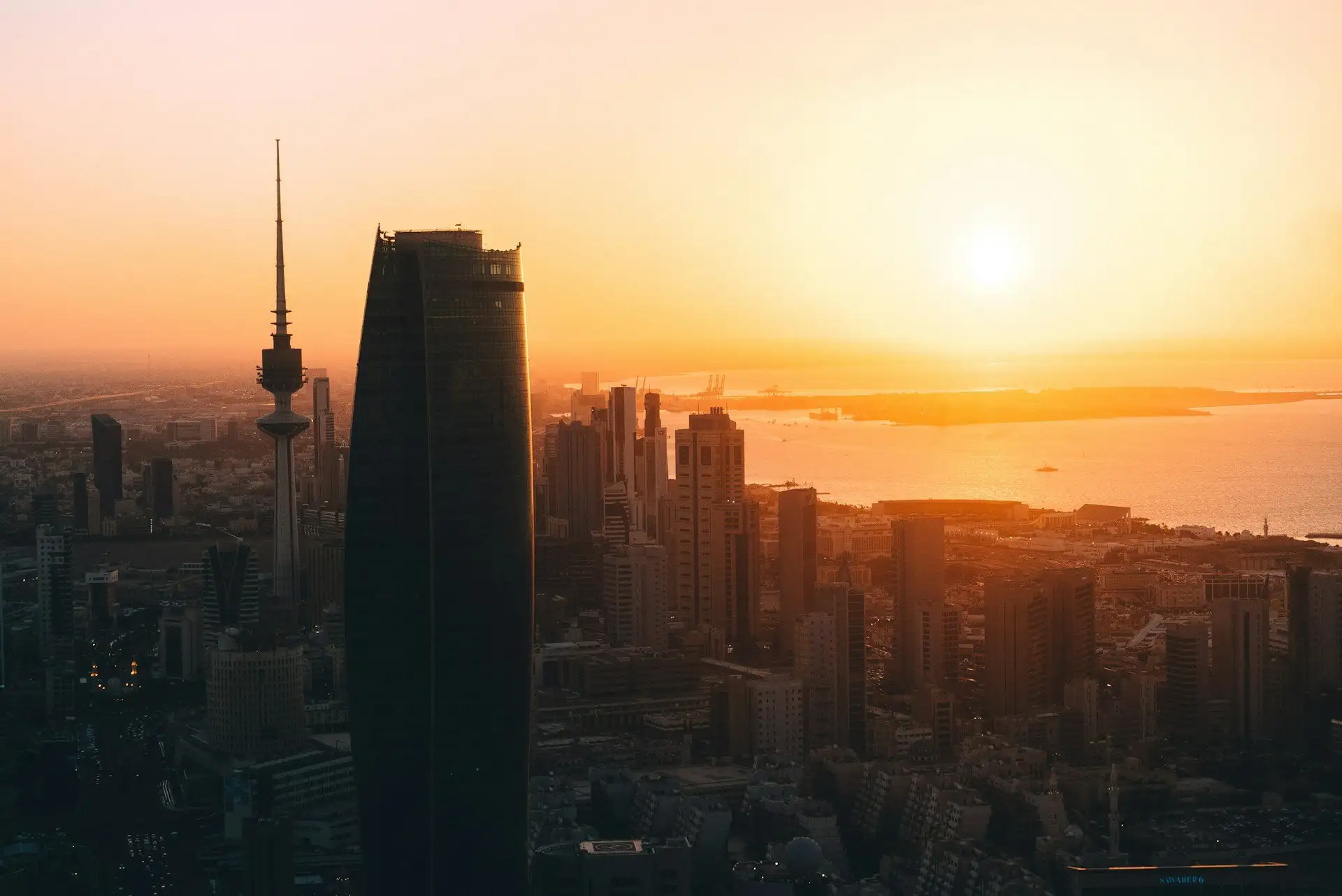
The city Kuwait City — which most Kuwaitis just call "Kuwait" — is the whole show. It faces the Gulf on a bay, and its most famous landmark, the Kuwait Towers, rises from a promontory over the water in a way that manages to be both functional (two of the three towers are water storage) and genuinely beautiful at dusk when the Gulf catches the last light. The old Souq Mubarakiya in the downtown is the city's most authentic neighborhood: spice merchants, gold vendors, traditional dress shops, a fish market at dawn that rewards early risers with both fresh catch and the sight of the whole working waterfront coming to life at once.
The honest context: Kuwait is not Dubai. It doesn't try to be. There's no ski slope inside a mall, no seven-star hotel shaped like a sail. What there is instead is a city that spent its oil wealth on its citizens first — healthcare, education, zero income tax — and built cultural institutions that actually reflect Kuwaiti identity rather than performing it for tourists. The National Museum, rebuilt after being looted and burned during the Iraqi occupation in 1990, has a collection of Gulf maritime history and pre-oil Kuwaiti life that puts the country's extraordinary recent transformation in genuinely moving perspective.
If you're transiting through Kuwait Airport or combining it with another Gulf destination, three days is enough to see everything properly. If you're coming specifically, give it four to five days in winter, eat your way through the restaurant scene, get out to Failaka Island by ferry, and accept every invitation to someone's home you receive. That last one is what separates the Kuwait you see as a tourist from the Kuwait that exists.
Kuwait at a Glance
A History Worth Knowing
Before oil, there was water. The Kuwait Bay, sheltered and deep enough for large vessels, made the place strategically and commercially useful for centuries before anyone knew what was underneath the desert. The Bani Utub tribes arrived from central Arabia in the early 18th century, established a fortified settlement — Kuwait means "little fort" in Arabic — and built an economy around pearl diving and maritime trade that made the city wealthy by regional standards well before the 20th century. The wooden dhows that carried trade goods between Kuwait, India, East Africa, and the Persian Gulf ports made Kuwait's merchants some of the most sophisticated commercial operators in the pre-oil Gulf.
The British arrived in the picture in 1899, when the Kuwaiti ruler Mubarak Al-Sabah signed a protectorate agreement giving Britain control of Kuwait's foreign affairs in exchange for protection from Ottoman expansion. This arrangement, an awkward kind of colonial relationship that the British called a "protectorate" rather than a colony, lasted until 1961 when Kuwait became fully independent. The Al-Sabah family, which has ruled Kuwait since the early 18th century, continues to govern as the ruling dynasty today.
Oil was discovered in commercial quantities in 1938, and what followed is one of history's more dramatic economic transformations. In 1946, when oil exports began, Kuwait was a pearl-diving city with mud houses and no paved roads. By the 1960s it had one of the highest per capita incomes on earth. By the 1970s it had free healthcare, free education, a welfare state, and a currency — the Kuwaiti Dinar — that became one of the world's highest-valued units of exchange. The generation that lived through this transition watched the entire material world of their childhood disappear within their own lifetimes.
Then came August 2, 1990. Saddam Hussein's Iraq invaded Kuwait, and what followed was seven months of occupation during which systematic looting stripped the country of its art, its records, its infrastructure, and in many cases its people. The Kuwait National Museum was looted so thoroughly that the recovery of artifacts from Iraq continued for years. Liberation came in February 1991, and the rebuilding that followed — physical, psychological, institutional — is a story of collective will that Kuwaitis discuss with a matter-of-factness that obscures how extraordinary it actually was. The country rebuilt. Faster than anyone expected. The towers went back up. The museum reopened. Kuwait continued.
What this history gives you as a visitor: a country that understands impermanence better than most, that holds its pearl diving past and its oil-funded present in simultaneous awareness, and that still greets strangers with the desert hospitality that predates both.
Bani Utub tribes settle the Kuwait Bay area. The Al-Sabah family emerges as leaders of the new trading settlement.
Mubarak Al-Sabah signs a secret agreement with Britain. Kuwait's foreign policy comes under British control in exchange for protection.
Commercial oil deposits found at Burgan, one of the world's largest oil fields. Everything changes.
Kuwait becomes fully independent. Immediately faces territorial claim from Iraq, averted by British troops briefly deployed at Kuwait's request.
Iraq invades on August 2, 1990. Seven months of occupation. Liberation by coalition forces in February 1991. The country rebuilds.
A constitutional emirate with one of the world's highest per capita incomes, a genuinely participatory parliament, and oil reserves projected to last well into the 22nd century.
Top Destinations
Kuwait is a city-state: almost everything worth seeing is in or immediately around Kuwait City. The country is small enough that you can drive from the Iraqi border to the Saudi border in under two hours. The city fans out from its Gulf-facing waterfront in a pattern of concentric ring roads, and most of the significant sites cluster in the old downtown area, the Salmiya district, and along the seaside Corniche. Getting out to Failaka Island requires a ferry and a half-day commitment, but it is the one excursion that genuinely rewards the effort.
Kuwait Towers
Three towers rising from a peninsula on the Gulf, designed by a Swedish firm in the 1970s and still one of the most recognizable pieces of architecture in the Arab world. Two are water storage; one has a revolving observation sphere at 123 meters that gives you the best view over the city and the Gulf. Go at sunset when the light on the water is extraordinary and the city's call to prayer echoes from multiple directions at once. The surrounding park and waterfront promenade are a social hub on winter evenings when the whole city seems to come outside at once.
Souq Mubarakiya
The oldest surviving market district in Kuwait City, and the only place in the city where the pre-oil aesthetic still breathes. Covered lanes lined with spice vendors, perfume merchants selling oud and bakhoor (incense), gold shops, traditional Kuwaiti dish stalls, and a fish market that operates from before dawn and winds down by mid-morning. The spice section on a Thursday evening — families shopping for the weekend, the smell of dried lime (loomi) and turmeric and rose water colliding — is the most authentically Kuwaiti scene in the city. Go on a Thursday evening or a Friday morning and walk without a plan.
Grand Mosque of Kuwait
Completed in 1986 and designed to hold 10,000 worshippers in the main prayer hall, the Grand Mosque is Kuwait's largest and architecturally its most significant. Non-Muslim visitors are welcome during specific morning hours on Saturday through Thursday — check current times before arriving. The interior is genuinely breathtaking: a central dome 26 meters in diameter, hand-crafted geometric tilework, and a quality of silence that sits strangely with the size of the space. Dress modestly; abayas are available to borrow at the entrance for women.
Kuwait National Museum
Closed, looted, burned, and rebuilt, the National Museum carries the weight of what happened here in 1990 in its very existence. The collection spans 7,000 years of Gulf history: Dilmun civilization artifacts, Islamic manuscripts, pre-oil Kuwaiti life reconstructed through objects and oral testimony, and the maritime history that made Kuwait wealthy before oil was even a concept. The Planetarium on the grounds is a separate building and worth the additional entry. Allow two hours and go on a weekday morning when it's quiet.
Failaka Island
An island in the Kuwait Bay, roughly 20 kilometers offshore, that has been continuously inhabited since the Bronze Age and was the site of a Greek settlement founded by Alexander the Great's successors in the 3rd century BCE. The archaeological site contains Greek temple foundations, Bronze Age tells (layered settlement mounds), and a museum explaining the extraordinary depth of human occupation here. Ferries run from the Ras Al Julai'a terminal. The island was evacuated and heavily damaged during the Iraqi occupation — the abandoned village on the southwestern shore is hauntingly intact, left exactly as it was in 1990. Allow a full day.
Sadu House
A restored traditional Kuwaiti house in the old downtown dedicated to the preservation of sadu — the geometric weaving art of Bedouin women, recognized by UNESCO as an Intangible Cultural Heritage. Weavers work in the courtyard on most mornings using traditional looms and the geometric patterns that encoded Bedouin tribal identity in fabric. The shop sells genuinely excellent examples at prices that are fair. Small, quiet, and one of the most specific cultural experiences in the Gulf. An hour well spent before or after the National Museum.
The Scientific Center
Kuwait's aquarium and natural history complex on the Salmiya waterfront is one of the best in the Gulf and substantially underrated. The aquarium section covers Gulf marine ecosystems with an indoor mangrove exhibit and a shark tunnel. The Discovery Place is an interactive science museum that works as well for adults as it does for children. The dhow harbor outside has preserved traditional Kuwaiti wooden boats in a setting that connects the ocean-facing history to the modern waterfront. A half day is about right.
Al Abraq & Desert Camps
The Kuwaiti desert north and west of the city comes alive from October through March when weekend camping is a serious national pastime. Kuwaiti families set up elaborate tents — some the size of a small house, with generators, full kitchens, and satellite dishes — and the desert fills with the smell of grilling meat and cardamom coffee. Joining a local family's desert camp, if you're invited, is one of the most genuine hospitality experiences in the country. Commercial desert experiences are available through tour operators for visitors without local contacts.
Culture & Etiquette
Kuwait is a conservative Muslim country and the social norms reflect that, applied with a courtesy and patience toward visitors that makes accidental missteps easier to recover from than in more rigidly enforced environments. Kuwaitis are genuinely warm toward visitors — the tradition of Gulf hospitality runs deep here and it is not a performance for tourists. If you are invited into a Kuwaiti home or tent, the welcome you receive will be substantial and the food will be more than you can finish, which is the point.
Two things have no negotiation room: alcohol and public affection. Kuwait is fully dry — no alcohol anywhere, at any price, in any hotel or venue. This is not a guideline. It is law and it is enforced. Public displays of affection between couples, even married couples, attract unwanted attention and potentially police involvement in conservative areas. Neither of these is difficult to observe once you accept them as the operating rules of the country you're in.
Women should cover shoulders and knees in public areas, markets, and all religious sites. Abaya is not required but is appreciated in conservative areas. Men in shorts are generally fine in malls and tourist areas but conspicuous in traditional neighborhoods. Swimwear at hotel pools and private beaches only.
Coffee, dates, and sweets offered at a shop, an office, or a home are a social ritual. Accept them with your right hand or both hands, say "shukran" (thank you), and mean it. Declining abruptly is rude in a way that is not immediately obvious but is felt.
"As-salamu alaykum" (peace be upon you) and "Ahlan wa sahlan" (welcome) are the standard greetings. Using them, even haltingly, marks you immediately as someone making an effort. Kuwaitis genuinely appreciate this.
Kuwait City's traffic is genuinely challenging. Planning that accounts for 30 minutes of additional travel time for any cross-city journey will save you from frustration that is otherwise inevitable.
During the five daily prayers, some shops briefly close and public spaces quiet. This lasts 15 to 20 minutes. Plan to be somewhere comfortable during midday and late afternoon prayer times rather than standing outside a locked shop.
Attempting to import alcohol into Kuwait — including in checked luggage — is illegal and will result in confiscation and potentially worse. This is a bright line. There is no workaround. Plan your trip accordingly.
Observed more strictly here than in some neighboring countries. Dedicated eating areas in malls and some hotel restaurants remain open for non-Muslims, but eating in public view during fasting hours is not appropriate and carries a legal dimension.
Photography of the Emir's palace, government ministries, military facilities, and checkpoints is prohibited. Be conservative about what you photograph from a car in government districts.
The left hand is considered unclean in Arab culture. Use your right hand for eating, passing food, offering items, and greeting. This is especially important at traditional dining settings.
Kuwait is more conservative than Dubai or Bahrain. What passes without comment in those cities may attract attention here. Dress a degree more conservatively than you think you need to and you will be comfortable everywhere.
Gahwa Culture
Kuwaiti qahwa — Arabic coffee spiced with cardamom and saffron, pale gold in color, served in small handleless cups called finjan — is offered at every formal meeting, every shop visit of any duration, and every home entrance. The coffee is not strong in the Western sense. It is delicate, aromatic, and ceremonial. Hold your cup with your right hand. When you've had enough, give it a small side-to-side wiggle to signal no more. Dates are served alongside it always.
Diwaniya
The diwaniya is a uniquely Kuwaiti institution: a gathering room, separate from the main house, where men receive guests, conduct informal business, discuss politics, and maintain social networks. Many Kuwaiti homes have a dedicated diwaniya space. If you are invited to a diwaniya — a rare privilege for foreign visitors — it is a significant expression of welcome. Sit where you are directed, accept the coffee, and let the conversation develop at its own pace.
Ramadan in Kuwait
Kuwait during Ramadan changes significantly. Daytime hours are quiet — businesses open late, traffic is lighter, the city has a contemplative quality. After iftar at sunset the city comes brilliantly alive: restaurants open, families fill the malls and waterfront, and the atmosphere has a festivity that lasts well past midnight. Visiting during Ramadan requires flexibility and the willingness to operate on the reversed schedule the city adopts. Many visitors find it the most memorable time to be there.
National Identity
Kuwait's national identity was tested in a way that few countries' have been, and Kuwaitis who lived through the 1990 invasion and occupation have a relationship with their country's symbols — the flag, the anthem, Liberation Day on February 26 — that is not abstract. Treating these with genuine respect rather than tourist politeness is appropriate. If you encounter anyone who lived through the occupation and wants to talk about it, listen. It is their country's most important story.
Food & Drink
Kuwait's food scene is the aspect of the country that most surprises first-time visitors, and it does so at every price point. Kuwaiti cuisine proper — rich, spiced, rooted in the Gulf's trading connections with India, Persia, and East Africa — is one of the Arab world's more complex and underexplored culinary traditions. The city's restaurant scene layers that tradition with Indian, South Asian, Lebanese, American, and increasingly modern Kuwaiti restaurants run by a new generation of chefs who are doing something genuinely interesting with their inheritance.
One practical note: alcohol is completely absent. This is not a partial restriction. No hotel minibar, no wine list, no craft beer. Water, fresh juice, coffee, tea, and the excellent regional soft drink culture fill the gap. The fresh juice culture in particular — pomegranate, watermelon, sugarcane, and the sweet lime drink called limonana — is worth embracing fully rather than mourning what's absent.
Machboos
The national dish, and the one that will settle the argument about whether Gulf food can be extraordinary. Spiced basmati rice cooked with dried limes (loomi), turmeric, cinnamon, coriander, and cardamom, under slow-braised chicken, lamb, or fresh shrimp, finished with fried onions and toasted almonds. The dried lime — loomi — is the key ingredient: it gives Kuwaiti rice dishes a sour, smoky back note that nothing else in the world tastes like. Order it everywhere and compare. They will all be different and mostly excellent.
Seafood
The Gulf produces hamour (grouper), zubaidi (silver pomfret), and fresh shrimp in volumes that put the fish on every traditional Kuwaiti table. The fish market at Souq Mubarakiya opens at 4am and is the city's freshest and cheapest source. The waterfront restaurants in Salmiya and Bneid Al Gar serve grilled Gulf fish that has been out of the water for hours rather than days. Order zubaidi grilled whole with lime and Arabic spices. It is the Gulf on a plate.
Mutabbaq & Street Food
Mutabbaq is a thin crispy pastry filled with spiced meat and egg, folded and pan-fried, sold from street stalls and small restaurants for a few dinars and eaten standing up with hot sauce. It arrived in Kuwait from Yemen and stayed because it is exactly right at midnight. The South Asian community — about 40 percent of Kuwait's population — has seeded the city with excellent Pakistani and Indian street food: haleem, biryani, and paratha rolls that cost almost nothing and compete seriously with everything else.
Breakfast Culture
A Kuwaiti breakfast is an event: balaleet (sweet vermicelli with eggs, flavored with saffron and cardamom, served in a dish that is simultaneously breakfast and dessert), chebab (Kuwaiti pancakes drizzled with date syrup), labneh with olive oil and za'atar, and bread from a clay tandoor. Hotel breakfasts will give you something, but a Friday morning at a Kuwaiti café or bakery near Souq Mubarakiya gives you something else entirely.
The Restaurant Scene
Kuwait City's restaurant landscape is broader than its reputation suggests. The Avenues Mall and its surrounding area in western Kuwait has a concentration of both international chains and genuinely good local restaurants. The Salmiya district has the best mix of Gulf and South Asian options. Bneid Al Gar for Lebanese and traditional Kuwaiti. The newer Dar Al Awadhi restaurant in the city center for formal traditional Kuwaiti cuisine served at its most ceremonial. For the food alone, Kuwait deserves two full evenings of dedicated eating.
Drinks in a Dry Country
The fresh juice culture saves the day: fresh-squeezed sugar cane juice from market stalls, watermelon juice in summer, pomegranate juice in winter, and the regional soft drink Vimto — a sweet berry cordial that arrived from Britain a century ago and is now the unofficial drink of Gulf Ramadan — which Kuwaitis consume in remarkable quantities during the holy month. Arabic coffee and cardamom tea are everywhere and excellent. The qahwa culture is its own reward.
When to Go
November through March, full stop. Kuwait in summer is genuinely dangerous for outdoor activity — temperatures regularly exceed 45°C and have been recorded above 50°C, at which point the air itself feels hostile. July and August outdoor photography sessions in Kuwait City are measured in minutes, not hours, before the heat becomes a medical consideration. Winter in Kuwait is something else entirely: mild temperatures, occasional dramatic Gulf cloudscapes, and a city that comes fully outside and operates at full social intensity from sunset until well after midnight.
Winter
Nov – FebThe city at its best: mild temperatures, full outdoor social life, desert camping season, and the waterfront promenades packed with families every evening. The occasional winter storm brings dramatic Gulf skies that make the Kuwait Towers skyline genuinely spectacular. December and January are the peak months.
Spring
Mar – AprStill comfortable before the heat builds. March includes Liberation Day celebrations (February 26) which continue into March with national pride events. The desert landscape briefly turns green after winter rains. April is transitional — getting warm but still manageable for outdoor activity before May closes that window.
Ramadan
Dates shift annuallyA genuinely different experience that rewards open-minded visitors. Daytime hours are quiet and reflective. Post-sunset Kuwait comes explosively alive with food, family, and social energy that lasts until 2am. Requires flexibility and a reversed schedule but delivers a version of Kuwaiti life unavailable at any other time of year.
Summer
May – OctGenuinely hostile. The heat is not dramatic in an interesting way — it's exhausting, limiting, and medically significant for unprepared visitors. Everything interesting moves indoors and into air-conditioned malls. The city empties as wealthy Kuwaitis travel abroad. There is no compelling reason to visit in summer.
Trip Planning
Three to four days covers Kuwait comfortably for a first visit, allowing time for the main city sites, a day trip to Failaka Island, and enough evenings out to actually experience the food scene and the waterfront social life that makes Kuwait worth coming to. Five days gives you a more relaxed pace and the option of a desert camp experience. Kuwait works well as a standalone destination or as a Gulf transit stop when combined with Dubai or Doha.
Kuwait City Core
Arrive, check in, walk to the Kuwait Towers at sunset. Dinner on the Salmiya waterfront — grilled Gulf fish and fresh juice while the skyline glitters across the bay. First machboos of the trip; it will not be the last.
Old City & Culture
Dawn at the Souq Mubarakiya fish market, then a slow morning through the spice and gold lanes as the souq wakes up. National Museum for two hours — focus the Maritime Gallery. Sadu House next door for the weaving. Grand Mosque in the afternoon during non-Muslim visiting hours. Dhow dinner cruise on the Gulf at sunset.
Failaka Island
Early ferry from Ras Al Julai'a terminal. Full day on the island: the Greek temple ruins, the Bronze Age archaeological site, the abandoned 1990 village on the southern shore that was left exactly as the evacuation left it. Return ferry late afternoon. Dinner in the city.
Scientific Center + Departure
Morning at the Scientific Center aquarium and dhow harbor. Final coffee and chebab breakfast at a Kuwaiti bakery near the souq. Airport transfer for afternoon or evening flight.
Kuwait City Immersion
Two full days in the city without rushing: the Towers, the Grand Mosque, the National Museum with time for the Planetarium as well, the Sadu House, and the Beit Al Othman Heritage Museum in Hawalli for traditional Kuwaiti domestic life reconstructed in an actual historic house. Evenings on the waterfront and in the restaurant scene around Salmiya.
Souq Deep Dive + Failaka
A full day at Souq Mubarakiya: morning fish market, midday in the spice and textile lanes, afternoon at the gold souq. Full-day Failaka Island excursion the following day. The island rewards unhurried exploration — bring lunch and expect to stay until the last ferry.
Desert Camp
Arrange through a tour operator or local contact: a two-day desert camp experience north or west of the city. Sunset over flat desert, fire-cooked meat, cardamom coffee, stars at 3am. This is the Kuwaiti weekend tradition that most visitors never reach and should. The contrast with the city is complete.
Avenues + Departure
The Avenues Mall — one of the largest in the Middle East and genuinely impressive in scale and architecture — for a final morning of air-conditioned wandering, Kuwaiti café breakfast, and last shopping. Airport.
Kuwait City in Full
Four days gives you the city's full cultural infrastructure: every museum, both the contemporary and heritage sites, the dhow harbor evening, and enough evenings to work through the restaurant landscape from traditional Kuwaiti to South Asian to modern Gulf. The Dar Salwa heritage house in Rumaithiya for a traditional family home experience.
Failaka + Al Kout Waterfront
Full-day Failaka Island. The following day south along the coast to Fahaheel and the Al Kout waterfront — the older, more traditional southern coastal district that preceded the northern development. Better fish restaurants, a surviving traditional dhow building yard, and a waterfront that looks like Kuwait thirty years ago.
Desert Camps
Two nights in the desert. Far enough from the city that the light pollution drops and the Milky Way appears. The silence of the Kuwaiti desert on a cold January night, interrupted only by wind and a distant generator, is one of those experiences you can't package.
Food, Markets & Departure
Final days for the food experiences you haven't ticked: a proper Kuwaiti breakfast at a local café, the evening Souq Mubarakiya on a Thursday when it's at its most social, the dhow dinner one more time. Fly home with a full mental folder of things you'll try to explain to people who will probably not fully believe you.
Vaccinations
No mandatory vaccinations for most visitors. Recommended: Hepatitis A, Hepatitis B, and routine vaccines up to date. The healthcare system in Kuwait is high quality and hospitals are well-equipped.
Full vaccine info →Connectivity
Excellent 5G coverage throughout Kuwait City and most of the country. An Airalo eSIM or a local SIM from Zain or Ooredoo at the airport works well. Download offline maps before arriving; the ring-road system is counterintuitive without navigation.
Get Kuwait eSIM →Power & Plugs
Kuwait uses Type G sockets — the British three-pin plug, 240V. Same as the UK. Visitors from the US, Europe, and Australia will need an adapter. Most hotels have universal adapters available at the front desk.
Language
Arabic is the official language. English is very widely spoken — more so than in most Gulf states — due to the large South Asian expat community and Kuwait's British colonial history. Navigating Kuwait City in English is straightforward in tourist and commercial areas.
Travel Insurance
Kuwait has high-quality private hospitals. Treatment costs for foreigners are significant. Comprehensive travel insurance with medical cover is recommended. Check that your policy covers Gulf states specifically.
No Alcohol — Plan for It
Kuwait is fully dry. Plan your trip assuming no alcohol anywhere at any price. Fresh juice, excellent coffee, and the full range of non-alcoholic beverages fill the gap reasonably well. Do not attempt to import alcohol in any form — the penalties are genuine.
Transport in Kuwait
Kuwait has no metro system and no urban rail. The city is built around the car, with a network of ring roads and expressways that function well at off-peak hours and badly during the rush hour crush that dominates 7–9am and 4–7pm. The practical options for visitors are: ride-hailing apps (Careem is the main one and works well), rental car for maximum flexibility, or taxis booked through your hotel. Walking is limited by both distance and, in summer, heat. In winter the Corniche and Kuwait Towers area are entirely pleasant on foot.
Careem
1–5 KD/tripThe regional ride-hailing app (owned by Uber) works reliably throughout Kuwait City. Download before arrival. Credit card payments work in-app. Prices are fixed before you confirm. Your most practical daily transport option in the city.
Car Rental
15–40 KD/dayAll major rental companies at Kuwait International Airport. Essential if you're exploring beyond the city center or visiting the desert. International driving permit technically required alongside your license. Traffic is aggressive by European standards but manageable. Navigation: use Waze, not Google Maps — locals swear by it for Kuwait's road network.
Hotel Taxis
Negotiated + meterTaxis booked through your hotel are more reliable and more expensive than street hailing. Metered taxis exist but meters are not always used by default — agree the price before getting in for any journey you haven't booked through an app or your hotel.
Failaka Island Ferry
~5 KD returnThe ferry from Ras Al Julai'a terminal to Failaka Island runs on a schedule that changes seasonally. Confirm departure times before making the drive to the terminal. The crossing takes 45 minutes to an hour. Buy return tickets before boarding. The terminal is about 25 kilometers south of central Kuwait City.
Dhow Cruises
10–30 KD/personEvening dinner cruises on traditional dhows run from the Marina Crescent area in Salmiya and from the waterfront near the Scientific Center. Book through your hotel or any tour operator in the city. The city skyline from the water at night is the best angle on Kuwait's built environment.
City Buses
0.25–0.5 KD/tripKuwait's public bus network covers most of the city but is heavily used by the South Asian expat workforce rather than tourists, runs on schedules that are not always predictable, and requires a degree of patience and route knowledge that Careem eliminates entirely. Useful as a budget option if you're comfortable navigating by map.
Walking
FreeGenuinely pleasant along the Kuwait City Corniche, the Marina Crescent in Salmiya, and the waterfront near the Kuwait Towers — in winter. The Souq Mubarakiya area is compact enough to walk entirely. Beyond these areas, Kuwait is not a pedestrian city and distances between sites require transport.
Kuwait International Airport
5–10 KD to cityTerminal 4 is the new international terminal, opened in 2023 and dramatically better than the previous facilities. About 20 kilometers south of Kuwait City center. Careem from the airport to central Kuwait City typically runs 4–7 KD and takes 25–40 minutes depending on traffic.
Accommodation in Kuwait
Kuwait's hotel landscape is dominated by international chains in the upper mid-range and luxury categories, with a smaller budget and mid-range independent hotel scene that has improved significantly in recent years. The location question matters here: staying in Salmiya puts you on the Gulf waterfront in the most active district for restaurants and evening life. Staying downtown near the Souq Mubarakiya gives you walking access to the old city. Staying near the Avenues Mall area in western Kuwait is practical for business travelers but distant from everything a tourist actually wants to reach.
Luxury Hotels
120–300 KD/nightThe Four Seasons Kuwait at Burj Alshaya, the JW Marriott, and the Hilton Kuwait Resort (on the beach at Mangaf, 30 minutes south of the city) cover the top end. The Four Seasons in particular occupies one of the best urban positions in the Gulf — above the Salhiya complex in central Kuwait City with views in every direction. For the hospitality experience at its most formal, this is the right choice.
Salmiya Waterfront Hotels
50–120 KD/nightThe cluster of mid-range and upper-mid hotels along the Salmiya coastline — including the Radisson Blu and various independent properties — give you walking access to the Marina Crescent and the Gulf, the best concentration of restaurants, and a neighborhood that operates at full social intensity from dusk until midnight. The best base for a cultural and culinary-focused visit.
Downtown Business Hotels
30–70 KD/nightThe downtown area between the National Assembly and the Souq Mubarakiya has several solid mid-range business hotels that put you walking distance from the museums and old souq district. Functional, reasonably priced, and well-located for the cultural itinerary. Less atmosphere than Salmiya but more authentic proximity to old Kuwait.
Desert Camp Stays
Arranged through operatorsFrom October through March, desert camp experiences are available through tour operators ranging from a shared group camp with basic facilities to private glamping setups with full catering. This is not hotel accommodation but it is the most distinctly Kuwaiti overnight experience available to visitors who don't have local family contacts providing the real thing.
Budget Planning
The Kuwaiti Dinar is the world's highest-valued currency unit — one KD is worth approximately $3.25 USD — which means prices look small in dinar but add up in real terms. Kuwait is moderately expensive: cheaper than London or Dubai for accommodation and dining, but not the budget destination that some neighboring countries can be. The saving grace is the food: excellent Kuwaiti and South Asian street food and canteen restaurants in the 1–3 KD range exist throughout the city and are genuinely good, meaning you can eat extraordinarily well at Kuwait City's price points without touching the expensive hotel restaurant tier.
- Budget hotel or apartment rental
- Local South Asian canteens, souq food stalls
- Careem for most transport
- Free or low-cost museums and sites
- Fresh juice and qahwa culture
- Mid-range waterfront hotel
- Mix of Kuwaiti restaurants and cafés
- Rental car for flexibility
- Failaka Island ferry included
- Dhow dinner one evening
- Four Seasons or Marriott tier
- Formal Kuwaiti restaurant dining
- Private desert camp arrangement
- Guided cultural experiences
- Premium dhow and waterfront experiences
Quick Reference Prices
Visa & Entry
GCC nationals (Saudi Arabia, UAE, Bahrain, Qatar, Oman) enter Kuwait without a visa. Citizens of many other nationalities including the US, UK, EU member states, Australia, Canada, Japan, and South Korea can obtain a visa on arrival at Kuwait International Airport or apply for an e-visa through the Kuwait Ministry of Interior's online portal before departure. The e-visa process is straightforward and typically takes two to five working days. It costs around $10–15 USD.
Some nationalities are not eligible for visa on arrival and must obtain a visa in advance through the Kuwait Embassy in their country. Check your specific passport's status at the Kuwait Ministry of Interior website before booking. The list changes and assumptions based on neighboring Gulf states' policies do not always hold.
Many nationalities eligible. GCC citizens visa-free. Check Kuwait Ministry of Interior for your specific passport: moi.gov.kw
Family Travel & Pets
Kuwait is a strong family destination in the winter months. Kuwaiti society is deeply family-oriented — the culture revolves around family gatherings, collective meals, and the social unit of the extended family in a way that visitors with children fit into naturally. Children receive warm, genuine attention from Kuwaitis. The facilities for families — the Scientific Center, the public parks along the Corniche, the family-friendly restaurant culture, the beach clubs in winter — are well-developed.
The practical consideration is the same as for all visitors: come in winter. Kuwait in summer with young children is not a recreational activity. The heat is simply incompatible with outdoor family life. In November through March, the waterfront parks, the Failaka Island ferry trip, and the desert stargazing are entirely suitable for families with children of most ages.
Scientific Center
The best family venue in Kuwait by a considerable distance. The aquarium — Gulf marine ecosystems, shark tunnel, indoor mangrove — holds children's attention at a level most museums don't. The Discovery Place interactive science section works for ages 4 to 14. The preserved dhow harbor outside gives older children a concrete visual of what Kuwait looked like before oil. A half day is ideal.
Failaka Island Ferry
Children respond to the ferry crossing — the Gulf, the city receding, the island appearing — in a way that simply driving to a site doesn't produce. The archaeological ruins and abandoned village are accessible enough for older children and teenagers. The picnic lunch on the island with the Gulf all around is the kind of family travel memory that accumulates into identity.
Desert Evening
A desert camp evening through a tour operator — fire, grilled meat, stars, open sky — is universally successful with children who have any capacity for wonder. The flatness of the Kuwaiti desert means the horizon goes all the way to the edge of the world in every direction, which children feel in a way that is hard to articulate and impossible to forget.
Souq Mubarakiya
Children find the sensory overload of the spice market engaging rather than overwhelming if you move at a pace that lets them look. The gold section is jewelry at a scale that impresses. The fish market at dawn — if you can manage the early start — is one of those experiences that lands differently on a child than any classroom ever could.
Beach Clubs
Several hotel beach clubs along Kuwait's coast open to non-guests by day pass in the winter season. The Gulf is warm enough to swim comfortably from November through April. For families with young children who need beach time between cultural activities, these are the practical solution — private, managed, and safe.
Family Dining
Kuwait's restaurant culture is inherently family-oriented — large groups, shared plates, and children welcome at virtually every venue. Machboos and grilled Gulf fish are broadly acceptable to most children's palates. The South Asian food options throughout the city cover rice dishes, breads, and mild curries that work well for younger eaters. Malls have every international fast food option as a fallback.
Traveling with Pets
Kuwait permits the import of pets with the appropriate documentation. Dogs and cats require a microchip compliant with ISO standards, a valid rabies vaccination, a health certificate issued by a licensed veterinarian within 14 days of travel, and a certificate from the official veterinary authority of your country. All documents must be submitted to Kuwait's Public Authority of Agriculture Affairs and Fish Resources for approval before travel — this is not a process you can complete on arrival.
Start the process at least two months before travel. The approval process involves submission of documents to the Kuwaiti embassy in your country and can take several weeks. Contact Kuwait's Public Authority of Agriculture Affairs directly to confirm current requirements, which can and do change.
Practically: Kuwait City has veterinary clinics and some pet-friendly accommodation, but the culture around pets in public spaces is more conservative than in Western countries. Dogs in particular are not welcomed in all public areas, and summer heat makes Kuwait a genuinely hostile environment for pets. Confine pet travel to the November–March window, ensure air-conditioned transport and accommodation at all times, and never leave an animal in a parked car.
Safety in Kuwait
Kuwait is one of the safer Gulf states for travelers and the safety record for tourists is genuinely good. Violent crime against visitors is rare. The country has a strong rule-of-law culture, a professional police force, and the social stability that comes with high living standards and a functioning welfare state. The risks that do exist are primarily legal rather than criminal: the laws around alcohol, public behavior, photography, and dress codes are real and enforced, and ignorance of them is not treated as a mitigating factor.
Traffic is the most genuine physical risk in Kuwait City. The road fatality rate is significant. Drivers are aggressive, speed limits are widely ignored, and pedestrian infrastructure is limited. Use Careem rather than walking when distances are more than a few blocks, and cross roads at marked crossings only.
Crime Rate
Very low by regional and global standards. Violent crime against tourists is extremely rare. Petty theft occurs but is not common. Kuwait City's public spaces feel safe at all hours during winter.
Women Travelers
Kuwait is manageable for solo women with appropriate dress and awareness. The country is more conservative than Bahrain or Dubai but not as restrictive as Saudi Arabia. Modest dress and general urban awareness are the practical requirements. Unwanted attention is less common here than in some neighboring countries.
Traffic
Genuinely dangerous. Kuwait's road fatality rate is one of the region's higher ones. Use ride-hailing apps, obey traffic signals when driving, and treat pedestrian crossings as aspirational rather than guaranteed safety. This is not alarmist — it is the actual situation.
Legal Risks
The prohibitions on alcohol, public affection, and disrespecting Islamic customs are legal matters, not cultural suggestions. Penalties range from fines to detention to deportation. None of these are difficult to avoid with basic preparation and awareness.
Summer Heat
Summer temperatures above 45°C are a genuine health risk for unprepared visitors. Heat exhaustion and heatstroke are real possibilities in outdoor environments from May through September. Stay hydrated, limit outdoor exposure during peak hours, and treat the heat as a serious environmental condition rather than an inconvenience.
Healthcare
Kuwait has an excellent private hospital sector. The American Hospital of Kuwait and various other private facilities provide high-quality care. Treatment costs for foreigners are significant — travel insurance with medical cover is strongly recommended.
Emergency Information
Your Embassy in Kuwait City
Most embassies are in the Bayan and Mishref diplomatic areas of Kuwait City.
Book Your Kuwait Trip
Everything in one place. These are services worth actually using.
The Country That Rebuilt
There's a particular quality to Kuwaiti hospitality that you only understand once you know the context: a country that had everything stripped from it in 1990 and chose, collectively, to rebuild it rather than be defined by the loss. The warmth you receive as a guest here isn't abstract cultural tradition. It's the expression of a people who understand, in their bones, what home means and what it means to welcome someone into it.
Kuwait doesn't have the infrastructure of Dubai or the ancient history of Jordan. What it has is something harder to manufacture: a genuine identity, a specific way of being in the world that was tested and held. The machboos will be better than you expected. The Gulf at dusk will be better than you expected. The conversation, if you make the effort to have it, will stay with you. That's enough.