
Taiwan
The island that perfected night markets, invented bubble tea, built one of the world's best metro systems, and somehow also contains marble gorges, high-altitude forest railways, hot springs, and aboriginal mountain cultures — all within a landmass roughly the size of Belgium. It converts almost every visitor into a repeat visitor. Consider yourself warned.
What You're Actually Getting Into
Taiwan is the closest thing to a guaranteed good time in Asia. That sounds like marketing language but it's more an observation about outcomes: the combination of extraordinary food, an excellent transport network, genuinely warm hospitality, dramatic natural scenery, and a complete absence of the tourist scams that tax your goodwill in other popular destinations produces a travel experience that is consistently, reliably good in a way that's almost statistically unusual.
The food situation alone justifies the flight. Taipei's night markets are among the most concentrated expressions of street food culture anywhere in the world — not just in variety but in quality, given that each vendor typically makes one thing and has made it for years. The beef noodle soup at a family restaurant in Zhongshan, the oyster vermicelli at Shilin Night Market, the xiaolongbao at Din Tai Fung (which started as a cooking oil shop on Xinyi Road), the scallion pancakes from a cart that appears at the same corner every evening at 6pm — these are not background experiences. They are the reason people come back.
Outside Taipei, Taiwan opens into something most visitors don't fully anticipate. Taroko Gorge — a canyon cut through solid white marble by the Liwu River — is genuinely one of the most dramatic landscapes in Asia, with walking trails cut into cliff faces hundreds of meters above rushing water. The Alishan forest railway climbs to 2,216 meters through cedar and cypress forest to watch the sunrise above a sea of clouds. The east coast highway between Hualien and Taitung, carved between the Pacific Ocean and the mountains, is one of the great drives in the region. The island's interior is mountainous enough to contain over 200 peaks above 3,000 meters.
One context that every visitor should know: Taiwan's political status is unique and important. Taiwan operates as a self-governing democracy with its own government, military, and institutions. The People's Republic of China claims Taiwan as part of its territory and has not renounced the use of force to achieve unification. Cross-strait tensions are a real geopolitical reality. They do not currently affect the daily experience of visiting Taiwan — the island is safe, stable, and welcoming — but travelers should understand the situation as background context. This guide handles it briefly in the safety section.
Taiwan at a Glance
A History Worth Knowing
Taiwan's indigenous Austronesian peoples have inhabited the island for at least 6,000 years and possibly for much longer — genetic and linguistic evidence suggests Taiwan was the point of origin for the great Austronesian migration that populated the Pacific and Indian Ocean worlds, from Madagascar to Hawaii. Approximately 16 officially recognized indigenous peoples still live in Taiwan today, primarily in the mountain interior and the east coast, with distinct languages, cultures, and traditions. The Taroko people of the Taroko Gorge region, the Amis on the east coast, the Bunun in the high mountains — these cultures are alive and accessible in ways that many indigenous cultures in the region are not, if visitors approach with appropriate respect.
Dutch and Spanish colonial presence in the 17th century was followed by the migration of Han Chinese settlers from Fujian and Guangdong provinces, primarily from the 17th century onward. The Qing Dynasty administered Taiwan from 1683 until 1895, when China ceded the island to Japan following the First Sino-Japanese War. Japanese colonial rule lasted 50 years (1895–1945), modernizing Taiwan's infrastructure, education system, and agricultural economy in ways that still shape the island today. The Japanese colonial legacy in Taiwan is complicated and discussed with more nuance in Taiwan than in most former Japanese colonies — there is genuine historical complexity rather than simple grievance.
The Kuomintang (KMT) government, defeated in the Chinese Civil War by the Communists in 1949, retreated to Taiwan under Chiang Kai-shek, bringing approximately 1.2 million mainlanders with them. The KMT ruled under martial law from 1949 to 1987 — one of the longest periods of continuous martial law in modern history — during which political opposition was suppressed and thousands of people were imprisoned or killed in what is known as the White Terror. The February 28 Incident of 1947, in which KMT forces killed an estimated 18,000 to 28,000 Taiwanese civilians following an anti-government uprising, remains one of the most significant and painful events in Taiwanese historical memory.
Taiwan's transition to democracy began in the 1980s and accelerated through the 1990s. The first direct presidential election was held in 1996, with Lee Teng-hui winning and China staging military exercises in the Taiwan Strait in a failed attempt at intimidation. Taiwan today is a fully functioning liberal democracy with free press, competitive elections, independent judiciary, and civil liberties protections. The Democratic Progressive Party (DPP) and Kuomintang (KMT) compete in regular elections on genuinely different platforms regarding cross-strait relations — the DPP broadly emphasizing Taiwanese identity and sovereignty, the KMT emphasizing engagement with China.
The cross-strait situation is the defining geopolitical context of Taiwan's existence. The People's Republic of China has never governed Taiwan and claims it as a breakaway province. The United States maintains a policy of "strategic ambiguity" — not explicitly committing to defend Taiwan militarily while providing arms sales and maintaining unofficial relations. Taiwan itself operates as a fully independent state in all practical respects while navigating the diplomatic isolation that China's pressure produces — most countries maintain unofficial rather than official relations with Taiwan. The tension is real, chronic, and periodically acute. It has not prevented Taiwan from becoming one of the most successful economies and vibrant democracies in Asia.
Taiwan's indigenous peoples inhabit the island. Genetic evidence suggests Taiwan as the likely origin point for the Austronesian migration that populated the Pacific world.
The Dutch East India Company establishes a trading base. Fort Zeelandia at present-day Tainan becomes the colonial center.
China cedes Taiwan to Japan after the First Sino-Japanese War. Fifty years of Japanese colonial rule begin, bringing infrastructure, education reform, and significant transformation.
Anti-government uprising followed by KMT military massacre of an estimated 18,000–28,000 Taiwanese civilians. A defining trauma in Taiwanese historical memory.
Defeated in the Chinese Civil War, Chiang Kai-shek and 1.2 million mainlanders relocate to Taiwan. Martial law declared, lasting until 1987.
After 38 years, one of the world's longest martial law periods ends. Democratic reforms begin in earnest.
Taiwan holds its first direct presidential election. China conducts military exercises in the strait. Taiwan votes anyway.
Taiwan becomes the first country in Asia to legalize same-sex marriage, passing the legislation by democratic process in the legislature.
Top Destinations
Taiwan divides into natural travel circuits: Taipei and the north (the capital, Jiufen, Yangmingshan), the west coast (Taichung, Sun Moon Lake, Alishan), the south (Tainan, Kaohsiung, Kenting), and the east (Hualien, Taroko Gorge, Taitung, the east coast highway). The High Speed Rail makes west coast travel frictionless. The east coast is less connected by HSR but compensates with scenery that is among Taiwan's finest.
Taipei
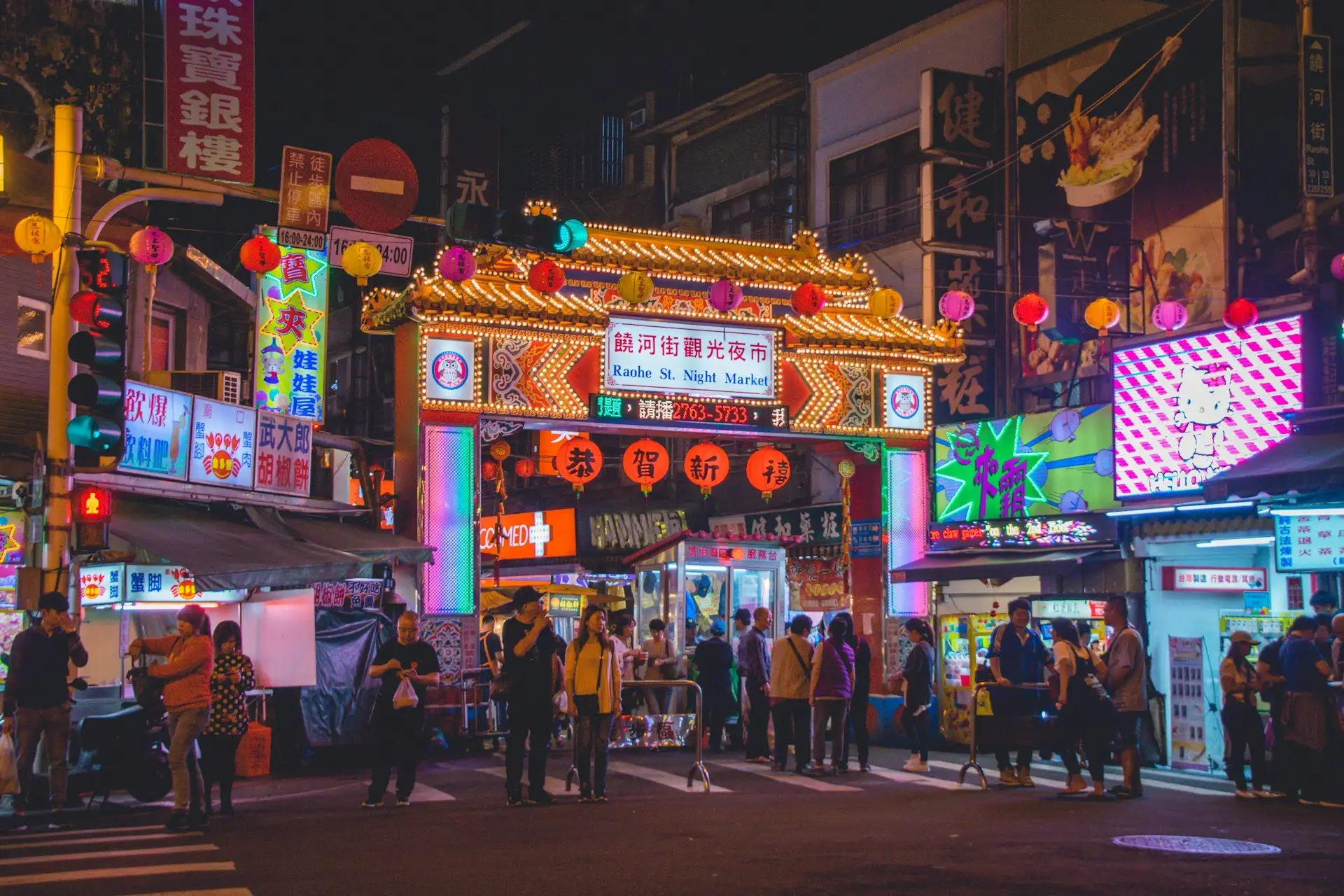
Taipei is one of Asia's most livable cities and one of its most rewarding to visit — not because it has a single iconic landmark but because the whole of it works so well. The MRT connects everything. The food at every price point is exceptional. The Chiang Kai-shek Memorial Hall and surrounding Liberty Square are politically charged and architecturally imposing. The old neighborhoods of Dadaocheng and Dihua Street, where Qing Dynasty-era merchant houses are gradually being restored into galleries and cafes, give the best sense of historical Taipei. Elephant Mountain behind the Xinyi district takes 20 minutes to climb and produces the best city view in Taiwan at sunset. Shilin Night Market for first-timers; Raohe Night Market for locals; Tonghua Night Market for both. Allow four days minimum.
Taroko Gorge
The Liwu River has cut through a mountain of white marble for millions of years, producing a canyon that descends from 3,000-meter peaks to sea level in an extraordinarily short distance. The result — marble walls, jade-green water, suspension bridges over gorges, and walking trails carved into sheer cliff faces — is one of the finest natural landscapes in all of East Asia. The Zhuilu Old Trail requires a permit and offers the most dramatic cliff-face walking. Swallow Grotto and Eternal Spring Shrine are accessible from the gorge road. The gorge is also Taroko indigenous territory — the Taroko people have lived here for centuries and the cultural context adds dimension to the geological spectacle.
Alishan Forest Railway
The narrow-gauge forest railway from Chiayi climbs to 2,216 meters through five climate zones — subtropical, temperate, cold — over 71 kilometers of track, passing through 66 tunnels and across 77 bridges in a journey of about two and a half hours. The traditional purpose: arriving at the top before dawn to watch the sunrise above a sea of cloud from Zhushan Viewing Platform. The cedar and cypress forests at the summit — trees over a thousand years old — make the arrival a specific kind of arrival. Stay the night at Alishan and walk the forest trail at dawn before the day-trippers arrive.
Jiufen
A former gold mining town in the mountains above the north coast, Jiufen's stepped red-lantern lanes, tea houses perched over the sea, and misty mountain atmosphere inspired some of the visual language of Hayao Miyazaki's Spirited Away — though Miyazaki himself has never confirmed this directly, and arguing about it with a Jiufen teahouse owner is a local entertainment. The mountain light in late afternoon, when the clouds come in from the sea and the lanterns start to glow, is genuinely extraordinary. Come on a weekday if possible — Jiufen on weekends is very crowded. The teahouses overlooking the valley are the reason to stay; drink tea for two hours and watch the light change.
Tainan
Taiwan's oldest city, the original Dutch and then Qing capital, and by general consensus the food capital of an island that takes food very seriously. The temples in Tainan are older and more elaborately decorated than anywhere else in Taiwan. The Anping Fort (Dutch colonial, 1624) and the Chihkan Towers (Dutch then Qing, 1653) give the city a layered historical depth that Taipei's relative youth can't match. The food: coffin bread (deep-fried bread box stuffed with seafood chowder), milkfish soup, shrimp roll, and the ubiquitous danzai noodles served by vendors from bamboo poles. Tainan demands slow travel and two or three meals a day for at least two days.
Hualien to Taitung
Taiwan's east coast highway — Provincial Highway 11, also called the Pacific Coast Highway — runs 180 kilometers between Hualien and Taitung with the Pacific Ocean to the left and the Central Mountain Range rising immediately to the right. By motorcycle, bicycle (the Taiwan Cycling Route No. 1 follows this coast), or bus, this is one of the great coastal drives in Asia. Several aboriginal communities along the route — Amis, Puyuma, Rukai — maintain cultural sites, traditional performances, and indigenous food markets that are some of the most accessible indigenous cultural experiences in East Asia.
Beitou & Wulai
Two of Taipei's most accessible hot spring escapes, both within an hour by MRT and bus. Beitou, developed during the Japanese colonial period, has the only naturally occurring radioactive hot spring water in Asia (radon sulfate springs at Thermal Valley — the water genuinely glows a vivid blue-green). Wulai, a Atayal aboriginal community in the mountains south of Taipei, has gorge scenery, an outdoor hot spring river pool, a small railway to a waterfall, and aboriginal barbecue restaurants that serve wild boar and mountain vegetables. Both are half-day or full-day trips from Taipei. Neither requires planning more than the morning you decide to go.
Sun Moon Lake
Taiwan's largest natural lake, in the mountains of Nantou County at 748 meters altitude, is ringed by aboriginal Thao communities and forested hills with walking paths, cycle routes, and a gondola. The name comes from the round southern section (the Sun) and the crescent northern section (the Moon). The light on the lake in the early morning, before the tour boats start running, is extremely gentle and completely different from what most photographs of Taiwan prepare you for. The ferry between the main pier, Ita Thao village, and Xuanzang Temple makes a pleasant half-day circuit.
Culture & Etiquette
Taiwan's culture is a synthesis of Han Chinese tradition (primarily Hokkien/Fujianese and Hakka), Japanese colonial influence, indigenous Austronesian heritage, and American mid-20th-century popular culture — the last arriving with US military and economic presence during the Cold War. The result is something genuinely distinct from mainland Chinese culture, Japanese culture, and any other reference point. Taiwanese people are consistently described by visitors from across the world as among the warmest and most genuinely helpful they've encountered anywhere. This is not a tourist infrastructure quality — it is a cultural disposition that extends equally to a stranger asking for directions and a researcher needing help with a document.
Taiwan was the first country in Asia to legalize same-sex marriage (2019), and the island hosts the largest LGBTQ+ Pride parade in Asia annually in October. The social environment for LGBTQ+ travelers is genuinely welcoming in a way that makes Taiwan stand out not just regionally but globally.
Taipei's MRT has marked standing positions on every platform, and people queue in two lines beside the doors, leaving the center clear for alighting passengers. This is one of the great civic behaviors of modern Asia and it works because everyone participates. Join the queue. Do not walk to the front. The system is a social contract and it works.
At traditional temples, some guesthouses, and many homes. Watch for the threshold step and the row of shoes at the entrance. More important at temples than most visitors expect — inside the main hall, the floor is sacred.
Standard Taiwanese and Chinese courtesy. Receiving a business card or a gift with both hands, held slightly elevated, is a small gesture that communicates significant respect in a business or formal context.
"Xièxiè" (shyeh-shyeh, thank you), "Nǐ hǎo" (nee-how, hello), "Duìbuqǐ" (dway-boo-chee, sorry/excuse me). Taiwan also uses Traditional Chinese characters rather than Simplified — if you read Simplified, you can mostly manage, but they're visually different. Google Translate's camera function handles both.
When a stranger in Taiwan offers to help you — with directions, with a menu, with finding your bus — accept. They mean it completely. The offer is not a prelude to a sales pitch. It is the natural response to perceiving that someone needs assistance. Declining it is the social miscommunication.
Eating and drinking — including water — on the Taipei MRT is prohibited and fined at NT$7,500. This is strictly enforced, not theoretically. The MRT is immaculate partly because of this rule and the consistent culture that maintains it. Finish your bubble tea before you go through the turnstile.
Taiwanese temples are active places of worship, not heritage sites. Worshippers are present at all hours, incense is burning, and the atmosphere is one of sincere devotion. Being loud, pushing to the front for photos, or treating rituals as entertainment is consistently disrespectful across all of Taiwan's religious traditions.
Taiwanese people have a distinct identity, political system, and cultural self-understanding that is different from mainland China. Describing Taiwan as "part of China" or assuming cultural or political equivalence is inaccurate and often received poorly. Taiwan is Taiwan. This is not a sensitive political point — it is a factual description of how the overwhelming majority of Taiwan's people understand their own situation.
Tipping is not standard practice in Taiwan's local restaurants, night markets, or taxis. High-end international hotels may expect tips for certain services. In most ordinary contexts, tipping creates mild awkwardness rather than gratitude — the service is excellent because that's the standard, not because of financial expectation.
Specifically: don't step on the threshold of a temple (step over it). Don't walk through the center door of the main hall (that's for deities, not mortals — use the side doors). Don't point at religious images. These are easy once you know them and are appreciated when observed.
Temple Culture
Taiwan has one of the highest densities of temples in the world — over 15,000 officially registered, in a country the size of Belgium. The Taiwanese religious tradition is a syncretic mix of Buddhism, Taoism, and folk religion that incorporates ancestor worship, deity cults (Mazu, the sea goddess, is one of the most widely worshipped), and divination practices. Temple festivals are among the most spectacular public events in Taiwan — dramatic parades with sedan chairs, firecrackers, and elaborate costumes that can last for days. The Dajia Mazu pilgrimage in April is the largest religious event in the Chinese-speaking world outside China.
Convenience Store Culture
Taiwan has roughly one 7-Eleven or Family Mart for every 2,000 people — the highest convenience store density in the world. This is not incidental. Taiwanese convenience stores function as genuine community services: hot food cooked in-store, payment of utilities, parcel collection, seat-yourself dining spaces, and 24-hour accessibility that makes them the default infrastructure for daily life. The 7-Eleven tea eggs, the Family Mart steamed buns, the rice triangle onigiri — these are legitimately good food, not concession items. Eat in them without apology or embarrassment.
Indigenous Cultures
Taiwan's 16 officially recognized indigenous peoples represent some of the most direct descendants of the original Austronesian migration that populated the Pacific. Their cultures — musical traditions, weaving, hunting practices, oral literature, architecture — are actively maintained and accessible through cultural centers and villages along the east coast and in the mountain interior. The best approach: visit established indigenous cultural tourism sites where communities themselves manage the presentation, rather than expecting spontaneous cultural encounters. The Amis Folk Center near Hualien and the Formosan Aboriginal Culture Village near Sun Moon Lake are starting points.
Traditional Culture Preservation
One of Taiwan's distinctive cultural positions is as a preserver of Chinese traditional culture that was disrupted on the mainland during the Cultural Revolution (1966–1976). Traditional Chinese medicine, classical calligraphy, Confucian temple ceremonies, and traditional performing arts that were suppressed or lost on the mainland survived and developed in Taiwan. The National Palace Museum's collection of imperial art is the most visible expression of this, but the same dynamic applies across traditional crafts, food, and religious practice — Taiwan often feels like a more complete version of a cultural tradition that exists only in fragments elsewhere.
Food & Drink
Taiwan's street food culture is the best argument for visiting the island and the best reason to return. The night market as a social institution — a condensed neighborhood of vendors each specializing in a single dish, operated within a culture that takes quality seriously because local competition is intense — produces a standard of street food that has no real equivalent. The cost-to-quality ratio is extraordinary: a bowl of beef noodle soup at a standing-room establishment costs NT$120–180 (around $4–6) and is better than most noodle bowls served at mid-range restaurants in other countries.
Taiwan invented bubble tea in the 1980s — the cold, sweet, tea-based drink with chewy tapioca pearls that is now sold in every country in the world. Drinking it at the original Chun Shui Tang in Taichung, where it was first served in 1986, is one of those low-stakes historical pilgrimages that delivers modest satisfaction. The drink is genuinely better in Taiwan — the tea quality, the pearl texture, the sweetness calibration are simply more carefully managed at the source.
Whiskey: Taiwan's Kavalan distillery in Yilan, founded in 2005, has won multiple World Whisky of the Year awards and is considered one of the world's top ten distilleries. Drinking a Kavalan single malt at the distillery is an experience that arrives with the specific pleasure of a very good whiskey at its production point, with the additional satisfaction of watching whisky critics revise their assumptions about where great whiskey can come from.
Beef Noodle Soup
Taiwan's unofficial national dish. Slow-braised beef — typically brisket or shank — in a deep, spiced broth with thick wheat noodles, served with pickled mustard greens and a pile of scallions. The broth base is soy-heavy in the northern style, with Sichuan-influenced spiced versions also common. The quality gradient between a good version and a mediocre one is enormous. Order the tendon — it dissolves into gelatin in the long braising and is the component that separates serious versions from average ones.
Xiaolongbao (Soup Dumplings)
Thin-skinned steamed dumplings containing both minced pork and a pocket of hot soup — the soup created by including aspic in the filling, which melts during steaming. Din Tai Fung, which started as a cooking oil retailer on Xinyi Road in Taipei in 1972, is credited with refining xiaolongbao to a global standard. There are now branches across Asia and in New York, but the original Taipei location is still the most consistent. The technique of eating them — rest it on a spoon, bite a small hole, drink the soup, add vinegar and ginger — requires brief instruction but pays off immediately.
Oyster Vermicelli & Night Market Staples
Ô-á-mi-suànn — oyster vermicelli in a thick sweet potato starch gravy, with oysters, pork intestine, or both — is the definitive Taiwanese night market dish. Other pillars: scallion pancakes fried on a flat iron; stinky tofu (fermented, deep-fried, smelling exactly as promised but tasting completely different — try it once and decide, but try it); grilled corn rubbed with miso butter; taro balls in peanut soup; and the entire universe of skewered and grilled meats that constitute the night market's secondary economy.
Tea Culture
Taiwan produces some of the world's finest oolong teas — particularly the high-mountain varieties from Alishan and Li Shan grown at 1,000–2,000 meters altitude. Taiwanese tea culture is distinct from Chinese or Japanese traditions: less ceremonial, more oriented toward flavor exploration and the appreciation of specific terroir. A tea tasting at a shop in the Maokong tea district above Taipei (accessible by gondola) provides the best introduction. Order the "milk oolong" — not made with milk but named for the natural creamy finish of the highest-grade Taiwan oolong.
Bubble Tea
Invented at Chun Shui Tang in Taichung in 1986 — a tea house employee added tapioca balls from a traditional dessert to her tea at lunch and the manager put it on the menu. The chewy tapioca pearls ("boba") became the defining texture. In Taiwan, order it at local chains (50 Lan, Tiger Sugar, Gong Cha's Taiwanese locations) rather than international ones and specify your sweetness level: fully sweet (全糖), half sweet (半糖), and less sweet (微糖) give completely different results. The brown sugar "tiger stripe" variant, poured over ice to create a caramel-swirled effect, is the one that went viral and deserves the attention.
Pineapple Cake & Sweets
The fenglisu — butter pastry filled with pineapple jam, sometimes with a layer of winter melon mixed in for texture, baked until the crust is sandy-crumbly and the filling glossy — is Taiwan's most iconic souvenir food. The best versions come from small bakeries in Taipei's traditional neighborhoods rather than the famous hotel brands. The SunnyHills pineapple cake, from a boutique concept store on Minsheng East Road, is widely considered the finest version. They give you a free sample. You will buy a box.
When to Go
Taiwan's climate is subtropical in the north and tropical in the south, with four distinct seasons in the north that don't fully apply to Kaohsiung and Kenting at the southern tip. The most important weather variables: typhoon season from July to October (powerful typhoons can shut down the country for days, though they typically pass within 24–48 hours) and the northeast monsoon that brings persistent rain and cloud to the north from October to March while the south stays sunny. This last pattern means that if you want beach weather in Taiwan, go south in winter.
Autumn
Oct – NovThe optimal window. Typhoon season is largely over, temperatures have moderated to 20–28°C, the light is clear, and the crowds thinner than spring. The best time for hiking — Taroko Gorge trails are well-maintained and temperatures at altitude are pleasant. Taiwan's landscapes at their most photogenic.
Spring
Mar – MayCherry blossoms in the mountain areas (February to March at Yangmingshan above Taipei). Temperatures pleasant throughout the island. Spring rains in the north are occasional rather than constant. The Dajia Mazu pilgrimage typically falls in April and is one of the great cultural events in Taiwan.
Winter
Dec – FebNorthern Taiwan is cool and often misty — Jiufen and the mountains above Taipei in this light are atmospheric rather than beautiful. But Kaohsiung, Tainan, and Kenting in the south are genuinely pleasant, with temperatures of 20–25°C and sunny skies while the north is grey. The perfect winter strategy: fly in, go straight south.
Typhoon Season
Jul – SepSummers are hot and humid — 35°C+ with high humidity in Taipei — and the typhoon risk is real. A strong typhoon closes airports, shuts down the rail network, and suspends outdoor activities for 24–48 hours. Travel is possible with flexible bookings and realistic expectations; it is not pleasant with fixed itineraries and no contingency. If you visit in summer, check the Central Weather Administration typhoon tracker obsessively.
Trip Planning
Ten days is the sweet spot for a first Taiwan trip. Two weeks lets you go deeper into either the east coast or the south without sprinting. Taipei alone could occupy a week if you let it, but four days in the city before moving south or east is the practical approach. The High Speed Rail makes the west coast remarkably compact — Taipei to Kaohsiung takes 90 minutes, meaning you can have lunch in Taipei and dinner in Tainan without unusual effort.
The EasyCard is the most useful single purchase in Taiwan: a rechargeable smart card that works on the Taipei MRT, city buses across the island, the Alishan Forest Railway, convenience store purchases, and much else. Buy it at any MRT station for NT$100 (deposit included) and load it with NT$500 to start. Never take it out of your pocket except to top it up.
Taipei
Land, buy EasyCard, take the MRT to your accommodation. Day one: Chiang Kai-shek Memorial, Yongkang Street for beef noodle soup, Elephant Mountain at sunset. Day two: National Palace Museum (full morning), Yangmingshan volcanic park in the afternoon, Shilin Night Market after dark. Day three: Jiufen day trip — the 1062 bus from Zhongxiao Fuxing station, arrive by 2pm, stay until the lanterns come on. Day four: Dihua Street old market, Bopiliao Historic Block in Wanhua, Longshan Temple, Raohe Night Market.
Taroko Gorge + Hualien
Train from Taipei to Hualien (2 hours on the Taroko Express — book in advance). Taroko Gorge National Park: Eternal Spring Shrine, Swallow Grotto, and if you have a permit, the Zhuilu Old Trail. Night in Hualien. Day seven: Qingshui Cliff drive south, return to Taipei on the evening train. The east coast train route between Hualien and Taipei, following the cliff edge above the Pacific, is one of the most scenic train journeys in East Asia.
Taipei
Four full days: National Palace Museum, Elephant Mountain, Jiufen, Beitou hot springs half-day, Wulai aboriginal village half-day, two different night markets (Shilin for first-timers, Tonghua for locals). Spend one afternoon at the Huashan 1914 Creative Park, one morning at the Longshan Temple for the early worshippers.
East Coast — Hualien, Taroko, Taitung
Train to Hualien. Full day in Taroko Gorge. Drive or cycle south on Highway 11 — the Pacific Coast Highway. Stop at Fuyuan National Forest Recreation Area, Seven Star Lake. Arrive Taitung. The Puyuma Express back to Taipei after two nights on the east coast is a three-hour journey through the Rift Valley's rice paddies and mountains.
Alishan + Sun Moon Lake
HSR to Chiayi, then the Alishan Forest Railway (book the narrow-gauge mountain train in advance). Two nights at Alishan — the sunrise on day one, the ancient cedar forest walk on day two. Bus to Sun Moon Lake. One full afternoon and morning on the lake: the ferry circuit, the lakeside cycling path, dinner of aboriginal Thao cuisine.
Tainan + Kaohsiung
HSR to Tainan — two full days eating the city. Every meal is an event. The Anping Fort, the Chihkan Towers, the Confucian Temple. Day thirteen: HSR to Kaohsiung (20 minutes), the Pier-2 Art Center, the Love River evening walk. Day fourteen: either Kenting National Park at the southern tip (2 hours south) or the Fo Guang Shan Buddha Museum outside Kaohsiung, then HSR back to Taipei for departure.
Taipei — slowly
Five days in Taipei without rushing. The neighborhoods each deserve individual attention: Zhongzheng for history, Da'an for cafes and food, Xinyi for modern Taiwan, Wanhua for the oldest city history, Songshan for creative industry. One day trip to the Kavalan Whisky Distillery in Yilan (1.5 hours by train) — the distillery tour, the tasting, and the drive back through the Yilan plain at dusk.
East Coast Circuit
Full east coast circuit by train and bus: Hualien (Taroko Gorge, two nights), Highway 11 south (by bus or rented scooter — the scooter is better), Taitung, Chishang (the rice paddies and the Beinan Cultural Park). The Chishang rice fields in autumn harvest season are one of Taiwan's most photogenic landscapes. Return to Taipei via the Rift Valley train route.
Central Taiwan
Alishan (two nights), Sun Moon Lake (two nights), the Hehuanshan alpine highway — the highest road in Taiwan at 3,275 meters, crossing the ridge between Nantou and Hualien counties. The drive across Hehuanshan on a clear day offers 360-degree views of the Central Mountain Range. Requires a rental car and some confidence with mountain roads.
The South
Tainan (three nights — the right amount), Kaohsiung (two nights), Kenting National Park (two nights, if beach is the goal). Tainan is the most historically layered city in Taiwan and a week there would not exhaust it. The coral coastline at Kenting, at Taiwan's very southern tip, is warm enough for swimming year-round and has very little international tourist presence relative to its quality.
Vaccinations
No mandatory vaccinations. Recommended: Hepatitis A, Hepatitis B, and routine vaccines up to date. Taiwan has a fully functioning public health system and no significant endemic disease risks for short-stay tourists. Japanese Encephalitis vaccination is recommended for extended rural stays. Dengue fever is present in the south in summer — use mosquito repellent.
Full vaccine info →Connectivity
Taiwan has excellent 4G/5G coverage across the island. Get a Taiwan SIM at the airport arrivals hall — Chunghwa Telecom, Taiwan Mobile, and Far EasTone all have counters. A 30-day unlimited data SIM costs around NT$300–500. Taiwan also has extensive free public wifi in MRT stations, convenience stores, and many public spaces. An EasyCard covers public transport; your phone covers everything else.
Get Taiwan eSIM →Power & Plugs
Taiwan uses Type A and B plugs (same as the US) at 110V. US and Canadian visitors need no adapter. European visitors need a Type A/B adapter — available at any convenience store for NT$50. Most modern devices are dual-voltage (100–240V) and handle 110V without a converter; check your device's power supply label before plugging in.
Language
Mandarin Chinese is the official language. Taiwanese (Hokkien) is widely spoken, particularly in the south. English proficiency is good in Taipei and tourist areas and among younger generations — many signs have English translations, especially on public transport. Outside the main cities, English becomes less common. Google Translate's camera function handles Traditional Chinese characters for menus and signs.
Travel Insurance
Recommended. Taiwan has excellent healthcare — National Taiwan University Hospital in Taipei is a world-class facility — but costs for non-residents without insurance are high. Standard medical and trip cancellation insurance is sufficient. Ensure it covers hiking and mountain activities if you're doing Taroko Gorge trails or high-altitude routes. Typhoon-related cancellations are often covered under trip interruption policies.
Train Reservations
Book train tickets in advance for the Alishan Forest Railway, the Taroko Express (Taipei–Hualien), and the Puyuma Express (east coast) — they sell out, particularly on weekends and during school holidays. The Taiwan Railways online booking system (railway.gov.tw) accepts foreign credit cards. The High Speed Rail has walk-up unreserved seating that usually works for western corridor travel except on national holidays.
Transport in Taiwan
Taiwan's transport is one of the best arguments for visiting. The Taiwan High Speed Rail runs the western corridor from Taipei to Kaohsiung in 90 minutes at up to 300 km/h. The national rail network covers the whole island, including the spectacular east coast line and the Alishan Forest Railway. Taipei's MRT is clean, precise, and runs to the second. An EasyCard unifies all of this into a single tap-in system and also works at 7-Eleven.
Getting around is genuinely easy here in a way that removes a major friction from the travel experience. The first thing to do on arrival at Taoyuan Airport: take the MRT direct to Taipei (35 minutes, NT$160, running from 6am to midnight). The second: buy your EasyCard at the station and load NT$500 onto it. Everything after that is logistics rather than adventure.
High Speed Rail
NT$700–1,630Taiwan High Speed Rail connects Taipei to Kaohsiung in 90 minutes at up to 300 km/h. Stations at Banqiao, Taoyuan, Hsinchu, Taichung, Chiayi, Tainan. Unreserved seating available at cheaper prices but reserved is worth the small premium. Standard Class is entirely comfortable. The foreigner 35% discount pass (available at the HSR website) is worth it for two-week trips covering the western corridor.
Taiwan Railways
NT$200–800The conventional rail network covers the whole island including the spectacular east coast. The Taroko Express and Puyuma Express are the premium east-coast services — book in advance. The east coast line between Hualien and Taitung, following the Pacific cliff face, is one of the great train journeys in Asia.
Taipei MRT
NT$20–65One of the world's best metro systems. 131 stations across 6 lines. Runs from 6am to midnight daily. Air-conditioned, spotlessly clean, punctual to the second. The EasyCard taps you in and out. Quiet carriage etiquette is strongly observed — no phone calls, minimal noise. A city this size having this transport system is not an accident; it is a significant achievement.
Intercity Buses
NT$100–500Ubus, Kuo-Kuang, and several companies run comfortable intercity coaches covering routes not on the HSR (including to Jiufen, Alishan, and east coast towns between rail stations). Air-conditioned, reliable, and often the most practical option for scenic routes. Buy tickets at bus stations or through operators' apps.
Scooter Rental
NT$400–600/dayThe preferred mode for the east coast highway and many scenic routes. Available in Hualien, Taitung, Tainan, and most tourist towns. Requires an international driver's permit endorsed for motorcycles. Taiwan's roads are good but scooter traffic in cities is dense and fast — the east coast is far more pleasant than city riding.
YouBike & Cycling
NT$10–30/30minTaiwan's national cycling infrastructure is genuinely excellent. The Taiwan Cycling Route No. 1 circumnavigates the entire island in 10–14 days. YouBike (the public bike-share system, registered via EasyCard or credit card) provides cheap city cycling in Taipei, Taichung, Tainan, and Kaohsiung. Sun Moon Lake and the east coast have dedicated cycling lanes that are among the finest in Asia.
The EasyCard is a rechargeable IC card that works on the Taipei MRT, Taipei and New Taipei buses, the HSR (for loading passes), Taiwan Railway, Kaohsiung MRT, city buses across the island, YouBike, the Maokong Gondola, some parking facilities, and purchases at 7-Eleven, Family Mart, and most convenience stores. Buy at any MRT station for NT$100 (NT$50 deposit + NT$50 initial balance). Load NT$500 to start. Never leaves your pocket unless you're topping it up. This is the correct way to travel in Taiwan.
Accommodation in Taiwan
Taiwan's accommodation sector spans the full range from capsule hotels in Taipei's Ximending neighborhood at NT$600 a night to spectacular mountain resorts on the Alishan plateau. The mid-range guesthouse category — locally run B&Bs (民宿, mínsu) that are a staple of Taiwan's domestic travel culture — is often the best value and most rewarding option outside the cities. Mínsu hosts almost universally provide breakfast, often have insider knowledge that no app can replicate, and take genuine pride in the guest experience. Booking directly or through Taiwanese booking platforms (like ezTravel) sometimes produces better results than international platforms for smaller properties.
City Hotels (Taipei)
NT$2,000–8,000/nightTaipei has strong mid-range hotels, particularly around the Zhongzheng and Da'an districts. The Mandarin Oriental and W Taipei serve the luxury tier. For value: the Amba hotels (Zhongshan and Songshan locations) offer design-conscious mid-range rooms at excellent prices. The Silk Hotel near National Taiwan University is consistently well-reviewed.
Mínsu (B&Bs)
NT$1,200–4,000/nightTaiwan's domestic guesthouse tradition. Family-run, breakfast included, hosts who know their area in detail. The best mínsu in Jiufen, Alishan, the east coast, and Sun Moon Lake are what make these destinations more than day trips. Book well ahead for weekend and holiday periods when Taiwanese domestic tourism fills them entirely.
Mountain Resorts
NT$4,000–15,000/nightThe Alishan House (Japanese colonial-era property at the top of the forest railway), resorts at Sun Moon Lake, and the Silks Place properties in Taroko Gorge and Tainan represent Taiwan's high end. The Silks Place Taroko — positioned inside the national park with gorge views from the rooms — is worth the price for the setting alone.
Hostels & Capsule Hotels
NT$600–1,500/nightTaipei has a mature hostel culture, particularly in Ximending, Zhongzheng, and Da'an. The Just Sleep Hostel brand is reliable. Capsule hotels modeled on the Japanese format have emerged in Taipei and several other cities. For budget travelers, the guesthouse system in smaller towns (Hualien, Taitung) often provides private rooms at hostel prices.
Budget Planning
Taiwan is affordable by East Asian standards — significantly cheaper than Japan or South Korea for day-to-day expenses, roughly comparable to the cheaper parts of Thailand but with considerably better infrastructure. The extraordinary value proposition is at the food level: eating extremely well from local restaurants and night markets costs almost nothing. The main budget variables are accommodation (wide range), HSR tickets (reasonable but adds up on multi-city trips), and paid attractions like the Alishan railway and entry fees to some national park trails.
- Hostel dorm or cheap mínsu
- Night markets and local eateries
- EasyCard for all transit
- Free temples, parks, and hiking
- Taiwan beer at local prices
- Mid-range hotel or quality mínsu
- Mix of restaurants and local food
- HSR for western corridor travel
- Alishan Forest Railway and paid attractions
- Day trips and cultural experiences
- Boutique hotel or mountain resort
- Din Tai Fung, upscale Taiwanese restaurants
- Taxi and private transport
- Guided tours and premium experiences
- Kavalan distillery visit and tasting
Quick Reference Prices
Visa & Entry
Taiwan offers visa-free entry for citizens of 65+ countries for stays of up to 90 days. This includes the US, UK, all EU countries, Australia, Canada, New Zealand, and most Western passport holders. The process is as simple as it gets: show up at immigration with your passport, fill out the arrival card, and you're admitted for 90 days with potential extension available at the National Immigration Agency. There is no pre-registration, no electronic travel authorization, and no fee for most qualifying nationalities.
The entry experience at Taoyuan Airport is efficient and organized. Biometric fingerprinting applies to most foreign visitors. The immigration queues are typically faster than comparable airports in the region.
65+ nationalities qualify. No pre-authorization required. Extensions available at the National Immigration Agency for stays beyond 90 days.
Family Travel & Pets
Taiwan is exceptional for family travel. The transport is stroller-friendly, the food is adaptable to children's preferences at every price point, and the culture is genuinely welcoming to children in ways that are immediate and visible. Taiwanese people respond to children with warmth that verges on delight — your child will be talked to, offered sweets, and photographed with general enthusiasm wherever you go. The primary challenge is heat management in summer and the steep terrain at some mountain sites that doesn't suit very young children.
The MRT
Taipei's MRT is family transport at its finest — stroller-accessible at every station (elevators at all exits), air-conditioned, completely safe, and running constantly. Children under 115cm travel free. Priority seating is well-observed. The MRT map is a family activity in itself: kids navigate by color and icon rather than language.
Food for Kids
Night markets are ideal for children — the sensory experience, the variety, the ability to eat while walking, and the price point that makes trying fifteen different things a reasonable proposition. Taiwanese children eat everything from stinky tofu to oyster vermicelli. Most children who visit Taiwan decide within two days that they like it unconditionally.
Butterfly Valley, Maolin
The Maolin district in Kaohsiung hosts one of Asia's most spectacular butterfly migrations from October to March — millions of purple crows and other species wintering in the protected valley. Walking through a forest where the air is thick with butterflies is an experience that children retain for decades. Accessible by bus from Kaohsiung.
Taroko for Families
The Taroko Gorge road and the main accessible trails are suitable for children of all ages. The suspension bridges over the river are exciting without being genuinely dangerous. The Eternal Spring Shrine trail is short, visually spectacular, and manageable even for small children. The more demanding cliff trails require assessment — the Zhuilu Old Trail involves exposure to significant drops and is not suitable for children under about 12.
Liuqiu Island
A small coral island off the Pingtung coast near Kaohsiung, Liuqiu (Little Ryukyu) has the clearest water in Taiwan, abundant sea turtles visible snorkeling from shore, rented electric scooters for circling the island in a morning, and almost no international tourist presence. The ferry from Donggang takes 30 minutes. A perfect family beach day that most international visitors never find.
Kenting National Park
Taiwan's only tropical national park, at the island's southern tip, has beaches suitable for children, coral reef snorkeling, whale shark watching tours offshore, and a wildlife diversity that includes land crabs migrating across the roads at night in season. The hot springs here are a different type from Beitou — ocean floor geothermal springs rather than volcanic. The Kenting Night Market has excellent seafood and a relaxed energy.
Traveling with Pets
Bringing pets to Taiwan involves a straightforward but specific process. Dogs and cats require a microchip compliant with ISO 11784/11785, valid rabies vaccination, a health certificate issued by an accredited veterinarian within 10 days of travel, and advance import permit approval from the Bureau of Animal and Plant Health Inspection and Quarantine (BAPHIQ). Taiwan is rabies-free and takes this status seriously — the requirements exist to protect it.
Quarantine may be required depending on your origin country. Pets from rabies-free countries with proper documentation may be exempt from quarantine or subject to reduced periods. Begin the process at least 3–4 months before travel and contact BAPHIQ directly for current requirements.
Once in Taiwan: Taipei is genuinely pet-friendly with pet cafes, dog-welcoming parks, and pet-accessible guesthouses. The MRT does not permit pets unless in carriers. Mountain trails and national parks generally do not permit dogs. Urban Taiwan — particularly Taipei — is among the most pet-accommodating cities in East Asia.
Safety in Taiwan
Taiwan is exceptionally safe. Crime rates are very low, violent crime against tourists is rare to statistical insignificance, and the infrastructure — from the metro to the healthcare system to the emergency services — is modern and functional. The primary safety concerns are natural rather than human: typhoons, earthquakes, and mountain hazards for hikers.
Personal Safety
Excellent. Taiwan consistently ranks among the safest countries in the world. Street crime is minimal. The police are approachable and typically have some English capacity in tourist areas. Walking alone at any hour in Taipei and most cities is comfortable and safe.
Solo Women
Among the best destinations in Asia for solo female travelers. Sexual harassment is uncommon and publicly disapproved. The MRT has designated women-only carriages during rush hours (though mixed carriages are also safe). Taiwan's social culture is respectful and intervention against harassment is normalized.
LGBTQ+ Safety
Taiwan is the safest destination in Asia for LGBTQ+ travelers — same-sex marriage has been legal since 2019, the annual Pride parade in Taipei is the largest in Asia, and social acceptance is genuinely high across the island. No concealment or discretion is required or expected.
Typhoons
Taiwan is struck by several typhoons each year from July to October. A strong typhoon closes airports, halts transport, and suspends outdoor activity for 24–48 hours. Monitor the Central Weather Administration typhoon tracker during this period. When a Land Warning Level 2 is issued, stay indoors, stock basic supplies, and wait — the storm passes quickly and everything resumes within hours of the center passing.
Earthquakes
Taiwan sits on the junction of the Eurasian and Philippine Sea tectonic plates and experiences frequent earthquakes. Most are minor. Significant earthquakes do occur — the 1999 921 earthquake killed over 2,400 people. Taiwan has excellent building codes and seismic preparedness infrastructure. If an earthquake occurs: move away from windows, take cover under a sturdy table, and follow local emergency guidance. The MyShake app provides early warnings.
Mountain Hiking Safety
Taiwan's high mountains are genuinely serious terrain. Over 200 peaks above 3,000 meters, with weather that changes rapidly and trails that require registration and permits for the high routes. The Jade Mountain (Yushan) summit trail requires advance permit through the Forestry Bureau's online system. Do not attempt unmarked high mountain trails without proper equipment and experience. Trail closures after typhoons should be respected — debris and washouts are real hazards.
Emergency Information
Representation in Taipei
Most countries maintain unofficial relations with Taiwan through trade offices rather than formal embassies, reflecting China's diplomatic pressure. These offices provide full consular services despite the informal names.
Book Your Taiwan Trip
Everything in one place. These are services worth actually using.
You'll Come Back
The statistic that surprises people most about Taiwan is the repeat visitor rate. Ask at any guesthouse, any night market, any Taroko Gorge tour operator how many of their guests have been before: the answer is consistently high. Something about the combination of extraordinary food at accessible prices, a transport system that makes logistics invisible, natural scenery of genuine scale, and a culture of warmth that doesn't perform itself for tourists — it creates a travel experience that people don't feel they've exhausted after one visit. There's always a night market they missed. There's the east coast that deserves a week on its own. There's the Hehuanshan alpine highway in clear winter light.
The Taiwanese concept of rèqíng — warmth, enthusiasm, the generous heat of hospitality offered without condition — describes the quality of human interaction that most visitors cite when asked why they return. It is not a service industry standard. It is how people here actually are with each other and with strangers who arrive at their island with curiosity and goodwill. The island receives that curiosity in kind. Come with both and the transaction is self-sustaining.