
Brunei
A tiny sultanate on the north coast of Borneo that was once the most powerful maritime empire in Southeast Asia, still ruled by the same dynasty, sitting on oil wealth that funds free healthcare and education, and almost entirely skipped by the tourists who fly over it to get to Bali. Their loss is your gain.
What You're Actually Getting Into
Brunei is the country on Borneo that most people know exists but almost none visit. It appears on maps as two small slivers of coastline on the northern side of the island, surrounded on three sides by the Malaysian state of Sarawak, which is why traveling between Brunei's two main districts, the Temburong enclave in the east and the main territory in the west, requires crossing into Malaysia and back again. This geographic inconvenience, combined with a reputation as a dry Islamic country with strict laws and not much to do, keeps most backpackers and package tourists firmly on course for Bali or Bangkok.
The people who stop here find something else. Kampong Ayer, the water village that stretches along both banks of the Brunei River in the capital Bandar Seri Begawan, is a community of around 30,000 people living in houses on stilts over the water, connected by a network of wooden walkways and water taxis, with its own mosques and schools and clinics and police stations. It has been continuously inhabited for at least 1,300 years. In the 15th century, when Brunei was the dominant maritime power in the region, the entire capital operated on the water and the Spanish explorer Pigafetta, sailing with Magellan's circumnavigation expedition in 1521, described it as a Venice of the East. The comparison holds. It is one of the most remarkable urban environments in Southeast Asia and it receives a fraction of the attention it deserves.
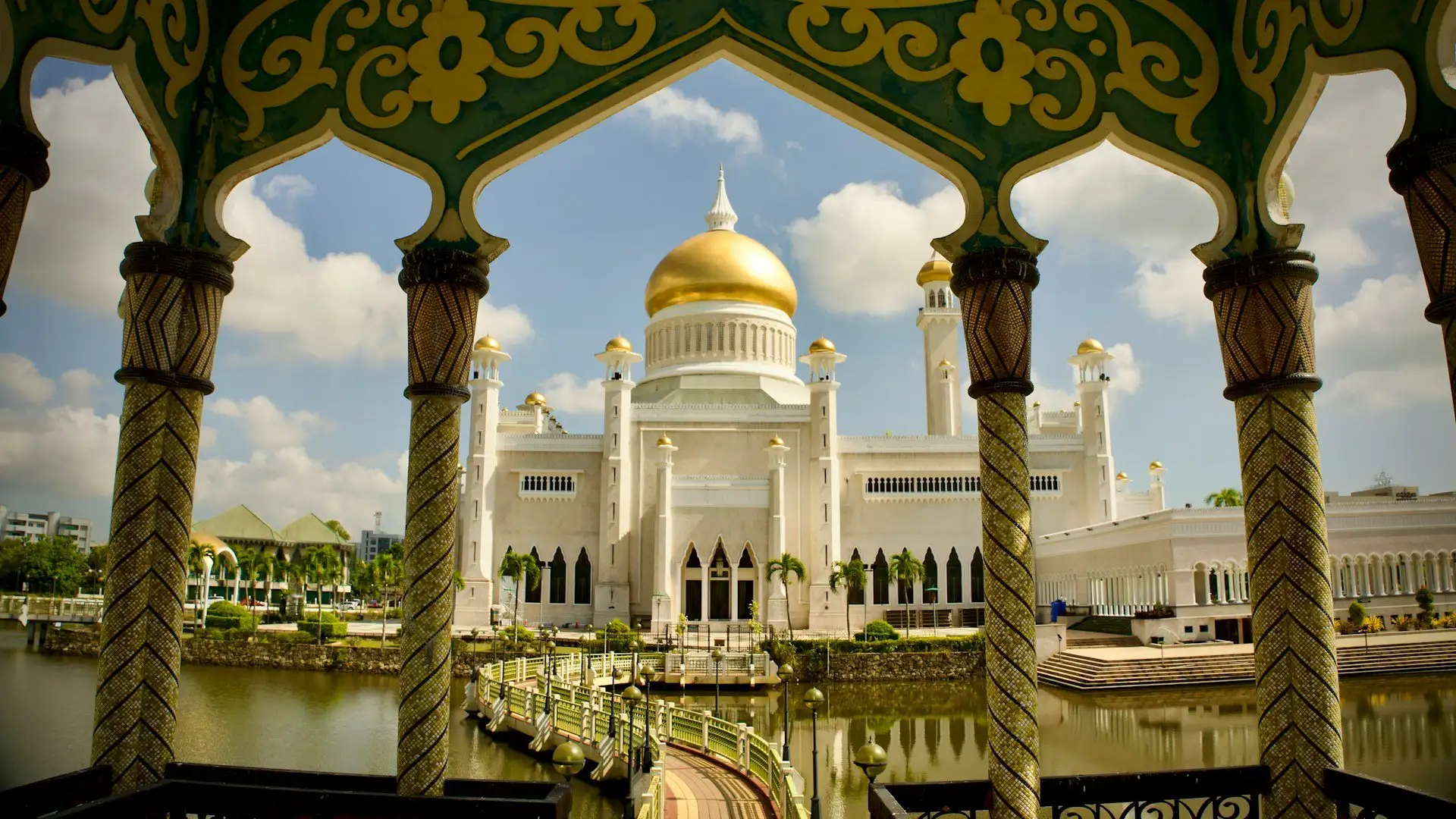
The Omar Ali Saifuddien Mosque, completed in 1958 on an artificial lagoon in the center of Bandar Seri Begawan, is one of the finest pieces of Islamic architecture built in the 20th century: a white marble structure with a gold dome, reflected in the water, surrounded by formal gardens and the low colonial-era buildings of the old city center. It is free to enter outside prayer times and has the particular quality of exceptional religious architecture everywhere: it produces a silence in visitors that they didn't plan to feel.
Beyond the capital: Ulu Temburong National Park in the Temburong enclave is the Bornean rainforest at its most intact, accessible only by longboat through river channels and offering canopy walks above the primary forest canopy that have no equivalent elsewhere in the island. The forest that covers 70 percent of Brunei's land area is genuinely old-growth in most of its extent, preserved by a combination of oil wealth that removed the economic pressure to log it and a government that decided the forest was worth more intact than exploited.
Two to three days is the right amount of time. Brunei is small: the entire country is about the size of Bali, and the main sights are genuinely comprehensible in that window. Extend with Temburong if the forest matters to you. Fit it into a Borneo itinerary that includes Sabah or Sarawak and you will have a complete picture of an island that remains one of the most biodiverse places on earth.
Brunei at a Glance
A History Worth Knowing
Brunei's current geography, two small slivers of territory on the northern coast of Borneo surrounded by Malaysia, is the residue of what was once the dominant maritime power in the western Pacific. Understanding the distance between that historical reality and the present small state gives the country a completely different weight than it appears to have from a map.
At its peak in the 15th and 16th centuries, the Bruneian Empire controlled most of Borneo, the southern Philippines, and significant portions of what is now Indonesia. The capital on the Brunei River was, by any contemporary account, one of the wealthiest and most sophisticated cities in Southeast Asia. Antonio Pigafetta, the Italian scholar who sailed with Magellan's circumnavigation in 1521 and whose account is among the most reliable early European descriptions of the region, wrote of the capital with genuine amazement: the number of cannon on the Sultan's war junks, the quality of the palace, the refinement of the court rituals, and the gold that was everywhere in a quantity that European visitors found difficult to believe. The Spanish, who would spend the next century trying to control the Philippines and frequently fighting or negotiating with Brunei, understood they were dealing with a power of serious consequence.
The decline came gradually through the 17th and 18th centuries, driven by a combination of colonial disruption to the trade networks that had made Brunei wealthy, succession disputes within the royal family that weakened central authority, and the emergence of piracy in the waters that Brunei had previously policed. By the 19th century the empire had contracted to approximately the territory Brunei holds today, and the sultans were signing treaties with the British that exchanged sovereignty over the coastal territories for protection from rivals and internal rebellion.
The most consequential of these treaties involved James Brooke, an English adventurer who helped suppress a rebellion against the Sultan in 1841 and was rewarded with the governorship of Sarawak, a territory he then proceeded to expand systematically northward at Brunei's expense over the following decades. The Brooke dynasty, the "White Rajahs" who governed Sarawak as a private kingdom from 1841 to 1946, took Brunei's territory piece by piece until what remained was the two-district rump that constitutes modern Brunei. The Limbang corridor that now separates the two Bruneian districts was ceded to Sarawak by James Brooke's nephew in 1890 under circumstances that remain disputed by Brunei to this day.
The British protectorate that covered what remained of Brunei was overturned briefly and violently by the Japanese occupation from 1941 to 1945, which destroyed much of the capital and caused significant civilian casualties. After the war, the British resumed protection, and Brunei began the process of negotiating independence, which was achieved in 1984 under Sultan Hassanal Bolkiah, who had acceded to the throne in 1967 and who remains the ruling Sultan today.
The oil that transformed everything had been discovered offshore in 1929. Shell began commercial extraction in 1932. By the 1970s, Brunei's small population and enormous oil revenues created a per-capita income that placed the country among the wealthiest in the world. The current Sultan, who holds the titles of Prime Minister, Minister of Finance, and Minister of Defence simultaneously, has used the oil revenues to fund a welfare state that provides free healthcare, free education, and subsidized housing to citizens. There is no income tax. The political bargain the population has made, no democracy in exchange for cradle-to-grave security, is one that Bruneian citizens appear, by most measures, to have accepted.
The same ruler introduced the Syariah Penal Code in stages from 2014 to 2019, a legal framework that applies to Muslims and in some provisions to non-Muslims, and that attracted significant international attention for its provision of amputation for theft and death by stoning for adultery and homosexual acts. The actual implementation of these punishments has been minimal: the standard of proof required is extremely high and Brunei's courts have not applied the most severe penalties in practice. The legal framework is nonetheless real and understanding it as part of the country's context is appropriate for any visitor.
Chinese sources mention Po-li, believed to be Brunei, as a trading polity in the region. The Brunei River settlement that becomes Kampong Ayer has its origins in this period.
The Bruneian Empire reaches its peak. The Sultan controls most of Borneo, the southern Philippines, and significant portions of the modern Indonesian archipelago. The capital is described by European visitors as one of the wealthiest cities in the region.
Antonio Pigafetta sails into Brunei with the first circumnavigation expedition. His account is the most detailed early European description of the sultanate and its wealth.
James Brooke receives governorship of Sarawak in exchange for suppressing a rebellion. His dynasty systematically annexes Brunei's territory over the following decades.
Offshore oil is found. Commercial extraction begins in 1932. The discovery that will transform a declining sultanate into one of the world's wealthiest countries per capita.
Brunei achieves full independence from Britain under Sultan Hassanal Bolkiah. The Sultan, who became head of state in 1967, begins the sole-ruler structure that continues today.
Free healthcare, education, housing subsidies, no income tax. Oil and gas produce the revenue. The Sultan rules. Tourism is slowly growing but Brunei remains one of the least-visited countries in Southeast Asia.
Top Destinations
Brunei is small enough that the capital and its main attractions can be covered thoroughly in two days. Adding Temburong for the rainforest extends the visit to three to four days. Everything described here is either in Bandar Seri Begawan or accessible as a day trip from it. There is no overland touring circuit: Brunei is a place to understand in depth rather than to cover in breadth.
Omar Ali Saifuddien Mosque
Built between 1954 and 1958 and named for the 28th Sultan of Brunei, the father of the current ruler, the Omar Ali Saifuddien Mosque is the spiritual and visual center of Bandar Seri Begawan and one of the finest examples of modern Islamic architecture in Southeast Asia. The main dome is covered in pure gold mosaic and rises 52 meters above the artificial lagoon that surrounds the mosque on three sides. The exterior is Italian marble. The interior carpet came from Belgium. The stained glass windows were made in England. The overall effect is of a building that was built with the resources of a country that had recently discovered it had very significant resources and intended to communicate this fact with architectural permanence. It achieves the intention. Non-Muslim visitors are welcome outside the five daily prayer times. Appropriate dress is mandatory and covering garments are available at the entrance. The reflection of the mosque in the lagoon at the golden hour before sunset is the single most photographed image in Brunei and it earns its prominence.
Kampong Ayer
The world's largest water village is not a tourist attraction that happens to have people living in it. It is a functioning community of approximately 30,000 residents in houses built on stilts over the Brunei River, connected by 36 kilometers of wooden boardwalks and served by water taxi boats that operate like informal bus routes. The village has its own mosques (built on platforms over the water), its own schools, its own health clinics, its own fire station, and its own police post, all waterborne. It has been inhabited continuously for at least 1,300 years, which makes it one of the oldest continuously inhabited settlements in Southeast Asia. The correct way to experience Kampong Ayer is to hire a water taxi from the waterfront in BSB, ask the driver to take you into the village, and then walk the boardwalks on your own for an hour or two. The people who live here are used to occasional visitors but not overwhelmed by them, which creates a quality of encounter that is genuinely rare in Southeast Asia. Some households display a welcome sign and offer tea. Accept.
Ulu Temburong National Park
Seventy percent of Brunei's land area is covered by intact forest. Ulu Temburong is the most protected and most accessible portion of it: 500 square kilometers of primary Bornean rainforest in the Temburong enclave, reached by speedboat from Bandar Seri Begawan through Limbang (in Malaysian Sarawak) and then by longboat through river channels under a canopy of riverside trees. The canopy walkway above the primary forest, suspended 60 meters above the forest floor, provides views across unbroken Bornean rainforest to the horizon in every direction. Proboscis monkeys, hornbills, pit vipers, and monitor lizards are commonly sighted. Swimming in the river at the research center is one of the unexpected pleasures. The park is accessible only on organized day trips or overnight stays from licensed operators in BSB; independent access is not permitted.
Royal Regalia Museum
The collection of the Sultan's coronation regalia and state gifts received from foreign heads of state is housed in a domed building in central BSB and represents one of the most concentrated displays of state wealth in Southeast Asia. The golden coronation chariot weighs several tonnes. The bejeweled ceremonial weapons, the solid gold state umbrella, and the throne room recreation communicate the sultanate's historical sense of its own importance with a directness that state museums in more self-conscious countries avoid. Admission is free. Photography is not permitted inside. The building itself, a scaled-down dome on a modest plot, creates an interesting contrast with the extravagance of what it contains.
Jame'Asr Hassanil Bolkiah Mosque
Built in 1994 to mark the 25th year of the current Sultan's reign, the Jame'Asr Hassanil Bolkiah Mosque in the Kiarong district of BSB is the largest mosque in Brunei and the one that looks most spectacular on a clear day: 29 golden domes (one for each of the Sultans of Brunei) visible from the highway, set in formal gardens of considerable scale. It can accommodate 5,000 worshippers. The interior is more ornate than the Omar Ali Saifuddien Mosque and the surrounding grounds include a library and an Islamic exhibition center. Open to non-Muslim visitors outside prayer times. The drive through the residential neighborhoods on the way gives a more accurate picture of everyday Bruneian life than the tourist-facing waterfront.
Proboscis Monkey River Cruise
The proboscis monkey, with its extraordinary pendulous nose and pot-bellied profile, is one of the most distinctive animals in Borneo and endemic to the island. Evening river cruises from the BSB waterfront along the Brunei River provide reliable sightings as the monkeys come to the riverside trees to settle for the night. The cruises also offer views of Kampong Ayer from the water, fireflies in the mangrove channels after dark, and the occasional silver leaf monkey alongside the proboscis. The hour-long cruises run at dusk and are operated by several waterfront tour companies at reasonable rates. Book in the afternoon for the same evening.
Brunei Museum & Malay Technology Museum
The Brunei Museum on the bank of the Brunei River houses the most comprehensive collection of regional Islamic art in Southeast Asia, alongside the extraordinary Muara shipwreck gallery: ceramics and trade goods recovered from a 10th-century Chinese trading vessel wrecked off the Brunei coast, which constitutes one of the most significant archaeological discoveries in the region. The adjacent Malay Technology Museum occupies a series of reconstructed traditional Malay buildings and documents the fishing, boat-building, and craft traditions of the Bruneian water villages. Both are free and substantially undervisited. The location on the river road east of BSB is a pleasant 20-minute walk from the Kampong Ayer waterfront.
Gadong Night Market
The Gadong Night Market in the commercial district of BSB operates from late afternoon until around 10pm and is the most concentrated expression of Bruneian food culture in the country: dozens of stalls selling ambuyat (the sago starch dish that is Brunei's equivalent of a national staple), nasi katok (rice, fried chicken, and sambal), grilled seafood, kuih (sweet rice cakes and coconut confections), and fruit juice from the local Bornean varieties. It is busy, primarily Bruneian in its clientele, and very cheap by the standards of a country where most things are not very cheap. The Saturday evening crowd is the most animated. Arrive hungry and work through it methodically rather than trying to plan what you'll order.
Culture & Etiquette
Brunei is a Malay Islamic Monarchy, which is not just a constitutional description but a genuine cultural framework that shapes daily life in ways that visitors from secular Western countries need some adjustment to navigate comfortably. The Islamic practice here is conservative and seriously maintained: the five daily prayers are observed, Friday is the weekly holy day when most businesses close from 11:30am to 2pm, and the Syariah framework that governs personal conduct for Muslims extends in some provisions to non-Muslims as well.
None of this makes Brunei unfriendly to visitors. Bruneians are, broadly, warm and curious about foreigners in the way that people in countries without significant tourism tend to be: they are not tired of you, they are not running a script, and the English that most educated Bruneians speak (it is a co-official language and the language of instruction in most schools from Year 1) means that genuine conversation is possible in ways that require translation elsewhere. The cultural expectation that visitors respect the country's Islamic character is reasonable and the practical requirements are not onerous: dress modestly, don't drink in public, observe Friday prayer time, and behave with the same consideration you'd want visitors to your own country to show.
Shoulders and knees covered everywhere outside hotel grounds. Women do not need to cover hair outside mosques and religious sites. At mosques, full covering including hair is required: appropriate garments are always provided at the entrance. Men in long trousers and a shirt with sleeves are appropriately dressed everywhere in the country.
Universal and non-negotiable at religious sites. At homes and guesthouses, the row of shoes at the entrance is the signal. Follow the lead of whoever is accompanying you. At the water village, remove shoes when entering anyone's home without being asked.
The left hand is considered unclean in Malay Muslim culture. Pass food, money, and objects with your right hand. Receive with both hands or the right hand. This is especially important when eating and when interacting with older Bruneians.
Non-Muslim visitors are permitted to bring two litres of spirits and 12 cans of beer for personal consumption. This must be declared at customs on arrival. The allowance is for genuine personal consumption only and must not be shared with Bruneian nationals or sold.
The Islamic greeting (peace be upon you) is the standard social opening for interactions with Bruneian Muslims. Using it, even imperfectly, is received with genuine warmth. Non-Muslims are not obligated to use it but doing so shows respect for the cultural context.
Alcohol is not sold anywhere in Brunei. Drinking in public is illegal. Consuming your personal import allowance in your hotel room or a private space is permitted. Carrying alcohol outside accommodation, appearing publicly intoxicated, or offering alcohol to Bruneian nationals are all serious offences with serious consequences.
During Ramadan, eating, drinking, and smoking in public during daylight hours is illegal for both Muslims and non-Muslims in Brunei. This is enforced. Restaurants remain open in designated areas with screens but eating in view of the street is not appropriate. Adjust your schedule and respect the observance.
Pointing with a single finger, especially at people, is considered rude in Malay culture. Use your thumb with a closed fist to point or indicate direction. This is the standard Bruneian pointing gesture and using it correctly creates a small but genuine positive impression.
Public displays of affection between couples are inappropriate throughout the country. The expectation applies to both same-sex and opposite-sex couples. Homosexuality is illegal under the Syariah Penal Code. Same-sex travelers should be aware of this legal context and exercise appropriate discretion.
The Sultan's portrait appears throughout Brunei in homes, offices, and public spaces. The royal family is respected with the kind of deference that in some countries applies to sacred objects. Social media posts or photographs perceived as disrespectful of the royal family have resulted in the deportation of visitors. Express opinions about the Sultan and the royal family with the same caution you'd apply to any subject with legal consequences.
Eating Culture: Warung & Kedai Kopi
Brunei's daily eating culture happens at the warung (small food stall), the kedai kopi (coffee shop), and the night markets. These are the social spaces where Bruneians from all backgrounds eat together: the coffee shops in particular are the morning gathering point where conversation runs from local politics to football to the price of fish, over teh tarik (pulled milk tea) and roti canai. The atmosphere is relaxed and foreigners are welcome without fanfare. Sitting down at a kedai kopi table, ordering teh tarik and whatever the cook is making, and watching the morning proceed is the single most accurate introduction to daily Bruneian life available to a visitor.
Hari Raya & National Day
The two most significant events in Brunei's annual calendar are Hari Raya Aidilfitri (the celebration ending Ramadan) and National Day on February 23rd. During Hari Raya, Bruneian homes are open to visitors for several days following the Eid prayers, with homeowners setting out an elaborate spread of kuih and traditional dishes for any caller. If you happen to be in Brunei during Hari Raya and someone invites you to their home, this is a genuine expression of the country's hospitality tradition and accepting is both appropriate and memorable. National Day is marked by a parade at the national stadium that is worth attending for the spectacle.
Friday in Brunei
Friday is Brunei's holy day and the country operates on a different rhythm. The Juma'ah prayer at midday closes most businesses, restaurants, and government offices from approximately 11:30am to 2pm. Shopping malls and larger restaurants typically reopen after 2pm. Tourist sites including the mosques are closed to non-Muslim visitors during the prayer period. Plan to use the 11:30am to 2pm window for your hotel, a rest during the midday heat, or eating somewhere that remains open. The post-prayer Friday afternoon in Brunei has a particular quiet quality that reveals something about the country's relationship to time.
Traditional Crafts
Brunei has a tradition of fine craft work that is less well-known internationally than its mosques and oil wealth. Kain tenunan, the hand-woven silk fabric with gold-thread patterns that was historically the preserve of the royal court, is still produced by a small number of traditional weavers in the Kampong Ayer area. Silverwork and brassware, particularly the distinctive Brunei brass cannon that appears in miniature form in gift shops, are the other traditional crafts. The Arts and Handicrafts Training Centre near the museum has workshops where traditional craft production can be observed and work purchased directly from the artisans.
Food & Drink
Bruneian food is Malay food at its most Bornean: the shared culinary tradition of the Malay world, with the specific influence of Borneo's coastal fishing culture, the water village cooking tradition, and the ingredient diversity of a country that sits at the center of one of the world's most biodiverse ecosystems. The flavors are coconut, lemongrass, galangal, belacan (fermented shrimp paste), and the specific Bornean chili varieties that are hotter than the standard Southeast Asian baseline. Pork is absent, as in any Muslim-majority country, which shapes the protein options toward beef, chicken, seafood, and the fresh river fish that are a particular strength of the riverine cooking tradition.
Alcohol is not available anywhere in Brunei. The drinks culture runs on teh tarik (pulled milk tea), kopi (Hainanese-style thick coffee sweetened with condensed milk), fresh coconut water, and an extraordinary range of fresh fruit juices from Borneo's native fruit species, including the local ambra (hog plum juice), belimbing (star fruit), and the sweet rose apple varieties that grow in the kampong gardens.
Nasi Katok
The definitive Bruneian street food: steamed white rice, a piece of fried chicken, and a scoop of sambal chili paste, wrapped in brown paper and sold from small roadside stalls for B$1. The simplicity is deliberate and the quality variable: the best nasi katok is made with properly marinated chicken fried in a wok over high heat, the sambal made fresh that morning. It is available at virtually every roadside stall in the country at any hour and is the correct introduction to Bruneian food culture for anyone arriving without local guidance.
Ambuyat
The national dish and the one that challenges most non-Bruneian visitors: a sticky, glutinous paste made from sago starch (the pith of the sago palm), flavorless by itself and eaten by wrapping it around a bamboo fork called a chandas and dipping it into a selection of accompanying sauces. The sauces, which include binjai (a sour mango-like fruit curry), salted fish, and sambal, are where the flavor comes from. The ambuyat itself is the neutral carrier and the textural experience: somewhere between thick mashed potato and warm chewing gum. It is unforgettable in a way that is either positive or negative depending on your relationship to unfamiliar textures.
River Fish & Seafood
Brunei's rivers and the South China Sea coastline produce excellent fresh fish: the tenggiri (Spanish mackerel) and the ikan bakar (grilled fish) tradition of the coastal communities is the best seafood eating in the country. The belacan-marinated grilled fish at the riverside stalls near Kampong Ayer, eaten with rice and a glass of iced lime juice, is the meal that visitors to Brunei most reliably describe as the one they remember. The freshness comes from the fact that the fish comes off the boat the same morning and goes directly onto the grill. Arrive at the waterfront stalls by 11am for the best selection.
Mee Goreng & Local Noodles
The Bruneian version of mee goreng (stir-fried noodles) uses the same yellow egg noodle base as Malaysian and Indonesian versions but the flavor profile is distinctly richer, with more belacan and a specific dark soy sauce that gives it its color. The kedai kopi breakfast noodle in BSB, eaten at 7am at a formica table with a glass of teh tarik, is one of the most grounding possible ways to start a day in Brunei. Most kedai kopi also serve the hawker staples of the broader Malay world: laksa, char kway teow, and nasi lemak, which reach Brunei in their slightly sweeter, slightly less spiced Malay rather than Singaporean form.
Kuih & Sweets
The kuih tradition of the Malay world produces an astonishing range of small sweet and savory cakes using rice flour, coconut milk, pandan leaf, and palm sugar. The Bruneian versions, many specific to the local ingredient range, are displayed at night market stalls in layered towers of color: the green pandan layer cakes, the pink rose-flavored jellies, the black glutinous rice puddings wrapped in banana leaf. Most are eaten as snacks rather than desserts and cost a few cents each. Buying a selection and working through it while walking the Gadong Night Market is one of the more pleasurable ways to spend an evening in Brunei.
Teh Tarik & Drinks
Teh tarik, the pulled milk tea made by pouring the sweetened tea mixture between two containers to create a froth, is the social beverage of Brunei's kedai kopi culture: available everywhere, excellent everywhere, and culturally irreplaceable. Kopi, the thick, intensely sweet Hainanese-style coffee, is the alternative. Fresh coconut water from the young coconuts available at market stalls is the correct hot-weather drink. Locally produced fruit juices from Bornean varieties including belimbing (star fruit), mangosteen, and the rare Bornean fruits visible only in specialist market stalls are worth seeking out for their specific flavors that do not survive export or processing.
When to Go
Brunei sits less than five degrees north of the equator and is hot and humid year-round. The practical distinction between seasons is rainfall rather than temperature. The northwest monsoon from November to February is generally considered drier and slightly more comfortable than the southwest monsoon from May to October. December to April is the most visited period. That said, Brunei receives rain in every month of the year and the difference between its best and worst weather months is considerably smaller than in most of Southeast Asia.
Dry Season
Dec – AprThe most reliably dry period. Temperatures of 24–32°C with lower humidity than the monsoon months. The Omar Ali Saifuddien Mosque reflection in the lagoon is at its most photogenic when the water is calm. National Day celebrations on February 23rd add a specific cultural draw. Ulu Temburong river levels allow comfortable longboat access throughout this period.
Shoulder
Oct – NovThe transition from southwest monsoon is generally manageable. Rain is possible but less sustained than July and August. The Gadong Night Market is less crowded than December and January weekends when regional tourists from Malaysia and Singapore visit. October is one of the better months for proboscis monkey sightings on the river cruise.
Southwest Monsoon
May – SepMore sustained rain and higher humidity. Afternoon thunderstorms are common. Ulu Temburong can have elevated river levels that affect longboat access to the canopy walk. The rain creates atmospheric conditions at the mosques that some photographers prefer. All indoor attractions and the water village are fully accessible regardless of rain.
Ramadan
Varies — lunar calendarBrunei's Ramadan observance is strict: no eating or drinking in public during daylight hours, most restaurants closed during the day, the social atmosphere quieter. The evenings after iftar are more vibrant. Non-Muslim visitors can find accommodation and food but need to plan carefully around the daytime restrictions. Not a reason to avoid Brunei but it requires adaptation.
Trip Planning
Two full days covers Bandar Seri Begawan thoroughly. Day one: morning at the Omar Ali Saifuddien Mosque, afternoon at the Royal Regalia Museum, water taxi to Kampong Ayer for the late afternoon, evening river cruise for the proboscis monkeys, dinner at a riverside stall. Day two: morning at the Brunei Museum and Malay Technology Museum, lunch at the Gadong Night Market (which operates from lunch onward), afternoon at the Jame'Asr Hassanil Bolkiah Mosque, final evening walk along the BSB waterfront. Day three, if you have it: Ulu Temburong full-day trip. This is genuinely sufficient. Brunei is not a country that rewards rushing any more than it rewards the days visitors who spend four hours and leave.
Brunei works very well as a two to three day add-on to a broader Borneo trip that includes Kota Kinabalu (Sabah) or Kuching (Sarawak). Royal Brunei Airlines and AirAsia operate connections between BSB and both cities. The geographic position puts Brunei logically in the middle of a Borneo itinerary.
BSB Mosques, Museum & Water Village
Early morning nasi katok at a roadside stall. Omar Ali Saifuddien Mosque at 9am (cooler before the midday heat). Royal Regalia Museum mid-morning. Lunch at a kedai kopi near the waterfront. Water taxi to Kampong Ayer at 2pm: explore the boardwalks, accept any tea invitations. Return to the waterfront for the dusk proboscis monkey river cruise at 5:30pm. Dinner at riverside fish stalls with fresh ikan bakar.
Museums, Gadong & the Second Mosque
Brunei Museum and Malay Technology Museum on the river road (allow 2.5 hours for both). Lunch at the Gadong Night Market. Drive to the Jame'Asr Hassanil Bolkiah Mosque in Kiarong for the afternoon. Final golden-hour return to the Omar Ali Saifuddien Mosque lagoon for the reflection photograph you spent the first day building up to. Evening walk along the BSB waterfront esplanade. Fly out the next morning.
Bandar Seri Begawan in Full
The full two-day BSB itinerary above, but slower: a longer morning at Kampong Ayer, a visit to the Arts and Handicrafts Centre to watch traditional weavers, and an evening at the Yayasan shopping complex food court which has the widest variety of Bruneian hawker food in one place. The extra day allows the city to reveal itself at its own pace rather than yours.
Ulu Temburong National Park
Depart BSB by speedboat for the 45-minute crossing to Bangar in Temburong. Transfer to longboat for the river journey into the national park (30–45 minutes of river channels through primary forest). Full day at the park: canopy walkway 60 meters above the forest floor, swimming in the river, birdwatching at dawn if staying overnight. Return to BSB by the same route. Overnight in the park is possible through licensed operators and is recommended for the dawn experience.
Kota Kinabalu, Sabah
Fly into Kota Kinabalu. Mount Kinabalu (if trekking), Kinabalu National Park, the Kinabatangan River for orangutans and pygmy elephants, Semporna for the Sipadan diving if you've booked a permit in advance. Four days in Sabah gives the main highlights without rushing the wildlife experiences that are Sabah's primary draw.
Brunei
Fly from KK to BSB (45 minutes on Royal Brunei or AirAsia). Three days: two days in BSB as above, one day in Ulu Temburong. The contrast with Sabah's relatively developed tourism infrastructure is instructive: Brunei shows you Borneo's other face, the face that has preserved itself through a different set of choices.
Kuching, Sarawak
Short flight or bus from BSB to Kuching (passing through Malaysian Sarawak again). The Sarawak Museum, the Semenggoh orangutan rehabilitation centre, the longhouse visits along the Skrang or Lemanak rivers, and Bako National Park's proboscis monkeys complete the Borneo circuit. Fly home from Kuching or back through KL.
Vaccinations
No mandatory vaccinations for most nationalities. Hepatitis A and Typhoid are recommended. Routine vaccines should be up to date. Dengue fever is present in Brunei: the country has periodic dengue clusters tracked by the Ministry of Health. Apply DEET repellent especially at dawn and dusk. The Ulu Temburong rainforest environment warrants additional protection against mosquitoes and leeches.
Full vaccine info →Connectivity
DST and Progresif are the two main operators. Tourist SIMs are available at the airport. 4G coverage is good in BSB and the main roads. Ulu Temburong has no coverage. Download offline maps before leaving the city. WhatsApp and other messaging apps work normally. There is no VoIP restriction as exists in some Gulf states.
Get Brunei eSIM →Power & Plugs
Brunei uses British-style Type G three-pin plugs at 240V. Identical to Singapore and Malaysia: the same adapters work for all three. Power is completely reliable throughout BSB and the main towns. Battery-powered equipment is useful for Ulu Temburong where charging is limited.
Language
Malay (Bahasa Melayu) is the official language and the language of government, courts, and Islamic observance. English is the co-official language and the primary language of education from Year 1. Almost all younger Bruneians are bilingual. Signage, menus, and tourist information are all in English. Navigation as an English speaker is completely straightforward.
Travel Insurance
Recommended. Healthcare in Brunei is free for citizens and subsidized for residents but foreigners pay full private rates. The Raja Isteri Pengiran Anak Saleha (RIPAS) Hospital is the main public hospital and is good quality. For travel to Ulu Temburong, ensure your policy covers remote forest environments and any activity rating for jungle trekking.
Legal Medications
Check the Brunei Ministry of Health's list of controlled pharmaceuticals before packing any prescription medication. Some medications commonly available elsewhere are controlled or prohibited in Brunei. Carry a prescription and doctor's letter for any prescription medication. Most standard medications are available at Guardian and other pharmacies in BSB's shopping malls.
Transport in Brunei
Brunei is a car-centric country with minimal public transport. There is no rail system. A public bus network serves BSB but is infrequent and not well mapped for tourists. Taxis are metered in theory and negotiated in practice. Grab operates in BSB and is the most reliable option for metered, fixed-price transport within the city. For Ulu Temburong, the journey requires the speedboat from Muara ferry terminal to Bangar, then transfer to a longboat: this is always arranged through a licensed tour operator as part of the package.
Grab
B$5–15/tripGrab operates throughout BSB and is by far the most reliable transport option: fixed prices, air-conditioned cars, no negotiation. Download the app before landing. Coverage extends across the main BSB districts including Gadong, Kiulap, and the waterfront. For the Brunei Museum and areas outside central BSB, Grab is significantly more practical than trying to find a passing taxi.
Taxis
Negotiate, B$5–20Metered taxis are available at the airport and a few dedicated stands but are less common than in most cities of comparable size. Negotiating a fare before getting in is standard practice. For day-trip purposes (airport to hotel, hotel to main sites), a prearranged driver through your hotel is often the most practical option, particularly if you want to visit several sites in a single day without Grab delays.
Water Taxi
B$1/boardingThe water taxis on the Brunei River between the BSB waterfront and Kampong Ayer operate continuously during daylight hours. Board from the waterfront near the customs wharf. B$1 per person per boarding in either direction. The boats are small wooden motorcraft and the journey takes two to five minutes depending on which section of the water village you're heading to. Flag one down from the waterfront — they pass constantly.
Speedboat to Temburong
B$10–15 returnThe high-speed ferry from Muara ferry terminal to Bangar in Temburong takes 45 minutes and operates several times daily. Public service or operator-arranged as part of the Ulu Temburong package. The Muara terminal is 25km north of BSB. From Bangar, longboats into the national park are arranged by tour operators. The entire Temburong journey is most conveniently done as part of an organized day or overnight package.
Brunei International Airport
Grab: B$8–12 to BSBThe airport is 10 kilometers north of central BSB. Grab is the easiest transfer option. The official taxi queue at arrivals charges approximately B$15–20 for the city center. Royal Brunei Airlines and AirAsia are the primary carriers operating out of BSB, with connections to Singapore, Kuala Lumpur, Kota Kinabalu, Manila, and direct Royal Brunei services to London, Melbourne, and Dubai.
Car Rental
B$60–100/dayCar rental is available through the main international companies at the airport. Driving is on the left, roads are good quality and well-signed in English, and the country is small enough that a rental car covers everything within Brunei's main territory in a single day. Not necessary for the BSB sights (Grab handles these) but useful if you want to visit the Temburong speedboat terminal at Muara and explore the less-visited interior roads at your own pace.
The journey to Ulu Temburong National Park is part of the experience: the speedboat from Muara crosses the Brunei Bay, threading between offshore oil platforms visible on the horizon, before entering the Temburong River delta and slowing to longboat territory. The longboat section, a narrow wooden boat with a canopy that negotiates increasingly tight river channels under an increasingly enclosed forest canopy, is one of the most distinctive approach journeys to any national park in Southeast Asia. By the time you reach the research station and step off the boat into primary Bornean rainforest, the journey itself has done significant preparatory work on your expectations. This is why the overnight option, which means doing the journey twice in different light conditions, is worth the extra day.
Accommodation in Brunei
Brunei's hotel sector is concentrated in BSB and skewed toward the mid-range and business travel market that makes up most of its visitors. There are a small number of genuine luxury properties and a reasonable range of mid-range international hotels. Budget accommodation is limited compared to what the rest of Southeast Asia provides at the same price point. The Empire Hotel and Country Club, if budget is genuinely not a constraint, is one of the most extraordinary hotel buildings in Southeast Asia: a palace built for Sultan Hassanal Bolkiah's 1998 jubilee that has since been converted to a luxury hotel of spectacular and slightly absurd grandeur.
Luxury Hotel
B$250–800/nightThe Empire Hotel and Country Club in Muara is the single most extraordinary hotel property in Brunei: a vast marble palace commissioned by the Sultan for a jubilee celebration, converted to a hotel with an atrium lobby you can drive a bus through, beach access, multiple pools, and every amenity known to luxury hospitality. The Radisson Hotel in central BSB is the most conveniently located five-star option for sightseeing.
Mid-Range Hotel
B$80–180/nightThe Riverview Hotel on the waterfront and the Sheraton Serasa in the Muara district are the most consistently recommended mid-range options. Central BSB has several well-run Chinese-owned hotels in the B$80–120 range that are clean, functional, and well-positioned for the main sights. The Kiulap commercial district has the best concentration of mid-range options with easy Grab access to everywhere.
Temburong Lodges
B$120–250/nightOvernight accommodation in Ulu Temburong National Park is available through a small number of licensed ecolodge operators. The lodges are riverside chalets with basic but comfortable facilities: the experience is the forest, not the room. Staying overnight means access to dawn and dusk wildlife activity windows that day visitors miss. Book well in advance for peak season (December to February).
Budget Guesthouse
B$40–70/nightBudget accommodation options are more limited in Brunei than in neighboring Malaysia. Jubilee Hotel and a small number of other guesthouses in the central BSB area serve this market. The quality is functional rather than charming. For visitors prioritizing budget over comfort, Miri in Malaysian Sarawak is a cheaper base from which BSB is a 4-hour bus journey if the Temburong trip is not part of the itinerary.
Budget Planning
Brunei is moderately expensive by Southeast Asian standards and cheap by Gulf standards, which reflects its position as an oil-wealthy Islamic country that is neither the backpacker corridor of Thailand and Vietnam nor the luxury-tier of Singapore. The food is genuinely cheap if you eat at local restaurants, night markets, and kedai kopi. Hotels are where the cost accumulates: there is no budget hostel tier comparable to what exists in Bangkok or Bali. The Brunei Dollar is pegged to the Singapore Dollar at 1:1, and Singapore Dollars are accepted everywhere at face value. ATMs are reliable and widespread.
- Budget guesthouse or economy hotel
- Kedai kopi and night market meals
- Grab and water taxis for transport
- Free attractions: mosques, museums, Kampong Ayer
- Nasi katok at B$1 per meal
- Mid-range hotel in central BSB
- Mix of local and restaurant dining
- Grab throughout plus occasional taxi
- Ulu Temburong day trip (amortized)
- Evening proboscis monkey cruise
- Radisson BSB or Empire Hotel
- Restaurant dining for every meal
- Private driver for day trips
- Overnight Temburong ecolodge
- Guided Kampong Ayer cultural tour
Quick Reference Prices
Visa & Entry
Brunei operates a relatively generous visa-free entry system for most Western nationalities. Citizens of the UK, Germany, France, the Netherlands, and most EU nations receive 30 days visa-free. US citizens receive 90 days visa-free. Australian and Canadian citizens receive 14 days. ASEAN nationals generally receive 14 days. Most visitors from Western countries can enter without any advance visa application: simply arrive at the airport with a valid passport, a return or onward ticket, and sufficient funds for your stay.
Some nationalities require a visa in advance through the nearest Brunei High Commission or Embassy. Check the current list at the Brunei Immigration Department website (immigration.gov.bn) before booking your flight: the list has changed periodically and the website is the authoritative current source.
UK (30 days), Germany (30 days), US (90 days), Australia (14 days), Canada (14 days). No advance application needed. Check current list at immigration.gov.bn before travel as terms vary by nationality.
Family Travel & Pets
Brunei is a comfortable family destination by Southeast Asian standards. It is very safe, English is everywhere, the distances are manageable, and the main attractions work across age ranges. The heat is the primary practical challenge for families with young children. The Ulu Temburong rainforest excursion is the headline experience and works well for children aged seven or older who can manage the longboat journey and the forest walking without distress. The water village exploration is suitable for children of any age who are comfortable on the water.
The country's conservative social environment is not a practical obstacle for families. The modesty dress requirements apply to children as well as adults (shoulders and knees covered at mosques) but are no different from what is appropriate at any religious site anywhere in the world. The absence of alcohol simplifies certain aspects of family dining in ways that are straightforwardly positive.
Water Village for Kids
The water taxi journey to Kampong Ayer and the walk along the village boardwalks above the river is one of those experiences that children process as genuinely unusual: the houses on stilts over the water, the boats passing underneath, the views of the mosque and the river traffic from a wooden walkway above the river. It works for children from about age five upward. The water taxis are small boats with no railings: keep young children close to the adult at all times on the boat and on the approaches to the water taxi boarding points.
Proboscis Monkeys
The evening river cruise for proboscis monkeys is a universally compelling experience for children who have seen the animal in a photograph and then encounter it in its actual scale in a riverside tree 30 meters away. The proboscis monkey's extraordinary nose, the oversized pot belly of the males, and the way they crash through the riverside trees to settle for the night is immediately and unapologetically funny. The evening timing (5:30 to 7pm) works well with the daily rhythm of families with children.
Ulu Temburong for Older Kids
The canopy walkway at Ulu Temburong, 60 meters above the primary forest floor, is the kind of experience that adults describe as vertigo-inducing and children often describe as the best thing they did on the trip. The suspension walkway sways gently in the wind. The view is of unbroken rainforest canopy in every direction, with occasional hornbills crossing the open sky above it. Suitable for children from about age eight who are not afraid of heights. The longboat approach through the river channels is itself an adventure that most children find thrilling.
Mosques for Families
The Omar Ali Saifuddien Mosque visit works well for families with older children who can engage with architecture and religious culture. Covering the children appropriately (garments provided at the entrance) and briefing them briefly on the expectation of quietness inside the mosque produces a context where the visit is respectful and memorable. The artificial lagoon and gardens surrounding the mosque are accessible to young children without entering the mosque building itself, which is the better option for very young children who may not manage the quiet interior.
Food for Kids
Bruneian food is broadly accessible for children: rice and chicken in various forms are everywhere and always available. The nasi katok (rice, fried chicken, sambal) can be served without the sambal for younger palates. The kedai kopi's roti canai (crispy flatbread with curry dipping sauce) is reliably popular with children across all cultural backgrounds. Night market kuih (sweet rice cakes) are universally approved of. The absence of alcohol means the family dining atmosphere at restaurants is entirely child-friendly without any table-management required.
Pools & Beaches
Brunei is not primarily a beach destination. The coast north of BSB has a few public beaches of which Muara Beach is the most accessible, but the water quality of the South China Sea coastline near Brunei is affected by coastal development and oil industry activity. Hotel pools are the more reliable option for families wanting water recreation. The Empire Hotel's pool complex, if the budget extends, is one of the best in the region.
Traveling with Pets
Brunei permits the import of dogs and cats with specific documentation: a health certificate from an accredited veterinarian issued within 10 days of travel, up-to-date rabies and other vaccinations, microchipping to ISO standard, and an import permit from the Department of Agriculture and Agrifood obtained before departure. The import permit application process takes several weeks. Some dog breeds are restricted: check the current list with the Brunei Department of Agriculture before making any travel arrangements.
Pet-friendly accommodation in Brunei is extremely limited. Most hotels do not accept pets. The practical recommendation for pet owners visiting Brunei on a short trip is to make alternative arrangements for animals at home. The duration of the typical Brunei visit (two to three days) does not justify the documentation complexity and the limited accommodation options that bringing an animal would create.
Safety in Brunei
Brunei is one of the safest countries in Southeast Asia by any standard. Violent crime is extremely rare. Petty theft is uncommon. Women travel alone without meaningful risk. The main safety considerations are legal rather than criminal: the laws that govern behavior in Brunei are real and enforced, and behaviors that are unremarkable elsewhere can have legal consequences here. Understanding the framework removes essentially all risk for a visitor behaving with basic consideration and awareness.
General Safety
Extremely safe for tourists. Crime is very low. Brunei has a well-functioning police service, a small population, and a social environment that is orderly and respectful. Leaving belongings unattended is lower risk here than in most destinations in the region.
Solo Women
Brunei is consistently rated among the safest destinations in Southeast Asia for solo female travelers. Street harassment is essentially absent. The conservative social environment is not hostile to women; it is structured and orderly in ways that create a specific kind of public safety. Travel alone at any hour in BSB without meaningful risk.
Legal Risks
The Syariah Penal Code applies to Muslims in full and to non-Muslims in several provisions. Alcohol consumption in public is prohibited for all. Eating or drinking in public during Ramadan is prohibited for all. The laws are enforced. Understanding them before arrival and staying within them requires minimal adjustment for most visitors.
Road Safety
Brunei has a high rate of car ownership and a driving culture that is generally orderly but fast on the main highways. Pedestrian infrastructure is minimal outside BSB's central areas. The roads to Temburong via Malaysian Sarawak involve border crossings with their own procedures. Use Grab or taxis rather than attempting to navigate unfamiliar roads on foot.
Healthcare
RIPAS Hospital in BSB is the primary facility and is good quality by regional standards. Emergency treatment is available. Foreign visitors pay full private rates. Travel insurance covering medical expenses is recommended. For serious medical emergencies, transfer to Singapore is sometimes necessary for specialist care.
Natural Hazards
Brunei's equatorial position makes heat and humidity year-round realities. Dengue fever is present with periodic local clusters. The Ulu Temburong rainforest environment has its own hazards: leeches (significant, manageable with leech socks), occasional venomous snakes, and river currents at the swimming holes that require awareness. Follow your guide's instructions in the forest at all times.
Emergency Information
Your Embassy in Brunei
Most major Western countries have diplomatic representation in Bandar Seri Begawan, concentrated in the Jalan Kebangsaan and Jalan Tutong diplomatic areas.
Book Your Brunei Trip
Everything in one place. These are services worth actually using.
The Empire That Shrank and Kept Going
There is a specific quality to places that were once larger than they are now, that carry in their present smallness the memory of a different scale. Brunei has this quality more than any other country in Southeast Asia. The Sultan who currently lives in the Istana Nurul Iman Palace, the largest residential palace in the world by floor area, is the 29th in a line that once controlled most of Borneo and the southern Philippines and was described by a man sailing with the first circumnavigation of the globe as ruling one of the wealthiest and most sophisticated courts in Asia. That territory is now mostly Malaysia and the Philippines. What remains is the size of a medium English county, inhabited by fewer people than a mid-sized European city, and sitting on enough oil to fund a welfare state that most countries ten times its size cannot afford.
The Kampong Ayer water village is the thread that connects these two Bruneis: the small and the large, the present and the historical. Thirty thousand people living on the water as their ancestors did for thirteen hundred years, in a community that has absorbed Portuguese contact and British protectorate and Japanese occupation and oil wealth and the current Sultan's simultaneously traditional and distinctive form of Islamic governance, and kept going. Sitting in a water taxi moving through the village at dusk, with the Omar Ali Saifuddien Mosque dome catching the last of the light on the lagoon and the call to prayer carrying across the water, is the moment when Brunei's complicated and compressed history feels not like a series of events but like a place that has always known who it is. Two days. Go.