
What You're Actually Getting Into
The moment your Narita Express slides out of the airport and into a sprawling grid of gray rooftops and vending machines every 50 meters, you'll realize Japan is going to be different from anywhere you've been before. Not exotic-different in a way that makes you feel like an outsider. Different in a way that makes you feel like you've been quietly underestimating the world your whole life.
Japan runs on a kind of quiet precision that you either find thrilling or maddening. Trains arrive to the second. Convenience stores sell better food than most restaurants back home. Strangers return lost wallets with everything intact. The streets are so clean you start to feel guilty about exhaling.
But don't let that give you the impression it's sterile. Tokyo's Golden Gai is 225 bars crammed into a space the size of a parking lot. Osaka is a city that basically runs on fried food and standing-bar arguments about baseball. The mountain town of Takayama hasn't changed its morning markets in 300 years. Kyoto in autumn looks like someone put the whole city through a color-grading suite.
The biggest trip-planning mistake people make: they try to do too much. Pick a lane. Two weeks in Japan with a focused route beats two weeks sprinting between bullet trains and checking off landmarks you're too tired to appreciate.
Japan at a Glance
A History Worth Knowing
Japan's history doesn't start with samurai, though that's everyone's first mental image. It starts much earlier, somewhere around 300 BCE, when rice farming arrived from mainland Asia and changed everything. Before that: the Jōmon people, some of the oldest pottery-makers on earth, living in pit houses along rivers that modern Tokyo has since paved over.
The country you're walking through today was shaped by a long sequence of borrowed-then-perfected ideas. Buddhism and writing came from China and Korea in the 6th century. Japan took them, absorbed them, and made them entirely its own. The great temple complexes in Nara, built in the 700s when Nara was the imperial capital, are still standing. Go see them. The deer that wander freely around them have been doing so for over a thousand years.
The feudal period is where Japan's global image was cemented. From roughly 1185 to 1868, the country was run by a succession of military governments: shogunates. The Tokugawa shogunate, which took power in 1603, closed Japan to almost all foreign trade and contact for over 250 years. The result was a culture that developed in near-complete isolation, producing kabuki theater, woodblock prints, haiku poetry, and the tea ceremony all at the same time. When Western ships finally forced the ports open in the 1850s, they found something no one had seen before.
The Meiji Restoration of 1868 is one of history's great pivots. Japan's new government, realizing the country was militarily outmatched, made a decision: industrialize, modernize, do it in decades rather than centuries. They sent envoys abroad to study Western science, law, and industry. They built railways, a modern military, and a constitution. By 1905, Japan had defeated imperial Russia in a war. The world took notice.
The 20th century is the part everyone knows and no one agrees on how to discuss. The militarism that drove Japan into WWII, the atomic bombings of Hiroshima and Nagasaki in August 1945, the occupation, the economic miracle that followed. By the 1980s, Japan had the second-largest economy on earth. Then came the bubble, the burst, the "lost decade" (which became two). What emerged was still one of the most sophisticated, creative, and quietly confident societies on the planet.
What's worth understanding before you visit: Japan has had centuries of practice at being distinctly itself. The overlap of ancient and modern isn't a marketing pitch. A Shinto shrine in central Tokyo may be 700 years old and have a full-time priest. The salaryman in a suit walking past it has probably passed it every morning for 20 years without stopping. That kind of layering, history and routine coexisting without comment, is what makes Japan feel unlike anywhere else.
Rice cultivation arrives. Japan's agricultural society begins.
First permanent capital. Buddhist temples still standing today.
Tokugawa shogunate. 250 years of isolation and extraordinary cultural flowering.
Rapid modernization. Japan transforms from feudal to industrial in decades.
Hiroshima and Nagasaki. Occupation. The country rebuilds.
Japan introduces the Shinkansen bullet train to the world. On time, obviously.
Quieter economy, extraordinary culture. One of earth's most visited countries.
Top Destinations
Japan is an archipelago of almost 7,000 islands, but for a first visit the main island of Honshu handles most of the work. The Tokyo–Kyoto–Osaka corridor, connected by bullet train, gives you urban intensity, ancient temples, and street food culture all within a two-hour radius. Build out from there depending on how much time you have.
Tokyo
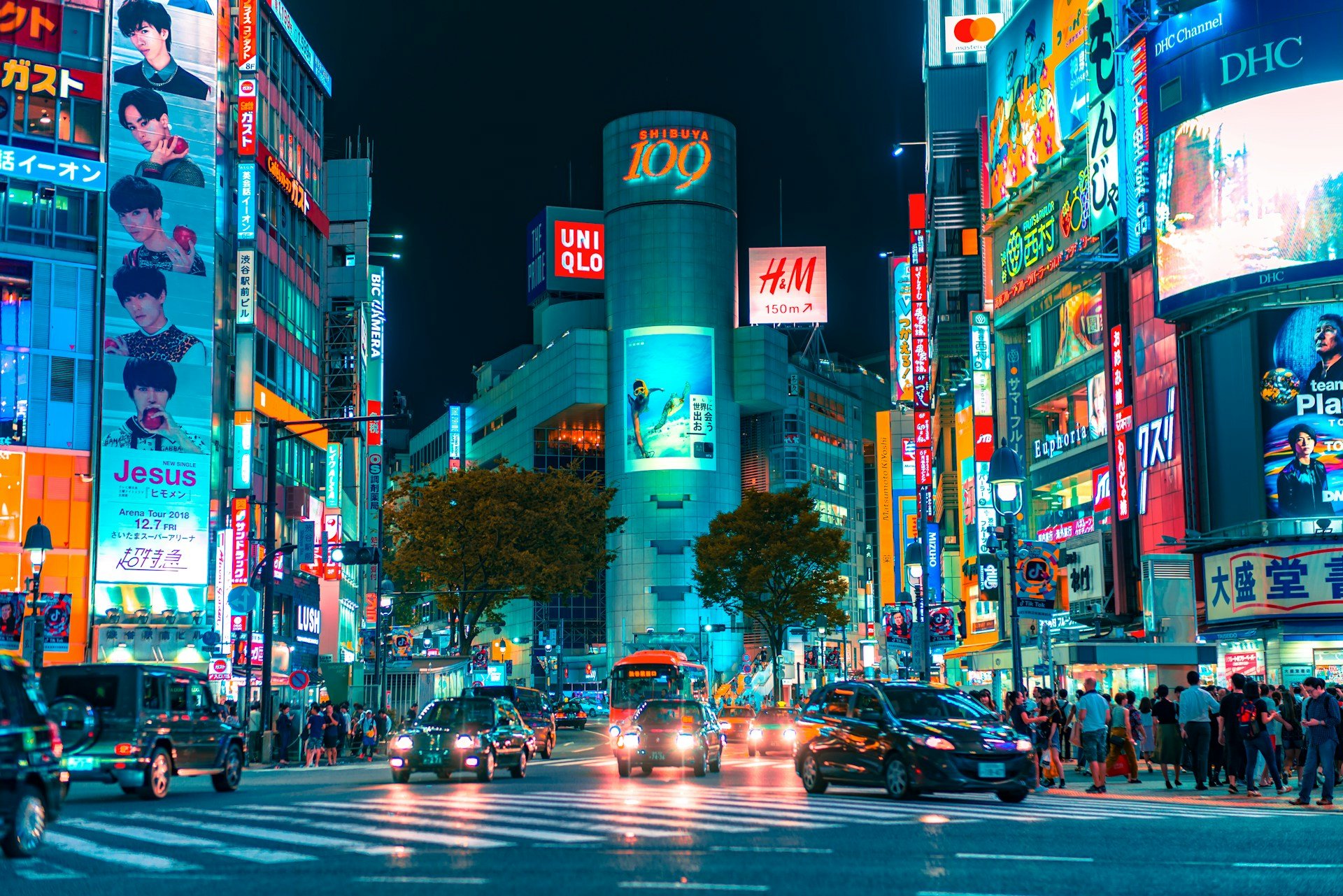
Thirty-seven million people, thirteen subway lines, and the world's most concentrated collection of Michelin-starred restaurants. Tokyo is enormous but weirdly manageable once you accept that each neighborhood is basically its own city. Shibuya for the crossing and the chaos. Shinjuku for the neon and the tiny bars. Yanaka for the Tokyo that somehow survived the bombs and the bubble. Stay three to four days minimum. You will not see everything. That's the point.
Kyoto
Kyoto is what people picture when they picture Japan. Seventeen UNESCO World Heritage sites, geisha districts that still function exactly as they did in the 1700s, and in autumn, a color-drenched landscape that looks so curated you'll suspect someone planned it. They didn't. Fushimi Inari's thousand torii gates at 6am, before the tour groups arrive, is one of the great walks in Asia. Allow four days if you can. Two is survivable. One is a mistake.
Osaka
Osaka has a personality that Tokyo doesn't. It's louder, messier, funnier. The local saying is kuidaore: "eat until you drop." The people of Osaka take this as a challenge. Dotonbori at night is sensory overload in the best possible way. Thirty minutes from Kyoto, it works perfectly as a base for both.
Hiroshima
An hour and a half from Osaka by Shinkansen. The Peace Memorial Park and Museum are obligatory. But Hiroshima is also a genuinely alive city with great okonomiyaki, a castle, and easy access to Miyajima Island and its floating torii gate. Don't treat it as just a pilgrimage. It's a city worth a full day.
Nara
45 minutes from Kyoto or Osaka. The free-roaming deer of Nara Park have been there since the 8th century and will absolutely try to eat your map. Todai-ji Temple, housing a 15-meter bronze Buddha, is one of Japan's most striking structures. Half a day is enough. A full day if you want to slow down.
Hakone
Two hours from Tokyo. Hot springs, views of Fuji on clear days, and the Hakone Open Air Museum. This is where you spend your ryokan night. The Hakone Free Pass covers almost all transport, including the scenic Romancecar train from Shinjuku. Buy it at Shinjuku before you leave.
Takayama
In the Japanese Alps, four hours from Tokyo by express train. The old town, Sanmachi Suji, is genuinely preserved Edo-period Japan. Morning markets have run since the 1600s. The sake distilleries start serving around 10am. Pairs beautifully with a night in a traditional inn and a side trip to the thatched-roof village of Shirakawa-go.
Naoshima
A small island in the Seto Inland Sea that decided to become one of the world's great outdoor art venues. Yayoi Kusama's pumpkins. James Turrell's light installations. Buildings designed by Tadao Ando embedded in the hillside. Getting there requires planning, but nothing else in Japan feels quite like it.
Culture & Etiquette
Japan doesn't expect you to know everything. Most Japanese people are remarkably patient with tourists who are clearly trying. But a little awareness goes a long way here in a way it doesn't everywhere. The gap between "completely oblivious tourist" and "person making a small genuine effort" is more noticeable in Japan than most countries, and people notice.
None of this should make you anxious. The rules are mostly logical once you understand the logic. Japan is a society built around collective consideration. Most of what you should and shouldn't do flows from asking: "does this affect the people around me?"
Look for the step up at the entrance, or a row of shoes at the door. Mandatory in ryokans, most traditional restaurants, many temples.
Silent mode on your phone. No calls. No music through speakers. No eating on most train platforms. The silence on Japanese trains is genuinely peaceful — respect it.
Queuing is taken seriously. Platform markings show exactly where to stand. Join the back. The system works because everyone participates.
Many smaller restaurants, temples, and shops still run cash-only. A ¥10,000 note is fine; trying to pay ¥800 ramen with one is mildly inconvenient for everyone.
You don't need to master the degrees of formality. A slight forward nod when someone helps you is enough and goes a long way.
Street food is meant to be eaten at the stall or a nearby bench. Walking and eating simultaneously is considered inconsiderate. Locals rarely do it.
Tipping is not practiced in Japan and can cause genuine confusion or mild offense. Service is excellent because that's the standard, not because of financial incentive. This is a better system.
Especially geiko and maiko in Kyoto, who are workers on their way to appointments, not street performers. Parts of Gion have banned photography entirely because of tourist behavior.
Many onsens still prohibit visible tattoos. Check before you pay. Some have private bath options. Policies are slowly evolving but this is still worth confirming.
Considered very rude. Find a bathroom. Sniffling quietly is somehow more acceptable. Japanese tissue etiquette is different from what most Westerners expect.
Onsen Rules
Shower thoroughly at the individual stations before entering the communal bath. The onsen is for soaking, not washing. Get in slowly. Don't splash. Don't submerge your towel. This is not complicated, it's just different from what most visitors expect.
Temple & Shrine Etiquette
Wash your hands at the temizuya (water basin) before entering. Don't touch the sacred objects. When throwing a coin into an offertory box at a shrine, do so quietly. Two bows, two claps, one bow at Shinto shrines is the standard. Nobody will quiz you on this.
Drinking Culture
Don't pour your own drink. Fill others' glasses, let others fill yours. Saying "kanpai" before the first drink is non-optional. It's polite to wait until everyone has been served before starting. Izakaya culture is one of Japan's great social inventions. Embrace it fully.
Why It's So Clean
Public waste bins in Japan are nearly nonexistent. You carry your trash until you find one, which might be at a convenience store. This is why the streets are so clean. Nobody told people to do this — it's simply the expectation. Match it.
Food & Drink
Japan has more Michelin stars than France. It also has vending machines that dispense warm corn soup at midnight. The entire spectrum of human food experience exists here, and most of it is extraordinary.
The most important thing most visitors miss: convenience stores are not a fallback option. They're a genuine part of Japanese food culture. 7-Eleven, Lawson, and FamilyMart here are not the 7-Eleven you know. Their onigiri, egg sandwiches, katsu sandwiches, and hot snacks are legitimately good and between ¥150 and ¥500. The FamilyMart chocolate croissant has a cult following for a reason. Eat there without embarrassment.
Ramen
Every region has its own style, and they will all tell you theirs is the best. Tokyo is soy-based and clean. Sapporo is rich miso. Hakata is tonkotsu: cloudy pork bone broth, thin noodles, and a side of kaedama so you can order extra noodles when you're done. Eat them all. Start arguments about which is better. This is how the Japanese do it.
Sushi & Sashimi
Skip the tourist conveyor belts near Tsukiji market. Better: find a mid-range sushi counter at lunch where the chef hands you pieces directly. Budget ¥3,000–5,000. You will eat something you've never tasted and struggle to describe afterward. That's the correct reaction.
Izakaya Culture
The Japanese pub. Order small plates: yakitori, edamame, sashimi, agedashi tofu. Drink beer or sake or shochu. Spend three hours. The bill will be lower than you expect. Golden Gai in Shinjuku for atmosphere, Namba in Osaka for energy and volume, Pontocho in Kyoto for the setting.
Street Food
Temple and shrine areas are street food gold. Dango (sweet rice dumplings), melonpan, taiyaki (fish-shaped waffles with red bean filling), takoyaki in Osaka, yakisoba at every matsuri festival. Asakusa's Nakamise shopping street has been running stalls since the 17th century. The standards are non-negotiable.
Tea & Coffee
Japan's matcha culture is the real thing, not the green powder you get at home. A proper matcha ceremony in Kyoto involves bamboo whisks, ceramic bowls, and bitter tea paired with something sweet. Also: Japan takes third-wave coffee more seriously than most countries that invented the trend. Kyoto and Fukuoka in particular.
Sake & Whisky
Sake is best drunk warm in the mountains in winter, cold in summer. Japanese whisky (Nikka, Suntory, Hibiki) is world-class and consistently cheaper here than abroad. Drink it while you can. Canned whisky highballs from convenience stores and vending machines are a genuine cultural institution and cost ¥180. This is peak civilization.
When to Go
Honest answer: November is the sweet spot. The maple and ginkgo foliage across Kyoto, Nikko, and the Japanese Alps is extraordinary, the summer crowds have gone home, and temperatures are ideal for walking all day without sweating through your shirt. Peak cherry blossom season in April gets more attention, but autumn color is just as stunning and you'll spend less time elbowing through tour groups at Fushimi Inari.
Autumn
Oct – NovFoliage turns Kyoto and Nikko into a painting. Pleasant temperatures, clear skies. Crowds are manageable if you avoid the peak November weekends when every Japanese person has the same idea.
Spring
Late Mar – MayCherry blossoms are worth the crowds. Book accommodation four to six months out. The week after peak bloom is consistently overlooked and still beautiful. The light is softer and the queues shorter.
Winter
Dec – FebCold in the cities but Hokkaido ski resorts are world-class. Fewer tourists means you get shrines and temples almost to yourself. Tokyo's winter illuminations are genuinely beautiful and underrated.
Summer
Jun – SepRainy season June to July. August is brutally hot and humid and you will want to die at every outdoor temple. That said, matsuri festival season is summer-only and some are spectacular enough to be worth the heat.
Trip Planning
Two weeks is the sweet spot for a first Japan trip. Less than ten days and you'll spend too much time on trains and not enough absorbing anything. More than three weeks and you run out of the obvious and have to get genuinely curious, which is actually the best kind of Japan travel.
Tokyo
Day one: land, navigate to your hotel, and do nothing ambitious. Wander Asakusa, eat something at a standing sushi counter, sleep. Day two: Shinjuku and Harajuku, Meiji Shrine at dawn before the crowds. Day three: day trip to Nikko or a slow morning in Yanaka, Tokyo's most intact old neighborhood.
Kyoto
Shinkansen from Tokyo (2h15m). Fushimi Inari at 6am before tour groups arrive. Arashiyama bamboo grove, same logic. At least one evening in Gion, ideally a kaiseki dinner if budget allows.
Osaka
30 minutes from Kyoto. Spend your final days eating: takoyaki and okonomiyaki in Dotonbori, fresh seafood at Kuromon Market, standing ramen at 11pm. Osaka is unapologetically chaotic and delicious.
Tokyo + Day Trips
Four days gives you real time in Tokyo. Add a day trip to Kamakura (the giant Buddha, sea breeze, excellent seafood) and another to Nikko (ornate shrines, waterfalls, cedar forest). Don't try to do everything on day one.
Hakone
Your ryokan night. Hakone Open Air Museum, Owakudani volcanic valley, views of Fuji on clear days. The Hakone Free Pass covers most transport.
Kyoto + Nara
Four days to actually explore Kyoto properly. Morning walks in the Philosopher's Path, Nishiki Market for snacks, Kinkaku-ji in late afternoon. One day to Nara where the deer will try to eat your map.
Osaka + Hiroshima
Two full days in Osaka for eating and Osaka Castle. A day trip to Hiroshima and Miyajima Island. Return to Osaka, fly home from Kansai International.
Tokyo + Surroundings
Slow down. Visit the neighborhoods that don't make it into guidebooks: Shimokitazawa for vintage shops and live music, Koenji for secondhand records, Nezu for quiet shrine walks. Day trips to Kamakura and Enoshima island.
Japanese Alps: Matsumoto + Takayama
Matsumoto Castle is one of Japan's best. Takayama's old town looks exactly like Edo-period Japan. Morning markets, sake distilleries, breakfast at 7am with locals who've been buying from the same stall for 40 years.
Kyoto + Nara + Osaka
Enough time to explore Kyoto's outer neighborhoods: Fushimi sake district, Ohara valley, the quiet eastern temples beyond Kiyomizudera. One night in a ryokan in Kinosaki Onsen if budget allows.
Western Japan: Hiroshima, Naoshima, Beppu
Hiroshima and Miyajima, then Naoshima island for contemporary art in a rural setting. Down to Beppu in Kyushu for the world's strangest hot spring resort town. Fly home from Fukuoka.
Vaccinations
No mandatory vaccinations required. Recommended: Hepatitis A, Hepatitis B, Japanese Encephalitis if spending time in rural areas, and routine vaccines up to date.
Full vaccine info →Connectivity
Get a Japan eSIM before departure. Airalo offers data plans from around $8 for 7 days. Having offline maps on your phone is non-negotiable in rural Japan.
Get Japan eSIM →Power & Plugs
Japan uses Type A plugs (same as the US and Canada) at 100V. European visitors need an adapter. Most modern devices handle the voltage difference without issues.
Language
English proficiency is lower than you'd expect outside tourist zones. Download Google Translate with Japanese offline. The camera translation feature reads menus and signs in real time and actually works.
Travel Insurance
Japan has excellent but expensive healthcare. Medical evacuation costs tens of thousands. Travel insurance with medical cover is strongly recommended. World Nomads and AXA are solid options.
Medication
Some common medications including certain cold medicines and Adderall are controlled substances in Japan. Pack a full supply of any prescription medication and check the Ministry of Health prohibited list before you fly.
Transport in Japan
Japan's train network is the best in the world. Not "among the best." The best. The Shinkansen connects Tokyo to Osaka in 2 hours 15 minutes. Subway maps look intimidating until the logic clicks, which takes about one day. Almost all signs are in English. Platforms announce delays in seconds, not hours. There are no delays.
First thing to do after landing: get a Suica or Pasmo IC card at any station kiosk. Load it with yen and tap in and out of every train, subway, and bus in the country. You can use it at convenience stores and vending machines. It is the best transit card in the world and costs ¥500.
Shinkansen
¥13,000–30,000/routeThe bullet train. Covers Tokyo to Kyoto in 2h15m at 320km/h. Punctual to the second. Buy the JR Pass if covering multiple cities. Check the math first.
City Metro
¥170–300/tripTokyo's subway has 13 lines and serves 8 million passengers daily. Confusing at first, intuitive by day two. Google Maps plus IC card is all you need.
Narita Express
¥3,070 to TokyoFrom Narita Airport to Tokyo in 53 minutes. Runs every 30 minutes. Worth the price for the convenience when you arrive exhausted with heavy bags.
Highway Bus
¥4,000–8,000Overnight buses between cities cut Shinkansen costs in half. Less comfortable but a reasonable option for budget travelers doing long routes.
Bicycle
¥1,000–2,000/dayKyoto is exceptional by bike. Smaller towns often have free or cheap rental. Japan is one of the safest cycling countries in Asia with good infrastructure.
Taxi
¥700 start + meterClean, reliable, doors open automatically. Expensive for long distances. Perfect for late nights in unfamiliar neighborhoods or when you've missed the last train.
Car Rental
¥5,000–10,000/dayOnly genuinely useful for rural areas like Hokkaido or the Noto Peninsula. Driving in Tokyo is a bad idea. International driving permit required.
Ferries
Varies by routeEssential for island hopping in the Seto Inland Sea (Naoshima, Miyajima). Also connects Honshu to Shikoku and Kyushu. Scenic and functional.
Tokyo to Kyoto single Shinkansen fare: ¥13,850. Round trip: ¥27,700. A 7-day JR Pass costs ¥50,000 (2026 price). Add one more intercity leg and it pays for itself. If you're covering Tokyo + Kyoto + Osaka + Hiroshima on a 2-week trip, buy the 14-day pass without hesitation.
Accommodation in Japan
Where you stay in Japan is part of the experience. A night in a traditional ryokan, tatami floors, futon bedding, dinner served in your room in twelve small courses, a communal onsen outside, is something no hotel chain can replicate. Budget at least one or two nights. For Tokyo, stay in Shinjuku or Shibuya if you want urban energy, or Asakusa if you want the old-Tokyo atmosphere.
Ryokan
¥15,000–80,000/nightTraditional Japanese inn. Futon bedding, in-room kaiseki dinner, communal onsen. Non-negotiable for at least one night. Hakone, Kyoto, or Kinosaki Onsen for the best experience.
Business Hotel
¥7,000–15,000/nightToyoko Inn, APA, and Dormy Inn are reliable, clean, and often have onsen. Small rooms but perfectly functional. Japan has perfected this format. The pillows are excellent.
Capsule Hotel
¥3,000–6,000/nightBoutique capsule hotels like 9 Hours and First Cabin are genuinely stylish and not just for budget travelers. Better communal showers than most Western motels.
Guesthouse
¥2,500–5,000/nightJapan's hostel scene is excellent and social. Many are in historic machiya townhouses. Good ones in Kyoto's Gion district and Tokyo's Yanaka neighborhood.
Budget Planning
Japan has a reputation for being expensive that's only half-deserved. Accommodation in Tokyo isn't cheap. A nice kaiseki dinner can cost as much as your flight. But day-to-day Japan, convenience store meals, ramen shops, city transport, is genuinely affordable. The yen has been weak against the dollar and euro since 2022, which means your money goes further right now than it has in decades.
- Capsule hotel or hostel dorm
- Convenience store meals (better than it sounds)
- IC card for all transport
- Free shrines, parks, and walking
- One sit-down ramen or soba daily
- Business hotel or mid-range ryokan
- Mix of restaurants and convenience stores
- JR Pass for intercity travel
- Paid attractions and experiences
- Occasional izakaya evening
- Boutique hotels or quality ryokan with meals
- Full restaurant dining for lunch and dinner
- Taxis when convenient
- Tea ceremonies, sake tastings, day trips
- One omakase or kaiseki splurge
Quick Reference Prices
Visa & Entry
Japan runs one of the more streamlined visa systems in Asia for visitors. Citizens of 68 countries get visa-free access for up to 90 days, including the US, UK, all EU countries, Australia, New Zealand, and Canada. You need a valid passport, a return ticket, and enough money to support yourself. That's it for most visitors.
Japan introduced its Visit Japan Web digital system in 2023, which lets you pre-register your passport and customs declaration. Not mandatory but speeds up immigration considerably, especially at busy Narita and Haneda. Worth the 10 minutes to set up before you fly.
Most Western passport holders qualify. Check the full list at the Japanese Ministry of Foreign Affairs before you book.
Family Travel & Pets
Japan is one of the best family travel destinations on the planet, and it's not even close. It's safe at a level that requires recalibration if you're used to other cities. It's clean. Children are welcomed warmly almost everywhere. The train system is stroller-friendly on most urban lines. Convenience stores exist on every block and handle all snack emergencies.
The practical challenge with young children is the size and intensity of the cities. Tokyo can be overwhelming even for adults. Build in slower days. Nara, with its famous free-roaming deer, is a natural highlight for kids. The Japanese Alps, Hakone, and smaller coastal towns offer breathing room without sacrificing what makes Japan remarkable.
Nara
The free-roaming deer are endlessly fascinating for children and will absolutely steal their snacks. Todai-ji's enormous Buddha provides genuine awe for all ages. Half a day is enough for young kids.
teamLab Planets
The immersive digital art installations in Tokyo are genuinely spectacular and accessible to all ages. Book tickets in advance online. Queues without advance booking are long enough to break a child's spirit entirely.
Osaka Castle
The grounds are spacious and excellent for kids to run around. The museum inside explains Japanese history in accessible ways. Combine with Osaka's street food culture for a full and reasonably priced day.
Parks & Nature
Ueno Park in Tokyo, Maruyama Park in Kyoto, and Shinjuku Gyoen are large, free or cheap, and child-friendly. Japan's obsession with seasonal nature (blossoms, foliage) is something children absorb without being told to appreciate it.
Food Strategy
Picky eaters will survive on tempura, yakitori, soba noodles, and onigiri. Ramen is almost universally accepted by children. Convenience store onigiri and melon bread cover emergency situations. Japan is actually one of the easier countries for managing children's food preferences.
Cultural Experiences
Hands-on workshops like wagashi (sweet) making, ikebana (flower arranging), and taiko drumming are offered throughout major cities and hold children's attention in a way museum visits often don't. Book through GetYourGuide or directly through the venues.
Traveling with Pets
Japan has strict biosecurity rules for pet entry, and they are not flexible. Dogs and cats require a microchip compliant with ISO standards, rabies vaccination, a rabies antibody titre test with results meeting Japan's minimum thresholds, a waiting period of 180 days after the test, and health certification issued by an accredited veterinarian. Start this process at least six months before you travel, ideally longer.
Pets that don't meet requirements face mandatory quarantine of up to 180 days at the owner's expense. This is not a bureaucratic technicality. Japan takes its status as a rabies-free country seriously and enforces the rules consistently.
Once in Japan: pet-friendly accommodation exists but is more limited than in Europe or North America. Many ryokans and traditional inns do not accept pets. Research your specific accommodation before booking. Dogs on public transport require carriers. Japan has excellent pet culture in its cities, particularly in Tokyo, with dog cafes, pet-friendly parks, and pet supply stores at every turn.
Safety in Japan
Japan is one of the safest countries on earth for travelers, and it's not a close call. Violent crime is remarkably rare. Women traveling solo consistently rate it among the most comfortable destinations in the world. You will likely leave Japan having never felt unsafe for a single moment. This is not marketing. The numbers back it up.
The actual risks are more mundane: getting lost in rural areas without data, missing the last train home, or getting caught in a natural disaster. Plan for those.
Street Safety
Excellent. Theft is rare. Lost wallets are routinely turned in to local police boxes (koban). Tokyo ranks consistently among the safest megacities in the world.
Solo Women
One of the most recommended solo female travel destinations globally. Women-only carriages operate on many lines during rush hour. The level of general consideration for personal space is high.
Natural Disasters
Japan is earthquake-prone and typhoon season runs June through October. Download the NHK World or Safety Tips app. Japan's earthquake alert system gives real warning time. Follow instructions immediately.
Getting Lost
Rural Japan can be genuinely remote. Download offline maps before leaving urban areas. A Japanese eSIM or SIM card is essential outside major cities where public wifi coverage is incomplete.
Scams
Tokyo has almost none. The main one: overpriced cocktail bars near Shinjuku and Roppongi that target tourists with friendly English-speaking touts. Walk past anyone who aggressively approaches you near clubs.
Healthcare
Excellent medical facilities. Staff in major cities often speak English. Travel insurance with medical cover is strongly recommended. Japanese hospitals are high quality and not free for foreign visitors.
Emergency Information
Your Embassy in Tokyo
Most embassies are in the Minato district (Roppongi, Azabu, and Akasaka areas).
Book Your Japan Trip
Everything in one place. These are services worth actually using.
You'll Want to Come Back
The strangest thing about Japan is how complete it feels on a first visit and yet how much you realize you missed the moment you land back home. People return to Japan more consistently than almost any other destination on earth. Some come back every year. That's not a coincidence.
There's a concept in Japanese called ichigo ichie: "one time, one meeting." The idea that each moment exists only once and should be treated accordingly. It's not a bad way to approach most things, wherever you happen to be.