
What Travellers Should Know About Brunei
Brunei's tourist traps are not scams in the conventional sense — they are legal and cultural rules that catch unprepared visitors. Understanding them transforms a potentially stressful visit into a seamless one.
Tourist Traps & Legal Rules in Brunei
Brunei's tourist risks are almost entirely legal and cultural. Each is entirely avoidable with advance knowledge.
Brunei has no Grab, Gojek, or other ride-hailing apps — the country is too small and too wealthy per capita to have attracted them at scale. Taxis operate on negotiated fares. Airport taxis quote BND 40–60 for the journey to central BSB; the fair range is BND 25–35. Within the city, without a meter standard, drivers frequently quote tourist prices 50–100% above local norms. Brunei is an expensive country for Southeast Asia generally; the taxi overcharging sits on top of already higher base prices.
- Ask your hotel to arrange airport collection — most BSB hotels do this for a known fixed rate.
- Agree the fare explicitly before entering any taxi — ask "berapa?" (how much?) and counter if the quote exceeds BND 35 for the airport run.
- The airport has a fixed-rate taxi counter inside the terminal — use this and confirm the rate before accepting.
- Brunei is compact and walkable in the central BSB area — the waterfront, Omar Ali Saifuddien Mosque, and Kampong Ayer water taxi are all within walking distance of each other.
- Water taxis (tambang) across the Brunei River to Kampong Ayer cost BND 1 — entirely fixed and honest.
The alcohol rules catch visitors in two ways: bringing more than the permitted allowance across the border, and drinking in public or bringing alcohol to a Muslim. The permitted non-Muslim adult allowance is 2 litres of spirits (or 2 bottles of wine) and 12 cans of beer — declared at customs on arrival. This alcohol may only be consumed privately (in your hotel room, for example). The Customs Department conducts checks, particularly at the Seria and Kuala Belait land border crossings from Malaysia where alcohol from Miri is sometimes carried in excess.
- Declare all alcohol at customs on arrival — non-declaration of permitted quantities is treated as smuggling.
- Stay within the 2-litre/12-can limit — exceeding it results in confiscation and possible prosecution.
- Never consume alcohol in public spaces — restaurants, parks, streets, or any venue outside a private room.
- Never offer or provide alcohol to a Bruneian Muslim — this is a serious offence for both parties.
- If you want access to a full bar, plan a day trip or overnight to Miri (Malaysian Sarawak, 1 hour by road) — the Senadin border crossing is straightforward for most nationalities.
The Istana Nurul Iman — the Sultan's official residence and one of the world's largest buildings (1,788 rooms, 257,000 m²) — dominates the BSB skyline from across the Brunei River. The temptation to photograph it is obvious; the prohibition is explicit and enforced. Photography from any angle — including from across the river, from boats, or from the road — is not permitted. Military bases, the Royal Brunei Police headquarters, border crossing infrastructure, and government ministry buildings are similarly off-limits. Signs are not always present; the safest rule is: if it belongs to the government or the royal family, ask before photographing.
- Do not photograph the Istana Nurul Iman from any location — this includes zoomed shots across the river.
- The Omar Ali Saifuddien Mosque is extensively photographable from outside; interior photography requires specific permission from mosque management.
- Tourist sites — Kampong Ayer, the waterfront, Jame'Asr Hassanil Bolkiah Mosque, the Royal Regalia Museum — can be photographed freely.
- Ask before photographing any uniformed personnel — Royal Brunei Armed Forces and police are generally happy to pose for photos when asked directly and respectfully.
Drone regulations in Brunei are stricter than in neighbouring Malaysia and Indonesia — all drone flights require advance permits from the Civil Aviation Department of Brunei (CADB), regardless of the drone's size or weight. The permit process takes time and must be completed before arrival. Content creators and travel photographers who arrive assuming they can fly freely — as they might in rural Sabah or Sarawak — find their equipment grounded or confiscated. Flights near the Istana, mosques, military areas, and BSB city centre are prohibited entirely regardless of permit status.
- Apply for drone permits through the Civil Aviation Department of Brunei at www.cadb.gov.bn well before your visit — at minimum 2–3 weeks in advance.
- Even with a permit, no drone flights over the Istana, mosques, military bases, or populated urban areas.
- If you're a content creator visiting Temburong for jungle footage, the permit is obtainable — apply early and specify your intended locations.
- Carrying an unregistered drone through customs may result in it being held until departure.
Brunei's dress codes are genuine and apply more broadly than just mosque entry — they cover government buildings, traditional markets, and general public spaces. Shorts above the knee and sleeveless tops are inappropriate in these contexts. The Omar Ali Saifuddien Mosque and Jame'Asr Mosque both provide sarongs and abayas at the entrance for under-dressed visitors, but arriving inappropriately dressed may result in being asked to leave or wait outside. During Ramadan, dress standards tighten and eating in public during daylight hours is disrespectful even for non-Muslims.
- Pack at least one outfit with long trousers/skirt and covered shoulders — this is the standard for mosque and government building visits.
- Lightweight cotton loose-fitting clothing that covers knees and shoulders is both culturally appropriate and practical in Brunei's humid heat.
- During Ramadan, eat and drink only in private spaces during daylight hours as a courtesy to fasting residents.
- Swimwear is appropriate only at the hotel pool or dedicated beach areas — not on the waterfront or in town.
Beyond alcohol, Brunei's customs restrictions include a complete ban on tobacco products above the duty-free allowance (200 cigarettes or 250g tobacco), restrictions on pork products, and — as in Singapore — severe penalties for drug importation (capital punishment applies for trafficking quantities). The country also restricts importing sexually explicit materials, materials deemed contrary to Islamic values, and certain publications. These are not unusual for the region but catch visitors who don't read the customs declaration form carefully.
- Read and complete the customs declaration form honestly — customs officers conduct checks, particularly at land borders.
- Tobacco allowance: 200 cigarettes or 250g of other tobacco products — exceeding this results in confiscation and fine.
- No pork products — including packaged goods from Malaysia that are not halal-certified.
- Drug laws are among the most severe in Southeast Asia — zero tolerance applies to all controlled substances.
Brunei's Key Destinations
Brunei is small — about the size of Luxembourg — but contains extraordinary contrasts between the urban capital, the world's largest water village, and some of Borneo's most pristine old-growth rainforest.
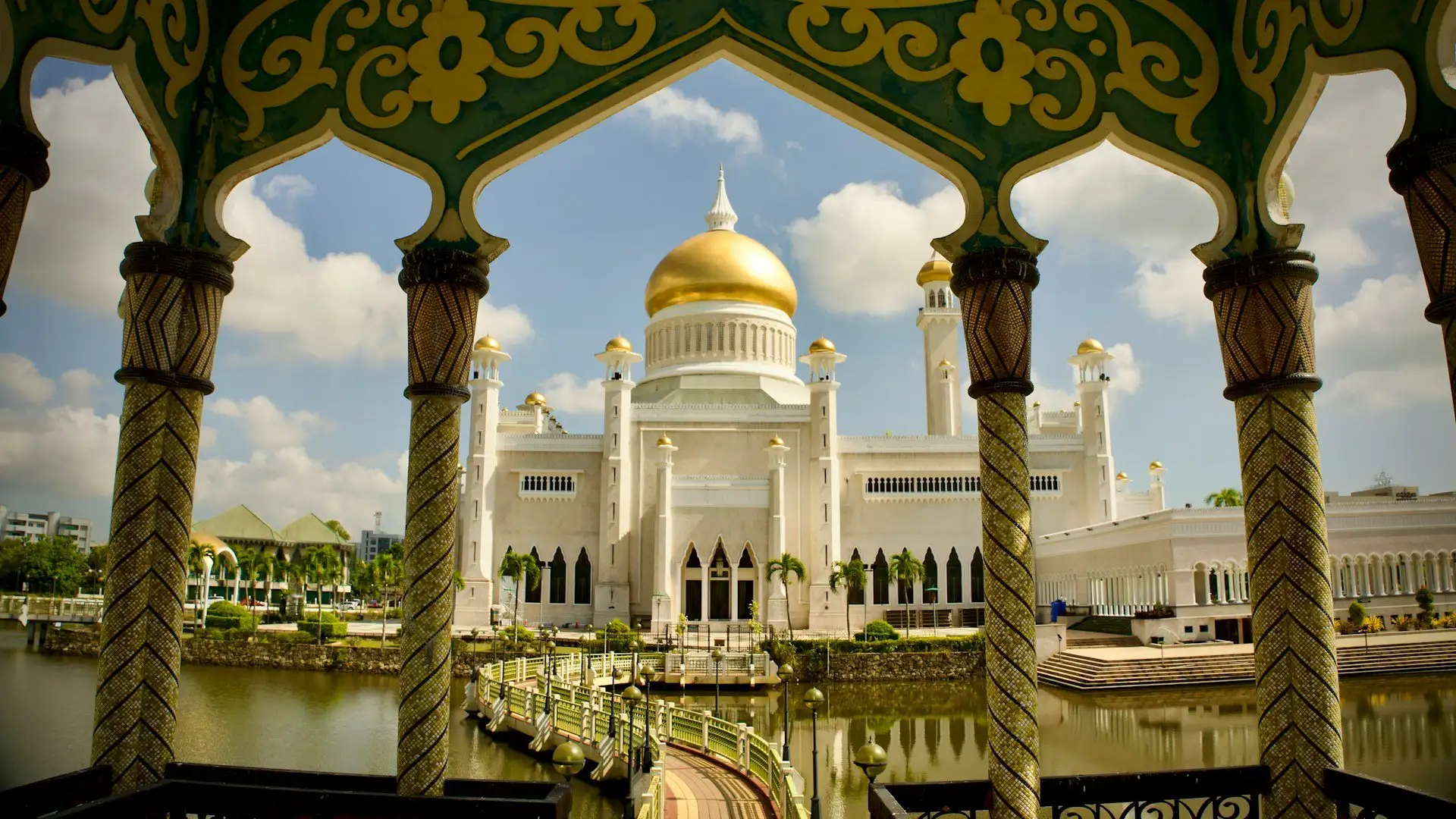
The capital is a quiet, unhurried city with extraordinary architecture. The Omar Ali Saifuddien Mosque — completed in 1958, with a golden dome reflected in its ceremonial lagoon — is genuinely one of the most beautiful buildings in Southeast Asia. The Royal Regalia Museum (free entry) houses the Sultan's coronation regalia and the golden chariot used in the royal procession. Yayasan Sultan Haji Hassanal Bolkiah — an ornate shopping complex built to look like a palace — and the waterfront promenade complete the city-centre circuit.
- Taxi overcharging from airport — agree fare before boarding; BND 25–35 is correct
- Omar Ali Saifuddien Mosque: dress code required; abayas provided at entrance
- Photography of Istana Nurul Iman from any angle: prohibited
- Water taxis (tambang) to Kampong Ayer: BND 1 each way — a fixed, honest price
- Most restaurants halal only; alcohol not available; excellent food at hawker centres near waterfront
Kampong Ayer is the world's largest water village — 30,000 people living in houses built on stilts over the Brunei River, connected by 36km of wooden boardwalks and served by water taxis. It has been continuously inhabited for over 1,000 years and was called the "Venice of the East" by Magellan's expedition in 1521. Residents have electricity, plumbing, schools, mosques, fire stations, and a police post — all on the water. It is entirely safe and fascinating to walk through, though visitors should be respectful of the residential nature of the community.
- Water taxi from waterfront: BND 1 fixed price — no negotiation needed
- The community is residential: stay on main boardwalks, do not enter homes without invitation
- Photography of residents: ask permission respectfully — most are happy to interact with visitors
- No tourist traps here — genuine community with no scam infrastructure
- Kampong Ayer Cultural and Tourism Gallery: free admission, excellent history of the water village
Temburong District — separated from the rest of Brunei by a strip of Malaysia (the Limbang District) — is accessible by express boat from BSB across Brunei Bay, then by longboat up the Temburong River. The Ulu Temburong National Park covers 500 km² of virgin rainforest; the treetop walkway at 60m above the forest floor is one of Southeast Asia's great experiences. Access is through licensed tour operators only — independent entry is not permitted, which makes the operator selection the key decision.
- Access to the park interior requires a licensed tour operator — independent entry is not permitted
- Book through well-reviewed operators from BSB: Freme Travel, Intrepid Tours Brunei, and other BTIB-registered operators
- Day tours (approximately BND 100–150/person) cover treetop walkway, longboat, and forest trekking
- Overnight packages in the park give a more immersive experience — book in advance, limited capacity
- The express boat from Bandar BSB (Serasa Ferry Terminal) to Bangar takes approximately 45 minutes; boat schedules require matching with tour timing
The Jame'Asr Hassanil Bolkiah Mosque — built in 1994 for the Sultan's Silver Jubilee — is the largest mosque in Brunei, with 29 golden domes and four minarets visible across the city. Set in extensive manicured grounds, it is a few kilometres from the city centre in Gadong. Like the Omar Ali Saifuddien Mosque, it is open to non-Muslim visitors outside prayer times and is one of Brunei's most photographable and architecturally impressive sites.
- Closed to non-Muslim visitors during the five daily prayer times — check schedule before visiting
- Dress code: robes and head coverings provided at the entrance for those who need them
- Photography of the exterior and interior (when open): permitted and encouraged
- Gadong area near the mosque has BSB's best hawker food market — Gadong Night Market, excellent for evening dining
Seria and Kuala Belait — in Belait District on the western coast — are the heart of Brunei's oil industry, home to Brunei Shell Petroleum operations since the 1920s. The Billionth Barrel Monument commemorates the production milestone; the Seria oil fields are visible from the coastal road. These towns see very few tourists and have no significant tourist infrastructure, but the drive along Brunei's coast from BSB through Tutong to Seria passes beautiful beaches and traditional fishing villages. The Malaysian border at Kuala Belait leads directly to Miri (1 hour).
- No tourist traps — almost no tourist infrastructure
- Photography of oil field infrastructure and Shell facilities: ask permission or avoid; some areas have security restrictions
- Kuala Belait to Miri border crossing: straightforward for most nationalities; have passport ready and ensure sufficient validity
- Beaches at Muara (near BSB) and Pantai Seri Kenangan (Tutong): pleasant, very uncrowded, no risks
Gadong is BSB's main commercial suburb — the Mall Gadong, Supa Save supermarket, and Gadong Night Market make it the practical shopping and eating hub. The night market serves excellent Bruneian hawker food: ambuyat (Brunei's national dish — a starchy glutinous paste made from sago, eaten by rolling it on a bamboo fork and dipping in various sauces), nasi katok (chicken and rice, cheaply and everywhere), and barbecued seafood. Ambuyat requires technique to eat correctly; it is tactile, shared, and should be tried.
- No scam risks at Gadong Night Market — genuine local hawker food at honest prices
- Supa Save supermarket: well-stocked, no alcohol section — this is the genuine shopping experience
- Mall taxi overcharging after shopping: agree fare before boarding
- Ambuyat: Brunei's sago-starch national dish requires a bamboo fork technique — restaurant staff will demonstrate; embrace the process
Safety Tips for Brunei
- ✓ Understand the alcohol rules before arrival — non-Muslim visitors 17+ may bring 2 litres of spirits and 12 cans of beer, declared at customs, for private consumption only. No alcohol is sold anywhere in Brunei.
- ✓ Agree taxi fares before entering the vehicle — BND 25–35 is the correct airport-to-BSB range. Ask your hotel to arrange transfers at known rates to avoid negotiation entirely.
- ✓ Do not photograph the Istana Nurul Iman from any angle or distance. The Omar Ali Saifuddien Mosque, Jame'Asr Mosque, Kampong Ayer, and all tourist sites are freely photographable.
- ✓ If bringing a drone, apply for permits from the Civil Aviation Department of Brunei (www.cadb.gov.bn) at least 2–3 weeks before arrival. Unpermitted drone use carries confiscation and fines.
- ✓ Pack clothing that covers knees and shoulders for mosque, government building, and general public use. Lightweight cotton works well in Brunei's humidity.
- ✓ For Ulu Temburong National Park, book through a BTIB-licensed operator — independent entry is not permitted. Freme Travel and Intrepid Tours Brunei are well-reviewed. Book in advance as capacity is limited.
- ✓ Water taxis (tambang) to Kampong Ayer cost BND 1 fixed — no negotiation, no overcharging possible. This is the most honest transport transaction in Southeast Asia.
- ✓ During Hari Raya Aidilfitri, the Sultan opens the Istana Nurul Iman to the public for three days — this is one of Southeast Asia's most extraordinary cultural experiences, with the Sultan personally greeting visitors. Check the Islamic calendar for the date, which changes annually.
- ✓ Brunei's drug laws carry the most severe penalties in Southeast Asia — zero tolerance with capital punishment for trafficking quantities. This is non-negotiable and applies to all nationalities without exception.
Book Smart, Explore Borneo's Hidden Kingdom
Pre-booked hotel transfers and licensed Temburong operators eliminate Brunei's two main tourist traps.
Emergency Numbers & Contacts
Brunei's emergency services are efficient and responsive. English is widely spoken by police and medical staff. Medical facilities in BSB are good by regional standards.