
What This Guide Is, and What's Changed
Uganda has spent two decades building a reputation as East Africa's best-value wildlife destination: mountain gorillas at half the permit price of Rwanda, chimp trekking, the source of the Nile, and savanna parks with the kind of game density that draws people back a second time. That reputation is still substantially earned. It is also, as of this update, sitting alongside a Level 4 Do Not Travel advisory from the US State Department, the highest level it issues, driven by a mix of factors that are worth separating out rather than lumping together.
The headline driver is health: the World Health Organization declared a Public Health Emergency of International Concern on 17 May 2026 over an Ebola outbreak that spread from the Democratic Republic of Congo into Uganda. Uganda's own outbreak, 20 confirmed cases and 2 deaths, was declared over on 28 July 2026, and the country is now in a 42-day enhanced surveillance window. The regional emergency remains active because the DRC side of the outbreak is still serious, with thousands of cases. Layered on top of that are separate, ongoing concerns the advisory also cites: a documented rise in crime targeting foreign nationals, an elevated terrorism threat linked to the ISIS-affiliated Allied Democratic Forces operating near the DRC border, and residual tension from the January 2026 general election. None of this means Uganda is closed to tourism, gorilla permits are still being sold and the safari circuit is still operating, but it does mean this is not the moment for a normal brochure-style guide.
What this guide does and doesn't cover
This guide covers Uganda's destinations, culture, food, budget and visa process in full, because people are still traveling here and deserve accurate, current information rather than either panic or denial. The Safety chapter has been moved up to position two, ahead of History and Destinations, because on a Level 4 country it should be one of the first things you read, not something buried near the bottom. Read it before you read anything else, and check the official advisories linked there yourself before you book, since conditions on a Level 4 country can move faster than any single guide can track.
The Level 4 Advisory, and What It Actually Means
The US State Department's Uganda advisory, last renewed 4 June 2026, sits at Level 4, Do Not Travel, citing crime, health, terrorism and unrest together. It's worth reading that as four separate threads rather than one undifferentiated warning, because they carry different weight for different kinds of trips.
Health: the Ebola picture
The WHO's Public Health Emergency of International Concern, declared 17 May 2026 over an outbreak of Bundibugyo-strain Ebola in the DRC and Uganda, is still active. Uganda's Ministry of Health declared its own outbreak over on 28 July 2026, twelve days after the last patient was discharged, with 20 confirmed cases and 2 deaths total and no new cases since 21 June. The country remains under 42-day enhanced surveillance as a precaution. The outbreak is still serious across the border in the DRC, which is why the WHO emergency hasn't been lifted, and why the US advisory hadn't been downgraded as of this writing despite Uganda's own case count reaching zero.
Terrorism
The UK Foreign Office rates a terrorist attack in Uganda as very likely, and the US State Department has assessed Kampala as a high-threat location for terrorism. The primary group is the Allied Democratic Forces (ADF), an ISIS-affiliated, originally Uganda-based militant group now operating from bases across the DRC border. Past attacks, including a June 2023 school attack in Kasese District that killed 42 people and an October 2023 killing of two tourists and their driver in Queen Elizabeth National Park, have concentrated in Uganda's west, near the DRC frontier, though attacks have also occurred in Kampala. Potential targets named in official guidance include hotels, restaurants, transport hubs, religious sites and national parks.
Crime
Officials report a documented rise in crime, including violent crime, affecting foreign nationals in 2026. Common patterns include pickpocketing in crowded areas, muggings involving boda-boda motorcycle taxis (sometimes with weapons), theft from stopped cars in traffic, and drink or food spiking on public transport and in bars, including cases of methanol poisoning in counterfeit alcohol. None of this is unique to Uganda among East African destinations, but the volume is currently trending up rather than down.
Political & civil unrest
Uganda held presidential and parliamentary elections on 15 January 2026, with the presidential inauguration on 12 May 2026. Election periods in Uganda have historically produced protests, internet disruptions and instances of police using tear gas and live ammunition against demonstrators. By this update the immediate post-election period has passed without a renewed crisis, but political gatherings and rallies remain worth avoiding on general principle, and red and yellow clothing, both strongly associated with Ugandan political parties, is worth leaving at home around any public event.
What this means for the tourist circuit specifically
The advisories above are national in scope, but the actual risk isn't evenly distributed across the country. The ADF attacks and the worst of the terrorism concern concentrate in a band along the western border with the DRC, overlapping with parts of Queen Elizabeth National Park's southwestern approach and Semuliki National Park, both of which sit directly on that border. The UK FCDO specifically continues to advise against all but essential travel to Semuliki. Bwindi Impenetrable National Park, where gorilla trekking happens, is also in the southwest near the DRC border, and travelers should check current, specific guidance for the exact trekking sector (Buhoma, Ruhija, Rushaga or Nkuringo) before booking rather than assuming the whole park carries identical risk. Murchison Falls, Kibale and Jinja sit well away from the border region. None of this is a substitute for reading the official advisories yourself; it's context for understanding why they read the way they do.
Practical precautions that actually matter here
Transport
Use hotel-arranged transfers, a reputable tour operator's vehicle, or the SafeBoda app in Kampala rather than hailing a boda-boda or matatu minibus off the street; both are involved in disproportionate numbers of accidents and robberies. Avoid road travel outside major towns after dark, with the exception of the Kampala-Entebbe road. The Jinja-Kampala and Kampala-Masaka roads see frequent serious accidents.
In town
Don't carry large amounts of cash, use ATMs inside banks or malls rather than street-facing ones, keep car doors locked and windows up in traffic, and don't accept food or drinks from strangers. Only drink alcohol from sealed, reputable-brand bottles given the methanol poisoning risk in counterfeit spirits.
Legal knowledge
Carry a passport photocopy at all times; officials can stop you and ask for ID. Wearing camouflage or military-style clothing is illegal and carries severe penalties. Photographing military, government or diplomatic sites, including Owen Falls Dam near Jinja, is prohibited.
LGBT+ travelers: a legal risk, not a cultural note
Uganda's Anti-Homosexuality Act 2023 is among the most severe anti-LGBT+ laws currently in force anywhere. Same-sex sexual activity carries a sentence of life imprisonment. Offences classed as "aggravated homosexuality," a category that includes sex with a minor, a repeat conviction, or sex while HIV-positive among other criteria, carries a potential death sentence, though Uganda has not carried out a civilian execution since 1999. "Promoting" homosexuality, defined broadly enough to include public advocacy, carries up to 20 years. This is a matter of Ugandan law that applies to everyone in the country, not a question of local attitudes to be navigated carefully; LGBT+ travelers should treat it as a serious, structural legal risk when deciding whether and how to visit.
The National Cleaning Day curfew
Since 23 July 2026, the Ugandan government has mandated a nationwide cleaning exercise on the last Saturday of every month, 7 to 10am. All businesses must close and non-essential movement of people and vehicles is prohibited during that window, enforced by police, with exemptions only for emergency services. It's unclear how strictly this will be enforced against foreign visitors or what it means for hotel and airport access on the affected mornings; check with your hotel or tour operator if your travel dates include a final Saturday of the month.
Emergency numbers
Solo women & family travel
Solo women travel in Uganda, most commonly on organized safaris and gorilla-trekking trips where transport and accommodation are arranged rather than improvised. Given the current crime and boda-boda risks, independent solo travel around Kampala after dark is not advisable right now, and joining a reputable operator for the national park circuit removes most of the practical risk. Uganda has not historically been a strong choice for family travel given the distances between parks, long game drives and gorilla trekking's minimum age of 15; under current conditions it's a harder recommendation still, and families considering it should talk to a specialist operator about which regions to avoid entirely.
A History Worth Knowing
Modern Uganda sits on top of older kingdoms, the Buganda Kingdom foremost among them, one of the oldest continuously functioning monarchies in Africa and still culturally central today even though it holds no formal political power. British colonization arrived through a protectorate treaty with Buganda in 1894, independence came in 1962, and the four decades since have swung between some of the most brutal state violence of the 20th century and one of the continent's longer periods of relative stability, under a president who has now held power for nearly forty years.
- Pre-1894
The kingdoms. Buganda, Bunyoro, Toro, Ankole and Busoga governed the region for centuries before colonization; Buganda's Kabaka (king) remains a real cultural institution in Kampala today.
- 1894-1962
British protectorate. Declared over Buganda in 1894, extended across the wider territory by 1896. Colonial administration ruled substantially through existing Buganda structures.
- 1962
Independence. Declared 9 October 1962, with Milton Obote as the first prime minister and later president.
- 1971-1979
Idi Amin. Seized power in a coup, expelled roughly 80,000 members of Uganda's Asian community in 1972, and presided over a regime historians estimate killed between 100,000 and 500,000 people before being ousted in the 1978-79 Tanzania-Uganda War.
- 1986-present
Museveni. Yoweri Museveni's National Resistance Army took power in January 1986 after a five-year bush war. He remains president as of this update, one of Africa's longest-serving heads of state, re-elected in the January 2026 general election.
- 1987-2000s
The LRA insurgency. Joseph Kony's Lord's Resistance Army waged a brutal guerrilla campaign in northern Uganda for two decades before being pushed out of the country by the mid-2000s; the north has been stable and safely visitable for years, a genuine success story that predates the current advisory.
More on Buganda, Amin's expulsion, and Museveni's Uganda
The Buganda Kingdom. Centered on Kampala and Mengo, Buganda is the largest of Uganda's traditional kingdoms and the reason the country's name uses the Swahili-derived "U-" prefix on the Ganda ethnic group's name. The Kabaka's palace complex at Mengo, and the Bulange (parliament building) nearby, remain functioning cultural and ceremonial institutions, restored after the kingdom was formally abolished by Obote in 1966 and reinstated as a cultural (non-political) institution in 1993.
The 1972 expulsion. Idi Amin's order to expel Uganda's Asian population, mostly of Indian and Pakistani descent and disproportionately involved in commerce, devastated the economy for a generation; many businesses were handed to unqualified allies of the regime and collapsed. Some members of that diaspora and their descendants have since returned to rebuild businesses in Kampala.
Museveni's Uganda. Credited internationally in the 1990s for an unusually candid, effective early response to HIV/AIDS and for a period of strong economic growth, Museveni's government has more recently drawn criticism, including from Western governments, over restrictions on political opposition, media freedom and, since 2023, the Anti-Homosexuality Act. The January 2026 election extended his tenure; opposition figures and international observers have raised concerns about the fairness of recent votes.
Top Destinations
Uganda's national parks are what put it on the map, and they remain genuinely exceptional; this section describes them as they are normally understood, with the geography that matters for the current advisory noted inline rather than repeated for every entry. Cross-reference the Safety chapter above before finalizing an itinerary, particularly for anything near the western DRC border.
Bwindi Impenetrable National Park
Roughly half the world's remaining mountain gorillas live in Bwindi's tangled, misty rainforest in Uganda's far southwest. Trekking involves a briefing at dawn, then a hike that can run anywhere from 30 minutes to 8 hours through dense, often muddy terrain to reach a habituated family, followed by a strictly enforced one hour with the gorillas once found. Permits cost $800 standard ($600 in the green season months of April, May and November), issued by the Uganda Wildlife Authority for one of four trailheads: Buhoma, Ruhija, Rushaga or Nkuringo. Bwindi sits near the DRC border; check current, sector-specific guidance before booking, since risk is not uniform across the park's four entry points.
Kibale National Park
The best chimpanzee trekking in East Africa, with habituated communities and a sighting success rate above 90%. Kibale also offers a rarer full-day Chimpanzee Habituation Experience for researchers and serious primate enthusiasts, and the surrounding Bigodi Wetland Sanctuary adds excellent birding on foot.
Murchison Falls National Park
Uganda's largest national park, split by the Nile itself, which is forced through a gap in the rock barely 7 meters wide before dropping 43 meters in the falls that give the park its name. A boat safari to the base of the falls and game drives across the northern savanna, home to elephants, giraffes, lions and the endangered Rothschild's giraffe, cover the essentials in two days.
Queen Elizabeth National Park
Known for tree-climbing lions in the Ishasha sector, a boat cruise along the Kazinga Channel between Lakes Edward and George that reliably delivers hippos, buffalo and elephant, and chimp tracking in Kyambura Gorge. The UK FCDO lifted its blanket advisory against the park itself in late 2025, but the area immediately southwest of Kasese town and neighboring Semuliki National Park remain flagged; check current guidance for whichever specific sector or lodge you're booking.
Jinja, the source of the Nile
About 80 kilometers and a 1.5 to 2 hour drive east of Kampala, Jinja marks the point where the White Nile leaves Lake Victoria and begins its 6,650-kilometer run to the Mediterranean. It's East Africa's adventure-sports hub: white-water rafting through Grade 4 and 5 rapids, bungee jumping, kayaking and quad biking all operate out of town, alongside calmer boat trips to the actual source point. Photography of Owen Falls Dam itself is prohibited under Ugandan law.
Lake Bunyonyi
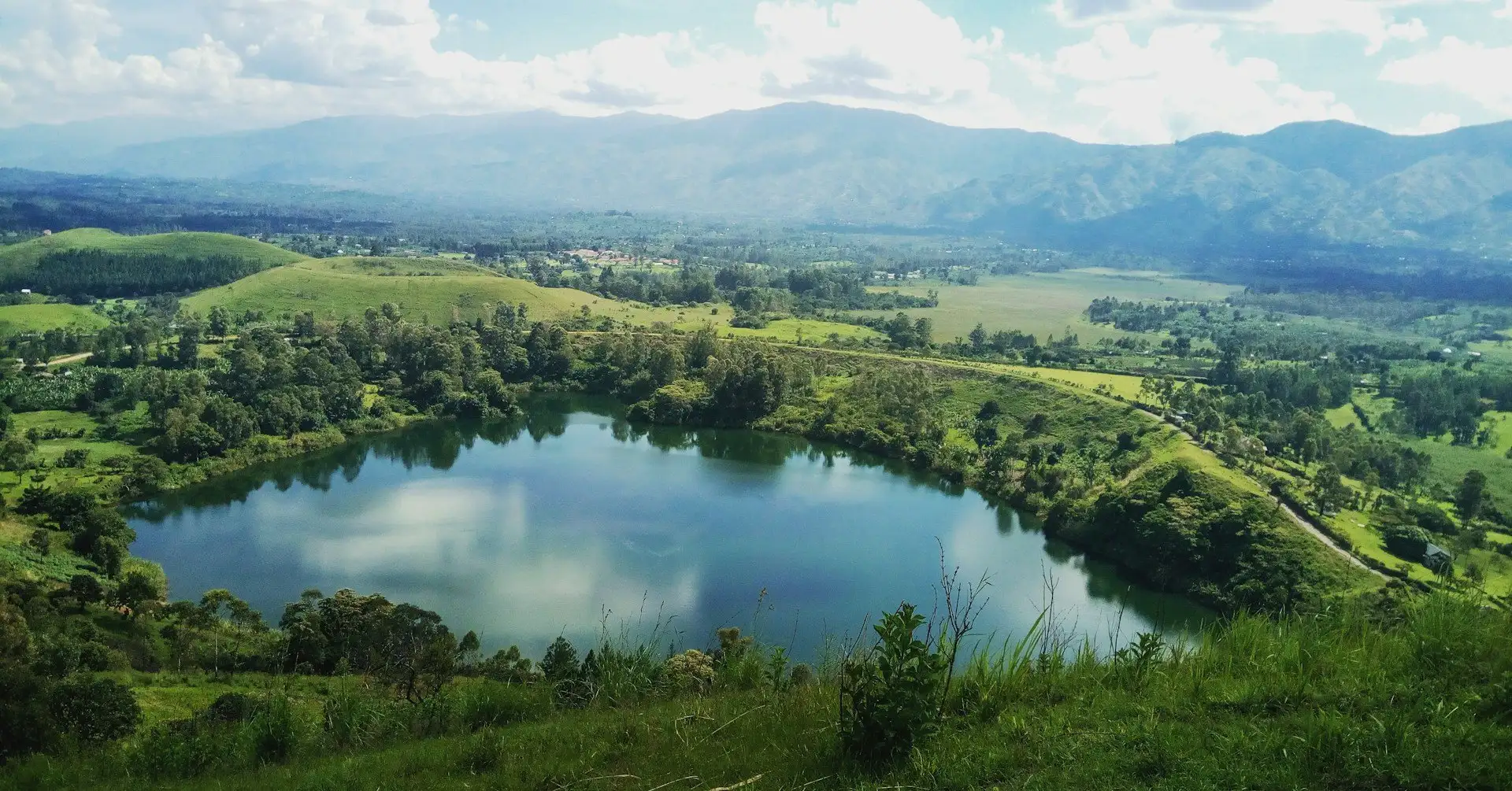
A dramatic crater lake near Kabale in the far southwest, ringed by terraced hills and dotted with small islands, several of which hold guesthouses reachable only by dugout canoe or boat transfer. A quiet, scenic stop en route to or from Bwindi rather than a destination in its own right, and free of the bilharzia risk that affects many other Ugandan lakes.
Ssese Islands
An archipelago of roughly 84 islands in Lake Victoria, reached by ferry from Entebbe or Bukakata, with a slower, beach-and-forest pace that contrasts with the safari circuit. Popular with backpackers and NGO staff taking a weekend off; infrastructure is basic on all but the main island, Buggala.
Culture & Etiquette
Uganda is home to more than 50 ethnic groups, with the Baganda the largest and most politically prominent, and Buganda's Kabaka still a genuine cultural presence rather than a ceremonial relic. Greetings matter more than they do in much of the West: a rushed hello without asking after someone's family or health reads as brusque. Hospitality is taken seriously, and visitors are generally met with warmth once the practical precautions in the Safety chapter are observed.
Do
- Greet properly. A handshake, often lingering longer than Western norms, paired with a spoken greeting and inquiry after someone's wellbeing, is standard before getting to business.
- Dress modestly, especially outside central Kampala and around religious or rural sites. Shoulders and knees covered is a safe default for both men and women.
- Use your right hand for eating, giving and receiving items; the left hand is considered unclean in many communities.
- Learn a few words of Luganda even though English is an official language: Oli otya (how are you), Webale (thank you), Kale (okay/fine) go a long way.
- Ask before photographing people, and expect a firm no around any official, military or religious site.
Don't
- Discuss or display support for LGBT+ rights publicly. Given the Anti-Homosexuality Act's broad "promotion" provisions, this is a legal matter, not a manners one; see the Safety chapter above.
- Wear camouflage or military-style clothing, including patterned children's clothing that resembles it. This is a criminal offence, not a faux pas.
- Give money or food directly to street children in Kampala. It's illegal, punishable by fine or imprisonment, and channeling support through a registered local charity is both legal and more effective.
- Smoke or vape in public places, workplaces or within 50 meters of a public building, or bring e-cigarettes or shisha into the country; both are banned.
- Assume everyone in Kampala's tourist economy is being straightforward with you. Standard scam awareness applies, as it does anywhere with a developed tourism industry.
Food & Drink
Ugandan food centers on the banana, in a form most visitors haven't encountered before, alongside groundnut-based sauces, freshwater fish from Lake Victoria, and some of the best Robusta coffee in the world grown in the country that gave the variety its name. It is filling, inexpensive, and served in far larger quantities than a first-timer usually expects.
Matoke ~$2-4
Green (starchy, unripe) bananas steamed and mashed into a dense, slightly tangy staple, the base of most Ugandan meals, usually served alongside a meat, groundnut or vegetable sauce.
Rolex ~$1-2
Kampala's own invention: a chapati rolled around a fried egg omelette with tomato, onion and cabbage, the name a local contraction of "rolled eggs." The definitive Ugandan street food, sold from roadside stalls across the city.
Luwombo
Chicken, beef or groundnut stew steamed slowly inside banana leaves, traditionally a Buganda royal dish and still the centerpiece of celebratory meals across the country.
Nile Perch & Tilapia $5-12
Fresh from Lake Victoria, grilled or fried whole and served with a side of matoke or posho; Nile perch can reach enormous sizes and is often sold by weight.
Uganda coffee
Uganda is Africa's largest Robusta exporter, with Arabica grown in the Rwenzori and Mount Elgon highlands. Kampala's specialty cafes, most notably 1000 Cups Coffee House, roast and serve it properly rather than exporting the best beans and keeping instant for the domestic market.
Waragi & local beer ~$1-3
Uganda Waragi, a banana- or grain-based gin, is the national spirit. Nile Special and Bell Lager are the dominant domestic beers. Stick to sealed, brand-name bottles given the methanol poisoning risk noted in the Safety chapter.
When to Go & How Long You Need
Uganda has two dry seasons, December to February and June to August, which are best for game viewing and for the driest, most manageable gorilla-trekking trails in Bwindi's rainforest. Gorilla trekking itself runs year-round since it isn't weather-dependent in the same way as a game drive; the green season months of April, May and November bring lower permit prices ($600 instead of $800) and lush scenery in exchange for slippery, more physically demanding trails.
Seasons compared, with rainfall
| Season | Verdict | Notes |
|---|---|---|
| Dec-Feb | Best | Driest, easiest gorilla trekking and game drives; busiest and priciest |
| Jun-Aug | Best | Second dry season; excellent wildlife viewing, moderate crowds |
| Sep-Nov | Good (wetter) | Green-season permit discount from April rules doesn't apply to Sep/Oct; short rains build through November |
| Mar-May | Green season | Long rains; $600 gorilla permits in April and May offset muddier trails |
Uganda sits on the equator, so temperatures stay fairly constant year-round (18-28°C in most areas); rainfall is the variable that matters for trip planning, not temperature.
How long to plan for
Ten to fourteen days covers gorilla trekking in Bwindi alongside one or two of the larger savanna parks without feeling rushed; Uganda's park-to-park driving distances are longer than they look on a map, and domestic flights between park airstrips are common for exactly that reason. A tighter seven-day trip can combine Bwindi gorilla trekking with Kampala and a Jinja stopover, skipping the savanna parks. Given the current advisory, a shorter, tightly organized trip with a specialist operator, rather than independent overland travel, is the more sensible structure right now regardless of budget.
Getting there & around
Entebbe International Airport (EBB), about 40 kilometers and 45 to 60 minutes from Kampala by road, is the country's only significant international gateway. Direct long-haul options are limited; most visitors connect via Amsterdam (KLM), Doha (Qatar Airways), Dubai (Emirates), Addis Ababa (Ethiopian Airlines) or Nairobi (Kenya Airways and regional carriers). For the national parks, small domestic operators including Aerolink and Bar Aviation fly scheduled routes into park airstrips, often faster and only modestly more expensive than the long road transfers, and worth strong consideration on this particular trip given the advisory context around road travel.
Road, boat and practical prep
Road travel between towns is genuinely hazardous by Western standards: poor lighting, unlit livestock on rural roads, and a high accident rate, concentrated on routes like Jinja-Kampala and Kampala-Masaka. A reputable safari operator's driver-guide, rather than a self-drive rental or public bus, is the standard and sensible choice for most itineraries.
Boats and ferries on Lakes Victoria and Albert have a history of fatal overloading incidents; use only clearly licensed operators, and don't board anything that looks overloaded regardless of how it's priced.
Practical prep: a yellow fever vaccination certificate is mandatory for entry, malaria prophylaxis is strongly recommended for all areas outside high-altitude gorilla-trekking zones, and a Ugandan SIM (available at the airport) or eSIM covers connectivity; signal drops out in dense forest areas like Bwindi.
Budget Planning
Day-to-day costs in Uganda are low by international standards, but the gorilla permit is a fixed, unavoidable major line item that dwarfs everything else if trekking is on your itinerary, and most visitors book at least part of their trip through an operator rather than piecing it together independently.
- Local guesthouses and hostel dorms
- Local eateries: posho, beans, rolex
- Public transport within Kampala (SafeBoda)
- Excludes gorilla permit and safari vehicle hire
- Mid-tier lodges inside/near parks
- Shared-vehicle guided safari
- Restaurant meals in Kampala
- Domestic flights between parks
- Premium lodges (Bwindi, Murchison, QENP)
- Private vehicle and guide throughout
- Gorilla Habituation Experience ($1,500)
- Domestic flights as standard
Quick reference prices
| Rolex from a street stall | ~$1-2 |
| Local restaurant meal | $3-6 |
| Coffee at a specialty cafe | ~$2 |
| Bwindi gorilla permit (standard) | $800 |
| Bwindi gorilla permit (green season) | $600 |
| Gorilla Habituation Experience | $1,500 |
| Entebbe-Kampala transfer | $20-30 (private) |
| Chimp trekking permit (Kibale) | ~$250 |
Prices reflect August 2026 research and shift over time, especially permit fees, which the Uganda Wildlife Authority adjusts periodically. Treat them as a planning baseline, not a quote.
Visa & Entry
Uganda no longer issues visas on arrival: every visitor must secure an e-visa online before traveling. A single-entry tourist e-visa costs $50 and covers 90 days; the East Africa Tourist Visa costs $100, covers Uganda, Kenya and Rwanda together, and allows multiple entries across all three within 90 days, useful if a gorilla-trekking trip is combining Uganda with a stop in Rwanda or Kenya. Apply through Uganda's official Directorate of Citizenship and Immigration Control portal, not a third-party site that charges extra for the same service.
✓ Valid passport
At least 6 months validity from your date of arrival, with at least one blank page.
✓ Yellow fever certificate
Mandatory, not optional. Border officials do check, and vaccination needs to happen at least 10 days before arrival.
✓ Printed approval letter
E-visa approval, once granted (typically 2-3 business days), must be printed and presented at the border for biometric processing. It expires 90 days after issuance if unused.
✓ Travel itinerary
Have your first accommodation address and onward travel plans ready; immigration officers may ask.
| Uganda | Rwanda | |
|---|---|---|
| Gorilla permit | $800 standard, $600 green season | $1,500 flat, no discount season |
| Current advisory | US Level 4, Do Not Travel | Typically rated lower risk; check current status |
| Trekking access | Bwindi: remoter, longer approach drives | Volcanoes NP: under 2 hours from Kigali airport |
| Wider wildlife | Broader: savanna parks, chimps, the Nile | More compact; gorillas are the headline draw |
| Overall cost | Lower across accommodation and transport too | Noticeably pricier throughout |
Uganda FAQ
Is Uganda safe to visit right now?
The US State Department currently rates Uganda Level 4, Do Not Travel, citing crime, an active regional Ebola emergency, terrorism and unrest. Uganda's own Ebola outbreak was declared over on 28 July 2026, but the WHO's regional emergency declaration remains active because of the much larger outbreak across the border in the DRC, and elevated terrorism and crime concerns are separate from the health picture. Tourism to the main safari and gorilla-trekking circuit continues, but this is not a normal-risk destination at the moment and you should read the full advisory before booking.
Is the Ebola outbreak in Uganda over?
Uganda's Ministry of Health declared its own outbreak over on 28 July 2026, twelve days after the last patient was discharged, with 20 confirmed cases and 2 deaths total. The World Health Organization's Public Health Emergency of International Concern, declared 17 May 2026, remains active because the outbreak is still serious in the neighboring Democratic Republic of Congo.
How much does gorilla trekking cost in Uganda?
A standard Bwindi gorilla permit costs $800 per person for one hour with a habituated family, dropping to $600 in the green season months of April, May and November. A four-hour Gorilla Habituation Experience costs $1,500. Uganda's permits are roughly half the price of Rwanda's equivalent $1,500 permit.
Do I need a visa for Uganda?
Yes, and it must be obtained online in advance: Uganda no longer issues visas on arrival. A single-entry tourist e-visa costs $50 for 90 days, or $100 for the East Africa Tourist Visa covering Uganda, Kenya and Rwanda. Apply through the official immigration portal, not third-party sites, and bring your yellow fever vaccination certificate.
Is it legal to be LGBT+ in Uganda?
No. Uganda's Anti-Homosexuality Act 2023 imposes life imprisonment for same-sex sexual activity, with the death penalty available for offences classed as "aggravated homosexuality," and up to 20 years for "promoting" homosexuality. This is a serious legal risk, not a matter of local attitudes, and LGBT+ travelers should weigh it carefully.
How many days do you need in Uganda?
Ten to fourteen days covers gorilla trekking in Bwindi plus one or two of the larger savanna parks properly. A standalone gorilla-trekking trip with Kampala and Jinja on either end can work in seven days, though park distances make Uganda a country that rewards not rushing.
What is the best time to visit Uganda?
The two dry seasons, December to February and June to August, are best for wildlife viewing and gorilla trekking, with easier trail conditions in Bwindi's rainforest. Gorilla trekking itself runs year-round; the green season (April, May, November) brings lower permit prices and lush scenery in exchange for muddier trails.
Is Kampala safe?
Kampala functions as a normal, busy East African capital day to day, and most visits pass without incident, but the US State Department assesses it as a high-threat location for terrorism and street crime has been rising. Use hotel-arranged transport or the SafeBoda app rather than hailing boda-bodas or matatus off the street, avoid walking after dark, and keep valuables out of sight.
Is Uganda cheaper than Rwanda for gorilla trekking?
Yes, substantially. A Uganda gorilla permit costs $800 against Rwanda's $1,500, and general costs (accommodation, food, transport) run lower in Uganda too. Rwanda's Volcanoes National Park is more compact and easier to combine with a short trip; Uganda's Bwindi is remoter and currently carries a higher risk rating.
What Stays With You
An hour spent sitting a few meters from a 200-kilogram silverback in his own rainforest is one of the more genuinely humbling wildlife experiences left on the planet, and it is still, right now, something you can book and do. That's the strange position Uganda occupies at the moment: a country whose signature experience remains fully operational while its government advisory sits at the highest level issued. Both things are true at once, and a good decision about whether to go depends on taking both seriously rather than picking whichever one is more convenient to believe.
If you do go, go through an operator who takes the current situation as seriously as this guide has tried to, read the primary advisories yourself right up until departure, and don't let the Pearl of Africa nickname, real as it is, talk you out of the homework.