
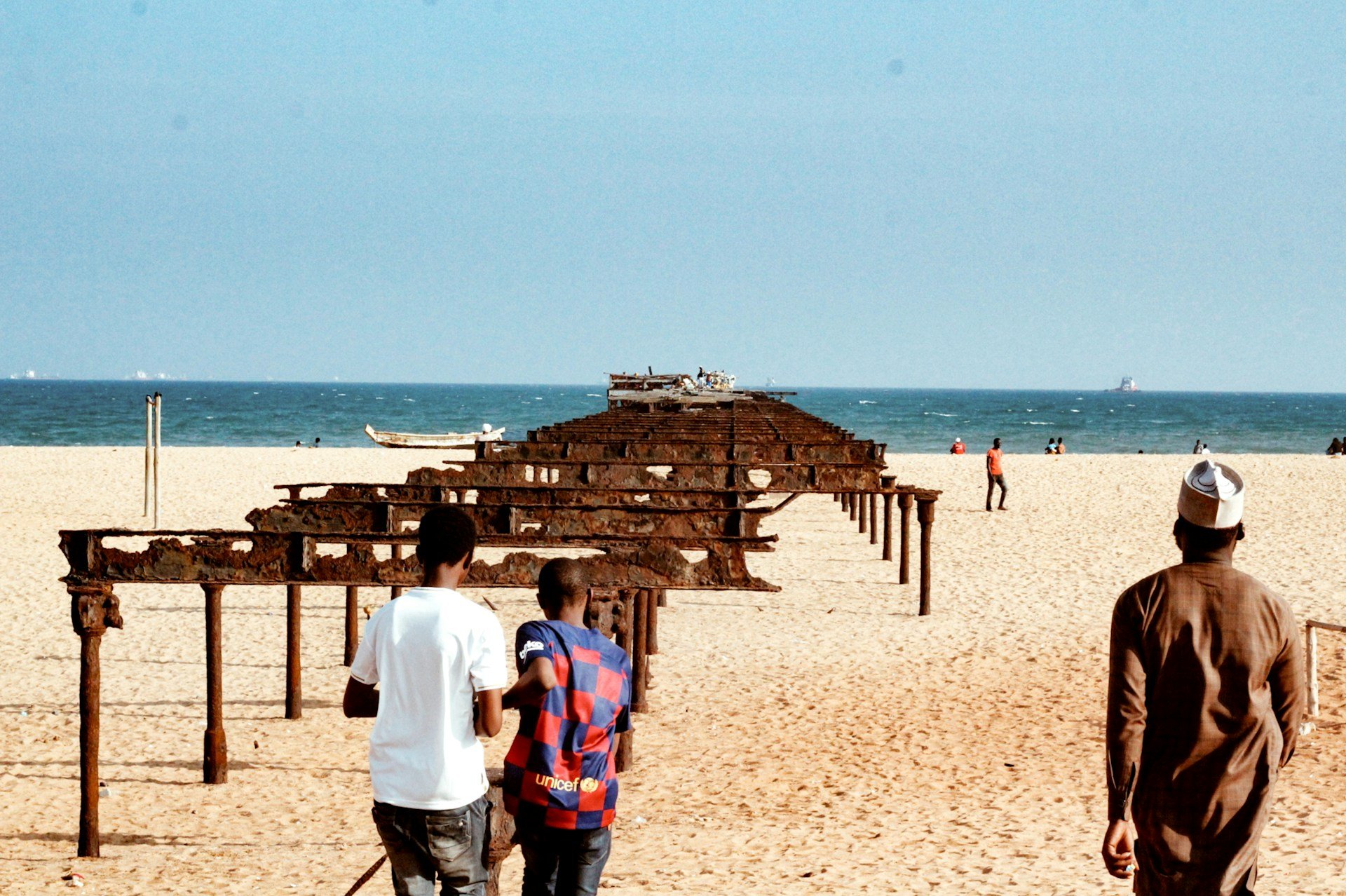
What You're Actually Getting Into
Togo is the country most travelers to this part of West Africa skip, and that is precisely why it rewards the ones who don't. Wedged between Ghana and Benin, at some points barely 50 kilometers wide, it runs from a short strip of Atlantic coast north through palm and savanna toward the edge of the Sahel. The capital, Lomé, has a genuinely lively beach and market scene; a short pirogue ride across Lake Togo reaches Togoville, where the treaty that created colonial "Togoland" was signed and where voodoo shrines still stand near the old royal palace; and in the far north, the Batammariba people still build the mud tower-houses that earned Koutammakou its UNESCO listing in 2004. None of it is set up for mass tourism, which is both the appeal and the honest catch.
Togo is also cheap by almost any measure: a plate of grilled fish and attiéké at a beach maquis costs about 2,000-3,000 CFA (roughly $3-5), and a decent guesthouse room runs 15,000-25,000 CFA a night. But the tourist infrastructure outside Lomé is thin. English is not widely spoken, roads outside the capital vary in quality, and the far north carries a real security risk that this guide does not soften.
The honest complications
Togo's politics are worth understanding before you land: the Gnassingbé family has held executive power continuously since 1967, and a 2024 constitutional overhaul shifted the country to a parliamentary system in which Faure Gnassingbé now governs as President of the Council of Ministers, a role with no term limit, while the presidency itself became largely ceremonial. This is not a travel-safety issue for tourists in Lomé, but it shapes the political backdrop and occasionally produces protests in the capital worth checking news on before you go. Separately, and more concretely relevant to trip planning: the northern border region near Burkina Faso carries a genuine terrorism and kidnapping risk that the US State Department flags specifically, and it is not a place to wing it without local guidance. Outside Lomé, French is close to essential; very little English is spoken beyond upscale hotels.
A History Worth Knowing
Togo's coast was home to Ewe- and Mina-speaking kingdoms and a minor node of the Atlantic slave trade before Germany declared a protectorate here in 1884, signing the founding treaty at Togoville on the shore of Lake Togo. Germany lost it after the First World War, and the League of Nations split the territory between Britain and France; British Togoland later joined Ghana at independence, while French Togoland became the Republic of Togo on 27 April 1960. What followed was Africa's first post-independence coup, then 38 years of one family in power, and, as of 2024-2025, a constitutional rewrite that changed the shape of that power without changing who holds it.
- 1884
German Togoland. Germany declares a protectorate; the founding treaty is signed at Togoville with King Mlapa III.
- 1914–1922
Partition. Anglo-French forces occupy the German colony in WWI; the League of Nations splits it into British and French mandates.
- 1960
Independence. French Togoland becomes Togo on 27 April. Sylvanus Olympio becomes the first president.
- 1963
First coup. Olympio is assassinated in a military coup, generally regarded as post-colonial Africa's first.
- 1967
Eyadéma takes power. Étienne (later Gnassingbé) Eyadéma seizes the presidency and rules as a one-party state for the next 24 years.
- 1990–1992
Multiparty reform. Pro-democracy protests force the legalization of opposition parties and a new constitution.
- 2005
Succession. Eyadéma dies after 38 years in power; his son Faure Gnassingbé becomes president amid disputed elections and unrest.
- 2024–2025
Fifth Republic. A new constitution moves Togo to a parliamentary system; Faure Gnassingbé becomes President of the Council of Ministers, an executive role with no term limit.
Read the full history: Olympio, Eyadéma and the 2024 constitutional change
Sylvanus Olympio led Togo to independence and into the early 1960s as a cautious, fiscally conservative president who resisted French pressure to keep colonial-era soldiers on the payroll after decolonization. That decision is widely credited with triggering his assassination in January 1963 by disaffected former French colonial army veterans, an event historians generally treat as the first successful coup in post-independence Africa and a grim template for the decades that followed across the continent.
Étienne Eyadéma, one of the soldiers involved in the 1963 coup, took power directly in a second coup in 1967 and ruled Togo as a one-party state under the Rally of the Togolese People for the next quarter-century, aligning with the West during the Cold War and nationalizing the phosphate industry in 1974 to fund the state. Pro-democracy protests in 1990 forced the legalization of opposition parties and a new constitution in 1992, but Eyadéma retained power through elections that international observers repeatedly criticized, and by his death in 2005 he was, at 38 years, the longest-serving head of state in modern African history.
His son Faure Gnassingbé's initial installation by the military in 2005 briefly triggered a constitutional crisis and violent unrest before a hastily arranged election confirmed him in office; he has led the country in some capacity ever since. In April 2024, Togo's National Assembly adopted a new constitution shifting the country from a presidential to a parliamentary system, and in May 2025 Gnassingbé became President of the Council of Ministers, a position that now holds the executive authority the presidency previously carried, with no term limit attached. Critics, including opposition parties who largely boycotted the process, describe the change as a mechanism to extend Gnassingbé family rule indefinitely rather than a genuine democratic reform; supporters frame it as modernization. Either way, it is the political context worth knowing before a trip, even though it has little bearing on day-to-day travel in Lomé.
Top Destinations
Togo divides into four practical zones: Lomé and the coast, Lake Togo and Togoville just inland, the coffee-and-waterfall hill country around Kpalimé, and the Batammariba tower-house country of the far north. The country's narrowness means distances look short on a map; road quality and border-area security are the real constraints, not geography.
Lomé, the beach capital
Lomé sits right on the Gulf of Guinea, close enough to the Ghanaian border that you can see it from parts of the city. The Grand Marché (Assigamé), a two-storey market dating to 1967, is the heart of the city's textile trade and the historic base of the "Nana-Benz," the wax-print fabric traders whose 1960s wealth was legendary enough to give them the nickname. Across town, the Akodessewa Fetish Market is the world's largest voodoo market: an unflinching display of animal parts, talismans and traditional medicine that draws Vodun practitioners from across the region, best visited with a guide who can explain what you're seeing rather than alone. The full breakdown of neighborhoods, hotels and restaurants is in our dedicated Lomé city guide. Budget two to three days.
Togoville, across the lake
Togoville sits on the northern shore of Lake Togo, reached from Lomé by road via Agbodrafo and then a short pirogue (dugout canoe) crossing that is itself part of the experience. This is the town that gave Togo its name, To-go meaning roughly "behind the lake" in Ewe, and where the 1884 treaty establishing German Togoland was signed. It remains Togo's most significant center of voodoo practice, with shrines standing near the old royal palace and a basilica built after a reported Marian apparition sitting incongruously close by, a genuinely striking juxtaposition of Vodun and Catholic faith that locals navigate without much friction. Go with a guide who can introduce you properly; wandering into shrine areas uninvited is not appreciated.
Kpalimé, coffee, cocoa and waterfalls
About 120 kilometers northwest of Lomé, Kpalimé is Togo's green escape: cocoa and coffee plantations climbing the slopes of Mount Agou, at 986 meters the country's highest point, and a scatter of waterfalls that make good half-day targets. The Cascade de Kpimé is the best known; the Womé waterfall, 12 kilometers from town, charges a small entry fee at the local Akatamanso Association gate. The Kloto Crafts Center introduces batik and woodcarving traditions, and the surrounding hills are genuinely rich in butterfly species, a niche but real draw for naturalists. This is also the most walkable and hikeable part of Togo for travelers without a vehicle.
Koutammakou, land of the Batammariba
In Togo's far northeast, spilling over into neighboring Benin, Koutammakou is a roughly 50,000-hectare cultural landscape that UNESCO listed in 2004 as an outstanding living settlement. The Batammariba, whose name means "those who shape the earth," still build and inhabit takienta, distinctive two-story mud tower-houses whose form reflects their social structure as directly as their architecture. Kara, several hours north of Lomé by road, is the practical gateway city for the region. This is also the zone where the safety picture changes: the area near Kara and Koutammakou itself is generally visited without incident, but the US State Department specifically warns against travel further north, toward the Burkina Faso border and areas north of Kandé, because of terrorism and kidnapping risk. Do this leg with an established guide or tour operator, not independently.
Hidden gems beyond the main circuit
With extra days, these are worth the detour even though they rarely make the standard itinerary.
Aného
Togo's former colonial capital under both Germany and France, a quiet coastal town near the Benin border with faded colonial architecture and a long, uncrowded beach. Worth a stop en route to or from Benin.
Agbodrafo
The lakeside village where the pirogue to Togoville departs, with its own colonial-era trading history tied to the transatlantic slave trade. Worth twenty unhurried minutes before or after the crossing.
Kloto Crafts Center
A cooperative where local artisans demonstrate batik dyeing and woodcarving. Buying directly here supports the makers rather than a Grand Marché middleman, and prices are honest.
Culture & Etiquette
Togo counts 37 to 44 ethnic groups depending on how you count, with the Ewe and Mina dominant along the coast and the Kabye, Kotokoli and related peoples dominant in the north. French is the official language of government and business; Ewe and Kabye carry semi-official national status and are the practical languages of daily life in their respective regions. Indigenous religion, dominated by Vodun (voodoo), is practiced by more than half the population, often alongside Christianity (around 29%) or Islam (around 20%) rather than instead of them: it is entirely normal to find someone who attends church on Sunday and consults a Vodun priest during the week.
Do
- Greet properly before anything else. A handshake and a few words of greeting before getting to business, a question, or a purchase is expected; skipping straight to what you want reads as rude.
- Learn a little French. Bonjour, merci, s'il vous plaît go a long way outside the handful of upscale Lomé hotels where English is spoken.
- Ask before photographing people, shrines or ceremonies. Vodun sites and practitioners are not photo backdrops; a guide can ask on your behalf and explain what's appropriate.
- Dress modestly at markets, villages and religious sites. Lightweight covered shoulders and knees are a safe default outside the beach itself.
- Carry cash in CFA francs. Togo is largely a cash economy outside a handful of Lomé hotels and the newer supermarkets.
Don't
- Touch fetish objects or market items at Akodessewa without explicit permission. These are sacred and functional objects to practitioners, not curios.
- Expect English. Outside Lomé's international hotels, assume French is required or bring someone who speaks it.
- Rush a greeting or transaction. Togolese social interaction runs at a more deliberate pace than many Western visitors expect; impatience reads poorly.
- Assume all of Togo is equally accessible. The far north near the Burkina Faso border is a genuine no-go area, not a "be careful" area; treat State Department guidance on it literally.
- Drink tap water untreated. Stick to bottled or filtered water, including for ice in less established places.
Deeper culture: the Nana-Benz, Vodun's global legacy and the Batammariba
The Nana-Benz. When the West African wax-print fabric trade shifted from Ghana to Lomé's Grand Marché in the 1960s, a group of Togolese women traders accumulated enough wealth to be among the first in the country to buy Mercedes-Benz cars, earning the nickname that still shapes how Lomé talks about commerce, taste and female economic power.
Vodun's global reach. The spiritual system practiced at Togoville and along this stretch of coast, involving communication with ancestral spirits and nature deities through shrines and ceremony, survived the transatlantic slave trade to become a foundational influence on Haitian Vodou, Brazilian Candomblé, Cuban Santería and Louisiana Voodoo. Visiting Togoville or Akodessewa is, in a real sense, visiting a root of several New World religious traditions.
The Batammariba. The name means "those who shape the earth," and their takienta tower-houses in Koutammakou are built with a form that mirrors their social and spiritual cosmology as much as it serves shelter, a rare case where UNESCO's "living heritage" designation describes something still genuinely, functionally alive rather than preserved as a museum piece.
Food & Drink
Togolese food shares the pounded-starch-and-sauce logic common across West Africa, built around fufu, pâte and rice, dressed with peanut, tomato or leaf-based sauces and grilled meat or fish. The best of it is street food and beach maquis cooking, not restaurant plates, and a filling meal rarely costs more than a few dollars.
Fufu ~1,000-2,000 CFA
Pounded yam, cassava or plantain worked into a smooth, stretchy dough, served with a peanut or vegetable sauce and fish, beef or chicken. Togo's most iconic single dish, found everywhere from street stalls to home kitchens.
Pâte & Koklo Meme
Pâte is a cornmeal dough eaten with a meat, fish or vegetable sauce. Koklo meme is grilled chicken marinated in a spicy pepper sauce, a festival and special-occasion favorite that's just as good from a good roadside grill on an ordinary Tuesday.
Attiéké & Grilled Fish 2,000-4,000 CFA
Fermented cassava couscous, originally Ivorian but ubiquitous on the Togolese coast, served alongside grilled fish or langoustine at the beach maquis. The single most representative Lomé meal.
Akpan
A fermented-corn snack with a yogurt-like tang, sweetened and sold ready to eat in small plastic bags by street vendors. Eaten as breakfast or a light dessert.
Flag Beer ~500-1,000 CFA
The dominant local lager, served cold at every beach maquis and bar. The default order alongside grilled fish at sunset.
Rice Sauce Plates
Riz sauce, rice with tomato-based sauce and meat or fish, is the everyday lunch counter staple in Lomé, cheap, filling and available on nearly every commercial street.
When to Go & Itineraries
Togo runs on a tropical calendar with two dry stretches: the long dry season from November to March is the easiest and most comfortable window, warm and mostly rainless on the coast. April through July brings the main rains, heaviest in the south, with a short dry spell in August before shorter rains return in September and October. The north runs hotter and drier overall, with dusty harmattan winds common from December into February.
Itineraries
A week covers the south comfortably. Two weeks is genuinely needed to add Koutammakou and the north, given road travel times and the case for going with a guide once you're past Kara.
- Days 1–3
Lomé. Grand Marché, Akodessewa Fetish Market with a guide, Coco Beach maquis at sunset. Full detail in our Lomé city guide.
- Day 4
Togoville. Drive to Agbodrafo, pirogue crossing to Togoville, the voodoo shrines and the royal palace site, back to Lomé by evening.
- Days 5–7
Kpalimé. Coffee and cocoa plantation walks, the Cascade de Kpimé, Mount Agou views, and the Kloto Crafts Center before returning to Lomé.
- Days 1–4
Lomé & Togoville. The one-week Lomé and Togoville itinerary above, at a gentler pace.
- Days 5–7
Kpalimé. Waterfalls, plantation tours and a night or two in the hills.
- Days 8–11
North to Kara. The long road trip north; Kara as a base for the region.
- Days 12–14
Koutammakou. Guided visits to the Batammariba takienta villages, then back south to Lomé to fly out. Do not continue further north toward the Burkina Faso border.
Getting there & around
Lomé–Tokoin International Airport (LFW) is Togo's only airport and doubles as the regional hub for ASKY Airlines, a Lomé-based carrier partnered with Ethiopian Airlines that connects roughly 30 cities across Africa, useful if you're combining Togo with a wider West African trip. Intercontinentally, Air France flies year-round to Paris CDG and Brussels Airlines runs seasonal service to Brussels. Within the country, shared bush taxis (cars or minibuses that leave when full) cover the main routes between Lomé, Kpalimé and Kara cheaply; a private driver or guide is the more practical choice for Togoville and especially for the north, where local knowledge matters for both roads and safety.
Yellow fever, SIM cards and practical prep
Yellow fever vaccination is mandatory, not optional, for entry to Togo at any age over 9 months. You must present the International Certificate of Vaccination at immigration; there is no exception. Get it at least 10 days before arrival.
Practical prep: buy a local SIM at the airport or arrange an eSIM before landing, since signal thins out considerably in Kpalimé's hills and the far north. Standard travel insurance is worth having with medical evacuation cover, given how limited formal medical infrastructure is outside Lomé. GetTransfer can arrange a fixed-price airport pickup from LFW, which avoids the arrivals-hall taxi negotiation on your first night.
Where to stay
Lomé beachfront hotels
Hotel Sarakawa, a beachfront 4-star with an Olympic-size pool and tennis courts, and Hôtel Sancta Maria, also facing the beach, are the established choices for comfort. Full Lomé hotel detail, including budget picks, is in the city guide.
Kpalimé & the north
Outside Lomé, accommodation shifts to simple guesthouses arranged through local tour operators or hotel front desks; book Kpalimé and Kara stays a few days ahead rather than assuming same-day availability, especially outside the November-February high season.
Budget Planning
Togo is inexpensive by international standards, though prices in Lomé's international hotels and restaurants can climb close to Western levels. Away from that narrow segment, a comfortable trip costs a fraction of what the same standard would in Ghana or coastal Kenya.
- Guesthouse room 15,000-25,000 CFA
- Street food and beach maquis meals
- Shared bush taxis and moto-taxis
- Free markets and beach time
- 3 to 4-star hotel or beachfront guesthouse
- Restaurant meals, 3,000-8,000 CFA
- Private driver for day trips
- Guided Togoville or Koutammakou excursion
- Best available hotels in Lomé
- Private guide and vehicle throughout
- All meals at established restaurants
- Multi-day north itinerary with a driver
Quick reference prices
| Grilled fish & attiéké, beach maquis | 2,000-4,000 CFA |
| Fufu with sauce, street stall | 1,000-2,000 CFA |
| Flag beer | 500-1,000 CFA |
| Guesthouse room | 15,000-25,000 CFA/night |
| Lomé beachfront hotel | 65,000-95,000 CFA/night |
| Womé waterfall entry, Kpalimé | ~2,500 CFA |
| Local SIM card | ~5,000 CFA |
Prices reflect August 2026 research and drift over time. Treat them as a planning baseline, not a quote.
Visa & Entry
Most nationalities, including the US, UK and EU, can obtain a single-entry, 30-day visa on arrival at Lomé-Tokoin International Airport or at land borders, for a standard fee of about $50. An e-visa can also be arranged in advance and typically takes 5 to 7 days to process, worth doing if you'd rather not deal with paperwork on arrival. The 30-day visa can be extended by up to 60 additional days at the immigration office in Lomé. Requirements do change, so confirm current rules with Togo's official channels or your nearest Togolese embassy before booking, rather than relying solely on this page or third-party visa-processing sites.
✓ Valid passport
UK guidance specifies at least 6 months validity from date of entry; other nationalities should carry similar buffer to avoid issues.
✓ Yellow fever certificate
Mandatory for every traveler aged 9 months and over. You will be denied entry without the International Certificate of Vaccination.
✓ Proof of accommodation
Have your first night's address ready; hotels register guests on arrival.
✓ Visa fee in cash or via e-visa
Around $50 for visa on arrival; e-visa applications are paid online in advance.
| Togo | Benin | |
|---|---|---|
| Voodoo heritage | Togoville's shrines and the Akodessewa Fetish Market | UNESCO-recognized Vodun heritage since 2021; Ouidah is the spiritual capital |
| Size & ease | Narrower, distances feel shorter; south is easy to see in a week | Larger, more established tourist infrastructure and English signage |
| Unique draw | Koutammakou's living Batammariba tower-houses | Abomey's royal palaces and the Pendjari wildlife park |
| Daily budget | $25-40 gets you far | Comparable, slightly higher in tourist zones |
| North-country safety | Far north near Burkina Faso: avoid | Northern Benin near Burkina Faso/Niger border: also avoid |
Safety, Solo Women & Family
The US State Department rates Togo Level 2, Exercise Increased Caution, as of its March 2026 advisory. Lomé and the southern coast are generally manageable with the awareness you'd apply in any West African capital: violent crime including carjacking, robbery and home invasion can occur, more often in urban areas, near the beach after dark, and in crowded markets, but it is not the dominant experience of a well-prepared visitor. The picture changes sharply in the far north: the State Department specifically advises against travel to the border region near Burkina Faso and to areas north of Kandé because of terrorism and kidnapping risk, and US government employees are barred from overnight stays north of Mango for the same reason. Treat that guidance as a hard boundary, not a suggestion.
Urban crime
Standard precautions apply in Lomé: don't display cash or phones openly, avoid the beach after dark away from lit areas, and use a known driver or hotel-arranged transport at night.
The far north
Do not travel to the border area near Burkina Faso or north of Kandé. Terrorism and kidnapping risk here is current and specific, not a generic advisory boilerplate.
Ocean currents
Currents along Togo's Atlantic coast are strong, and drownings occur most years. Dangerous stretches are rarely marked; swim only where locals swim and ask your hotel before going in.
One more thing worth knowing: limited outside-Lomé services
The US government notes limited ability to provide emergency or routine consular services to citizens outside Lomé, given the security environment. Practically, this means travel insurance with medical evacuation coverage matters more here than in destinations with denser embassy and hospital networks, particularly once you're past Kpalimé.
Solo women travelers
Togo is manageable for solo women but not effortless (around 6/10 on our scale). Tourist infrastructure for independent travel is thin outside Lomé, English is limited, and the general West African pattern of street attention and unsolicited offers of help applies. Most solo travelers who do well here stick to Lomé, Togoville and Kpalimé independently and bring a local guide for anything further north, both for logistics and for the clearer social buffer a guide provides. Dress modestly away from the beach itself, and arrange transport after dark through your hotel rather than hailing on the street.
Emergency numbers
US Embassy Lomé and family travel notes
The US Embassy in Lomé sits on Boulevard Eyadéma, reachable at +228 22 61 54 70. Its ability to assist citizens outside Lomé is limited, reinforcing the case for good travel insurance if your itinerary goes north.
Family travel: Lomé's beach and markets work reasonably well with older children accompanied by an adult, and the pirogue crossing to Togoville is a genuine adventure for kids old enough to sit still in a canoe. The Akodessewa Fetish Market's more graphic displays are worth previewing yourself before deciding whether to bring young children. The far north is not a reasonable family destination given the security guidance above.
Togo FAQ
Is Togo safe to visit?
Lomé and the southern coast are generally manageable with normal city precautions. The US State Department rates Togo Level 2, Exercise Increased Caution, and specifically warns against travel to the northern border region near Burkina Faso and areas north of Kandé because of terrorism and kidnapping risk.
Do I need a visa for Togo?
Most nationalities, including the US, UK and EU, can get a 30-day visa on arrival at Lomé airport for about $50, or apply for an e-visa in advance. A yellow fever vaccination certificate is mandatory for entry regardless of visa type.
How much does Togo cost per day?
Budget travelers manage on roughly $25-40 a day covering guesthouses, street food and shared taxis. Mid-range runs $85-150 a day for a comfortable hotel, restaurant meals and private transport.
What currency does Togo use?
The West African CFA franc (XOF), shared with seven other West African countries and pegged to the euro at a fixed rate of 655.957 XOF per euro.
What language is spoken in Togo?
French is the official language. Ewe and Mina are the main languages in the south, Kabye and other languages dominate the north. English is uncommon outside upscale hotels in Lomé, so basic French is genuinely useful.
What is Koutammakou?
A UNESCO World Heritage cultural landscape in northeastern Togo, home to the Batammariba people and their distinctive mud tower-houses called takienta. Listed in 2004 as an outstanding living example of traditional settlement.
Is Togo the birthplace of voodoo?
Togo and neighboring Benin are both considered homelands of Vodun. Togoville, on Lake Togo, is Togo's main center of the practice, with shrines near the former royal palace and the world's largest fetish market at Akodessewa in Lomé.
How many days do you need in Togo?
A week covers Lomé, Togoville and Kpalimé comfortably. Adding Koutammakou and the north requires two weeks given road travel times and is best done with a driver or guide.
Is Togo good for solo female travelers?
Manageable but not effortless. Infrastructure for independent tourism is thin outside Lomé, English is limited, and the usual West African street attention applies. Most solo travelers do fine sticking to the south and traveling with a local guide further north.
What Stays With You
Togo doesn't try to sell itself the way its neighbors do. There's no polished tourist board campaign, no well-worn backpacker trail, just a narrow strip of a country that gets on with being what it is: a beach city with a market that still runs on the reputation of women who bought Mercedes in the 1960s, a lake town where a Catholic basilica sits a short walk from voodoo shrines and nobody finds that strange, and a corner of the far north where people still build the same mud tower-houses their ancestors did, not for tourists, just because it's still how they live.
Go for the pirogue crossing to Togoville at golden hour, and the grilled fish on Coco Beach afterward. Skip the far north unless you're going properly, with a guide who knows exactly where the line is.