
West Africa's westernmost capital sets its own pace
Dakar sits at the tip of the Cap Vert peninsula, the westernmost point of mainland Africa, a sprawling, self-assured city of roughly three million where French colonial Plateau, dense residential Médina, and the beach suburbs of Almadies, Ngor and Yoff each feel like different cities stitched together by chaotic, unmissable traffic. It is not trying to be a resort town. It is a real capital that happens to have some of West Africa's best beaches at its edges, a slave-trade memorial a short ferry ride offshore, and a music and food culture that rewards slowing down to match it.
What changed for tourism in the last decade is infrastructure: the newer Blaise Diagne International Airport, a genuine hostel-to-five-star hotel scene, and a well-worn day-trip circuit to Gorée Island, Lac Rose and the Bandia Wildlife Reserve. But go two streets back from the Corniche and you're in a city that runs on its own rhythm, where an attaya tea ceremony takes an hour because that's how long it takes, and nobody's in a hurry to change that for visitors.
The honest complications
Dakar's traffic is genuinely bad, a short-looking crossing of the peninsula at rush hour can eat an hour, and there's no metro to escape it. Persistent, if rarely aggressive, street hustling clusters around the Gorée ferry terminal, the airport and central markets. The rainy season (June to October) brings heavy, if usually brief, downpours that catch visitors off guard, and Sandaga Market, long a headline Dakar sight, has been mid-demolition and relocation following repeated fires, so it's currently more curiosity than destination. None of it undermines a trip; all of it is worth knowing before you land.
Five neighbourhoods, one very different city each
Dakar's neighbourhoods are defined by their distance from the Atlantic and from the old colonial center. Where you base yourself comes down to how much beach you want versus how central you want to be for sightseeing.
Plateau
The old French administrative quarter: wide boulevards, the Presidential Palace, Place de l'Indépendance, and the port with the Gorée ferry terminal. Plateau keeps most major sights within walking distance, but it absorbs the city's traffic and exhaust from early morning onward, and it empties out at night.
Médina
Dakar's original African residential quarter, dense and locally oriented, the historic heart of Senegalese urban culture and, by reputation, the birthplace of mbalax music. Genuine immersion in city life rather than tourist Dakar, with strong street food and fabric markets, best explored with a guide or local contact for a first visit.
Almadies
The upmarket beach suburb at the peninsula's tip, holding Dakar's best restaurant concentration, most of its mid-range and upscale hotels, embassies, and the closest thing the city has to a relaxed, walkable evening scene. For a first visit, this is the base that balances beach time with easy taxi access to everything else.
Ngor
A former fishing village turned surf destination that has kept its pace despite sitting minutes from Almadies. Ngor Island, a short pirogue hop offshore, holds the legendary Ngor Right surf break and a handful of beach guesthouses. Cheaper and quieter than Almadies proper, with genuine colonial-era architecture in the village core.
Yoff
North of Almadies, Yoff is a real working fishing village with a long sandy beach that suits beginner surfers, plus Dakar's small hostel scene. A good compromise between beach access and lower cost than Almadies proper.
From beach resorts to Ngor's backpacker scene
Dakar's hotel scene runs from simple fishing-village hostels to full international resorts, almost all of it clustered along the Corniche and the Almadies-Ngor-Yoff stretch of the peninsula. These picks cover every budget and each earns its place.
At the top, Terrou-Bi Resort is Dakar's best-known beach resort, facing the sea with a private beach, a landscaped garden, an outdoor pool and an on-site casino, from around $180 a night. Freshly rebranded, Noom Hotel Dakar Sea Plaza, a member of Radisson Individuals (formerly Radisson Blu, rebranded January 2025) sits on the Corniche with sleek, modern rooms and remains one of the most polished stays in the city.
In the upscale-but-less-flashy bracket, Pullman Dakar Teranga sits on the Corniche with Atlantic views, a beach club and a heated pool, while King Fahd Palace near Pointe des Almadies is known for its extensive grounds, tennis courts and lavish scale, both from roughly $130-200 a night.
For a smaller, design-led stay, La Villa 126 in Ngor Almadies is a compact six-room guesthouse (from around $70) that books up quickly; and at the budget end, Ngor International Hostel, the Ngor-Almadies area's first hostel, and ViaVia Travellers Café in the Yoff fishing village (both from around $15-20 a night) built Dakar's small but genuine backpacker scene.
Compare hotels on the map
Thiéboudienne, attaya tea and the Almadies seafood scene
Dakar's food runs on rice, fresh Atlantic fish and slow-cooked sauces, best eaten at neighborhood spots rather than hotel restaurants. The Almadies and Ngor coastline holds the city's strongest concentration of proper seafood restaurants, while the national dish is best found at unglamorous local canteens for a few dollars a plate.
Thiéboudienne
Fish, usually thiof, stuffed with a garlic-parsley paste and braised with vegetables in tomato broth, then broken rice cooked in the same liquid until a prized crust forms at the bottom. A UNESCO-recognized dish since 2021, and best found at unpretentious local canteens rather than tourist-facing restaurants.
Grilled seafood in Almadies & Ngor
The Almadies and Ngor coastline is Dakar's best eating: La Cabane du Pêcheur and La Pointe des Almadies both do fresh seafood with ocean views on the Petite Corniche, while Le Ngor les pieds dans l'eau, its blue-and-green walls right on the beach road, and Alkimia in Ngor both lean into the district's relaxed seaside pace. On tiny Ngor Island itself, Sunu Makane (Chez Seck) serves simple, excellent local fare in a genuinely unpretentious setting, and is worth the short pirogue crossing on its own.
Yassa & Mafé
Yassa (chicken or fish marinated in lemon, onion and mustard) and mafé (a peanut-and-tomato beef stew) are the two dishes you'll see on nearly every menu, from street stalls to hotel dining rooms. Both travel well for visitors nervous about spice, and both taste noticeably better at local canteens than at international-style restaurants.
Attaya & Bissap
Attaya is the three-round green tea ceremony poured from height to build foam, each round sweeter than the last, a genuine daily social ritual rather than a show. Bissap, a deep-red hibiscus juice sold from street carts everywhere, is the better cold-drink antidote to Dakar's heat.
A ferry ride, a monument on a hill, and a surf break at the edge of Africa
Dakar's essential sights span history, art and the Atlantic itself. A few need advance planning; most reward simply showing up. This chapter walks through the city roughly the way a good two or three days would.
Gorée Island
The single most essential thing to do from Dakar: a 20 to 30 minute ferry from the Plateau terminal near Place de l'Indépendance reaches a car-free UNESCO island of sand streets and pastel colonial facades. The House of Slaves (Maison des Esclaves), an 18th-century red building whose Door of No Return opens straight onto the Atlantic, is the island's central and sobering landmark, converted into a museum in 1962 and a UNESCO World Heritage Site since 1978. Round-trip ferry tickets run roughly $9-11 for foreign visitors; go in the morning before the island gets busy, and budget a half to a full day including the crossing.
Plateau's museums and monuments
The Théodore Monod African Art Museum (still widely known as the IFAN Museum), founded in 1936, holds nearly 10,000 pieces of traditional African art across two floors and is open Tuesday to Sunday. The newer Museum of Black Civilizations, a circular building modeled on traditional Casamance houses that opened in 2018 to fulfil a decades-old dream of first president Léopold Sédar Senghor, covers everything from human origins to the African diaspora. Outside the center on the Collines des Mamelles, the 50-metre bronze African Renaissance Monument is visible across much of the city; walking the base is free, with a modest fee to climb inside for the view over the peninsula.
Ngor Island and the surf
A two-minute pirogue crossing from Ngor village reaches tiny Ngor Island and Ngor Right, Senegal's most famous wave, a long point break made internationally known by the 1966 surf film "The Endless Summer." Beginners head instead to Yoff's sandy-bottomed beach breaks; several surf camps on Ngor Island rent boards and arrange lessons for both levels. Even without surfing, the crossing and the tiny island itself are worth the trip for the change of pace.
Markets and the Corniche
Marché Kermel in Plateau, an 1860s wrought-iron colonial market hall, is the better bet for flowers, crafts and produce than the larger Sandaga Market nearby, which has been mid-demolition and relocation following repeated fires and is best treated as a passing curiosity rather than a planned stop for now. The Corniche des Almadies, Dakar's coastal road, makes for a good sunset walk or run, with informal beach volleyball and football games most evenings.
Dak'Art, if the timing lines up
Africa's longest-running contemporary art biennale, held in Dakar since 1992. The 16th edition runs 19 November to 19 December 2026 under the theme "(Anti)fragility," with exhibitions across the city's galleries and public spaces; worth building a trip around if the dates line up.
One, two or three days, planned district by district
Two to three full days covers Dakar properly, including Gorée Island; even one well-planned day delivers the essentials. These routes account for the city's traffic and are sequenced to dodge the worst of it.
- Morning
Gorée Island. First ferry from Plateau, the House of Slaves, an unhurried walk through the car-free lanes.
- Midday
Back to Plateau. Lunch near Place de l'Indépendance, a walk past the Presidential Palace and colonial-era buildings.
- Afternoon
African Renaissance Monument. The view over the peninsula from the Collines des Mamelles.
- Sunset
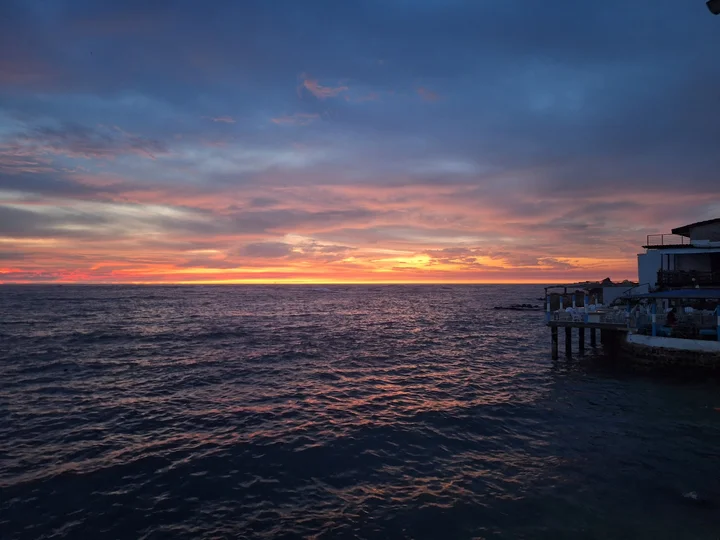
Almadies. Seafood on the Corniche des Almadies as the sun drops into the Atlantic.
- Day 1
The one-day route: Gorée Island in the morning, Plateau and the African Renaissance Monument in the afternoon, Almadies at sunset.
- Day 2 morning
Museums. The Théodore Monod African Art Museum and the Museum of Black Civilizations, both in or near Plateau.
- Day 2 afternoon
Ngor Island. The short pirogue crossing, Ngor Right if you surf, Sunu Makane for lunch.
- Day 2 evening
Yoff or Ngor. A slower dinner away from the busier Almadies strip.
- Days 1-2
The two-day route above, at a gentler pace, adding Marché Kermel and a Médina neighborhood walk with a local guide.
- Day 3, option A
Lac Rose day trip. The pink-tinted lake 45 minutes from Dakar, salt-harvesting pirogues, best with sun and a fresh wind.
- Day 3, option B
Bandia Wildlife Reserve. A half-day safari roughly 65km south, giraffes, white rhinos and zebras in a fenced reserve of baobab bush.
Sprawling, traffic-heavy, and worth a driver for full days
Dakar's neighbourhoods are spread across the whole Cap Vert peninsula, and the city's notorious traffic means a short-looking map route can take far longer on the ground. From Blaise Diagne International Airport (DSS), about 50km southeast of the centre near Diass, a taxi takes 60 to 90 minutes and costs roughly $40-65 (25,000-40,000 CFA); pre-booked fixed-price transfers avoid the arrivals-hall haggling. In the city, yellow taxis are everywhere but rarely metered, so agree the fare before getting in, or use the Yango ride-hailing app, which works well in Dakar and removes the negotiation entirely.
Car rapides and ndiaga ndiaye, the colorful shared minibuses that run fixed routes across the city, cost under a dollar but aren't signed in English and work best once you know the routes. For a full sightseeing day covering Plateau, Gorée and Almadies, hiring a driver for the day (arranged through most hotels, roughly $50-80) is often more efficient and comfortable than stitching together taxis, especially given the traffic.
Best time to visit and seasonal notes
Dakar's Atlantic position keeps it cooler and more temperate than inland Senegal year-round. December to February is the sweet spot: dry, cool evenings, comfortable daytime heat. November and March to May are also dry and workable, if warmer, especially inland. June to October is the rainy season, hot and humid with brief but heavy afternoon downpours; it's still a workable time for a Dakar-focused trip, just a harder one for day trips on rural roads.
Pricier than many West African capitals, still manageable on a budget
Dakar's international hotel and restaurant scene pushes its ceiling higher than many regional capitals, but street food, local transport and guesthouses keep a budget trip genuinely affordable. The main cost trap is assuming Almadies restaurant prices apply citywide; they don't.
- Hostel dorm or basic guesthouse $15-30
- Thiéboudienne stalls and canteens $3-8
- Car rapides and shared taxis
- Gorée ferry plus one museum
- Boutique hotel or guesthouse $70-150
- Restaurant meals $15-25/person
- Yango rides plus a half-day driver
- Gorée, museums, a Lac Rose day trip
- Terrou-Bi or equivalent resort $180+
- Fine dining in Almadies
- Private driver for full days
- Bandia Reserve private safari
Safe by regional standards, with a short list of real concerns
Dakar rates Level 1 with the US State Department, exercise normal precautions, in line with the rest of non-Casamance Senegal. Violent crime against tourists is uncommon, and the tourist circuit of Plateau, Gorée Island, Almadies and Ngor carries no particular caveat beyond normal city awareness. Dakar is also a reasonable choice for solo female travelers in these areas, where the teranga hospitality culture extends genuinely to visitors.
The concerns that actually catch visitors: pickpocketing and persistent hustling, concentrated around the Gorée ferry terminal, the airport and central Dakar markets, so keep bags closed and in front and a firm but polite decline handles most approaches; traffic, which is genuinely chaotic and makes crossing streets and using unmarked taxis worth extra care; and walking alone after dark in unfamiliar parts of Médina or central Plateau, much as in any large capital. Use licensed taxis or the Yango app rather than unmarked cars, especially at night. Emergency numbers are Police 17, Fire 18 and SAMU ambulance 1515; note that emergency dispatchers communicate primarily in French and Wolof.
Dakar's position makes it an easy base for the rest of Senegal
Dakar's location on the Cap Vert peninsula puts several of Senegal's best destinations within a half-day's reach. Four trips are worth the detour, from an easy afternoon out to a full overnight excursion.
Lac Rose (Lake Retba)
A saline lake whose pink hue, from salt-tolerant algae, faded to green after severe 2022 flooding and has since recovered; best seen with sun and a fresh wind. Salt-harvesting pirogues on the water are a genuine, ongoing local industry rather than a show, and the nearby dunes make for an easy add-on.
Bandia Wildlife Reserve
A fenced 3,500-hectare reserve near Saly that has reintroduced giraffes, white rhinos, zebras, buffalo and crocodiles among baobab-studded bush since 1990. A straightforward safari format that works well for families and doesn't require a multi-day East Africa-style trip.
Saint-Louis
Senegal's former colonial capital, an old island town connected to the mainland by the iron Faidherbe Bridge, with a UNESCO-listed historic center and the Djoudj bird sanctuary nearby. Far enough that an overnight makes more sense than a rushed day trip.
Sine-Saloum Delta
A UNESCO World Heritage mangrove delta south of Dakar, best experienced with at least one night to catch a dawn pirogue trip through the bolongs when birdlife is most active. A genuine change of pace from the capital's noise.
Dakar FAQ
Is Dakar safe for tourists?
Dakar rates Level 1 with the US State Department, exercise normal precautions. Violent crime against tourists is uncommon; the main concerns are pickpocketing around markets and the Gorée ferry terminal, and Dakar's genuinely chaotic traffic.
How many days do I need in Dakar?
Two to three full days covers the city well: one for Plateau and the museums, one for Gorée Island, and a third for Almadies, Ngor and a Lac Rose day trip. A fourth day fits Bandia Reserve or a longer excursion.
How much does Dakar cost per day?
Budget travellers manage on $40-60 a day with hostels and street food; mid-range runs $90-160. Dakar is pricier than many West African capitals for hotels and imported goods, but street food and local transport stay cheap.
When is the best time to visit Dakar?
December to February: dry, cool and comfortable. November, March, April and May are also dry and workable, if warmer. June to October is Dakar's hot, humid rainy season with brief but heavy afternoon downpours.
How do I get from Dakar airport to the city centre?
Blaise Diagne International Airport (DSS) sits about 50km southeast of the centre. A taxi takes 60-90 minutes and costs roughly $40-65 (25,000-40,000 CFA); pre-booked fixed-price transfers avoid arrivals-hall haggling.
What is the best area to stay in Dakar?
Almadies and Ngor for first-timers: beachfront, walkable to good restaurants, and closer to Dakar's calmer pace than downtown. Plateau is more central for sightseeing but noisier and further from the beach.
Is Gorée Island worth the trip?
Yes. A 20 to 30 minute ferry from Plateau reaches a car-free UNESCO island holding the House of Slaves and its Door of No Return, one of the Atlantic slave trade's most visited memorials. Most visitors call it the single most essential thing to do in Dakar.
Do I need to speak French in Dakar?
It helps considerably. French is the official language and Wolof the everyday one; English is limited outside upscale hotels, tour operators and some Almadies restaurants. A few French phrases go a long way.
Is Dakar walkable?
Parts of it. Plateau and central Almadies are walkable in short stretches, but Dakar is a sprawling city with serious traffic, so taxis or ride apps like Yango handle longer distances between neighbourhoods.
What Stays With You
Dakar doesn't perform its history for visitors, it lives alongside it. The Door of No Return on Gorée, opening onto the same Atlantic the fishing pirogues launch into every morning. The African Renaissance Monument catching the last light over a city that outlasted the empire that built its boulevards. A total stranger who pours you a third round of attaya because that's simply what is done. None of it was staged, which is why it sticks.
Take the last ferry back from Gorée at dusk, watch Plateau's lights come up across the water, and understand why Senegalese reach for teranga, hospitality, before any other word to describe their country.