
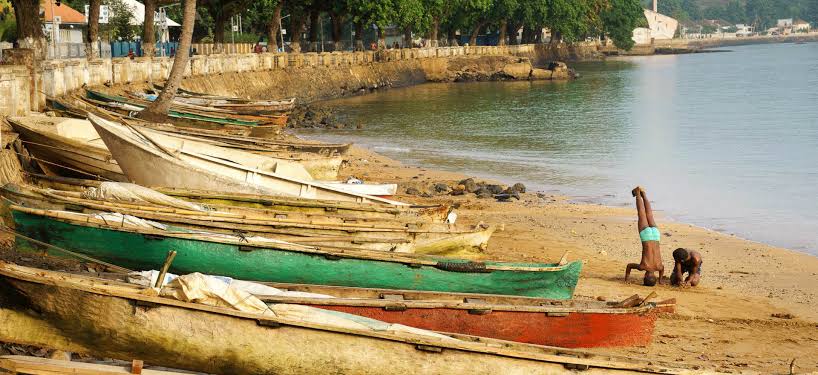
A working harbor city, not a resort town
São Tomé is small enough that "city" feels like a generous word: Água Grande District, which the capital anchors, holds roughly 80,000 people across the whole capital area. What it lacks in scale it makes up for in texture. The fishing harbor runs on its own schedule, boats in at dawn with yellowfin tuna, bonito and wahoo; the Fortaleza de São Sebastião, built by the Portuguese in 1575, is the oldest building in the country and now holds the national museum; and a few streets over, the Italian chocolate maker Claudio Corallo turns cacao from his own Príncipe plantation into bars that regularly place at international competitions, made in a teak-lined workshop he built from shipping containers.
The city is also, unavoidably, the gateway rather than the destination for most visitors: Ôbo National Park's rainforest interior, the Equator crossing at Ilhéu das Rolas, and the domestic flight to Príncipe are all within an hour or two, and most itineraries treat São Tomé as a base for two or three nights rather than the main event. That is the right way to think about it. Spend your city time well, then head out.
The honest complications
Infrastructure is genuinely thin. Cash is close to essential since ATMs are scarce and card acceptance outside the larger hotels is unreliable; English is limited beyond hotel staff and established guides; and the city's own Wild West energy, cars moving fast with horns instead of indicators, uneven pavements, patchy street lighting at night, takes some adjusting to. None of it is dangerous in the way a high-crime city is dangerous, but it does mean building in more buffer time, more cash, and more patience than a typical African capital of comparable size would require.
A small city, four areas worth knowing
São Tomé does not have the kind of distinct, guidebook-ready neighbourhoods a European or Latin American city does; it is small enough to cover mostly on foot or by short taxi ride. Still, four areas shape where you'll actually spend time.
Downtown / Fortaleza area
The compact historic center holds the Fortaleza de São Sebastião, the Sé Catedral de Nossa Senhora da Graça, and the Mercado Municipal. It's dense, a little chaotic, and the part of the city where the colonial-era architecture is most visible, even where it's crumbling. Most first-time sightseeing happens here.
Avenida Marginal 12 de Julho
The coastal boulevard that runs along the water is the city's real spine: the Portuguese embassy, the Pestana São Tomé hotel, and Claudio Corallo's chocolate workshop all sit on or just off it. Walkable in the cooler morning and evening hours, and the natural place to watch the sunset with a Rosema beer in hand.
Pantufo
Água Grande District's second subdistrict, just north of the center, is where much of the beachfront resort accommodation, including Omali São Tomé, sits. Quieter than downtown, with a more residential, slower pace, and an easy base if you'd rather not be in the middle of the harbor traffic.
Riboque
A residential bairro inland from the center, home to around 4,600 people and largely outside the tourist circuit. Worth knowing about mainly because it illustrates that most of São Tomé city is simply a lived-in African capital going about its business, not a stage set for visitors.
A short list, and every option on it earns its place
São Tomé city's hotel scene is small compared to almost any capital its size, which makes the decision easier rather than harder. Three options cover the range from full-service resort to simple guesthouse.
At the top end, Pestana São Tomé, a 5-star beachfront property directly on Avenida Marginal 12 de Julho, has an outdoor pool, spa, casino and a restaurant serving both international and Santomean dishes, plus organized snorkeling, diving and fishing trips, from around €150 a night. A few minutes north in Pantufo, Omali São Tomé is the other established beachfront resort, set in tropical gardens with a pool, fitness center and tennis court, and often cited by repeat visitors as the more relaxed of the two, from around €120 a night. Outside the capital in Santana, Club Santana Resort is a beach-focused alternative worth considering if you'd rather base yourself away from the city center entirely and commute in for sightseeing.
Simpler guesthouses exist throughout the city at a fraction of the resort price, generally €30-60 a night, though most require a phone call or a message through a local contact to book rather than an online reservation system, and English at this level is not guaranteed.
Calulu, fresh-off-the-boat fish, and some of the best chocolate you'll ever taste
São Tomé's food scene is small but genuine: fish caught that morning, palm-oil stews built on generations-old family recipes, and a chocolate tradition that punches wildly above the country's size. Restaurants here are simple, often family-run, and rarely try to be anything other than what they are.
Calulu
Dried or fresh fish slow-cooked with okra, eggplant and leafy greens in palm oil. Petisqueira Léo is known specifically for Tia Léo's version, considered by many locals the city's best, while Restaurante Bar ZIMA pairs its own calulu with grilled fish and fried bananas in a relaxed, unpretentious setting.
Grilled fish & seafood
O Pirata, an oceanfront restaurant with sundown views, does an excellent cherne (grouper) alongside a mixed fish-and-shrimp curry with a green sweet-curry flavor and a peppered tuna steak; order a Rosema, the local lager, and watch the water. Dona Teté, set in a charming, rustic garden, does homestyle seafood with a warmth that feels more like a family dinner than a restaurant meal.
Single-origin chocolate
Claudio Corallo's workshop at Avenida Marginal 12 de Julho 978 runs weekday tastings (8am-2:30pm) that walk through the whole process, from cacao pods grown on his own Príncipe plantation to finished bars ranging from 100% dark to versions flavored with pepper and salt. Book ahead; the sessions are small and popular with the handful of tourists who make it this far.
A morning city, best explored before the heat builds
São Tomé rewards an early start: the harbor, the market and the fortress are all more alive, and more comfortable, before mid-morning heat sets in. Most of the city's sights cluster within walking distance of each other in the historic core.
The historic core
Start at the Fortaleza de São Sebastião, built by the Portuguese in 1575 and the oldest surviving building in the country. It now houses the Museu Nacional de São Tomé e Príncipe, with exhibits on the slave trade, colonial rule and independence, a compact but honest telling of a difficult history. A short walk away, the neoclassical Sé Catedral de Nossa Senhora da Graça, dating to the late 19th century, is worth a few quiet minutes inside. From there it's a few blocks to the Mercado Municipal, best visited in the morning while the produce, fish and spices are freshest and the crowd is almost entirely local.
The harbor at dawn
Get to the fishing harbor near the market by 7-8am to watch the day's catch, yellowfin tuna, bonito, wahoo, come in and get sorted, weighed and sold. It's one of the few genuinely unstaged experiences in the city, and a good photography spot if you ask before pointing a camera at anyone directly.
Chocolate and the Marginal
Book a tasting session at Claudio Corallo's workshop on Avenida Marginal 12 de Julho, then walk the boulevard itself toward sunset, past the Pestana São Tomé and the Portuguese embassy, with the Gulf of Guinea on one side. It is the closest thing São Tomé city has to a formal promenade, and the golden-hour light off the water is worth timing for.
Diving and fishing trips
Both Pestana São Tomé and Omali São Tomé organize snorkeling, diving and sport-fishing excursions directly from the city, though the more serious dive center is out at Pestana Equador on Ilhéu das Rolas, worth the day trip if diving is a priority (see Day Trips below).
One, two or three days, city first, rainforest after
Two full days covers São Tomé city itself comfortably. A third day is the one to add if you want either Ôbo National Park or the Equator crossing without rushing.
- Morning
The harbor and the Fortaleza. Watch the catch come in, then the Fortaleza de São Sebastião and Museu Nacional before the heat builds.
- Midday
Mercado Municipal and calulu. Browse the market, then lunch at Petisqueira Léo or Restaurante Bar ZIMA for the national dish done properly.
- Afternoon
Chocolate at Claudio Corallo. Book ahead for a weekday tasting session on Avenida Marginal 12 de Julho.
- Sunset
The Marginal. Walk the waterfront boulevard, then dinner at O Pirata with a Rosema beer and the sunset over the water.
- Day 1
The one-day route: harbor, Fortaleza, market, chocolate tasting, sunset dinner on the Marginal.
- Day 2 morning
Sé Catedral and a slower walk. The cathedral, then a wander through the downtown streets around it without a fixed plan.
- Day 2 afternoon
Beach time in Pantufo. A relaxed afternoon at the beachfront near Omali São Tomé, or a swim off the hotel's own stretch of coast.
- Day 2 evening
Dona Teté. Homestyle seafood in a rustic garden setting, a quieter close to the city portion of the trip.
- Days 1-2
The two-day route above, at an unhurried pace.
- Day 3, option A
Ôbo National Park. Roadside Pico Cão Grande viewpoints and, with a guide, the Lagoa Amélia crater hike. See Day Trips below.
- Day 3, option B
Ilhéu das Rolas and the Equator. The boat crossing to stand on the Equator itself, with diving or a swim at Pestana Equador. See Day Trips below.
Small enough to walk, but arrange your taxis in advance
São Tomé International Airport (TMS) sits about 5km from the city center, roughly a 10-15 minute drive. There is no metered taxi system and no ride-hailing app in reliable operation, so arrange an airport transfer through your hotel in advance or agree a fare with the driver before getting in. Within the city, the historic core and the Marginal waterfront are walkable, especially in the cooler early morning and evening; taxis, again negotiated rather than metered, cover longer hops to Pantufo or out toward Ôbo National Park.
For day trips beyond the city, hire a driver with a 4x4 rather than a self-drive rental; roads outside the paved city center are frequently unpaved and pothole-heavy, and local knowledge of the route matters more than a map.
Best time to visit and whale season
June through September, the gravana dry season, is the most reliable window for city sightseeing and coincides with humpback whale season offshore (best seen from the south coast near Ilhéu das Rolas). December and January bring a shorter secondary dry spell, the gravanito. The rest of the year is wetter, with rain peaking October-November and again March-May, though temperatures stay warm and equatorial year-round with little seasonal swing.
Pricier than mainland West Africa, cheaper than a resort island
São Tomé city costs more than its size and remoteness might suggest, mainly because imported goods, fuel and hotel supplies all arrive by ship or plane. Local food and guesthouses keep the budget tier reasonable; imported goods and resort-level hotels push the top tier up quickly.
- Local guesthouse €30-60
- Calulu and market meals €6-10
- Walking plus the occasional taxi
- Free harbor, market and Marginal walk
- Omali or Pestana São Tomé €120-150
- Restaurant meals €10-20/person
- A chocolate tasting and a guided excursion
- Negotiated taxis for day trips
- Best rooms at Pestana São Tomé
- Private guided day trips with a 4x4
- Diving at Pestana Equador
- Domestic flight to Príncipe added on
Low-key and low-crime, with a country-level advisory worth reading
Day-to-day life in São Tomé city is low-crime: violent crime against visitors is rare, and the main practical concern is petty theft rather than anything more serious. The wider country carries a US State Department Level 3, reconsider travel, advisory as of April 2026, citing political unrest risk and limited medical services nationwide, worth reading in full on the country guide before you book, even though it does not reflect a dramatic daily-life risk within the city itself.
The practical things that actually matter in the city: uneven pavements and patchy street lighting, so watch your footing after dark and stick to main routes; cash security, since carrying the euros or dobras you'll need for the day is unavoidable, so keep it split between bag and pocket rather than all in one place; and negotiated taxi fares, agree the price before getting in rather than after. Emergency numbers are 112 for fire and ambulance and 113 for police; medical care is limited, with Hospital Ayres de Menezes the main public facility, and comprehensive travel insurance with evacuation coverage is worth having.
The rest of São Tomé island is why you came
São Tomé city's real value is as a base. Three trips are each worth a full day, all reachable by hired driver or organized tour without needing to change accommodation.
Ôbo National Park
Roadside viewpoints of Pico Cão Grande, the 663-meter volcanic spike that rises about 370 meters clear of the surrounding rainforest, need no hiking at all. For more, the Caminho do Fugitivo trail is a roughly 5-hour loop up to Lagoa Amélia, a crater lake at 1,500 meters; a local guide is strongly recommended since the trail is not consistently marked. Lagoa Azul, an easier lagoon near the coast, suits a shorter, more relaxed outing.
Ilhéu das Rolas & the Equator
A short boat ride across the Canal das Rolas from São Tomé's southern tip reaches the marked Equator monument, one of the few places on Earth where you can stand in both hemispheres at once. Pestana Equador, the resort on the islet, runs a PADI and SSI dive center in warm, clear water; visibility peaks December-March, while humpback whales pass offshore June-October.
Monte Café Coffee Estate
A working coffee roça in the hills above the city, with colonial-era buildings and views back down to the coast. Combine it with a stop at Claudio Corallo's own plantation nearby for coffee alongside the chocolate you tasted in the city.
São Tomé FAQ
Is São Tomé city safe for tourists?
Generally yes for everyday crime, petty theft is the main concern rather than violence. The wider country carries a US State Department Level 3 advisory over unrest risk and limited medical care, worth reading before you book, but daily life in São Tomé city itself is low-key and low-crime.
How many days do I need in São Tomé city?
Two full days covers the city itself: the Fortaleza, the Mercado Municipal, a chocolate tasting and the waterfront. A third day is worth adding for Ôbo National Park or the Equator crossing at Ilhéu das Rolas, both under an hour away.
How much does São Tomé city cost per day?
Budget travelers manage on €50-70 a day with guesthouses and local restaurants; mid-range runs €90-160 with a beachfront hotel and guided excursions. Prices run higher than mainland West Africa because most goods are shipped in.
When is the best time to visit São Tomé city?
June through September, the gravana dry season, has the most reliable weather and overlaps with humpback whale season offshore. December and January offer a shorter secondary dry window.
How do I get from the airport into São Tomé city?
São Tomé International Airport (TMS) is about 5km from the city center, roughly a 10-15 minute taxi ride. Arrange a hotel transfer in advance or agree a fare before getting in; there is no metered taxi system.
What is the best area to stay in São Tomé city?
The waterfront along Avenida Marginal 12 de Julho puts you within walking distance of the Fortaleza, the chocolate workshop and the harbor restaurants. Pantufo, just north of downtown, has the beachfront resort hotels and a quieter pace.
Do I need to speak Portuguese in São Tomé city?
It helps significantly. English is limited outside hotel staff and the more established tour operators. A few Portuguese phrases, obrigado (thank you), bom dia (good morning), go a long way.
Can I pay with a card in São Tomé city?
Rarely reliably. Visa works at the larger hotels and BISTP ATMs; Mastercard has patchier acceptance. Carry cash, ideally euros, for restaurants, the market and most day-to-day spending.
What Stays With You
São Tomé does not try to impress you, and that turns out to be exactly the point. The fishermen sort the morning's catch the same way they have for generations, the Fortaleza sits unrestored and unbothered by 450 years of history, and a small chocolate workshop built from shipping containers quietly makes some of the best chocolate on the continent without a hint of fanfare. Nothing here was staged for a visitor's benefit, which is precisely why the good parts feel earned rather than performed.
Walk the Marginal at sunset, order a Rosema, and let the léve-léve pace take over. The rainforest and the Equator will still be there tomorrow.