
Africa's Second-Smallest Country, and One of Its Least Visited
São Tomé and Príncipe had no indigenous population before Portuguese navigators found the islands empty in the 1470s, a fact that makes the country's entire human history, plantation, colony, chocolate empire, one-party state, young democracy, a story of arrival rather than conquest of an existing people. Today it is Africa's second-smallest nation by both population (roughly 230,000) and land area (964 square kilometers), and one of its least-visited: around 35,000 tourists in 2023, against 12.5 million who visited the Bahamas the same year. The reason is not that there is little to see. It is that almost nothing about getting here or moving around once you land is convenient.
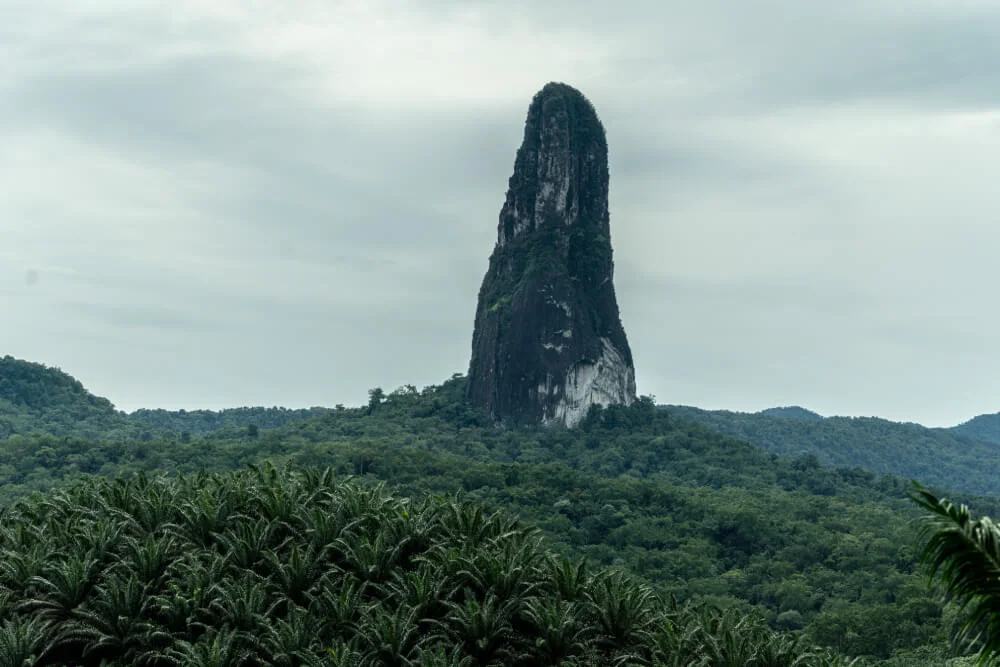
What you get in exchange is rainforest that covers nearly a third of the main island inside Ôbo Natural Park, a volcanic spike called Pico Cão Grande that looks unreal even in photographs, beaches with turtle nests and nobody else on them, and Príncipe, a UNESCO Biosphere Reserve of 55 square miles reached only by a short prop-plane hop. Locals sum up the pace with one phrase you will hear constantly: léve-léve, go slowly, take it easy. It is not a slogan invented for tourists. It is how the place actually runs.
The honest complications
This is not a beach-resort country in the Caribbean sense, and travelers expecting that will be disappointed. Cash is close to essential: ATMs are scarce, dispense only dobras, and card acceptance is limited mostly to Visa at the larger hotels. Because nearly everything, fuel, imported food, spare parts, arrives by ship or plane, prices run noticeably higher than the "Africa is cheap" assumption suggests, especially for anything imported. Roads outside São Tomé city are often unpaved and pothole-strewn, medical care is limited with no reliable trauma or ambulance service, and in April 2026 the US State Department raised its advisory to Level 3, reconsider travel, citing both political unrest risk and that limited medical capacity. None of this makes the country unsafe in the way a war zone is unsafe. It makes it a place that rewards travelers who plan carefully and pack a healthy cash reserve, not ones looking for an easy, well-signposted trip.
From Empty Islands to the Chocolate Islands
Portuguese sailors found São Tomé and Príncipe uninhabited in 1470-71 and began settling them soon after, initially with sugar cane worked by enslaved Africans. Coffee arrived in 1787 and cocoa in 1819, and cocoa is what defined the next century: by around 1908 São Tomé was briefly the world's largest cocoa producer, exporting roughly 36,000 tons a year and supplying over half of Cadbury's chocolate. Independence came on 12 July 1975, followed by a one-party socialist state, a rocky transition to multi-party democracy in 1990, and Príncipe's status as an autonomous region since 1995.
- 1470-71
Portuguese arrival. Navigators find both islands uninhabited and begin settlement, first with sugar cane and enslaved African labor.
- 1787 & 1819
Coffee, then cocoa. Coffee is introduced in 1787; cocoa follows in 1819 and becomes the islands' defining crop within a century.
- c.1908
Peak of the Chocolate Islands. São Tomé is briefly the world's largest cocoa producer, roughly 36,000 tons a year, on roças, self-contained plantation estates with their own hospitals, chapels and workers' quarters.
- 1876-1909
Slavery abolished, forced labor continues. Portugal officially ends slavery in 1876, but a contract-labor system using workers from Angola, Mozambique and Cabo Verde persists; British chocolate maker Cadbury investigates conditions and shifts sourcing away from the islands by 1909.
- 1975
Independence. Declared 12 July under Manuel Pinto da Costa (president) and Miguel Trovoada (prime minister); the new government nationalizes the roças, which held most of the country's arable land.
- 1990-1995
Multi-party democracy. The one-party state transitions to competitive elections in 1990; Príncipe becomes an autonomous region with its own regional government in 1995.
Read the full history: the roças, the Cadbury boycott, and independence
The Portuguese planters who built the cocoa economy organized it around roças, plantation-estates that functioned as near-total worlds: a planter's grand house, a hospital, a chapel, workers' housing, processing sheds and often a school, all under one ownership. At their peak these estates covered the overwhelming majority of the country's usable land, and the labor force that ran them, first enslaved, later nominally "contracted", came mostly from Angola, Mozambique and Cabo Verde rather than from São Tomé itself, a demographic legacy still visible in the country's population today.
The contract-labor system, in which workers were recruited under terms that in practice differed little from slavery, became an international scandal in the early 20th century after investigations backed by the British chocolate manufacturer Cadbury, at the time importing more than half its cocoa from São Tomé. William Cadbury's own inquiries into labor conditions on the roças, published from 1908, led the company to shift its sourcing to the Gold Coast (Ghana) by 1909, a reputational blow the islands' cocoa economy never fully recovered from.
Independence in 1975 followed Portugal's own 1974 revolution and the collapse of its African empire. The Movement for the Liberation of São Tomé and Príncipe (MLSTP) took power under Manuel Pinto da Costa, nationalized the roças, and ran a one-party socialist state through the 1980s. Economic strain and the wider wave of African democratization brought multi-party elections in 1990, and the country has held them regularly since, making it one of the more politically open states in Central Africa even as it remains one of the poorest.
Top Destinations
The country splits naturally into four zones: São Tomé city and the accessible south of the main island, the Ôbo rainforest interior, the Equator crossing at Ilhéu das Rolas, and Príncipe, a separate trip in every practical sense since it requires its own flight. Ten days covers São Tomé island properly with a few days added on Príncipe; a week is enough if you stick to the main island alone.
São Tomé city, the harbor capital
São Tomé city has what one recent visiting American writer called a Wild West feel: cars run loose with their horns doing the work of a horse's whinny, and fishermen unload the day's yellowfin tuna, bonito and wahoo along the harbor each morning. The Fortaleza de São Sebastião, built in 1575 and the city's oldest surviving building, now houses the Museu Nacional's collection on the slave trade and colonial history; the neoclassical Sé Catedral de Nossa Senhora da Graça anchors the old town nearby. The Mercado Municipal is the place for produce, spices and fish and a genuine slice of daily life rather than a tourist market. For chocolate, book a tasting at Claudio Corallo's workshop on Avenida Marginal 12 de Julho, where the Italian maker has spent over four decades turning cacao from his own Príncipe plantation into some of the purest, most awarded chocolate on the continent, weekday tastings run 8am to 2:30pm.
Ôbo Natural Park, the rainforest interior
Parque Natural Ôbo covers around 300 square kilometers, roughly 30% of São Tomé island, and holds the country's best hiking and its most photographed landmark, Pico Cão Grande, a volcanic plug that reaches 663 meters above sea level and rises about 370 meters clear of the forest around it, visible from several roadside viewpoints without a hike at all. For an actual hike, the Caminho do Fugitivo (Fugitives' Path) is a roughly 5-hour loop up to Lagoa Amélia, a crater lake at 1,500 meters thick with endemic plants and birds; a guide is strongly recommended since the trail is not consistently marked. Lagoa Azul, a calm lagoon near the coast, is the easier, family-friendly counterpart for anyone who wants the color of the water without the climb.
Ilhéu das Rolas, where the Equator crosses land
A short boat ride from São Tomé's southern tip across the Canal das Rolas, this small islet is one of the few places on Earth where you can stand with one foot in each hemisphere at a marked Equator monument. Pestana Equador, the resort on the islet, runs a PADI and SSI dive center with warm, clear water (27-30°C) that holds good marine life most of the year; visibility peaks December to March, while humpback, pilot and sperm whales pass offshore between June and October, best seen from the southern coast near the islet. The water is also a favored nursery for humpback mothers and calves in season.
Príncipe, Africa's last true wilderness
Príncipe is 90 miles from São Tomé by a roughly 40-minute STP Airways flight, and it feels like a different country: 55 square miles, a population of around 8,000, dirt roads, and jungle so dense the sky nearly disappears above the road. The entire island is a UNESCO Biosphere Reserve with more than 30 endemic bird species, most famously the tiny, hard-to-spot Príncipe scops owl found nowhere else on Earth. The Bay of Needles (Baía das Agulhas) has turquoise, current-free water excellent for snorkeling; the Oquê Pipi Waterfall Trail is a humid rainforest hike to the island's tallest waterfall, with a swimmable pool at the base. Praia Banana, a crescent of pale sand framed by palms and volcanic rock, appears in enough travel magazines to need no further introduction, and is still often empty. HBD Príncipe's small collection of properties, Bom Bom on a beachfront peninsula, Roça Sundy in a converted 19th-century cacao plantation house, and the tented Sundy Praia, are the main comfortable bases; simpler local guesthouses exist for a fraction of the price.
Hidden gems beyond the main circuit
The zones above cover a first trip well. With extra days, these reward the detour.
Roça São João dos Angolares
A former cacao roça turned artist residency and cultural space on the southeast coast, with a small restaurant and rooms in the restored plantation buildings. A quieter, more local counterpart to Príncipe's grander roça hotels.
Maria Correia Waterfall
A demanding, roughly 6-hour hike through rainforest, fishing villages and ocean inlets to a remote waterfall. Rewarding in dry weather, genuinely tough if the rain arrives; check conditions with your guesthouse before setting out.
Monte Café Coffee Estate
A working coffee roça in the hills above the capital with colonial-era buildings and views back down to the coast. Combine with a stop at Claudio Corallo's plantation nearby for coffee alongside the chocolate.
Culture & Etiquette
Santomean culture blends Portuguese colonial inheritance with West and Central African roots brought by the plantation-era labor migrations, expressed today in Forro, Angolar and Principense creole languages, in a relaxed Catholic-majority religious life, and in the léve-léve pace that governs everything from restaurant service to bureaucracy. Visitors who arrive expecting mainland-Africa rhythms or Lisbon efficiency both adjust the same way: by slowing down.
Do
- Carry cash, in euros or dobras. ATMs are scarce and often out of order; the largest hotels take Visa, almost nothing else takes cards at all.
- Learn a few Portuguese phrases. Obrigado (thank you), bom dia (good morning), por favor (please). English is limited outside hotel staff.
- Book guides for hikes and remote beaches. Trails in Ôbo Natural Park are not consistently marked, and turtle-nesting beaches have visitor rules a local guide will know.
- Accept the pace. Léve-léve is not an excuse for poor service, it is a genuine cultural value; rushing a Santomean rarely produces a faster outcome.
- Pack more cash and repellent than you think you need. Both run out fast and cost far more locally than you would pay at home.
Don't
- Expect reliable card payment, even at restaurants that look upscale. Confirm before you order if you are relying on plastic.
- Underestimate the roads. Outside São Tomé city, expect unpaved, pothole-heavy routes; a 4x4 and a driver who knows the terrain beat a rental car for most excursions.
- Skip the yellow fever certificate. It is checked on entry, and travel without malaria prophylaxis is genuinely risky given the country's high transmission rate.
- Photograph people, especially in fishing villages, without asking first. A friendly request is almost always granted; assuming it is rarely appreciated.
- Assume Príncipe is a same-day add-on. The flight schedule and the island's own slow pace mean it deserves at least two to three nights, not a day trip.
Deeper culture: creole languages, the roça legacy, and religion
The creole languages. Forro (also called Santomense), descended from the plantation-era mixing of Portuguese and West African languages, is the most widely spoken creole and the closest thing to a national vernacular alongside Portuguese. Angolar, spoken in the south of São Tomé, descends from communities of escaped plantation slaves who formed independent settlements; Principense, on Príncipe, now has only a few hundred fluent speakers and is considered endangered.
The roça legacy. The plantation estates that built the colonial economy were nationalized after independence and largely fell into disrepair through the late 20th century; some, like Roça Sundy on Príncipe and Roça São João dos Angolares on São Tomé, have been restored as hotels or cultural spaces, while many others remain as atmospheric ruins visible from the country's roads, a visible layer of the country's plantation history most visitors drive past without realizing what they are.
Religion. The population is majority Roman Catholic, a legacy of Portuguese colonization, with smaller Protestant and syncretic communities. Religious life is generally relaxed and not a source of friction for visitors.
Food & Drink
Santomean food centers on fresh fish, palm oil, tropical produce grown on the same volcanic soil that made the cocoa famous, and a Portuguese-influenced bean stew tradition. It is simpler and less internationally known than West African cuisine, but the seafood, caught the same morning it is served, is consistently excellent.
Calulu €6-10
The national dish: dried or fresh fish, sometimes smoked, slow-cooked with okra, eggplant and leafy greens in palm oil. Every Santomean has an opinion about whose version is best; Petisqueira Léo in São Tomé city is known specifically for it.
Feijoada Santomense €7-12
A Portuguese-rooted bean stew with black-eyed peas, pork and sausage, adapted with local vegetables. Hearty, filling, and found on nearly every menu in São Tomé city.
Single-origin chocolate €5-15/bar
Claudio Corallo's chocolate, made from cacao grown on his own Príncipe plantation and finished in a São Tomé city workshop, ranges from 100% dark bars to versions flavored with pepper or salt, and regularly wins international competitions.
Grilled fish €8-15
Cherne (grouper), tuna and wahoo grilled whole and served with the day's catch guaranteed fresh. O Pirata, an oceanfront São Tomé city restaurant, does a well-regarded version alongside a mixed fish and shrimp curry.
Rosema beer €2-4
The country's own lager, brewed locally and the default drink at nearly every restaurant and bar. Order it with a sunset view over the water for the full local experience.
Fried bananas & tropical fruit
Bananas fried as a savory side or sweet dessert, alongside papaya, jackfruit and passionfruit sold at the Mercado Municipal. A simple, cheap way to sample the volcanic soil's other exports beyond cocoa.
When to Go & Itineraries
June through September, the gravana dry season, has the most reliable weather and overlaps with whale season. December and January, the short gravanito dry spell, is the secondary window. The rest of the year is wetter, with rain peaking October-November and again March-May; diving visibility is actually best in the wetter December-March stretch, so divers and hikers want slightly different windows.
Seasons compared, with temperatures
| Season | Verdict | Temps | Notes |
|---|---|---|---|
| Jun-Sep (gravana) | Best | 23-28°C | Driest, most reliable; whale season Jun-Oct |
| Dec-Jan (gravanito) | Good | 24-29°C | Short secondary dry spell; good diving visibility begins |
| Feb, Oct-Nov | Mixed | 25-29°C | Transitional; rain increasing or easing |
| Mar-May | Wettest | 25-29°C | Heaviest rain; lush landscapes, fewer travelers, best dive visibility (Dec-Mar overlap) |
Temperatures stay warm and equatorial year-round with little seasonal swing; humidity and rainfall, not heat, define the seasons.
Itineraries
A week covers São Tomé island's highlights without Príncipe. Ten days adds a proper Príncipe stay, which the flight schedule and the island's own pace both reward rather than rush.
- Days 1-2
São Tomé city. Fortaleza de São Sebastião, the Mercado Municipal at dawn, a Claudio Corallo chocolate tasting, dinner at O Pirata on the water.
- Days 3-4
Ôbo National Park. Roadside Pico Cão Grande viewpoints, the Lagoa Amélia hike with a guide, and Lagoa Azul for an easier afternoon.
- Days 5-7
South coast & Ilhéu das Rolas. Beach time on the wilder southern coast, then the boat crossing to stand on the Equator and, June-October, watch for whales offshore.
- Days 1-4
The 7-day route, compressed to 4: São Tomé city, Ôbo National Park, Ilhéu das Rolas.
- Day 5
Fly to Príncipe. The roughly 40-minute STP Airways hop; settle in and adjust to an even slower pace.
- Days 6-8
Príncipe. Bay of Needles snorkeling, the Oquê Pipi Waterfall Trail, birdwatching for the Príncipe scops owl, an afternoon at Praia Banana.
- Days 9-10
Fly back & wind down. Return to São Tomé for a final beach day or the Monte Café coffee estate before departure.
- Days 1-5
São Tomé island in full: the city, Ôbo National Park including the longer Caminho do Fugitivo loop, Roça São João dos Angolares, Ilhéu das Rolas, and turtle-season Praia Jalé if timing allows (Oct-Apr).
- Days 6-12
Príncipe, unhurried. A full week: Bay of Needles, the Oquê Pipi and, for the ambitious, the demanding Maria Correia Waterfall hike, Roça Sundy or Bom Bom as a base, and slow days built around léve-léve rather than a checklist.
- Days 13-14
Return & recover. Fly back to São Tomé, a final chocolate tasting or coffee estate visit, and a buffer day before the long flight home via Lisbon.
Getting there & around
São Tomé International Airport, also called Nuno Xavier International Airport (TMS), sits 5km from São Tomé city and is the country's only international gateway. TAP Portugal and STP Airways fly nonstop from Lisbon a few times a week, roughly 6 hours 45 minutes, the only direct European connection; there is no direct US flight, so plan to connect through Lisbon. Within the country, STP Airways runs the roughly 40-minute prop-plane hop between São Tomé (TMS) and Príncipe (PCP) most weekdays and Saturdays; the alternative boat crossing takes about 6 hours and is used mainly for cargo, not passengers.
Money, SIM cards and practical prep
| Option | Notes |
|---|---|
| Cash (euros or dobras) | Essential. ATMs are scarce; Banco Internacional de São Tomé e Príncipe (BISTP) is the main network. Bring more than you think you need. |
| Cards | Visa has the best acceptance, limited to hotels and BISTP ATMs. Mastercard works at some Afriland ATMs and a few hotel terminals. Amex and Discover are not accepted. |
| Dobra exchange rate | Fixed peg since 2018: 24.5 STN per 1 EUR at banks and hotels; licensed downtown changers offer slightly better rates. |
| SIM cards | Available at the airport or in São Tomé city; signal is limited or absent in Ôbo National Park and much of Príncipe, so download offline maps first. |
Health prep: malaria risk is high nationwide, prophylaxis (atovaquone/proguanil, doxycycline or mefloquine) plus dusk-to-dawn repellent is strongly recommended, and a yellow fever vaccination certificate is required for entry. Standard travel insurance with medical evacuation coverage is worth the extra cost given the country's limited trauma and ambulance capacity.
Where to stay
City & beachfront hotels
Omali São Tomé and the 5-star Pestana São Tomé both sit on the water within a few minutes of the capital, with pools, spas and organized diving or fishing trips. The best base for anyone splitting time between the city and Ôbo National Park.
Pestana Equador
The resort on the Equator islet itself, with a PADI and SSI dive center on site. Book the boat transfer from São Tomé's south coast in advance; it is not a spontaneous day trip.
HBD Príncipe collection
Bom Bom on a beachfront peninsula, Roça Sundy in a converted 19th-century cacao estate house, and the tented Sundy Praia are the island's comfortable options, all working with local fishers, farmers and a recycling program that funds school supplies.
Local guesthouses
Simpler family-run rooms exist on both islands at a fraction of the resort price, though English is limited and advance booking usually means a phone call or a message through a local contact rather than an online form.
Budget Planning
São Tomé and Príncipe costs more than its remoteness and small size might suggest, because nearly everything beyond fresh fish and local produce arrives by ship or plane. Budget travelers still get by reasonably, but the "cheap African getaway" assumption does not hold here the way it might elsewhere on the continent.
- Local guesthouse €30-60
- Calulu or feijoada at local spots €6-10
- Shared taxis and walking in São Tomé city
- Free beaches and roadside Pico Cão Grande views
- Beachfront hotel like Omali or Pestana São Tomé
- Restaurant dinners €10-20/person
- Guided hikes and a chocolate tasting
- Ilhéu das Rolas day trip with diving
- HBD Príncipe properties from $230/night
- Domestic flight to Príncipe included
- Private guides and boat charters
- Full-board rates at Bom Bom or Sundy Praia
Quick reference prices: meals, flights, entry fees
| Calulu at a local spot | €6-10 |
| Rosema beer | €2-4 |
| Restaurant meal, mid-range | €10-20 |
| Claudio Corallo chocolate tasting | €15-25 |
| São Tomé-Príncipe domestic flight (STP Airways) | €80-130 one way |
| Lisbon-São Tomé flight (TAP/STP Airways) | €500-900 return |
| Local guesthouse | €30-60/night |
| Beachfront hotel, São Tomé city | €90-180/night |
| Guided Ôbo National Park hike | €25-50/person |
| Visa on arrival fee | €20 cash |
Prices reflect August 2026 research and drift over time, especially flights and imported-goods pricing. Treat them as a planning baseline, not a quote.
Visa & Entry
More than 50 nationalities, including the EU, UK, US visa-adjacent partner arrangements and most of the Americas, enter visa-free for up to 15 days. Everyone else applies through the country's online e-visa portal before arrival, prints the documentation, and pays a 20-euro cash fee at São Tomé airport on arrival regardless of whether the online application was completed. Rules change; verify current requirements directly before booking rather than relying on third-party paid "visa service" sites that rank well in search.
✓ Valid passport
At least 6 months validity from date of entry, required for all visitors regardless of nationality.
✓ Yellow fever certificate
Proof of yellow fever vaccination is required for entry. Carry the physical certificate; it is checked at the airport.
✓ €20 arrival fee, cash
Charged on arrival at São Tomé airport for everyone requiring a visa, whether applied for online in advance or not.
✓ Accommodation address
Have your first night's hotel or guesthouse address ready; it is sometimes requested at immigration.
| São Tomé and Príncipe | Equatorial Guinea | |
|---|---|---|
| Entry | Visa-free for 50+ countries, straightforward e-visa otherwise | E-visa required for nearly everyone, around $75 |
| Daily budget | €50-70 gets you by; remoteness pushes prices up | $80-100/day, generally pricier |
| Vibe | Rainforest islands, empty beaches, UNESCO biosphere on Príncipe | Oil-wealth capital Malabo plus Bioko Island rainforest |
| Openness | Tourism-friendly, though infrastructure is thin | More bureaucratic, tighter restrictions on movement and photography |
| Best time | Jun-Sep (gravana), secondary Dec-Jan | Dec-Feb dry season |
Safety, Solo Women & Family
Day-to-day, São Tomé and Príncipe is a low-crime country: violent crime against tourists is rare, and the main practical risk is petty theft rather than anything more serious. That said, the US State Department raised its advisory to Level 3, reconsider travel, in April 2026, citing both the risk that the political and security situation could deteriorate without warning and the country's limited medical services, which include no adequate trauma or ambulance care. Read this chapter fully before booking, not after.
Political unrest risk
The advisory flags that the security environment can shift with little notice around the local political situation. Monitor local news during your trip and keep your embassy's contact information handy.
Limited medical care
No adequate trauma or ambulance service exists nationwide. Comprehensive travel insurance with medical evacuation coverage is strongly recommended, particularly for remote hikes or diving.
Petty theft
Burglary and pickpocketing occur, occasionally including home invasions, though rare. Keep valuables secured and avoid isolated beaches or streets alone after dark.
Road conditions and remote-area caution
Roads: outside São Tomé city, expect unpaved surfaces, deep potholes and minimal lighting or signage. A driver familiar with the terrain is safer than self-driving for excursions into Ôbo National Park or the wilder south coast.
Remote beaches and hikes: avoid visiting isolated beaches or trailheads alone; go with a guide or in a group, both for safety and because trails are not consistently marked.
Solo women travelers
São Tomé and Príncipe is relatively safe for solo women, with street harassment rare and a generally laid-back local culture. The main practical challenges are logistical rather than safety-related: limited public transport means relying on hotel-arranged taxis, and it is worth avoiding remote beaches or trails alone, a precaution that applies to all solo travelers regardless of gender. Full detail on our Solo Woman Explorer pages.
Emergency numbers
Hospitals, embassies and mountain or remote-area protocol
Hospital Ayres de Menezes in São Tomé city is the country's main public hospital, though facilities are limited by Western standards; serious trauma cases are typically evacuated. The Portuguese embassy sits at Avenida Marginal 12 de Julho in São Tomé city. The United States has no resident embassy in the country; American citizens are covered by the US Embassy in Luanda, Angola, which handles São Tomé and Príncipe consular matters.
Remote areas: for hikes in Ôbo National Park or on Príncipe's more demanding trails, confirm your route and expected return time with your guesthouse or guide before setting out, and carry a charged phone even though signal is often absent; your host or guide is usually faster to coordinate help than any formal service.
Family travel & pets
Families do visit, mainly opting for the easier beaches and Lagoa Azul over the more demanding Ôbo hikes, and hotel staff and locals alike are generally warm toward children. That said, the malaria risk, limited medical infrastructure and lack of pediatric-specific care are worth weighing carefully for families traveling with young children; consult a travel medicine specialist well before departure.
Kids on the islands, and bringing pets
With children: Lagoa Azul and the calmer beaches near São Tomé city are more manageable than the longer Ôbo National Park hikes or Príncipe's rougher trails. Malaria prophylaxis for children requires specific pediatric guidance from a travel clinic well before departure, not a general adult prescription.
Pets: information on importing pets is limited and inconsistently documented; contact the nearest Santomean embassy or consulate directly well in advance if traveling with an animal, rather than relying on general guidance.
São Tomé and Príncipe FAQ
Is São Tomé and Príncipe safe to visit?
Mostly yes for everyday crime, petty theft is the main concern rather than violent crime, but the US State Department currently rates the country Level 3, reconsider travel, over political unrest risk and limited medical services. Read the safety chapter before booking rather than after.
Do I need a visa for São Tomé and Príncipe?
Citizens of more than 50 countries, including the EU, UK and most of the Americas, can enter visa-free for up to 15 days. Everyone else applies for an e-visa online before arrival and pays a 20-euro cash fee at the airport regardless. A yellow fever vaccination certificate is required for entry.
How much does a trip to São Tomé and Príncipe cost?
Budget travelers manage on 50-70 euros a day, mid-range on 90-160. Prices run higher than the rest of West and Central Africa because almost everything is shipped in, and the country is a cash economy with few working ATMs.
When is the best time to visit São Tomé and Príncipe?
June through September, the gravana dry season, has the most reliable weather and overlaps with humpback whale season. December and January, the short gravanito dry spell, is the second-best window. October to May is wetter, with rain peaking October-November and March-May.
How do I get to São Tomé and Príncipe?
Fly into São Tomé International Airport (TMS) via Lisbon, the only European hub with a direct connection, roughly 6 hours 45 minutes nonstop on TAP Portugal or STP Airways, a few times a week. There are no direct flights from the US; connect through Lisbon.
How do I get from São Tomé to Príncipe?
STP Airways runs a roughly 40-minute propeller-plane flight between São Tomé (TMS) and Príncipe (PCP) most weekdays and Saturdays. It is the only practical option; the boat crossing takes about 6 hours and is used mainly for cargo.
Is São Tomé and Príncipe expensive?
More expensive than its remoteness suggests. Nearly everything, from fuel to imported food to hotel supplies, arrives by ship or plane, which pushes prices above the African mainland average. Cash is essential; ATMs are scarce and card acceptance is limited to Visa at hotels.
What language is spoken in São Tomé and Príncipe?
Portuguese is the official language. Most Santomeans also speak Forro, a Portuguese-based creole, plus Angolar in the south of São Tomé and Principense on Príncipe. English is limited outside the main hotels.
Why is São Tomé and Príncipe called the Chocolate Islands?
The islands were briefly the world's largest cocoa producer around 1908, exporting roughly 36,000 tons a year and supplying over half of Cadbury's chocolate. Production collapsed after independence, but small-batch chocolate, led by the Italian maker Claudio Corallo, has revived the islands' reputation for exceptional cacao.
Do you need malaria pills for São Tomé and Príncipe?
Yes. Malaria risk is high across the entire country, and prophylaxis (atovaquone/proguanil, doxycycline or mefloquine, prescribed by a travel clinic) plus dusk-to-dawn repellent is strongly recommended for every visitor.
What Stays With You
Every visitor to São Tomé and Príncipe ends up doing the same mental math: this is one of the least-visited countries on Earth, and it takes real effort, cash reserves, patience with unpaved roads and slow service, to get here at all. And then Pico Cão Grande appears through a gap in the canopy, or a humpback whale surfaces off Ilhéu das Rolas, or a chocolate square from a workshop built out of shipping containers turns out to be one of the best you've ever tasted, and the effort stops registering as a cost.
Léve-léve is the phrase that will stay with you longest. Go slowly. Take it easy. The islands were built by people who arrived from somewhere else and, eventually, learned to move at the pace the place demanded rather than the one they brought with them. Do the same, and budget more time than you think you need.