
What You're Actually Getting Into
Guinea-Bissau is one of the smallest and least-visited countries in Africa, a fact that says more about the state of global tourism than it does about the country itself. It has one of the most ecologically extraordinary coastlines on the continent, a genuinely distinctive creole culture built across five centuries of Portuguese colonial interaction and West African tradition, and an archipelago of 88 islands sitting in the Atlantic that the UN declared a UNESCO Biosphere Reserve in 1996. The reason most people haven't been is simple: it's hard to get to, the infrastructure is thin, and the country has changed governments by force often enough that it rarely makes anyone's shortlist for a relaxing holiday.
That is the honest framing. Now the honest other side: the Bijagós Archipelago is one of the great undiscovered travel experiences in West Africa. The outer islands in particular — Orango with its saltwater hippos, João Vieira with its nesting sea turtles, Poilão with some of the largest green turtle nesting concentrations in the Atlantic — exist in a state of ecological preservation that you simply cannot find on the heavily-touristed coasts of Senegal, Ghana, or Cabo Verde. The water is clear, the mangrove channels are dense with birdlife, and the Bijagó people who inhabit the islands maintain a matrilineal society and animist ceremonial tradition that is entirely their own.
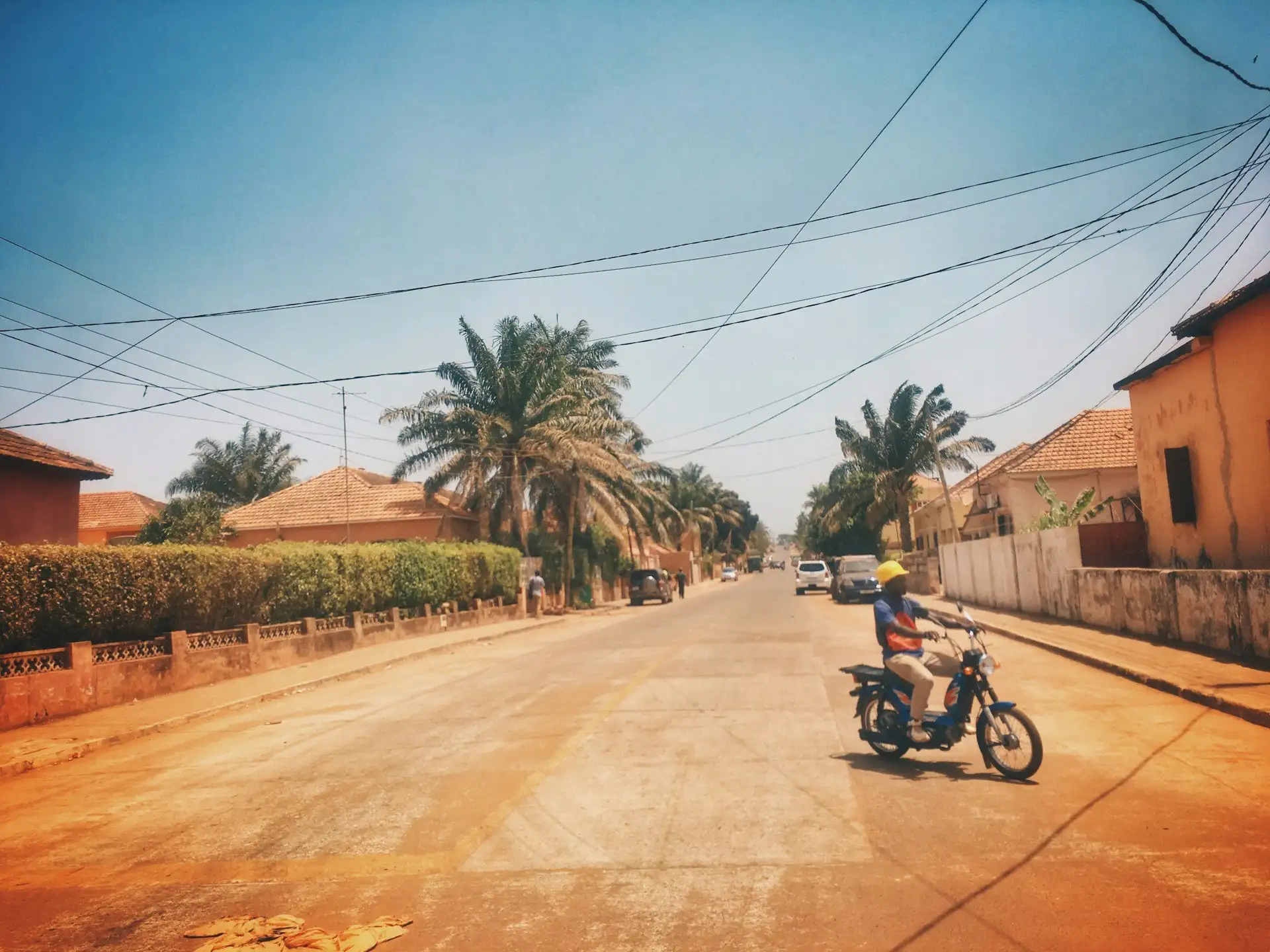
Bissau the capital is a different proposition. It is a small, dusty city with crumbling Portuguese colonial architecture, erratic electricity, pot-holed roads, and a population of about half a million that goes about its business with a cheerfulness that given the country's political history is either inspiring or baffling depending on your perspective. There is very little in Bissau that is conventionally worth seeing. There is quite a lot that is worth experiencing — the evening atmosphere on Avenida Amílcar Cabral, the chaos of the central market, the sound of kora music coming from a bar you can't locate — if you have the patience and temperament for a city that doesn't perform for visitors.
Guinea-Bissau has had more coups than most people can count without looking them up. The most recent significant political crisis was in 2022, when President Embaló survived a coup attempt. The country is nominally stable at time of writing but political fragility is structural here rather than exceptional. Go with your eyes open, register with your embassy, and keep an eye on current advisories in the weeks before travel.
Guinea-Bissau at a Glance
A History Worth Knowing
Before the Portuguese arrived, the territory that is now Guinea-Bissau sat at the edge of the Mali Empire's sphere of influence and was home to a mosaic of peoples including the Mandinka, Fula, Papel, Manjaco, and the Bijagó of the islands. The Bijagó in particular had a reputation among early European navigators as exceptionally fierce defenders of their archipelago — they raided the mainland coast in war canoes and resisted Portuguese control far longer and more effectively than most groups on the West African littoral.
The Portuguese established a trading presence from the mid-15th century, initially using the islands as a base for the slave trade that would devastate the region over the following centuries. The fort at Cacheu on the mainland became one of the most important slave trading posts in West Africa. Between the 15th and 19th centuries, an estimated 1.5 million enslaved people passed through the ports of what is now Guinea-Bissau, bound for Brazil and the Caribbean. The country's creole population — the descendants of relationships between Portuguese traders and African women — became the intermediary class of this economy, and their culture, language, and music form the distinctive identity of Guinea-Bissau today.
The colonial period was economically extractive and largely indifferent to the territory's development. Portuguese Guinea, as it was known, remained one of the poorest and least developed corners of the empire right through to the 20th century. The independence movement that changed this was led by Amílcar Cabral, one of the most significant revolutionary theorists in 20th-century African history. Cabral founded the PAIGC liberation movement in 1956, conducted a guerrilla war against the Portuguese from the mid-1960s, and was assassinated in Conakry in January 1973, just months before the independence he had worked toward his entire life was formally declared.
Cabral's murder is one of the formative wounds of modern Guinea-Bissau. His brother Luís Cabral led the country to formal independence on September 24, 1974, after the Portuguese Carnation Revolution removed the Lisbon government that had been fighting colonial wars on three fronts simultaneously. What followed was decades of political turbulence: a coup in 1980 brought João Bernardo "Nino" Vieira to power; a civil war ran from 1998 to 1999; Vieira was assassinated in 2009. Between 1999 and 2012 alone, the country had eight prime ministers and five heads of state. It became the first country in the world to be classified by the UN as a narco-state, a hub for South American cocaine transiting to Europe. That designation has eased somewhat, but the structural fragility that enabled it remains.
Against this context, the country's ecological preservation is almost paradoxical. The poverty and instability that held back development also held back deforestation, industrial fishing, and the coastal construction that has damaged equivalent habitats throughout the region. The Bijagós exists today in large part because Guinea-Bissau never had the money or governance capacity to exploit it.
Portuguese navigators establish trading posts on the coast. The slave trade begins its catastrophic impact on the region.
Cacheu becomes a major slave trading hub. An estimated 1.5 million people are enslaved and transported from this territory over four centuries.
Amílcar Cabral founds the liberation movement. His political and military strategy becomes a model for African independence movements.
Amílcar Cabral is murdered in Conakry months before independence. He never sees the country he died for.
Following Portugal's Carnation Revolution, Guinea-Bissau gains formal international recognition of independence on September 24.
Multiple coups, a civil war, and repeated political crises. Eight prime ministers in thirteen years. The UN narco-state designation.
The archipelago is designated a UNESCO Biosphere Reserve, protecting one of West Africa's most important coastal ecosystems.
Top Destinations
Guinea-Bissau divides practically into three zones: the capital Bissau and its immediate surroundings, the mainland interior with its rivers and forest-savanna transition, and the Bijagós Archipelago offshore. For most visitors the archipelago is the primary draw, with Bissau as a necessary gateway. The mainland interior — Bafatá, Gabú, the Cacheu River mangroves — rewards travellers with specific interests in history, birdwatching, or simply seeing a part of West Africa that receives almost no visitors at all.
Orango Islands National Park
Orango is in the southern Bijagós and is home to the only population of saltwater hippos on earth. These animals have adapted over generations to a marine and tidal environment, feeding on sea grasses at night and resting in mangrove channels during the day. They are sacred to the Bijagó people, who consider them the reincarnated spirits of their ancestors, and are protected accordingly. Viewing requires a local guide arranged through the national park or your lodge — you approach by pirogue through mangrove channels at dawn or dusk and wait. When a hippo surfaces three metres from your canoe in brackish tidal water while the forest is reflected in the surface around you, the hours of planning that got you there immediately justify themselves.
João Vieira and Poilão Marine Park
Poilão Island hosts one of the largest green sea turtle nesting concentrations in the entire Atlantic Ocean. Between October and February, hundreds of females come ashore nightly on beaches that are otherwise completely uninhabited. The marine park also protects hawksbill turtles, dolphins, manatees, and a reef system of considerable productivity. Getting here requires either a multi-day pirogue journey from Bubaque or a charter flight — there is no regular transport. The effort is significant. What you arrive to find is a beach where the only footprints are those of turtles, and an ocean so clear you can see the reef from the surface in the morning light.
Bubaque
The largest inhabited island in the Bijagós and the main arrival point for travellers heading into the archipelago. Bubaque has the most developed tourism infrastructure in the islands — which means a handful of small hotels, a few restaurants serving fresh fish, and a generator that runs for a few hours each evening. The town is small and relaxed. From here you organise pirogues to the outer islands and arrange guides for national park visits. The beach south of the main dock is clean and almost always empty. Allow a day in each direction as a buffer — transport to and from Bubaque is weather-dependent and delays are standard.
Cacheu River Mangroves
The Cacheu River Natural Park on the mainland protects the largest contiguous mangrove forest in West Africa, covering over 100,000 hectares of tidal estuary, forest, and wetland. Over 400 bird species have been recorded here, including massive concentrations of migratory waders from Europe — dunlin, knot, curlew sandpiper — arriving from October. The historic town of Cacheu itself, with its 17th-century Portuguese fort that served as a slave trading post, is one of the most significant and least-visited historical sites in West Africa. The weight of what happened here is palpable and worth sitting with.
Bissau
The capital is not conventionally attractive. The Portuguese colonial buildings along Avenida Amílcar Cabral are in various states of elegant decay. The electricity cuts out several times a day. The roads are among the worst in West Africa. What Bissau has is atmosphere: the central market (Bandim Market) is one of the most energetic in the region, the evening scene along the waterfront has a genuine relaxed warmth, and the gumbe and tinga music that comes out of bars and courtyards at night is the sound of a culture that is entirely its own. Give it two nights and meet it on its own terms.
Cantanhez Forest National Park
In the far south of the mainland near the Guinea-Conakry border, Cantanhez is one of the last fragments of West African tropical forest and home to chimpanzees, colobus monkeys, forest buffalo, and leopard. Community-based ecotourism initiatives here are fragile but functioning. The park was established in 2008 and still has minimal infrastructure. Getting here requires commitment: a rough road journey from Bissau of around five to six hours, and accommodation that is basic by any measure. What you get in return is a forest experience with almost no other visitors and chimpanzee communities that are progressively habituating to human presence.
Bafatá & Gabú
Amílcar Cabral was born in Bafatá, and the town has a small museum in his honour that is worth the journey for anyone who has read his work. Gabú further east is the main Fula town in Guinea-Bissau, with a different cultural register from the creole coast — mosque-centred, cattle-herding, connected to the Sahel. The road east from Bissau is paved and manageable. These towns receive almost no foreign visitors and respond to the rare arrival with considerable curiosity and warmth.
Formosa & Caravela Islands
The northern Bijagós are the least visited section of the archipelago. Formosa and Caravela are largely uninhabited and ecologically pristine. The reef systems in the northern channels support exceptional underwater biodiversity and are essentially unexplored by sport divers. Reaching them requires chartering a boat from Bubaque and carrying everything you need. This is frontier travel in the most literal sense: you will encounter no infrastructure, no other tourists, and no guarantees of anything. For the right traveller, that is the entire appeal.
Culture & Etiquette
Guinea-Bissau's cultural identity is genuinely multiple. The creole population of the coast carries a five-century-old Portuguese-African fusion in their language, music, food, and architecture. The Bijagó people of the islands maintain one of the most intact matrilineal societies in West Africa, with initiation ceremonies, sacred animals, and spiritual traditions that have resisted both colonial Christianity and post-colonial Islam. The Fula and Mandinka of the interior bring a Sahel and savanna dimension that connects the country to the wider Muslim West Africa. These three worlds coexist without obvious tension and without being homogenised into a single national culture.
The thing that strikes most visitors within hours of arriving is the absence of hustle. Guinea-Bissau has very little of the aggressive tourist-targeting that makes some West African cities exhausting to navigate. People are curious about foreign visitors rather than primarily commercially interested in them. This is partly because there are so few tourists that the market for hassling them never developed.
"Kuma di korpu?" (How is the body? — the standard informal greeting) will produce immediate smiles in any context. Crioulo is the language people actually use with each other, not Portuguese. Using it signals respect and genuine engagement.
The hippos of Orango are sacred, not wildlife attractions. The fan palms of certain islands are spiritually significant. Approach both with the seriousness the Bijagó give them, and follow your guide's instructions about where you may and may not go.
Hospitality is expressed through sharing. Declining food or drink without a clear reason reads as standoffishness. Even a token acceptance — a sip, a small taste — is the socially correct response.
In Gabú, Bafatá, and Muslim villages throughout the interior, covered shoulders and modest clothing are appropriate for both men and women. The coast and islands are more relaxed.
Guinea-Bissau operates on a time scale that is not governed by schedules. The pirogue to Bubaque will leave when it leaves. The meeting will happen when the person arrives. Building this into your planning rather than fighting it transforms the experience.
The initiation ceremonies of the Bijagó — the fanado male initiation and the women's ceremonies — are closed to outsiders. If you encounter signs of a ceremony in progress at a village, retreat. Entering uninvited is not a cultural faux pas; it is a genuine transgression.
Ask before pointing a camera. Most people will agree happily. The act of asking matters here more than the answer. On the islands especially, be aware that some Bijagó individuals believe photographs capture something of the soul and will refuse — respect this without question.
Electricity, mobile data, fuel supply, and ferry schedules are all unreliable by design rather than by exception. Plan every leg of your journey with a day of buffer and carry cash, water, and food for unexpected waits. This is not pessimism; it is practical planning.
The saltwater hippos of Orango are wild animals, not a zoo exhibit. Approaching without a knowledgeable local guide, or ignoring a guide's instruction to stop or retreat, is genuinely dangerous. These animals are large, fast, and unpredictable in water.
The country's political history is living memory for most adults. Views on coups, the PAIGC, and successive governments are deeply personal. Listen more than you offer opinions, particularly early in a conversation.
Gumbe & Tinga Music
Guinea-Bissau's creole musical traditions are among the most distinctive in West Africa and almost entirely unknown outside the country. Gumbe is the foundational rhythm, brought by freed slaves returning from Brazil and the Caribbean in the 19th century and blended with local traditions. Tinga emerged later as a more urban electric form. The kora and balafon of Mandinka griots add another dimension in the interior. None of these have been heavily commercialised or exported, which means hearing them in context — at a celebration, in a bar, at a courtyard gathering — is experiencing music that exists for itself rather than for an audience.
Bijagó Matrilineal Society
The Bijagó people organise their society through the female line. Land rights, social status, and spiritual authority pass from mother to daughter. Women choose their husbands rather than being chosen — a young woman presents a man she has selected with a bowl of food as a proposal, and he accepts or declines. This is not a romanticised tradition; it is a functioning social order that has shaped island life for centuries and continues to do so.
Mask Traditions
Bijagó ceremonial masks — particularly those used in the dugn'be ceremony involving the bull mask — are among the most distinctive objects in West African art. They appear at initiation ceremonies and agricultural festivals. You may encounter them displayed at village centres or community spaces. The masks in the Bissau National Museum give context before you encounter them in the islands.
Palm Wine Culture
Palm wine — tapped fresh from the raffia palm each morning — is the social drink of the islands and the rural coast. It is sweet, slightly fizzy, and mildly alcoholic when fresh; it ferments quickly and becomes stronger through the day. Sharing palm wine at a village is an act of social inclusion. Bring nothing, expect to contribute nothing, and simply be present in the hour or so it takes a calabash to circulate.
Food & Drink
Guinea-Bissau's cuisine is built around rice, fresh fish, and palm oil, with Portuguese and Brazilian influences visible in the spicing and cooking techniques of the creole kitchen. It is not an internationally celebrated food culture — you will not find Guinea-Bissau on any list of great culinary destinations. What you will find is fresh Atlantic and river fish cooked simply over wood fires, rice dishes of genuine depth and character, and fruit — mango, papaya, cashew — in abundance and at a quality that makes the imported versions you eat at home feel like a different product entirely.
Cashews deserve specific mention. Guinea-Bissau is among the world's largest cashew producers and the harvest season from March to May transforms the country. Fresh cashew fruit — the yellow and red fleshy fruit attached to the nut — is eaten raw, fermented into wine (cajú wine, sweet and slightly funky), and distilled into a firewater spirit called cajuqueira that is consumed with some enthusiasm at most celebrations.
Grilled Atlantic Fish
Barracuda, red snapper, grouper, and capitaine grilled over charcoal with lime and chilli. On the islands, caught that morning. In Bissau, from boats at the dock. At a small restaurant on Bubaque's waterfront, a whole grilled fish with rice costs 1,500–2,500 XOF and is the best meal you will eat in Guinea-Bissau. Order it every day and vary the fish.
Caldo de Mancarra
Peanut stew over rice, the most common home-cooked dish in the country. Made with chicken or fish, groundnuts, tomato, and palm oil, slow-cooked until the sauce is thick and deep. The version made in rural homes, eaten from a communal bowl with your right hand, is almost always better than any restaurant version. This is the dish that defines weekday eating for most Bissauans.
Oysters from the Mangroves
The mangrove oysters of the Cacheu River estuary are harvested by women who wade the tidal channels at low water. They are small, intensely flavoured, and eaten raw or quickly grilled at riverside stalls. A plate of a dozen costs almost nothing. If you are in the Cacheu area at low tide and see a woman with a basket, ask if she will sell you some. She almost certainly will.
Yassé Poulet
The influence of neighbouring Senegal is strong across the border region and in Bissau's restaurants. Chicken yassé — slow-cooked in onions, lemon, and mustard — appears on almost every menu and is consistently well-made. It is the safe default order in any restaurant you're uncertain about and rarely disappoints.
Cajú Wine & Cajuqueira
Fresh cashew fruit wine is made throughout the harvest season from March to May. It is slightly sour, slightly sweet, and mildly alcoholic. It does not travel or keep and is only available in the country during the harvest. The distilled version — cajuqueira — is a clear spirit of considerable strength that appears at celebrations year-round and should be approached with reasonable caution.
Strela Beer
Guinea-Bissau's own lager, produced in Bissau. Cold, light, and sold in most bars and restaurants at 200–400 XOF per bottle. When the electricity has been off for several hours and the refrigerator is no longer cold, Strela at ambient temperature is still better than many alternatives. The locals drink it that way without complaint.
When to Go
November to May is the dry season and the only period most operators will confidently recommend. The harmattan wind from the Sahara blows from December through February, bringing dust but also cooler, drier air that is far more comfortable than the wet season humidity. October to February is the best window for sea turtle nesting at Poilão and the João Vieira Marine Park. March to May, the cashew harvest, is a particularly atmospheric time on the mainland — villages are active with harvest activity and fresh cajú wine is available everywhere. Avoid June to October unless you have significant experience with West African rainy season travel.
Dry Season
Nov – FebThe primary travel window. Roads are passable, seas are calmer for island crossings, birdwatching peaks with European winter migrants, and sea turtle nesting on the outer islands is at its height. The harmattan in December to February brings dusty skies but comfortable temperatures.
Cashew Season
Mar – MayThe harvest season transforms the country. Fresh cajú fruit and wine are everywhere. Village life is energetic and social. Temperatures rise but remain manageable. Birdwatching is still excellent. Seas are generally good for island travel.
Rainy Season
Jun – OctHeavy rainfall from June through October makes many roads impassable and can strand travellers on islands for days at a time if seas are rough. Malaria transmission peaks. Humidity is extreme. Most specialist operators don't offer island programmes during this period. The mainland turns dramatically green but access is severely constrained.
Turtle Season
Oct – FebGreen sea turtle nesting peaks at Poilão and in the João Vieira Marine Park from October through February. The early part of this window overlaps with the end of the rains, so November onwards is the safer target. Viewing requires a permit and a licensed guide arranged through park authorities.
Trip Planning
Ten to fourteen days is the minimum to cover Bissau, the central Bijagós around Bubaque and Orango, and one of the outer wildlife parks. Less than ten days and you'll spend a disproportionate amount of time in transit waiting for boats and pirogues. More than two weeks opens up the outer islands, Cantanhez Forest in the south, and the mainland river and mangrove routes properly.
Working with a specialist operator based in Guinea-Bissau or with deep in-country connections is strongly recommended, not because independent travel is impossible but because the logistics require local knowledge that no guide book or website provides reliably. Boat schedules, park permit arrangements, guide availability, and accommodation on the outer islands all require someone who spoke to the right person last week, not someone who wrote a guide six months ago.
Portuguese is officially the language of government, but Crioulo is what everyone actually speaks. French is genuinely useful given the country is surrounded by francophone neighbours and many educated Bissauans speak it. English is rare enough that you should not plan to rely on it anywhere outside your hotel in Bissau.
Bissau
Arrive Osvaldo Vieira airport. Two nights in the capital: Bandim Market on day one for orientation, the National Museum for the Bijagó mask collection and context, Fortaleza d'Amura in the afternoon. Evening along Avenida Amílcar Cabral. Day two: sort any remaining logistics for the islands — confirm boat departure, buy provisions, change money.
Bubaque & Orango
Morning pirogue or ferry to Bubaque (4–5 hours). Same afternoon or next morning: arrange guide for Orango hippo pirogue. The hippo viewing dawn excursion from Orango requires two to three hours on the water and is timed for first light. Allow an overnight on Orango rather than rushing back to Bubaque. Return to Bubaque on day five.
Return to Bissau
Morning return pirogue from Bubaque to Bissau port. Build in a buffer day — rough seas or mechanical issues are common and a missed international connection from a late pirogue is the most frequently reported travel disaster in Guinea-Bissau. Spend the extra time in Bissau: the Bandim market evening, a final meal of grilled barracuda at the port restaurants.
Bissau
Arrival, orientation, National Museum, Bandim Market, evening along the waterfront. Confirm all logistics. Stock up on island provisions at the supermarket near the port.
Cacheu River & Mangroves
Drive north to Cacheu (2–3 hours). The Portuguese fort, the river market, and an afternoon pirogue through the mangrove channels for birdwatching. Overnight at a basic guesthouse in Cacheu town. The mangroves at dawn are extraordinary for waders and herons.
Bijagós: Bubaque, Orango & João Vieira
Return to Bissau, take the afternoon pirogue to Bubaque. Four nights allows Orango hippos (one day trip and overnight), a pirogue day in the mangrove channels, and a run out toward João Vieira Marine Park if scheduling allows. The outer park requires pre-arranged permits — sort these through your operator before departure from Bissau.
Return Buffer
Two full days as a buffer for the Bissau–Bubaque return crossing. One of these days will almost certainly be used. The other becomes a final Bissau day: the evening music scene, a proper sit-down dinner at Restaurante Chez Aurélio, the only restaurant in the city that will make you think twice about leaving.
Bissau
Arrival and two nights in the capital. Museum, market, evening music. Logistics confirmed.
Cacheu & Varela
North to Cacheu for the fort and mangroves. Continue to Varela on the Senegalese border — one of the most beautiful beaches in Guinea-Bissau, essentially empty, and reached by rough road through cashew groves. Two nights here for complete decompression.
Bijagós: Full Archipelago Circuit
Return to Bissau, cross to Bubaque. Six nights in the islands: Orango for hippos, a full day on Rubane Island's beaches, João Vieira Marine Park for the reef and (in season) turtles, and time on Canhabaque for a traditional Bijagó village stay arranged through a local guide. This is the itinerary that requires the most logistics pre-arranged from home.
Bafatá & Return
After the islands, drive east to Bafatá to see Amílcar Cabral's birthplace and the small museum. The cultural contrast between the creole coast and the Fula interior is worth experiencing directly. Return to Bissau with one full buffer day before departure.
Vaccinations
Yellow fever vaccination is mandatory for entry — carry your yellow card. Malaria prophylaxis is essential year-round. Hepatitis A, Typhoid, Hepatitis B, Meningitis, and Rabies (for extended rural stays) are recommended. Guinea-Bissau has had cholera outbreaks historically — drink only bottled or treated water throughout.
Full vaccine info →Connectivity
Orange and MTN are the main operators. Coverage in Bissau is reasonable. On the islands and in the interior, coverage is patchy to non-existent. Download offline maps (Maps.me works well for Guinea-Bissau) before leaving Bissau. A satellite communicator is advisable for remote island travel.
Get eSIM →Power & Plugs
Type C round two-pin plugs. 220V. Power cuts are extremely frequent in Bissau and unavoidable on the islands where generator hours are limited. Carry a large-capacity power bank and solar charging capability for any stay beyond Bubaque. Assume no reliable mains power outside your Bissau hotel.
Language
Crioulo is the de facto national language. Portuguese is official but spoken natively by few. French is widely understood. English is very rare. Investing in basic Crioulo phrases before arrival — even just greetings and numbers — transforms interactions. A Portuguese-English dictionary covers the written language you'll encounter on signs and menus.
Travel Insurance
Emergency medical evacuation insurance is non-negotiable. The best medical care in Bissau is limited. Serious illness or injury requires evacuation to Dakar, Senegal or further afield. Your policy must explicitly cover emergency evacuation. Read the fine print before you buy. Flying Doctors Society of Africa covers this region.
Health Essentials
Carry a comprehensive medical kit: broad-spectrum antibiotics, rehydration salts, antimalarial treatment dose (in case prophylaxis fails and you're far from a clinic), wound care, and a water filter or purification tablets. On the outer islands you are hours from any medical assistance. Plan accordingly.
Transport in Guinea-Bissau
Transport in Guinea-Bissau is the honest challenge of the country. There is no rail network. Domestic flights operate irregularly. The roads in Bissau are poor and outside the capital many routes are effectively tracks. For the archipelago, everything moves by boat. This is not a country where you can plan precise timings and expect them to hold. The correct approach is to identify the key moments that require specific timing — international arrival and departure — and build everything else around buffers.
Pirogue to Bijagós
2,000–5,000 XOFThe main passenger pirogue from Bissau port to Bubaque runs most days in the dry season, taking 4–5 hours. Departure times are nominal. Carry water, a hat, and waterproof bags. Seas can be rough even in the dry season. The crossing is an experience in itself.
Charter Flight (Bijagós)
~$200–400/personSmall charter aircraft from Osvaldo Vieira airport in Bissau to airstrips on Bubaque and some outer islands. Faster but expensive and subject to cancellation without explanation. Book through your operator rather than directly.
Taxi & Shared Bush Taxi
500–3,000 XOFShared taxis (sept-place — seven-seater Peugeot estates) run between Bissau and regional towns. They depart when full, not on a schedule. Negotiate clearly before boarding. Private taxi hire for the day in Bissau is around 15,000–25,000 XOF and gives you much more flexibility.
Moto-Taxi (Jakarta)
200–500 XOFMotorcycle taxis — called jakartas in Guinea-Bissau — are the quickest way to navigate Bissau's roads. They are everywhere, they are cheap, and they are not the safest option. If you use them, negotiate the fare before mounting and insist on a helmet if one is available.
Island Pirogue (Bijagós)
Negotiated locallyBetween islands and for mangrove channel excursions, smaller pirogues operated by local boatmen are the transport. Arrange through your lodge or directly with a guide. Always agree on the return arrangement before you depart — being stranded on an outer island is a real risk if this isn't clear.
Car Rental
25,000–50,000 XOF/dayAvailable in Bissau through a handful of agencies and some hotels. A 4WD is essential for any road outside the capital. Hire with a driver if you don't have experience with the roads — local knowledge of which routes are currently passable is worth more than a map.
Osvaldo Vieira International
—Bissau's international airport is small and handles limited traffic. TAP Air Portugal from Lisbon is the most reliable connection. TACV from Dakar, and occasional regional flights. The airport has limited facilities and slow processing. Arrive early for departures.
Overland to/from Senegal
3,000–6,000 XOFShared bush taxis run between Bissau and Ziguinchor in Senegal's Casamance region, crossing at the São Domingos border. The journey takes 3–4 hours. This is a viable entry or exit route if combining Guinea-Bissau with southern Senegal, where the atmosphere is considerably easier.
Accommodation in Guinea-Bissau
Accommodation in Guinea-Bissau is honest about what the country is. In Bissau there are a handful of adequate hotels with reliable generators and functioning air conditioning, priced for the NGO and business market. On Bubaque there are small guesthouses and one or two lodges with real character. On the outer islands there is whatever the community or a small eco-camp has built, which may be a comfortable thatched banda or may be a mattress in a concrete room. Know what you're heading toward before you leave Bissau.
Island Eco-Camp
€40–120/nightThe best island accommodation — places like Orango Parcs Lodge on Orango and the lodges at Rubane — is genuinely lovely: thatched bandas, kerosene lamps, Atlantic views, and fresh fish for every meal. These are the experiences the archipelago is capable of delivering. Book months ahead and confirm the week before you travel.
Bissau Hotel
€50–120/nightHotel Azalai Bissau and Hotel Malaika are the most reliable upmarket options. Both have generators, air conditioning, and functioning wifi during generator hours. Mid-range options like Hotel 24 de Setembro are functional at lower cost. Book ahead — the city doesn't have excess capacity.
Guesthouse
€15–40/nightOn Bubaque, several family-run guesthouses offer simple but clean rooms, usually with shared bathrooms and a cold-water shower. The better ones serve meals on request. Ask your operator for current recommendations — the landscape here changes as owners move on and new places open.
Community Homestay
€10–25/nightOn some outer islands and in Cantanhez Forest, community-based accommodation exists where visitors sleep in village compounds, eat with local families, and contribute directly to the community's income. Facilities are basic. The experience, if you approach it with the right expectations, is the most genuine available in the country.
Budget Planning
Guinea-Bissau occupies an unusual budget position. Day-to-day costs — food at local restaurants, shared transport, market shopping — are very low, reflecting one of the poorest economies in the world. The tourism infrastructure costs — island lodge accommodation, speedboat charters, national park permits, charter flights — are high, reflecting the small market and the cost of operating in a place with no supply chains. Your total daily spend depends almost entirely on where you are sleeping and how you are moving.
- Basic guesthouses in Bissau and Bubaque
- Local restaurants and market food
- Shared pirogue and bush taxi transport
- Mostly independent, minimal guides
- Community homestays on the islands
- Mid-range Bissau hotel and island lodge
- Guided hippo viewing at Orango
- Mix of shared and private boat transport
- Restaurant meals and some market eating
- National park fees included
- Best available Bissau hotel
- Premium eco-lodge on the islands, full board
- Speedboat charter for island crossings
- Private guides throughout
- Charter flight from Bissau to islands
Quick Reference Prices
Visa & Entry
Most visitors require a visa for Guinea-Bissau. Visas are available on arrival at Osvaldo Vieira International Airport in Bissau for citizens of many countries including the US, UK, and EU member states. An e-visa system also allows online application before travel — this is the recommended route as it reduces processing time at an airport that handles arrivals slowly. Visa fees and processing change periodically; verify via the official Guinean immigration authority or your country's embassy before booking.
Yellow fever vaccination is mandatory for entry. You must carry your international vaccination certificate — the yellow card. Travellers without valid documentation can be denied boarding by airlines or entry at the airport. Get the vaccination at least ten days before travel as it requires time to take effect.
Available for many nationalities at Osvaldo Vieira International Airport. E-visa application online recommended for smoother processing. Verify current requirements with official sources before booking.
Family Travel & Pets
Guinea-Bissau is a destination for families with older children — teenagers and above — who are comfortable with a high degree of flexibility and a low degree of conventional comfort. The country's genuine rewards: saltwater hippos, sea turtles, pristine beaches, and a culture that has almost no commercial tourist layer, are accessible and memorable for children old enough to engage with them on their own terms. For younger children, the combination of unreliable transport, basic accommodation, and high malaria risk makes this a destination to return to rather than introduce first.
The malaria risk is high year-round and paediatric malaria prophylaxis requires specific medical advice about appropriate medications for children's age and weight. The isolation on the outer islands means that any medical emergency involving a child requires evacuation that may take many hours. Assess this honestly before booking family travel here.
Hippos at Orango
Teenagers who make the pirogue journey to see saltwater hippos at dawn — watching an animal the size of a car surface three metres from the canoe in tidal mangrove water — carry that experience indefinitely. Age limit for the hippo viewing pirogue is typically 12 and above due to the need for stillness and quiet on the boat.
Turtle Nesting Walks
Night walks on Poilão or João Vieira beaches to observe nesting green turtles are appropriate for children of all ages who can manage the walking and darkness. The scale of the animals — up to 200kg — is remarkable. Pre-arrange permits through a licensed operator months ahead.
Pirogue Journeys
The pirogue crossings and mangrove channel explorations are themselves an experience. Children who have only experienced boat travel in sanitised contexts find the reality of navigation by wooden canoe through dense mangrove — birds erupting from the roots, occasional dolphins in the open channels — considerably more engaging than any nature documentary equivalent.
Island Beaches
The Atlantic beaches of Rubane, Canhabaque, and the southern Bijagós are clean, empty, and safe for swimming in the dry season when surf is minimal. There is nothing to do at them except swim, build fires in the evening, and be present on a beach that almost nobody else has found. This is sufficient.
Music & Village Life
The Bijagó villages on the inhabited islands have ceremonial music, drumming, and dance that visitors encounter as genuine community activity rather than performance. Children are welcomed into these situations with warmth that can surprise parents accustomed to more guarded cultural interactions elsewhere in the world.
Cantanhez Chimpanzees
For families with older teenagers interested in primates, the chimpanzee communities at Cantanhez Forest Park in the south offer a genuinely undeveloped wildlife experience. Habituation is in progress; sightings are not guaranteed, which is itself part of the lesson about what wild wildlife actually looks like.
Traveling with Pets
Bringing a pet to Guinea-Bissau is impractical to the point of being inadvisable for a visit of any length. The combination of high malaria and disease risk to animals, the absence of veterinary care outside Bissau, the pirogue transport system that has no capacity for animal carriers, and accommodation on the islands that has no facilities for domestic animals makes this a destination for animals only in the context of relocation with full preparation.
If you are relocating to Guinea-Bissau, contact the country's Dirección de Serviços Veterinários for current import requirements well in advance. Expect to need current rabies vaccination, health certificates, and official documentation. The process is not fast and the bureaucratic capacity is limited.
Safety in Guinea-Bissau
Guinea-Bissau's safety record for tourists is better than its political reputation suggests. Violent crime against foreign visitors is rare. The islands are genuinely relaxed and safe. Bissau has petty crime at the level you'd expect in any capital city of a poor country — opportunistic phone theft, pickpocketing in the Bandim Market — without the organised criminal targeting of tourists that makes some West African cities genuinely stressful. The main risks are environmental (malaria, waterborne disease, rough sea crossings) and infrastructural (medical care, evacuation) rather than personal security.
The Bijagós Islands
Very safe. The islands have almost no crime and the Bijagó communities are welcoming to visitors who approach respectfully. The risks are environmental: rough sea crossings, wildlife, and remoteness from medical care.
Bissau City
Standard urban precautions apply. Avoid displaying phones and cameras on crowded streets and in the Bandim Market. Don't walk alone in unfamiliar areas after dark. The city is not dangerous by West African standards but it is not risk-free.
Political Instability
The country has a history of sudden political change. The 2022 coup attempt is the most recent significant event. Monitor government travel advisories in the weeks before travel and register with your embassy on arrival. If political unrest occurs during your visit, follow embassy guidance immediately.
Sea Crossings
Pirogue crossings between Bissau and the islands can be rough, particularly when weather changes. Boats are often overloaded. In the dry season this is manageable; early in the wet season it is dangerous. Check weather before any crossing and don't board if conditions look wrong to you — they will be wrong.
Malaria
High risk year-round. This is the primary health threat to travellers. Take prophylaxis seriously, use DEET repellent consistently, and sleep under a permethrin-treated net. If you develop fever during or after your trip, seek medical attention immediately and mention malaria.
Medical Care
Limited in Bissau and essentially absent on the outer islands. The Agostinho Neto Hospital in Bissau handles basic treatment. Serious illness or injury requires evacuation to Dakar, Senegal. Medical evacuation insurance and the number of an evacuation service are essential.
Emergency Information
Embassies in Bissau
The diplomatic presence in Bissau is thin. Several countries handle Guinea-Bissau consular affairs from embassies in Dakar, Senegal or Lisbon, Portugal. Check your government's website before travel.
Book Your Guinea-Bissau Trip
Everything in one place. These are services worth actually using.
The Place That Rewards Being Found
Guinea-Bissau is not going to meet you halfway. The transport will be late, the electricity will cut out, the pirogue will smell of diesel and be three-quarters full of smoked fish, and the road to the forest will end without warning at a river crossing that was not on the map. None of this is an obstacle to the experience — it is the experience, or at least the frame around it. What sits inside the frame is one of the most ecologically intact coastlines in Africa, a culture of considerable warmth and depth, and wildlife encounters available nowhere else on earth.
Amílcar Cabral, whose portrait appears on the currency and whose name is on the airport and the main avenue, had a phrase he used often in his writing: mascarar a realidade — to mask reality. His entire project was the opposite: the refusal to accept false surfaces, the insistence on seeing and naming things as they are. Guinea-Bissau as a travel destination operates by the same principle. It shows you what it is. Everything else is up to you.