
A Capital Built on a Thousand-Year Tradition, Under a Level 4 Advisory
Ouagadougou, known locally simply as Ouaga, has functioned as the seat of Mossi political power since 1441 and specifically as the permanent residence of the Mogho Naaba, the Mossi emperor, since 1681. That imperial court still holds a ceremonial Friday audience today, one of the more remarkable pieces of living continuity in West Africa. The city built a second identity around cinema: FESPACO, the Panafrican Film and Television Festival of Ouagadougou, has run here biennially since 1969 and is Africa's largest film festival, drawing filmmakers from across the continent to compete for the Golden Stallion of Yennenga.
This guide covers Ouagadougou's neighbourhoods, named hotels and restaurants, and things to do the way any Atlas Guide city page would, because that history and infrastructure are real and worth documenting. It is not, however, a recommendation to visit. Ouagadougou sits under the same Level 4, Do Not Travel advisory and UK FCDO advice against all travel as the rest of Burkina Faso, without a capital-city carve-out, and this guide should be read with that fact in mind throughout, not just in the safety chapter below.
The honest complications
Ouagadougou has generally been spared the sustained territorial fighting affecting Burkina Faso's north and east, and day-to-day life in the city continues, government offices operate, FESPACO and SIAO still happen on their biennial schedule, and the Moro-Naba ceremony still runs most Fridays. But "generally spared sustained fighting" is a very different claim from "safe to visit," and the capital has experienced its own attacks, including on security forces, over the past several years. Both the US and UK advisories were written with full knowledge of that distinction and still cover Ouagadougou without exception.
The Same Advisory as the Rest of the Country
Ouagadougou is not carved out from Burkina Faso's Level 4, Do Not Travel advisory or the UK Foreign Office's advice against all travel to the entire country. Relative to the north and east, where the jihadist insurgency has the firmest grip, the capital's day-to-day risk profile is lower, but "lower than an active conflict zone" is not the same as "safe," and neither government's advisory treats it that way.
The US Embassy itself, present in Ouagadougou, has at points restricted its own staff's movement to specific neighbourhoods on the capital's periphery at night, a useful signal of where the practical risk is judged highest even within city limits. Petty crime, opportunistic theft and the general caution that applies in any large, under-resourced capital also apply here, on top of the terrorism and kidnapping risk that defines the country-wide advisory.
Emergency numbers
Emergency response, including ambulance dispatch, is more developed in Ouagadougou than elsewhere in the country but still limited by the standards most travellers are used to. Comprehensive insurance covering medical evacuation is essential for anyone here on essential business, and evacuation may still be slow.
A City Built Around the Old Centre and a Planned New Quarter
Ouagadougou's layout splits fairly cleanly between the historic centre around the Moro-Naba Palace and Rood Woko market, and Ouaga 2000, the planned administrative district built from the 2000s onward on the city's southern edge.
Centre-ville
The old heart of the city, home to Rood Woko, the central market whose name translates roughly as "big market" in Moore, and, a short walk southwest, the Moro-Naba Palace where the Mossi emperor's court still holds its Friday ritual. This is the densest, most historically layered part of Ouagadougou.
Ouaga 2000
Built from the 2000s as Ouagadougou's new administrative and diplomatic quarter, Ouaga 2000 has wide boulevards, government buildings, international institutions and most of the city's modern hotel stock. It's the calmest, most secure-feeling part of the city, and the base most business and diplomatic visitors use by default.
Zone du Bois
A residential district long favoured by expatriates and diplomatic staff for its relative tranquillity and quick access back into the centre, with smaller houses but larger yards than some of the newer developments.
Gounghin
A mixed residential and commercial neighbourhood that has long combined everyday market life with a cultural streak, cinemas and concerts historically drew both locals and expats here. Restaurants like P'tit Paris Gounghin sit within this district.
A Small, Business-Oriented Hotel Scene
Ouagadougou's hotel scene is built for business, diplomatic and NGO travellers rather than leisure tourism, and it shows: the strongest properties cluster in Ouaga 2000, near the airport and government institutions.
In Ouaga 2000, Lancaster Ouaga 2000 (formerly branded Laico Ouaga 2000, still referenced under both names) is the district's established large-scale hotel: 231 rooms built out in 2004, from standard rooms to suites and villas, with rates historically running around $130 to $160 a night. Close to the airport, Bravia Hotel Ouagadougou is a newer 4.5-star property with a full-service spa, an outdoor pool, a fitness centre and a restaurant aiming at an international standard, and consistently strong guest ratings. Azalaï Hotel Ouagadougou, part of the Azalaï chain found in several West African capitals including Bamako and Dakar, is a further established option in the same business-hotel bracket.
An International-Leaning Scene for a Small Capital
Ouagadougou's restaurant scene reflects its diplomatic and NGO population as much as it reflects Burkinabe cuisine itself, with a genuine mix of French, Lebanese, Italian and Turkish kitchens alongside places serving tô and riz gras.
Restaurant l'Élysée
An established address for French-leaning fine dining in the capital, the kind of restaurant that shows up consistently across independent listings for Ouagadougou's better tables.
Le Verdoyant
One of the more reliable places to find proper Burkinabe cooking, tô, riz gras and poulet bicyclette, alongside a broader international menu, in a proper sit-down setting rather than a street stall.
Chellas Cafe
A genuinely multi-cuisine spot that reflects Ouagadougou's international community, worth knowing about specifically for the range on one menu.
Restaurant Italien Rosa Dei Venti
An Italian kitchen based in Ouaga 2000, convenient for anyone based in the district for business or diplomatic reasons.
P'tit Paris Gounghin
A Gounghin neighbourhood fixture that turns up repeatedly in local restaurant round-ups for the district.
What the City Offers, Described for Context
In ordinary times, Ouagadougou's sights covered a comfortable day or two: a living imperial ceremony, one of Africa's most significant film festivals, and a genuinely interesting national museum. All of it is described below for what it is, not as a current recommendation.
The Moro-Naba ceremony
Held every Friday around 7am at the Moro-Naba Palace, this ritual traces back to the Mossi imperial court established in the city in 1681. The Mogho Naaba appears dressed in red, as if prepared for war and mounted on a horse, a cannon is fired, senior chiefs pledge their allegiance, and the emperor then reappears in white, symbolically making peace. It's one of the more remarkable pieces of living political tradition anywhere in West Africa, a fifteen-minute walk southwest of Rood Woko market.
Rood Woko Central Market
Ouagadougou's main marketplace, whose name translates roughly as "big market" in Moore, sells everything from textiles and crafts to everyday goods, and historically paired naturally with a Moro-Naba ceremony visit given the short walk between them.
Musée National du Burkina Faso
Burkina Faso's national museum, inaugurated in 2004 on a large site east of the city centre, built in Sudano-Sahelian architectural style with two exhibition halls and an open-air theatre. Its ethnographic collection runs to roughly 14,000 objects, one of the more substantial museum holdings in the wider Sahel region.
Place des Cinéastes
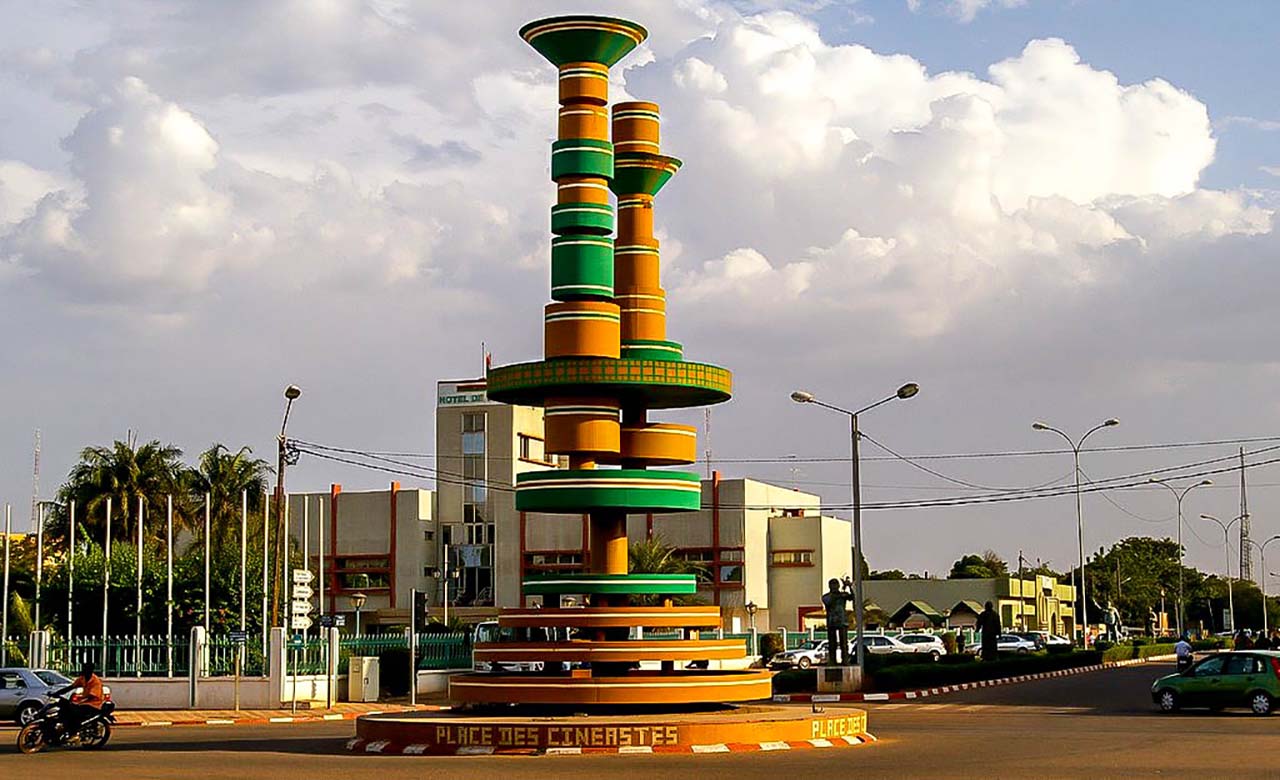
A small roundabout in the city centre built around a colourful 1987 monument to African cinema, its film-reel and camera-shaped sculpture arranged in a V for the "victory" of African film. A fitting, low-key landmark for a city that hosts FESPACO, Africa's largest film festival, every two years.
FESPACO & SIAO
FESPACO, the Panafrican Film and Television Festival of Ouagadougou, runs biennially in odd-numbered years, usually in late February or early March (the 30th edition is set for 20-27 March 2027), and is Africa's largest film festival, awarding the Golden Stallion of Yennenga. SIAO, the International Art and Craft Fair, alternates with FESPACO on the even years, typically late October (the 18th edition runs 30 October to 8 November 2026), and is one of Africa's most significant crafts trade shows.
Thomas Sankara International Airport, Then Shared Taxis
Thomas Sankara International Airport (OUA), named for the former president, sits close to central Ouagadougou and is served by around a dozen international carriers including Air France, Brussels Airlines, Ethiopian Airlines, Turkish Airlines, Royal Air Maroc, Air Côte d'Ivoire and Air Burkina, with connections typically routed through Paris, Brussels, Addis Ababa, Istanbul or Casablanca. Within the city, shared taxis with the fare agreed before you get in, meters aren't standard, and hotel-arranged transfers are the normal way to move between Ouaga 2000, the centre and Zone du Bois.
Reference Costs for Essential Travellers
As with the country guide, these are reference figures gathered for essential (business, diplomatic, NGO) travellers, not a suggested daily budget for a leisure trip that Atlas Guide isn't recommending.
Local meals & transport
A local meal of tô or riz gras runs roughly 1,000 to 3,000 CFA ($1.50-5); shared taxi fares within the city are agreed per trip rather than metered and are generally inexpensive by international standards.
Ouaga 2000 & airport-area properties
Lancaster Ouaga 2000 has historically run around $130-160 a night; Bravia Hotel Ouagadougou and Azalaï Hotel Ouagadougou sit in a broadly comparable business-hotel bracket. Confirm current rates directly given how quickly conditions and pricing can shift.
In Ordinary Times, Not Right Now
Under normal conditions, Bobo-Dioulasso, the Sindou Peaks, the Banfora waterfalls and W National Park would appear here as onward trips from the capital. They're covered instead, with the same safety caveats, in the Burkina Faso country guide's destinations chapter, since none of them currently has a safety picture that supports treating them as a realistic add-on to a Ouagadougou stay.
Ouagadougou FAQ
Is Ouagadougou safe for visitors right now?
No, not by any normal travel standard. The capital has generally avoided the sustained territorial fighting seen in Burkina Faso's north and east, but it has experienced attacks, and both the US Level 4 Do Not Travel advisory and the UK FCDO's advice against all travel cover Ouagadougou exactly as they cover the rest of the country, without a capital-city exception.
Can Americans currently visit Ouagadougou?
Not easily. As of January 2026, Burkina Faso and the United States mutually suspended visa issuance to each other's citizens, so American travellers cannot currently obtain a Burkinabe visa through normal channels, on top of the existing Do Not Travel advisory.
What is the Moro-Naba ceremony?
A ritual held every Friday around 7am at the Moro-Naba Palace, rooted in the Mossi imperial court established in Ouagadougou in 1681. The Mogho Naaba appears dressed in red as if for war, senior chiefs pledge allegiance, and he reappears in white as a symbolic gesture of peace.
How many days do you need in Ouagadougou?
In ordinary times, one to two days covered the city's core sights comfortably: the Moro-Naba ceremony, Rood Woko market, the National Museum and Place des Cinéastes. That's a description of the city's scale, not a current recommendation to visit.
What is FESPACO and when is it held?
The Panafrican Film and Television Festival of Ouagadougou, Africa's largest film festival, held biennially in odd-numbered years, usually in late February or early March. Its top prize, the Golden Stallion of Yennenga, is named for the legendary founder of the Mossi dynasty.
What language is spoken in Ouagadougou?
French is the official language of government and business, but Moore, the language of the majority Mossi population, is the most widely spoken day to day, alongside Dioula and other national languages.
Do I need a visa to visit Ouagadougou?
The same national entry rules apply as for the rest of Burkina Faso: a visa obtained in advance through the official online portal (visaburkina.bf), with visa on arrival granted only in exceptional, urgent cases, and, as of January 2026, a mutual suspension of visa issuance between Burkina Faso and the United States. See our Burkina Faso country guide for the full picture.
Is Ouagadougou's central market worth visiting?
Rood Woko, meaning roughly "big market" in Moore, is the city's main marketplace and, in ordinary times, one of its most interesting single stops, a short walk from the Moro-Naba Palace. Any visit today should be weighed against the same country-wide safety advisory as everything else in this guide.
What Stays With You
Ouagadougou is a genuinely rare thing: a capital where a centuries-old imperial court still holds court every Friday morning, cannon fire and all, in the same city that hosts Africa's largest film festival every two years. That combination, ancient continuity and forward-looking cultural ambition, is why the city built a reputation well beyond its size before conditions changed.
The honest answer to whether to visit right now is still no. This page exists so that reputation, and the specific, named places that earned it, Rood Woko, the Moro-Naba Palace, Place des Cinéastes, aren't lost to the advisory that currently and correctly overrides every other answer about the city.