
Morocco Travel Scams
A friendly local offers to show you the way through the Marrakech medina for free and leads you straight into a carpet shop. A woman grabs your hand near Djemaa el-Fna and begins applying henna before you can react. A teenage boy in Fes tells you the tannery you want is "just this way" through his cousin's leather shop. Morocco is one of the world's most extraordinary destinations. Understanding its specific tourist traps transforms your trip from exhausting to exhilarating.
Morocco Scam Overview 2026
Morocco receives around 13 million tourists per year and is Africa's most visited country. The medinas of Marrakech and Fes are UNESCO World Heritage Sites and among the most visually and culturally overwhelming urban environments on earth. They are also environments in which organized commission-based tourism hustling has operated for generations and has evolved into a sophisticated ecosystem that targets visitors at every entry point.
The critical thing to understand about Morocco's tourist scams is that they are almost never violent or coercive in the physical sense. They rely on social mechanics: generosity (the free gift that creates obligation), helpfulness (the guide who was never asked to guide), hospitality (the tea offered before the sales pitch), and the tourist's discomfort with confrontation. Understanding these mechanics in advance does not make you cynical about Morocco — it makes you able to engage with genuine Moroccan hospitality without confusing it for the transactional version.
Morocco also has a functioning tourist police (Brigade Touristique) that takes harassment seriously. The government has made significant efforts to reduce faux guide activity in the major medinas, with licensed guides now required to wear official badges. These efforts have reduced but not eliminated the problem documented here.
Morocco's most widespread tourist trap. Unsolicited guides lead tourists to commission shops. Any local who approaches and offers to help navigate is almost always working on commission.
Henna applied without prior price agreement on Djemaa el-Fna. Photo demands from animal handlers, costumed performers, and food stall operators. Payment expected without advance disclosure.
Initial prices in souks are routinely 3-10x the realistic final price. Knowing reference prices and the bargaining culture transforms shopping from a trap into an enjoyable cultural exchange.
Airport taxis, petits taxis, and hired drivers routinely quote above official or fair rates to tourists. Grand taxi system is opaque for first-time visitors without reference prices.
Morocco Safety at a Glance
Marrakech Scams
Marrakech is Morocco's most visited city and the one with the highest density of tourist-targeting hustles. The medina, Djemaa el-Fna square, and the surrounding souks are genuinely among the world's most captivating urban environments — and the most demanding of active awareness. Every entry point to the medina sees unsolicited guide approaches. Every step through the souks involves price negotiation. Every encounter on Djemaa el-Fna involves a transaction of some kind. Knowing this in advance is the single most important preparation for Marrakech, because it transforms the experience from overwhelming to navigable.
👨🕚 The Fake / Unsolicited Guide
This is Morocco's most consistent and most refined tourist trap. A young man approaches you at the edge of the medina — usually well-dressed, often claiming to be a student or a local rather than a guide. He offers to help you find wherever you are going, insisting he is not a guide and does not want payment. He navigates the medina confidently, answers your questions, and seems genuinely helpful. After 15-30 minutes he delivers you to a carpet shop, argan oil cooperative, spice shop, or leather goods store whose owner happens to be his cousin/uncle/friend. Inside, you are given mint tea, shown products, and subjected to polished high-pressure sales patter. If you buy nothing, the "free" guide often becomes hostile and demands payment for the guiding service he explicitly said was free. If you do buy, you are paying both tourist-price markups and the guide's commission (typically 20-40% of your purchase).
The sophistication of this scam is that the guide often genuinely helps you navigate and the shop you end up in may sell genuinely good products — at prices that include all the commissions in the chain. A carpet sold for MAD 3,000 in a commission shop might cost MAD 800 at the same quality level from a shop found independently.
The complete prevention is to hire an official licensed guide from the start. Official guides are registered with the Ministry of Tourism, carry a badge and lanyard with their photo and registration number, and can be booked through your riad or the Marrakech tourism office near Djemaa el-Fna. A licensed guide for a half-day medina tour costs MAD 200-350 (EUR 18-32) and eliminates every commission-shop approach because the guide is paid directly by you, not by the shops. If you prefer exploring independently: download an offline map of the medina before entering (Maps.me or Google offline maps), keep your phone in your pocket, and use "La bas, shukran" (I'm fine, thank you) confidently and repeatedly to unsolicited approaches without engaging further.
🍃 Henna Hand Ambush
Women in traditional dress position themselves around Djemaa el-Fna and near souk entrances. They approach tourists — most often women — and take their hand, beginning to apply henna without asking permission and before any price is mentioned, saying "for you, free" or "Moroccan tradition, gift." The application begins and stopping it feels socially impossible once the paste is on your hand. When the design is complete, they demand MAD 200-500 (EUR 18-45) for what should cost MAD 20-50. If you refuse to pay the demanded amount, they become increasingly aggressive, threatening to ruin the unfinished design or calling male relatives nearby.
A significant additional concern: the henna applied by many Djemaa el-Fna touts is not traditional natural henna but "black henna" containing paraphenylenediamine (PPD), a chemical dye used in hair coloring products. PPD applied to skin causes allergic reactions in a significant percentage of people, ranging from blistering and scarring to serious systemic reactions. EU and US consumer safety bodies warn against black henna specifically. Natural henna ranges from orange to dark brown and never applies black to the skin.
Keep your hands in your pockets when walking through Djemaa el-Fna. If someone approaches, say "La shukran" firmly while keeping your hands unavailable. If you want henna: negotiate the price and the design in full before a single drop of paste touches your skin. Agree the amount in writing or clearly stated (MAD 20-50 for a small design is fair). Go to an established henna shop inside the souks rather than accepting Djemaa el-Fna street applications — shop-based henna artists typically use better-quality natural paste and the transaction is more transparent. Never accept black-colored henna regardless of the price.
📷 Djemaa el-Fna Photo and Performance Payment Demands
Djemaa el-Fna is a UNESCO-recognized intangible cultural heritage site and its performers, food stalls, snake charmers, monkey handlers, and storytellers are a genuine living tradition. They are also a source of tourist income and the payment expectations are not always disclosed. Photographing a snake charmer, a monkey, a costumed performer, or any animal handler on the square without prior payment agreement will result in a payment demand. The approach: the performer spots your camera raised, makes eye contact, sometimes poses — then demands MAD 10-50 per photo. Refusing after the photo is taken creates an increasingly unpleasant confrontation in a crowd. In a more aggressive version, a monkey is placed on your shoulder by its handler and payment demanded immediately — some tourists report MAD 100-200 demanded and significant aggression when refused.
Agree the price for any photograph before raising your camera. MAD 5-10 per photo is reasonable for most Djemaa el-Fna performers and reflects a fair transaction for a genuine cultural exchange. Do not allow anyone to place an animal on you without your explicit prior agreement and a clear stated price. If a monkey is placed on you unexpectedly: do not panic (the animal responds to your agitation), remove it firmly, and pay MAD 10-20 as a reasonable resolution — this is far less than the confrontational demand that follows refusal. The best photos of Djemaa el-Fna are taken from the cafe terraces above the square where no individual payment is expected.
🏭 Carpet and Argan Oil Commission Shops
Whether delivered by a commission guide or entered independently, Marrakech's carpet and argan oil shops use a sophisticated sales approach. The mint tea welcome is genuine and the hospitality is real — but it creates a social obligation that is deliberately cultivated. Carpets are unrolled with theatrical skill and genuine aesthetic judgment about what you might like. The first price quoted is routinely 5-10x the final selling price, and the gap is bridged through a negotiation process that many tourists find uncomfortable. Argan oil "cooperatives" — many of which are commercial shops using the cooperative branding — price oil at EUR 30-60 per 100ml for product available in Moroccan supermarkets at MAD 80-150 per 500ml. Some argan oil sold to tourists is diluted with cheaper oils or mislabeled as pure when it is a blend.
For carpets: if you want to buy a Moroccan carpet (they are genuinely beautiful and worth buying), approach it as a deliberate purchase rather than an impulse one. Research fair prices before entering any shop: a medium quality Berber carpet (approximately 2m x 1m) should realistically cost MAD 800-2,000. Start your bargaining at 25-30% of the first quoted price. For argan oil: buy from the Marjane or Aswak Assalam supermarkets in Marrakech or from the airport duty free for verified, labeled products at honest prices. The "women's cooperative" label does not guarantee authenticity — look for the Moroccan state certification label for cosmetic argan oil (ONSSA approved).
🍷 Mint Tea Obligation Setup
Mint tea offered in a Moroccan context is often genuinely hospitable and accepting it is culturally correct. The scam version: shops in tourist areas offer tea immediately on entry and before any browsing occurs, creating a social dynamic in which leaving without buying feels ungrateful. After the tea, the sales patter begins and the combination of the hospitality debt and a long pour of selling energy makes "I'm just looking" feel increasingly uncomfortable. This is not unique to Morocco — similar hospitality-pressure sales environments exist across the region — but it is particularly refined in Marrakech's carpet and antiques trade.
Accept the tea if you genuinely want to browse and consider buying — accepting hospitality and not buying is culturally fine in Morocco and any shopkeeper who tells you otherwise is misrepresenting the tradition. The correct response to social pressure is genuine, warm, and firm: "Shukran bzaf, ghadi nmshi" (Thank you very much, I am going to go). You owe nothing for a glass of tea in a shop context. The obligation created is entirely psychological. Drinking the tea and leaving without buying is a normal outcome in Morocco's market culture.
Fes Scams
Fes el-Bali is the world's largest living medieval city and arguably the most disorienting urban environment most tourists will ever navigate. The medina has over 9,000 streets and alleys, many indistinguishable from each other, and getting genuinely lost is a real possibility without offline maps. This navigation difficulty is the foundation of Fes' tourist scam ecosystem: the city is hard to navigate independently, which creates a genuine market for guides that is systematically exploited by unlicensed hustlers. The tanneries are Fes' most photographed site and the most consistently reported location for pressure selling.
🖤 Chouara Tannery Viewpoint Pressure Selling
The Chouara Tannery is one of the world's most striking working craft sites — an ancient leather dyeing operation visible from terraces above, where workers stand in stone vats of colored dye in a scene unchanged for centuries. The access to these viewing terraces runs through the leather shops that surround the tannery. Shop owners allow free terrace access in exchange for the implied expectation that you will view their leather goods. The arrangement creates a social dynamic that many tourists describe as deeply uncomfortable: you are given a sprig of mint to hold against the smell, shown up to the terrace, spend twenty minutes watching, and are then expected to at minimum browse the shop at length and ideally buy something. Staff become noticeably less friendly when visitors attempt to leave without buying. Some shops lock or block the exit informally until a purchase is made or the situation is resolved with cash.
The leather goods sold from tannery shops range from genuine Fassi craftsmanship of high quality to tourist-grade machine-made products presented as handmade. Prices are high by Moroccan standards but the quality at the upper end genuinely justifies a premium. The problem is the coercive viewing-to-selling mechanism rather than the products themselves.
Enter the tannery access shops with a clear decision made in advance: either you are there to look and buy leather if you see something at a price you are willing to pay, or you are only there for the view. Communicate this clearly at the start. Spend 10-15 minutes at the terrace, which is genuinely worth the visit. When you leave, "La shukran, mashi mushkil" (No thank you, no problem) and a confident exit is sufficient. You cannot be physically prevented from leaving. If staff are particularly aggressive, name the Brigade Touristique (tourist police) and your situation will almost certainly resolve immediately. A licensed guide accompanying you changes the dynamic entirely — shops behave differently toward accompanied tourists.
👨🕚 Navigation "Help" and Misdirection
The Fes medina version of the unsolicited guide operates with added effectiveness because Fes genuinely is harder to navigate than Marrakech, and tourists who are clearly lost are particularly vulnerable. A young man offers to show you to the tanneries, the Bou Inania madrasa, or wherever you want to go. He leads you there — often genuinely, not via a commission shop — and then demands MAD 100-200 for the navigation when you arrive, despite claiming no payment was expected. A second variant: he "guides" you to a commission shop while claiming it is on the route to your destination, then demands payment for the guide service when you try to leave the shop without buying. A third variant specifically in Fes: someone claims you need a "special access permit" to enter a particular section of the medina and offers to obtain it for you — no such permit exists for any publicly accessible part of the medina.
Download Maps.me with the Fes offline map before entering the medina. The app navigates the medina's streets accurately and removes the need to ask anyone for directions. Alternatively, hire an official licensed guide through your riad — a morning guided Fes medina tour (MAD 250-400) navigates you through the main sites efficiently and eliminates every unsolicited approach. There are no access permits required for any public area of Fes el-Bali. If someone claims otherwise, they are wrong or lying.
📚 Madrasa "Free Entry" Confusion
Fes has several magnificent medieval Islamic schools (madrasas) that are among the finest examples of Moroccan architecture anywhere. Some require an entrance ticket; others have varying access policies. Touts outside claim to be "official ticket sellers" or "entrance fee collectors" for sites that either have a standard ticket window or are genuinely free. The "ticket" sold outside is either an overpriced genuine ticket or simply cash collected with no receipt for nothing. Some touts position themselves inside the madrasa entrance and collect additional "fees" from tourists who already hold valid tickets. Genuine ticket prices: Bou Inania Madrasa entrance is approximately MAD 20-30.
Buy attraction tickets only at the official ticket window inside the entrance, not from anyone outside on the street. Legitimate tickets come with a printed receipt. If someone asks for money inside an attraction after you have already paid at the entrance, decline and show your receipt. Your riad or a licensed guide can tell you the current admission price for any specific site before you visit.
Chefchaouen Scams
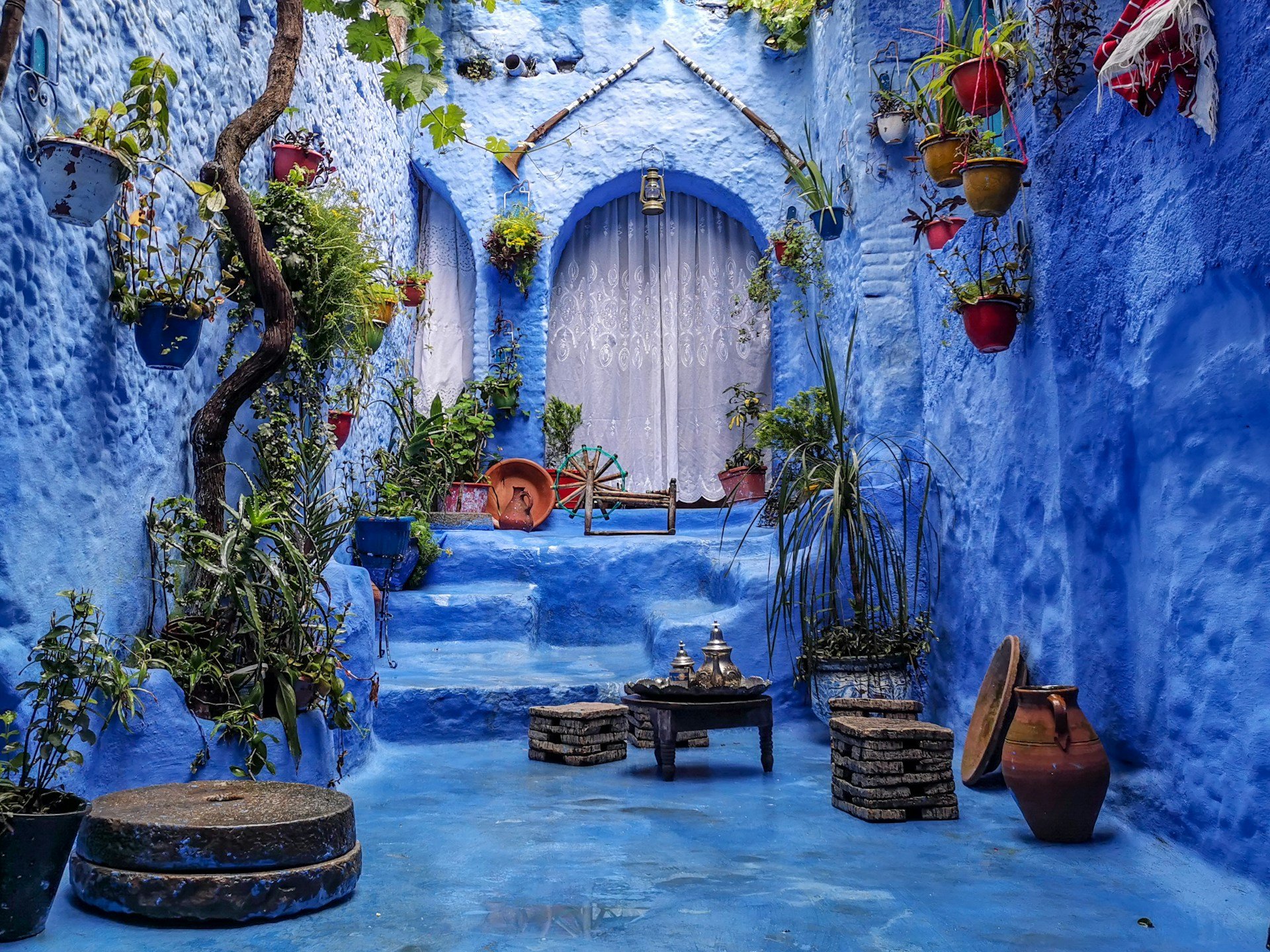
Chefchaouen is genuinely one of Morocco's most pleasant tourist destinations and has a significantly lower scam intensity than Marrakech or Fes. The blue-painted medina, the Rif mountain backdrop, and a relaxed pace make it a favorite for travelers seeking respite from the imperial city intensity. The specific risks here are lower-stakes but worth knowing.
🌿 Cannabis (Kif) Offers and Legal Risk
The Rif Mountain region around Chefchaouen is one of the world's largest cannabis-producing areas and kif (cannabis) is offered openly to tourists in Chefchaouen's streets by young men who approach quietly. The offers are frequent enough to be a defining feature of the town for some travelers. The risk is straightforward: cannabis is illegal in Morocco regardless of how openly it is offered, and possession can result in arrest, detention, and prosecution. Moroccan law provides for sentences of one month to five years for possession. Some offers are from police informants rather than genuine dealers — accepting leads directly to arrest. Others involve being sold poor-quality product at inflated prices (MAD 100-300 for what regular users consider a minimal amount). Some offers are followed by a demand for additional payment or a threat to call police if not paid more.
Decline firmly and without engagement. "La shukran" and keep walking. The frequency of offers does not indicate toleration by authorities — arrests of tourists for cannabis possession are documented. The presence of informants within the dealer network means that accepting any offer in Chefchaouen carries specific legal risk beyond the standard possession charge. The town is beautiful and worth visiting for its architecture, the Ras el-Maa waterfall, and its genuinely excellent cafes. None of that requires engaging with any drug offer.
📷 Cat and Donkey Photo Demands
Chefchaouen is full of photogenic cats and the occasional donkey that owners have positioned in the blue streets for tourist photograph income. In some spots, individuals who have positioned an animal or a particularly photogenic scene expect payment if you photograph it. This is a genuinely modest transaction — MAD 5-10 is typical — but the expectation is not always communicated in advance. More relevant: some residents of photogenic alleyways expect payment if photographed themselves or if their doorway or balcony is the centerpiece of your shot.
Ask before photographing any person or animal that appears to have been positioned for tourist photos. Agree a small payment (MAD 5-10) before taking the shot. Photographing the blue streets and architecture without people in them requires no payment. The cats of Chefchaouen are genuinely excellent subjects and most of them are simply resident cats of the medina rather than positioned props — you can generally tell the difference.
🏭 Souvenir Markup in the Blue Medina
Chefchaouen's souvenir economy is less aggressive than Marrakech or Fes but the tourist premium is real. Handwoven wool items (jellabiyas, blankets, hats) and blue-themed ceramics are sold at prices roughly double what the same items cost in local markets in non-tourist towns. The quality of Chefchaouen's woven wool products is genuinely good — the town has a real artisan tradition in this. The issue is simply price transparency and the expectation that bargaining is part of every transaction.
Bargaining is standard and expected. Start at 40-50% of the first quoted price. For Chefchaouen wool products, fair final prices: a wool djellaba MAD 200-400, a woven blanket MAD 150-300, a small ceramic bowl MAD 15-30. The fixed-price cooperatives in the medina (look for the "prix fixe" sign) sell at honest non-negotiable rates and are useful for calibrating what things should cost before bargaining elsewhere.
Desert & Atlas Mountain Scams
The Sahara Desert edges near Merzouga and Zagora, the Draa Valley, and the High Atlas Mountain passes are among Morocco's most spectacular destinations. They are also contexts where tourist dependence on local operators is higher and information asymmetry (not knowing fair prices for remote services) creates specific vulnerability. The camel ride, desert camp, and mountain guide industries all have pricing that tourists rarely know in advance.
🏭 Sahara Desert Tour Misrepresentation
Desert tours from Marrakech to Merzouga (3-day/2-night overland) are one of Morocco's most popular tourist experiences and one of its most variable in quality. Tours sold by commission agents in Marrakech's medina or via unofficial tour operators range from MAD 1,200 to MAD 3,500 per person for nominally similar itineraries. Price variation this wide almost always reflects genuine quality differences: accommodation ranging from a genuine luxury desert camp with private tents and proper bedding to a plastic-sheeted enclosure with sleeping bags on the ground; transport ranging from a proper 4WD vehicle to an overloaded minivan; camel ride quality varying from a scenic dusk experience to a brief loop that the cost barely justifies.
Additional issues: the "sunrise camel ride" promised in many packages involves waking at 4am and riding for 20 minutes before the operator turns back. The "luxury desert camp" photos in marketing materials often show different facilities from what arrives on the night. And some operators collect full payment in Marrakech then call the client sick or have an "emergency" and provide a significantly inferior substitute operator.
Book desert tours through your riad (they have tested operator relationships and stake their reputation on quality), through GetYourGuide with operator reviews, or directly with Merzouga-based camps. Ask specifically: how long is the camel ride (the standard dusk-to-camp ride should be 45-90 minutes); what are the tent specifications; what is included (dinner, breakfast, bedding); and what vehicle is used for overland transport. Pay by credit card where possible — it gives you chargeback recourse if the tour is materially different from what was promised. Tours costing less than MAD 1,500 per person for a 2-night Merzouga desert experience are almost certainly cutting significant corners on quality.
🏔 High Atlas Mountain Guide Commission Shops
The villages at the base of Jebel Toubkal and in the Ourika Valley have a guide industry catering to trekkers and day-hikers. The unsolicited guide approach operates here as it does in the medinas: a local offers to accompany you up the trail or to show you a "hidden waterfall" that happens to be accessible through a relative's house where an argan oil demonstration or carpet showing is required. Additionally: "mandatory" mule hire is quoted for trekking routes where mules are optional, and village "entrance fees" are sometimes collected informally by individuals with no official role.
For Jebel Toubkal ascent (Morocco's highest peak, 4,167m): hire a licensed mountain guide through the Imlil-based guide association (Association des Guides de Montagne), where rates are officially published (approximately MAD 400-600 per day). The CAF (Club Alpin Français) refuge in Imlil provides reliable information on official guide rates and trail conditions. There are no legitimate entrance fees for any Moroccan mountain trail. Mule hire is genuinely optional for most routes — useful for heavy loads but not required.
🐪 Camel Ride Price Ambush
Camel rides offered outside the Palmeraie area near Marrakech and at the desert edges near Merzouga are a completely legitimate tourist activity. The scam element: the price is not agreed before mounting, and at the end of the ride the demanded price is significantly above what was initially implied or assumed. A one-hour camel ride costing MAD 50-100 for a properly agreed transaction becomes MAD 300-500 when the price was never discussed and the operator sees tourist cash. A separate issue: very short "rides" of 10-15 minutes are often sold as hour-long experiences to tourists who do not check the duration.
Agree the price, duration, and route in full before mounting any camel. For a short tourist ride (30-45 minutes): MAD 50-100 is fair. For a dusk-to-camp desert ride included in a Merzouga package: this should be in the tour price. Never mount a camel without a confirmed price written or clearly stated. The negotiation happens on the ground, not from the saddle.
Transport Scams
✈️ Marrakech Airport Taxi Overcharging
Marrakech Menara Airport is 5km from the medina and the taxi journey takes 10-20 minutes. The official regulated grand taxi fare from the airport to the Djemaa el-Fna area is MAD 100-150. Unofficial taxis inside and outside the terminal approach arriving tourists and quote MAD 200-400 for the same journey. Some licensed taxis in the official rank also attempt flat-rate overcharging rather than using the meter, knowing tourists do not know the local rate. The No. 19 public bus runs from the airport to Djemaa el-Fna for MAD 4 and is perfectly safe — simply less convenient with luggage.
Use the official grand taxi rank outside arrivals and confirm MAD 100-150 to the medina area before getting in. If your riad offers a pickup service, use it — the cost (typically MAD 80-150) is comparable to a taxi and saves the negotiation. The Bus No. 19 costs MAD 4 and runs to Djemaa el-Fna every 30-40 minutes. Uber and Careem both operate in Marrakech and show the price before booking — use them for airport journeys to remove all ambiguity.
🚘 Petit Taxi Meter Refusal
Morocco's petit taxis (small metered taxis for short urban journeys) are legally required to use their meters. In practice, many drivers quote flat rates to tourists that are above what the meter would show. A metered petit taxi journey across Marrakech or Fes typically costs MAD 10-25. Flat-rate tourist quotes for the same journeys range from MAD 30-80. Some drivers claim the meter is broken or start the journey without turning it on.
Say "Compteur, afak" (meter, please) before getting into any petit taxi. If the driver refuses, find another taxi. Uber and Careem are increasingly viable alternatives in Marrakech and eliminate meter disputes entirely. For reference: any metered petit taxi journey within the central areas of Marrakech or Fes should cost MAD 10-25. Night rates (after 8pm) are approximately 50% higher — this is legitimate and should be shown on the meter as a tariff indicator.
🚕 Grand Taxi Route Confusion and Overcharging
Morocco's grand taxi system (shared taxis for intercity and regional routes) is an efficient and legitimate transport option that tourists rarely use correctly, creating overcharging vulnerability. Grand taxis leave when full (typically 6 passengers) and charge fixed per-seat rates. Tourists are often quoted the full-taxi price rather than the per-seat price, paying 6x what a Moroccan would for the same journey. Others are told no shared option is available and offered a private hire at tourist prices for what should be a shared-rate journey. Additionally: drivers sometimes add bags to the route, making the journey significantly longer than stated.
Ask your riad or hotel for the current per-seat grand taxi price for your specific route before going to the station. Present this price at the station and share the taxi with other passengers. The shared-seat price is typically MAD 15-50 per person for most regional routes. If you want a private grand taxi (faster, more comfortable), negotiate explicitly for the full-vehicle price and understand you are paying for 6 seats. The ONCF (Moroccan national railway) and CTM buses are excellent, affordable alternatives for longer routes.
An Airalo eSIM for Morocco activates before you board and gives you data from arrival. Morocco coverage (Maroc Telecom, Orange Maroc, Inwi) is good in all cities and on main roads. More importantly: download Maps.me with Marrakech and Fes offline maps before you leave home. Navigating the medinas independently with an offline map removes the entire unsolicited guide ecosystem from your experience. Uber and Careem also require a working data connection.
Restaurant Traps & What Things Should Cost
Moroccan food is genuinely excellent and the country feeds tourists well at fair prices if they eat away from the immediate tourist row. The rooftop restaurants visible from Djemaa el-Fna and the Placa-equivalent restaurants on the square's edges charge tourist premiums of 200-400% above local prices for the same quality food. Knowing the reference prices and where to find honest restaurants transforms Morocco's food experience.
What Things Actually Cost in Morocco 2026
🍽 Djemaa el-Fna Food Stall Overcharging
The evening food stalls on Djemaa el-Fna are one of the world's great street food experiences and worth eating at. The pricing trap: individual stall operators do not always provide menus or state prices before serving. Dishes arrive, are consumed, and the bill is dramatically above what was expected, with prices charged per ingredient, per serving, and sometimes per person sitting at the table. Some stalls also approach tourists walking past with plates of food to "try" and then demand payment as though the food was ordered. The official tourist department of Marrakech has posted regulated prices at the stalls — they are visible on boards — but not all stalls honor them and enforcement is inconsistent.
Ask for a menu with prices before sitting at any food stall. If prices are not clearly displayed, state what you want and ask the cost before eating. The official price board at most stalls lists: harira soup MAD 5, brochette (skewer) MAD 5-8, kefta (meatball) MAD 5-8. A full meal at a Djemaa el-Fna stall should cost MAD 30-60 per person. Any bill significantly above this is above official rates. Do not take food handed to you by stall operators on the approach paths — this is a tactic to create a payment obligation for food you did not order.
Morocco is a largely cash economy — credit cards are accepted in hotels, some restaurants, and modern shops, but the medina souks, food stalls, and transport are cash-only. A Wise card or Revolut gives you the best exchange rate when withdrawing dirhams from Moroccan ATMs (Attijariwafa, CIH, BMCE are reliable banks). Carry small denomination bills — MAD 10, 20, and 50 notes make every transaction cleaner and prevent change-manipulation at market stalls.
Shopping Traps & Bargaining
Morocco's souks are among the world's great shopping environments. The quality of its crafts — leather, ceramics, textiles, metalwork, spices, and rugs — is genuine and the best examples are extraordinary objects worth significant money. The challenge is that the pricing system is entirely opaque to visitors and the initial quoted price bears almost no relationship to the fair market price. This is not a scam — it is the traditional market pricing system operating as designed. The information needed to navigate it is specific prices for specific categories of goods.
🧵 Fake Antiques and "Authentic" Berber Goods
Marrakech's antique market sells a mix of genuine old objects, quality reproductions, and items manufactured last week and artificially aged. The words "antique," "authentic," "Berber," and "handmade" in the context of tourist-facing souvenir shops describe marketing categories rather than guarantees. Artificially distressed wood, chemically aged silver, and machine-woven carpets sold as hand-knotted are the most common misrepresentations. Items sold as "silver" may be nickel or alpaca. Fossils sold as genuinely ancient are often cast resin. Prices can be significant — a "genuine Berber carpet" at MAD 8,000 that is machine-made is a substantial financial loss.
For carpets specifically: Ensemble Artisanal on Avenue Mohammed V in Marrakech is a state-run cooperative that sells certified authentic Moroccan crafts at fixed, fair prices with product provenance. It is an excellent calibration reference before shopping in the souks — you will know what quality level corresponds to what price. For silver: genuine Moroccan silver has a government hallmark (a small stamp). For antiques: if genuine provenance matters, buy from established dealers with certificates rather than souk stalls. Ask specifically "est-ce fait à la main?" (is this handmade?) and "quelle est l'année de fabrication?" (what year was it made?) — the answers tell you a great deal.
🎁 The Bargaining System — A Practical Guide
Morocco's souk pricing is not a scam — it is a different pricing system. First price quoted: routinely 3-10x the final realistic price. The gap exists because it has always existed and because tourists will sometimes pay it. A ceramic bowl quoted at MAD 200 might sell for MAD 30-50. A small rug quoted at MAD 2,000 might sell for MAD 400-600. The negotiation is expected by both parties and sellers are not offended by low initial offers. What tourists mistake for dishonesty is simply a different market convention — one that rewards knowledge of local prices and willingness to negotiate.
Reference prices for common purchases: small ceramic bowl MAD 20-50, hand-painted ceramic plate MAD 50-100, small Berber rug MAD 200-500, medium-quality leather bag MAD 200-400, quality babouche slippers MAD 80-150, small mosaic tile table MAD 300-600. Start at 25-30% of any quoted price. The seller's reaction tells you how close you are to a real price — theatrical outrage usually means you are in the right range. Walk away slowly if no agreement is reached; being called back usually means the price can go lower. Buy things you genuinely want at a price you are genuinely happy with. That is the complete guide to Moroccan souk shopping.
Solo Women Travelers
Morocco presents genuine challenges for solo women travelers that are worth addressing honestly. Street harassment — verbal comments, following, unsolicited physical contact — occurs more frequently in Morocco than in most European destinations and is a consistent report from women who travel the country alone. It is most intense in Marrakech and Fes and significantly less frequent in Chefchaouen, Essaouira, and smaller towns.
The harassment is almost never violent and Morocco's violent crime rate against tourists is low. The cumulative psychological impact of persistent unwanted attention is, however, genuinely fatiguing and worth preparing for rather than discovering on arrival. Specific practical strategies that experienced solo women Morocco travelers report as effective: walking with purpose and without hesitation (uncertainty reads as vulnerability in a hustle environment); wearing clothing that is locally appropriate (covered shoulders and knees removes one vector of approach); staying in riads whose staff can recommend safe routes and trustworthy local contacts; and joining organized tours for the Sahara and Atlas Mountain segments where isolation from other travelers creates more exposure.
The Ensemble Artisanal and fixed-price cooperatives in Marrakech are genuinely more comfortable shopping environments for solo women than the open souk, because the fixed pricing removes the extended negotiation interaction that creates unwanted engagement. A licensed female guide (available through the Marrakech tourism office) provides the most comfortable medina experience for solo women travelers.
Essaouira, on Morocco's Atlantic coast, is consistently recommended by solo women travelers as the country's most relaxed and least harassment-intensive destination. Its Portuguese colonial architecture, reliable Atlantic wind, and established arts community create a significantly different atmosphere from the imperial cities.
Universal Prevention Guide
Offline Maps Before You Enter the Medina
Download Maps.me with Marrakech and Fes offline maps before you arrive in Morocco. Navigating confidently with a phone map removes the need to ask anyone for directions and eliminates the entire unsolicited guide ecosystem. This single preparation prevents Morocco's most common tourist trap.
Hire a Licensed Guide from the Start
An official licensed guide from the Marrakech or Fes tourism office (MAD 200-350 per half day) is worth every dirham. They navigate efficiently, prevent commission-shop approaches, explain context that transforms what you see, and are the single most effective scam prevention measure available. Their badge and registration number are verifiable.
Hands in Pockets Near Djemaa el-Fna
Keep both hands in your pockets when walking through Djemaa el-Fna's henna and photo zones. Agree any price before making physical contact with any performer, animal, or henna artist. Never allow anything to be started on your body without a confirmed prior price.
Know Reference Prices
Visit Ensemble Artisanal on your first day in Marrakech. The fixed prices there calibrate your understanding of what Moroccan crafts should cost at honest prices. Every subsequent souk negotiation is better informed. The difference between knowing and not knowing reference prices is the difference between enjoyable bargaining and being taken advantage of.
Save Tourist Police: 0524 38 46 01
Morocco's Brigade Touristique (tourist police) take harassment complaints seriously. Mentioning them by name in a confrontational situation — tannery pressure selling, aggressive fake guide demand — almost always resolves it immediately. Save this number before entering any medina.
Drink Tea Freely, Buy Nothing Obligatorily
Accepting mint tea in a Moroccan shop creates no legal or moral obligation to buy anything. The hospitality obligation is a psychological construction, not a cultural reality. Drink the tea, enjoy the welcome, and leave when you are ready. "Shukran bzaf, ghadi nmshi" is sufficient and will be accepted.
GetYourGuide lists licensed operators for Marrakech medina food tours with local guides, Fes pottery workshop visits with artisans, Sahara Desert camps with specified tent quality, and High Atlas day treks with certified mountain guides. Transparent pricing, operator reviews, and consumer protection — the tour shows exactly what is included before you pay. No commission shops, no unsolicited additions.
Reporting Scams in Morocco
Morocco has a functioning tourist police (Brigade Touristique) that operates in all major tourist cities. Reporting harassment and scam incidents is encouraged and the government has made genuine efforts to improve the tourist experience, particularly in reducing unlicensed guide activity. Filing a report both resolves your immediate situation and contributes to enforcement data.
Step-by-step: What to Do if You're Scammed
Morocco Is Worth All of It.
Morocco's tourist traps are numerous, persistent, and entirely documented. They are also the thin surface layer of a country of extraordinary depth. The Fes medina is one of the world's genuinely irreplaceable human environments — nine hundred years of continuous urban life with no cars, no gap years, no renovation projects, just the same trades and streets and light-filtered alleys that have existed since the Marinid dynasty. The Sahara at dawn from a dune crest above Merzouga is one of those experiences that people describe as life-dividing. The food, eaten properly, in a proper Moroccan home or a proper local restaurant, is among the world's finest.
Go with offline maps. Hire a licensed guide for the first medina day. Know the tannery situation before you walk in. Say "Brigade Touristique" with confidence when the situation calls for it. Drink the tea and feel no obligation. Morocco rewards the traveler who understands it and gives them something that cannot be found anywhere else on earth.