
What You're Actually Dealing With
The Scams That Actually Catch People
Guatemala's risk profile is more serious than most countries in this guide. The express kidnapping risk in Guatemala City is in a different category from tourist pricing scams — it requires hard rules rather than general awareness.
Victims enter unmarked taxis, which are then joined by armed accomplices. The victim is driven to multiple ATMs to withdraw the daily withdrawal limit, sometimes held overnight for a second round. This is specifically documented around La Aurora Airport arrivals, Zone 1 (the historic centre), and late-night rides in tourist zones. The taxis look normal — the risk is in the driver and who may be waiting or join the vehicle.
- From the airport: use only Uber (book before leaving the terminal) or a pre-arranged shuttle from a licensed operator — Atitrans, Adrenalina Tours, or your hotel's arrangement.
- In the city: Uber is the safe option. If Uber is unavailable, call a taxi by phone through your hotel — never hail from the street.
- Legitimate yellow taxis exist in Guatemala City but identifying genuine licensed vehicles from fraudulent ones is unreliable for visitors. Uber removes this problem entirely.
Lake Atitlán has a documented history of boat accidents, some fatal, often linked to overloading, inadequate life jackets, and operators who prioritise speed over safety on a lake that can generate dangerous waves quickly. Financial scams include boat operators who quote one price at the dock and demand more on arrival at the destination, or who claim additional fees for luggage. The collective lanchas from Panajachel's public dock are the most regulated and generally safer than private hire.
- Use the collective lanchas from the official Panajachel public dock rather than private operators who approach you — regulated, cheaper, and subject to some oversight.
- Check that life jackets are available and accessible before departing — if they are under the seats in sealed bags, ask for them out.
- Agree all fares in quetzales before boarding and confirm the price covers the full journey including luggage.
- Avoid crossing the lake after dark or when waves are visibly rough — the lake weather can change fast.
Individuals near Tikal's entrance and other major sites offer guide services without prior price agreement. At Tikal specifically, the site is genuinely enormous — 16 square kilometres of active excavation — and a knowledgeable guide adds real value. The issue is unofficial guides who establish the fee at the end rather than the start. Some also claim mandatory guide requirements that don't exist for self-guided visitors.
- Book licensed guides through your Flores guesthouse or the INGUAT-registered guide association at the Tikal entrance — agree the full fee before starting.
- Self-guided entry to Tikal is entirely permitted and the main trails are well-marked — a guide is an enhancement, not a requirement.
- At Chichicastenango market, vendors sometimes follow visitors persistently — "no gracias" repeated firmly while continuing to walk is the appropriate response.
Street money changers occasionally short-count quetzales handed over, relying on visitors not counting large wads of small-denomination bills quickly. Some exchange bureaus quote one rate and apply another. Airport exchange counters in La Aurora have worse rates than ATMs in Antigua and Guatemala City. Counterfeit quetzal bills also circulate — the Q50 and Q100 notes are the most commonly faked.
- Use ATMs at official banks (Banrural, BAC, Agromercantil) rather than street changers or airport counters.
- Count all received quetzales before leaving any exchange point — count in full view of the person who gave you the money.
- Check Q50 and Q100 notes: genuine notes have a security strip visible when held to light and a watermark. If a note feels unusually thin or the colours are faded, it may be fake.
Bag and phone snatching is the most common property crime against tourists. In Antigua, it typically occurs when visitors are distracted — stepping out of a restaurant, on the street at dusk, on the quieter streets north and east of the central park. Phone snatching from café tables is common. In Guatemala City Zone 1, street theft risk is high enough that most guesthouses advise against unnecessary walking in the historic centre.
- Keep phones in pockets and bags closed in front in Antigua streets and all Guatemala City areas.
- Don't display expensive cameras, phones, or jewellery in Guatemala City Zone 1 — leave valuables at your hotel.
- Stick to well-lit central streets in Antigua after dark and use a taxi rather than walking on less-trafficked streets at night.
Guatemala has 37 volcanoes, three of them actively erupting. Volcano tours from Antigua range from excellent to genuinely dangerous depending on the operator. The Acatenango overnight — camping on the crater rim above the clouds with Fuego erupting opposite — is one of the most extraordinary experiences in Central America. The cheapest operators sometimes provide inadequate equipment, guides without proper training, and ignore current volcanic activity alerts.
- Book volcano tours through established Antigua operators: OX Expeditions, Wicho & Charlie's, and Tropicana are consistently recommended by travellers with recent reviews.
- For Acatenango, confirm the operator provides: proper camping equipment, an experienced guide with radio communication, and current activity status for Fuego before departure.
- Check INSIVUMEH (Guatemala's volcanic observatory) alerts before any volcano visit — some hikes are suspended when activity increases.
The Destinations — Honest Takes
The main tourist circuit — Antigua, Lake Atitlán, Tikal — is well-travelled and the country beyond it is extraordinary for those who go further.
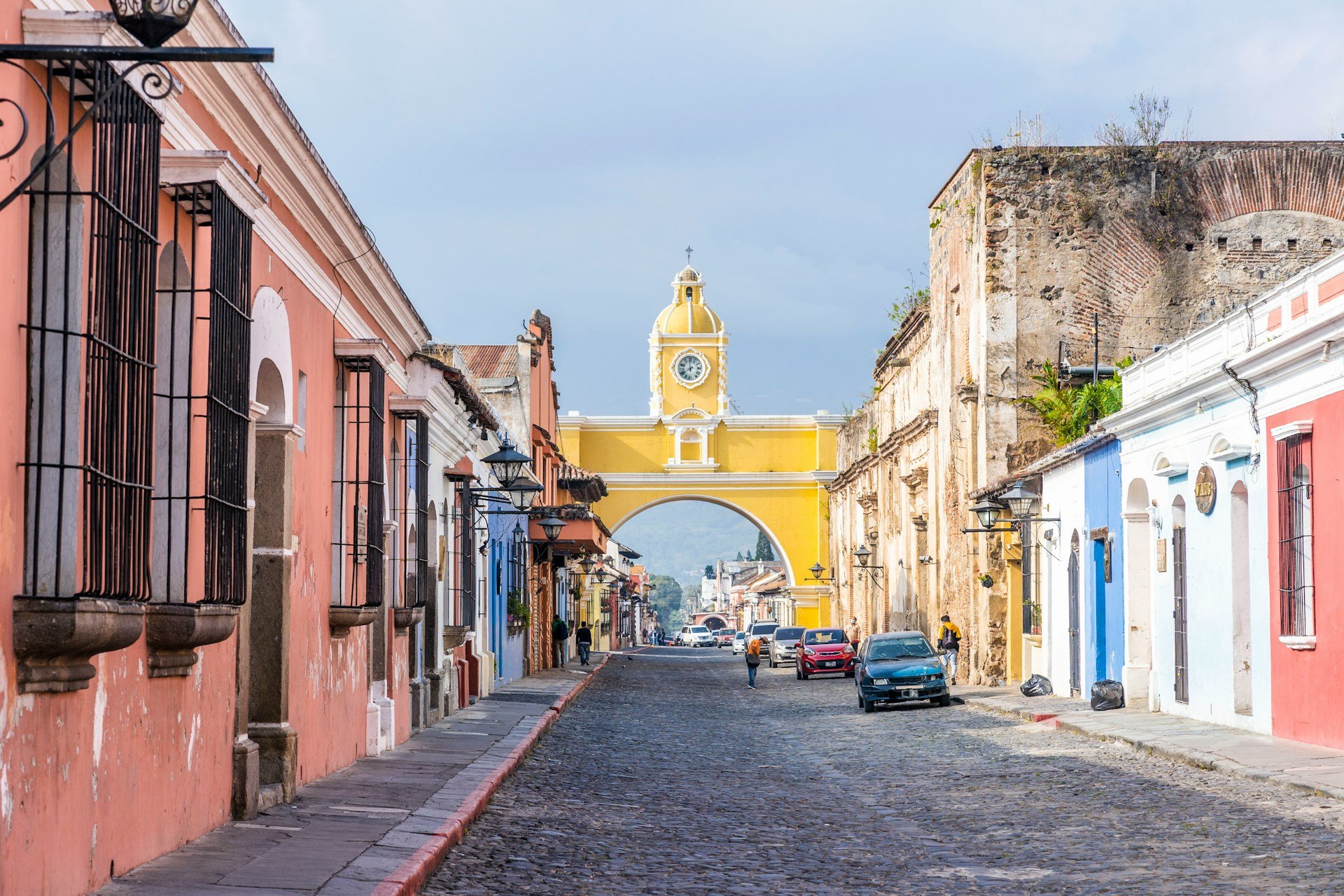
Antigua was the colonial capital of Central America and is the best-preserved Spanish colonial city in the western hemisphere — cobblestone streets, 16th and 17th-century churches and convents, many of them beautifully ruined by earthquakes and left that way. Three volcanoes frame the city from different angles. It has excellent cafés, Spanish language schools that draw students from across the world, and the most developed tourist infrastructure in Guatemala. Semana Santa here is the event of the year — processions lasting 12 hours, alfombras covering entire streets, a week of sacred intensity that no other Easter celebration in Latin America matches.
- Bag and phone snatching on quieter streets — keep valuables secured and stick to well-lit central areas after dark
- Licensed shuttle buses to Guatemala City airport and Lake Atitlán — book through your guesthouse, not from touts on the street
- Volcano tour operators vary significantly — book with established operators with recent reviews rather than on price
- The Cerro de la Cruz viewpoint above the city requires going in a group or with a security escort — street robberies on the trail have been documented
Lake Atitlán sits in a volcanic caldera at 1,560 metres, ringed by three volcanoes and a dozen Maya communities each with their own dialect, textile tradition, and character. Panajachel is the transport hub and most touristic — the "Gringotenango" of Guatemala, full of craft stalls and cafés. San Marcos La Laguna draws a holistic and yoga crowd. San Juan La Laguna is quieter with serious cooperative weavers. Santiago Atitlán has the most traditionally dressed population on the lake and the shrine to Maximón — a pre-Christian folk saint of cigars, rum, and complex theology — that is one of the stranger and more memorable experiences in Central America.
- Use the collective lanchas from Panajachel's public dock rather than private operators — safer and cheaper
- Agree boat fares in quetzales before boarding and confirm they cover the full route and luggage
- Check life jacket availability before any boat crossing
- Panajachel after dark on quieter streets requires the same awareness as Antigua — stay on well-lit central streets
Tikal is one of the great archaeological sites of the Americas — the largest excavated Maya city of the Classic Period (250-900 AD), in dense jungle in the Petén region of northern Guatemala. Temple IV rises 65 metres above the forest floor. At dawn, from the top of Temple II, you watch sunrise over the canopy with howler monkeys roaring in the trees below and spider monkeys moving through the canopy at eye level. The site covers 16 square kilometres and a full day visit covers only a fraction of what has been excavated. The jungle wildlife alone — toucans, parrots, coatimundis, jaguars in the margins — justifies the journey.
- Stay overnight in the park (there are three lodges) or in nearby Flores/El Remate — sunrise from the temples before the day-trip crowds arrive is the specific Tikal experience
- Book licensed guides through INGUAT at the entrance if you want interpretation — self-guided entry is fully permitted
- The jungle lodges inside Tikal are expensive but the dawn and dusk wildlife activity with no other tourists present is extraordinary
- Bring insect repellent with DEET — the jungle in Petén is serious mosquito country
Chichicastenango hosts the largest indigenous Maya market in Central America on Thursdays and Sundays — a chaos of colour, masks, textiles, incense, and commerce that has been operating since pre-Columbian times. The Santo Tomás church at the market's centre is the most striking syncretism of Maya and Catholic practice you'll encounter anywhere: Maya priests burn incense on the church steps while Mass is conducted inside. The market is genuinely extraordinary and thoroughly commercial — it exists for trade rather than performance, and most of the sellers are professional merchants who have travelled from across the region.
- Vendor persistence is high but non-aggressive — "no gracias" works if stated clearly while continuing to walk
- Negotiate on textiles and crafts — opening prices are set for foreigners and 40-60% of the asking price is usually achievable
- The best quality textiles (handwoven on backstrap looms, not machine-produced) cost more and are worth the premium — ask specifically whether the item is hand-woven
The Ixil Triangle — Nebaj, Chajul, and Cotzal — is a highland region of the Cuchumatanes mountains in El Quiché department that saw some of the worst violence of Guatemala's 36-year civil war (1960-1996). Today it's a destination for serious hikers — multi-day treks through mountain villages with accommodation in community-run guesthouses that provide direct income to communities still recovering economically. The Nebaj to Todos Santos trek through the high Cuchumatanes is considered one of the finest multi-day hikes in Central America. The Ixil people have maintained their language and traditional dress through centuries of colonial violence and 20th century conflict.
- Low scam presence — the Ixil Triangle sees few enough tourists that tourist-facing exploitation hasn't developed
- Hire guides from the community-run tourism offices in Nebaj — the income is direct and the trail knowledge is essential for multi-day routes
- The road from Huehuetenango to Nebaj is spectacular and requires a full day — don't attempt it at night
Most tourists transit Guatemala City without spending meaningful time there, which is reasonable. For those who do stay: Zone 10 (Zona Viva) and Zone 14 are the safest areas with good hotels and restaurants. Zone 1 (the historic centre) has the National Palace, the Metropolitan Cathedral, and the Central Market — all worth visiting — but requires specific daytime precautions and no walking on less-trafficked streets. The Museo Popol Vuh in Zone 10 has the finest collection of pre-Columbian Maya artefacts in the country. The Mercado Central for textiles on weekday mornings is genuinely excellent for buying directly from vendors at lower prices than Antigua.
- Never hail a taxi from the street — use Uber or a hotel-called taxi only
- Zone 1 daytime: visit with a guide or tour, don't display phones or cameras, be alert to your surroundings
- Zone 1 at night and Zones 3, 5, 6, 18: avoid entirely
- Keep hotel valuables in the room safe — walk-in areas of even good hotels can have petty theft issues
Before You Go — The Checklist
- ✓ Never hail a taxi from the street in Guatemala City — use Uber or a hotel-called taxi only. Express kidnapping via unmarked taxi is the most serious tourist risk in the country.
- ✓ From La Aurora Airport: use a pre-arranged licensed shuttle or Uber — never accept rides from anyone approaching you in the arrivals hall.
- ✓ Use collective lanchas from Panajachel's public dock for Lake Atitlán crossings — check life jacket availability before boarding and confirm fares before departure.
- ✓ Book volcano tours through established Antigua operators with recent verifiable reviews — not the cheapest option on the street.
- ✓ Travel intercity by licensed shuttle bus during daylight hours — avoid night travel on non-tourist routes.
- ✓ Keep phones in pockets and bags secured in Antigua after dark and in all Guatemala City areas.
- ✓ Carry quetzal cash for Lake Atitlán villages, Tikal, and rural areas — ATMs are unreliable outside Antigua and Guatemala City.