
A capital that lost its title and kept its character
Antigua stopped being Guatemala's capital in 1776, after the 1773 Santa Marta earthquakes left it too damaged to rebuild. Nearly 250 years on, that failure is the city's defining feature: roofless convents, collapsed arches and cracked bell towers sit alongside a fully functioning, thoroughly lived-in colonial city, its single-story facades painted mustard, terracotta and faded blue, its cobbled grid closed to most through-traffic. Three volcanoes ring the valley, Agua directly south, Fuego and Acatenango to the southwest, and on a clear day you can see all three from a rooftop bar with a glass of Guatemalan coffee or a local IPA in hand.
What changed in the last few years is that the world caught up to what backpackers and Spanish-school students already knew. Antigua's food scene now runs from Q30 comedor plates to 12-course tasting menus, after the city hosted Latin America's 50 Best Restaurants event in late 2025. The tourist infrastructure is excellent and English is common in the center. Walk two blocks off the main tourist streets, though, and you're in a residential grid where laundry hangs over the same balconies it has for generations.
The honest complications
Antigua sits at 1,530 meters, high enough that altitude genuinely affects some visitors in the first day or two: mild headaches, shortness of breath, and a very real reason not to attempt Pacaya or Acatenango on arrival day. The cobblestones are uneven enough to be a real hazard, not a charming inconvenience; twisted ankles are common and flat, grippy shoes matter more than they do in most cities. And the volcanoes aren't scenery, they're active and monitored: Fuego, visible from Antigua's rooftops, had a serious eruptive phase in early August 2026 that evacuated roughly 1,700 people from nearby villages before authorities declared it over. Antigua itself was never in danger and stayed open throughout, but it's a reminder that "volcano views" here come with genuine, occasionally newsworthy activity attached, not a dormant backdrop.
A city small enough that "neighbourhood" means a few blocks
Antigua's historic center is compact, walkable end to end in about 25 minutes, and organized around Parque Central. Where you stay comes down to how close to the party-leaning streets you want to be after dark, not distance in any real sense.
Around Parque Central
The plaza itself, flanked by the Cathedral, the Palacio de los Capitanes Generales and the Ayuntamiento, is Antigua's social heart: benches full of locals by evening, marimba buskers, shoeshine stands. Streets immediately around it hold the highest concentration of restaurants, bars and tour operators, and correspondingly the most street noise at night.
Near Santa Catalina Arch
A few blocks north of the plaza, the streets around the arch are quieter after dark than the immediate center while staying an easy walk from everything. A good default choice for a first stay.
Around the Ruins (La Merced, San Francisco)
The blocks near La Merced and San Francisco churches feel more residential and local, with fewer tourist-facing businesses and a genuinely quieter night's sleep, at the cost of a slightly longer walk back from dinner.
Near Cerro de la Cruz
Guesthouses on Antigua's northern edge, closer to the Cerro de la Cruz viewpoint, trade a short uphill walk into the center for quiet and, in some cases, direct volcano views from the room.
From a former convent to treehouses in the coffee hills
Antigua's accommodation runs from simple courtyard guesthouses to genuinely grand colonial-building hotels, with a strong boutique tier in between. These picks cover every budget and each earns its place.
At the top, Casa Santo Domingo occupies a former 16th-century Dominican convent complex, complete with its own on-site archaeology museum, spa and whirlpool baths, from around $209 a night. Nearby, Camino Real Antigua (from around $131) offers 100 garden-view rooms a short walk from the artisan market.
In the boutique bracket, Mesón Panza Verde, Antigua's first European-style boutique hotel since 1986, pairs a serene courtyard, art gallery and celebrated restaurant with a genuinely romantic colonial setting. Outside the center in the coffee-farm hills, Earth Lodge offers rustic treehouses and freestanding cabins with sweeping valley views and one of the better yoga studios in the country, a slower, greener alternative to staying in town.
For value, GOOD Hotel and Posada del Ángel both sit in the solid mid-range bracket close to the center. At the budget end, Cacao Boutique Hotel delivers character and courtyard charm without the luxury price tag, a reasonable base for travelers prioritizing location over amenities.
Market comedores and a genuine fine-dining scene, in the same six blocks
Antigua's food scene spans further than most cities its size, from a Q30 plate of pepián at a market stall to a 12-course tasting menu that would hold its own in a much larger capital. In late 2025 the city hosted Latin America's 50 Best Restaurants, real recognition for a dining culture that had quietly been building for years.
Pepián
Meat in a thick, toasted-seed-and-chili sauce, Guatemala's national dish, and the plate to order at the upstairs food stalls of Antigua's central market off 4a Calle Poniente, made the way most Guatemalan families actually eat it.
El Comalote
A restaurant built around heritage corn varieties sourced directly from local farmers, serving traditional dishes like pepián and tamales with real technique behind the simplicity. One of Antigua's most quietly serious kitchens.
Quiltro
Sophisticated fine dining built around Guatemalan ingredients and world-class technique. Antigua's most ambitious tasting-menu experience, and the kind of restaurant that put the city on the Latin America's 50 Best radar.
Por Qué No?
A well-loved dinner address that regularly turns up on locals' and repeat visitors' must-do lists alike; a reliable, atmospheric choice when you want a good meal without a tasting-menu commitment.
Ruins you wander, volcanoes you climb, coffee you drink at the source
Antigua rewards unhurried walking more than a checklist, but a handful of sights and experiences are worth planning around, from the earthquake ruins scattered through the grid to the volcano hikes that are the reason many visitors extend their stay.
The ruins and the arch
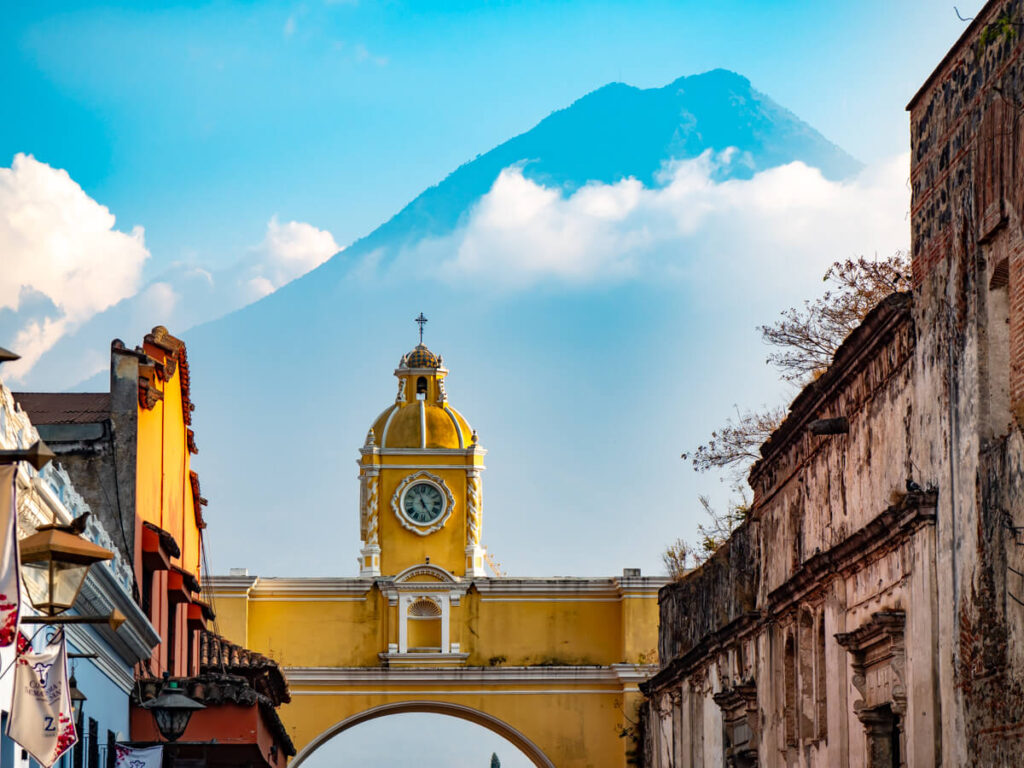
Santa Catalina Arch, built in 1694 to let cloistered nuns cross the street unseen, framing Volcán de Agua at the end of 5a Avenida Norte, is Antigua's signature image and best photographed at sunrise before tour groups and traffic fill the street. The Church of San Francisco (entry around Q35) preserves its roofless nave and grassy former convent grounds; La Merced has a striking yellow baroque facade with a fountain-filled cloister behind it; and Santo Domingo, the largest of the ruined convents, is now partly incorporated into the Casa Santo Domingo hotel complex, with an excellent on-site archaeology and colonial art museum open to non-guests. Climb, free, to Cerro de la Cruz on the city's northern edge for the classic wide shot of Antigua's rooftops with Agua and Fuego behind them; go with others or in daylight, as it's a somewhat isolated walk up.
Pacaya Volcano
The easiest, most accessible volcano experience near Antigua: a roughly one-hour drive to the base, then about a 2-hour hike across fields of petrified lava to a spot where guides help you roast marshmallows over volcanic heat. Moderate fitness required, no technical climbing, and doable as a half-day trip that still leaves you time for dinner back in town.
Acatenango overnight
The harder, more serious version: an overnight trek to a base camp facing Fuego, where dozens of Strombolian explosions light the dark sky through the night. Genuinely demanding, steep terrain, cold overnight temperatures, real altitude, and worth every bit of the effort for anyone reasonably fit. As of this update, Acatenango hiking has resumed with full authorization after Guatemala's volcanology institute (INSIVUMEH) declared Fuego's early-August 2026 eruptive phase over; book only with an operator who checks current alert levels before departing, and expect the trip to focus on altitude, cold and trail conditions rather than the volcano itself, which reputable guides handle with appropriate caution and route planning.
Coffee farms and a cooking class
Beyond Finca Filadelfia and De La Gente (see Food, above), several operators run half-day Guatemalan cooking classes in Antigua, working through dishes like pepián from market shopping to table, a good rainy-afternoon alternative to a volcano hike.
Semana Santa, if your dates line up
Holy Week, dates move with Easter each year, is Antigua's single biggest event: elaborate sawdust-and-flower alfombras laid across whole streets overnight, processed over and destroyed by hooded penitents carrying massive wooden floats. Extraordinary to witness, and the reason to book accommodation months in advance if your trip happens to land during it.
One, two or three days, plus what to bolt on
Two to three full days covers Antigua itself properly. A fourth day is really the Acatenango overnight in disguise, since it consumes most of two calendar days for one night on the mountain.
- Morning
Santa Catalina Arch at sunrise, then Parque Central and the Cathedral before the day heats up.
- Midday
San Francisco and La Merced ruins, lunch at a market comedor off 4a Calle Poniente.
- Afternoon
Santo Domingo's museum or a short coffee farm visit if time allows.
- Evening
Cerro de la Cruz for the classic view (go with others), dinner at El Comalote or Por Qué No?.
- Day 1
The one-day route above: Santa Catalina Arch, the ruins, Cerro de la Cruz.
- Day 2
Pacaya Volcano, half-day hike and marshmallow roasting, back in town for a relaxed dinner and, if you booked ahead, a table at Quiltro.
- Days 1-2
The two-day route above, at a gentler pace, adding a coffee farm tour and a cooking class.
- Day 3, option A
Acatenango overnight, departing morning of day 3, returning midday of day 4; plan for a slow rest day afterward.
- Day 3, option B
Lake Atitlán day trip. Shuttle out early, boat between villages, back in Antigua by evening.
Compact, walkable, and uneven underfoot
Antigua's historic center is small enough to cross on foot in about 25 minutes, though the cobblestones make it slower going than the map suggests. From La Aurora International Airport (GUA) in Guatemala City, shared shuttles cost $19-25 per person and take 45 minutes to an hour for the 25-kilometer route; private transfers run $32-50. Book ahead for early-morning or late-night flights, when fewer shared shuttles run.
Within town, walking covers almost everything. Colorful tuk-tuks handle short hops for Q10-20, useful for the uphill walk back from Cerro de la Cruz or a late return from dinner. For onward travel, tourist shuttles connect Antigua to Lake Atitlán (2.5-3 hours, $10-15) and Chichicastenango ($10-20), timed around the Thursday and Sunday market days; book through your hotel or a travel desk in town rather than showing up at a bus terminal.
Best time to visit and Semana Santa
November to April is Antigua's dry season and by far the easiest time to visit: clear skies for volcano hikes and reliable views from Cerro de la Cruz. February and March are the sweet spot, dry weather without Semana Santa's crowds. May to October brings dependable afternoon rain but lower prices and a greener city.
Semana Santa, Holy Week, moves with Easter each year and is Antigua's defining event: elaborate sawdust-and-flower alfombras laid overnight across entire streets, processed over by hooded penitents carrying massive floats through the night. Hotels book out months ahead; plan deliberately around it, either to be there or to avoid the crowds and prices.
One of the better-value colonial cities in the Americas
Antigua costs more than rural Guatemala but remains genuinely affordable next to comparable colonial cities elsewhere in Latin America. The main cost spikes are the Acatenango guide fee and a table at Quiltro.
- Guesthouse dorm or room $15-25
- Market comedor meals Q25-40
- Walking plus the occasional tuk-tuk
- Free ruins views, Cerro de la Cruz
- Boutique hotel $60-100
- Restaurant meals $8-20/person
- Pacaya or Acatenango guided hike
- Coffee farm tour, museum entries
- Casa Santo Domingo or equivalent
- Tasting menu at Quiltro
- Private guides and transfers
- Cooking class, spa treatments
Guatemala's most comfortable city, with real things to plan around
Antigua is the most tourist-comfortable base in Guatemala: the historic center is fine to walk by day and into the evening, with a visible tourist police presence (Politur) around the main sights. It sits well outside the areas the US State Department specifically names in its Level 3, Reconsider Travel advisory for Guatemala, San Marcos and Huehuetenango departments, and two Guatemala City zones, none of which are anywhere near Antigua.
The things that actually matter here: cobblestones, genuinely uneven enough to cause twisted ankles, so wear flat shoes with real grip; altitude, at 1,530 meters real enough to cause headaches or fatigue in the first day or two, especially if you push straight into a volcano hike; petty theft in crowded spots like the central market and around Semana Santa processions, standard bag-awareness handles it; and volcanic activity, genuinely dynamic rather than a fixed backdrop, so book Pacaya or Acatenango only through operators who check current INSIVUMEH alert levels before departing. Beyond the historic center after dark, stick to lit main streets or a tuk-tuk rather than walking unfamiliar side streets. Guatemala's national emergency police line is 110; the tourist assistance line, staffed by English-speaking operators, is 1500.
Antigua is the best base in the country for a reason
Antigua's position in the central highlands, roughly equidistant from Lake Atitlán and the western highlands, makes it an excellent launch point beyond its own sights. Three trips are worth a full day each.
Lake Atitlán
The volcano-ringed crater lake Aldous Huxley called the most beautiful in the world. A day trip gets you Panajachel and one or two villages by boat, Q10-25 a hop; an overnight stay is genuinely better if you can spare it, since the lake rewards slowing down more than most day-trip destinations.
Chichicastenango Market
One of the largest and most colorful Indigenous markets in the Americas, textiles, wood carvings and produce spread across the plaza in front of the Iglesia de Santo Tomás, where K'iche' Maya ritual runs alongside Catholic practice on the church steps. Only operates Thursday and Sunday, plan your day trip accordingly, and go early before tour buses arrive mid-morning.
San Antonio Aguas Calientes & Iximché
San Antonio Aguas Calientes, 30 minutes from Antigua, is known for exceptional backstrap-loom weaving; several family workshops welcome visitors to watch the process. Further on, Iximché, the ruined former capital of the Kaqchikel Maya kingdom, sees a fraction of Tikal's visitors and remains an active Maya ceremonial site.
Antigua Guatemala FAQ
Is Antigua Guatemala safe for tourists?
Yes, within the standard precautions any Guatemala trip requires. Antigua's tourist core is comfortable to walk by day and into the evening; use registered tourist shuttles for trips beyond town, and watch your footing on the cobblestones after dark.
How many days do I need in Antigua Guatemala?
Two to three full days covers the ruins, Santa Catalina Arch and a coffee farm tour comfortably. Add a fourth day if you're doing the Acatenango overnight hike, and a fifth if you want Lake Atitlán or Chichicastenango as a day trip rather than folding them into a longer Guatemala itinerary.
How much does Antigua Guatemala cost per day?
Budget travelers manage on $35-50 a day with guesthouses and comedor meals; mid-range runs $80-120 with a boutique hotel and restaurant dining. Antigua is pricier than most of rural Guatemala but still one of the better-value colonial cities in the Americas.
Is Acatenango or Pacaya the better volcano hike?
Pacaya is a roughly 2-hour hike suited to most fitness levels, ending with marshmallow-roasting over volcanic heat. Acatenango is a genuinely hard overnight trek to a base camp facing Fuego, rewarded with Strombolian explosions lighting up the night. Do Pacaya if you have one day and moderate fitness; do Acatenango if you have two days and want the harder, more memorable version.
When is the best time to visit Antigua?
November through April, the dry season, with February and March the sweet spot for weather and crowds. Semana Santa (Holy Week, dates move with Easter) is Antigua's single biggest event and its most crowded, book months ahead if your trip lands during it.
How do I get from Guatemala City airport to Antigua?
Shared shuttles run $19-25 per person and take 45 minutes to an hour for the 25km route; private transfers cost $32-50. Book ahead for early morning or late night flights, when fewer shuttles run.
What is the best area to stay in Antigua?
Anywhere within about six blocks of Parque Central puts you in walking distance of everything. Streets nearer Santa Catalina Arch and the ruins are quieter at night than the blocks immediately around the party-leaning bars near the park.
Do I need to speak Spanish in Antigua?
No, though it helps. English is common in hotels, restaurants and tour operators in the tourist core; it thins out quickly once you're in the market or outside the center.
Is Antigua walkable?
Very. The historic center is compact enough to cross on foot in 25 minutes, though the cobblestones are uneven and genuinely cause twisted ankles, so wear flat shoes with real grip.
Can I drink the tap water in Antigua?
No. Tap water isn't safe to drink anywhere in Guatemala, including Antigua. It's fine for showering and brushing teeth. Most hotels and restaurants provide filtered water.
What Stays With You
Antigua doesn't hide what happened to it. The roofless naves and collapsed arches sit right in the middle of the tourist route, not tucked into a fenced-off archaeological park, and that honesty is most of what makes the city work. You eat dinner two blocks from a convent nobody rebuilt, walk past a fountain still running in a cloister the earthquake half-destroyed, and watch three volcanoes from a rooftop bar, one of them still, occasionally, actively erupting.
Go up to Cerro de la Cruz in the late afternoon, watch the light change on Agua's slopes, and understand why nobody who spends three days here leaves wishing they'd based themselves in the capital instead.