
What You're Actually Getting Into
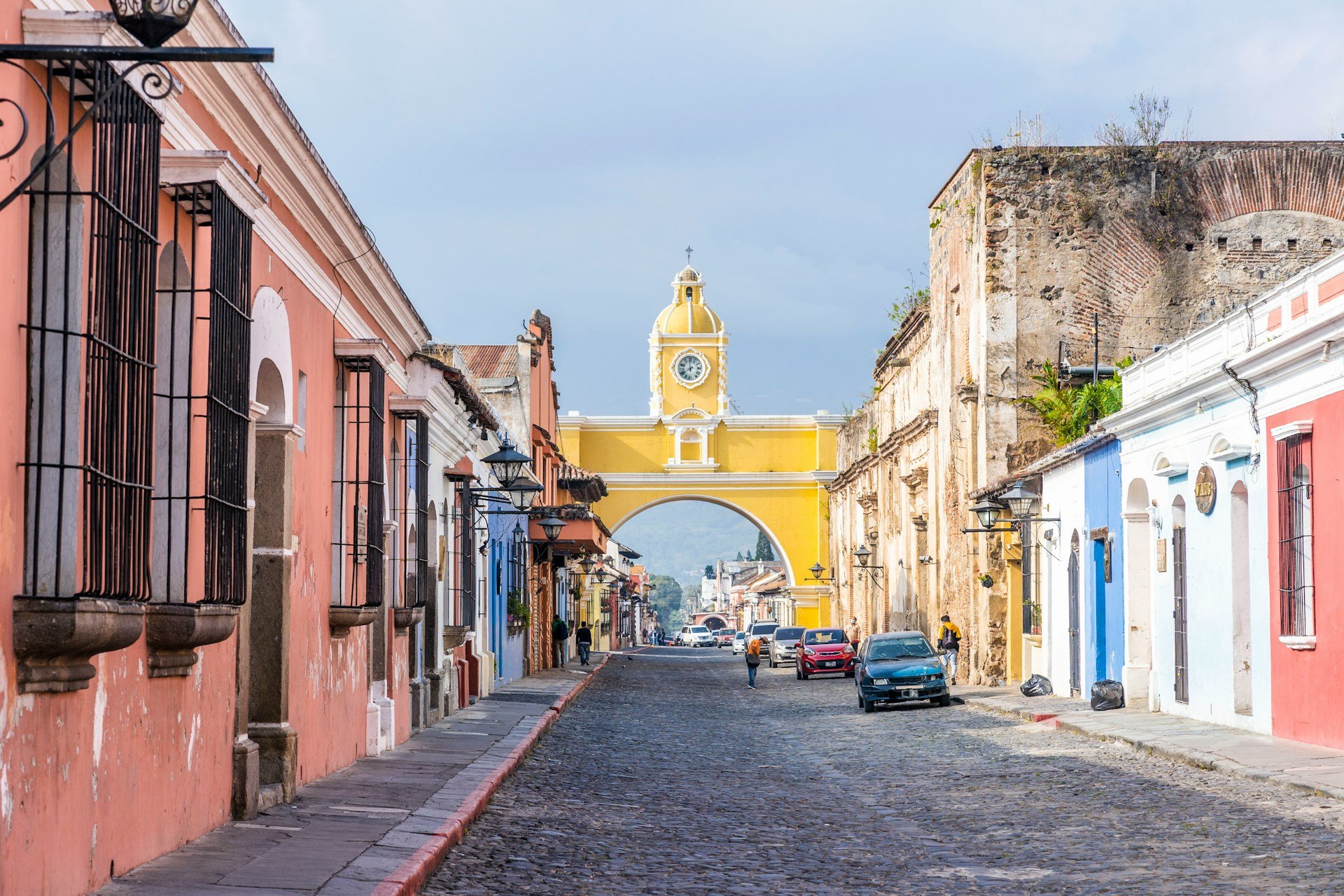
Guatemala is the country most travelers to Central America wish they'd allotted more time for. It has the region's deepest Maya heritage, its most photogenic colonial city, and landscapes that shift from cloud forest to volcanic highland to jungle lowland within a few hours' drive. Antigua, the former colonial capital, sits in a valley ringed by three volcanoes and has been rebuilt around its own ruins since a pair of 18th-century earthquakes drove the government out for good, and the result is a city that wears its damage as visibly as its charm.
The country is also one of the best-value destinations in the Americas. A full lunch at a market comedor costs 25 to 40 quetzales, about 3 to 5 dollars. A boutique guesthouse room in Antigua runs 40 to 80 dollars. And the volcano hikes, the coffee, at some of the world's best growing altitudes, and the sheer density of UNESCO sites (Antigua, Tikal, Quiriguá) make it punch well above its size for a country roughly the area of Ohio.
The honest complications
Guatemala carries a US State Department Level 3, Reconsider Travel advisory, and it is not a blanket rating to wave away: San Marcos and Huehuetenango departments, plus Zone 18 and the city of Villa Nueva within Guatemala City, are specifically flagged Do Not Travel for cartel and gang activity. None of that touches Antigua, Lake Atitlán, Tikal, or Guatemala City's Zones 10 and 14, which is where the standard itinerary lives, but it means Guatemala rewards travelers who stick to the known circuit and use tourist shuttles rather than improvising with public chicken buses on intercity routes. Altitude is a real, undersold factor too: Antigua sits at 1,530 meters and the highlands go higher, so budget a slow first day. And in August 2026, Volcán de Fuego near Antigua had a serious eruptive phase that evacuated roughly 1,700 people before authorities declared it over; volcanic activity here is real and monitored, not a remote abstraction, and it's worth checking current alert levels before booking a volcano hike.
A History Worth Knowing
Guatemala sits at the heart of the Maya world: Tikal was a major city-state a thousand years before Spain existed as a nation. Pedro de Alvarado's conquest in 1524 began three centuries of colonial rule from a capital that earthquakes twice forced to relocate. Independence in 1821 gave way to a turbulent 20th century, including a 36-year civil war that ended in 1996, and the country's recent history is a story of fragile democratic gains against deeply entrenched corruption.
- c. 250-900 CE
The Maya Classic Period. Tikal and other city-states flourish across the Petén lowlands, building temple-pyramids and a sophisticated calendar and writing system before a still-debated collapse scatters the population.
- 1524
Spanish conquest. Pedro de Alvarado defeats the K'iche' Maya and founds the first colonial capital; after it's destroyed, a second capital is founded at present-day Antigua in 1543.
- 1773
The Santa Marta earthquakes. A catastrophic sequence of quakes devastates Antigua so badly that the Spanish crown relocates the capital to the site of modern Guatemala City in 1776, abandoning Antigua's grandest buildings as ruins.
- 1821
Independence. Guatemala breaks from Spain as part of the Federal Republic of Central America, which dissolves by 1841 into separate nations.
- 1960-1996
Civil war. A 36-year conflict between the military government and leftist guerrillas kills or disappears roughly 200,000 people, with UN-documented genocide against Maya communities concentrated in the early 1980s. Peace Accords are signed in 1996.
- 2023-2024
A contested handover. Anti-corruption reformist Bernardo Arévalo wins the 2023 runoff; prosecutors and Congress spend months trying to block his inauguration before he's sworn in in January 2024 after sustained Indigenous-led protests.
Read the full history: the Maya collapse, colonial Antigua, the war and Rigoberta Menchú
The Classic Maya collapse around 900 CE remains one of archaeology's open questions, with drought, warfare, overpopulation and soil exhaustion all cited as likely contributing factors. Tikal itself was rediscovered by outsiders only in the 19th century, though it had never been entirely forgotten by the region's Indigenous population. Guatemala's Maya heritage isn't a museum piece: more than 40% of the population identifies as Indigenous today, one of the highest shares in the Americas, and 21 distinct Mayan languages are still spoken.
Antigua, founded as Santiago de los Caballeros de Guatemala in 1543, became one of the most important cities in the Spanish Americas, seat of the Captaincy General of Guatemala and home to grand churches, convents and a university. The 1773 Santa Marta earthquakes, following an earlier devastating quake in 1717, left so much of the city in ruins that colonial authorities gave up rebuilding it and moved the capital roughly 45 kilometers away. The ruins were never fully cleared; they're what you walk through today.
The 20th century was harder. A 1954 CIA-backed coup ousted the democratically elected Jacobo Árbenz after his land reform program threatened United Fruit Company holdings, a turning point that historians link directly to the instability that followed. Civil war broke out in 1960 and ran for 36 years, with a UN-backed truth commission later concluding that state forces committed acts of genocide against Maya communities, particularly during the early-1980s scorched-earth campaigns under General Efraín Ríos Montt. Rigoberta Menchú, a K'iche' Maya rights activist who lost family members to the violence, won the Nobel Peace Prize in 1992 for her advocacy, four years before the 1996 Peace Accords formally ended the war.
Where things stand now. A 2015 corruption scandal (the "La Línea" customs fraud case) forced President Otto Pérez Molina's resignation, part of a wave of accountability driven by the UN-backed CICIG anti-corruption commission before it was expelled in 2019. Bernardo Arévalo's 2023 election on an anti-corruption platform, and the extraordinary effort by prosecutors and outgoing officials to prevent his inauguration, showed both how far the country has come and how contested that progress remains; 2026 has been described as an institutional reset year, with his approval rating dipping amid public frustration over security and infrastructure even as international observers credit his government with real anti-corruption efforts.
Top Destinations
Guatemala divides into five travel zones: colonial Antigua and its volcanoes, Lake Atitlán's Maya villages, the Petén jungle around Tikal, the western highlands, and the capital plus the Pacific coast. Distances are short as the crow flies but the roads are mountainous, so budget more travel time than the map suggests. A week covers Antigua, Atitlán and Chichicastenango well; two weeks adds Tikal.
Antigua, the colonial capital that refuses to be a museum
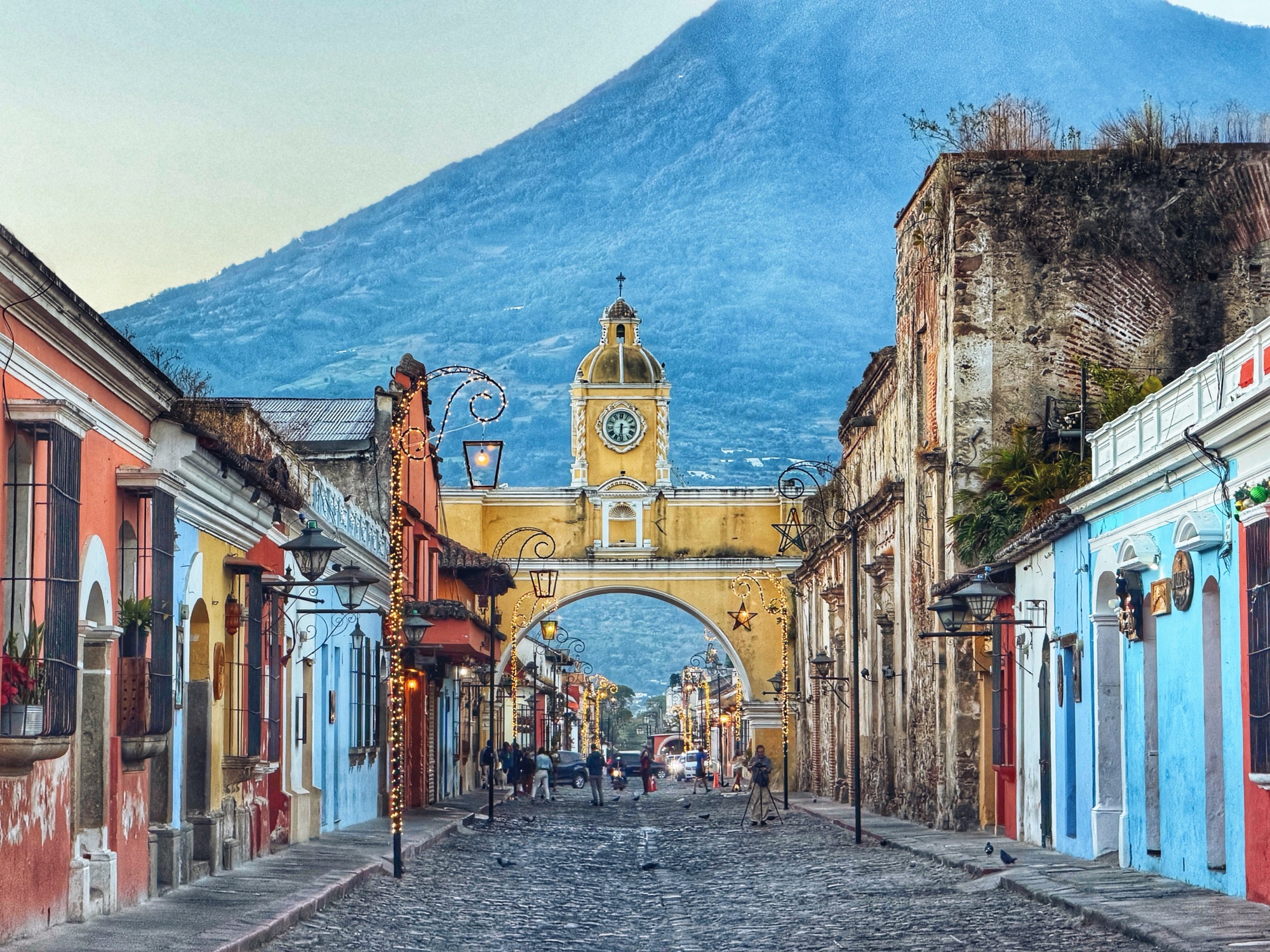
Antigua is compact enough to walk end to end in 25 minutes, its grid of cobbled streets lined with single-story colonial facades in mustard yellow, terracotta and faded blue. Santa Catalina Arch, built in 1694 so cloistered nuns could cross the street unseen, frames Volcán de Agua at the end of 5a Avenida Norte and is the city's signature shot, best at sunrise before the tour groups. The earthquake-ruined convents, La Merced, Santo Domingo (now partly the Casa Santo Domingo hotel and archaeology museum) and the Church of San Francisco (entry around Q35), are wandered rather than toured: roofless naves, collapsed arches and grass growing where the altar once stood. Climb to Cerro de la Cruz, a free viewpoint above the city, for the postcard shot of Antigua's rooftops with Agua and Fuego behind it.
Lake Atitlán, ringed by three volcanoes
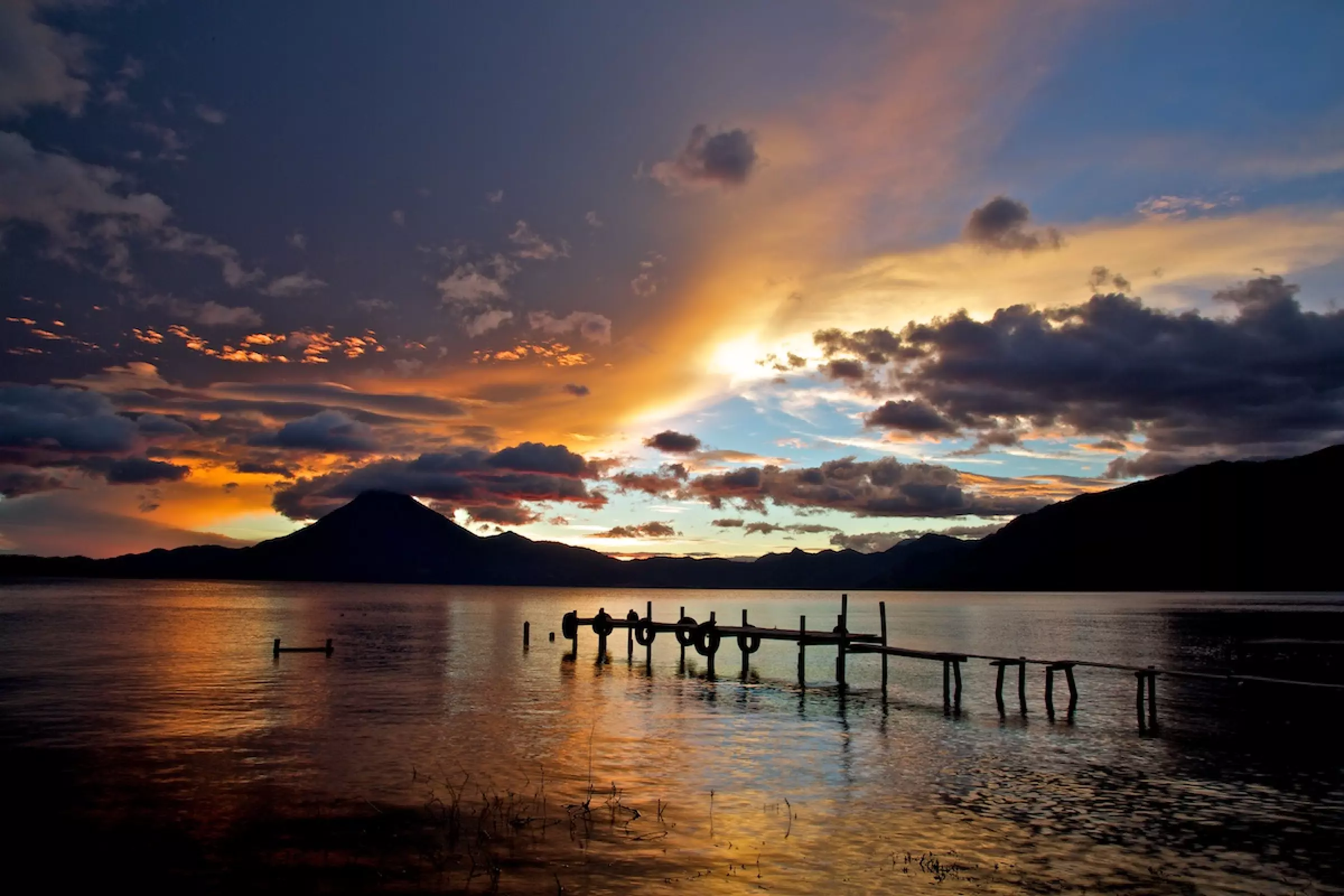
Aldous Huxley called Lake Atitlán the most beautiful lake in the world, and the claim has aged well: a vast volcanic crater lake, deep blue, framed by the cones of Atitlán, Tolimán and San Pedro volcanoes, with a dozen Maya villages scattered around its shore, each with its own character and boats connecting them. Panajachel ("Pana") is the practical gateway, with the widest choice of hotels and the lancha (boat) docks. San Pedro La Laguna has the backpacker and language-school energy, cheap guesthouses stacked up the volcano's lower slopes. San Juan La Laguna is quieter and built around Maya weaving cooperatives where you watch natural dyes made from plants, and San Marcos La Laguna is the wellness and yoga retreat village, with a startling number of cliff-jump swimming spots along its shore path.
Tikal, temples above the jungle canopy
Tikal, a UNESCO World Heritage Site deep in the Petén jungle, was one of the most powerful Maya city-states of the Classic Period, and its scale still lands: Temple IV rises 65 meters, tall enough that its summit clears the surrounding rainforest canopy, howler monkeys included. The Great Plaza, flanked by Temples I and II facing each other across a grass square, is the classic image; climbing (where permitted) or viewing Temple IV at sunrise or sunset, when mist sits in the canopy below, is worth arranging in advance with a guide. Base yourself in Flores, a small colorful island town on Lake Petén Itzá connected by causeway, rather than trying to see Tikal in a single rushed day from Antigua.
Yaxhá, the quieter alternative
An hour from Flores, Yaxhá is a smaller, far less visited Maya site on a lakeshore, with a similarly dramatic sunset climb and a fraction of Tikal's crowds. Worth the extra day if you have it.
Chichicastenango's market
Chichicastenango's market, held only on Thursdays and Sundays, is one of the largest and most colorful Indigenous markets in the Americas: textiles, wood carvings, ceramics and produce spread across the plaza in front of the whitewashed Iglesia de Santo Tomás, where K'iche' Maya religious practice, incense burned on the church steps, prayers offered in Mayan, runs alongside Catholic ritual rather than beneath it. Go early, before the tour buses from Antigua and Guatemala City arrive mid-morning.
Quetzaltenango (Xela) & the far highlands
Guatemala's second city, known locally as Xela, is a highland hub for Spanish language schools and a base for the Fuentes Georginas hot springs, volcanic pools set into a cloud-forest hillside. The Ixil Triangle further north, around Nebaj, is remote, still recovering from the civil war's worst violence, and rewarded with some of the country's most dramatic, least-visited trekking.
Guatemala City, a one-to-two-day add-on
Guatemala City is not where visitors base themselves, but Zones 10 and 14 hold genuinely good museums: the Museo Popol Vuh, with one of the best Maya art collections anywhere, and the Museo Ixchel, dedicated to Maya textiles, both sit on the Universidad Francisco Marroquín campus in Zone 15/16. The historic Zone 1, with the Palacio Nacional de la Cultura and the Metropolitan Cathedral around the central plaza, is worth a daytime look but not an overnight stay.
Monterrico, the Pacific coast
Monterrico's black volcanic-sand beaches, about 3 hours from Antigua, are a legitimate add-on for a slower trip: strong Pacific surf (better for watching than swimming for most visitors), mangrove boat tours, and a sea turtle hatchery that releases baby olive ridley turtles most evenings in season.
Hidden gems beyond the main circuit
The zones above cover a first or second trip well. With extra days, these reward the detour.
Pacaya Volcano
An active volcano with a roughly 2-hour hike across petrified lava fields to a spot where guides let you roast marshmallows over volcanic heat. The easiest, most family-friendly volcano experience near Antigua.
Acatenango Base Camp
An overnight trek to a base camp facing Fuego, where dozens of Strombolian explosions light up the dark. Genuinely hard (altitude, cold, a steep final push), and the reason serious trekkers put Guatemala on the list.
Quiriguá
A small, little-visited UNESCO Maya site famous for the tallest carved stelae in the Maya world, some over 10 meters, with hieroglyphic detail still sharp after 1,300 years.
Semuc Champey
Turquoise limestone pools stepped above a river that runs underneath them through a natural cave. Remote and rough to reach, which is exactly why it still feels undiscovered.
Kak'ik country
The Cobán area is the home of kak'ik, a spiced turkey soup recognized as part of Guatemala's intangible cultural heritage, and one of the country's coolest, mistiest climates.
Iximché
The ruined former capital of the Kaqchikel Maya kingdom, an easy stop between Antigua and Lake Atitlán, with far fewer visitors than Tikal and genuine Maya ceremonial use still ongoing on-site.
Culture & Etiquette
Guatemala's Maya heritage isn't a historical backdrop, it's a living majority culture: over 40% of the population identifies as Indigenous, 21 Mayan languages are spoken alongside Spanish, and traditional woven traje típico, especially the huipil blouse, carries village-specific patterns that function almost like a dialect in cloth. Religion here is frequently syncretic: Catholic ritual runs alongside Maya spiritual practice, most visibly at Chichicastenango's church steps and around the folk saint Maximón (also called San Simón), a cigar-smoking effigy honored with rum and offerings in Santiago Atitlán and elsewhere.
Do
- Ask before photographing people, especially in traditional dress at markets. A small purchase or a polite request goes further than a candid shot.
- Carry small bills and coins (quetzales). Market vendors and tuk-tuks rarely have change for large notes; ATMs are common in Antigua but scarcer in villages.
- Learn a few Spanish phrases. Gracias, por favor, buenos días. English is common in Antigua's tourist zone and drops off quickly elsewhere.
- Respect Maya ceremonial sites. At Iximché or during a Maximón visit, follow your guide's lead on what's appropriate to photograph or touch.
- Acclimatize before exerting yourself. Antigua sits at 1,530 meters; give yourself a slow first day before a volcano hike.
Don't
- Take public "chicken buses" for intercity travel without local guidance. They're an authentic experience on short local hops but carry a real, specifically flagged robbery risk on some intercity routes; tourist shuttles exist for a reason.
- Wander outside your hotel after dark in Guatemala City outside Zones 10 and 14, or in unlit parts of any town.
- Assume all "Guatemalan" crafts in a shop are handmade locally. Ask, and buy from cooperatives like De La Gente or San Juan's weaving collectives when authenticity matters to you.
- Hike Fuego volcano itself. It's not permitted and not safe. Acatenango's base camp, facing Fuego from a safe distance, is the way to experience it.
- Skip travel insurance with evacuation coverage. Altitude, volcano hikes and rural roads make it a genuinely useful safety net here, not a formality.
Deeper culture: marimba, weaving traditions and Maximón
Marimba. Guatemala's national instrument, a large wooden xylophone played by ensembles of up to a dozen musicians, heard at festivals, in restaurants and from speakers in almost every town plaza. UNESCO-recognized as part of the country's intangible cultural heritage.
Weaving. Backstrap-loom weaving, unchanged in method for centuries, produces huipiles whose colors and patterns traditionally identify the weaver's home village. Cooperatives around Lake Atitlán, especially San Juan La Laguna, let visitors watch the full process, from natural dye extraction to the loom.
Maximón / San Simón. A folk saint venerated in several highland towns, most famously Santiago Atitlán and Zunil, represented as a mannequin dressed in layers of scarves, offered cigarettes, liquor and money by supplicants seeking help with everything from health to love. Genuinely fascinating, and genuinely a living devotional practice, not a tourist photo op, however it can feel to an outsider.
Semana Santa in Antigua. Holy Week is Antigua's biggest event: elaborate alfombras, sawdust-and-flower "carpets" laid across entire streets overnight, are processed over and destroyed by hooded penitents carrying massive wooden floats, some requiring dozens of bearers. Dates move with Easter each year; book accommodation months ahead if your trip lands during it.
Food & Drink
Guatemalan food centers on corn, beans, and a small set of dishes cooked slow and eaten everywhere: at market comedores, at family tables, and increasingly at a genuinely serious fine-dining scene that put Antigua on the map when the city hosted Latin America's 50 Best Restaurants event in late 2025.
Pepián Q30-40
Guatemala's national dish: meat (usually chicken or beef) in a thick, toasted-seed-and-chili sauce with vegetables, served with rice and corn tortillas. Every region and family has its own version.
Kak'ik Q35-50
A spiced turkey soup from the Cobán region, recognized as part of the country's intangible cultural heritage, deep red from achiote and dried chilis. Worth seeking out even outside its home region.
Tamales Q5-10
Corn dough steamed in banana leaves (tamales colorados) or corn husks, filled with meat, chili sauce and sometimes olives and prunes. A Sunday and holiday staple sold from home kitchens and market stalls.
Chiles Rellenos Q25-35
Poblano peppers stuffed with meat and vegetables, battered and fried, served in tomato broth. A market lunch classic.
Guatemalan Coffee Q15-25
Grown at some of the world's best altitudes in eight recognized regions, including Antigua's own. Skip the instant coffee still served at some budget hotels and ask for local single-origin.
Gallo Beer & Atol Q10-15
Gallo, Guatemala's national lager, is everywhere. Atol de elote (sweet corn drink) and atol shuco (a fermented, savory version) are street-stall staples worth trying at least once.
When to Go & Itineraries
November through April is the dry season (verano) and the easiest time to travel: clear skies for volcano hikes, passable rural roads, and reliable visibility at Tikal and the highland viewpoints. February and March are the sweet spot, dry-season weather without the Semana Santa crowds that fill Antigua in March or April. May through October is the rainy season (invierno), with dependable afternoon downpours but lower prices, greener landscapes and thinner crowds.
All seasons compared, with temperatures
| Season | Verdict | Temps | Prices & crowds |
|---|---|---|---|
| Feb-Mar | Best | 12-25°C Antigua/highlands | Dry, mid crowds, before Semana Santa |
| Nov-Jan | Very good | 10-23°C Antigua/highlands | Dry, busy around Christmas/New Year |
| Apr | Good but busy | 14-27°C | Hottest dry-season month; Semana Santa crowds and prices |
| May-Oct | Good, wetter | 13-24°C | Lower prices; reliable afternoon rain, mornings often clear |
Year-round: Antigua and the highlands stay temperate (12-25°C) thanks to altitude; Guatemala City is similar; Tikal and the Petén lowlands run notably hotter and more humid (20-33°C) all year; the Pacific coast at Monterrico is hot and humid year-round.
Itineraries
Seven days covers the core circuit well. Two weeks adds Tikal and a volcano hike properly rather than rushed. The constraint is less distance than the mountain roads between zones.
- Days 1-3
Antigua. Arrive, acclimatize, ruins and Santa Catalina Arch, a coffee farm tour, and either Pacaya (day) or Acatenango (overnight, needs its own day either side).
- Days 4-5
Lake Atitlán. Shuttle from Antigua (2.5-3 hrs), base in Panajachel, boat to San Juan and San Pedro.
- Days 6-7
Chichicastenango & return. Time it for a Thursday or Sunday market day en route back to Antigua or the airport.
- Days 1-4
Antigua. Full exploration, coffee farm, Pacaya day hike, and the Acatenango overnight with a rest day either side.
- Days 5-8
Lake Atitlán. Slower pace across Panajachel, San Juan, San Marcos and San Pedro, with time to swim and just sit by the water.
- Day 9
Chichicastenango market en route to or from Atitlán, timed for Thursday or Sunday.
- Days 10-13
Tikal & Flores. Fly Guatemala City to Flores, sunrise or sunset at Tikal, a day at Yaxhá if time allows.
- Day 14
Guatemala City museums (Popol Vuh, Ixchel) before an international departure.
- Days 1-5
Antigua extended. Both Pacaya and Acatenango, multiple coffee farms, day trip to Iximché.
- Days 6-10
Lake Atitlán slow. All the villages, a weaving cooperative visit, and time at San Marcos's swimming spots.
- Days 11-13
Western highlands. Chichicastenango market, Xela, Fuentes Georginas hot springs.
- Days 14-17
Tikal, Flores & Yaxhá. An unhurried Petén stretch with both major sites and time on Lake Petén Itzá.
- Days 18-21
Pacific coast & capital. Monterrico's turtle release and black-sand beach, then Guatemala City's museums before departure.
Getting there & around
La Aurora International Airport (GUA) in Guatemala City is the country's main gateway, with direct flights from most major US hubs. It sits about 25 kilometers, roughly 45 minutes to an hour, from Antigua; shared shuttles run $19-25 per person, private transfers $32-50. Most first-time visitors go straight from the airport to Antigua rather than staying in the capital.
All transport options with prices: shuttles, flights, chicken buses
| Option | Price | Notes |
|---|---|---|
| GUA airport to Antigua shuttle | $19-25 shared | Multiple daily departures; book ahead for early morning flights. |
| Tourist shuttles (Antigua-Atitlán-Chichi) | $10-20/route | Door-to-door minivans; the standard way tourists move between hubs. |
| GUA/Antigua to Flores flight | $120-220 return | TAG Airlines and Avianca, several daily; the practical way to reach Tikal. |
| Public lanchas, Lake Atitlán | Q10-25/hop | Village-to-village boats; the way locals and most travelers get around the lake. |
| Tuk-tuks, Antigua | Q10-20 | Quick hops within town; agree the fare before getting in. |
Chicken buses, repurposed and elaborately painted US school buses, are the classic budget way locals travel between towns, cheap and genuinely memorable for a short local hop. For intercity travel between major tourist hubs, though, tourist shuttles are the standard choice: some chicken bus routes carry a specific, well-documented robbery risk that shuttles largely avoid.
Practical prep: buy a Guatemalan SIM at the airport or an eSIM before landing; Claro and Tigo both have decent coverage on the standard circuit, weaker around Lake Atitlán's far shore and in the Petén. Pack layers: Antigua and the highlands get cold at night year-round despite the tropical latitude.
Where to stay
Antigua hostels & guesthouses
Antigua has an excellent budget scene: family-run guesthouses in converted colonial homes, courtyards included, walking distance from the ruins and Parque Central.
Antigua boutique hotels
Converted colonial buildings with courtyards and volcano views. Mesón Panza Verde, Antigua's first European-style boutique hotel and restaurant since 1986, is the standout in this bracket.
Antigua's grand hotels
Camino Real Antigua (from around $131) and the 5-star Casa Santo Domingo (from around $209), built into a former Dominican convent complete with its own museum and spa, are the top tier.
Lake Atitlán & Flores
San Pedro and San Marcos La Laguna have some of the cheapest lakeside guesthouses in Central America; Flores' small hotels on Lake Petén Itzá are similarly good value ahead of a Tikal visit.
Budget Planning
Guatemala is one of the more affordable countries in the Americas, especially outside Antigua's tourist core. Budget travelers eat and sleep well on 35 to 50 dollars a day; the main cost spikes are the Acatenango overnight guide fee and the Flores flight for Tikal.
- Hostel or guesthouse $15-25
- Market comedor meals Q25-40
- Tourist shuttles between hubs
- Free viewpoints, market days
- Boutique hotel or B&B
- Restaurant dinners $8-20/person
- Guided volcano hikes & coffee tours
- Private shuttle transfers
- Casa Santo Domingo or equivalent
- Tasting menus at El Comalote or Quiltro
- Flores flight & private Tikal guide
- Private drivers between zones
Quick reference prices: comedor meals, coffee, entry fees
| Market comedor meal | Q25-40 (~$3-5) |
| Coffee, local cafe | Q15-25 |
| Restaurant dinner (mid) | $8-20 |
| Antigua ruins entry (each) | ~Q20-35 |
| Antigua-Atitlán shuttle | $10-15 |
| Acatenango guided overnight | $45-75 |
| Tikal park entrance | ~$20 (Q150) |
| Boutique hotel, Antigua | $40-100/night |
Prices reflect August 2026 research and drift over time. Treat them as a planning baseline, not a quote; the quetzal traded at roughly 7.6 to the US dollar at the time of writing.
Visa & Entry
Guatemala has a permissive visa regime for most Western passports: US, EU, UK, Canadian, Australian and New Zealand citizens enter visa-free for 90 days, stamped on arrival, no advance tourist card required. Guatemala participates in the CA-4 Border Control Agreement with El Salvador, Honduras and Nicaragua, meaning the 90-day allowance is shared across all four countries: time spent in any of them counts against the same clock, and exiting to a non-CA-4 country resets it.
✓ Valid passport
At least 6 months validity is commonly recommended, though the formal minimum is shorter; keep a photocopy separate from the original.
✓ Proof of onward travel
May be requested at immigration, particularly for air arrivals without a return ticket already booked.
✓ CA-4 shared 90 days
Extendable once for an additional 90 days for a $25 fee at Guatemalan immigration; exiting to a non-CA-4 country resets the clock entirely.
✓ Not Schengen-adjacent
Guatemala's visa rules are entirely independent of any European travel allowance you may also be managing.
| Guatemala | Belize | |
|---|---|---|
| Daily budget | $35-50 gets you far; one of the region's cheapest | Noticeably pricier, especially the cayes and diving |
| Headline draw | Colonial Antigua, volcanoes, deep Maya culture | The Belize Barrier Reef, diving and snorkeling |
| Maya ruins | Tikal, one of the largest and most dramatic sites | Caracol and Xunantunich, smaller but genuinely good |
| Language | Spanish; English limited outside tourist zones | English is the official language |
| Pace | Highland hikes and market towns, more active | Beach and reef, more laid-back |
Safety, Solo Women & Family
Guatemala carries a US State Department Level 3, Reconsider Travel advisory (last updated 12 March 2026), citing crime and terrorism. That's a real, specific rating, not boilerplate: it names San Marcos and Huehuetenango departments, plus Zone 18 and the city of Villa Nueva within Guatemala City, as Do Not Travel due to cartel and gang activity. None of those fall on the standard Antigua-Atitlán-Tikal circuit. Within Guatemala City, Zones 4, 10, 13, 14, 15 and 16 are the safe, well-patrolled areas where most visitors, embassies and international hotels sit; Zone 1's historic center is fine by day but best avoided after dark, and locals themselves generally steer clear of it at night.
Intercity transport
Use tourist shuttles between Antigua, Atitlán, Chichicastenango and other hubs rather than public "chicken buses," which carry a specific, documented robbery risk on some routes.
Volcanic activity
Fuego near Antigua had a serious eruptive phase in early August 2026. Book Acatenango and Pacaya hikes only with operators who check current INSIVUMEH alert levels before departing.
Petty theft & ATM scams
Pickpocketing occurs in crowded markets like Chichicastenango. Use bank-branch ATMs rather than standalone street machines, and be alert for card skimmers.
Two more things worth knowing: altitude and evolving volcano advisories
Altitude is an underrated risk. Antigua sits at 1,530 meters and Quetzaltenango higher still; mild headaches and shortness of breath in the first day or two are common and usually resolve with hydration and rest, not a reason to push through a strenuous hike immediately on arrival.
Volcano advisories change fast. The August 2026 Fuego eruption, which evacuated roughly 1,700 people over about 50 hours before authorities declared the eruptive phase over, is a reminder that alert levels here are genuinely dynamic, not a fixed background fact. Check CONRED and INSIVUMEH updates, or simply your tour operator's current guidance, close to your trip dates rather than relying on this page alone.
Solo women travelers
Guatemala is manageable for solo women who stick to the standard circuit and take the same precautions that apply to Guatemala City after dark: Antigua itself feels comfortable to walk during the day and into the evening in the tourist core, and the hostel and Spanish-school scenes around Lake Atitlán make it easy to meet other travelers and pair up for chicken-bus-adjacent activities like the Acatenango hike, which is always done in a group with a guide regardless. Dress modestly in rural highland villages and at religious sites, keep valuables out of sight on public transport, and use registered tourist shuttles rather than hailing unmarked taxis at night.
Emergency numbers
Embassies and a note on inconsistent emergency numbers
Sources vary on the exact ambulance and fire number, with 122, 123 and 128 all appearing across different official and secondary listings; if in doubt, the tourist line 1500 (ASISTUR/POLITUR), staffed by English-speaking operators trained specifically for visitors, is the most reliable first call and can route you further. It's reachable 24/7 from a Guatemalan number, or at +502-2290-2810.
- USA
- Guatemala City, +502-2326-4000
- Canada
- Guatemala City, +502-2363-4348
- UK
- Guatemala City, +502-2380-7300
- Germany
- Guatemala City, +502-2364-6700
- France
- Guatemala City, +502-2421-7370
- Spain
- Guatemala City, +502-2379-3530
Family travel & pets
Guatemala works well for families with older children and teens who can manage altitude, cobblestones and long travel days between zones. Pacaya's marshmallow-roasting hike, Lake Atitlán's boat rides and swimming spots, and Tikal's climbable temples all land well with kids old enough for the walking involved; the altitude in Antigua and the highlands can be tough on younger children and infants, so build in extra rest time.
Kids at altitude and bringing pets
Altitude with children: pediatric guidance generally recommends extra caution and a slower acclimatization schedule for children under 2 at elevations like Antigua's; check with a pediatrician before traveling with infants to the highlands.
Pets: importing a dog or cat requires a health certificate and proof of rabies vaccination issued by an accredited vet, typically within 10-15 days of travel, plus advance notice to Guatemalan agricultural authorities (MAGA). Rules shift periodically, so confirm current requirements directly with MAGA or your airline before booking.
Guatemala FAQ
Is Guatemala safe to visit?
The standard tourist circuit, Antigua, Lake Atitlán, Tikal and Guatemala City's Zones 10 and 14, is visited by hundreds of thousands of travelers a year without incident. The US State Department rates the country Level 3, Reconsider Travel, and specifically advises against San Marcos and Huehuetenango departments and two Guatemala City zones, none of which are on a typical itinerary.
Is Acatenango safe to hike right now?
Yes, as of this update. Fuego volcano had a paroxysmal eruption on 3-5 August 2026 that evacuated around 1,700 people; Guatemala's volcanology institute declared that phase over on 5 August, and Acatenango hiking resumed with full authorization. Book with a reputable operator who checks daily alert levels before departing.
Do I need a visa for Guatemala?
Citizens of the US, Canada, the UK, the EU, Australia and New Zealand enter visa-free for 90 days, stamped on arrival. Guatemala shares this 90-day allowance with El Salvador, Honduras and Nicaragua under the CA-4 agreement, so time in any of the four counts against the same clock.
How much does Guatemala cost per day?
Budget travelers manage on $35-50 a day with hostels, street food and shuttle transport. Mid-range runs $80-120 a day for boutique hotels and restaurant dining. Guatemala is one of the more affordable countries in the Americas.
When is the best time to visit Guatemala?
November through April is the dry season and the easiest time to travel, with February and March the sweet spot for weather and moderate crowds before Semana Santa. May through October is the rainy season, with afternoon downpours but lower prices and green landscapes.
How many days do you need in Guatemala?
Seven days covers Antigua, Lake Atitlán and Chichicastenango's market. Two weeks adds Tikal and a volcano hike. Three weeks fits the western highlands and the Pacific coast without rushing.
Should I base myself in Antigua or Guatemala City?
Antigua. It holds nearly all of the country's tourist infrastructure, sits 25km and about 45 minutes to an hour from the international airport, and is the standard first-time base. Guatemala City is treated as a one-to-two-day add-on for its museums, not a base.
Is the tap water safe in Guatemala?
No. Tap water isn't safe to drink anywhere in the country, including Antigua. It's fine for showering and brushing teeth. Most hotels and restaurants provide filtered water, and many properties use Ecofiltro clay filtration systems.
What language is spoken in Guatemala?
Spanish is the official language, but Guatemala recognizes 21 Mayan languages plus Xinca and Garífuna, and over 40% of the population identifies as Indigenous. English is common in Antigua and tourist areas, less so elsewhere.
Is Guatemala safe for solo female travelers?
Manageable on the standard circuit with normal precautions: stick to tourist shuttles rather than public chicken buses for intercity travel, avoid walking alone after dark outside Zones 10 and 14 in Guatemala City, and book volcano hikes through reputable operators. Antigua itself feels comfortable to walk during the day.
Can I see Tikal as a day trip from Antigua?
Yes, by air. Fly Antigua or Guatemala City to Flores in the morning, tour Tikal, and fly back the same evening. It's a long day but doable. A one or two-night stay in Flores is more relaxed and allows a sunrise tour over the jungle canopy.
Is Guatemala good for families with kids?
Yes for families with older children and teenagers who can handle altitude, cobblestones and long travel days. Lake Atitlán's boat rides, Pacaya's marshmallow roasting and Tikal's temples all land well; younger children may struggle with the altitude in Antigua and the highlands.
What Stays With You
Every traveler who spends a week in Guatemala ends up talking about Antigua the same way: a city that could have rebuilt itself glossy and complete after the 1773 earthquakes and chose instead to keep its ruins standing, cracked columns and roofless naves included, as though the damage was as worth preserving as the parts that survived. The volcanoes ringing it aren't scenery, they're active, monitored, occasionally evacuating, part of daily life rather than a backdrop.
The country asks a little more of you than some of its Central American neighbors: altitude, mountain roads, a Level 3 advisory that has to be read carefully rather than dismissed or feared wholesale. What it gives back, Maya temples clearing the jungle canopy, a lake that lives up to Huxley's claim, a market that has run on the same two days a week for centuries, is worth the extra care.