
Grenada
The air smells of nutmeg before you land. The harbor at St. George's is the most beautiful in the Caribbean. There are human figures made of concrete standing on the seabed forty feet down, encrusted with coral. Grenada is the island that keeps producing surprises.
What You're Actually Getting Into
Grenada (greh-NAY-dah) is a small island nation of about 120,000 people sitting at the southern end of the Eastern Caribbean chain, close enough to Trinidad that on a clear day you can see Venezuela's coastline from its southern tip. It covers 344 square kilometers across three main islands: Grenada itself, Carriacou, and Petite Martinique. The whole country is roughly the size of a medium-sized city's downtown. You can drive around the main island in three hours on a good road day, and you should.
What Grenada is not: a mass-market beach resort destination. There are no casino strips, no all-inclusive hotel complexes taking up kilometers of coastline, and no cruise ship beaches developed exclusively for day passengers. What Grenada is: a genuinely beautiful, well-run, English-speaking Caribbean island with one of the best natural harbors in the region, extraordinary marine life, a spice agriculture tradition that dates back centuries, and a bean-to-bar chocolate industry that has attracted serious attention from people who care about such things.
The island attracts a particular kind of traveler: people who've done the resort Caribbean and want something with more substance, sailors who use St. George's as a hurricane-hole and provisioning stop, divers coming specifically for the Bianca C wreck and the underwater sculpture park, and increasingly, food-focused visitors who've heard about the Grenada Chocolate Festival or the nutmeg estate tours. These are all correct reasons to come. So is Grand Anse beach, which is three kilometers of white sand framed by green hills and is as good as its reputation.
The island is not cheap by regional standards. It has no mass tourism economy to subsidize visitor costs, and what there is of an infrastructure is genuinely maintained. Accommodation ranges from small guesthouses to well-run boutique hotels and a small number of larger properties. This is not where you come to spend $40 a day. It is where you come to spend a week eating well, diving exceptionally, and leaving with spices that will improve your cooking for the next year.
Grenada at a Glance
A History Worth Knowing
Grenada's pre-colonial history follows the pattern common to the Eastern Caribbean: Arawak and later Kalinago (Island Carib) peoples inhabited the island for centuries before European contact. Columbus sighted Grenada on his third voyage in 1498 but did not land. The Spanish made no serious attempt to settle it, and French colonization began in the 1640s. The French exterminated the Kalinago population in a campaign that culminated at the northern tip of the island in 1651, where, according to the account, the last surviving Kalinago warriors leaped to their deaths from a cliff rather than surrender. That promontory is still called Le Morne des Sauteurs, Leapers' Hill, and is one of the most solemn spots in the Caribbean.
The French established the plantation economy, importing enslaved Africans to work the sugar, cacao, and indigo cultivation that defined the island's colonial period. Britain captured Grenada in 1762 and formalized control under the Treaty of Paris in 1763. The island switched between French and British control several more times before Britain secured permanent possession in 1783. The nutmeg tree was introduced from the Dutch East Indies in 1843, a decision that would permanently define the island's agricultural identity and its smell.
Emancipation came in 1838, and the subsequent century brought the slow development of a working class, labor movements, and eventually independence. Grenada became independent from Britain on February 7, 1974, under Prime Minister Eric Gairy. What followed is the most dramatic chapter in the island's modern history.
On March 13, 1979, the New Jewel Movement led by Maurice Bishop staged a coup while Gairy was abroad, overthrowing his government and establishing the People's Revolutionary Government. Bishop's government was socialist, allied with Cuba, and instituted genuinely popular policies including free education and healthcare. The revolution was watched closely across the Caribbean and caused significant anxiety in Washington. The Reagan administration considered Grenada a potential Soviet outpost, particularly regarding the airport being built with Cuban assistance at Point Salines.
On October 19, 1983, a faction within the New Jewel Movement led by Deputy Prime Minister Bernard Coard placed Bishop under house arrest. A crowd freed him and marched to Fort Rupert, where he and several of his cabinet were executed by soldiers loyal to Coard's faction. Six days later, the United States invaded Grenada under Operation Urgent Fury. The intervention, which Reagan framed as a rescue of American medical students and a rollback of communism, was condemned by the United Nations General Assembly but succeeded militarily within days. The American medical students were largely unaware they were in danger. The airport was eventually completed and now bears Bishop's name.
The 1983 events remain contested in Grenada. Maurice Bishop is remembered with genuine affection by many Grenadians. Fort Rupert, now called Fort George, is where the executions took place and where you can still see the bullet marks on the walls. The political period from 1979 to 1983 left a complicated legacy: genuine social achievements, a violent internal rupture, and a US intervention that ended it all. Understanding this history explains why Grenada feels somewhat different from the more straightforwardly tourist-oriented islands around it.
Does not land. The Spanish make no serious attempt to settle the island.
French settlers arrive and begin a systematic campaign against the Kalinago population, culminating at Leapers' Hill in 1651.
Treaty of Paris. Grenada becomes a British colony after a decade of Anglo-French conflict. Plantation agriculture intensifies.
Nutmeg trees planted from Dutch East Indies stock. Grenada will eventually produce 20% of the world's supply.
Grenada becomes independent under Prime Minister Eric Gairy on February 7.
Maurice Bishop's New Jewel Movement seizes power. Four years of socialist government, Cuban assistance, and Cold War anxiety follow.
Internal coup kills Bishop at Fort Rupert. Six days later, the United States invades under Operation Urgent Fury. Democracy restored.
Category 4 storm destroys 90% of the island's structures and devastates the nutmeg industry. Grenada rebuilds over the following decade.
Top Destinations
Grenada's main island is compact enough that you can see most of it in a week without rushing. The south, where the airport, Grand Anse, and St. George's are clustered, handles most of the tourist activity. The north is wilder, less visited, and where the best spice estates and rainforest hiking live. Carriacou, 37km north by ferry, is a different island in character and worth a night or two if you have the time.
St. George's
The most attractive capital in the Eastern Caribbean. The horseshoe harbor called the Carenage is lined with Georgian warehouses painted in red, yellow, and ochre, their reflections doubling in the calm water below. The covered market on Saturday morning sells spices, fresh produce, and fish with a commercial energy that feels entirely unperformed. The Sendall Tunnel connects the Carenage to the Market Square, cutting through the hillside and emerging into a completely different part of town. Fort George on the headland has the history and the view. Allow a full day to walk it properly.
Grand Anse
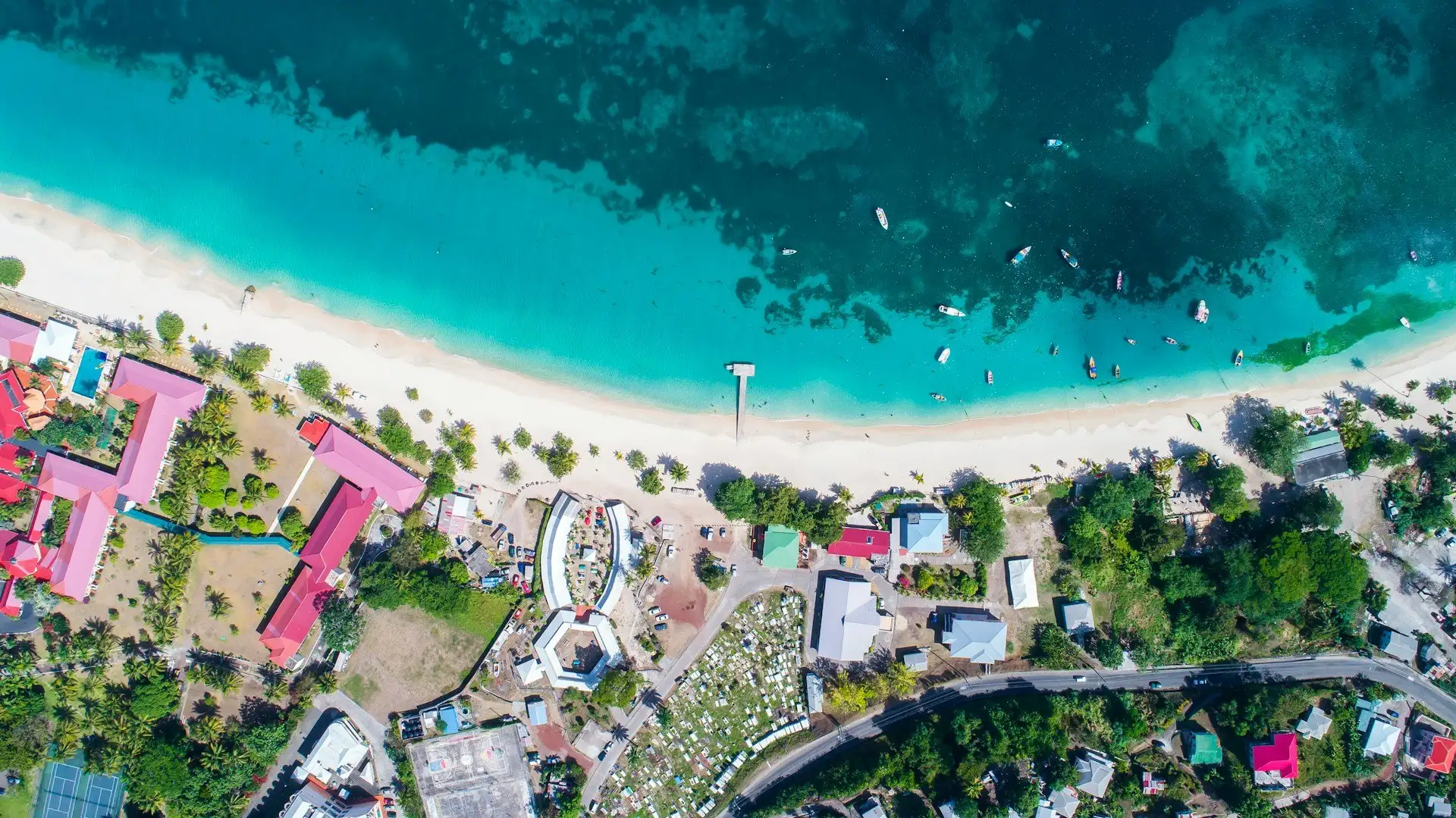
Three kilometers of white sand beach backed by green hills with calm, clear water and none of the commercial sprawl that ruins equivalent beaches elsewhere in the Caribbean. There are beach bars, a few sunlounger operators, and some watersports rentals, but the beach retains an uncrowded, unhurried quality on most days outside major cruise ship arrivals. The walk along the full length of Grand Anse at any time of day is the best free activity on the island. The southern end near the Spice Island Beach Resort has the most facilities; the northern end toward the reef is quieter and the snorkeling starts from the beach.
Molinere Underwater Sculpture Park
In 2006, British sculptor Jason deCaires Taylor installed a series of concrete human figures on the seafloor at Molinere Bay, north of St. George's. Now heavily colonised by coral, sponges, and marine life, the sculptures have transformed into artificial reef structures that attract an extraordinary diversity of fish. The Ring of Children and the Vicissitudes installation are the most photographed. Accessible to both divers and snorkelers. The site is managed as a protected area.
Bianca C
On October 22, 1961, the Italian cruise liner Bianca C caught fire in St. George's harbor and sank in 55 meters of water off the south coast of Grenada. At 183 meters, it is the largest wreck dive in the Caribbean. The ship lists to one side, its massive hull encrusted with black corals, huge schools of fish moving through the ballrooms and engine rooms. Advanced certification and experience are required for the deep sections. The upper sections can be explored by recreational divers. Every serious diver who visits Grenada dives the Bianca C.
Dougaldston & Belmont Estates
Two of the island's best agricultural estate tours, both in the northern interior. Dougaldston Estate near Gouyave is an old plantation still processing nutmeg and mace by hand, the drying racks laid out just as they have been for 150 years. Belmont Estate near Sauteurs has a working cacao operation offering a full bean-to-bar demonstration: fermentation, drying, roasting, grinding, and tasting. The tour ends with a lunch of traditional Grenadian food made with estate-grown produce. Budget three hours for Belmont. It's the best agricultural experience on the island.
Annandale & Seven Sisters Falls
Annandale Falls is the most accessible waterfall on the island: a 10-minute walk from the main road, a 30-meter cascade into a pool, and local kids diving from the rocks for tips. Good for a quick stop. Seven Sisters Falls in the Grand Etang Forest Reserve is the serious option: a 45-minute hike through rainforest to a series of falls where the swimming is genuinely excellent. The forest reserve also has Grand Etang Lake, a crater lake at 530 meters, and trails through montane cloud forest where the mona monkeys that escaped from a research station in the 1960s now live freely.
Carriacou
Grenada's largest dependency sits 37km north and takes about 1.5 hours by high-speed ferry from St. George's. Smaller, quieter, and with a different character from the main island, Carriacou has excellent beaches including Paradise Beach and Anse La Roche, strong diving off Sandy Island (a tiny sandbar islet surrounded by reef), and a boatbuilding tradition that has continued in the village of Windward since Scottish shipwrights settled there in the 18th century. The Carriacou Regatta in August is one of the Caribbean's great sailing events. Two nights minimum to understand the pace.
Gouyave Fish Friday
Every Friday evening, the small fishing town of Gouyave on the west coast transforms its seafront into a street food market running from around 7pm. Fresh grilled fish, oil-down (the national dish, cooked in large pots), fried bakes, rum punch, and live music from a speaker that has no concept of a volume upper limit. This is the most concentrated experience of everyday Grenadian social life available to visitors. A 30-minute drive from St. George's or Grand Anse. Go every Friday you're on the island.
Culture & Etiquette
Grenada has the warmth common to smaller English-speaking Caribbean islands combined with a social directness that reflects its scale. With 120,000 people, it functions like a large town: people know each other, word travels fast, and visitors who behave with genuine interest and respect are remembered and treated accordingly. The cultural atmosphere is conservative by European standards, religious (predominantly Roman Catholic and Anglican), and family-oriented in ways that shape public behavior.
Grenadians are proud of their island and its products. Showing genuine interest in the nutmeg industry, the chocolate, the rum (Clarke's Court and Rivers rum are both made here), and the fishing culture earns you far more than generic beach-tourist engagement. Ask your taxi driver about oil-down. Ask the woman at the spice market what to do with mace. These conversations will be better than most.
"Good morning" or "good afternoon" is the mandatory opener for any interaction. Walking into a shop, approaching a market stall, or asking directions without this greeting first reads as rude. It takes two seconds and the social return is immediate.
Not just for the food, though the food is excellent. For the experience of seeing a Grenadian fishing town organize its own celebration every single week without any tourist infrastructure requiring it. This is the island's social culture on full display.
The women at the Saturday market in St. George's have been selling hand-packaged nutmeg, mace, cinnamon, and bay leaf for decades. The prices are lower than the tourist shops, the quality is better, and every EC dollar goes directly to the sellers. Buy more than you think you need.
Swimwear is for beaches and pools. In St. George's, at the market, or visiting any community, a shirt and shorts is the baseline expectation. The island is genuinely conservative about this and it's worth respecting.
Clarke's Court rum is made in Woodlands and is excellent. Rivers rum is made by a waterwheel-powered pot still and is the most characterful rum in the Eastern Caribbean. Both are available on the island for a fraction of what they cost if exported. Try both. Buy both.
The site of Maurice Bishop's execution is not presented with drama or heavy signage. It's just an old fort with a view and some bullet holes. But those bullet holes are recent history that shaped an entire generation of Grenadians. Knowing the story before you go makes the visit meaningful rather than just scenic.
Grenada sits close to the equator and the humidity is genuine year-round. Hiking in the Grand Etang forest in the middle of the afternoon in August is not comfortable. Schedule active activities for early morning. Save the afternoons for the beach or the shade.
Outside the Grand Anse/St. George's corridor, Grenada is a real Caribbean island with variable road quality, limited mobile coverage in parts of the north, and restaurants that work on island time. A stated opening hour is a suggestion. Allow flexibility.
Belmont Estate's full tour is three hours including lunch. Dougaldston is an hour. These are not destinations you pass through quickly. The entire point is a slow immersion in how something you've been buying dried in a jar is actually grown, processed, and used. Give them the time they deserve.
Mace is the bright red lacy covering of the nutmeg seed and is intensely aromatic. Most of the world never encounters it fresh because it's almost entirely consumed on the island or exported in dried form. The mace sold at the Carenage market is as fresh as it gets. It will change the way you cook eggs.
Spicemas Carnival
Grenada's Carnival, called Spicemas, takes place in August over the weekend before the first Monday of the month. Unlike the pre-Lent Carnivals of Trinidad and Barbados, Spicemas has its own August timing and its own character: the Jab Jab (devil masquerade) tradition, where participants cover themselves in oil, mud, or chocolate and move through the streets in deliberately confrontational procession, is one of the most intense and distinctive Carnival traditions in the Caribbean. Not for the easily alarmed.
Sailing Culture
St. George's is one of the premier hurricane-hole harbors in the Eastern Caribbean. The anchorage in the lagoon fills with yachts year-round, and many long-distance sailors consider Grenada their home port. The Grenada Sailing Festival in January is a week of racing and social events that brings the sailing community together. The island has a sailing culture that predates tourism and continues to shape how the waterfront is organized and experienced.
Chocolate Culture
The Grenada Chocolate Company, founded in 1999, was one of the first bean-to-bar chocolate makers in the Caribbean and pioneered the model of farmer-owned cooperative chocolate production that has since been widely copied. Their dark chocolate bars, made from organic Trinitario cacao, have won multiple international awards. The Grenada Chocolate Festival, held annually in May, brings chefs, producers, and serious chocolate people from around the world. The chocolate here is not a novelty. It is genuinely excellent.
Fishing Tradition
Grenada has a deep fishing culture centered on towns like Gouyave, Victoria, and Sauteurs. The brightly painted traditional fishing boats (pirogues) pulled up on beaches around the island are working vessels, not decorations. Fish is central to Grenadian cooking and the freshest fish on the island is found at the markets in fishing towns rather than at Grand Anse tourist restaurants. The fishermen who brought the survivors of the Bianca C fire to shore in 1961 did so at significant personal risk and are still remembered.
Food & Drink
Grenadian food is built around the remarkable agricultural abundance of a volcanic spice island. Fresh fish, root vegetables, plantain, breadfruit, and the entire pharmacopeia of the spice trade: nutmeg, mace, cinnamon, cloves, bay leaf, and turmeric are all grown within driving distance of your plate. The cooking absorbs all of it. A simple fish stew here has a layering of flavor that equivalent dishes elsewhere in the Caribbean don't achieve.
The island's signature dish is oil-down: breadfruit, salted meat (typically pig's tail or chicken), callaloo, dumplings, and vegetables slow-cooked in coconut milk and turmeric until everything is saturated and the liquid has reduced to an oily residue at the bottom of the pot. It takes several hours to make properly, feeds a crowd, and is served at every significant social occasion. When you eat it at Gouyave Fish Friday from a pot that's been going since the afternoon, you understand what it means to cook with patience and intention.
Oil-Down
The national dish. Breadfruit braised in spiced coconut milk with salted meat, callaloo, and dumplings until everything is deeply flavored and the coconut milk has reduced to a rich glossy coating. Takes three to four hours to make correctly. Worth seeking out at Fish Friday in Gouyave, at Sunday community gatherings, and at the handful of restaurants that make it properly. Ask for it specifically. Not every restaurant offers it daily.
Fresh Fish
Grenada's fishing tradition means the fresh fish at local markets and the better restaurants is exceptional. Lambi (conch) stewed or curried, dolphinfish (mahi-mahi) grilled over charcoal, and jacks fried crisp are the staples. The fish market at the Carenage in St. George's operates early morning. The grilled fish at Gouyave on Friday nights is caught that day. This matters in the eating.
Nutmeg Everything
Nutmeg appears in Grenadian cooking in ways that would astonish you at home. Nutmeg jelly on toast for breakfast. Fresh-grated nutmeg over warm rum punch. Nutmeg ice cream. Nutmeg in fish cakes. Nutmeg in the seasoning rubs for grilled meat. This is not gratuitous. The fresh nutmeg flavor is genuinely different from the pre-ground powder and the Grenadians know exactly how much to use and when.
Chocolate
Buy the Grenada Chocolate Company bars at the source in Hermitage or at the shop on Young Street in St. George's. The 71% dark bar and the 82% are both exceptional. Crayfish Bay chocolate from the north of the island is more rustic and equally good. The chocolate tourism infrastructure on the island is well developed: Belmont Estate's cacao tour (book in advance) is the most complete chocolate origin experience in the Caribbean.
Rivers Rum
Rivers Antoine Estate in St. Patrick's parish in the north has been operating since 1785 using essentially unchanged technology: a 12-meter waterwheel drives the cane crusher, and the rum is distilled in a pot still with no modern intervention. The result is an overproof rum (up to 75% ABV in some expressions) with a cane-heavy character that bears little resemblance to commercially refined Caribbean rums. The estate is open for tours. The tasting is memorable. Go carefully with the 75%.
Rum Punch & Sea Moss
Grenadian rum punch uses Clarke's Court or Rivers rum as the base, fresh lime, Angostura bitters, and freshly grated nutmeg on top. This is the correct rum punch. All other rum punch is an approximation. Sea moss drink, made from Irish moss seaweed blended with nutmeg, cinnamon, and condensed milk, is the island's nutritional institution and available from street carts throughout St. George's.
When to Go
January to May is the dry season and the best time to visit. February and March are the optimal months: excellent weather, the Grenada Sailing Festival wraps up in January, humidity is at its lowest, and the sea conditions are good for diving. Grenada sits at 12° north latitude, slightly south of the main Caribbean hurricane corridor, which historically has made it less vulnerable than islands like Barbados or Dominica. However, Hurricane Ivan in 2004 was a Category 4 direct hit that caused catastrophic damage, so the "south of the hurricane belt" reputation should not be taken as absolute protection.
Dry Season
Jan – MayThe optimal window. January has the Sailing Festival energy. February and March are the driest and most comfortable months. April and May remain excellent. Sea visibility for diving is at its best. The trade winds keep temperatures manageable. Book accommodation in advance for January and February.
Shoulder
Nov – DecHurricane season officially ends November 30. December is generally excellent weather and the island is quieter than January before the peak season crowd returns. Some smaller properties offer discounted rates. Festive atmosphere in St. George's in December without the January peak pricing.
Carnival Season
AugSpicemas Carnival in August is worth timing around if the Jab Jab masquerade and street festival culture interest you. The weather is wetter and more humid, but Carnival energy overrides weather complaints. The Carriacou Regatta is also in August and is one of the Caribbean's finest sailing events.
Hurricane Season
Sep – OctPeak hurricane risk. Grenada's southerly position provides some statistical protection but not immunity. Ivan in 2004 proved this. Many smaller properties close for September and October. Sea conditions can make diving uncomfortable. Travel insurance with hurricane coverage is non-negotiable if you visit during this window.
Trip Planning
Seven to ten days is the right length for Grenada. Less than a week and you'll spend too much of it recovering from travel and not enough actually exploring. Two weeks is ideal if you add Carriacou for two or three nights. Three weeks on a small island requires genuine curiosity and a deep willingness to slow down, which some people find and others don't.
The island is compact and well-organized enough for independent travel without a car, using a combination of local buses (minivans running fixed routes for EC$2–5), taxis, and tour operators for specific excursions. A rental car adds freedom particularly for the north of the island, where the spice estates, Rivers Rum, and the wilder coastline require your own transport to explore comfortably. Driving on the left.
St. George's & Grand Anse
Arrive, settle in on or near Grand Anse. First afternoon: walk the full beach and swim. Day two: full day in St. George's. The Carenage, the market, Fort George, the Sendall Tunnel. Lunch at BB's on the waterfront. Evening back on the beach with a rum punch and freshly grated nutmeg on top.
Diving or Sculpture Park
Morning dive at the underwater sculpture park and/or the Bianca C if certified. Non-divers: snorkeling at the sculpture park or Grand Anse reef. Afternoon: Annandale Falls as a quick stop, then rest. Friday evening: Gouyave Fish Friday (30 minutes by taxi). Non-negotiable.
Northern Spice Country
Full day with a rental car or driver into the north. Dougaldston Estate for nutmeg processing. Lunch at a local rum shop. Rivers Antoine Estate and the waterwheel distillery. Sauteurs and Leapers' Hill. Overnight in a guesthouse in Sauteurs or return south. Day five: Belmont Estate full tour and lunch.
Grand Etang & Final Beach
Morning hike in the Grand Etang Forest Reserve: Seven Sisters Falls trail with mona monkeys. Afternoon: Grand Anse for the last time. Evening: the Carenage for dinner and a final look at the harbor at night when the lights reflect in the water. Fly out day eight.
South: St. George's & Grand Anse
Full exploration of the capital over two days. Third day: dive day, starting with a warm-up dive at Molinere before progressing to the Bianca C on day four with a night dive briefing.
Dive Sequence & Forest
Multiple dives over three days: the Bianca C, the Dragon Bay wall, the underwater sculpture park. Between dives: Seven Sisters Falls hike, Grand Etang crater lake, and the Gouyave Fish Friday that falls within this window.
Northern Grenada
Three days in the north with a rental car. Dougaldston, Belmont, Rivers Antoine. The coastal road from Sauteurs to Victoria. Leapers' Hill. A night in the north at a smaller guesthouse.
Carriacou
Ferry from St. George's (1.5 hours). Sandy Island snorkeling. Paradise Beach. Windward boatbuilding village. Two nights on the island is enough to get the pace right. Return to Grenada for one final night before the flight.
St. George's & Diving
Five days to properly absorb the capital and its diving. Complete a PADI Advanced Open Water course if you want the full Bianca C experience. Multiple dives including night dives on the Bianca C, which is a fundamentally different experience from the daylight version.
Southern & Central Grenada
The beach hotels on the south coast. The chocolate factory at Hermitage. Concord Falls in the northwest. Hiking the full Seven Sisters circuit rather than just the first waterfall. A Saturday at the Carenage market with no other plan.
Northern Deep Dive
A full week in the north: Belmont over two visits (once for the tour, once for a slow lunch). Rivers Antoine for rum, the Victoria Fish Market on a morning when boats come in. The Lake Antoine crater lake, smaller and wilder than Grand Etang. Sauteurs for a long afternoon.
Carriacou & Petite Martinique
Five days in the sister islands. Carriacou's reefs, Petite Martinique's complete quiet (population around 900, no cars on some roads). The Carriacou museum for the history of Scottish settlement and the boatbuilding tradition. Return to St. George's for the flight.
Vaccinations
No mandatory vaccinations. Recommended: Hepatitis A, Hepatitis B, Typhoid, and routine vaccines. No malaria risk on the island. Dengue has been reported; mosquito protection is sensible particularly in the wetter months.
Full vaccine info →Connectivity
Digicel and Flow provide mobile coverage. Good in St. George's and the Grand Anse corridor. Patchy in parts of the north and interior. Download offline maps before heading into the hills. An eSIM with Caribbean coverage is the simplest setup.
Get a Caribbean eSIM →Currency
East Caribbean Dollar (XCD), fixed at EC$2.70 to US$1. US dollars widely accepted. ATMs in St. George's (Scotiabank and RBTT on Halifax Street) are the most reliable. Carry EC dollars for markets, local buses, and small restaurants. Cards work at hotels and larger restaurants.
Dive Certification
If diving is a priority, consider completing your PADI Open Water or Advanced Open Water before arriving. Grenada Dive Centre and Aquanauts on Grand Anse offer courses, but completing certification saves your first days for actual diving rather than pool work. The Bianca C requires Advanced certification at minimum.
Travel Insurance
Strongly recommended with dive coverage if you're diving, and with medical evacuation cover. St. George's General Hospital handles routine medical needs. Serious trauma requires evacuation to Trinidad or Barbados. Dive insurance through DAN (Divers Alert Network) is worth adding if diving is a major part of your trip.
Spice Luggage
You will buy more spices than planned. Allow for it in your packing. Vacuum-sealed spice packages from the market women at the Carenage travel well. Whole nutmeg keeps longer than ground. Mace is intense and a little goes very far. A small box of mixed Grenadian spices is the best thing you can bring home from this island.
Transport in Grenada
Getting around Grenada is manageable without a car for the main tourist areas of Grand Anse, St. George's, and the west coast, but requires your own wheels for comfortable exploration of the north. The local minibus network is cheap and well-established, running routes between St. George's and most towns on the island for EC$2–5 per trip. They depart from the bus terminus on the Esplanade near the Market Square and from various points along the main roads. Frequency decreases in the afternoon and stops almost entirely after dark.
Getting There
Via hubs or directMaurice Bishop International Airport (GND) receives direct flights from the UK (British Airways), New York (American Airlines), Toronto (Air Canada), and regional connections through Barbados (LIAT/Caribbean Airlines) and Trinidad. The airport is 10 minutes from Grand Anse and 20 minutes from St. George's.
Minibus
EC$2–5 per tripThe local public transport system. Minivans on fixed routes departing from the Esplanade terminus in St. George's. Cheap, functional, and crowded. Good for Grand Anse, Grenville, Gouyave, and intermediate towns. Route numbers painted on the front. Ask where they're going before boarding.
Taxi
Negotiate upfrontNo meters. Agree on a fare before getting in. Your hotel or guesthouse can give you the going rate for common routes. Airport to Grand Anse is around EC$35. A full-day island tour with a driver costs EC$200–300 and is worth considering for the northern estates circuit.
Car Rental
$50–75 USD/dayThe best option for the north of the island. Small cars and 4WDs available from operators at the airport and in St. George's. Temporary local driving permit required (EC$30, arranged by rental company). Drive on the left. Mountain roads are narrow with sharp bends. Use your horn on blind corners.
Ferry to Carriacou
EC$60–80 returnOsprey Lines operates high-speed ferry service from the Carenage in St. George's to Carriacou (Hillsborough) with a stop at Petite Martinique. Journey takes about 90 minutes. Two departures daily in each direction. Book in advance for peak season weekends. Check the schedule before planning your Carriacou nights.
Water Taxi
EC$10–20 per tripSmall boats operate along the Grand Anse beach corridor, connecting the beach hotels with St. George's harbor for a fraction of what a road taxi costs. A 10-minute boat ride versus a 20-minute road journey. Ask at your hotel about the current water taxi service.
Accommodation in Grenada
Grenada's accommodation is dominated by small to medium-sized properties rather than large resort complexes. The Grand Anse beach corridor has the most concentration of hotels, from well-regarded mid-range properties like the Calabash and Spice Island Beach Resort to smaller guesthouses behind the beach. St. George's has a handful of guesthouses and small hotels. The north and east are sparsely accommodated but options exist.
There are no all-inclusive complexes in the Dominican Republic sense. This is deliberate and a feature rather than a limitation. The best hotels here are boutique-scale and well-run, with staff who know the island and guests who've often been returning for years. The Grenada hotel industry has a professionalism that comes from serving a discerning rather than a mass market.
Boutique Beach Hotel
$150–400/nightSpice Island Beach Resort and Calabash Boutique Hotel are Grenada's benchmark properties: small, well-staffed, on or immediately behind Grand Anse, with restaurants that cook seriously with local ingredients. The Calabash in particular has a long-standing reputation for excellence. Book well ahead for peak season.
Mid-Range Hotel
$80–150/nightTrue Blue Bay Boutique Resort at True Blue Bay is a good mid-range option with dive facilities, a pool, and a friendly atmosphere. Mount Cinnamon on Grand Anse is another reliable property at this price point. Both have restaurants and direct beach or bay access.
Guesthouse
$40–80/nightSmall, family-run guesthouses in St. George's (particularly around Paddock Road and Lucas Street), in the village of Woburn, and in Sauteurs in the north. These are where your breakfast will include fresh breadfruit and saltfish and your host will tell you things about the island that no hotel concierge knows.
Carriacou Guesthouses
$50–120/nightCarriacou has a small selection of guesthouses and one or two small hotels in Hillsborough. The Bayaleau Point Cottages on the north coast of Carriacou are the best option if you want seclusion and a proper view. Book directly. Carriacou accommodation fills fast for the August Regatta.
Budget Planning
Grenada is not a budget Caribbean destination. The absence of a mass tourism economy means that accommodation, restaurants, and activities are priced for a smaller, more discerning visitor base rather than driven down by volume competition. Expect to spend more here per day than in, say, Jamaica or the Dominican Republic. What you get for that money is proportionately better: smaller properties with genuine service, food cooked with proper local ingredients, and an island that has not been scraped clean of its character.
Budget travel is possible at the lower end of the scale by using local transport, eating at rum shops and local restaurants rather than hotel dining rooms, and staying in guesthouses rather than beachfront hotels. The gap between budget and mid-range in Grenada is not as wide as in some Caribbean destinations because the options at every level are genuinely well-run.
- Guesthouse with shared or basic facilities
- Local rum shops and market food
- Minibuses for transport
- Self-organized beach and hiking days
- Fish Friday in Gouyave (very affordable)
- Good mid-range hotel on or near Grand Anse
- Mix of local and hotel restaurants
- Rental car for 2–3 days of exploration
- One or two dive days
- Belmont Estate tour and spice purchases
- Spice Island Beach Resort or Calabash
- Fine dining with local ingredients
- Multiple dive days with equipment
- Private charter day trips
- Full chocolate and spice estate program
Quick Reference Prices
Visa & Entry
Entry to Grenada is straightforward for the vast majority of visitors. Citizens of the United States, United Kingdom, Canada, all EU member states, Australia, New Zealand, and most Caribbean and Commonwealth nations enter visa-free for stays of up to six months. The six-month allowance is one of the more generous in the Caribbean and reflects Grenada's history as a sailing destination where visitors may stay for extended periods.
You need a valid passport, a return or onward ticket, and proof of sufficient funds or accommodation. There is no tourist card fee. You fill out an arrival form on the plane and present it at immigration. The process takes five minutes at a quiet arrivals time and rather longer when a large flight from London or New York has just landed.
Most Western passport holders enter without a visa and no tourist card fee. One of the most generous entry allowances in the Eastern Caribbean.
Family Travel & Pets
Grenada works well for families with children who are curious rather than just beach-seeking. The island offers enough variety to hold children's attention: snorkeling with live coral fish at Grand Anse, the underwater sculpture park, the spice estate tours where you can touch and smell everything, the mona monkeys at Grand Etang, and the Gouyave Fish Friday as a Friday evening event that works for all ages. The beaches are calm-water and safe. The island is genuinely child-friendly in its social culture.
The one limitation is that the island has no large-scale children's entertainment infrastructure of the kind that resort destinations provide. No waterparks, no kids' clubs on the beach, no organized evening shows. For parents with young children who need structured entertainment, this may be a gap. For parents with curious older children who are interested in how chocolate is made, what a nutmeg tree looks like, and why there are stone statues on the seabed, Grenada is excellent.
Snorkeling & Junior Diving
The sculpture park is accessible to strong swimmers without scuba equipment. Children aged 10 and above can complete a PADI Bubblemaker or Junior Open Water course with the island's dive operators. The calm conditions at Grand Anse beach and Molinere Bay make first-time underwater experiences manageable for children who are comfortable in the sea.
Chocolate Tour
Belmont Estate's bean-to-bar demonstration is extraordinarily effective with children. The concrete sensory experience of smelling raw cacao, watching fermentation, hearing roasting, and grinding before tasting teaches more about food origin than any classroom can. The estate also has animals that roam the grounds and a lunch that works for picky eaters.
Mona Monkeys
The West African mona monkeys in the Grand Etang Forest Reserve escaped from a research facility in the 1960s and have been thriving in the rainforest ever since. They appear along the trail to the crater lake and around the visitor center. They are bold, curious, and entirely unafraid of people. Children find them immediately compelling.
Gouyave Fish Friday
A Friday evening at the Gouyave Fish Friday market works for families: outdoor, informal, well-lit, with fresh grilled fish at very low cost and enough noise and activity to hold children's attention for a couple of hours. The walk along the waterfront watching the fishing boats is free, educational, and takes as long as it takes.
Grand Anse Beach
Three kilometers of calm-water beach with gradual depth and no significant current. The northern reef end provides easy snorkeling for confident swimmers. Beach bars have cold juice and simple food. The watersports operators near the Flamboyant Hotel rent kayaks and paddleboards by the hour for reasonable rates.
Carriacou Day Trip
The ferry to Carriacou and back makes a good full day for older children: a 90-minute sea crossing, Sandy Island's shallow snorkeling, a fish lunch in Hillsborough, and the return ferry in the afternoon. Children who don't get seasick will enjoy the crossing. The sea between Grenada and Carriacou can be choppy; seasickness precautions are sensible for uncertain stomachs.
Traveling with Pets
Grenada requires a valid health certificate from an accredited veterinarian issued no more than 7 days before travel, proof of current vaccination against rabies and distemper (for dogs), and an import permit from the Grenada Ministry of Agriculture obtained in advance. Pets not meeting these requirements are subject to mandatory quarantine at the owner's expense.
In practical terms, bringing a pet to Grenada for a holiday trip is logistically heavy and poorly supported by accommodation. The island's hotel and guesthouse sector largely does not accommodate animals. The heat and the road conditions make traveling with a pet on the island itself more challenging than in temperate destinations. For stays of less than a month, the paperwork and logistics rarely justify the benefit. Leave pets at home.
Safety in Grenada
Grenada is one of the safer Caribbean islands for tourists. Violent crime against visitors is rare. The island's small size and close-knit social fabric create a natural accountability that larger destinations lack. The Grand Anse beach corridor, St. George's center, and the main tourist areas are safe to walk during the day. Standard evening precautions apply after dark, particularly in parts of St. George's away from the Carenage.
The more realistic concerns are natural: hurricane risk in season, strong currents on the Atlantic east coast where swimming is inadvisable, and the physical demands of trails and dives that exceed the preparation of some visitors. Marine safety is the most consistent risk category.
General Safety
Low crime rate against tourists. Petty theft can occur at beaches and in busy market areas. The Grand Anse corridor and central St. George's are safe for day and evening activity.
Solo Women
One of the more comfortable Eastern Caribbean destinations for solo female travelers. The small-island social accountability and English-language culture reduce the isolation that can be a factor on other islands. Standard evening precautions apply.
Marine Safety
Atlantic east coast beaches have strong currents and are not suitable for swimming. Check conditions before any open-water snorkeling. The Bianca C dive in strong current conditions is an advanced-level challenge. Dive only with reputable operators who check certification and conditions.
Hurricane Risk
Grenada sits slightly south of the main hurricane corridor but is not immune. Hurricane Ivan in 2004 was catastrophic. Monitor forecasts June through November and have travel insurance with hurricane disruption coverage. Follow any official evacuation instructions immediately.
Road Safety
Mountain roads are narrow with blind corners and no crash barriers. Drive slowly, use your horn before blind bends, and avoid driving the northern mountain roads after dark. The roads are manageable in daylight with appropriate caution.
Healthcare
St. George's General Hospital handles routine and emergency medical care. Serious trauma or complex medical needs require evacuation to Trinidad or Barbados. Travel insurance with medical evacuation cover is important. DAN dive insurance is recommended if diving is a significant part of your trip.
Emergency Information
Your Embassy
Most countries do not maintain a resident embassy in Grenada. Consular services are typically handled through regional high commissions.
Book Your Grenada Trip
Everything in one place for the Spice Isle.
The Island That Smells Like Nowhere Else
There is a moment on the approach to Maurice Bishop International Airport when, if the wind is right, the aircraft passes low over the nutmeg groves and the cabin fills with a smell that you will spend the rest of your life trying to find again. This is not a metaphor. It is the actual smell of fresh nutmeg meeting warm air at altitude, and it does not exist anywhere else on the planet in exactly that form.
Grenada does this repeatedly: it gives you something specific and unrepeatable and then, just as you've absorbed it, gives you something else. The harbor light at dusk in St. George's. The silence inside the Bianca C at thirty meters with a torch and the fish moving through what used to be a ballroom. The first bite of oil-down on a Friday night when the pot has been going since two in the afternoon.
The Grenadians have an expression for the quality they're proudest of in themselves: pure heart. It means genuine warmth without agenda, hospitality without performance. It's what you notice first and what you remember longest. It is the thing most difficult to manufacture and most rare in tourism, and it is simply what the island is.