
Dominica
The Caribbean that doesn't look like the Caribbean. No mega-resorts, no cruise ship beaches. Just sperm whales, boiling lakes, and rainforest so dense Columbus could still navigate by it today.
What You're Actually Getting Into
First things first: Dominica (dom-ih-NEE-kah) is not the Dominican Republic. This confusion ends careers in travel planning every year. Dominica is a small, fiercely independent island of about 72,000 people sitting between Martinique and Guadeloupe in the Eastern Caribbean. It has no significant beach resort culture, no casino strip, and no all-inclusive economy. What it has is 365 rivers, an active volcanic system, the second-largest boiling lake on the planet, primary rainforest covering most of the interior, and some of the most reliable sperm whale sightings in the world just off its west coast.
Columbus reportedly said that if he had to describe Dominica to the Spanish court, he'd crumple a piece of paper and put it on the table. That is still the most accurate description. The island is almost entirely mountainous. There are no flat beaches worth flying for. The "beaches" here are black volcanic sand or smooth river stones, backed by jungle. If that sounds like a disappointment, Dominica is not for you. If that sounds like exactly what you want from a Caribbean island, you'll find it hard to leave.
Tourism in Dominica is genuinely small-scale by regional standards. The island made a deliberate strategic decision not to compete with Barbados or St. Lucia on resort development but to position itself as the "Nature Isle of the Caribbean." That label is not marketing fluff. The Morne Trois Pitons National Park is a UNESCO World Heritage Site. The Kalinago Territory on the northeast coast is one of the last remaining indigenous Kalinago (Island Carib) communities in the Caribbean. The diving off the west coast, with its geothermal vents and wall dives, is genuinely exceptional.
The island was hit catastrophically by Hurricane Maria in September 2017. The recovery has been substantial but the infrastructure is still being rebuilt in places. Roads that were washed out have been repaired, guesthouses rebuilt, trails reopened. Dominica in 2026 is in better shape than many expected. The resilience here is real and worth acknowledging when you visit.
Dominica at a Glance
A History Worth Knowing
Dominica was among the last Caribbean islands to be colonized by Europeans, primarily because the Kalinago people who inhabited it were formidable defenders and the terrain was nearly impossible to subjugate. Columbus arrived in 1493, named the island for the Sunday (domingo) he landed, and the Spanish largely left it alone. The French and British fought over it repeatedly through the 17th and 18th centuries, and the Kalinago fought both. The island changed European hands ten times before Britain gained final control in 1763 under the Treaty of Paris.
The colonial period brought the plantation economy and the enslavement of African people, though on a smaller scale than larger islands given Dominica's difficult terrain. The mountainous interior became a refuge for escaped enslaved people known as Maroons, who established communities that British forces repeatedly failed to destroy. The Maroon leader Pharcell negotiated a peace treaty with colonial authorities in 1814 that gave the Maroon community formal recognition, one of the few such agreements in Caribbean history.
Dominica gained independence from Britain in 1978 and became a republic within the Commonwealth. The transition was not entirely smooth: two coup attempts in 1981 were foiled, both linked to mercenary groups operating from the United States. The government of Prime Minister Eugenia Charles, who led the country from 1980 to 1995 and was the first female prime minister in the Caribbean, stabilized the young republic and guided it through those turbulent years.
The Kalinago (Island Carib) people, who had survived centuries of colonial pressure, retained a defined territory on the northeast coast of the island established by the British in 1903. Today the Kalinago Territory is home to around 3,000 Kalinago people and represents one of the most significant surviving indigenous communities in the Eastern Caribbean. Their crafts, particularly intricately woven basketwork, their language Kalinago (which is being actively revived), and their traditional canoe-building are living culture, not museum artifacts.
Hurricane Maria in 2017 was the worst natural disaster in the island's modern history. Category 5 winds caused damage estimated at 226% of GDP. Ninety percent of structures on the island were damaged or destroyed. Prime Minister Roosevelt Skerrit, speaking at the United Nations days after the storm, made an impassioned plea about climate change that became one of the most widely shared speeches from a world leader that year. Dominica's reconstruction has been guided by an ambition to become the world's first climate-resilient nation, an aspiration that shapes infrastructure decisions, building codes, and tourism policy to this day.
Names the island for a Sunday landing. The Spanish find it too difficult to colonize against Kalinago resistance.
Treaty of Paris gives Britain final possession after a century of Franco-British conflict over the island.
Leader Pharcell negotiates formal recognition for escaped enslaved communities. One of the Caribbean's rare indigenous peace agreements.
British authorities formally designate the northeast coast as a Kalinago reserve, preserving the last significant Caribbean indigenous community.
Dominica becomes an independent republic within the Commonwealth after nearly 300 years of European colonial rule.
First female prime minister in the Caribbean. Leads Dominica through two coup attempts and fifteen years of nation-building.
Category 5 storm destroys 90% of structures. Damage equals 226% of GDP. Rebuilding continues, guided by a climate resilience framework.
Top Destinations
Dominica is small enough that you can cross it in under two hours on a good road day, but the terrain makes distances deceptive. A 20km drive can take 45 minutes on mountain roads. The island divides naturally into the volcanic interior and the coast. Most accommodation is on the west coast between Roseau and Portsmouth. The interior requires day trips with guides. Give yourself at least a week to do it justice.
Roseau
The smallest capital city in the Caribbean, with around 15,000 people and a compact historic core that takes about an hour to walk entirely. The Saturday morning market on the Old Market Plaza is the social center of the island: fresh produce, spices, dasheen, plantains, locally made hot sauce, and the best concentration of local conversation you'll find anywhere in Dominica. The Roseau waterfront has been significantly rebuilt since Maria. It's not a glamorous city. It's a real one, and that's rarer in the Caribbean than it sounds.
Boiling Lake & Valley of Desolation
The second-largest boiling lake in the world sits in the crater of a flooded fumarole at 2,168m altitude. Getting there involves a 13km round trip with 900m of elevation change, a descent into the Valley of Desolation (a volcanic wasteland of sulfur vents and bubbling mud pools), and a final scramble to the lake itself, which appears suddenly over a ridge edge as a grey-blue cauldron of roiling water. You are legally required to hire a certified guide. Book one through your accommodation. The hike takes 6 to 8 hours. Bring more water than you think you need.
Champagne Reef
A shallow reef named for the constant stream of geothermal bubbles rising from vents in the seabed, giving the water a sparkling appearance and a warmer temperature in patches. Accessible to snorkelers as well as divers. Located just south of Pointe Michel, about 8km from Roseau. It's one of the most genuinely unusual underwater experiences in the Caribbean and requires no advanced certification to enjoy.
Whale Watching (West Coast)
The deep submarine canyon that runs close to Dominica's west coast provides permanent habitat for a resident population of sperm whales. Tours operate year-round from Roseau and Portsmouth, typically leaving early morning. Sighting rates are among the highest in the world for sperm whales. Between January and March, humpback whales also pass through. The Dominica Sperm Whale Research Project has been studying the same individual whales here for decades; some operators include briefings on the individual animals you're watching.
Morne Trois Pitons National Park
The UNESCO World Heritage Site covering the volcanic core of southern Dominica. Besides the Boiling Lake, it contains Titou Gorge (a narrow volcanic canyon where you swim through warm dark water toward a waterfall), Freshwater Lake and Boeri Lake (two crater lakes sitting at different elevations connected by trail), and Middleham Falls, one of the island's most impressive waterfalls accessible on a moderate 45-minute hike.
Portsmouth & Indian River
The island's second town sits on Prince Rupert Bay, one of the most beautiful natural harbors in the Eastern Caribbean. The Indian River just south of town is Dominica's most atmospheric experience: a slow guided rowboat journey under a canopy of bloodwood trees whose roots arch into the dark water, with herons and egrets in the branches above. Tours depart from the river mouth. No motorized boats are permitted on the river. The silence is the point.
Kalinago Territory
The northeast coast of Dominica is home to approximately 3,000 Kalinago people, descendants of the original Caribbean inhabitants who resisted European colonization longer than any other group in the region. The Kalinago Barana Autê living heritage village near Crayfish River offers guided tours that demonstrate traditional canoe construction, cassava bread making, and larouma reed basket weaving. The coastal scenery here, Atlantic-facing with dramatic cliffs and black sand, is the most dramatic on the island.
Emerald Pool & Trafalgar Falls
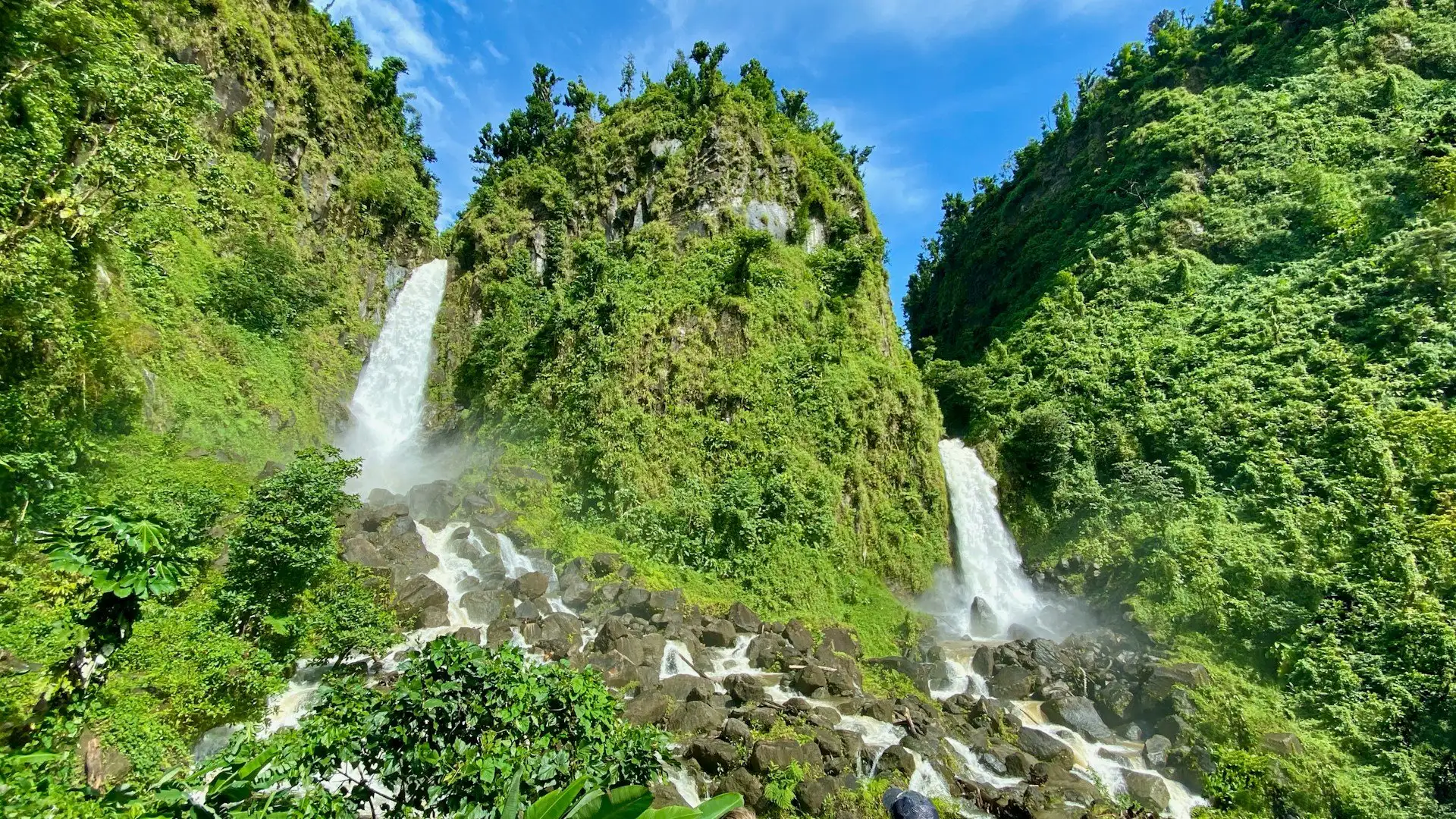
The two most accessible natural sites for visitors who aren't tackling the Boiling Lake trail. Emerald Pool is a 20-minute rainforest walk to a waterfall plunging into a green-lit pool. Trafalgar Falls, 8km from Roseau in the Roseau Valley, is twin waterfalls separated by a scramble over hot volcanic rocks; one waterfall runs warm from geothermal activity, the other cold from mountain runoff. Swimming between them is one of Dominica's signature experiences.
Culture & Etiquette
Dominica has the warmth of small-island Caribbean culture combined with a certain directness that surprises visitors expecting the performative hospitality of resort destinations. People here are genuinely friendly but also busy living their lives. They'll give you directions, talk about where you've been on the island, and invite you for a Kubuli beer with real hospitality. They won't perform any of it.
The island has a deeply Christian social culture, particularly in rural areas. Sunday is genuinely quiet. Dress standards outside of beach and trail contexts lean conservative. English is the official language, but Dominican Creole (a French-lexified creole called Antillean Creole or Kwéyòl) is widely spoken between locals. You'll hear it constantly. A few words of Kwéyòl go a long way and are received with genuine appreciation.
"Good morning" or "good afternoon" before any question or transaction is not optional courtesy here. It's baseline respect. Missing it reads as rude in a way that will follow you through the interaction.
For the Boiling Lake trail it's legally mandatory. For other hikes it's strongly recommended. Trails can be flooded, unmarked, or changed after rain. Guides know the forest and the conditions. This isn't bureaucracy. It's sensible.
Kalinago baskets, bay rum products, locally made hot sauce, and fresh produce at Roseau market. Every dollar spent with producers rather than middlemen matters more here than most places.
At the market, in the Kalinago Territory, in communities. People are not scenery. The question is quick and almost always answered yes. The act of asking is what matters.
Swimwear is for beaches and river pools. Walking through Roseau in a bikini top is considered disrespectful. A simple shirt and shorts is all that's needed.
The Boiling Lake trail has injured and killed unprepared hikers. Flip-flops and a lack of water are the most common mistakes. If you're not in good physical condition, choose Emerald Pool or Trafalgar Falls instead. No shame in that.
Mobile data works but can be slow in the interior. Some roads remain rough. Power outages occur. This is part of the experience, not a failure. If reliable air conditioning and wifi are non-negotiable, Dominica is genuinely not the right island.
The people there are not actors in a cultural display. They're a living community continuing traditions that survived 500 years of colonial pressure. Visit the formal cultural site, buy crafts, and treat the broader territory as someone's home neighborhood.
Dominica's environmental ethic is genuine and deeply held. Leaving trash at a waterfall or river pool is not just bad manners here. It's taken seriously as an insult to the island's central identity.
Prices at the market and from small operators are already modest. Hard bargaining with a woman selling dasheen at the Saturday market for the equivalent of two euros is not a travel hack. It's extractive.
Music & Carnival
Dominica's Carnival (Mas Domnik) is held in February and is one of the most authentic in the Caribbean. Unlike Trinidad or Barbados, it hasn't been heavily commercialized. The street jumping on Carnival Monday and Tuesday, the calypso tents, and the Dame Lorraine masquerade tradition all feel like they belong to the island rather than to a tourism calendar. If you're in the region in February, route through Dominica for Carnival.
Bush Medicine
Traditional herbal medicine is deeply embedded in Dominican culture. Bay rum, distilled from bay leaves grown on the island, has been an export and local remedy for over a century. Older Dominicans will have an encyclopedic knowledge of the medicinal uses of forest plants. If your guesthouse host offers you a bush tea for a stomach complaint or a headache, accept it. It will probably work.
Religion
Dominica is predominantly Catholic with significant Protestant communities. Religion is central to daily life in a way that's unusual compared to most Western countries. Church bells, Sunday quiet, and grace before meals in guesthouses are all genuine expressions of how the island lives rather than performances for visitors.
Climate Identity
Since Hurricane Maria, Dominica has framed its national identity around climate resilience. This is not background policy. It comes up in daily conversation, on signs, in how guesthouses are built. Understanding that Dominica sees itself as on the front line of climate change helps explain everything from building codes to the national pride around ecotourism. This is not abstract here.
Food & Drink
Dominican food is honest Caribbean cooking rooted in the agricultural abundance of a volcanic island with 365 rivers. Dasheen (taro), breadfruit, plantain, christophene (chayote), yam, and fresh fish are the foundation. The island grows an extraordinary range of tropical produce and the cooking reflects it. Don't expect elaborate technique. Expect flavor that comes from ingredients grown in volcanic soil with regular rainfall.
The best food in Dominica is found in small local restaurants and guesthouses rather than formal hotel dining rooms. A plate of stewed chicken with rice and provisions (the local term for root vegetables) and a cold Kubuli beer costs around EC$25 at a roadside lunch spot and will be better than anything at three times the price in a tourist restaurant. Eat where Dominicans eat.
Mountain Chicken
Not chicken. The giant ditch frog (Leptodactylus fallax), called "mountain chicken" locally and found almost exclusively on Dominica and Montserrat. Once a central protein in Dominican cooking, it's now critically endangered and protected. You will likely not eat it and should not try to. It appears on the menu of history rather than current restaurants. Worth knowing about as part of the island's story.
Crayfish & River Shrimp
With 365 rivers, Dominica has abundant freshwater crayfish. River shrimp (ouassou) stewed in garlic and butter or fried crisp is the island's most distinctive protein. Ask specifically at guesthouses in the Roseau Valley or Portsmouth area where they have relationships with local fishers. It's not on every menu but when you find it, order it.
Provisions & Stew
The standard Dominican lunch: stewed chicken or fish with a heap of boiled provisions (dasheen, breadfruit, plantain, yam), sometimes callaloo (green leafy stew), and rice. It's filling, nourishing, and deeply tied to the island's agricultural identity. The seasoning uses fresh herbs rather than dried spice blends and the difference is noticeable.
Hot Sauce
Dominican hot sauce, made from locally grown scotch bonnet peppers with vinegar and often fruit, is a serious local product. The Saturday market in Roseau has vendors selling their own family recipes, often in recycled rum bottles with handwritten labels. Buy several. They travel well and are the best edible souvenir on the island. Ask which one is hottest. The vendors will be pleased you asked.
Kubuli Beer
The national lager, brewed in Dominica since 1980. Named for the Kalinago word for the island. Cold, light, and exactly right after a long hike or an afternoon on the river. It's served everywhere and costs EC$5–7 at a local bar. The island also produces good rum: Macoucherie rum distilled by a waterwheel-powered still in the Macoucherie valley is the most local and characterful option.
Fresh Juice & Seamoss
Fresh-pressed passion fruit, soursop, tamarind, and golden apple juices are available at the market and good local shops. Seamoss drink, made from Irish moss seaweed blended with milk and spices, is a Dominican institution. Thick, slightly earthy, and extremely nutritious. An acquired taste that most visitors acquire quickly once they try it cold on a hot morning.
When to Go
February to April is the dry season and the best time to visit, particularly if the Boiling Lake hike is on your list. The trail involves river crossings that can become dangerous after heavy rain, and the volcanic landscape in dry conditions is easier and safer to navigate. February also has the added appeal of Carnival, which is one of the best in the Eastern Caribbean.
Dry Season
Feb – AprIdeal hiking conditions. Trails passable, river crossings manageable, humidity lower. February includes Carnival. The island is greener than you'd think even in the dry season because the elevation creates its own moisture. This is when to come if the Boiling Lake is your primary goal.
Early Dry
Dec – JanChristmas and New Year bring a diaspora influx of Dominicans returning home, which gives the island genuine energy. Good weather, festive atmosphere, whale watching conditions excellent. Accommodation books up earlier than other times.
Shoulder
May, NovTransitional months with some rain but often fine periods. Cheaper accommodation, fewer visitors. November in particular can be excellent: post-hurricane season, lush from the rains, uncrowded. If budget is the primary concern, November is underrated.
Hurricane Season
Jun – OctDominica sits directly in the hurricane corridor and has been hit repeatedly. August to October carries real storm risk. Trails can be closed after heavy rain. Some smaller guesthouses close for the season. The peak risk months are August through October. June and July are wetter but less dangerous.
Trip Planning
A week is the minimum for Dominica to make sense. Four to five days is enough to tick boxes but not enough to understand what the island is. Ten days lets you do the Boiling Lake, the Indian River, whale watching, Champagne Reef, the Kalinago Territory, and still have afternoons to just sit on a river bank with a Kubuli. That's the right trip.
Getting to Dominica requires a connection through another Caribbean island. There are no long-haul direct flights. Barbados (BGI), Antigua (ANU), and Martinique (FDF) are the main hubs with connections to Dominica's two airports: Douglas-Charles Airport (DCF) in the north, close to Portsmouth, and Canefield Airport (DCF) just north of Roseau for smaller aircraft. Check which airport your accommodation is closer to before booking. They're on different ends of the island.
Roseau Area
Arrive, settle in, walk Roseau. Saturday market if timing works. Trafalgar Falls afternoon (40 minutes from Roseau, no guide required). Champagne Reef snorkeling in the afternoon. Get your bearings and eat well at a local spot on Kennedy Avenue.
Boiling Lake
The main event. Start at 7am with your certified guide. 6–8 hours round trip. You will be tired. You will also have seen something genuinely extraordinary. Return, eat everything at your guesthouse, sleep early.
Portsmouth & Indian River
Drive or bus north (1.5 hours). Indian River rowboat tour in the morning before the heat builds. Whale watching afternoon tour. Overnight in Portsmouth. A second morning to explore the fort ruins at Cabrits National Park above the bay.
Kalinago Territory & Return
Drive to the northeast coast for the Kalinago Barana Autê village. Buy baskets. Watch canoe building. Swim at Emerald Pool on the way back south. Final evening in Roseau or the Roseau Valley. Fly out morning of day 8.
Roseau & South
Three full days in the south. Champagne Reef and Scott's Head diving or snorkeling. Trafalgar Falls and the Roseau Valley. Saturday market if timing allows. A day at leisure: river swimming at one of the pools near the capital.
Boiling Lake
Full day hike. Rest day afterward is strongly recommended. Book a massage at your guesthouse or just sit in a river pool.
Morne Trois Pitons Interior
Three days exploring the UNESCO park properly. Freshwater and Boeri lakes trail. Titou Gorge at dawn. Middleham Falls. These are moderate trails you can do without a guide. One full recovery day between hikes is sensible.
Portsmouth & North
Indian River, whale watching, Cabrits National Park. One day exploring the north of the island toward Capuchin and the rugged Atlantic coast.
Kalinago Territory & Wind-Down
Full day at the Kalinago Territory. A final day of nothing scheduled: river, hammock, Kubuli. Fly out on day 15.
Roseau & Deep South
Five days in the south including a full PADI dive course if desired (Dominica is an excellent place to learn), multiple dives at Champagne Reef and L'Abym wall dive, and the complete Morne Trois Pitons circuit including Boiling Lake.
Central Valleys & Rivers
The Layou River valley. The Macoucherie rum distillery. River tubing on the Layou River (one of Dominica's most fun afternoons). A long hike to Sari Sari Falls on the east coast, one of the island's most impressive waterfalls and rarely visited.
Portsmouth & Whale Research
Consider a multi-day arrangement with one of the research-linked whale watching operators. Some allow passengers to observe research activities over multiple days. Morning tours, afternoon diving or snorkeling in Prince Rupert Bay. Evenings at the Portsmouth Beach Bar.
East Coast & Slow Travel
The Atlantic coast is the least visited and most dramatic part of Dominica. Castle Bruce, Bataka, Hampstead Beach (black sand and complete solitude). The Kalinago Territory for a day. The final days: do less, notice more.
Vaccinations
No mandatory vaccinations for most visitors. Recommended: Hepatitis A, Typhoid, and routine vaccines up to date. Dengue fever has been present on the island; mosquito protection is recommended particularly in the rainy season.
Full vaccine info →Connectivity
Digicel and Flow are the main providers. Mobile coverage is reasonable on the coast and in Roseau but can be patchy in the interior mountains. Download trail maps and offline guides before heading into the park. An eSIM with Caribbean data coverage works well.
Get a Caribbean eSIM →What to Pack
Proper hiking boots or trail shoes are essential. The trails are wet, rooted, and rocky. Sandals are for the beach. A dry bag for river crossings. Waterproof everything. Rain can arrive without warning even in the dry season. The mountains create their own weather.
Getting Around
Renting a car gives you genuine freedom on an island where public minibuses run on their own schedule. Roads are challenging but manageable with a small 4WD. Drive on the left. Mountain roads have blind corners and no crash barriers. Go slowly and use your horn on corners.
Travel Insurance
Essential. The Boiling Lake trail involves genuine physical risk. Medical evacuation from Dominica is expensive. Make sure your policy covers adventure activities including hiking and diving. A policy that covers cancellation for hurricane disruption is worth the extra premium in the wet season.
Currency
The East Caribbean Dollar (XCD) is fixed at EC$2.70 to US$1. US dollars are widely accepted at a slightly worse rate. Bring cash; ATMs exist in Roseau and Portsmouth but rural areas are cash-only. Visa and Mastercard work at larger hotels and some restaurants. Bring enough cash for trail fees, market shopping, and local restaurants.
Transport in Dominica
Dominica has no rail, no tuk-tuks, no taxis in the conventional sense, and no Uber. What it has is a network of shared minibuses running fixed routes along the main roads, private taxis arranged through guesthouses, and rental cars. If you're serious about exploring the island beyond Roseau and the immediate surroundings, a rental car is strongly recommended. The freedom to stop at a river, detour to a viewpoint, and arrive at a trailhead at 6am without depending on a driver is worth more here than almost any other Caribbean island.
Getting There
Via regional hubsNo direct long-haul flights. Connect through Barbados (LIAT, Caribbean Airlines), Antigua, or Martinique (Air Antilles). Douglas-Charles Airport (DCF) in the north serves most regional routes. Canefield near Roseau handles smaller propeller aircraft. Check which airport is closer to your accommodation.
Minibus
EC$2–8 per routeShared minibuses connect Roseau to most large villages on a loose schedule. They depart when full, not at fixed times. Cheap, sociable, and fine for getting to Trafalgar or the Botanical Gardens. Not practical for early morning trailheads or remote east coast destinations.
Car Rental
$50–80 USD/dayThe best way to see Dominica. Small 4WDs are ideal for mountain roads. A temporary local driver's permit is required and costs around EC$30 — your rental company arranges it. Drive on the left. Mountain roads have blind corners; use your horn. Fuel up in Roseau; rural stations are rare.
Private Taxi
Negotiate per tripArranged through guesthouses or at the airports. Good for airport transfers and single-day excursions if you don't want to drive. Full-day rates with a driver-guide (many taxi drivers double as knowledgeable local guides) run $100–150 USD and are worth considering for a dedicated Boiling Lake day.
Ferry
$60–100 USD one-wayL'Express des Iles runs high-speed catamaran ferries connecting Dominica with Guadeloupe, Martinique, and St. Lucia. A good option if you're island-hopping. Journey times are 1.5–3.5 hours depending on destination. Book in advance in peak season.
Indian River Boats
EC$50–70 per personGuided rowboats are the only permitted transport on the Indian River. Tours depart from the river mouth near Portsmouth. No motorized craft are allowed. Tours last about 1.5 hours. Officially licensed guides only; avoid unsolicited offers at the river entrance.
Accommodation in Dominica
Dominica's accommodation landscape is dominated by small locally owned guesthouses and eco-lodges rather than international hotel chains. This is deliberate policy and genuine culture. Papillote Wilderness Retreat in the Roseau Valley, built around a natural hot spring garden, and Zandoli Inn in the south are consistently regarded as the island's best properties. Fort Young Hotel in Roseau, built into a colonial fort on the waterfront, is the main full-service hotel option.
Where you stay matters more in Dominica than most destinations because your accommodation host is often your best source of island knowledge: which trails are passable after last week's rain, which fishing boat does the whale watching, where the best river pool for a quiet afternoon swim is located. A good guesthouse host in Dominica is worth more than a guidebook.
Eco-Lodge
$100–250/nightThe island's signature accommodation type. Properties like Papillote Wilderness Retreat and Beau Rive Estate are set in rainforest with hot spring pools, natural gardens, and an intimacy that larger hotels can't replicate. Often include meals and guide services. Book months ahead in dry season.
Guesthouse
$40–90/nightSmall family-run guesthouses throughout Roseau, Portsmouth, and villages across the island. Often include breakfast. The quality varies but the better ones offer real hospitality and local knowledge that more expensive properties rarely match.
Hotel
$90–180/nightFort Young Hotel in Roseau is the main conventional option: a colonial fort converted into a comfortable waterfront hotel with a pool and dive shop on site. The building alone is worth it. Castaways Beach Hotel north of Roseau is the alternative for beach access.
Glamping & Cabins
$60–130/nightA growing category post-Maria. Riverside cabins and forest glamping operations in the Roseau Valley and near Portsmouth offer a genuine immersion in the natural environment. Some have outdoor showers fed by hot spring water. The category has expanded significantly since 2019.
Budget Planning
Dominica is not a cheap Caribbean destination, but the cost is justified by what you're getting: genuine wilderness experiences, exceptional marine life, and some of the most significant hiking in the region. The main cost drivers are accommodation (limited supply keeps prices elevated), car rental (recommended), and guide fees for the Boiling Lake trail (mandatory and fair). Food and local transport are inexpensive. The island doesn't have the economic scale to compete on price with mass-tourism destinations, and it's not trying to.
- Basic guesthouse with shared bathroom
- Local restaurants and market food
- Minibuses for transport
- Certified guide for Boiling Lake (shared)
- Kubuli beers at local bars
- Good guesthouse or small hotel with breakfast
- Mix of local and tourist restaurants
- Car rental for flexibility
- Whale watching and snorkeling tours
- Certified guide for hikes
- Eco-lodge with meals and hot spring access
- Private guide for all major hikes
- Diving courses or multiple dive days
- Private whale watching charter
- Full-day driver-guide for island touring
Quick Reference Prices
Visa & Entry
Citizens of most Western countries including the US, UK, all EU member states, Canada, Australia, and New Zealand do not need a visa to visit Dominica. Visa-free entry is granted for up to 6 months, which is generous by Caribbean standards. You need a valid passport, a return or onward ticket, and proof of accommodation or sufficient funds for your stay.
A departure tax is charged on leaving Dominica, though it's typically included in airline ticket prices. Check whether your ticket includes it before arriving at the airport. There is no tourist card equivalent to purchase. Entry is straightforward for the vast majority of visitors.
Most Western passport holders enter without a visa. One of the more generous entry allowances in the Caribbean. Check the Dominica Customs and Immigration website for your specific nationality.
Family Travel & Pets
Dominica works well for families with children old enough to manage short hikes and appreciate natural environments, roughly eight years old and up. The island is safe, English-speaking, and the people are genuinely warm toward children in a way that makes day-to-day logistics easy. Younger children will find Trafalgar Falls, the Indian River, snorkeling at Champagne Reef, and the whale watching manageable and genuinely exciting. The Boiling Lake trail is not appropriate for children under about 12 and only then with good fitness preparation.
For very young children (under 5), the lack of traditional beach infrastructure is a genuine constraint. There are no calm shallow sandy beaches for toddlers on the west coast. The natural pools on some rivers have calmer water and make reasonable alternatives, but this is something to consider when choosing Dominica over more conventionally family-friendly Caribbean islands.
Whale Watching
Children who are old enough not to be sick on a small boat will find whale watching genuinely transformative. Sperm whales can reach 18 meters. Seeing one surface next to a small boat, hear it exhale, and watch it dive will not be forgotten. Tour operators can advise on sea conditions and suitability for age groups.
Nature Trails
The Emerald Pool trail (30 minutes, easy) and the Botanical Gardens in Roseau work well for younger children. Iguanas, hummingbirds, and the sisserou parrot (Dominica's national bird, found only here) are all visible on or near trails that don't require serious hiking.
Indian River
The slow rowboat journey under the bloodwood tree canopy is genuinely magical for children. No noise, no engine, just the sound of birds and the guide explaining what's in the water. The darkness under the canopy combined with the sudden appearance of herons overhead tends to produce genuine wonder in younger travelers.
Champagne Reef Snorkeling
The geothermal bubbles rising through the reef are immediately comprehensible and fascinating for children. The reef is shallow and the water clear. Rental equipment is available on site. Children who can swim comfortably in the sea will have no difficulty here.
Kalinago Territory
Children respond well to the basket weaving and canoe building demonstrations at the Kalinago Barana Autê village. The concepts are concrete and visual in a way that museum exhibits rarely are. The coastal scenery on the drive over from the west coast is itself worth the trip.
River Swimming
Dominica's rivers are clean, clear, and warm from volcanic activity in the upper reaches. Natural river pools scattered throughout the island are the family beach alternative. Ask your guesthouse for the nearest safe swimming hole. Some of the best are known only to locals and reached via ten-minute walks through the forest.
Traveling with Pets
Bringing pets to Dominica involves significant import requirements. Dogs and cats require a health certificate from an accredited veterinarian, proof of current vaccination including rabies, and an import permit from Dominica's Veterinary Division applied for in advance. Pets must be accompanied by their health documentation and may be inspected on arrival. Quarantine is not typically required if documentation is in order, but this is subject to change.
In practical terms, Dominica is not a pet-friendly travel destination. Most guesthouses and eco-lodges do not accept animals, and the island's wildlife (including protected bird species) is a reason to keep domestic animals out of natural areas entirely. The logistics significantly outweigh the benefits for a short visit. Leave pets at home.
Safety in Dominica
Dominica is one of the safer small island nations in the Caribbean. Violent crime against tourists is rare. The small population and close-knit social fabric mean that most of the island functions with a level of mutual awareness that keeps petty crime low. Standard precautions apply: don't leave valuables in rental cars, be aware in Roseau after dark, and use your guesthouse's safe.
The more significant safety concerns are natural rather than human. Trail conditions change rapidly after rain. The Boiling Lake can produce sudden surges. River crossings are genuinely dangerous in flood conditions. Volcanic activity in the Valley of Desolation occasionally closes the trail. Always check current conditions with your guide before heading out.
General Safety
Low crime rate. Violent crime against tourists is rare. Roseau is safe to walk during the day. Normal evening caution in any urban area applies after dark on back streets.
Trail Conditions
Trails change after rain. The Boiling Lake trail has claimed lives due to unprepared hikers and flash flooding. Hire certified guides, check conditions, carry adequate water and food, and turn back if conditions deteriorate. This is not cautious advice. It's necessary.
Volcanic Hazards
The Valley of Desolation has areas of unstable ground and toxic gas vents. Stay on marked paths. The Boiling Lake itself is superheated water that can surge unexpectedly. Your guide knows where to stand and when to move. Follow their instructions.
Hurricane Risk
June to November is hurricane season. Monitor forecasts during this period. The government's disaster management agency issues alerts promptly. Follow evacuation instructions immediately if issued. Maria's speed of intensification in 2017 caught residents and visitors off guard.
Solo Women
Generally safe. Street harassment is less pronounced than in some Caribbean islands. Women traveling alone report feeling comfortable in most areas. Normal evening precautions apply. Your guesthouse host's local knowledge is your best security resource.
Marine Safety
Atlantic-side beaches have dangerous currents and are not suitable for swimming. West coast conditions are calmer. Always check with local operators before open-water activities. The whale watching area involves open ocean swells; sea sickness medication is wise for sensitive travelers.
Emergency Information
Your Embassy
Dominica is a small nation and most countries do not maintain a resident embassy. Consular services are typically handled through regional high commissions or embassies in nearby countries.
Book Your Dominica Trip
Everything in one place for the Nature Isle.
The Island That Refuses to Be Anything Other Than Itself
Most Caribbean islands have spent the last fifty years becoming versions of what wealthy visitors from cold countries imagine the Caribbean to be. Dominica opted out of that. There are no casinos, no duty-free malls, no beach clubs serving frozen cocktails with umbrellas. What there is: a boiling lake sitting at the top of a volcanic mountain, a river that runs warm from geothermal heat, sperm whales that have lived in the same canyon for generations, and a people who have survived colonialism, hurricanes, and the pressure to be something more convenient for tourists than they actually are.
The Kalinago have a word for the island: Wai'tu kubuli. "Tall is her body." It's where the name Kubuli comes from, printed on every beer bottle on the island. When you raise a Kubuli at sunset on the west coast watching the light go off the water, you're saying the same thing people have said about this place for a thousand years. Some things don't need improving.