
What You're Actually Dealing With
The Scams That Actually Catch People
Grenada's scam profile is thin. Most of what catches visitors involves taxi pricing without agreed fares, beach vendor persistence, and variable water sports operator quality. Nothing here is aggressive or dangerous.
Grenada has government-published fixed taxi rates between major destinations — airport to Grand Anse is USD $20, airport to St George's is USD $18. These rates are posted at the airport and at major taxi stands. The overcharging happens when visitors don't know the published rate and don't ask before getting in, allowing drivers to quote whatever they think will be accepted. The gap between the published rate and the quoted rate can be significant at peak arrival times.
- Photograph the taxi rate card posted at the airport arrivals area before leaving the terminal — it lists official fares for all major routes.
- Confirm the fare before getting in the taxi, quoted in either USD or EC dollars at the published rate.
- Drivers at the official airport taxi rank are generally more regulated than those approaching arrivals informally — use the official rank.
Grand Anse Beach attracts vendors selling craft, jewellery, hair-braiding, and local produce. The approach is persistent rather than aggressive — a vendor will sit down next to you and begin a conversation that leads to a sales pitch. Prices open high for visitors. The goods are mostly genuine and often good quality; the dynamic is about negotiation rather than deception.
- A friendly "no thank you, I'm just relaxing today" early in the approach prevents a long pitch without creating hostility.
- Negotiate anything you do want — beach prices are opening positions and 40-50% of the asking price is usually achievable.
- Morne Rouge Bay (Magazine Beach), ten minutes from Grand Anse, has fewer vendors and more local atmosphere.
Individuals near popular sites and the St George's waterfront offer guide services for spice estate visits, waterfall hikes, and island tours. The service is often genuine but the fee is established at the end rather than the beginning, and the final ask is invariably higher than what would have been agreed upfront. Grenada has licensed tour guides registered with the Grenada Tourism Authority.
- Book tours through your hotel, a licensed operator, or the Grenada Tourism Authority — guides with official registration are listed on the GTA website.
- If you accept an informal guide, agree the full fee before starting — "Before we go, what is your fee for this?" — and get a nod of confirmation.
Grenada has excellent diving — the Bianca C wreck, one of the Caribbean's great dive sites, sits at 29-50 metres off the southwest coast. Water sports and dive operators range from professionally equipped to those with poorly maintained equipment. The cheapest option is not always safe. Some beach vendors also offer ad hoc water sports activities without the safety equipment or qualification the activity requires.
- Use PADI-affiliated dive operators for scuba — Dive Grenada, Aquanauts Grenada, and Eco Dive are established operators with proper safety records.
- Inspect equipment before any water activity — life jackets, BCDs, and regulators should be visibly maintained.
- The Bianca C dive requires experience — it is a deep wreck and conditions can be challenging; don't attempt it with an operator who doesn't assess your qualifications first.
Opening prices at St George's craft market are set for visitors rather than locals. Spices, nutmeg products, handmade jewellery, and woven goods are all priced with a foreigner premium. The goods are genuine and often excellent value even at inflated prices compared to buying the same items in import shops abroad — the premium is about negotiation, not deception.
- Negotiate at craft stalls — it's expected and nobody takes offence. Starting at 60% of the asking price is reasonable.
- Buy spices directly from spice estates in the interior (Dougaldston, Gouyave) rather than craft market stalls — better quality, better price, and the context of buying nutmeg at a nutmeg estate is worth having.
- The Grenada Chocolate Company factory store sells chocolate at source prices — significantly less than the export price in specialty shops elsewhere.
Petty theft in Grenada is low by Caribbean standards. Phone theft from towels on Grand Anse Beach and bag theft in the St George's market area are the most common forms. Neither is frequent enough to significantly affect most visitors — normal awareness is sufficient.
- Don't leave valuables unattended on Grand Anse Beach — bring only what you need and keep phones either in hand or secured.
- Keep bags closed and held in front in the St George's market and bus terminal area.
- Grenada's theft rate is significantly lower than most other Caribbean tourist destinations.
The Destinations — Honest Takes
Grenada is small enough to cover in a week — the main island plus the sister islands of Carriacou and Petite Martinique if you have time. Every part of it rewards the effort to get there.
St George's is one of the most beautiful harbour towns in the Caribbean — a horseshoe of water with Georgian brick warehouses on one side, colourful houses climbing steep hills on the other, and Fort George on a promontory above the whole thing. The inner harbour (the Carenage) is where the fishing boats and yachts tie up alongside each other. The market in the lower town on Saturday mornings is the best single introduction to Grenadian food culture — piles of nutmeg, dasheen, christophene, breadfruit, and fresh fish from the morning catch.
- Confirm taxi fares before getting in — the rate card at the taxi stand lists official published rates
- The Saturday morning market is busiest 7-10am — arrive early for the freshest produce and the best atmosphere
- Fort George is free to enter and the views over the harbour and across to Grand Anse are the best in the island — 20-minute walk uphill from the Carenage
- Keep bags closed in the market and bus terminal area
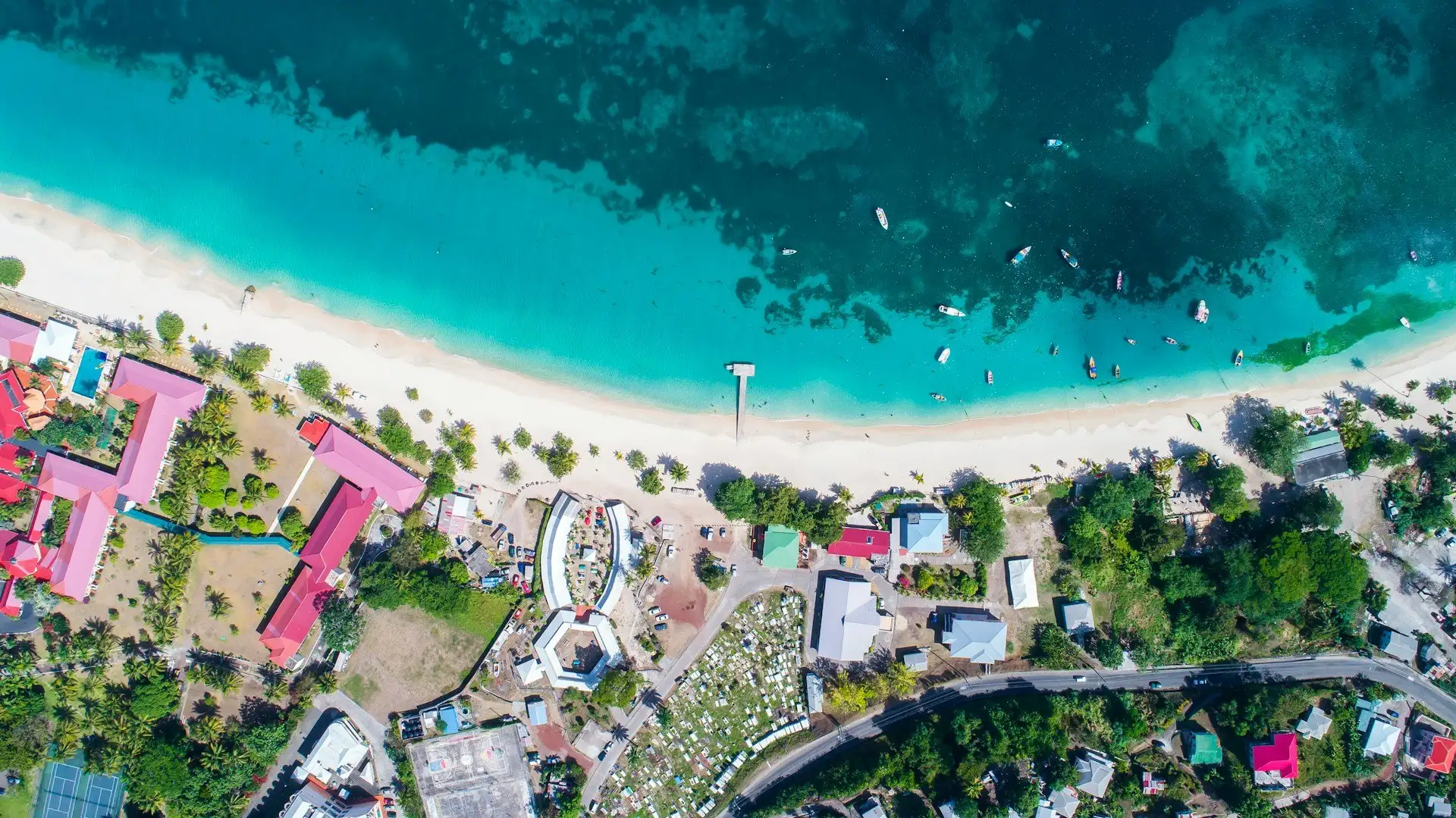
Grand Anse is a 3km arc of white sand with clear water — consistently ranked among the finest beaches in the Caribbean and justifiably so. The strip of hotels and restaurants behind it is the main tourist infrastructure zone. Morne Rouge Bay immediately south of Grand Anse is quieter with fewer vendors and equally good swimming. The underwater sculpture park off Molinière Point, a 20-minute drive north of St George's, is a collection of more than 65 life-size human sculptures on the seabed at 5-8 metres — accessible by snorkelling and one of the most distinctive underwater experiences in the Caribbean.
- Grand Anse beach vendors are persistent but non-aggressive — a polite early decline prevents a long pitch
- The underwater sculpture park is accessible by snorkel directly from the beach or on a guided boat — book through an established operator for the boat option
- Morne Rouge Bay (Magazine Beach) has fewer vendors and more local families on weekends
The interior of Grenada is a different country from the beach strip. The Grand Etang National Park sits at 530 metres in a volcanic crater lake surrounded by cloud forest — trails lead to the Seven Sisters waterfall (90-minute hike, genuinely beautiful) and the Concord Falls on the Atlantic coast. The Belmont Estate runs excellent guided tours through their cocoa and spice production, ending with chocolate tasting. Dougaldston Estate near Gouyave has been processing nutmeg since 1898 and the Friday Nutmeg Processing Station in Gouyave town shows the full operation at the island's largest facility.
- No scam presence in the interior — spice estate and waterfall visits are honest operations that want return visitors and good reviews
- The trails to Seven Sisters waterfall are well-marked but a local guide adds knowledge of the forest ecosystem that makes the walk significantly better
- Buy chocolate and spices directly at Belmont Estate and Gouyave rather than St George's craft stalls — better quality, better prices, better context
The Bianca C was an Italian ocean liner that caught fire and sank in Grenada's harbour in 1961 — the largest wreck in the Caribbean at 183 metres long, sitting at 29-50 metres on its side off the southwest coast. Grenadians helped rescue the passengers and crew, for which the Italian government awarded the island a bronze statue of Christ of the Deep that now stands in the Carenage. The dive is one of the Caribbean's great wreck dives: intact funnels, portholes, railings, and abundant marine life colonising the structure over six decades.
- The Bianca C is a deep, advanced dive — operators should ask for your qualifications and dive log before taking you; if they don't, that is itself a warning sign
- Use PADI-affiliated operators: Dive Grenada, Aquanauts, and Eco Dive all have strong safety records on this specific site
- The shallowest part of the wreck at 29m is accessible to advanced open water divers — the deeper sections at 50m require technical certification
Carriacou is Grenada's sister island — a 34 square kilometre island 37km north, accessible by ferry (90 minutes) or small plane (15 minutes). Hillsborough is the small capital. The beaches on the northeast coast — Anse La Roche, Petit Carenage — are among the most pristine in the entire Eastern Caribbean, largely empty even in peak season. The Carriacou Carnival and Parang (Christmas folk tradition) maintain traditions from West African and French Creole heritage more strongly than the main island. It has almost no tourist infrastructure and that is entirely the point.
- No tourist scam presence — Carriacou sees few enough visitors that the economic dynamics around extracting from tourists simply haven't developed
- The Osprey Lines ferry from St George's takes about 90 minutes and runs several times weekly — check the current schedule before planning
- Accommodation on Carriacou is basic and limited; book in advance for dry season visits
The northern tip of Grenada — Levera National Park — is a protected area of mangroves, reef, and nesting beach for leatherback sea turtles. The Levera Beach itself is one of the most dramatic on the island: dark sand against crashing Atlantic surf with the Sugar Loaf islands visible offshore. Between March and August, leatherback turtles nest here nightly — rangers from the Grenada Sea Turtle Conservation Network facilitate respectful viewing. The drive up the Atlantic coast from Grenville is one of the most scenic on the island and almost no tourists take it.
- No scam presence in the north — visitor numbers are low and the communities are entirely agriculture and fishing focused
- Turtle watching must be done with a ranger from the GSTCN — approaching nesting turtles independently disturbs them and is prohibited
- The Grenville nutmeg cooperative and Saturday market are the most authentic market experience on the island — larger, less tourist-facing than St George's
Before You Go — The Checklist
- ✓ Photograph the taxi rate card at the airport before leaving the terminal — it lists official government-published fares for all major routes and is your reference for any fare negotiation.
- ✓ Confirm taxi fares before getting in — state the rate from the card rather than asking the driver to quote.
- ✓ For the Bianca C wreck dive, use only PADI-affiliated operators who ask for your qualifications before accepting your booking.
- ✓ Buy spices and chocolate directly at estates (Belmont, Dougaldston, Grenada Chocolate Company) rather than craft market stalls — better quality, better price.
- ✓ Agree guide fees before starting any informal tour — not at the end.
- ✓ Don't leave valuables unattended on Grand Anse Beach.
- ✓ Buy travel insurance covering hurricane disruption if visiting June through November.