
What You're Actually Getting Into
Grenada is a tri-island state, Grenada proper plus Carriacou and Petite Martinique, sitting at the southern tail of the Windward Islands where the Caribbean Sea meets the Atlantic. It is one of the few Caribbean destinations that is simultaneously a beach trip and an agricultural one: about a fifth to two-fifths of the world's nutmeg (sources vary on the exact share) still comes from small holdings in the island's interior, and the smell of drying spice reaches the coast on the trade winds. The nutmeg is on the flag for a reason.
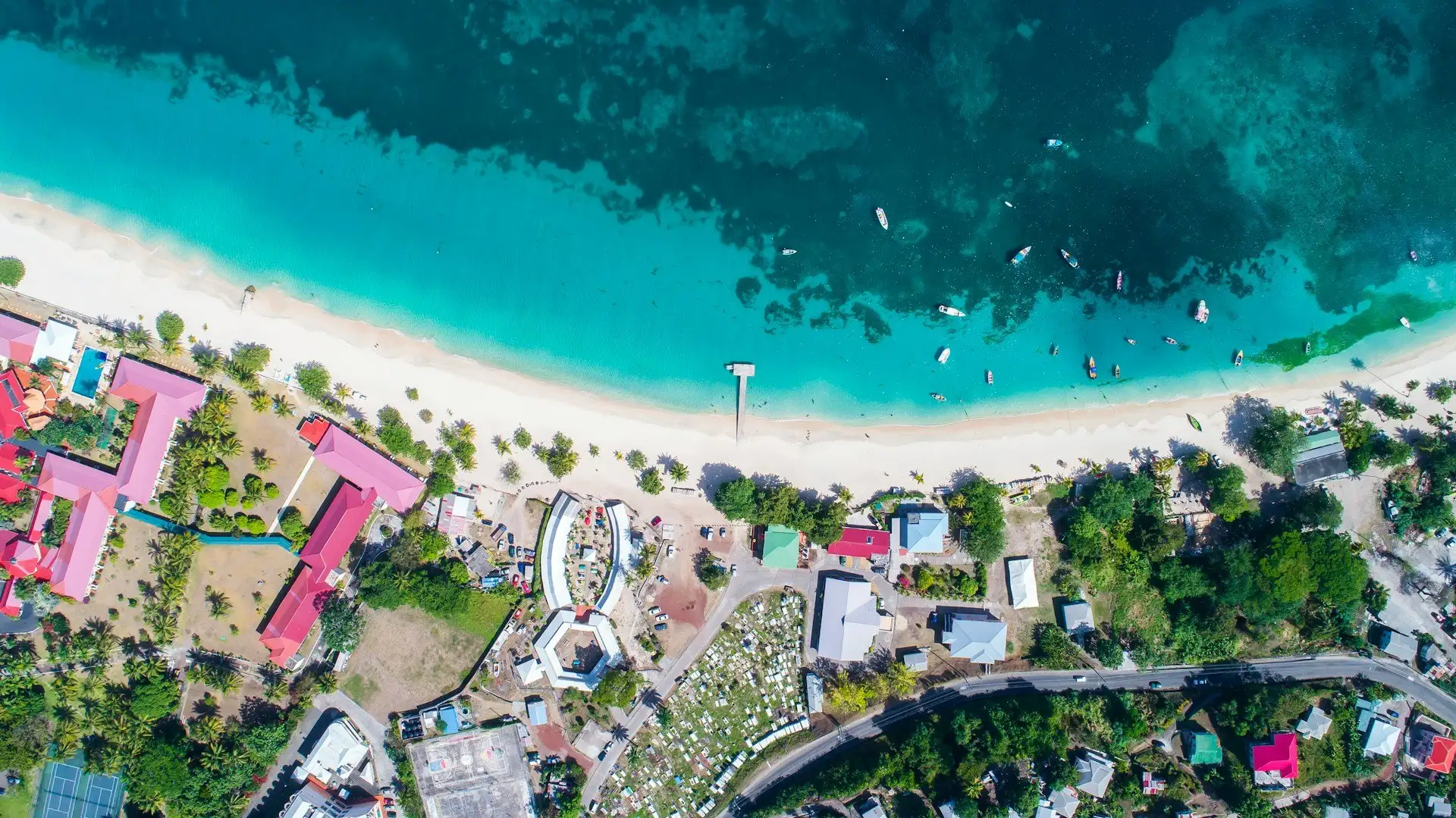
The tourism infrastructure concentrates almost entirely around Grand Anse, a two-mile stretch of white sand just south of the capital, St. George's, a horseshoe-harbor town regularly ranked among the prettiest small capitals in the Caribbean. Beyond that strip, Grenada is mountainous and green: Grand Etang National Park fills the island's volcanic center with rainforest and a crater lake, and waterfalls, river tubing and the world's first underwater sculpture park all sit within a short drive of the beach.
The honest complications
The US State Department raised Grenada to Level 2, Exercise Increased Caution, in January 2026 after a run of reported armed robbery, assault, burglary and at least one rape and killing involving American citizens; this is covered honestly in the Safety chapter rather than glossed over. Grenada also markets itself as sitting outside the main hurricane belt, which is true in a statistical sense but not an absolute one: Hurricane Ivan hit the island directly in September 2004, killed 34 people and damaged more than 80 percent of its buildings, a fact worth knowing if traveling June through November. And outside Grand Anse, English is universal but infrastructure thins out fast: interior roads are narrow and winding, and a rental car or a guide is the practical way to see the waterfalls and the north coast.
A History Worth Knowing
Grenada's Indigenous Kalinago population resisted French colonization until a mass suicide at Sauteurs' "Leapers Hill" in 1651 rather than surrender; the French and later the British ran the island on enslaved labor and, from the 1780s, nutmeg. Independence in 1974 was followed within five years by a leftist revolution, a Cuban alliance, an internal coup that ended in the execution of the revolution's own leader, and a US-led invasion, one of the more eventful two decades any small Caribbean nation has had.
- 1651
Sauteurs. The last Kalinago inhabitants leap from a cliff at the island's north tip rather than submit to French colonization, giving the town its name (French for "leapers").
- 1783
British rule begins. France cedes Grenada to Britain under the Treaty of Paris; nutmeg cultivation, introduced by the French, becomes the colony's defining export.
- 1974
Independence. Grenada becomes independent on 7 February under Prime Minister Eric Gairy, whose rule grows autocratic and is enforced by his paramilitary "Mongoose Gang."
- 1979
The revolution. Maurice Bishop's New Jewel Movement seizes power in a nearly bloodless coup, suspends the constitution and aligns with Cuba.
- Oct 1983
Coup, execution and invasion. Deputy PM Bernard Coard's faction ousts and executes Bishop on 19 October; a US-led force invades six days later, citing regional security and the safety of American medical students.
- 2004
Hurricane Ivan. A direct Category 3 hit kills 34 people and damages more than 80 percent of the island's structures, the costliest disaster in Grenada's history.
Read the full history: nutmeg, the revolution and the invasion
Grenada changed hands between France and Britain several times before the 1783 Treaty of Paris settled British control for good. The French had already introduced nutmeg and cocoa cultivation; the British expanded the plantation economy on the labor of enslaved Africans, whose descendants make up the great majority of Grenadians today, and later indentured laborers from India after abolition in 1834.
Eric Gairy led Grenada to independence in 1974 but governed with increasing authoritarianism, using a paramilitary group known as the Mongoose Gang to intimidate opponents. In March 1979, while Gairy was out of the country, the Marxist-leaning New Jewel Movement under Maurice Bishop seized power in a coup that met little resistance. Bishop's People's Revolutionary Government suspended the constitution, built ties with Fidel Castro's Cuba, and began work with Cuban assistance on a new international airport at Point Salines, ostensibly for tourism, which Washington viewed with suspicion as a potential military asset.
Internal party divisions turned violent in October 1983: hardline deputy Bernard Coard's faction placed Bishop under house arrest, and a crowd that freed him was met with military gunfire; Bishop and several ministers were subsequently captured and executed. The resulting power vacuum, combined with US concern for the safety of American students at St. George's University medical school and the wider regional security picture, led President Reagan to order a US-led invasion, "Operation Urgent Fury," on 25 October 1983. A brief but genuine conflict followed before a pro-Western interim government took over; elections resumed in 1984.
The airport Cuba built was completed by the US after the invasion and eventually renamed Maurice Bishop International Airport, the country's sole international gateway today, a quiet irony of the island's history.
Top Destinations
Grenada divides into the southwest coast around the capital and Grand Anse (covered in depth in our Grand Anse city guide), the mountainous interior, the quieter north and east coasts, and the sister islands of Carriacou and Petite Martinique. The main island is about 21 miles long and 12 miles wide, small enough that almost everything below is reachable as a day trip from Grand Anse.
St. George's, the horseshoe-harbor capital
St. George's wraps around the Carenage, a horseshoe inner harbor lined with pastel Georgian and French colonial warehouses climbing the hillside behind it, and is routinely called one of the prettiest small capitals in the Caribbean. Climb to Fort George, built by the French in 1705 and still fitted with cannon, for panoramic views over the harbor and coastline for a token entry fee, roughly $2 (5 XCD), cash only. Below it, Market Square fills with spice vendors and produce sellers daily and is at its fullest on Saturday mornings, when farmers come in from across the island; buy sealed, packaged spices rather than loose ones, since only factory-sealed nutmeg clears US customs on the way home. For lunch with a harbor view, BB's Crabback, run by Grenada-born, England-trained chef Brian Benjamin, does the island's best version of crabback (stuffed land crab) alongside curried goat and pan-fried barracuda. Budget half a day.
Grand Etang National Park
Grand Etang fills the extinct volcanic crater at the island's center with rainforest and a dark, still crater lake at about 1,740 feet. A network of short, well-marked trails circles the lake and pushes further into the forest, and troops of Mona monkeys, introduced from West Africa centuries ago, are reliably seen near the visitor center. It rains often up here even when the coast is dry, so bring a light waterproof layer.
Annandale & Concord Falls
Annandale Falls, a 10-15 minute drive from St. George's, drops into a swimmable pool ringed by rainforest and is popular enough with local schoolkids after class that it never feels remote; the waterside restaurant Wild Orchid serves drinks and lunch overlooking the falls. Concord Falls, further north, is a three-tier waterfall reached by a short walk to the lowest tier or a genuine hike (30-45 minutes each way, sturdy shoes required) to the upper two, which see far fewer visitors.
River Antoine Rum Distillery
Grenada's, and one of the Caribbean's, oldest working rum distilleries has been running since 1785 using the original water wheel to crush sugar cane, no electricity involved. Guided tours cost around $2 and end with a tasting of the distillery's famously strong overproof rum (do not attempt to fly with it in carry-on, it exceeds most airline limits).
Levera & the north coast
Levera National Park, at the island's northeastern tip, pairs a wild, windswept Atlantic beach with a protected lagoon and mangrove system, and is one of Grenada's key nesting sites for leatherback turtles between roughly April and June. It is undeveloped by design: no beach bars, no sunbeds, just the water, the reef offshore and the view across to Sugar Loaf Island.
Sauteurs & Leapers Hill
The northernmost town takes its name, French for "leapers," from the 1651 event at the clifftop above town where the last Kalinago inhabitants chose to jump rather than surrender to French forces. The site today is a quiet, sobering viewpoint rather than a developed attraction.
La Sagesse
A calmer, more sheltered bay on the southeast coast with a small nature reserve behind the beach, popular for its relative lack of crowds compared to Grand Anse and for a short mangrove and estuary walk.
Carriacou
The larger of Grenada's two sister islands, reached by the Osprey Lines fast ferry from the Carenage in St. George's (roughly 90 minutes to just over 2 hours depending on the vessel and conditions; around $31 one-way or $62 return), Carriacou is quieter, flatter and less developed than the mainland, with excellent snorkeling around Sandy Island and a boatbuilding tradition, centered on the town of Windward, that still produces wooden schooners by hand. Ferry schedules run only a few days a week, so confirm the current timetable directly with Osprey before planning a day trip; an overnight is the safer way to do it justice.
Petite Martinique
Smaller again, and reached onward from Carriacou, Petite Martinique is a working fishing community with almost no tourist infrastructure: a genuine look at daily Grenadine life rather than a beach destination in its own right.
The Underwater Sculpture Park
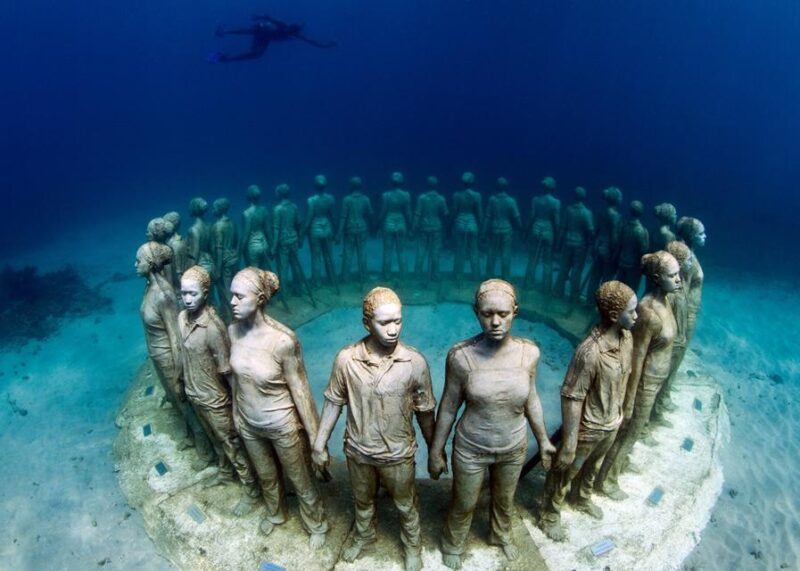
Off Moliniere Bay, a short boat ride north of St. George's, British sculptor Jason deCaires Taylor planted the world's first underwater sculpture park in 2006, life-size figures set 15-25 feet down that are gradually being colonized by coral and reef fish, part functioning art installation, part artificial reef restoration project. It made National Geographic's list of 25 Wonders of the World and works equally well as a snorkel or a dive.
The Bianca C wreck
Nicknamed the "Titanic of the Caribbean," this 600-foot Italian cruise liner sank off Grenada in 1961 after an onboard explosion and fire, and now rests upright at around 165-170 feet, with its highest point around 90 feet, one of the largest diveable wrecks in the Caribbean and an advanced-level dive only.
Aquanauts Grenada (bases at True Blue Bay and on Grand Anse Beach at Spice Island Beach Resort) and EcoDive (Grand Anse at Coyaba Beach Resort, marine-biologist owned) both run the sculpture park, reef and wreck dives, with single dives from roughly $50-55 and PADI open-water certification from around $460.
Culture & Etiquette
Grenada is an English-speaking Commonwealth realm, King Charles III remains head of state in a ceremonial capacity, with a culture shaped by West African, British, French and, more recently, Indian and Lebanese influences layered on top of an almost entirely erased Indigenous Kalinago presence. Christianity, both Roman Catholic and various Protestant denominations, runs deep, and Sunday remains a genuinely quiet day outside the resort strip.
Do
- Greet before you ask anything. A "good morning" or "good afternoon" before a question, even to a shopkeeper or driver, is expected; skipping it reads as brusque.
- Dress modestly off the beach. Swimwear is for the beach and pool only; cover up to walk through St. George's or visit a church.
- Carry small XCD bills. Market vendors, minibuses and Fort George's entry fee are cash-only and rarely have change for large notes.
- Try the rum, respectfully. River Antoine's overproof rum is famously strong; locals cut it with water or juice, and doing the same is not a faux pas.
- Ask before photographing people, particularly in the market and fishing communities.
Don't
- Buy loose spices expecting to bring them home easily. US customs requires factory-sealed packaging; loose market spices are typically confiscated.
- Assume every beach is like Grand Anse. The north and east coasts are wilder and often unsupervised; know the conditions before swimming.
- Display affection or dress that would be fine on the beach in town or at church. Grenadian public norms are conservative outside the resort areas.
- Walk isolated stretches of beach or road after dark, particularly alone; see the Safety chapter for the current advisory context.
- Expect fast police response times outside the main tourist areas. The US State Department has flagged this directly as of January 2026.
Deeper culture: Big Drum, Carnival and LGBTQ+ travelers
Big Drum. A ceremonial dance and drumming tradition, strongest in Carriacou, that traces directly back to specific West African ethnic nations and is performed at both celebrations and funerals ("saraca" ceremonies). Carriacou's version is recognized as one of the more intact African retentions anywhere in the Caribbean.
Spicemas. Grenada's Carnival, held in August rather than the pre-Lenten date used elsewhere in the Caribbean, culminates in Jab Jab, revelers covered in black oil or paint representing devil figures, one of the more visually intense Carnival traditions in the region.
LGBTQ+ travelers. Consensual same-sex activity remains criminalized under Grenadian law, with a maximum penalty of ten years, though enforcement against individuals is rare and a constitutional challenge to the law was pending in Grenada's courts as of early 2026. There is no legal protection against discrimination. Public displays of affection between any couple are uncommon outside resorts; LGBTQ+ travelers generally report low-key, incident-free visits within resort areas, but should not expect the same openness as in nearby islands with fewer legal restrictions.
Food & Drink
Grenadian food runs on the same spices the island exports: nutmeg finds its way into savory dishes as often as sweet ones, and the seafood, breadfruit and root vegetables that anchor most meals reflect a genuinely self-sufficient small-farm economy. Eating well and cheaply means finding the roadside "cook shops" rather than the resort buffets.
Oil Down $8-14
The national dish: breadfruit, dasheen (taro), salted meat or fish, dumplings and callaloo simmered together in coconut milk with turmeric and island spices until the liquid reduces to a thick, golden coating. Order it at a local cook shop rather than a resort for the real version.
Crabback $15-22
Land crab meat picked, seasoned with nutmeg, thyme and scotch bonnet, then baked back in the shell. BB's Crabback in St. George's, run by chef Brian Benjamin, is the best-known version on the island.
Rum & Cocoa $4-8
River Antoine's overproof rum (distilled since 1785) is the strong end; Grenada's cocoa, grown near enough to the nutmeg and cinnamon groves to pick up hints of both, also goes into a genuinely good small-batch chocolate industry worth seeking out.
Lambi (Conch) $12-20
Served souse-style (slow-cooked with onion, garlic, herbs and lime), as fritters, or ceviche. Umbrella's Beach Club on Grand Anse does all three well.
Nutmeg Ice Cream & Syrup
A genuinely good use of the island's signature spice: fresh nutmeg grated over ice cream or into a rum punch is more common here than anywhere else in the Caribbean.
Fish Fry (Gouyave) $8-15
The fishing town of Gouyave on the west coast runs a Friday night fish fry that draws visitors and locals alike for grilled fish, lambi and cold beer by the water.
When to Go & Itineraries
January through May is Grenada's dry season and the best all-round window: consistent sun, low humidity and the lowest hurricane risk of the year, which also makes it the most expensive and crowded stretch. Late May and early June offer a genuine value window, lower prices, few crowds, rain not yet heavy. June through November is the Atlantic hurricane season; Grenada is hit less often than islands further north but not never, see the History chapter for Hurricane Ivan.
All seasons compared, with temperatures
| Season | Verdict | Temps | Prices & crowds |
|---|---|---|---|
| Jan-May | Best | 75-85°F (24-29°C) | Peak prices and crowds, especially Feb-Apr |
| Late May-Jun | Good value | 78-87°F (26-31°C) | Lower prices, thin crowds, rain still light |
| Jul-Nov | Hurricane season | 78-88°F (26-31°C) | Lowest prices; storms are possible, not routine |
| Dec (early) | Good, filling up | 76-85°F (24-29°C) | Prices climbing toward the Jan-Apr peak |
Grenada's temperature swings little year-round; humidity and rainfall, not heat, are what change between seasons. The interior around Grand Etang runs several degrees cooler and wetter than the coast at any time of year.
Itineraries
Five days covers the essentials adequately from a Grand Anse base. Eight days allows a proper mix of beach and interior at an unhurried pace. Twelve days adds Carriacou and Petite Martinique without feeling rushed anywhere.
- Days 1-2
Grand Anse. Settle in, snorkel or dive the Underwater Sculpture Park, half a day in St. George's for Fort George and Market Square.
- Day 3
The interior. Grand Etang's crater lake and Mona monkeys, Annandale Falls, and the River Antoine Rum Distillery on the way back.
- Days 4-5
Beach and dive. A wreck or reef dive with Aquanauts or EcoDive, an afternoon at La Sagesse for a quieter beach, Friday night fish fry in Gouyave if the dates line up.
- Days 1-3
Grand Anse and St. George's, at a gentler pace: the five-day route above with a rest day added.
- Days 4-5
The full interior. Grand Etang, Concord Falls' upper tiers (the real hike), River Antoine, and a night away from the beach if a rainforest lodge appeals.
- Days 6-7
The north coast. Levera for a wild Atlantic beach and, in season, turtle nesting, Sauteurs and Leapers Hill, La Sagesse on the way back south.
- Day 8
Diving day. The Bianca C wreck for certified divers, or a second sculpture park and reef session for everyone else.
- Days 1-8
The eight-day route above, covering Grand Anse, the interior and the north coast in full.
- Days 9-11
Carriacou. The Osprey ferry over, snorkeling at Sandy Island, a look at Windward's traditional wooden boatbuilding, and a slower, quieter pace than the mainland.
- Day 12
Petite Martinique or a last Grand Anse day, depending on the ferry schedule and how much of a working-fishing-village detour appeals before flying home.
Getting there & around
Maurice Bishop International Airport (GND) is Grenada's only international gateway, with direct flights from American Airlines (Miami, Charlotte), Delta (Atlanta), JetBlue (New York), British Airways and Virgin Atlantic (London), Air Canada and regional service from Caribbean Airlines. There is no rail and no public bus system in the formal sense; privately-run minibuses cover main routes for $1-4 EC (roughly $0.40-1.50) and are the cheapest way to reach Grand Etang or the north coast, though they run on informal schedules and don't reach every attraction directly.
All transport options with prices: minibuses, taxis, car rental, the Carriacou ferry
| Option | Price | Notes |
|---|---|---|
| Minibuses | ~$0.40-1.50/route | Privately run, flag them down on main roads; don't reach every interior site directly. |
| Taxis | $15-30 (airport to Grand Anse) | Fixed rates set by the taxi association; agree the fare before getting in. |
| Rental car | $45-65/day | Left-hand drive on the left side of the road; a Grenada driving permit (~$22, arranged through the rental company, valid 90 days) plus your home license is required. |
| Osprey ferry to Carriacou | ~$31 one-way / ~$62 return | 90 minutes to just over 2 hours depending on the vessel; runs only a few days a week, confirm the current schedule directly. |
Driving in Grenada: the island drives on the left with mostly right-hand-drive vehicles. Interior roads to Grand Etang and Concord Falls are narrow, winding and occasionally goat-obstructed; a small SUV handles them more comfortably than a sedan. The Grenada driving permit is a separate, mandatory document on top of a valid home license, not an International Driving Permit substitute; your rental company arranges it on pickup.
Practical prep: buy a local SIM at the airport or an eSIM before landing; coverage is solid on the main island and thinner on Carriacou. Standard travel insurance works well; given the current security advisory, confirm it covers medical evacuation. GetTransfer offers fixed-price airport pickups from GND.
Budget Planning
Grenada sits in the middle of the Caribbean price spectrum: pricier than Central America or the Dominican Republic, noticeably cheaper than Barbados, the British Virgin Islands or St. Barts. The XCD's fixed peg to the US dollar (2.70 to 1) makes budgeting predictable.
- Guesthouse or budget hotel $50-90
- Cook shop meals $6-12
- Minibuses between towns
- Free beaches and one paid attraction
- Beachfront hotel or boutique resort
- Restaurant meals $20-40/person
- Rental car $45-65/day
- Dive trips or a guided waterfall tour
- Top all-inclusive or luxury Grand Anse resort
- Private tours and boat charters
- Fine dining and premium rum tastings
- Carriacou extension by private charter
Quick reference prices: coffee, ferries, entry fees
| Cook shop meal (oil down or similar) | $8-14 |
| Coffee | ~$2-3 |
| Restaurant dinner with a drink | $20-40 |
| Fort George entry | ~$2 (5 XCD) |
| River Antoine Distillery tour | ~$2 |
| Single scuba dive | $50-55 |
| Snorkel trip (guided, 1.5-2 hrs) | ~$26 |
| Osprey ferry to Carriacou, one-way | ~$31 |
| Rental car | $45-65/day |
Prices reflect August 2026 research and drift over time, especially peak-season Grand Anse accommodation. Treat them as a planning baseline, not a quote.
Visa & Entry
Grenada has a permissive visa regime for most Western passports: citizens of the US, Canada, UK, EU member states, Japan and South Korea, along with most Commonwealth nations, enter visa-free for up to 90 days. Requirements can change; the Grenada Tourism Authority is the authoritative current source.
✓ Valid passport
At least 6 months validity remaining from the date of arrival, required for entry regardless of nationality.
✓ Return/onward ticket
May be requested at immigration; airlines sometimes check before boarding.
✓ Accommodation address
Have your first night's hotel or guesthouse address ready for the arrival card.
✓ 90 days visa-free
Covers most trip lengths comfortably; longer stays require applying for an extension locally.
| Grenada | Barbados | |
|---|---|---|
| Daily budget | $60-90 gets a comfortable base | Noticeably pricier across the board |
| Landscape | Mountainous, rainforest interior, waterfalls | Flatter, more built-up, fewer wild interior trails |
| Diving | Underwater Sculpture Park and the Bianca C wreck | Good reefs, fewer standout dive sites |
| Pace | Quieter, fewer resorts, more agricultural | More developed tourist infrastructure and nightlife |
| Safety advisory | Level 2 as of Jan 2026 | Level 1, Barbados's lowest tier |
Safety, Solo Women & Family
The US State Department raised Grenada to Level 2, Exercise Increased Caution, effective 5 January 2026, adding a crime indicator after reports that American citizens had been victims of armed robbery, assault, burglary and rape, with some cases resulting in deaths. Most visits to Grand Anse and the standard tourist circuit remain trouble-free, but this is a genuine, current change worth planning around rather than a routine boilerplate advisory.
Robbery & burglary
The State Department specifically advises not physically resisting a robbery attempt. Use hotel safes, don't answer your door without confirming who it is, and avoid displaying cash or jewelry.
Night travel
Walking or driving alone at night, especially outside the lit, populated Grand Anse strip, carries more risk than in daylight. Use registered taxis after dark rather than walking.
Police response
Response times outside the main tourist areas are slower than US or European visitors may expect; this affects how quickly help arrives in the interior or on the north coast.
Two more things worth knowing: isolated beaches and hurricane season
Isolated beaches. The wilder north and east coast beaches (Levera, parts of La Sagesse) have no lifeguards, no facilities and periodically no other people around; swim with a buddy and check conditions locally rather than assuming Grand Anse's calm water is typical.
Hurricane season, June through November. Grenada's reputation for sitting outside the main hurricane belt is statistically true but not absolute, as Hurricane Ivan's direct 2004 hit demonstrated. Register with your embassy's traveler program if visiting during peak season and keep an eye on regional forecasts.
The 3 scams to actually know about
Grenada is not a high-scam destination by Caribbean standards, and most reported problems are opportunistic crime rather than elaborate cons. Three patterns are still worth knowing before you land. The full country list lives on our Grenada travel alerts page.
Unofficial taxi overcharging
Unlicensed drivers at the airport or cruise dock quote inflated fares to tourists who don't know the standard rates. Use the official taxi association rank, agree the fare before getting in, or pre-book a fixed-price transfer.
Beach and market opportunistic theft
Unattended bags on Grand Anse Beach or in Market Square crowds are the most common target. Use a hotel safe, don't bring valuables to the beach, and keep bags zipped and in front of you in crowds.
Loose spice mislabeling
A few Market Square vendors sell cheaper substitute spices mislabeled as premium nutmeg or saffron (actually turmeric, used as a saffron substitute in Grenadian cooking). Buy from vendors with visible, packaged goods and ask directly what's in the blend.
Solo women travelers
Many solo women visit Grenada without incident, particularly staying within the resort-dense Grand Anse strip and using registered transport. That said, the January 2026 advisory specifically names assault and rape among the reported crimes against American citizens, which is a materially different risk picture than the region's typically reassuring safety copy. Practical steps: avoid walking alone after dark even within Grand Anse, don't accept rides from unofficial drivers, keep a friend or the hotel informed of day-trip plans into the interior, and treat isolated beaches and trails as buddy-only. None of this rules out a great trip; it changes how it should be planned.
Emergency numbers
Embassies and consular support
The US does not maintain a resident embassy in Grenada; consular services are handled through the US Embassy in Bridgetown, Barbados, with a small liaison presence in St. George's. The UK, Canada and most EU countries similarly cover Grenada from their Barbados or Trinidad missions. Confirm current contact details with your government's travel advisory page before departure, since consular arrangements shift periodically.
Medical care: St. George's General Hospital is the main public facility; for anything serious, most visitors are stabilized locally and evacuated, which is why confirming medical evacuation coverage on your travel insurance matters more here than in destinations with more robust hospital infrastructure.
Family travel & pets
Grenada works well for families: Grand Anse's calm, shallow water suits young swimmers, several resorts run kids' clubs, and Grand Etang's short rainforest loop with Mona monkeys is an easy, engaging half-day for children of most ages. The interior waterfalls involve rock-hopping and some scrambling, more comfortable for kids six or seven and up.
Kids at the resorts, waterfall safety, and bringing pets
Resorts with kids' clubs cluster on Grand Anse; ask specifically when booking since not every property offers one. The Underwater Sculpture Park's shallow sections work as a family snorkel outing for competent young swimmers with a guide.
Waterfall safety: Annandale's lower pool is gentle and popular with local families; Concord's upper tiers are a genuine hike with slippery rock, better suited to older children and confident adults.
Pets: Grenada requires an import permit, a valid rabies vaccination certificate and, depending on origin country, a period of pre-arrival planning through the Ministry of Agriculture; start the paperwork well before travel, as requirements are stricter and slower to process than many neighboring islands.
Grenada FAQ
Is Grenada safe to visit?
Grenada is rated Level 2, Exercise Increased Caution, by the US State Department as of January 2026 after a rise in reported crime against visitors, including armed robbery and assault. Most trips remain trouble-free with normal precautions: use hotel safes, avoid isolated beaches and roads after dark, and do not resist a robbery attempt.
How much does Grenada cost per day?
Budget travelers manage on $60-90 a day with guesthouses and local food, mid-range on $150-250. Grenada is pricier than Central America but noticeably cheaper than Barbados or the British Virgin Islands.
Do I need a visa for Grenada?
Citizens of the US, Canada, UK, EU, Japan and South Korea can enter visa-free for up to 90 days. A passport valid at least six months beyond arrival and a return or onward ticket are required.
When is the best time to visit Grenada?
January to May is the dry season and the best all-round window: sunny, low humidity and the lowest hurricane risk. Late May to early June offers lower prices before the wet season without much rain yet. June to November is hurricane season.
Is Grenada in the hurricane belt?
Grenada sits on the southern edge of the Caribbean hurricane belt and is hit far less often than islands further north, but it is not immune. Hurricane Ivan struck directly in September 2004 as a Category 3, killing 34 people and damaging more than 80 percent of the island's buildings.
What is Grenada known for?
Grenada is called the Spice Isle for its nutmeg, mace, cocoa and cinnamon production, and for the world's first underwater sculpture park at Moliniere Bay. It is also the birthplace of a 1979 revolution and the site of the 1983 US invasion.
How many days do you need in Grenada?
Five days covers Grand Anse, St. George's and the interior rainforest and waterfalls comfortably. Eight days adds the north coast and a proper beach-and-dive pace. Twelve days fits a Carriacou and Petite Martinique extension.
Is it better to rent a car in Grenada?
A rental car with a Grenada driving permit is the most flexible way to reach the interior waterfalls and north coast, since minibuses cover main routes but not every attraction. Grenada drives on the left; rentals run roughly $45-65 a day.
Is Grenada part of the Commonwealth?
Yes. Grenada is an independent Commonwealth realm with King Charles III as head of state, represented locally by a Governor-General, and has been self-governing since independence from Britain on 7 February 1974.
What language is spoken in Grenada?
English is the official language and what visitors will use everywhere. Grenadian Creole English is spoken informally, and pockets of French Creole (Patois) survive from the island's earlier French colonial period.
Is Grenada safe for solo female travelers?
Many solo women travel Grenada without incident, especially around Grand Anse's resort strip, but the January 2026 advisory specifically cites assault and rape among reported crimes against Americans, so avoid walking alone after dark, use registered taxis, and keep valuables in a hotel safe.
Is Grenada good for families with kids?
Yes. Grand Anse's calm, shallow water suits young swimmers, Grand Etang's short rainforest trails and Mona monkeys engage older kids, and several resorts run kids' clubs. The interior waterfalls involve some scrambling, better suited to children over 6 or 7.
What Stays With You
Grenada's trick is that it never asks you to choose between the beach and everything behind it. Grand Anse does its job as well as any strip of sand in the eastern Caribbean, but the memory that lasts is usually the crater lake at Grand Etang, the water wheel still turning at River Antoine after two and a half centuries, or a Saturday morning spent haggling gently over nutmeg with the person who grew it.
Go with reasonable caution given where the safety picture stands right now, and go anyway. A country this small rarely has this much going on.