
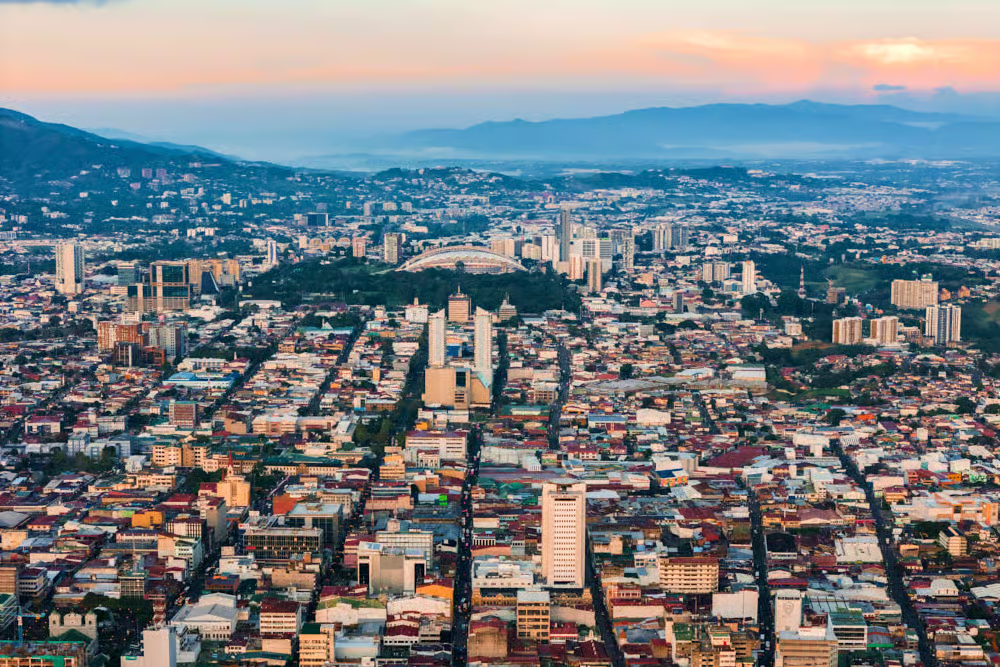
Costa Rica's capital plays a supporting role, and plays it well
San José sits at 1,170 meters in the Central Valley, ringed by coffee farms and four volcanoes, with a climate mild enough that neither heating nor air conditioning is standard in most homes. It is not trying to be Costa Rica's main attraction, and most travel guides treat it purely as the airport city you pass through on the way to a volcano or a beach. That reputation is not entirely fair: Barrio Escalante alone, a few blocks of converted early-20th-century homes now packed with restaurants, coffee roasters and craft breweries, justifies a night on its own.
What the city actually offers is a genuine, unpolished slice of a Latin American capital between the rainforest postcards: a 19th-century opera house paid for by coffee exports, a pre-Columbian jade and gold collection that rivals anything in the region, and a produce market that has fed the city since 1880. Go in expecting a working city rather than a resort, and it delivers more than its reputation suggests.
The honest complications
Downtown San Jose is genuinely rundown in patches, the area around the Coca-Cola bus terminal has a real petty-crime problem worth actively avoiding, and the one-way street grid combined with aggressive local driving makes renting a car for city days a bad idea. Air pollution and traffic congestion are noticeable during weekday rush hours. None of this makes the city dangerous for a well-informed visitor, but the "colorful, chaotic capital" framing some blogs use undersells how much of downtown is simply tired infrastructure rather than charm, and a taxi or Uber is usually the better call after dark.
Four areas that matter, and they're spread out
San Jose's metro area sprawls across the Central Valley rather than concentrating into a single walkable core, so where you base yourself changes your evenings more than it changes your days.
Barrio Escalante
Centered on Calle 33 a few blocks east of downtown, Escalante is San Jose's culinary district: historic homes converted into restaurants, coffee roasters, wine bars and breweries along what locals call La Calle de la Gastronomía. It is safe to walk in the evening, close enough to downtown's sights for a short taxi ride, and the clear first choice for a one-or-two-night stay.
Escazú
Southwest of the city, Escazú is San Jose's most affluent suburb, home to embassies, private hospitals and the Multiplaza mall, with a reputation as the safest place to base yourself in the metro area. It trades atmosphere for tranquility: expect a car- or Uber-dependent, mall-adjacent stay rather than a walkable one, a reasonable trade for families or anyone prioritizing an easy, quiet night before or after a long drive.
Downtown (Catedral & El Carmen)
The historic core holds the Teatro Nacional, the Mercado Central and most of the museums, all walkable from each other via the pedestrianized Avenida Central. It is also the cheapest place to sleep and the one where street-level caution matters most, especially north toward the Coca-Cola market area. Fine for sightseeing by day; less appealing after dark than Escalante or Escazú.
San Pedro
Home to the University of Costa Rica, San Pedro has a younger, livelier bar and bookstore scene than downtown, reachable from the center by the city's light rail. A reasonable alternative to Escalante for travelers who want nightlife and lower prices over polish.
From a converted coffee mansion to a $13 hostel bunk
San Jose's hotel scene runs from restored historic mansions to straightforward international-standard business hotels, with a genuinely good hostel tier for travelers heading onward to the volcano and beach circuit. These picks cover every budget and neighborhood worth considering.
At the top of the boutique tier, Hotel Grano de Oro, a converted Victorian-era mansion near downtown, is consistently ranked among the city's best-reviewed properties, with a well-regarded on-site restaurant and rooms from around $130-190 a night. In Barrio Escalante itself, Selina San Jose combines a hostel's social atmosphere with private-room options and puts you inside the neighborhood's restaurant and bar scene rather than a taxi ride from it.
For a mid-range, reliably comfortable stay, Barceló San Jose runs from around $90 a night with the consistency of an international chain, a sensible choice for a one-night arrival or departure stop near the airport side of the valley. In Escazú, boutique and business hotels from roughly $55 a night trade nightlife for the metro area's quietest, most secure streets.
At the budget end, Costa Rica Backpackers Hostel, with an outdoor pool and rates from around $9-15 a dorm bed, has long been the city's best-known budget option for travelers assembling a longer Costa Rica itinerary from San Jose outward.
Gallo pinto, then a craft beer district nobody expects
San Jose's food scene splits cleanly in two: the unpretentious sodas serving gallo pinto and casados for a few dollars, and Barrio Escalante's fast-maturing restaurant and craft-beer scene, which would not feel out of place in a much larger capital.
Mercado Central sodas
The Central Market, trading since 1880 on Avenida Central and Avenida 1, packs spice stalls, flower sellers and a handful of tightly-packed sodas serving gallo pinto, casados and fresh-squeezed juice at the prices locals actually pay. Come hungry before noon, when the lunch counters are liveliest.
Al Mercat
A narrow, chalkboard-menu room on Calle 33 built around small plates designed for sharing: octopus with smoked paprika aioli, Ibérico croquetas and grilled pejibaye (peach palm fruit) with manchego. The clearest sign that Escalante's food scene is not just hype.
Costa Rica Beer Factory & Wilk Craft Beer
Costa Rica Beer Factory, just south of the neighborhood's Fresh Market, brews beers named for the country's own regions, including an Escalante Red Ale and a Tortuguero IPA, while Wilkcr's brewpub a few blocks away pours its own line using local ingredients. Between the two, plus Dill Gastropub's rotating taps of Costa Rican microbrews, Escalante has quietly become the country's best neighborhood for craft beer.
Costa Rican coffee
Arabica-only, grown at altitude just outside the city, and taken seriously here: Escalante's specialty cafes pull espresso with the same intensity as its restaurants plate food, while a chorreado, coffee poured through a cloth sock filter, is still how a lot of San Jose households make their morning cup.
A one-day city, done properly
San Jose's sightseeing fits comfortably into a single day, walkable almost entirely along and around the pedestrianized Avenida Central. Nothing here demands more than a morning and an afternoon, which is exactly why one full day, rather than a rushed half-day transit stop, is the right amount of time to give it.
The historic core
Start at the Teatro Nacional, built in 1897 with a tax on coffee exports after a touring opera star reportedly skipped the country for lack of a proper venue; the neoclassical interior, Italian marble and painted ceiling frescoes, plus the small on-site cafe, make the modest entry fee worthwhile even without catching a performance by the National Symphony Orchestra. A short walk away, the Mercado Central has fed the city since 1880 and is still the best place for a cheap, authentic lunch between spice stalls and flower sellers.
The museums
The Museo del Jade, beside the Plaza de la Democracia, holds the largest collection of pre-Columbian jade in the Americas, with pieces dating back to 500 BCE displayed in a well-designed, genuinely interactive exhibit. A short taxi or walk away, the Museo del Oro Precolombino (Gold Museum), built underground beneath the Plaza de la Cultura, shows more than 1,600 pre-Columbian gold objects alongside the National Numismatic Museum's currency collection in the same building. Both are easily combined with the Teatro Nacional, which sits right above the Gold Museum.
Barrio Escalante by evening
Save the late afternoon and evening for Barrio Escalante: wander Calle 33 before dinner, stop into a specialty coffee roaster while the light is still good, then eat at Al Mercat or a similar small-plates spot before finishing at Costa Rica Beer Factory or Wilkcr. This is the version of San Jose that changes people's minds about the city.
A morning walking tour
Several operators run free (tip-based) walking tours of the historic center covering the National Theatre, Plaza de la Cultura and the surrounding architecture in about two hours, a low-effort way to get oriented on your first morning before setting off independently for the museums and market.
One day covers it, two makes room for a volcano
One full day is enough for San Jose's sights and Barrio Escalante's food; a second day is the one to give to a Central Valley day trip before continuing on to the rest of Costa Rica.
- Morning
Teatro Nacional and the historic core. Tour the theatre, then walk to the Museo del Oro Precolombino beneath the Plaza de la Cultura.
- Midday
Mercado Central. Lunch at a market soda: gallo pinto or a casado with fresh juice.
- Afternoon
Museo del Jade. The pre-Columbian jade collection at Plaza de la Democracia, then a taxi to Barrio Escalante.
- Evening
Barrio Escalante. Dinner at Al Mercat, then craft beer at Costa Rica Beer Factory or Wilkcr.
- Day 1
The one-day route above: Teatro Nacional, the museums, Mercado Central lunch, Barrio Escalante at night.
- Day 2
Poás Volcano and La Paz Waterfall Gardens. A full-day trip into the Central Valley (see Day Trips below), back in San Jose or continuing straight on toward Arenal by early evening.
- Days 1-2
The two-day route above, at a gentler pace.
- Day 3, option A
Sarchí and the Doka coffee tour. A half-day combining a working coffee plantation with the oxcart-painting town, easily paired with a morning departure toward Arenal.
- Day 3, option B
Orosi Valley and Irazú Volcano. A quieter loop of coffee farms and a colonial church ruin, finishing at Irazú's crater lake on a clear morning.
Easy to fly into, not a city to drive yourself around
Juan Santamaría International Airport (SJO) sits in Alajuela, about 20-30 minutes from downtown San Jose depending on traffic. Official orange airport taxis, marked "Taxi Aeropuerto," charge roughly $25-30 for the ride into the center; agree the fare or confirm the meter is running before you set off. There is no flat-rate Uber pickup directly at SJO, though requesting a ride from the city back to the airport works normally.
Inside the city, red taxis (marked with a yellow triangle logo) are common and metered; insist on the meter (maría) rather than a negotiated fare for short in-town trips. Uber operates throughout the metro area and is often cheaper and less hassle than hailing a taxi on the street. A light rail line (tren eléctrico) connects downtown to San Pedro and a few outer suburbs cheaply, though coverage is limited compared to a larger capital. Avoid renting a car for city days specifically: the one-way grid, aggressive local driving and scarce parking make it more trouble than it's worth; pick up a rental only when you're ready to leave for the rest of the country.
Best time to visit and the Central Valley's microclimate
San Jose's 1,170-meter elevation keeps temperatures mild and remarkably stable year-round, typically 18-27°C, so the city itself is comfortable in any month. December through April (dry season) gives the most reliable weather for day trips into the surrounding volcano country; May through November (green season) still tends to have sunny mornings with afternoon rain, so plan outdoor day trips for the early part of the day regardless of season.
One of the more affordable stops on a Costa Rica trip
San Jose is noticeably cheaper than Costa Rica's beach resorts and eco-lodges, since it runs on local city prices rather than tourism-zone markups. The main cost trap is eating at restaurants aimed squarely at visitors near the main sights instead of the sodas a block or two away.
- Hostel dorm $9-20
- Soda meals and the market $12-20
- Taxis, light rail and walking $5-10
- Free museums days plus one paid sight
- Boutique hotel or B&B $70-130
- Restaurant meals with drinks $30-55
- Taxis and the occasional Uber
- A museum, a walking tour, a craft-beer evening
- Hotel Grano de Oro or equivalent $130-190+
- Tasting menus in Barrio Escalante
- Private Poás Volcano day tour
- Private airport transfers
Fine with normal precautions, with one area to actively avoid
San Jose is safe for tourists who take standard city precautions, in line with Costa Rica's overall Level 2 (Exercise Increased Caution) rating. Violent crime against visitors is uncommon; the real, practical risk is petty theft, pickpocketing and occasional bag-snatching concentrated in specific, identifiable spots rather than spread evenly across the city.
The one area worth actively avoiding, especially after dark, is the Coca-Cola market and bus terminal district north of Avenida 1 in the western part of downtown: a major transit hub with a long-documented petty-crime problem. If you find yourself there, head south to Avenida Central rather than continuing north. Elsewhere downtown, stick to well-lit streets after dark and take a taxi or Uber rather than walking, particularly around the Museo Nacional and the areas bordering the Cesár river canyon after sunset. Barrio Escalante and Escazú both feel noticeably calmer at night than downtown. Emergency number is the nationwide 911 from any phone.
A volcano crater and a waterfall garden, both under two hours out
San Jose's position in the Central Valley makes it a genuinely convenient base for day trips before continuing on to the rest of Costa Rica. Three are worth a half or full day each.
Poás Volcano National Park
One of the most accessible volcano craters in the world: a short, paved path leads from the parking area to a viewing platform over Poás' massive, steaming main crater, weather and volcanic activity permitting (the park occasionally closes the summit trail on short notice for gas or ash activity, so check conditions the morning of your visit). Entry is capped and often requires booking a specific time slot online in advance.
La Paz Waterfall Gardens
A private nature park built around five waterfalls linked by forest trails, plus a wildlife rescue center with toucans, monkeys, a butterfly observatory and a hummingbird garden. Most visitors combine it with Poás Volcano on a single full-day tour (roughly 11 hours door to door, typically departing San Jose hotels around 6-8:30am) that includes hotel pickup, a coffee plantation stop, both sites and lunch.
Sarchí & the Doka Coffee Estate
Sarchí is Costa Rica's traditional handicraft town, best known for hand-painted oxcarts (carretas); the Joaquín Chaverría Oxcart Factory, founded in 1902, is the birthplace of the craft and displays a Guinness-listed oxcart nearly 14 meters long. Paired on the same day with a working coffee tour at the Doka Estate, a 60-minute walk-through of cultivation, harvesting and roasting, this makes a satisfying half-day alternative to the Poás/La Paz route, and some operators combine all three (Poás, Doka and Sarchí) into one longer day.
San José FAQ
Is San Jose, Costa Rica safe for tourists?
San Jose is safe for tourists who take normal city precautions. The main concern is petty theft and pickpocketing, concentrated around the Coca-Cola bus terminal area, which is worth avoiding after dark. Standard downtown streets are fine to walk in daylight.
How many days do I need in San Jose?
One full day covers the city center well: the National Theatre, Mercado Central and the museums. Most visitors add a second day for a Poás Volcano or La Paz Waterfall Gardens day trip before continuing on to Arenal, Monteverde or the coast.
How much does San Jose cost per day?
Budget travelers manage on $45-65 a day with hostels and soda meals; mid-range runs $110-180. San Jose itself is one of the more affordable stops on a Costa Rica trip compared to the beach resorts.
When is the best time to visit San Jose?
December through April, the dry season, gives the most reliable weather for day trips to Poás and the Central Valley. The Central Valley's altitude keeps San Jose mild year-round, so the city itself is comfortable in the rainier months too, mornings are usually dry even in green season.
Is San Jose worth visiting or just a gateway?
It is genuinely worth one full day, mainly for Barrio Escalante's food and craft-beer scene and the Poás Volcano or La Paz Waterfall Gardens day trip, but most visitors are right to treat it as a one-to-two-night base rather than the main event of a Costa Rica trip.
How do I get from Juan Santamaria Airport to San Jose?
Official orange airport taxis cost roughly $25-30 for the 20-30 minute ride into the city center; agree the fare or confirm the meter before departing. There is no flat-rate Uber pickup at the airport, though Uber can be requested for the return trip from the city.
What is the best area to stay in San Jose?
Barrio Escalante for food, craft beer and a walkable, safer feel close to downtown. Escazú for a quieter, more suburban base with the city's safest reputation, about 20 minutes from the center. Downtown only if sights and budget matter more than a lively evening scene.
Do I need to speak Spanish in San Jose?
No, but it helps outside hotels and the main tourist restaurants. English is common in Escazú, Barrio Escalante and among tour operators; less so at sodas, markets and on public buses.
Is San Jose walkable?
The pedestrianized Avenida Central downtown and Barrio Escalante are both walkable and pleasant in daylight. Distances between neighborhoods like Escazú and downtown are too far to walk; use a taxi or Uber instead, and avoid walking alone anywhere after dark.
Should I rent a car for San Jose itself?
No. San Jose's traffic and one-way street grid are genuinely difficult for visitors, and taxis and Uber are cheap. Rent a car only once you are leaving the city for the rest of Costa Rica, and consider picking it up on your way out rather than for city days.
What Stays With You
San Jose does not perform for visitors the way a resort town does, and that is exactly its appeal for the one day most people give it. The city gets on with its own life, coffee culture at the Teatro Nacional's cafe, market vendors who've worked the same stall for decades, a craft brewer naming a beer after a Caribbean coast town he grew up visiting, and lets you walk through the middle of it before you head for the volcano.
Give Barrio Escalante one proper evening: dinner at a chalkboard-menu restaurant, a pint at a brewery named after the neighborhood, and a sense of a capital that was never trying to be the postcard, only the place that makes the postcards possible.