
Canada
The second-largest country in the world by land area, with fewer people than California. Most of it is wilderness. The Rocky Mountains are larger, wilder, and emptier than visitors from Europe expect. The aurora borealis appears in the north with a frequency and intensity that no photograph prepares you for. And Québec is a French city on a different continent, 400 years old and entirely itself.
What You're Actually Getting Into
Canada is the world's second-largest country by area — 9.98 million square kilometres — with a population of approximately 40 million people, most of whom live within 200km of the US border. The implication: most of Canada is essentially empty. The Yukon, the Northwest Territories, Nunavut, northern Quebec, Labrador — these regions are larger than most countries and contain almost nobody. The wilderness is not scenery in the European sense of managed landscapes with walking trails. It is actual wilderness, where bears and wolves and moose move through landscapes that have never had a road built through them. This is genuinely extraordinary and genuinely requires appropriate preparation and respect.
The Canada that most visitors encounter is the populated southern corridor: Vancouver on the Pacific coast, the Canadian Rockies (Banff, Jasper, Yoho), the prairie cities (Calgary, Edmonton, Winnipeg), Toronto and the Great Lakes, Ottawa, Montréal, and Québec City. These destinations are physically safe, well-infrastructure'd, and extremely welcoming — Canada consistently ranks among the world's most pleasant countries for international visitors. But they represent a narrow slice of what the country actually is.
The two things that international visitors most consistently underestimate about Canada. First, the cold. European visitors from countries with cold climates (Scandinavia, Germany, the UK) arrive in Canadian winter assuming they know what cold is. They don't, not at the scale Canada produces it. Toronto in January averages -4°C but feels significantly colder with the wind off Lake Ontario. Winnipeg averages -16°C and has recorded temperatures below -50°C with wind chill. Ottawa averages -11°C. Montreal has -10°C average with two metres of snow. This cold is not a hardship if you dress correctly — but it requires a level of layering and equipment that casual winter clothing does not provide. Proper base layers, mid-layers, and a rated winter jacket are not optional in January in any Canadian city east of Vancouver.
Second, the driving distances. Toronto to Québec City is 8 hours by car. Toronto to Halifax in Nova Scotia is 22 hours. Vancouver to Calgary is 10 hours. Ottawa to Montreal is 2 hours (this one is manageable). If you plan to drive across Canada "on a road trip," understand that the Trans-Canada Highway is 7,821km from St. John's, Newfoundland to Victoria, British Columbia — roughly the distance from London to India. Driving it end-to-end in two weeks means driving 8–10 hours per day with minimal stops. Drive one region properly rather than racing across the whole country.
Canada at a Glance
A History Worth Knowing
The land that became Canada has been home to Indigenous peoples for at least 14,000 years — and possibly much longer — organized into hundreds of distinct First Nations, Métis, and Inuit peoples across an enormous range of environments, from the Pacific coastal nations (Haida, Tsimshian, Coast Salish) whose sophisticated maritime culture produced extraordinary art traditions, to the Plains nations (Blackfoot, Cree, Sioux) whose buffalo-based economy sustained large populations across the prairies, to the Inuit peoples of the Arctic who developed the technologies necessary to survive and thrive in one of the harshest environments on earth. By the time European contact began, Canada's Indigenous population numbered somewhere between 250,000 and 2 million (estimates vary widely). The peoples were not primitive — they had developed complex governance systems, trade networks, agricultural practices, and legal traditions over millennia.
European contact began with Norse explorer Leif Eriksson, who reached Newfoundland around 1000 CE — the L'Anse aux Meadows site in northern Newfoundland is a UNESCO World Heritage site with confirmed Norse remains. The sustained colonization began with John Cabot's 1497 voyage (English) and Jacques Cartier's 1534 voyage (French), which claimed the St. Lawrence River valley for France. The French colony of New France developed along the St. Lawrence, with Québec City founded in 1608 by Samuel de Champlain. The fur trade was the economic engine — beaver pelts for European hat fashion drove exploration, established trading relationships with Indigenous peoples, and created the geography of Canadian settlement.
The British-French struggle for control of North America culminated in the Seven Years' War (1756–1763), sometimes called the first world war in its geographic scope. British forces under General James Wolfe defeated the French under the Marquis de Montcalm on the Plains of Abraham above Québec City in September 1759 — a battle that lasted less than 30 minutes but determined the political future of a continent. Both commanders died in the battle. New France became British Canada, but the French-speaking population (les Canadiens) retained their language, religion (Catholic), and legal system (the civil law tradition) under the Québec Act of 1774 — a pragmatic accommodation whose consequences continue to shape Canadian politics today in the form of Québec's distinct identity within Confederation.
Canada's Indigenous peoples were systematically dispossessed through the treaty process — agreements often made under duress, frequently not honored by the Crown, and used to clear land for European settlement. The Indian Act of 1876 imposed a colonial governance structure on First Nations communities, prohibited cultural practices, and enabled the residential school system — government-funded, church-run boarding schools that operated from the 1880s until 1996, where approximately 150,000 Indigenous children were forcibly separated from their families and communities, forbidden from speaking their languages, and subjected to physical and sexual abuse on a systematic scale. The Truth and Reconciliation Commission's 2015 report concluded that the residential school system constituted cultural genocide. In 2021, the discovery of unmarked graves at the sites of former residential schools across the country — over 1,300 children whose deaths had never been formally recorded — brought the full horror of this history into public consciousness in ways that the earlier TRC report alone had not managed.
Canada's Confederation in 1867 created a dominion of four provinces (Ontario, Québec, Nova Scotia, New Brunswick) that gradually expanded to ten provinces and three territories by 1999. The country evolved from British dominion to full sovereign independence through the 20th century, achieving control of its own foreign policy in 1931 (Statute of Westminster) and full constitutional independence with the Constitution Act of 1982, which also included the Canadian Charter of Rights and Freedoms — the foundational human rights document. The 1980 and 1995 Québec referendums on sovereignty brought the country to the edge of partition — the 1995 referendum failed by the narrowest possible margin (50.58% No to 49.42% Yes). The Québec question has not been definitively resolved and remains a live dimension of Canadian political identity.
Indigenous peoples inhabit every region. Hundreds of distinct nations, languages, and cultures. The land is deeply known and managed.
Leif Eriksson reaches Newfoundland. L'Anse aux Meadows — confirmed Norse settlement. The first European presence in North America.
Jacques Cartier claims the St. Lawrence for France. Samuel de Champlain founds Québec City (1608). New France develops along the river.
British defeat French above Québec City. Less than 30 minutes. Both commanders die. The political future of North America decided.
Canada becomes a self-governing dominion of Britain. Four provinces. Gradually expands to 10 provinces and 3 territories by 1999.
150,000 Indigenous children forcibly separated from families. Cultural genocide. Truth and Reconciliation Commission 2015. Unmarked graves confirmed 2021.
Constitution Act and Charter of Rights and Freedoms. Canada fully sovereign. No longer legally subordinate to Britain in any respect.
Sovereignty vote fails: 50.58% No. The closest the country has come to partition. The Québec question remains constitutionally unresolved.
Top Destinations
Canada's main tourist circuits are regional rather than national. The west (Vancouver + Canadian Rockies) is the most visited circuit. Québec (Montréal + Québec City) is the French Canada circuit. The Maritimes (Nova Scotia, PEI, New Brunswick) is for those with more time and interest in coastal Atlantic Canada. The North (Yukon, Northwest Territories) is specifically for Northern Lights and wilderness. These do not combine efficiently — choose one or two per trip.
Banff & Jasper National Parks
The Canadian Rockies are among the world's greatest mountain landscapes — and unlike the Alps or the Himalaya, they are accessible by car from a major international airport (Calgary, 1.5 hours to the Banff townsite). Banff National Park has the extraordinary turquoise glacial lakes — Lake Louise and Moraine Lake — that produce their impossible color from glacial flour suspended in meltwater. Moraine Lake specifically, with the Valley of Ten Peaks behind it, is one of the most visually spectacular landscapes on earth. Jasper National Park, 3.5 hours north of Banff, is larger, wilder, and less crowded. The Icefields Parkway connecting them is routinely cited as one of the world's most beautiful drives. Year-round destination: summer for hiking, winter for skiing and dramatically fewer crowds at the lakes.
Yellowknife & the Yukon
Yellowknife in the Northwest Territories sits directly under the auroral oval — the band of maximum aurora activity that circles the magnetic pole. This positioning means Yellowknife has more reliable Northern Lights viewing than almost any other accessible destination on earth, with clear nights producing aurora activity on approximately 240 nights per year. The viewing season is late August through April, peaking October through March when nights are longest. Whitehorse in Yukon has built a major aurora tourism infrastructure and combines Northern Lights with spectacular wilderness. Churchill in northern Manitoba is better known for the polar bear migration (October–November) but is also an excellent aurora destination through winter. All three require flights from major Canadian cities and pre-booked accommodation.
Québec City
Québec City is the most European city in North America and the only walled city north of Mexico. The UNESCO-listed Old Town divides into the Haute-Ville (Upper Town), dominated by the Château Frontenac — the most photographed hotel in the world — and the walls and fortifications that have stood since 1608; and the Basse-Ville (Lower Town), where the original colonial settlement is now the Quartier Petit Champlain with its narrow stone streets and French bistros. The city operates entirely in French — not as a cultural performance but as the genuine first language of its residents. In February, the Carnaval de Québec transforms the city into the world's largest winter festival with ice sculptures, night parades, and the iconic Ice Hotel.
Vancouver
Vancouver is regularly ranked among the world's most livable cities — the combination of ocean and mountain in a single view, the Pacific Rim food culture (the best Asian food in North America outside major US cities), Stanley Park (a 405-hectare temperate rainforest park immediately adjacent to downtown), and a mild, rainy climate that keeps everything green year-round. Whistler, 2 hours north, is one of the world's great ski resorts in winter and a mountain biking and hiking destination in summer. The Sea to Sky Highway connecting Vancouver to Whistler is as dramatic as its name suggests. Combine with the Gulf Islands or Vancouver Island for a coastal extension.
Toronto
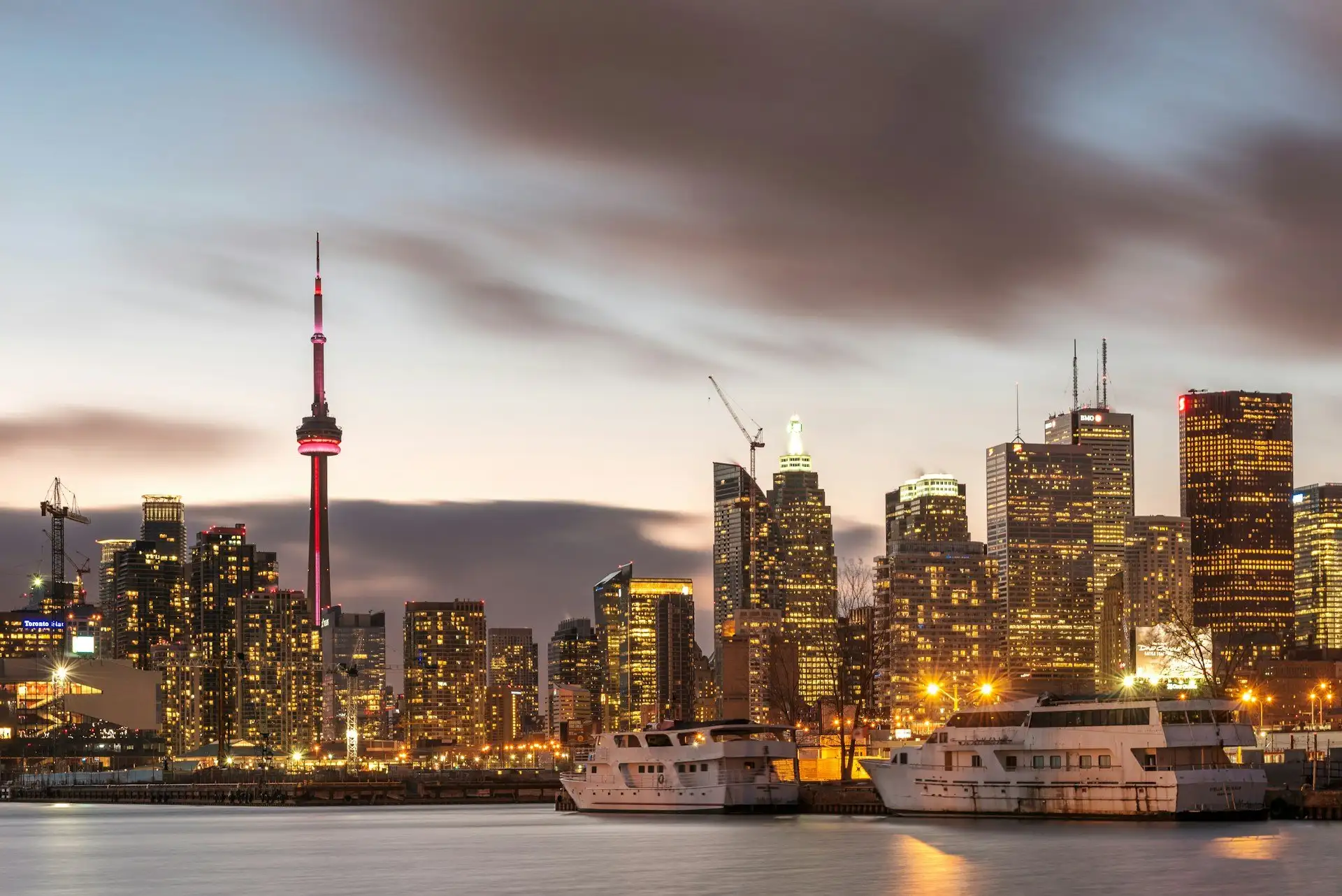
Toronto is Canada's largest city and one of the world's most ethnically diverse — over half the population was born outside Canada, making it one of the most genuinely multicultural major cities on earth. Kensington Market (a Victorian-era neighborhood turned into an eccentric food and second-hand market), Chinatown, Greektown, Little India, Little Portugal — the city's ethnic neighborhoods are the correct way to eat and experience it. The CN Tower, the ROM (Royal Ontario Museum), the Art Gallery of Ontario (redesigned by Frank Gehry), Niagara Falls 1.5 hours away, and the Distillery District all belong on the itinerary. Toronto in summer (June–September) is a genuinely excellent city; in January it is a brutal one.
Montréal
Montréal is where French Canadian culture is most alive and most urban — a city of 2 million people on an island in the St. Lawrence where the languages, food, and social atmosphere are distinctly not anglophone Canadian. The Plateau-Mont-Royal neighborhood has a density of great restaurants, independent bookshops, and music venues per square meter that rivals any city in North America. The Festival International de Jazz de Montréal (July) and Just for Laughs comedy festival (July–August) are world-class annual events. The underground city (RESO) — 33km of underground walkways connecting metro stations, shopping, hotels, and office buildings — is the practical solution to a city where January temperatures reach -15°C with regularity.
Nova Scotia & the Maritimes
The Maritime Provinces (Nova Scotia, New Brunswick, Prince Edward Island) are the most overlooked major tourist region in Canada — a coastal Atlantic landscape of fishing villages, dramatic tidal phenomena (the Bay of Fundy has the world's highest tides — up to 16 metres, which means the ocean floor is exposed twice daily at low tide), excellent seafood (lobster, Digby scallops, PEI oysters), and a Scottish and Acadian cultural heritage that is entirely distinct from the rest of the country. Cabot Trail in Cape Breton Island (Nova Scotia) is one of North America's most beautiful coastal drives. The PEI red soil and pastoral landscape is famously the setting of Anne of Green Gables. Best in July–September.
Vancouver Island & British Columbia Coast
Vancouver Island is a 460km-long island off BC's coast — larger than many European countries, mostly forested, with the city of Victoria (BC's capital, famously more British than Britain) at its southern tip and the Pacific Rim National Park on its wild west coast. Tofino on the west coast is a surfer and whale-watching town at the end of a dramatic highway through old-growth rainforest. The Great Bear Rainforest, north of Vancouver Island on the BC mainland coast, is one of the world's last intact temperate rainforests — and the home of the Spirit Bear (kermode bear), a rare white-colored black bear found nowhere else on earth.
Culture & Etiquette
Canadian culture is not American culture with a maple leaf applied to it. The two countries share a language (in English Canada) and a border but differ in ways that are subtle to outsiders and significant to Canadians. The differences are primarily in the relationship between individual and community: Canadians tend toward a more social-democratic consensus, are more comfortable with government services and public institutions, and are less likely to express strong opinions to strangers on political topics — not because they don't have opinions but because aggressive public assertion of one's views is considered poor form. "Sorry" is used constantly in Canada and does not always signal apology — it signals social lubrication, acknowledgment, and a desire to maintain smooth interaction. The Canadian "sorry" is famous internationally and is entirely real.
In Québec, the cultural norms are different from English Canada and require specific awareness. Speaking French — even badly, even just a "Bonjour, je voudrais..." before switching to English — is both polite and practically effective. Québécois people are not hostile to anglophone visitors but they do appreciate the gesture of engaging in their language. Walking into a Montréal restaurant and immediately speaking English without attempting French is noticed.
Canada follows North American tipping culture. Restaurant servers expect 18–20% of the pre-tax bill. Bar staff: $1–2 per drink. Hotel housekeeping: $3–5 per night. Taxi: 10–15%. Unlike some European countries, this is genuinely part of the wage structure and not optional. The service industry in Canada is pleasant and professional and the tip is the correct way to acknowledge it.
Parks Canada's bear safety rules exist because bears are present in all Rocky Mountain national parks and encounters happen regularly. Store all food in bear-proof containers or designated food lockers — never in your tent or car with the window cracked. Carry bear spray and know how to use it. Make noise on trails. Don't approach bear sightings. The rules are simple and following them is what allows the parks to remain wild rather than requiring aggressive bear management.
In Montréal and Québec City, beginning any interaction with "Bonjour" (hello) before switching to English is the correct approach regardless of your French level. The city of Montréal is officially bilingual; Québec City is predominantly French. The effort is noted positively. "Bonjour, do you speak English?" gets a much warmer response than walking in speaking English from the outset.
Canadian winter clothing is not European winter clothing. Proper layering for -20°C with wind requires: moisture-wicking base layer, insulating mid-layer (fleece or down), and a wind and waterproof outer shell rated for at least -30°C. Wool or synthetic socks, not cotton (cotton holds moisture and accelerates heat loss). Insulated boots rated to at least -30°C. A balaclava or neck gaiter. Mittens rather than gloves for extreme cold. Buying Canadian outdoor brands (Canada Goose, Arc'teryx, Moose Knuckles) in Canada is cheaper than in Europe.
Canada's sales taxes (the federal GST — 5% — and provincial HST or PST that varies by province) are not included in displayed prices. Ontario's HST is 13%; BC's is 12%; Québec's combined rate is 14.975%. A $100 restaurant bill in Toronto costs $113 before tip. Budget with this in mind throughout the trip.
Canadians are aware that their country is frequently treated as an adjunct of the United States by people who haven't thought about it, and this is mildly but genuinely irritating. Canada has a distinct history, distinct political culture, distinct healthcare system, and distinct national identity from its southern neighbour. The maple leaf on a backpack is not decoration.
The most consistent international visitor mistake in Canada. Banff and Jasper "look close" on a map of Canada — they are 3.5 hours apart by car. Calgary to Vancouver is 10 hours. Toronto to Québec City is 8 hours. Planning to drive these distances as day trips produces a trip of mostly highway driving. Use domestic flights between major regions and drive within regions.
Feeding any wildlife in a national park or provincial park is illegal, dangerous for the animal, and can result in the animal being destroyed. A habituated bear — one that has lost its fear of humans through food association — is a dead bear. This applies to all wildlife: ground squirrels in Banff, seagulls in Halifax, Canada geese in Toronto. The rule is not about the visitor's safety; it's about the animal's.
Smoking is prohibited in all Canadian national parks. Campfire restrictions vary by fire risk — some Parks Canada campgrounds have complete fire bans during dry summer periods. Check the current fire status on the Parks Canada website before your visit. Violating fire restrictions in a national park is a serious criminal offence with substantial fines.
Outside Montréal, Québec is predominantly French-speaking and the expectation that English will be immediately available is not always accurate. In smaller Québec towns, restaurants, and shops, French is the working language. A translation app, basic French phrases, and patience cover most situations. Outside Québec, English is universal.
The Canadian Identity
Canadians have a complicated relationship with their national identity — partly because it is defined less by what Canadians are than by what they are not (American), and partly because the country's genuine multiculturalism means there is no single "Canadian experience." The official policy of multiculturalism (codified in the Multiculturalism Act of 1988) celebrates cultural retention rather than assimilation, which is philosophically distinct from the American melting-pot ideal. Indigenous, French, English, and immigrant communities are each understood as contributing to a Canadian mosaic rather than merging into a single identity. The practical effect is a country of unusual cultural variety, warmth toward newcomers, and a slightly anxious pride in being polite.
Hockey
Hockey is not just a sport in Canada — it is a cultural institution that functions somewhere between religion and collective memory. The NHL was founded primarily by Canadian teams. The game is played on outdoor rinks in backyards, in arenas in every small town, and watched simultaneously by an enormous proportion of the population during playoffs. The Hockey Hall of Fame in Toronto. Attending an NHL game — particularly a playoff game between the Montréal Canadiens and the Toronto Maple Leafs, the sport's oldest rivalry — is one of the genuinely loudest and most emotionally intense crowd experiences in North American sport. Tickets for regular season games are accessible; playoff tickets require planning.
Indigenous Arts
Indigenous Canadian art traditions — particularly from the Northwest Coast (Haida, Tlingit, Tsimshian formline design), the Inuit (soapstone carving, printmaking), and the Plains nations (beadwork, quillwork) — are among the world's most distinctive visual traditions. The UBC Museum of Anthropology in Vancouver has the finest collection of Northwest Coast art outside Indigenous communities themselves. The Winnipeg Art Gallery has the world's largest collection of Inuit art. Buying Indigenous art directly from Indigenous-owned galleries (rather than non-Indigenous resellers) supports the communities whose traditions produced the work.
Cannabis Culture
Canada was the first G7 country to federally legalize recreational cannabis (October 2018). Legal retail cannabis stores operate across the country with regulated products, age limits (18 or 19 depending on the province), and quality standards. This is relevant for international visitors from countries where cannabis is not legal: bringing cannabis into or out of Canada is still illegal regardless of legality in either country. Public consumption rules vary by province and municipality — many public spaces have the same rules as tobacco smoking. The legal market has normalized cannabis in Canadian public life in ways that visitors from more restrictive countries may find surprising.
Food & Drink
Canadian cuisine is younger and less codified than French or Mexican cuisine but has developed distinct regional traditions that reward engagement. The food culture that most consistently surprises international visitors is Canadian multicultural city food — Toronto and Vancouver in particular have food scenes driven by immigrant communities that produce some of the best Chinese, Indian, Japanese, Korean, Vietnamese, and Caribbean food outside their countries of origin. A proper dim sum Sunday in Richmond (the suburb of Vancouver with the highest concentration of Cantonese restaurants) is a better meal than most of what gets called Chinese food elsewhere in the world. This is not an accident: the communities that produce these cuisines are cooking for themselves, not performing for tourists.
The Canadian food traditions that are specifically Canadian and worth knowing about: poutine (unmissable), the east coast seafood tradition (lobster, fish and chips, dulse, chowder), Québec cuisine (tourtière, sugar pie, crêpes in every form), Alberta beef (genuinely the best beef in North America by most serious assessments), and the Indigenous food traditions that are beginning to be celebrated more formally — bannock, bison, cedar-planked salmon, foraged berries.
Poutine
Québec's most celebrated export: french fries topped with fresh cheese curds (which squeak — this is correct and intentional) and hot brown gravy. The combination sounds improbable and tastes extraordinary. Originated in rural Québec in the 1950s, now found across Canada and internationally, though the Québec versions at a proper chip truck or casse-croûte (snack bar) remain the definitive versions. The cheese curd must be fresh enough to squeak when bitten; day-old curds don't produce the right texture. La Banquise in Montréal has 30 varieties. A late-night poutine after a night out in Montréal is a specific Canadian cultural institution.
Maritime Lobster
Nova Scotia and Prince Edward Island lobster — pulled from the cold North Atlantic and eaten within hours — is among the best shellfish in the world. During lobster season (May–July for spring season, August–October for fall in Nova Scotia), entire roadside stands sell whole steamed lobsters for prices that are startlingly low by European comparison. A lobster supper at a church hall in PEI — a community fundraising tradition that includes the full spread of chowder, rolls, and all-you-can-eat lobster for a fixed price — is the correct way to eat it.
Québec Cuisine
Tourtière (the traditional meat pie of the Saguenay region, spiced with cloves and cinnamon, eaten at Christmas), tarte au sucre (sugar pie — caramelized maple sugar in pastry, genuinely extraordinary), cretons (a pork spread similar to rillettes), soupe aux pois (yellow pea soup, the survivor from New France's winter cuisine), and maple syrup on everything. Québec is the world's largest producer of maple syrup — over 70% of the global supply — and uses it in ways that European maple syrup consumers (who mainly use it on pancakes) don't anticipate. The cabane à sucre (sugar shack) experience in February–March, when maple syrup is being produced, is one of the most specifically Québécois cultural experiences available.
Vancouver Pacific Rim Food
Vancouver and its suburb Richmond have an extraordinary density of high-quality Asian restaurants driven by the large Chinese, Japanese, Korean, Vietnamese, and Indian diaspora communities. The dim sum restaurants in Richmond operate at a quality level that produces regular pilgrimage from food writers and restaurant professionals from across North America. Sushi restaurants in Vancouver receive fish deliveries from the same boats as Tokyo. The ramen scene is among the best outside Japan. This food culture is not tourism-facing — it is a community cooking for itself, which is the correct condition for extraordinary food.
Maple Syrup
Canada produces 70% of the world's maple syrup — a fact that becomes clear when you encounter it in Québec, where it is not a pancake topping but an ingredient in everything from salad dressings to meat glazes to the pure grade B (now called Amber, Rich Taste) that is drunk warm at a sugar shack in March. The different grades (Golden, Amber, Dark, Very Dark) have genuinely different flavor profiles — the very dark syrup has a deep, almost molasses character that the golden variety doesn't. Buying maple syrup directly from a Québec producer (sucrerie) rather than from an airport gift shop produces a better product for a lower price.
Canadian Craft Beer & Whisky
The Canadian craft beer scene has exploded since the 2010s — every major city now has multiple excellent breweries. Unibroue in Québec (La Fin du Monde, Maudite) makes Belgian-style ales that have received international recognition. Tree Brewing in BC, Dieu du Ciel in Montréal, and Steam Whistle in Toronto represent the diversity of the scene. Canadian whisky (rye whisky — the Canadian style, lighter than Bourbon) from distilleries including Canadian Club, Crown Royal, and the newer craft producers is an excellent gift and a distinct tradition from Scotch or Bourbon.
When to Go
Canada's seasons are extreme in ways that create genuinely distinct travel experiences rather than simply better and worse times to visit. Summer (June–September) is the obvious answer for most destinations but winter Canada — properly equipped — is extraordinary. The Canadian Rockies in winter have fewer crowds, ski resorts at world-class level, and mountain landscapes under snow that are incomparably beautiful. Québec City in February during Carnaval is one of the world's best winter festival experiences. Yellowknife and Whitehorse in winter are the Northern Lights and Arctic wildlife. What winter requires is preparation: specifically rated clothing, proper footwear, and understanding that outdoor activities are conducted in conditions that European visitors typically consider extreme.
Summer
Jun – SepThe primary season for the Rockies (hiking, lake viewing), the Maritimes (lobster, Cabot Trail), Vancouver Island (whale watching, surfing), and northern destinations (Midnight Sun in Yukon, aurora starts returning in August). July and August are peak crowds and prices at Banff — Moraine Lake shuttles and popular hike trailheads book out. September is the best month: turning foliage, fewer crowds, comfortable temperatures.
Winter
Dec – MarNorthern Lights peak season in Yellowknife, Whitehorse, and Churchill. World-class skiing in Whistler, Banff Sunshine, and Mont Tremblant. Carnaval de Québec (February). Dramatically fewer crowds at Banff and Jasper — the mountains under snow, the lakes frozen. Requires proper cold-weather gear. Ottawa's Winterlude festival (February) celebrates the Rideau Canal skating rink — the world's largest naturally frozen skating surface.
Fall
Sep – OctSeptember and October are the least discussed and most underrated time to visit Canada. The Rocky Mountains turn gold with larch trees (mid-September in Banff — the most beautiful single week of the year in the parks). Foliage across Québec, New Brunswick, and Ontario. Shoulder-season prices. Manageable crowds. Weather still pleasant in the south (12–18°C). Churchill polar bears arrive on Hudson Bay shore in October–November.
Spring
Mar – MaySpring in Canada is more difficult than fall. The Rockies are still mostly snowed in until May; the mountain roads don't reliably open until June. April and May in Canadian cities are cold, wet, and muddy. The Maritimes are cold until June. This is the "shoulder season" that doesn't actually benefit the visitor — ski season is winding down but hiking season hasn't started. April in Québec City is still winter.
Trip Planning
Ten to fourteen days is the right length for a focused Canadian regional trip. Two weeks allows the West Coast (Vancouver + Rockies circuit), the Québec circuit (Montréal + Québec City), or the Maritimes (Nova Scotia + PEI). Three weeks can combine two regions with a domestic flight between them. The country is too large to drive end-to-end on a two-week trip with any quality. Choose a region, rent a car, and drive within it.
The discovery card: Parks Canada's Parks Pass. An annual Discovery Pass ($72.25 CAD per adult, $145.25 for a family/group vehicle) gives unlimited entry to all 46 national parks, national historic sites, and national marine conservation areas for one year. It pays for itself on a two-week Rockies trip immediately and is the correct purchase for any Canadian nature itinerary.
Vancouver
Day one: arrive YVR, Stanley Park seawall walk or cycle (3-hour loop). Granville Island Public Market for lunch — cheese, charcuterie, fresh bread. Day two: Richmond for dim sum at one of the large Cantonese restaurants on No. 3 Road (arrive before 11am for tables). Afternoon at the UBC Museum of Anthropology — the finest Northwest Coast Indigenous art collection in any public museum. Day three: North Shore — the Capilano Suspension Bridge (touristy but the forest is genuine) or the free Lynn Canyon suspension bridge in a quieter setting. Drive to Banff (10 hours, scenic via the Trans-Canada) or fly to Calgary (50 min) and drive from there (1.5 hours to Banff).
Banff & the Rockies
Day four: arrive Banff, Lake Louise in the afternoon (take the shuttle). Day five: Moraine Lake at sunrise via the first shuttle of the day (5:30am in peak season). Larch Valley hike (late September: magnificent; mid-summer: crowded but beautiful). Day six: drive north on the Icefields Parkway (Highway 93) — stop at Peyto Lake, Bow Summit, the Athabasca Glacier, and Athabasca Falls. Arrive Jasper late afternoon. Day seven: full Jasper day — Maligne Lake and Spirit Island boat tour (book ahead), Maligne Canyon. Day eight: return south via the Icefields Parkway at a different pace — the Weeping Wall, Sunwapta Falls, and a stop at the Num-Ti-Jah Lodge on Bow Lake. Back to Banff.
Calgary & Departure
Day nine: drive from Banff to Kananaskis Country (less visited than Banff but extraordinary) or take the Banff Gondola to Sulphur Mountain for the panoramic view. Evening in Calgary — the Stephen Avenue pedestrian mall, a steak at a Calgary restaurant (Alberta beef, the best in Canada). Day ten: Calgary departure or extend with a day trip to the Drumheller badlands (1.5 hours east) — dinosaur fossil country, the Hoodoos, and the Royal Tyrrell Museum (one of the world's great palaeontology museums).
Montréal
Five days. Day one: Plateau-Mont-Royal neighborhood — the main rue Saint-Denis, Mile End bagel institutions (Fairmount or St-Viateur — the Montréal bagel, hand-rolled and wood-fired, is specifically better than New York bagels and the debate is settled). Day two: Old Montréal (Vieux-Montréal) — the basilica Notre-Dame, the cobblestone streets, the St. Lawrence riverfront. Day three: Jean-Talon Market in Little Italy (the best farmers' market in Canada), the Plateau in the evening for the best restaurant density per block in the country. Day four: Day trip to Mont-Tremblant (2 hours) for skiing in winter or hiking in fall. Day five: the underground city in winter, or the Mount Royal Park hike in summer. Train to Québec City.
Québec City
Four days. Day six: arrive by VIA Rail train (3 hours from Montréal — scenic and comfortable). Haute-Ville: the Château Frontenac, the Plains of Abraham, the fortification walls. Day seven: Basse-Ville and Quartier Petit Champlain — the oldest commercial street in North America, the funicular between upper and lower towns. Day eight: drive to Montmorency Falls (7km east, higher than Niagara, suspension bridge over the top) and the Île d'Orléans — the island in the St. Lawrence where Québécois agricultural heritage is preserved, with farms, orchards, and artisan food producers. Day nine: winter (Carnaval, ice hotel at the Hotel de Glace) or fall (drive the Charlevoix region north of Québec City along the St. Lawrence — extraordinary foliage).
Sugar Shack & Countryside (Seasonal)
If visiting February–April: a cabane à sucre (sugar shack experience) is essential — a Québec maple producer who opens their production house for a traditional meal of all-maple-syrup foods served on communal tables, with tire sur la neige (maple taffy pulled onto snow) for dessert. This experience exists only in Québec during sugar season and is one of the most specifically Canadian food experiences available. Return to Montréal for departure, or extend with a drive to the Eastern Townships (Cantons-de-l'Est), the most overtly European landscape in Canada.
Vancouver
Three Vancouver days as above, adding the Squamish Lil'wat Cultural Centre in Whistler if timing permits the 2-hour drive north. The Centre provides the best introduction to Pacific Northwest Coast Indigenous culture available in a museum setting outside the UBC MOA.
Canadian Rockies
Six days for the full Rockies circuit. Banff (two days), Icefields Parkway to Jasper (day five), full Jasper day (day six), Yoho National Park (day seven — Emerald Lake, Natural Bridge, Takakkaw Falls: Yoho is smaller and less visited than Banff but has some of the finest scenery in the Rockies). Return to Calgary for the flight to Halifax.
Nova Scotia & PEI
Fly Calgary to Halifax (4 hours). Four days. Halifax city day (the Citadel, the waterfront, the Alexander Keith's Brewery tour — the oldest continuously operating brewery in North America). Drive the Cabot Trail in Cape Breton (day 12) — a full loop drive of approximately 5–6 hours with spectacular coastal scenery and whale sightings if in season. Ferry from Caribou NS to Wood Islands PEI (75 minutes) on day 13 — red clay cliffs, pastoral landscape, PEI Preserve Company for the best jam in Canada.
Montréal
Fly from Charlottetown PEI to Montréal (2 hours). Three days for the best of Montréal: Plateau restaurants, Old Montréal, the Jazz Festival if timing is July, the Montreal Museum of Fine Arts. Fly home from YUL.
Parks Canada Discovery Pass
$72.25 CAD per adult or $145.25 for a family/group vehicle. Covers unlimited entry to all 46 national parks, 171 national historic sites, and 4 marine conservation areas for one year. On a 10-day Rockies trip where Banff costs $10.50 per vehicle per day and Jasper the same, the pass pays for itself within a week. Buy at parks.canada.ca or at any Parks Canada gate. Non-residents pay the same price as residents.
Winter Clothing
For visits between November and March outside Vancouver: rated base layer (merino wool or synthetic), insulating mid-layer (down or fleece), and wind/waterproof outer shell rated to at least -30°C. Insulated winter boots rated to -30°C or below. Balaclava or neck gaiter. Mittens (warmer than gloves for extreme cold). Hand and foot warmers for aurora watching. Canadian outdoor gear brands (Arc'teryx, Canada Goose, Moose Knuckles) are available in Canadian cities for less than in Europe.
Bear Safety
Bear spray (effective against grizzlies and black bears, far more reliable than a firearm at close range) is sold at Canadian Tire, outdoor gear shops, and some Parks Canada visitor centres. Know how to use it before you need to: safety clip off, spray at 7–9 metres in a sweeping horizontal pattern, don't run. Store all food in bear-proof containers or lockers — a bear that raids a campsite becomes habituated and must usually be destroyed. Respect all bear warning signs.
Connectivity
Bell, Rogers, and Telus are the main national carriers. Canadian SIMs are expensive compared to European equivalents — a 30-day data plan costs CAD $50–90. An eSIM through Airalo is often more cost-effective for short visits. Coverage in cities and along highways is good. National parks have variable coverage — some areas (particularly in Jasper and remote parts of the Maritimes) have no signal. Download offline maps before entering parks.
Get Canada eSIM →Renting a Car
Essential for the Rockies, the Maritimes, and any rural or national park destination. Canadian car rental requires a valid driving licence and credit card. International licences accepted alongside home country licences. Budget winter tires: in some provinces (Québec requires them by law December–March) winter tires are mandatory. Rental companies automatically provide winter tire-equipped vehicles in winter but confirm when booking. Driving in snow requires specific technique — take it slowly on hills.
Travel Insurance
Canada does not have reciprocal healthcare agreements with most countries (UK visitors are not covered by provincial health plans). A hospital visit can cost CAD $3,000–20,000+ without coverage. Travel insurance with comprehensive medical coverage is essential. For winter sports (skiing at Whistler, Banff Sunshine), confirm your policy covers the activity. For backcountry hiking or aurora viewing in remote areas, confirm it covers emergency helicopter evacuation.
Transport in Canada
Canada's transport reality is: fly between regions, drive within regions. The country lacks the intercity rail network that would make rail a practical alternative for most routes — the Canadian (VIA Rail's transcontinental train from Toronto to Vancouver) takes 4 days and is a specific experience in itself rather than a transport solution. The Quebec City–Windsor corridor (Québec City, Montréal, Ottawa, Toronto) has reliable VIA Rail service. Everything else is either flying or driving.
Domestic Flights
CAD $120–450/routeAir Canada, WestJet, and Porter Airlines (eastern Canada) connect all major cities. Vancouver to Calgary: 1 hour. Calgary to Toronto: 4 hours. Toronto to Halifax: 2.5 hours. Flying between regions is far more time-efficient than any ground option. Book 3–4 weeks ahead for reasonable prices. WestJet and Flair Airlines (budget) offer cheaper base fares with add-on structures.
Rental Car
CAD $60–130/dayEssential for the Rockies, Maritimes, and any national park visit. Major companies (Enterprise, Budget, Hertz, Avis) at all airport and city locations. In winter, confirm winter tires are included (standard in most provinces but verify). Driving in Canada is on the right, rules are similar to the US, and roads are generally excellent. Rural roads in Atlantic Canada can be narrow and winding — allow extra time.
VIA Rail
CAD $60–200/routeVIA Rail's Québec City–Windsor corridor (QC City → Montréal → Ottawa → Toronto) is the most useful train route in Canada. Comfortable, on time, and scenic along the St. Lawrence. The full Corridor Pass is good value for multi-stop trips in the east. The Canadian (Toronto → Vancouver in 4 days) is an extraordinary experience but a journey, not transport. Book ahead for sleeping berths on long routes.
Uber & Local Taxis
App rateUber operates in Toronto, Vancouver, Calgary, and Montréal. Lyft also in some cities. Traditional taxi infrastructure remains in most cities — generally reliable and metered. In cities with good transit (Toronto, Montréal, Vancouver), taxis and ride-shares are most useful for airport arrivals and late nights rather than general movement. Indriver operates in some cities as a cheaper alternative.
Urban Transit
CAD $3–4/rideToronto (TTC subway and streetcar), Vancouver (SkyTrain rapid transit to YVR), and Montréal (metro) have the strongest urban transit systems. Ottawa's O-Train is improving. In Calgary and Edmonton, light rail (CTrain/LRT) covers the downtown core but not the suburbs. Use transit apps (Moovit or Google Maps transit) — tap with a credit card or buy a day pass for convenience.
Ferries
CAD $15–60BC Ferries connects Vancouver to Vancouver Island (Tsawwassen–Swartz Bay, 1.5 hours) and the Gulf Islands — the most beautiful ferry route in Canada. Northumberland Strait ferries to PEI run May–December. Marine Atlantic connects Nova Scotia to Newfoundland (5.5–14 hours depending on route). Book BC Ferries peak-season sailings 3–7 days ahead to avoid long waits — the Vancouver Island ferry fills up on summer long weekends.
Greyhound Canada (Limited)
CAD $30–100Greyhound Canada significantly reduced its network after 2018 and is no longer the coast-to-coast option it once was. Regional bus operators (Orléans Express in Québec, Maritime Bus in Atlantic Canada, Red Arrow in Alberta) fill some gaps. For budget travelers, the bus remains useful for the Québec corridor and some Maritime routes. Flying is more time-efficient for longer distances.
Parks Canada Shuttles
CAD $15–30 returnParks Canada operates mandatory shuttle services to Moraine Lake, the Plain of Six Glaciers teahouse, and other high-demand destinations in Banff during peak season when private vehicle access is restricted. Shuttle reservations open in February for the upcoming summer season on the Parks Canada reservation system. Without a shuttle reservation in summer, you cannot access Moraine Lake by road — arrive before dawn on foot or by Parks Canada shuttle only.
Accommodation in Canada
Canada's accommodation is expensive compared to Mexico, Southeast Asia, or Eastern Europe — and moderately expensive compared to Western Europe or the United States. A good mid-range hotel in Toronto or Vancouver costs CAD $200–300/night (approximately €130–200); a national park lodge inside Banff or Jasper costs CAD $250–500/night and books out 6–12 months ahead for peak summer and ski season. The hostel sector in Canadian cities is good value for budget travelers — HI Canada (Hostelling International) operates excellent properties in most cities and in many national parks.
Staying inside the national parks rather than in gateway towns (Banff townsite for Banff NP; Jasper townsite for Jasper NP) is more expensive but gives you the experience of being in the park at dawn and dusk when wildlife is most active and the light is best. This is worth the premium for any nature-focused visit.
National Park Lodge
CAD $250–700+/nightThe iconic Canadian accommodation experience: Fairmont Chateau Lake Louise (right on Lake Louise, the views are worth the price), Fairmont Banff Springs (the castle-like hotel that defined Banff's visual identity), Jasper Park Lodge (log cabin cottages on the Athabasca River), and the Wickaninnish Inn in Tofino (ocean-facing, extraordinary). All must be booked 4–12 months ahead for peak season. Budget alternatives: Parks Canada's national park campgrounds and backcountry huts.
City Hotel
CAD $150–400+/nightCanadian cities have good hotel infrastructure across the range. In Vancouver: the Rosewood Hotel Georgia (luxury), the Victorian Hotel (mid-range, heritage building). In Toronto: the Drake Hotel (boutique, west end) and the Gladstone Hotel (boutique, arts community). In Montréal: Hotel Gault (boutique, Vieux-Montréal). In Québec City: Fairmont Château Frontenac (the landmark hotel, dramatically situated, deservedly expensive) and smaller B&Bs in Vieux-Québec for better value.
Camping
CAD $20–50/nightParks Canada campgrounds inside the national parks are the most immersive and best-value accommodation in Canada's natural areas. Tunnel Mountain in Banff, Wapiti in Jasper, and the sites at the Icefields Parkway are all bookable at reservation.pc.gc.ca — opening in January for the upcoming summer season. Frontcountry sites have vehicle access and usually flush toilets; backcountry requires overnight hiking permits (also bookable on the Parks Canada system).
Aurora Viewing Lodge
CAD $200–600/nightYellowknife and Whitehorse have purpose-built aurora viewing lodges — properties with glass viewing rooms or outdoor heated viewing platforms designed for overnight aurora watching. Aurora Village in Yellowknife (traditional Indigenous tepee-style structures with aurora viewing directly above) and various wilderness lodges in the Yukon provide the premium experience. Includes evening aurora alerts, guides who watch the forecast and wake guests when conditions are favorable, and return transfer from the city.
Budget Planning
Canada is an expensive country by global standards — comparable to Northern Europe in most cost categories and more expensive than the US in some (housing, telecoms). The Canadian dollar's weakness against the euro and pound (check the current rate — it varies) provides modest relief for European visitors. The main budget drivers: accommodation (particularly during peak summer season in national park gateway towns), domestic flights between regions, food in cities, and car rental. Budget travelers who camp and cook can manage comfortably; mid-range travelers in hotels and restaurants should budget CAD $250–400 per person per day excluding flights.
- HI hostel dorm (CAD $35–55)
- Self-catering and grocery stores
- National park camping
- Tim Hortons and food courts
- Parks Canada Discovery Pass
- Mid-range hotel (CAD $150–250)
- Restaurant meals with drinks
- Domestic flights between regions
- Guided tours (aurora, wildlife)
- Rental car for park driving
- Fairmont Banff Springs or Lake Louise
- Destination restaurants in Vancouver/TO
- Premium aurora lodge (Yellowknife)
- Heli-hiking in the Rockies
- Private guide for wildlife or fishing
Quick Reference Prices
Visa & eTA
Canada's entry system divides visitors into three categories: US citizens (who can enter by land, air, or sea with just a valid passport); visa-exempt foreign nationals (citizens of about 50 countries including the UK, EU nations, Australia, Japan, and South Korea) who need an eTA for air travel; and everyone else who needs a full visitor visa applied for through a visa application centre.
The eTA (Electronic Travel Authorization) is quick and cheap — CAD $7, applied for at canada.ca/en/immigration-refugees-citizenship/services/visit-canada/eta, and usually approved within minutes. It is valid for 5 years or until your passport expires, whichever comes first, and allows multiple entries with stays up to 6 months each time. The eTA is only required for air travel to Canada — visa-exempt nationals entering by land don't need one.
Apply at canada.ca/eta. Usually approved within minutes but can take 72 hours. Valid 5 years. Only required for air travel. EU, UK, Australia, Japan, South Korea, and ~45 other countries are visa-exempt. Check your specific passport status at the IRCC website.
Family Travel & Pets
Canada is one of the world's best family travel destinations — the national parks are universally accessible with excellent infrastructure (paved paths, interpretive centres, excellent parks staff), the cities are safe and family-oriented, and the outdoor experiences (wildlife viewing, kayaking, skiing, beach-going in summer) are available at every age level. The main family consideration is the distances — driving through the Rockies with young children requires realistic expectations about how many hours per day are manageable, and national park accommodation books out far in advance.
National Park Wildlife
Seeing wildlife in the Rockies is nearly guaranteed for family visitors in summer: elk are visible daily in Banff and Jasper townsites (including on the golf course and streets), ground squirrels in every parking lot, bighorn sheep on the mountain roads, and bears visible from vehicles along the Bow Valley Parkway. The encounter with a grizzly or black bear from a safely stopped car — not at feeding stations but as a natural sighting in a natural landscape — is one of the most memorable wildlife experiences available to families in any developed-country destination.
Ski Resorts
Whistler Blackcomb in BC and Banff Sunshine/Lake Louise in Alberta are among the world's best family ski destinations — extraordinary mountain scenery, excellent ski school infrastructure for children, and winter landscapes that are intrinsically dramatic. The ski school programs at all major Canadian resorts are well-developed, with children-specific programs from age 3. For non-skiers in the family, snowshoeing, winter spa facilities, and ice skating are available at all resort towns.
Northern Lights for Families
Seeing the Northern Lights — genuinely, the actual aurora borealis in the sky, not a stock photo — is one of the travel experiences that children never forget. Yellowknife and Whitehorse aurora tours are designed for families with aurora alert systems, heated warming stations, and guides who make waiting interesting. The key requirement is being awake at midnight in -25°C — which requires proper cold-weather clothing and a child old enough to manage both. Most operators recommend age 5+ for aurora tours.
Pacific Coast Wildlife
The BC coast offers exceptional family wildlife experiences: orca whale watching from Victoria (the J, K, and L pods are resident in the Salish Sea and viewed on 3–4 hour boat tours from Victoria and Vancouver), grizzly bear viewing in the Great Bear Rainforest (boat-based, extremely calm and safe), and the annual salmon run in autumn (September–October) where bears and eagles can be watched catching salmon in rivers accessible from the road. Sea kayaking in the Gulf Islands is suitable for children old enough to paddle (approximately 8+).
PEI & Maritime Beaches
Prince Edward Island's red-clay beaches have warm, shallow water that is consistently safe for young children (the Gulf of St. Lawrence is significantly warmer than the Atlantic-facing Nova Scotia coast). Cavendish Beach in PEI National Park is the classic family beach. The Anne of Green Gables farmhouse (L.M. Montgomery's inspiration for the novel) is an excellent family cultural stop. PEI in summer is a calm, safe, and spectacularly beautiful destination that many Canadian families regard as the best beach in the country.
Toronto with Children
The ROM (Royal Ontario Museum) is genuinely excellent for children — the dinosaur gallery, the bat cave, and the global natural history collection. The Ontario Science Centre is a multi-floor interactive science museum specifically designed for children. Ripley's Aquarium in downtown Toronto (sharks, jellies, and the tunnel under a shark tank) is predictably popular. Niagara Falls at 1.5 hours from Toronto is a universally loved day trip. The CN Tower's EdgeWalk (outdoor ledge walk at 356m) is for families with older children who handle heights confidently.
Traveling with Pets
Canada is one of the world's most pet-friendly travel destinations for dogs and cats. US citizens can cross the land border with dogs and cats with proof of current rabies vaccination — no additional documentation required. Visitors flying from other countries need a valid rabies vaccination certificate (for dogs) and may need a health certificate from an accredited vet. Dogs from rabies-free countries (UK, Japan, Australia, some EU nations) entering by air require a specific import permit from the CFIA (Canadian Food Inspection Agency) applied for in advance. Check the CFIA website for your specific origin country requirements.
Within Canada: dogs are not permitted on most hiking trails in national parks (they can only be on leash in campgrounds and specific frontcountry areas). This is a hard rule, not a suggestion — Parks Canada enforces it because off-trail dogs disturb wildlife. The exceptions are some provincial parks and recreation areas outside national park boundaries. Vancouver, Victoria, Montréal, and Toronto all have excellent off-leash parks and a strong dog culture. Accommodation that accepts pets is available throughout Canada — filter on Booking.com or Airbnb specifically for pet-friendly properties.
Safety in Canada
Canada is one of the safest countries in the world for international visitors. There is no part of the tourist circuit that requires the kind of security awareness needed in parts of Mexico, Brazil, or the US. Violent crime against tourists is extremely rare. The primary safety considerations in Canada are environmental: wildlife encounters in national parks, extreme cold in winter, and the specific dangers of backcountry wilderness travel. These are not trivial — people die in the Canadian Rockies every summer from underestimating trail difficulty and in the north from cold exposure — but they are manageable with appropriate preparation and information.
Cities
All major Canadian cities are safe for tourists. Urban petty crime (phone theft, pickpocketing) exists in downtown cores during events and at night, but at rates significantly lower than US or European equivalents. The Downtown Eastside of Vancouver (between Gastown and the port) is Canada's most concentrated area of poverty, drug use, and homelessness — not dangerous to tourists who don't engage, but confronting and worth knowing about before wandering that way from the tourist areas.
Wildlife Encounters
Bears (grizzly and black) in the Rockies and BC, moose throughout Canada, cougars in western provinces — all are genuine hazards in natural areas. The rules: carry and know how to use bear spray. Make noise on trails. Don't run from a bear. Never approach wildlife regardless of how docile it appears. A moose is more dangerous than a bear — they are large, fast, and will charge without warning. Never get between a moose and water (moose charge anything they perceive as threatening their route to water).
Cold Exposure
Hypothermia and frostbite are real risks in Canadian winters and in high-altitude mountain environments even in summer (Banff can have snow in any month). The body's warning signs for hypothermia — shivering, confusion, lack of coordination — must be recognized and treated immediately by moving to warmth. Wet + wind + cold is the most dangerous combination. Never venture into the backcountry in winter without proper gear, navigation skills, and someone knowing your expected return time.
Trail Safety
National park trails range from paved easy walks to extremely demanding backcountry routes. Check the Parks Canada website for current trail conditions, which change seasonally and can include bear closures, avalanche risk, and flash flood warnings. Register your backcountry travel plan — Parks Canada staff need to know where you're going and when to expect you back. Don't attempt trails rated above your experience level, particularly at altitude where rescue takes longer.
Winter Driving
Driving on snow-covered Canadian roads requires specific skills and proper tires. Wheel spin, hard braking, and overconfidence are the causes of most winter accidents. Reduce speed significantly (50% of posted limit in snow/ice conditions is the guideline). Allow triple the stopping distance. If you lose traction, steer gently in the direction you want to go and don't brake. Rental cars in winter come with winter tires — don't switch to all-seasons.
Medical Facilities
Canada's provincial healthcare systems are excellent but do not cover visitors from most countries. Private clinics and hospital emergency departments are available everywhere. In Toronto, Vancouver, and Montréal, emergency department wait times can be long for non-critical cases — urgent care clinics are faster for minor injuries. In national parks, Parks Canada wardens provide first response and can coordinate helicopter evacuation for serious emergencies. Travel insurance with direct billing to Canadian hospitals is the correct preparation.
Emergency Information
Your Embassy in Ottawa
Most foreign embassies are in Ottawa. Major countries also have consulates in Toronto, Vancouver, and Montréal — a consulate is often more useful than the embassy for practical emergencies depending on your location.
Book Your Canada Trip
Everything in one place. These are services worth actually using.
The Emptiness Is the Point
The thing about Canada that no photograph communicates is the scale of the emptiness. Driving the Icefields Parkway on a September morning with low cloud on the mountains and elk on the road and no other cars in either direction for as far as you can see in either direction — this is a feeling that requires the actual country to produce it. You are in a landscape the size of Europe with a fraction of Europe's population, and the wilderness does not feel managed or parcelled or scheduled. It feels like what the planet looked like before there were enough of us to change it.
The Northern Lights at midnight in Yellowknife are similar in kind — an encounter with something operating at a scale that makes the human body feel the correct size: very small, in the face of something very large and indifferent and beautiful. Canada does this repeatedly. The orca that surfaces 20 metres from your kayak off Vancouver Island. The grizzly bear at the river bank who looks at your boat and decides you're not interesting. The moment at Moraine Lake in September when the light hits the water and the valley goes golden and you understand why people come back here every year until they can't.
This is what the country is for. Everything else — the cities, the food, the hockey — is excellent context. The wilderness is the argument.