
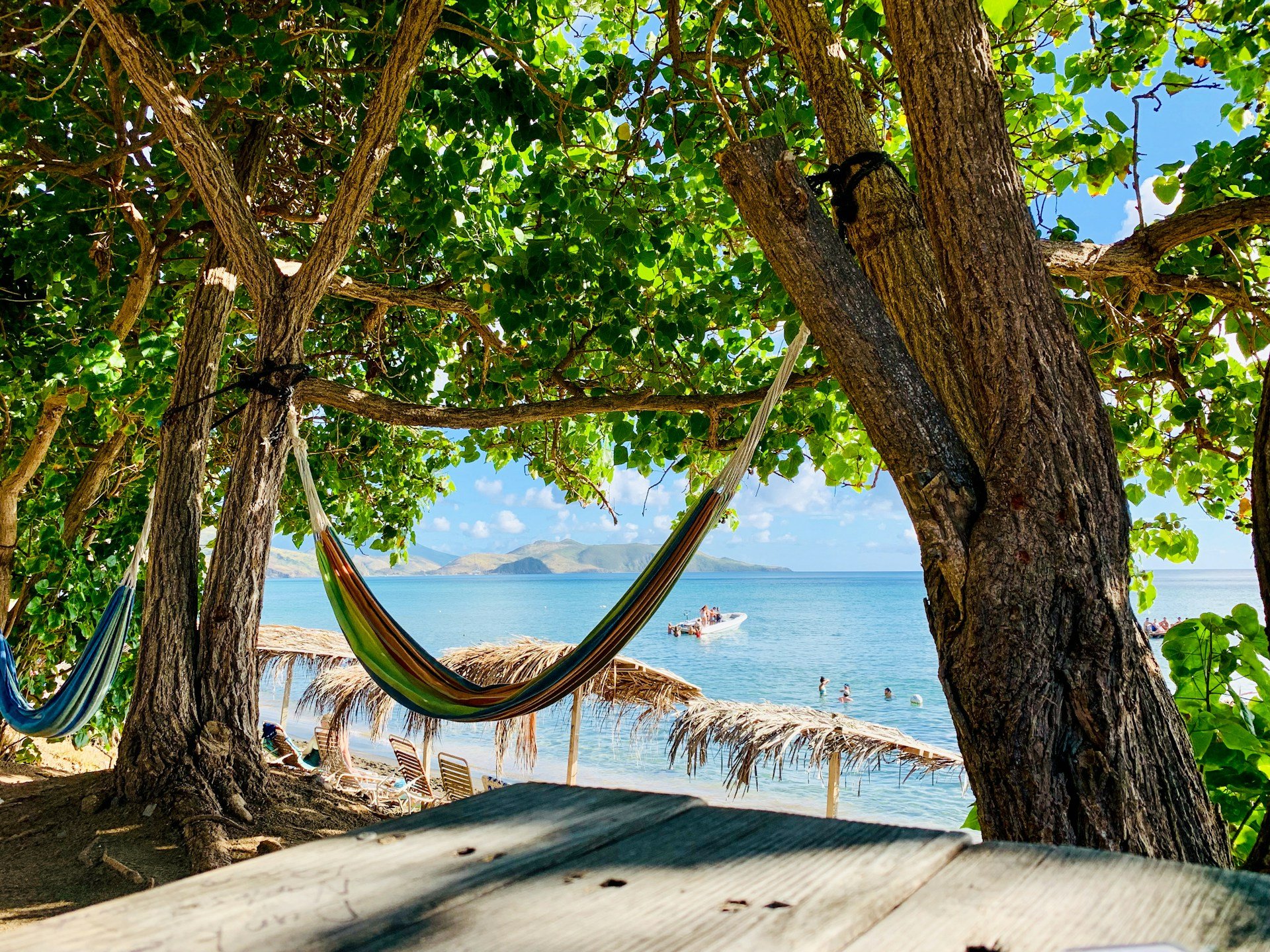
Saint Kitts & Nevis
The smallest country in the Western Hemisphere. Two volcanic islands three kilometres apart, a UNESCO fortress built by enslaved hands over a century of British empire, the birthplace of Alexander Hamilton on the quieter island, and a circular railway still making its way around cane fields that haven't grown sugar since 2005.
What You're Actually Getting Into
Saint Kitts and Nevis is a two-island federation — the smallest sovereign state in the Western Hemisphere by both area and population — sitting in the northern Leeward Islands about 300 kilometres southeast of Puerto Rico. Between the two islands the total land area is 261 square kilometres and the combined population is around 47,000 people. You can drive the entire coastal road of Saint Kitts in under two hours. Nevis is smaller still. This is a country where you will recognise faces at the supermarket by day two.
Saint Kitts, the larger island, has the airport, the capital Basseterre, and the Brimstone Hill Fortress — a UNESCO World Heritage Site that is one of the finest and most intact British military fortifications in the Caribbean, built over a century by enslaved workers on the summit of a 240-metre basalt hill with views that stretch across six islands on a clear morning. Saint Kitts also has Mount Liamuiga, a dormant volcanic crater at 1,156 metres whose rainforest interior is genuinely spectacular and requires a guide and a full day to reach properly.
Nevis, three kilometres across the water and reached by a 45-minute ferry, is smaller, quieter, and holds two things that pull visitors across the channel: the birthplace of Alexander Hamilton — the first US Secretary of the Treasury, now famous globally because of the Lin-Manuel Miranda musical — in a modest house in Charlestown that is now a museum; and Nevis Peak, a near-perfect volcanic cone at 985 metres whose cloud-forested slopes contain the most intact rainforest in the Eastern Caribbean, technically in the sense that you can hike to the crater rim through primary forest without encountering any significant development.
The federation is solidly middle-to-upper income Caribbean in pricing terms. It is not a budget destination. The sugar industry, which defined the islands' economy for three centuries, closed in 2005 when global sugar prices made Kittitian cane uncompetitive. The economic pivot has been toward financial services, citizenship-by-investment (the oldest such programme in the Caribbean, established in 1984), and upscale tourism. The St. Kitts Scenic Railway, which originally carried harvested cane from the fields to the sugar mill, now carries tourists on a full-island circuit. It is the last working railway in the Caribbean, repurposed with considerable elegance for its new audience.
What Saint Kitts and Nevis offers: history with specific, named weight (Brimstone Hill, Hamilton, the plantation great houses converted to hotels); landscape that is vertically dramatic for the island size; a quietness that the larger Caribbean islands cannot replicate; and a pace that is genuinely slow in the Nevis sense of the word — not performed relaxation, but actual absence of hurry.
Saint Kitts and Nevis at a Glance
A History Worth Knowing
The islands were inhabited by the Kalinago (Island Carib) people when Christopher Columbus passed them on his second voyage in 1493. He named the larger island after Saint Christopher — a name that survives in the formal "Saint Christopher and Nevis" alongside the universally used "Saint Kitts." The Spanish made no significant effort to colonise either island, which left them available to the first sustained English settlement in the Caribbean.
Saint Kitts became the first English colony in the Caribbean when Thomas Warner established a settlement at Old Road Town in January 1623 — a fact the island marks with visible pride. A French settlement followed on the same island in 1625 under Pierre Belain d'Esnambuc, and for several decades the island operated under a peculiar split colonial governance, with the French occupying the north and south ends and the English the middle. Both powers promptly massacred the Kalinago population in the Massacre of 1626 — a collaborative genocide in which the French and English, otherwise rivals, found common cause. The stream that runs through the massacre site on the island is still called Bloody Point.
Sugar transformed the islands from the 1640s onward. Enslaved West African people were brought in numbers that rapidly exceeded the European population. By the late 17th century Saint Kitts had one of the highest sugar yields per acre of any island in the Caribbean and one of the most brutal plantation economies in the British empire. The Brimstone Hill Fortress, begun in 1690 and expanded steadily through the 18th century, was both a defensive structure against the French and a symbol of how much wealth the island generated — enough to justify a century of military engineering in volcanic stone.
The fortress changed hands once: in February 1782, a French force under the Marquis de Bouillé besieged Brimstone Hill for a month and the British garrison of 1,000 men surrendered on February 12 — one of the rare French victories in the Caribbean during this period. The British regained the island the following year under the Treaty of Paris (1783). The story of Brimstone Hill is essentially the story of why the Caribbean was worth fighting over: sugar, and the enslaved people who produced it.
Alexander Hamilton was born in Charlestown, Nevis, in 1755 or 1757 — the date is disputed by historians, with Hamilton himself claiming different years at different times. His mother Rachel Faucette had been previously married and was involved in a long legal dispute when Hamilton was born, which created the "illegitimate" status that would follow him and that he references in the musical. His father James Hamilton abandoned the family when Alexander was around ten. Hamilton grew up in poverty on Nevis and later St Croix before a hurricane in 1772 prompted local merchants to fund his passage to New York for education. The rest, as the musical suggests, is history that is well-known but rarely situated in its Caribbean origins.
Emancipation came in 1834, with the Apprenticeship period ending in 1838. Post-emancipation Saint Kitts struggled economically as formerly enslaved people refused to work on plantations under the conditions that followed. The sugar industry limped along through the 19th and 20th centuries, declining as global prices fell and mechanisation costs rose, until the final closure in 2005. Independence from Britain came on September 19, 1983 — making this one of the most recently independent nations in the Caribbean. Nevis has its own semi-autonomous government, the Nevis Island Administration, and held a referendum on independence from Saint Kitts in 1998 in which the vote for separation reached 61.7% — short of the two-thirds threshold required by the constitution. The relationship between the two islands remains the defining political tension of the federation.
The larger island is named after Saint Christopher. The Kalinago people are the existing inhabitants.
Thomas Warner establishes the first permanent English settlement in the Caribbean at Old Road Town on Saint Kitts.
French and English settlers jointly massacre the Kalinago population. Bloody Point stream marks the site.
Sugar cultivation begins on both islands. Enslaved West African people are brought in numbers that quickly exceed the European population.
A century of military construction by enslaved workers. The fortress changes hands once, to France in 1782, and returns to Britain in 1783.
Born in Charlestown in disputed poverty. Leaves for New York in 1772, becomes a Founding Father, dies in a duel with Aaron Burr in 1804.
Slavery abolished 1834. Apprenticeship period ends 1838. Sugar industry continues in diminished form for another 167 years.
September 19. Saint Kitts and Nevis becomes independent from Britain as a federation. The smallest independent nation in the Western Hemisphere.
61.7% of Nevisian voters support separation from Saint Kitts. Falls short of the two-thirds constitutional threshold. The political tension persists.
The last sugar crop harvested. The Scenic Railway, once used to transport cane, is repurposed for tourism.
Top Destinations
The federation's small size means you can cover both islands thoroughly in a week without feeling rushed. Saint Kitts has the airport, the capital, and the majority of tourist infrastructure. Nevis is reached by ferry in 45 minutes and rewards those who make the crossing with a quieter, more intimate island. Most visitors to Saint Kitts do not cross to Nevis, which is a significant oversight — the two islands offer different enough experiences that visiting only one is like reading half a book.
Brimstone Hill Fortress
On the northwest coast of Saint Kitts, Brimstone Hill sits on a dramatic basalt plug rising 240 metres above the Caribbean. The British began construction in 1690 and the fortification was expanded continuously through 1790 using enslaved labour over that entire century. The Citadel, the Prince of Wales Bastion, the hospital, the barracks, and the magazine are all intact or substantially preserved. On a clear morning the view from the ramparts encompasses Saint Eustatius, Saba, Saint Barthélemy, and Montserrat simultaneously — six neighbouring islands visible without a telescope. The fortress is the most significant British military fortification remaining in the Eastern Caribbean. Allow three to four hours for a proper visit including the museum.
Charlestown, Nevis
The capital of Nevis is a small, well-preserved colonial town with an unhurried pace that hasn't changed substantially in character since Hamilton left. The Museum of Nevis History occupies the site of Hamilton's birth house on Main Street — the original building was destroyed by an earthquake, and the current structure is a reconstruction, but the museum inside is genuine and thoughtful, providing the Caribbean context for Hamilton's early life that the musical necessarily compresses. The Jewish Cemetery nearby is one of the oldest in the Americas, evidence of the Sephardic Jewish community that arrived in Nevis in the 17th century and played a significant role in establishing the sugar economy. Charlestown also has the Cotton Ginnery complex by the pier, converted to a small craft market.
St. Kitts Scenic Railway
The 30-kilometre narrow-gauge railway built between 1912 and 1926 to carry harvested sugar cane from the fields to the Basseterre sugar mill now carries tourists on a circuit of the island that takes 3.5 hours by train and bus combined (the railway only covers the northern two-thirds of the island; the southern section is completed by bus). The double-decker carriages have open upper decks for views and enclosed lower levels with rum punch and Kittitian narration. It passes through old cane fields, along the Atlantic coast, through tunnels, and around the volcanic slopes of Mount Liamuiga. The railway is one of the most thoughtful repurposings of colonial sugar infrastructure in the Caribbean. Book in advance — seats fill on cruise ship days.
Mount Liamuiga, Saint Kitts
The dormant volcanic peak at 1,156 metres is the highest point on Saint Kitts and the most significant hike on the island. The trail climbs through sugar cane fields, then secondary forest, then into montane rainforest, and finally into the cloud forest of the crater rim. The crater itself drops approximately 250 metres below the rim and contains a small crater lake. The hike takes 4–5 hours up and back. A guide is strongly recommended — the trail is not always well-marked in the upper sections and the vegetation is dense enough that you can lose your bearing quickly. Book through any Basseterre tour operator the day before.
Nevis Peak
The near-perfect volcanic cone of Nevis Peak rises to 985 metres from the sea and is visible from Saint Kitts across the channel on clear days. The hike to the crater rim passes through five ecological zones in under 5 kilometres: coastal scrub, secondary forest, transition forest, elfin woodland, and the true cloud forest of the upper slopes. The volcanic soil produces an extraordinary plant density. The rim is usually in cloud and the wind is cold. A guide is not optional for this hike — the trail becomes genuinely difficult to follow in the upper cloud zone. Allow 5–6 hours with a guide. The descent is harder on the knees than the ascent.
Frigate Bay & the Southeast Peninsula
Frigate Bay on Saint Kitts has the widest beach infrastructure: the North Frigate Bay beach faces the Atlantic and is rougher and windier; South Frigate Bay faces the Caribbean and is calmer, with a line of beach bars (the "Strip") that becomes lively on weekends. The Southeast Peninsula, connected to the rest of Saint Kitts by a narrow causeway, has the finest beaches on the island — Cockleshell Bay and Major's Bay — and the peninsula's salt ponds attract flamingos. The vervet monkeys that live in the forest along the peninsula road will approach cars if given the opportunity. Don't feed them.
Nevis Great Houses
Nevis has more plantation great houses converted to hotels and restaurants per square kilometre than almost anywhere in the Caribbean. Montpelier Plantation (where the wedding reception of Admiral Horatio Nelson and Fanny Nisbet was held in 1787), Golden Rock Estate, and Nisbet Plantation are the most historically significant and the most comfortable. Several offer dining to non-guests — lunch at a plantation great house in the Nevis highlands, looking down toward the Caribbean, is one of the more atmospheric meals in the Eastern Caribbean. The plantation hotel model deserves the historical discomfort of its colonial origins acknowledged; the discomfort does not require avoiding it.
Diving & Snorkelling
The waters around both islands have good diving — largely uncrowded, which is itself a selling point in the Caribbean. The wreck of the River Taw off Basseterre is a popular dive site. The volcanic walls around Nevis drop dramatically. Turtle nesting on both islands means turtle encounters on most dives. Kenneth's Dive Centre on Saint Kitts and the Scuba Safaris operation at Oualie Beach on Nevis are the main operators. Snorkelling directly from the beach at Oualie Bay on Nevis is productive — the reef begins close to shore and the visibility is usually good.
Culture & Etiquette
Kittitians and Nevisians are English-speaking, broadly Christian (Anglican, Methodist, Catholic, and Evangelical denominations are all represented), and culturally descended from the West African populations brought to the islands as enslaved people between the 17th and early 19th centuries. The British colonial overlay is everywhere in the architecture, the legal system, the cricket culture, and the education system — the islands remain a Commonwealth realm with King Charles III as head of state. The coexistence of these inheritances is unremarkable to the people who live within it and occasionally striking to visitors.
The two islands have distinct characters. Saint Kitts, with the airport and the tourist infrastructure, is more accustomed to visitors and moves at a slightly faster pace. Nevis is where people come who already know Saint Kitts. It has a particular kind of quietness that some visitors find immediately restorative and others find slightly slow. The same quality. Different reactions. Know which one you are before you book.
"Good morning" before any request — for directions, service, or information — is not optional courtesy in Saint Kitts and Nevis. It is the baseline expectation and its absence is read as rudeness. The pace of the greeting is also its own signal: a slow, warm good morning lands differently than a brisk transactional one.
Most visitors who fly into Saint Kitts do not take the 45-minute ferry to Nevis. This is a missed experience. The two islands are different enough in character that seeing only Saint Kitts means seeing half a story. The ferry is inexpensive, reliable, and the crossing itself — with Nevis Peak filling the horizon — is one of the better approaches to any island in the Caribbean.
The plantation great houses converted to hotels on Nevis are beautiful and they are the physical inheritance of an economy built on enslaved labor. Holding both things simultaneously is more honest than pretending the colonial aesthetic is purely picturesque. The tour guides at Brimstone Hill and the museum in Charlestown do this work thoughtfully and reward engagement.
Both Mount Liamuiga and Nevis Peak require guides — not as a legal formality but as a genuine practical necessity. The trails lose themselves in the cloud forest on both mountains and people have gotten into difficulty going without local knowledge. The guides are excellent, the rates are reasonable ($50–80 USD per person), and they carry the natural history of the islands in the way only people who grew up on them can.
Cricket is the national sport and the culture around it is alive in a way that mainland visitors from North America and Europe often don't expect. The Warner Park stadium in Basseterre hosted World Cup matches. Conversations about cricket — even ignorant ones from people who don't understand the game — are welcomed with extraordinary warmth if they are genuine.
Swimwear and beachwear in Basseterre town, Charlestown, or any commercial area is socially inappropriate and occasionally pointed out directly. Wrap up or change before going into towns, restaurants, or any setting that is not the beach itself.
The vervet monkey population on Saint Kitts — descendants of monkeys brought from West Africa centuries ago — has learned to associate cars and tourists with food and will approach vehicles on the Southeast Peninsula road. They are quick, surprisingly strong, and carrying food in your hand near them is a reliable way to get a hand bitten. Don't feed them.
Nevis is not "quieter Saint Kitts." It has its own history, its own semi-autonomous government, its own distinct social character, and a significant portion of its population that voted in 1998 to be independent of Saint Kitts. Referring to Nevis as a day trip from Saint Kitts undersells what it is.
The pace of life on both islands, particularly Nevis, is genuinely slow. Service takes the time it takes. Buses leave when they are full, not on schedule. The ferry occasionally runs late. Bringing the urgency of a schedule from elsewhere and applying it here produces frustration in one direction only. The islands will not speed up for you.
The Eastern Caribbean Dollar (XCD) is the currency, pegged to the USD at 2.70:1. US dollars are accepted in tourist establishments but you will receive change in EC dollars and the mental arithmetic of the exchange is a daily exercise. Withdraw EC dollars from ATMs for local purchases.
Carnival
Saint Kitts Carnival (Sugar Mas) runs from December through January 2nd, making it one of the few Caribbean carnivals that runs over Christmas and New Year. The J'ouvert morning — the pre-dawn street party that opens carnival season — is one of the most culturally alive events on the island calendar. The National Carnival Village opens in December and hosts calypso competitions, pageants, and the parade on January 2nd. Nevis has its own Culturama festival in late July and early August, which is both a cultural showcase and one of the most community-rooted events in the Eastern Caribbean.
Music: Calypso & Soca
The musical tradition of Saint Kitts and Nevis runs through calypso — the socially satirical song form originating in Trinidad that spread across the Caribbean — into modern soca. The calypso competitions during Carnival season are genuine events with genuine competition: local artists composing lyrics about current events, politicians, and social issues that are specific enough to require local knowledge to fully understand and sharp enough to require local knowledge to fully appreciate.
Cricket Culture
Saint Kitts and Nevis is represented in West Indies cricket, the regional team that combines thirteen Caribbean nations. Kittitian and Nevisian players have represented the West Indies at international level. Warner Park in Basseterre hosted ICC World Cup matches in 2007. The culture around cricket — the specific vocabulary, the knowledge of historical matches, the opinions about current selectors — is a reliable point of genuine connection with people on both islands.
Sailing Heritage
The waters between Saint Kitts and Nevis and the northern Leeward Islands have been sailed for trade for centuries. The annual Nevis to Antigua race and the sailing culture around Oualie Beach on Nevis reflects this tradition in its contemporary form. The federation's position in the Leeward Islands chain makes it a natural stop on the Caribbean charter sailing circuit, and the anchorages at Oualie Bay on Nevis and Basseterre harbour on Saint Kitts are year-round active.
Food & Drink
The food of Saint Kitts and Nevis is the food of the Eastern Caribbean broadly: fresh seafood, ground provisions (yuca, sweet potato, breadfruit, plantain), stewed meats, and rice and peas — the Caribbean version where the "peas" are kidney or pigeon beans cooked with coconut milk. It is honest and good and substantially better at local restaurants and roadside stands than at hotel dining rooms. The specific Kittitian and Nevisian dishes worth seeking out — goat water, stewed saltfish, conkies — have a cultural specificity that the hotel buffet version will not convey.
Goat Water
The national dish of Nevis. A slow-cooked goat stew — not goat curry, which is a different preparation — in a dark broth enriched with breadfruit, dumplings, marjoram, and ketchup (which sounds incongruous and is correct). The goat cooks for hours until the meat falls from the bone and the broth develops a depth that is specific to this dish and not replicable from shortcuts. Available at small restaurants in Charlestown and Basseterre and at community events. Costs $8–15 EC. If you see a sign saying goat water today, stop.
Stewed Saltfish
The Kittitian breakfast staple: salted cod rehydrated and stewed with onions, tomato, green pepper, and fresh herbs, served with johnny cake (a thick fried bread), boiled plantain, and sometimes fried black pudding. The quality difference between saltfish made from properly rehydrated and desalted cod and the quick version is significant. At the small breakfast spots that open from 6–7am in Basseterre this dish costs $10–15 EC and is made properly. At hotel breakfast buffets it is usually not.
Conkies
A traditional dish of cornmeal mixed with sweet potato, coconut, pumpkin, raisins, and spices, wrapped in banana leaf and steamed. Originally made for specific community celebrations and now available year-round at bakeries and from women who make batches to sell at markets. Sweet, dense, and filling — the texture is somewhere between a pudding and a tamale. Cost $2–4 EC per parcel. The banana leaf steaming gives the conkie a flavor note that the same ingredients cooked any other way would lack.
Fresh Seafood
The waters around both islands produce lobster, snapper, mahi-mahi, and conch. The fish market in Basseterre near the Port Zante cruise terminal has the freshest product, sold by the same fishermen who caught it that morning. Several beachside restaurants on the Southeast Peninsula cook the catch of the day to order. The conch fritters at the beach bars in Frigate Bay are the reliable quick option. Lobster season closes March through July to protect the population — outside season, the lobster is frozen.
Cane Spirit Rothschild
CSR — Cane Spirit Rothschild — is the local spirit of Saint Kitts, made from sugar cane juice (not molasses) in a process similar to Martinique's rhum agricole. It is unaged, clear, and has a grassy, clean sweetness that is very different from dark rum or Barbadian molasses rum. Drunk with ginger beer as a "CSR and ginger," it is the local casual drink of choice. Costs about $15–20 USD for a full bottle at the duty-free or local grocery. Take a bottle home. It does not have the international distribution of Barbados or Jamaica rums and you will not find it easily elsewhere.
Carib Beer & Local Rum Punch
Carib lager is the regional beer of the Eastern Caribbean — brewed in Trinidad and distributed across the Leewards. At $8–10 EC at a local bar it is cold, reliable, and exactly right after a morning at Brimstone Hill in the heat. The rum punch served at the Scenic Railway and at most beach bars follows the Eastern Caribbean ratio: one of sour (lime), two of sweet (sugar syrup), three of strong (rum), four of weak (juice or water) — with a grating of nutmeg. Correctly made it is excellent.
When to Go
Saint Kitts and Nevis has a relatively consistent Caribbean climate — warm year-round with a wet season from June to November and a dry season from December to May. The dry season is the most comfortable for hiking and beach activities. The hurricane risk from August through October is real — the islands have been significantly affected by Caribbean storms historically and the Atlantic hurricane corridor passes close enough that September and October require contingency planning in any itinerary.
Dry Season
Dec – MayThe best conditions across both islands. Hiking trails are drier, the views from Brimstone Hill are clearest, and the sea conditions are most consistent for diving and snorkelling. January and February are the least humid and most comfortable months. Carnival on Saint Kitts runs through January 2nd, making December–January the most festive period. Book accommodation several months ahead for peak season.
Culturama Season
Late Jul – AugNevis Culturama runs in late July and early August — a ten-day cultural festival with beauty pageants, calypso competitions, a boat race, and community events that give a window into Nevisian identity that the dry season tourist season does not. The weather is wetter but the experience is more authentically local than anything in the peak season calendar.
Hurricane Season Peak
Sep – OctThe highest hurricane risk period. Several major Caribbean storms have tracked close enough to Saint Kitts and Nevis to cause significant disruption. Travel insurance with hurricane cancellation cover is non-negotiable for travel during these months. Hotels offer lowest prices. Some properties close partially during the slow season.
Trip Planning
Five days is the comfortable minimum for both islands — two nights on Saint Kitts, two on Nevis, and a travel day. Seven days is better and allows the volcano hikes on both islands without rushing. Ten days opens up the slower pace that Nevis in particular rewards. The island is small enough that extended stays require a shift in expectation from doing to being — which is the correct expectation.
There are no direct transatlantic flights to Saint Kitts. The island is served from the US via Miami (American), JFK and Newark (United), and Atlanta (Delta). From Europe, connections typically run through Antigua, Barbados, or San Juan. Copa Airlines connects from Panama for South American routing. The Robert L. Bradshaw International Airport on Saint Kitts (SKB) is small but efficient.
Saint Kitts Essentials
Day one: Basseterre orientation, the Circus roundabout, the Independence Square, the morning fish market. Afternoon: Brimstone Hill Fortress with an on-site guide. Sunset at Frigate Bay Strip. Day two: Southeast Peninsula drive to Cockleshell Bay and the salt ponds — early morning for flamingos. The vervet monkeys on the road. Afternoon swim at the Caribbean-facing beach.
Nevis
Morning ferry from Basseterre to Charlestown (45 min). Two nights on Nevis. Day three: the Museum of Nevis History and the Hamilton birth house, the Jewish cemetery, lunch at a plantation great house. Afternoon swim at Pinney's Beach. Day four: the Nevis Peak hike with a guide — full day. Dinner at the plantation hotel restaurant, ferry back to Saint Kitts the next morning.
St. Kitts Scenic Railway
The railway circuit operates most mornings and takes 3.5 hours with the bus section. Morning circuit around the island with rum punch and views of the Atlantic and Caribbean coasts simultaneously. Afternoon: local lunch on Cayon Street, departure flight.
Saint Kitts
Three days: Brimstone Hill with extended time in the outer fortifications. The Mount Liamuiga crater hike on day two (full day, guide arranged the day before). Day three: the Scenic Railway circuit in the morning, the Old Road Town historical site (the original 1623 English settlement) in the afternoon — the oldest European settlement in the Caribbean and surprisingly unremarked upon.
Nevis
Four days on Nevis. Day four: Charlestown walking tour — the Hamilton museum, the courthouse, the Bath Hotel (the oldest functioning hotel in the Caribbean, established 1778 and still operating). Day five: Nevis Peak hike with a guide. Day six: plantation great house lunch at Montpelier, afternoon at the natural hot spring at the Bath Hotel, evening at Pinney's Beach. Day seven: snorkelling at Oualie Beach, ferry back to Saint Kitts for the departure flight.
Saint Kitts in Depth
Four days: Brimstone Hill, Mount Liamuiga, the Scenic Railway, and the Southeast Peninsula. Add the Black Rocks on the northeast coast — lava formations from a volcanic eruption that entered the Atlantic and solidified at the waterline. Visit Romney Manor, the great house where Caribelle Batik produces silk-screen fabric using a traditional wax-resist process from the same site as a 350-year-old saman tree.
Nevis: The Slow Version
Six nights on Nevis. The first two days cover the essentials. The remaining four days should involve no specific programme: morning walks on the beach before the heat, afternoons in a plantation garden or at the natural hot spring, evenings at small restaurants in Charlestown. The Nevis Peak hike belongs somewhere in the middle. The plantation circuit involves at least three separate lunch or dinner visits to different estates. Swim at Oualie Beach every morning before anything else. The point of six nights on Nevis is the island itself, not an itinerary of activities within it.
Vaccinations
No mandatory vaccinations. Recommended: Hepatitis A, Hepatitis B, Typhoid, and routine vaccines. No malaria risk. Dengue is present; mosquito protection is advisable particularly in the wet season. The Zika outbreak of 2016 affected the Eastern Caribbean — check current status before travel if relevant to your circumstances.
Full vaccine info →Currency
Eastern Caribbean Dollar (XCD/EC$), pegged to the USD at 2.70:1. US dollars accepted in most tourist establishments, EC dollars everywhere. Withdraw EC dollars from ATMs in Basseterre and Charlestown for local purchases. Credit cards accepted at hotels and larger restaurants. Small restaurants, market vendors, and transport require cash.
Connectivity
Flow and Digicel are the main providers. Good coverage in Basseterre and tourist areas on Saint Kitts. Nevis coverage is good in Charlestown and along the coastal road but patchy in the mountain interior. Mountain hiking areas on both islands have no coverage. Download offline maps before heading to the hills.
Get a Caribbean eSIM →Driving
Drive on the left. A local driving permit is required — obtained at the car rental office for approximately $24 USD by presenting your home driving licence. Roads on Saint Kitts are generally good; the Southeast Peninsula road is excellent. Nevis roads are narrower and sometimes rougher in the interior. The ferry does not transport rental cars; you need a separate car on each island.
The Nevis Ferry
The MV Sea Hustler and MV Caribe Breeze ferries run between Basseterre and Charlestown multiple times daily. The crossing takes 45 minutes. Schedule varies — confirm locally as it changes seasonally. Cost: approximately $8 USD each way. Book the same-day crossing for day trips; stay overnight to get the most from Nevis.
Travel Insurance
Recommended with hurricane cancellation cover if visiting June–November. Medical facilities on both islands are limited — the Joseph N. France Hospital in Basseterre handles most cases; serious trauma may require evacuation to Barbados or Puerto Rico. Travel insurance with medical evacuation cover is important for either island.
Transport in Saint Kitts and Nevis
The islands are small enough that transport is never a major logistical challenge — the entire coastal road of Saint Kitts can be driven in under two hours. The main decision is between renting a car (giving full flexibility to stop at Brimstone Hill, Black Rocks, and the Southeast Peninsula on your own schedule) or using the minibus and taxi combination (cheaper and social but schedule-dependent). On Nevis, the island is small enough that a single day with a rented car covers all accessible roads.
Robert L. Bradshaw Airport
SKB — US connectionsThe main international airport on Saint Kitts, 3km from Basseterre. Direct flights from Miami, New York (JFK/EWR), and Atlanta on American, United, and Delta. European visitors typically connect through Antigua (British Airways, Virgin Atlantic direct) or Barbados. The airport is small and the process quick — immigration and baggage claim typically take 20–30 minutes.
Inter-Island Ferry
~$8 USD each wayMultiple crossings daily between the Basseterre ferry terminal and Charlestown, Nevis. The crossing takes 45 minutes in normal sea conditions. Schedules change seasonally — check locally or at the ferry terminal for the current timetable. Morning ferries allow day trips to Nevis from Saint Kitts, though staying overnight is strongly recommended.
Car Rental
$45–70 USD/dayAvailable at the airport and in Basseterre. Separate rental required for Nevis. A local driving permit is required ($24 USD) alongside your home licence. Drive on the left. The roads are well-signposted and the island is impossible to get meaningfully lost on. Fuel is more expensive than North American prices.
Minibus
$1.50–3 USD per routePrivately operated minibuses run fixed routes on Saint Kitts from the Basseterre bus terminal. Very cheap, social, and slightly unpredictable in timing. They fill up and depart, rather than running on fixed schedules. The Basseterre to Sandy Point route passes the Brimstone Hill turn-off. Useful for locals and adventurous visitors; car rental is more practical for sightseeing with a schedule.
Taxi
Fixed government ratesThe government publishes a standard taxi rate sheet available at the airport and online. Drivers use these rates; metered taxis do not exist. A taxi from the airport to Basseterre is approximately $12–15 USD; Basseterre to Brimstone Hill is approximately $30 USD one-way (round trip with waiting time for the fortress visit is more cost-effective). Reliable and the drivers double as informal tour guides with genuine local knowledge.
Scenic Railway
$89–109 USDThe St. Kitts Scenic Railway operates most mornings, departing from the Needsmust station near the airport. The 3.5-hour circuit covers the northern two-thirds of the island by rail and the southern section by bus. Book in advance through hotels or directly at the railway office. Cruise ship passengers fill up certain departure days — the experience is more intimate on non-cruise days.
Accommodation
Saint Kitts and Nevis skews toward mid-range and upscale accommodation reflecting the citizenship-by-investment money and the financial services economy that has replaced sugar. The plantation great house hotels on Nevis are genuinely distinctive — the most atmospheric accommodation on either island is in converted estate buildings with colonial garden settings. Budget accommodation exists but is limited relative to larger Caribbean islands.
Nevis Plantation Hotel
$250–600+/nightThe defining accommodation experience of the federation. Montpelier Plantation, Nisbet Plantation, and Golden Rock Estate are converted great houses with tropical gardens, small pools, and restaurants that attract non-guests for dinner. The colonial setting is beautiful, the historical context is uncomfortable, and the combination of both is more honest than pretending the setting is purely aesthetic. Nelson's wedding reception was at Montpelier in 1787.
Saint Kitts Beach Resort
$150–350/nightPark Hyatt Saint Kitts at Banana Bay and the St. Kitts Marriott Resort at Frigate Bay are the largest resort properties. Both have pools, multiple restaurants, watersports, and the full resort amenity set. The Park Hyatt is the most architecturally distinguished new resort in the Eastern Caribbean. Less personal than the plantation hotels but significantly more consistent in service delivery.
Oualie Beach Hotel, Nevis
$120–200/nightThe most practical mid-range option on Nevis. On the beach at Oualie Bay, with a dive operation on site (Scuba Safaris), good snorkelling directly from the beach, and a restaurant that serves fresh seafood at honest prices. Not a plantation hotel — just a well-run, well-located Caribbean beach hotel where the dive packages make the rate genuinely good value.
Guesthouses & Villas
$70–150/nightBoth islands have a small number of guesthouses and self-catering villas particularly useful for longer stays. Bird Rock Beach Hotel on Saint Kitts and the various plantation estate cottages that rent separately from the main house provide more modest options. Booking directly rather than through platforms is common and produces better rates.
Budget Planning
Saint Kitts and Nevis is not a budget Caribbean destination. The plantation hotels on Nevis start at $250 per night and the beach resorts on Saint Kitts at $150–200. Mid-range independent travel — a good guesthouse, local restaurants, hired taxis for day trips — runs $120–180 USD per day per person. The dining is the most manageable cost: eating at local restaurants and market stalls is very affordable; eating at plantation hotel restaurants is expensive.
- Guesthouse or basic hotel
- Goat water and roti at local spots
- Minibus for most transport
- Self-guided Brimstone Hill visit
- Carib beer at EC$8–10 at local bars
- Beach hotel or Oualie Beach on Nevis
- Mix of local and tourist restaurants
- Taxi round-trips for sightseeing
- Scenic Railway and guided hike
- One plantation dinner on Nevis
- Nevis plantation hotel
- Park Hyatt Saint Kitts
- Private car and driver for island tours
- Plantation dining every evening
- Guided diving and private charter
Quick Reference Prices
Visa & Entry
Citizens of the United States, Canada, the United Kingdom, all EU member states, Australia, New Zealand, and most other Western nations enter Saint Kitts and Nevis visa-free for tourist stays of up to 90 days. The immigration process at the small airport is quick. You need a valid passport, a return or onward ticket, and accommodation details. An embarkation/disembarkation card is filled out on arrival and the departure portion retained for when you leave.
The Citizenship by Investment programme of Saint Kitts and Nevis, the oldest such programme in the Caribbean established in 1984, operates separately from the tourist visa regime and requires significant financial investment — a minimum $250,000 USD contribution. This is not relevant to the tourist experience but explains some of the economic infrastructure on both islands.
Most Western passport holders enter without a visa. Arrival card completed at entry. Return or onward ticket and accommodation details required.
Family Travel & Pets
Saint Kitts and Nevis is a good family destination particularly for families with historically curious older children. The Brimstone Hill visit works for children who can engage with military history; the Hamilton connection on Nevis resonates for children who know the musical (which in practice means most North American children over ten). The beaches are calm on the Caribbean-facing coasts and the vervet monkeys on the Southeast Peninsula road produce instant delight in children of all ages.
The plantation hotel model on Nevis deserves a note for families: these are beautiful properties with pool and garden settings that work well for families with older children who can appreciate the surroundings. They are less appropriate for young children who need structured children's club programming and shallow pool entertainment — the resort hotels on Saint Kitts (the Marriott particularly) are better equipped for that.
Brimstone Hill for Kids
The fortress provides the kind of child-friendly history that doesn't require sitting still: you can walk the ramparts, look through cannon embrasures, descend into magazine rooms, and climb between fortification levels. The views across to six islands simultaneously provide genuine wow-factor that requires no explanation. The on-site guides understand how to engage children in the story of who built this and why.
Vervet Monkey Spotting
The vervet monkeys on the Southeast Peninsula road of Saint Kitts are a reliable and entirely free family wildlife experience. They approach vehicles and eat vegetation from the roadsides. Children are immediately captivated. The instruction is firm: do not feed them and do not get out of the car to interact with them. Watch from the car window. They are quick, strong, and not domesticated.
Hamilton on Nevis (Older Kids)
For families with children who know the musical — and many North American families do — the Museum of Nevis History in Charlestown provides the context that the musical compresses. The poverty of Hamilton's early life, the Caribbean legal system that defined his parents' situation, and the specific Nevisian landscape he grew up in are all more vivid in the actual place than they can be in any theatre. Worth the ferry crossing just for this.
The Scenic Railway
The double-decker carriage with an open upper deck works well for children who like to stand and look at things going past — which is most children. The railway circuit takes 3.5 hours including the bus portion, which is on the edge of reasonable for young children. The rum punch served to adults is accompanied by juice for children. The narration by the Kittitian staff is warm and engaging.
Turtle Watching
Leatherback and hawksbill sea turtles nest on beaches on both islands, particularly from March through August. The St. Kitts Sea Turtle Monitoring Network runs guided nest-watching sessions on beaches where nesting turtles come ashore — a genuinely memorable wildlife experience for children. Contact them before arrival to check the current nesting season schedule.
Beach Swimming
The Caribbean-facing beaches on both islands — South Frigate Bay and Cockleshell Bay on Saint Kitts, Pinney's Beach and Oualie Bay on Nevis — have calm, shallow water with gentle gradients suitable for children who can swim. The water clarity is excellent. Pinney's Beach on Nevis is particularly good for families: a long, calm stretch with beach bar infrastructure and the Nevis Peak visible directly inland.
Traveling with Pets
Bringing pets to Saint Kitts and Nevis requires a veterinary health certificate, proof of current rabies vaccination, a health inspection on arrival, and import permits from the Department of Agriculture. All documentation must be prepared well in advance and authenticated appropriately. Quarantine requirements apply to certain countries of origin — check current requirements with the St. Kitts and Nevis High Commission or Embassy before planning.
In practical terms, the plantation hotels do not accept pets and the resort hotels have variable policies. The small size of the islands and the warm local attitude toward animals makes day-to-day life with a pet manageable, but the documentation burden and the accommodation constraints make leaving pets at home the more sensible approach for most visits.
Safety
Saint Kitts and Nevis is one of the safer Caribbean destinations for tourists. The islands' small size and community character mean that visitors are visible and crimes against them are high-profile in a way that crime on larger islands is not. Violent crime exists — Saint Kitts in particular has had gang-related violence in certain communities that is concentrated and does not typically involve tourists. Petty theft is the most relevant risk for visitors.
Tourist Areas
Brimstone Hill, the Southeast Peninsula, Frigate Bay, the Scenic Railway, and the Nevis plantation hotels are all broadly safe. Charlestown on Nevis is very low-risk. Standard precautions — don't leave valuables on the beach, keep phones out of sight in busy areas — apply.
Nevis Generally
Nevis is extremely low crime by Caribbean standards. The small population, the community character, and the limited anonymity of an island of 12,000 people mean that criminal incidents involving tourists are rare and typically minor when they occur.
Basseterre at Night
Parts of Basseterre beyond the tourist zone have gang activity that has resulted in violence between local community members. This is not targeted at tourists but it creates areas that are not advisable to wander in unfamiliar after dark. Ask at your hotel specifically which areas to avoid.
Hurricane Season
The Eastern Caribbean has been significantly affected by Atlantic hurricanes including Irma (2017) which caused devastation across the region. Saint Kitts and Nevis has emergency protocols but infrastructure damage from major storms can be extensive. Travel insurance with hurricane cancellation cover is essential June–November.
Mountain Hiking
Both Mount Liamuiga and Nevis Peak require guides for safety reasons — not for legal reasons. The trails become genuinely difficult to follow in the upper cloud forest sections and people have required rescue after getting off-trail. A guide is mandatory in the practical sense. Book through your hotel or any Basseterre or Charlestown tour operator.
Water Safety
The Atlantic-facing beaches (North Frigate Bay on Saint Kitts) can have strong currents and are not suitable for weak swimmers. The Caribbean-facing beaches are calmer. The sea around both islands has boat traffic from water taxis and tour operators — be visible when swimming in channels and anchorages.
Emergency Information
Your Embassy
Most nations do not have embassies resident in Saint Kitts and Nevis. Consular assistance is typically provided from embassies in Barbados, Trinidad, or Washington DC. Key contacts:
Book Your Trip
Everything in one place. Both islands reward preparation.
The Small Country That Contains Multitudes
In the 1998 referendum, 61.7% of Nevisians voted to separate from Saint Kitts. They fell short of two-thirds by just over four percentage points. The two islands are three kilometres apart across the Narrows, separated by water that takes 45 minutes to cross by ferry, and they remain in a federation whose political tension is a standing fact of daily life. The Nevis Island Administration has its own premier, its own assembly, its own budget — and its own opinion of Basseterre that is rarely complimentary.
This political complexity exists within a country of 47,000 people on 261 square kilometres of volcanic rock in the middle of the Caribbean. The smallest country in the Western Hemisphere, which gave Alexander Hamilton to the United States, gave the British empire one of its most productive sugar colonies and most elaborate fortresses, and gave the Caribbean a railway that still runs because the Scenic Railway was the only thing worth keeping from the sugar economy that defined both islands for 350 years. The cane is gone. The railway runs on rum punch and tourist attention now. It is still beautiful. The view from the upper deck, looking across at the Atlantic on one side and the Caribbean on the other simultaneously, with Nevis Peak visible across the Narrows and Brimstone Hill above you on the hill, is a genuinely good view. This is a small country. It has earned its complexity.