

What You're Actually Getting Into
Antigua and Barbuda is two islands with two entirely different tempos. Antigua, the larger and far more visited of the pair, is a full-service Caribbean resort destination: all-inclusive properties along the calm west coast, a genuine cricket and sailing culture, and a UNESCO-listed working dockyard at English Harbour that most visitors never expect to find here. Barbuda, a 90-minute ferry away, is what Antigua might look like if tourism had never arrived in force: one town, one road system, a lagoon with thousands of nesting frigate birds, and a beach the color of a conch shell.
The country markets itself hard on "365 beaches," and while that number is closer to a slogan than a survey, the underlying claim holds up: the coastline genuinely changes character every few kilometers, from the flat, protected bays on the west and south to the wilder, reef-strewn Atlantic side in the east. English is the official language, the US dollar is accepted everywhere, and the whole country runs on Eastern Caribbean time, both literally and figuratively.
The honest complications
This is a resort-economy country, and it prices like one: there is no real backpacker circuit, hostels are scarce, and a lot of the best experiences (diving, sailing, the Barbuda day trip) come with a real bill attached. Hurricane season, June through November, is not a rounding error: Barbuda was almost entirely destroyed by Hurricane Irma in September 2017 and the whole island had to be evacuated. Antigua sits slightly outside the main storm track and direct hits are less frequent, but both islands regularly see tropical storm activity in this window, and travel insurance with storm coverage is a genuinely sensible purchase, not just an upsell. Public transport exists but runs on its own logic (minibuses that leave when full, not on a schedule), and taxis don't use meters, so agree the fare before you get in.
A History Worth Knowing
Both islands were originally settled by Amerindian peoples, the Siboney, Arawak and later Kalinago (Carib), who called Antigua "Wadadli," a name still used locally with real pride. English colonization from 1632 turned the island into a sugar economy built on enslaved African labor, a system that shaped everything from the built landscape to the food to the country's Carnival, which commemorates one of the earliest emancipations in the British Caribbean. Independence came in 1981 under Vere Cornwall (V.C.) Bird, the labor leader turned first prime minister whose name is now attached to the international airport.
- 1632
English colonization begins. Antigua becomes an English colony; Barbuda is settled and later leased to the Codrington family, who ran it largely as a provisioning estate for their Antigua plantations.
- 1674
Sugar takes over. Sir Christopher Codrington establishes Betty's Hope, one of the island's first large sugar plantations, built and worked by enslaved Africans. Sugar remains the backbone of the economy for the next two and a half centuries.
- 1834
Emancipation. Slavery is abolished across the British Caribbean; Antigua is notable for moving straight to full freedom rather than the intermediate "apprenticeship" period used elsewhere, an event still marked by Antigua's Carnival.
- 1940s-1967
The labor movement. V.C. Bird builds the Antigua Trades and Labour Union into the country's dominant political force; the islands become an associated state of the UK in 1967, with full self-government short of independence.
- 1981
Independence. Antigua and Barbuda becomes fully independent on 1 November, with V.C. Bird as the first prime minister, beginning a political dynasty that shapes the country for decades.
- 2017
Hurricane Irma. A Category 5 storm devastates Barbuda on 6 September, damaging or destroying most structures on the island and forcing a full evacuation to Antigua. Barbuda's recovery has been steady but is still visible in parts of Codrington today.
Read more: sugar, Codrington, and the naming of Barbuda's bird sanctuary
The Codrington family, who leased Barbuda from the British Crown for nearly two centuries, ran the smaller island differently from Antigua: rather than sugar, Barbuda supplied provisions, livestock and labor to the family's Antigua plantations, which is part of why Barbuda developed such a distinct, more rural identity that persists today. The Codrington name still marks the island's only town.
Betty's Hope, named for Christopher Codrington's daughter, is now a historic site rather than a working plantation: its restored twin windmill towers and the ruins of the still house and boiling house are the clearest surviving picture in the country of how the sugar economy actually operated, and of the enslaved labor that ran it.
Antigua's Carnival, usually held in the last week of July into the first days of August, is explicitly an emancipation celebration, not a pre-Lenten festival like its Trinidadian or Brazilian cousins. J'ouvert, the pre-dawn street party that opens the main event, and the Calypso and soca competitions that run throughout, make it one of the most-attended events in the Eastern Caribbean.
Top Destinations
Antigua is small enough to treat as one touring base (see the St. John's city guide for a full breakdown), but it divides naturally into a resort-heavy west coast, a historic south, and a wilder, less-visited east. Barbuda is its own separate trip, best done as a full day or, better, an overnight.
St. John's, the working capital
St. John's is Antigua's capital, cruise port and only real city: duty-free shopping at Heritage Quay and Redcliffe Quay, the twin-towered St. John's Cathedral, and a genuinely good Friday and Saturday market on the southern edge of downtown. It's covered in full in our St. John's city guide. Just north, Dickenson Bay is the country's main resort beach: calm, shallow, lined with hotels and watersports operators, and the easiest base for a first visit.
Nelson's Dockyard & English Harbour
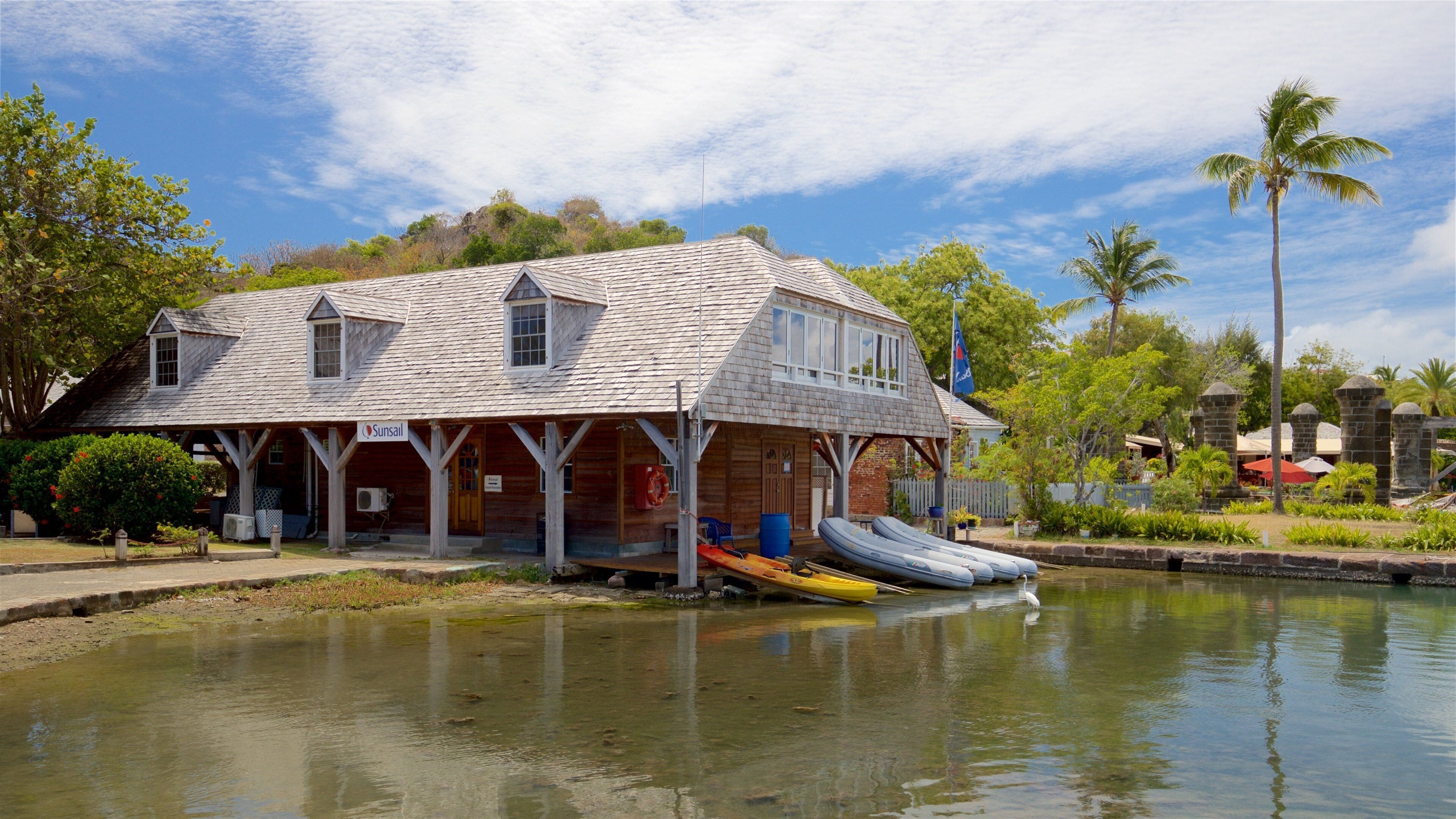
English Harbour, on Antigua's sheltered south coast, is built around Nelson's Dockyard, the only continuously working Georgian-era naval dockyard anywhere in the world, restored rather than ruined and still a functioning yacht marina today. In 2016 UNESCO listed the dockyard and its surrounding area as the Antigua Naval Dockyard and Related Archaeological Sites, and the wider Nelson's Dockyard National Park also takes in Clarence House and the Dow's Hill Interpretation Centre, which gives useful context before you wander the stone warehouses and officers' quarters.
Shirley Heights
Above the harbour, the old military lookout at Shirley Heights has the best panoramic view in the country, over English Harbour and out to the neighboring islands. It's also the site of Antigua's best-known recurring party: a sunset barbecue and steel-band session every Sunday, with a smaller Thursday version, that draws visitors from across the island.
Half Moon Bay & Devil's Bridge
Antigua's Atlantic-facing east coast is rougher and far less developed than the west. Half Moon Bay is a mile-long crescent of pale sand with a real swell, good for bodysurfing and mostly free of the sunbed rows that line the west coast. Devil's Bridge, a natural limestone arch in Indian Town National Park, was carved by centuries of Atlantic waves and throws up dramatic blowhole spray in rough seas; there's no beach here, just rock, spray and a genuinely wild stretch of coastline.
Betty's Hope
Inland, Betty's Hope is the restored sugar estate that anchors Antigua's plantation history: one rebuilt working windmill, the ruins of a second, and the stone shells of the still house and boiling house where the island's sugar economy, and the enslaved labor behind it, actually operated.
Pink Sand Beach & the Frigate Bird Sanctuary
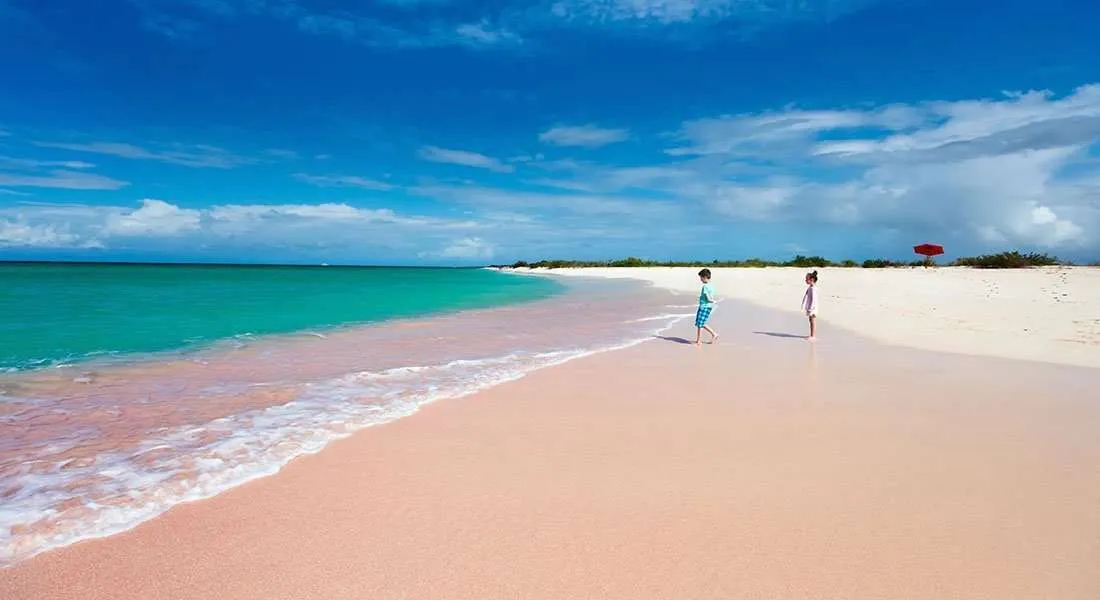
Barbuda's Pink Sand Beach, its coral fragments giving the shoreline a genuine rose tint, has been ranked among the best beaches in the world and typically has a fraction of the visitors Antigua's beaches see. In the lagoon near Codrington, the island's only town, the Frigate Bird Sanctuary holds the largest breeding colony of magnificent frigatebirds outside the Galápagos, roughly 2,500 birds, reached by a short boat trip through the mangroves.
Barbuda is reached by the Barbuda Express ferry from St John's, about 90 minutes each way, or by a short charter flight. Most visitors do it as a long day trip; day tours typically bundle the ferry, the sanctuary boat trip, and a lobster lunch on the beach. The island is still visibly rebuilding from Hurricane Irma's near-total destruction in September 2017, and infrastructure is thinner than Antigua's: bring cash, sun protection and water, since services on the ground are limited.
Beyond the main circuit
With a few extra days, these reward the detour from the standard beach-and-dockyard trip.
Cades Reef
Antigua's best-known dive and snorkel site, a two-mile barrier reef with calm, shallow water that suits beginners as well as certified divers. Most dive shops run half-day trips here.
Stingray City Antigua
A sandbar operation where you wade and snorkel with docile southern stingrays in waist-deep water. Touristy but genuinely well run, and a reliable hit with kids.
Antigua Sailing Week
One of the Caribbean's premier regattas, held in the last week of April out of Falmouth and English Harbour. Even non-sailors come for the après-race parties.
Culture & Etiquette
English is the official language, but everyday conversation runs on Antiguan Creole, an English-based creole with African roots and a rhythm of its own; visitors won't struggle to be understood, but tuning your ear in takes a day or two. Cricket is closer to a national religion than a sport: Antiguan-born Sir Vivian Richards, widely considered one of the greatest batsmen ever to play the game, has a stadium named for him that hosted matches at the 2007 Cricket World Cup. Carnival, not Christmas or Easter, is the emotional center of the calendar.
Do
- Greet before you ask anything. A "good morning" or "good afternoon" before a question, even to a shopkeeper or taxi driver, is expected and its absence is noticed.
- Dress for town, not just the beach. Swimwear is for the beach and pool; cover up with a shirt or wrap in St John's, restaurants and church settings.
- Agree taxi fares before you get in. Taxis don't run meters; rates are technically government-regulated but confirming upfront avoids disputes at the destination.
- Try the black pineapple if it's in season. Antigua's own naturally sweet pineapple variety, grown almost nowhere else, is worth seeking out at the market.
- Carry small EC$ bills. USD is accepted everywhere but change often comes back in Eastern Caribbean dollars, and small vendors appreciate exact change.
Don't
- Wander into a timeshare presentation "just to look." The free-gift pitches near cruise terminals and popular beaches lead to hours-long, high-pressure sales sessions.
- Assume a rental car works like home. Driving is on the left, roads are often unmarked and potholed outside main routes, and a temporary local permit is required.
- Skip travel insurance because the season "looks calm." Hurricane season runs June to November and conditions can shift with only days of warning.
- Underestimate Barbuda's limited services. One town, a handful of guesthouses, and infrastructure still recovering from 2017; it's not a place to arrive without a plan.
- Photograph people, especially in Barbuda's smaller community, without asking first.
Deeper culture: Carnival, Antiguan Creole and cricket
Antigua's Carnival runs roughly the last week of July into early August (2026: 25 July to 4 August, with the main parade on 3 August), commemorating the abolition of slavery rather than following the pre-Lenten Trinidadian calendar. J'ouvert, calypso and soca competitions, and a Grand Parade of costumed troupes make it the country's biggest annual event by a wide margin, and accommodation books up accordingly.
Antiguan Creole shares its grammar backbone with other Eastern Caribbean English creoles but has its own vocabulary and cadence. It's not a barrier to communication, standard English works everywhere tourism reaches, but picking up a phrase or two is noticed and appreciated.
Cricket is woven into daily life well beyond match days. Sir Vivian Richards, born in St John's in 1952, captained the West Indies through one of its most dominant stretches and remains a genuine national hero; the stadium bearing his name, built for the 2007 Cricket World Cup, still hosts regional and international matches.
Food & Drink
Antiguan food draws on West African, British and broader Caribbean traditions, built around saltfish, root vegetables, fresh seafood and the local rum that's distilled a short drive from St John's. The national dish shows up on nearly every local menu, and the best versions are usually at unfussy, family-run spots rather than resort buffets.
Fungee & Pepperpot $10-15
The national dish: a cornmeal-and-okra dumpling (fungee, pronounced "foon-jee") served with pepperpot, a hearty, slow-cooked stew of vegetables and often salted meat. Ask at any local restaurant rather than a resort menu for the real version.
Saltfish & Lobster $10-30
Saltfish fricassee is a breakfast and lunch staple; local lobster, often flambéed in Cavalier rum, shows up on nearly every seafood menu, especially around English Harbour and Barbuda's beach shacks.
Local Rum $4-10/drink
English Harbour Rum and Cavalier are Antigua's own labels, both distilled on-island. A rum punch or a neat pour of the aged English Harbour 5-year is the standard order at any beach bar.
Ducana ~$1-2 each
A sweet potato and coconut dumpling wrapped and steamed in banana leaf, usually served alongside saltfish and spicy sauce. A market-stall staple.
Goat Water
A thick, peppery goat stew often associated with celebrations and weekends. Worth trying at a local restaurant rather than looking for it on a hotel menu.
Antigua Black Pineapple
A naturally low-acid, extra-sweet pineapple variety grown almost exclusively on Antigua's Cades Bay area. Seasonal; look for it at the Friday and Saturday market in St John's.
When to Go & Itineraries
December through April is high season for good reason: dry, sunny, and outside the hurricane window, with daytime temperatures around 25-28C. June and July bring warm weather and noticeably lower prices before the risk of storms climbs. Hurricane season officially runs June through November, with the highest chance of a direct threat from mid-August through mid-October; Antigua sits just outside the Caribbean's main storm track, so direct hits are less frequent than in the northern Caribbean, but Barbuda's near-total destruction by Hurricane Irma in September 2017 is a real reminder that "less frequent" isn't "never."
All-season comparison, with temperatures
| Season | Verdict | Temps | Prices & crowds |
|---|---|---|---|
| Dec-Apr | Best | 25-28°C | Peak prices and crowds; book early over Christmas/New Year |
| May-Jun | Good | 27-30°C | Warm, lower prices, hurricane risk still low |
| Jul-Aug | Good (Carnival) | 29-32°C | Hot and humid; Carnival crowds late Jul/early Aug; early hurricane season |
| Sep-Nov | Riskiest | 27-30°C | Lowest prices; peak hurricane risk mid-Aug to mid-Oct; some hotels close |
Sea temperatures stay a swimmable 26-29°C year-round. Barbuda runs a degree or two warmer and drier than Antigua on average.
Itineraries
Four days covers Antigua's essentials; a week adds Barbuda and lets the pace slow down; ten days is genuinely relaxed, with time for diving, sailing or simply doing very little.
- Day 1
St. John's. Heritage and Redcliffe Quay, the Cathedral, the Friday/Saturday market if timing allows, dinner at Hemingway's.
- Day 2
Dickenson Bay. A slow beach day with watersports, or a half-day snorkel trip out to Cades Reef.
- Day 3
English Harbour. Nelson's Dockyard in the morning, then Shirley Heights for sunset (Thursday or Sunday for the full party).
- Day 4
The east coast. Betty's Hope in the morning, Devil's Bridge and Half Moon Bay in the afternoon.
- Days 1-4
The four-day route above, at a gentler pace, with an extra beach day worked in.
- Day 5
Barbuda day trip. Early Barbuda Express ferry, Frigate Bird Sanctuary boat tour, Pink Sand Beach and a lobster lunch, afternoon ferry back.
- Days 6-7
Slow finish. A dive trip if certified, Stingray City with kids, and one more Shirley Heights sunset before flying home.
- Days 1-5
The seven-day route above, unhurried, with time added at whichever beach you liked best.
- Days 6-7
Barbuda overnight. Stay a night in Codrington instead of doing it as a day trip; far fewer visitors and a genuinely different pace than Antigua.
- Days 8-10
Antigua Sailing Week (late April) or a diving block. If your dates align with the regatta, base in Falmouth or English Harbour for the parties; otherwise, string together dive trips to Cades Reef and the wrecks off the south coast.
Getting there & around
V.C. Bird International Airport (ANU) is the only international airport, with direct flights from the US East Coast, Toronto, London and several regional Caribbean hubs; flight time from Miami is roughly 3.5 hours. A taxi into St John's or Dickenson Bay costs around $12-20 for up to four passengers; taxis are unmetered, so agree the fare before you get in. Renting a car requires a temporary local driving permit (about $20, available from the Transport Board, car rental agencies or police stations, valid three months), and driving is on the left.
All transport options with prices: buses, ferries, car rental
| Option | Price | Notes |
|---|---|---|
| Local minibuses | EC$2.25-5 | Privately owned, leave when full rather than on a schedule, run roughly 5:30am-6pm. West Bus Station in St John's covers Dickenson Bay, Jolly Harbour and English Harbour routes. |
| Taxis | $12-20+ (up to 4 people) | No meters; government-set rates exist but confirm the fare before departure. Airport to St John's runs about $12-20. |
| Car rental | $60-120/day | Plus a $20 temporary local permit, valid 3 months. Driving is on the left. |
| Barbuda Express ferry | ~$100 round trip | About 90 minutes each way, St John's to Codrington. Departs early morning, returns mid-afternoon most days. |
Practical prep: pick up a local SIM at the airport or arrange an eSIM before landing. Power outlets are the familiar North American type A/B flat-pin plugs, but the actual voltage is 230V/60Hz, not the 120V most American appliances expect, so check your device before plugging in anything that isn't dual-voltage. GetTransfer offers pre-booked, fixed-price airport pickups if you'd rather not negotiate on arrival.
Where to stay
St. John's guesthouses
The cheapest and most practical base for exploring beyond the beach: close to the market, the quays and local restaurants, with the west coast beaches a short taxi or bus ride away. Full picks are in the St. John's city guide.
Dickenson Bay & the west coast
Mid-range beachfront hotels with easy access to watersports and restaurants, and the shortest transfer from the airport. Tranquility Bay Antigua is a solid mid-range pick directly on the sand.
Luxury resorts
Hermitage Bay, Galley Bay Resort & Spa and Blue Waters Resort & Spa anchor Antigua's high end: private coves, multiple restaurants and full spa facilities, priced accordingly.
Barbuda guesthouses
A small, still-recovering pool of guesthouses around Codrington. Book directly and confirm availability before the ferry, since options are limited and infrastructure remains lighter than Antigua's.
Budget Planning
Antigua and Barbuda is priced like the resort destination it is, not like a budget backpacking stop. There is no meaningful hostel scene, and the cheapest real accommodation is a guesthouse rather than a dorm bed. A 15% tax (ABST) applies to restaurant bills, so factor that in when reading a menu price.
- Guesthouse or budget hotel $60-90
- Local restaurant meals $10-20
- Minibuses between towns
- Free beaches, self-guided sights
- Beachfront mid-range hotel
- Restaurant dinners $20-35/person
- Rental car or regular taxis
- One tour: sanctuary, snorkel or dive trip
- All-inclusive luxury resort
- Fine dining and premium rum
- Private tours or boat charters
- Barbuda overnight with transfers
Quick reference prices: food, transport, activities
| Fungee & pepperpot, local spot | $10-15 |
| Fast food combo meal | ~$7.40 |
| Rum punch or cocktail | $4-10 |
| Airport-St John's taxi | $12-20 |
| Minibus fare | EC$2.25-5 (~$1-2) |
| Barbuda Express round trip | ~$100 |
| Half-day snorkel/Cades Reef trip | $50-80 |
| Car rental (plus $20 permit) | $60-120/day |
Prices reflect August 2026 research and drift with the season, especially over Christmas/New Year and around Antigua Sailing Week. Treat them as a planning baseline, not a quote.
Visa & Entry
Citizens of the US, UK, Canada and the EU do not need a visa to visit Antigua and Barbuda. Immigration officers commonly issue an initial stamp of 30 days on arrival, though the maximum permitted stay for visa-exempt visitors is up to 180 days, obtainable by requesting an extension from the Immigration Department once in-country. Sources vary on exactly how generous the initial stamp is, so don't assume the full 180 days without asking; if you're planning a longer stay, confirm your options with the Antigua and Barbuda Immigration Department directly rather than a third-party visa site.
✓ Valid passport
At least 6 months validity from your date of entry, with at least one blank page for the entry stamp.
✓ Return or onward ticket
Immigration can ask to see proof you're not planning to overstay.
✓ Proof of accommodation
A hotel booking or confirmed address; have it accessible on arrival.
✓ Sufficient funds
Officers can ask for evidence you can support yourself for the length of your stay.
| Antigua & Barbuda | Saint Lucia | |
|---|---|---|
| Landscape | Flat, beach-driven, 365 named beaches | Dramatic volcanic peaks (the Pitons) alongside its beaches |
| Signature sight | UNESCO-listed Nelson's Dockyard | The Pitons and Sulphur Springs |
| Day-trip island | Barbuda: pink sand, frigate birds, 90-min ferry | No comparable second-island trip |
| Sailing culture | Antigua Sailing Week, a major regional regatta | Strong but smaller sailing scene |
| Hurricane exposure | Antigua lower risk; Barbuda hit hard by Irma in 2017 | Similar seasonal exposure, June-November |
Safety, Solo Women & Family
Antigua and Barbuda carries a Level 1 rating from the US State Department, Exercise Normal Precautions, its lowest advisory tier, last updated 20 May 2026. Violent crime against visitors is rare and mostly confined to late-night incidents well outside tourist areas. The things that actually catch travelers out here are commercial rather than violent: unlicensed taxi drivers renegotiating an agreed fare on arrival, and high-pressure timeshare sales pitches near cruise terminals and popular beaches.
Taxi disputes
Confirm the fare before getting in; a few unlicensed operators quote one price verbally and demand more on arrival, sometimes claiming the quote was "per person."
Timeshare pressure
Free-gift offers near cruise terminals and busy beaches lead into long, high-pressure sales presentations. Politely decline and walk on if approached.
Petty theft
Pickpocketing and bag snatching happen in crowded tourist spots and pick up around Carnival. Keep valuables secured and out of sight on the beach.
Hurricane season and Barbuda-specific notes
Hurricane season runs June through November, with the highest risk mid-August to mid-October. Antigua sits slightly outside the Caribbean's main storm track, but Barbuda's near-complete destruction by Hurricane Irma in September 2017 shows the risk is real, not theoretical. Buy travel insurance that explicitly covers named-storm cancellations if traveling in this window.
Barbuda has thinner medical and emergency infrastructure than Antigua; anything beyond routine care typically means transfer back to Antigua. Plan accordingly if you have ongoing medical needs.
Solo women travelers
Antigua and Barbuda rates reasonably well for solo women (7.5/10 on our scale), particularly around the resort coast, St John's and English Harbour, where tourism staff and fellow travelers are a constant presence. The main issue reported is unwanted attention rather than any specific safety threat. Standard precautions apply: avoid walking alone on unlit stretches at night, use licensed taxis after dark, and the usual beach-bar caution about drinks left unattended.
Emergency numbers
US consular contact and practical notes
Both 911 and 999 reach police, fire and ambulance dispatch; either works from a local or roaming phone. There is no full US Embassy on Antigua: US citizens are covered by the Embassy in Bridgetown, Barbados, with a Consular Agent office in St John's at Jasmine Court, Suite #2, Friars Hill Road, tel +1-268-463-6531 (or +1-268-726-6531 for the cell line) for routine assistance.
UK, Canadian and EU nationals should check their nearest regional embassy or high commission, most are based in Barbados or Trinidad and handle Antigua and Barbuda by extension, before travel if they anticipate needing consular support.
Family travel
Antigua and Barbuda works well for families (8.5/10): English is spoken everywhere, Dickenson Bay's calm, shallow water suits young swimmers, and Stingray City's guided wade-ins are an easy, memorable win with kids. Barbuda's frigate bird colony is a genuine wildlife highlight for children old enough to sit through a short boat ride. The main planning consideration is timing around hurricane season rather than anything specific to traveling with kids.
Antigua and Barbuda FAQ
Is Antigua and Barbuda safe to visit?
Yes. The US State Department rates it Level 1, Exercise Normal Precautions, its lowest advisory tier. Violent crime against visitors is rare; the real risks are taxi overcharging, timeshare pressure sales and ordinary petty theft in tourist areas.
Do I need a visa for Antigua and Barbuda?
No. Citizens of the US, UK, Canada and the EU enter visa-free. Immigration typically stamps 30 days on arrival, extendable up to 180 days total through the Immigration Department, provided you can show a return ticket, accommodation and enough funds.
How much does a trip to Antigua and Barbuda cost?
Budget travelers manage on $90-140 a day using guesthouses and local food. Mid-range runs $150-280 with a decent hotel and restaurant meals. Antigua's resorts push comfortable travel well past $350 a day.
When is the best time to visit Antigua and Barbuda?
December to April: dry, warm (25-28°C) and outside hurricane season. Antigua Sailing Week runs late April. Hurricane season is June to November, with the highest risk from mid-August to mid-October.
How do I get to Barbuda?
The Barbuda Express ferry runs from St John's to Codrington in about 90 minutes, roughly $100 round trip, departing early morning and returning mid-afternoon. A short charter flight is the faster, pricier alternative.
What is the currency in Antigua and Barbuda?
The Eastern Caribbean dollar (XCD), pegged at roughly EC$2.70 to US$1 since 1976. US dollars are accepted almost everywhere, though change often comes back in EC$.
Are there really 365 beaches?
It's the country's own tourism slogan, one for every day of the year, and more marketing than geological survey. What's true is the coastline genuinely changes character every few kilometers, from calm western bays to the wilder Atlantic east.
What language is spoken in Antigua and Barbuda?
English is the official language. Most people speak Antiguan Creole day to day, an English-based creole with African and local influences; it's easy to follow but has its own rhythm and vocabulary.
Is Antigua and Barbuda good for solo female travelers?
Generally yes, especially around the resort coast and St John's. Normal city awareness applies at night, and unwanted attention is more of an issue than any serious safety concern.
Is Antigua and Barbuda good for families?
Yes. Calm west-coast beaches like Dickenson Bay suit young children, English is spoken everywhere, and stingray and turtle encounters are easy wins with kids. Just plan around hurricane season if traveling June to November.
What Stays With You
The number that gets printed on every brochure, 365 beaches, is a marketing line, and most visitors know it. What they don't expect is how much variety actually exists inside a country this small: the working stone quays of Nelson's Dockyard where wooden-hulled ships still tie up two centuries after the Royal Navy left, the pink tint of Barbuda's sand that isn't a filter, and the specific quiet of a beach on the wild Atlantic side after the tour buses have all gone to the calm west coast instead.
Go for the beaches if that's what brought you. Stay for the dockyard, the frigate birds, and the sense that a country this size found a way to hold two entirely different Caribbean experiences at once.