
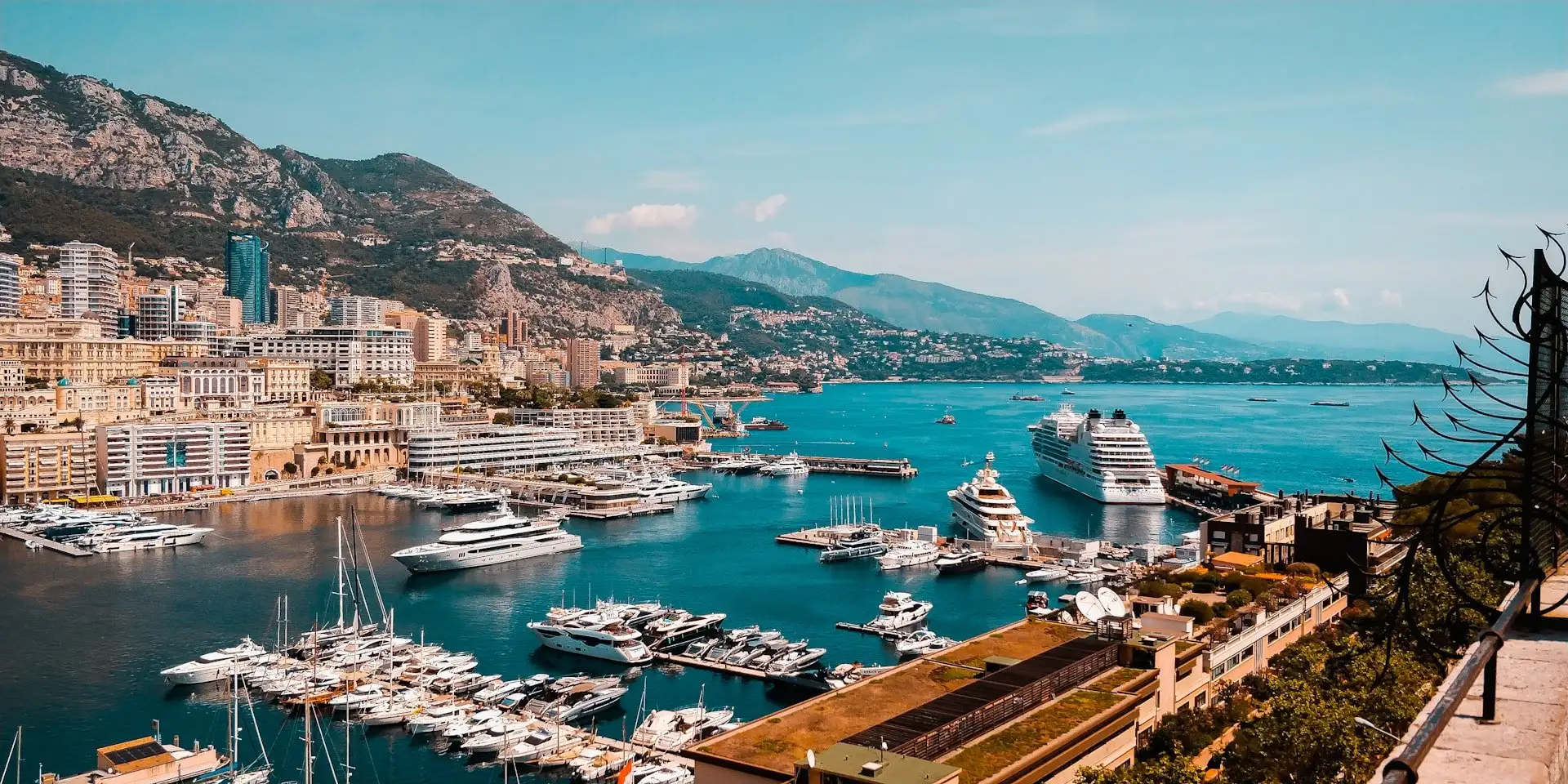
Monaco
Two square kilometers on a Mediterranean cliff, ruled by the same family since 1297, with the world's most expensive real estate, a Formula 1 circuit through its streets, an extraordinary oceanographic museum founded by a prince who explored the deep sea, and a casino that has been separating Europeans from their money since 1863. More interesting than a yacht show. Less intimidating than the prices suggest.
What You're Actually Getting Into
Monaco is 2.02 square kilometers — the world's second-smallest sovereign state after Vatican City. It is entirely surrounded by France and the Mediterranean Sea. The population of approximately 39,000 includes only about 9,000 actual Monégasque citizens; the rest are French, Italian, British, and other nationalities who live here primarily because Monaco levies no income tax on residents. The GDP per capita is the highest in the world, the real estate is the most expensive per square meter on earth, and there are more police officers per capita than anywhere else in Europe — the principality is extremely well-secured, effectively crime-free, and covered by surveillance cameras at a density that visitors occasionally find unsettling.
The honest visitor reality: Monaco is fascinating for specific reasons and underwhelming for others. The Casino de Monte-Carlo is genuinely extraordinary as a piece of Belle Époque architecture and genuinely accessible to any visitor who pays the €17 entrance fee and adheres to the smart-casual dress code. The Oceanographic Museum is one of the finest marine science institutions in the world and deserves at least two hours. The walk up to the Rock — the original medieval settlement where the Prince's Palace stands — gives a view of the harbor full of superyachts that is simultaneously spectacular and slightly cartoonish. The Formula 1 circuit walked on foot, following the actual race line through Casino Square, down the descent to Mirabeau, through the tunnel, and around the harbour chicane, is a genuinely exciting experience for anyone who follows the sport.
What Monaco is not: a beach destination (the beaches are small, rocky, and expensive), a food destination (restaurants range from excellent but extremely expensive to tourist-trap mediocre), or an experience of authentic Mediterranean culture. It is a tax haven that became a tourist destination, with a genuinely extraordinary casino at its center, a remarkable oceanographic museum, and a history of dynastic continuity — the same family for 727 years — that produces a specific kind of place that exists nowhere else in Europe.
The practical planning point: most people visit Monaco as a day trip from Nice (20 minutes by train, €4 each way) or Menton (15 minutes). This is the correct approach for most visitors. The train station connects to the city center via escalators and lifts — Monaco is built on a cliff and vertical movement between the levels is a constant feature of getting around. Budget accordingly for food (a coffee in Monte Carlo costs €5–8; a restaurant lunch runs €35–60 per person) and for the Casino entrance fee if you plan to go inside.
Monaco at a Glance
A History Worth Knowing
The Grimaldi family's connection to Monaco begins with a story that may be partly legend but is thoroughly Monégasque. On January 8, 1297, François Grimaldi — a Genoese nobleman who had been exiled from Genoa with the Guelph (pro-papal) faction following the Ghibelline (pro-imperial) victory — disguised himself as a Franciscan monk and knocked on the gate of the fortress on the Rock of Monaco, which was then held by the Ghibelline-aligned Spinola family. The gatekeepers admitted a monk. Once inside, Grimaldi dropped the disguise and his soldiers rushed the gate. The fortress fell. The Grimaldis have held Monaco, with two interruptions (the French Revolutionary period 1793–1814, and a very brief Sardinian interlude), ever since. The Grimaldi family coat of arms still bears two monks holding swords — a reference to the deception. The 1297 date is celebrated as the founding of Monaco as a Grimaldi possession.
Monaco's physical position — a rock promontory almost entirely surrounded by sea, accessible by land only through Genoa's rival territories — made it a natural fortress and a coveted strategic point throughout the medieval and early modern periods. The Grimaldis navigated the great-power conflicts of the Mediterranean by shifting alliances between France, Spain, and the Holy Roman Empire depending on which offered the best terms for their survival. In 1612, Honoré II took the title of Prince rather than Lord of Monaco, marking the formal establishment of the principality. In 1641, Monaco formally allied with France, a relationship that has defined the country's external orientation ever since.
The Casino is central to understanding modern Monaco. Before 1856, the principality was essentially bankrupt — it had lost the towns of Menton and Roquebrune to the Kingdom of Sardinia and its revenues were negligible. Prince Charles III authorized the establishment of a casino in 1856, granting François Blanc (who had built the Monte Carlo, Germany casino) a concession in 1863 to run gambling operations on the newly created district named Monte Carlo (Monte Carlo = Mount Charles, named for the Prince). The results were transformative: within a decade, Monaco's finances had stabilized, the railway connection to Nice was built (1868), and the principality's income from the Casino allowed the abolition of personal taxation for Monégasque citizens — a policy that remains in force today.
Prince Albert I (1889–1922) transformed Monaco's scientific reputation. A dedicated oceanographer who funded and conducted multiple deep-sea expeditions, he founded the Oceanographic Museum in 1910 and the International Hydrographic Bureau, and was instrumental in establishing international arbitration mechanisms. He is one of the most scientifically significant European monarchs of the 20th century and almost entirely responsible for Monaco being taken seriously as anything other than a gambling destination.
The most romantically famous chapter of Monaco's modern history is the marriage of Prince Rainier III to the American actress Grace Kelly in 1956 — the fairy-tale celebrity marriage that made Monaco internationally known to a generation that might otherwise not have visited. Grace Kelly became Princess Grace and proved to be a serious and effective advocate for Monégasque culture and patronage of the arts until her death in a car accident in 1982 on the road above Monaco. Her tomb in the Cathedral of the Immaculate Conception on the Rock draws visitors who are moved by the combination of fairy tale and tragedy it represents. Rainier III died in 2005 after the second-longest reign of any European monarch of the 20th century. Prince Albert II has ruled since.
Contemporary Monaco is the site of increasing tension between its traditional tax-haven role and the broader European and global pressure for fiscal transparency. The principality has been on and off the OECD's grey list for tax cooperation at various points, and France has periodically raised concerns about Monaco being used to shelter French citizens from French tax obligations. The 2013 agreement between Monaco and France requires French citizens resident in Monaco to pay French taxes — eliminating the principal tax advantage for French nationals specifically. The principality adapts. It still operates with no income tax for non-French residents. The yachts remain.
Disguised as a Franciscan monk, he seizes the fortress on January 8. The Grimaldi family's 727-year reign begins. The monks-with-swords coat of arms commemorates the deception.
Honoré II takes the title of Prince. Monaco formally becomes a principality rather than a lordship.
François Blanc receives concession. The Casino de Monte-Carlo opens. Monaco's finances transform within a decade. Personal taxation abolished for citizens.
The railway connection to Nice opens, funded by Casino revenues. Monaco becomes accessible from across Europe. Tourism begins.
Deep-sea expeditions, the Oceanographic Museum (1910), international arbitration mechanisms. Monaco's scientific legacy established.
The circuit through Monaco's streets hosts its first Formula 1 predecessor race. The Grand Prix becomes an annual institution, the most glamorous race on the calendar.
The celebrity fairy-tale marriage makes Monaco globally famous. Princess Grace transforms Monaco's cultural profile until her death in 1982.
Prince Albert II succeeds after Rainier III's 56-year reign — second longest in 20th-century Europe. Monaco enters its current form.
What to See
Monaco has five distinct districts — Monaco-Ville (the Rock), Monte-Carlo (the casino district), La Condamine (the port area), Fontvieille (the industrial and residential district on reclaimed land), and Moneghetti (the western residential area). A full day covers all the main sites. The vertical geography means you spend more time going up and down than moving horizontally.
Monte-Carlo & the Casino de Monte-Carlo
The Casino de Monte-Carlo, designed by Charles Garnier (who also designed the Paris Opéra) and completed in 1878, is the most photographed building in Monaco and one of the finest Belle Époque structures in Europe. The Casino Square in front of it — with the fountain, the Hôtel de Paris, and the Café de Paris — is where you get the canonical Monte-Carlo postcard image. Entry to the public atrium is free; entry to the gaming rooms costs €17 after 2pm and requires proof of age (18+) and smart casual dress — no shorts, no trainers, no sportswear. The rooms themselves are extraordinary: gilded ceilings, crystal chandeliers, roulette and baccarat tables where the minimum bet is higher than most people's lunch. You don't have to bet anything. Walk in, look at the rooms, leave with your money intact.
Musée Océanographique de Monaco
The Oceanographic Museum perches on the edge of the Rock above the sea, its foundations built into the cliff face, founded by Prince Albert I in 1910 after his decades of deep-sea exploration. The building itself is spectacular — a Renaissance Revival facade facing the Mediterranean, with a rooftop terrace that gives one of the finest views on the Côte d'Azur. Inside: 90 tanks of Mediterranean and tropical marine life, including a shark lagoon, the museum's remarkable collection of specimens from Albert I's expeditions (including gigantic deep-sea creatures pulled from extreme depths), and exhibitions on ocean conservation. Jacques Cousteau ran the museum from 1957 to 1988. Entry costs €20. Allow two hours. Go before 11am to avoid school groups. The rooftop café has the best free view in Monaco.
Monaco-Ville (The Rock)
The original medieval settlement occupies the plateau of the Rock — a limestone promontory 60 meters above the sea — and contains the Prince's Palace, the Cathedral, and a cluster of museums. The Grimaldi family has lived in the Prince's Palace since 1297 and it remains their primary residence. The State Apartments are open to visitors in summer (April–October, €12). The changing of the Guard ceremony at the palace gate happens daily at 11:55am — brief, genuine, and free. The Cathedral where Grace Kelly and Rainier III are buried is open to visitors between services. The Place du Palais gives the best view over the harbor — arrive early, leave before the afternoon coach tour groups arrive.
The Formula 1 Circuit
The Monaco Grand Prix circuit (3.337km, 78 laps) uses the actual streets of the principality. Every corner has a name known to any Formula 1 fan: Casino Square (the sharp right at the top of the hill), Mirabeau (the downhill left-hander), the Tunnel (under the Fairmont Hotel), the chicane at the harbour, and the Swimming Pool complex. Walking the circuit in the direction of the race — starting at Casino Square, descending through Mirabeau, through the tunnel, around the harbour — takes about 40 minutes. The Monaco Grand Prix happens on the last weekend of May, when the barriers go up and the city transforms; the circuit walk is best done on a quiet morning any other time of year. The collection of race-related exhibits at the Automobile Club de Monaco in the Porte Hercule area includes historic cars.
Port Hercule & La Condamine
Port Hercule is the harbor at the base of the Rock — the protected natural port that has made this location strategically valuable since antiquity. Today it is best known for the superyachts that fill it year-round, with peak density during the Grand Prix weekend when boats charging €30,000 per night as floating grandstands pack the harbor. The market at La Condamine (the neighborhood surrounding the port) has a daily covered market with flowers, produce, and Monégasque specialties. The Orange Square (Place d'Armes) at the base of the Rock is the most local and least touristy public space in Monaco — an outdoor market, a café, and the atmosphere of a neighborhood rather than a destination.
Jardin Japonais
Monaco's Japanese Garden on the seafront near the Grimaldi Forum is a genuine Japanese garden — designed by Yasuo Beppu and consecrated following Shinto rites — with a tea house, koi pond, and the specific quality of compressed natural space that Japanese garden tradition excels at. Free to enter. In a principality of 2 square kilometers, a full-scale garden feels disproportionate in the best possible way. Most visitors skip it in favor of the Casino and the Rock. The garden is particularly good in early morning before the day heats up, and provides a specific quiet that the Monte-Carlo district does not.
Jardin Exotique & Prehistoric Museum
Monaco's Exotic Garden (Jardin Exotique) on the western cliff face has one of the world's finest collections of succulent plants — thousands of cacti and succulents clinging to a near-vertical limestone face with views over the principality. The entry fee (€8) includes access to the Prehistoric Anthropology Museum housed in the cave system beneath the garden — natural caves that were inhabited in the Neolithic period and contain genuine prehistoric remains found on site. The combination of extraordinary Mediterranean succulent garden and unexpected prehistory museum is one of Monaco's most rewarding and least-crowded experiences.
Fontvieille
Monaco's newest district, built entirely on land reclaimed from the sea since the 1960s, houses the principality's industry (such as it is), several museums, and the Roseraie Princess Grace — a rose garden with 8,000 plants including a variety named for Princess Grace. The Collection de Voitures Anciennes (Vintage Car Collection) at Fontvieille has over 100 cars from Prince Rainier III's personal collection, including early Formula 1 cars and historic vehicles. Entry €10, family-friendly, and less visited than the main Monaco-Ville and Monte-Carlo sites.
Culture & Etiquette
Monaco's official language is French, the practical language of the principality in all formal contexts. Monégasque — a Ligurian dialect historically spoken by the indigenous Monégasque population — is still taught in schools and has a small number of active speakers, but French is what you will hear on the streets and need at restaurants. Italian is widely understood given the principality's position between France and Italy and its Italian demographic influence. English is spoken fluently in the tourist and hospitality sector.
The social register in Monaco is specific. The principality's wealth is concentrated and visible, and its social norms reflect an expectation of a certain standard of presentation. This is not snobbery for its own sake — it is the self-image of a microstate whose primary product is exclusivity. The dress code requirements at the Casino are formal rules, not suggestions. Arriving in the Monte-Carlo district in beach clothes (shorts, flip-flops) will not get you refused service anywhere other than the Casino gaming rooms, but it will mark you as a tourist immediately. The principality is genuinely welcoming to visitors who engage with it on its own terms.
Smart casual for the gaming rooms — no shorts, no sportswear, no flip-flops. A collared shirt and long trousers for men is the minimum. Women have more flexibility but the same general standard applies. The security staff at the door will turn you away if you don't meet the standard, and they're experienced at it. If in doubt, dress slightly better than you think you need to.
The Formula 1 circuit walk is best done before 9am when the traffic is minimal and you can stand in the middle of Casino Square and imagine the cars launching over the crest toward you. Later in the day the roads are normal working streets and the imagination required is harder to sustain against the traffic noise.
Monaco has an extensive network of public lifts, escalators, and moving walkways connecting its vertical levels. These are free to use and essential for moving between the Rock, the Casino district, the port level, and the seafront. The tourist information office has a map. Using the stairs exclusively will exhaust you — the cliff the city is built on is real.
The Museum opens at 10am. Arriving early means you have the shark lagoon and the deep-sea specimens before the school groups and cruise ship day-trippers arrive. By 11:30am in summer the main halls are packed. By 9:30am you have them to yourself.
The restaurants on and around Casino Square and the seafront boulevard charge rates that are genuinely disconnected from value. A pasta main course that costs €12 in Nice costs €35 in the Casino area of Monte-Carlo. The food is not measurably better. The view is not dramatically different. Walk down to La Condamine, where Monégasque residents actually eat, and pay a fraction of the price.
Monaco has parking, but it is expensive and navigating the principality's streets by car during the day produces a specific kind of claustrophobic frustration — the streets are narrow, the gradients are steep, and the traffic is intense. Come by train (from Nice or Menton, frequent, cheap), use the free lifts internally, and walk. This is unambiguously the correct approach.
Monaco is not France. It is a sovereign principality with its own government, courts, police force (the Carabiniers du Prince), stamps, and regulations. The police-to-citizen ratio is the highest in the world and the surveillance camera network is pervasive. Public disorder of any kind is addressed immediately and decisively. Monaco has essentially no crime — and no tolerance for behavior that might lead to it.
The "I was at the Monte-Carlo Casino Square" photograph takes three minutes to arrange and requires no particular engagement with the principality. Monaco rewards visitors who look past the postcard: the Oceanographic Museum's deep-sea collection, the Exotic Garden's cliff-face succulents, the Circuit walk at dawn, the Cathedral's quiet tombs. The photograph is not the reason to come.
The Grimaldi Forum & Arts
The Grimaldi Forum is Monaco's main congress and cultural center, hosting exhibitions, concerts, and the Monaco Yacht Show (one of the world's leading yacht events) in September. The Princess Grace Rose Theater brings opera and ballet. Monaco has a cultural program disproportionate to its size, funded by the principality's revenues and by the sponsorship of multinational corporations based here for tax purposes. The Opera de Monte-Carlo in the Casino building puts on a full season from October through April.
The Grand Prix as Cultural Event
The Monaco Grand Prix (last weekend of May) is the most glamorous and most impractical race on the Formula 1 calendar — the circuit is too slow and too narrow for modern cars to overtake effectively, but the combination of speed, history, and setting produces something genuinely extraordinary. Attending costs thousands of euros for the cheapest grandstand tickets. But the free areas on the hillside above the circuit are accessible to anyone who arrives early enough and is willing to stand for most of the race. The week before the race, while the barriers are being installed and the cars are practicing, is one of the most interesting times to visit the principality.
Ocean Conservation Legacy
Prince Albert II has continued the scientific and environmental legacy of Prince Albert I — the Principality of Monaco is disproportionately active in international ocean conservation diplomacy, hosting conferences and providing institutional support for marine protected area proposals. The Oceanographic Museum under the direction of various directors since Cousteau has maintained its scientific program. For a territory of 2 square kilometers, Monaco's contribution to ocean science and advocacy is genuinely significant.
The Ruling Family
Prince Albert II, born in 1958, has ruled since 2005. He was married to Charlene Wittstock, a South African competitive swimmer, in 2011. The couple have twins, Jacques and Gabriella, born in 2014 — Jacques is the hereditary Prince. The royal family's activities, health, and public appearances are covered in Monaco's local press with the intensity usually reserved for much larger royal houses. The Grimaldis are the last ruling house in the Mediterranean and among the oldest continuously ruling dynasties in Europe.
Food & Drink
Monaco's food scene divides cleanly into two categories: the excellent but extremely expensive restaurants in the Monte-Carlo area that cater to the principality's wealthy resident and visitor base, and the genuinely good-value neighborhood restaurants in La Condamine and around Place d'Armes that serve the people who actually live and work here. The cuisine is Niçoise in character — the same Mediterranean tradition of socca, salad Niçoise, fresh seafood, and olive oil-based cooking that defines the French Riviera immediately west. The Monégasque additions are modest: barbajuan (deep-fried pastries filled with ricotta and spinach, the national snack) and stocafi (stockfish stew).
Barbajuan
The specific Monégasque national snack: a small deep-fried pastry (the name means "Uncle John" in Monégasque dialect) filled with ricotta cheese, Swiss chard, leeks, and Parmesan. Available at the covered market in La Condamine and at the few restaurants that maintain traditional Monégasque cooking. They are sold individually and eaten as a snack rather than a course. The texture is crispy outside and soft inside; the filling is savory and herbed. They are difficult to find in the tourist areas of Monte-Carlo and common at the Place d'Armes market.
Salade Niçoise & Socca
Monaco sits in Niçoise culinary territory — the salade Niçoise here (tuna, anchovies, olives, hard-boiled eggs, fresh tomatoes, raw French beans, and no cooked vegetables, ever) is the real thing made with quality ingredients. Socca — thick chickpea flour pancakes cooked in a wood oven — is the street food of the French Riviera available at La Condamine market and in the neighborhood restaurants. The overlap between Niçoise and Monégasque cooking is almost total; the difference is entirely in price.
Stocafi
The traditional Monégasque stockfish stew — salted and dried cod rehydrated and braised with tomatoes, olives, capers, and Provençal herbs — is a dish with North Atlantic roots adapted by Mediterranean coastal cooking over centuries. It appears on the menus of the few restaurants that maintain traditional Monégasque cuisine, usually at prices that reflect the premium the principality charges for everything. Worth ordering once at a restaurant that does it well; the covered market occasionally has vendors selling prepared versions.
Coffee Geography
Monaco's coffee price map is worth understanding before ordering. A café on the Casino Square: €7–9. The Café de Paris: €8. Same coffee, identical quality at Place d'Armes in La Condamine: €2.50–3.50. The gradient is not about quality — it is purely about location relative to the Casino. The strategy is simple: have breakfast and your first coffee at La Condamine before walking up to the Casino district, not after arriving from the train station into the Monte-Carlo area.
Bellet Wine
The Bellet appellation — a tiny AOC produced in the hills above Nice, one of the smallest in France — is served in Monaco's better restaurants as the local wine. The red (made from Braquet and Folle Noire), the white (from Rolle/Vermentino), and the rosé are all excellent and produced in such tiny quantities (approximately 120,000 bottles total annually) that they are effectively impossible to find outside the region. Ordering a glass of Bellet blanc in a Monaco restaurant is ordering the most specifically local wine possible on the entire French Riviera.
The Price Strategy
Monaco's restaurant market has an explicit two-tier structure that rewards awareness. The same prix-fixe lunch that costs €85 at a Monte-Carlo address costs €22 at a restaurant in La Condamine. The covered market (Marché de la Condamine) on Place d'Armes has lunch stalls serving socca, barbajuan, and Niçoise salad for €8–12. Buy groceries at the Carrefour supermarket in Fontvieille rather than the Casino area. The savings across a day are significant — a full day of eating at La Condamine prices rather than Monte-Carlo prices saves €60–80 per person.
When to Go
Monaco's Mediterranean climate makes it pleasant year-round. The main decision is whether to come during the Grand Prix (late May) — which is expensive, crowded, and spectacular — or at any other time, which is pleasant, less crowded, and considerably cheaper. November through February is the quietest period. April and May are ideal before the Grand Prix week. September and October are excellent after the summer crowds and with the Yacht Show adding spectacle to the harbor.
Spring
Apr – mid MayWarm and clear. The Rose Garden in Fontvieille approaching peak bloom. The Oceanographic Museum accessible without summer crowds. The Grand Prix barriers not yet installed. Long evenings. The Côte d'Azur at its most photogenic before the summer haze. April is specifically excellent.
Autumn
Sep – OctSummer crowds gone, sea still warm (24°C), the Monaco Yacht Show in September fills the harbor with vessels of spectacular size. October is quiet, mild, and the light on the principality's limestone buildings is extraordinary. The opera season opens at the Casino Opera. Most underrated time to visit.
Winter
Nov – FebMild by northern European standards (10–16°C), very quiet, cheapest hotel rates (if staying overnight), the Casino's opera season running, Christmas decorations in the Casino Square. The Exotic Garden in winter light is particularly atmospheric. Cruise ships absent. Some restaurants reduce hours. The most local Monaco available.
Grand Prix Week
Last week of MayThe principality transforms. Barriers go up on all race streets. Normal road access through parts of Monaco is blocked for practice sessions. Hotels charge 5–10x normal rates. The cheapest grandstand tickets cost €300+. The harbor is packed with chartered yachts at €30,000 per night. Extraordinary if you're here specifically for the race. Very expensive and congested for any other purpose.
Trip Planning
Monaco plans itself around a single day itinerary for most visitors. The key decisions: morning or afternoon at the Oceanographic Museum (morning, before crowds), Casino visit (afternoon, after 2pm for the full gaming rooms), the Rock at some point in the day, and the circuit walk if Formula 1 is relevant. Everything is within walking distance if you use the lifts and escalators for the vertical transitions.
If staying overnight: the few hotels under €200 are in Moneghetti or near the train station, a short walk from the main sites. The correct budget calculation is: one night in Monaco at €200 versus two nights in Nice at €100 each — the Nice option gives you a genuinely good city to spend evenings in, a better restaurant scene, and the same 20-minute train access to Monaco each day.
Oceanographic Museum & the Rock
Take the 8:30am or 9am train from Nice. Arrive Monaco station, use the escalators to reach the upper level, walk to the Oceanographic Museum — arrive as it opens at 10am. Two hours inside: shark lagoon first, then the deep-sea specimen collection, then the rooftop terrace for the Mediterranean view. Walk west along the Rock plateau to the Cathedral — Princess Grace and Rainier III's tombs. Arrive at Place du Palais at 11:45am for the guard change at 11:55am.
La Condamine Market
Descend from the Rock to the port level. Walk to Place d'Armes and the Marché de la Condamine. Lunch at the market stalls — socca, barbajuan, a glass of rosé — for €10–15. The market closes at 1pm so arrive by 12:30pm. This is the affordable and authentic Monaco lunch.
Circuit Walk & Casino
Walk the Formula 1 circuit clockwise from the port: through the chicane, along the harbor front, under the tunnel entrance, up to Casino Square. Stand in Casino Square and look down the hill at the circuit descending toward Mirabeau. Enter the Casino at 2pm (€17). Walk the gaming rooms. Return to Casino Square for the canonical postcard view. Japanese Garden if time allows — free, 10 minutes' walk downhill from the Casino. Train back to Nice from 5pm onward.
Everything Essential
The full one-day itinerary above. If staying overnight in Monaco, afternoon additions: the Prince's Palace State Apartments (if April–October, €12, 45 minutes). Evening at one of La Condamine's brasseries rather than the Casino district — the price difference per person for dinner is €40–80.
Fontvieille & Exotic Garden
Morning: walk the harbourfront at sunrise before any other visitors arrive — the superyachts in the early morning light with the Rock above them. Fontvieille for the Vintage Car Collection (€10, 90 minutes, Prince Rainier's personal cars). The Roseraie Princess Grace at peak bloom in May–June. Afternoon: the Exotic Garden and cave museum on the western cliff (€8, 1.5 hours, the succulent collection is genuinely extraordinary). Return to Nice or continue down the Riviera to Menton (15 minutes east by train).
Nice as Base
Stay in Nice (proper city, excellent food, affordable). Day one: the full Monaco day-trip itinerary. Day two: Monaco's secondary sites — Fontvieille, Exotic Garden, the circuit walk in the morning. Evening in Nice's Old Town.
Menton & the Italian Border
Menton (15 minutes east of Monaco by train) — France's warmest and most Italian-influenced city, with a Baroque church above the harbor, the Cocteau Museum, and lemon groves. Ventimiglia just across the Italian border (another 15 minutes) for the Friday outdoor market. The hills behind Monaco to Peille and Sainte-Agnès — the highest coastal village in Europe at 780m — for the views back over the coast.
The Corniche Roads
The three Corniche roads between Nice and Monaco — the Grande Corniche (the highest, with the most dramatic views), the Moyenne Corniche (the middle road, passing Èze village), and the Basse Corniche (the coastal road) — form one of Europe's most celebrated coastal drives. Renting a car for a day and driving all three, stopping at Èze village (medieval hilltop, cactus garden, extraordinary views) and the village of La Turbie (with its Roman Trophy of Augustus, the monument celebrating the conquest of Alpine tribes in 7 BCE) makes the Monaco visit into a proper Riviera experience rather than a Casino-and-train proposition.
Train from Nice
TER trains from Nice-Ville station to Monaco-Monte-Carlo station run every 15–30 minutes throughout the day. Journey time: 20 minutes. Return ticket: approximately €8. The train station in Monaco is underground — lifts and escalators ascend to street level near the Monte-Carlo and La Condamine areas. This is the correct arrival method.
Casino Dress Code
Smart casual for the gaming rooms — collared shirt and long trousers for men, equivalent standard for women. No shorts, no sportswear, no trainers (athletic shoes), no flip-flops. The dress code is enforced by security staff at the door who are experienced at this. If in doubt, dress better. No admission under 18.
Lifts & Escalators
Monaco's public lifts, escalators, and moving walkways are free and essential. Get a map from the Tourist Information Office (2 Boulevard des Moulins) showing all the vertical connections. Without them, the principality's cliff geography produces exhausting stair climbs. With them, moving between the four main vertical levels is entirely manageable.
Vaccinations
No mandatory vaccinations for Monaco. Routine vaccines recommended. Standard European health precautions apply. No specific health risks. The French social security system and private Monaco health services both operate at high standards.
Full vaccine info →Connectivity
Monaco has its own mobile network (+377 code) but is practically integrated with French coverage. EU roaming applies for European carriers. Monaco has excellent 4G/5G coverage throughout the principality. WiFi is available at all hotels, most cafés, and the main public spaces.
Get Monaco eSIM →Views Worth Knowing
The best free views in Monaco: the rooftop terrace of the Oceanographic Museum (free with entry), the Place du Palais on the Rock (free, go early), the Port Hercule waterfront at dawn (free, no crowds). The paid version of the same view from a hotel terrace costs €25+ for a cocktail you don't necessarily want.
Transport in Monaco
Monaco is walkable — the entire principality is 2 square kilometers. The challenge is vertical rather than horizontal. The public lifts, escalators, and buses handle the vertical transitions. Walking everywhere within a level is entirely practical. The train from Nice is the correct arrival method. Taxis exist but are rarely necessary for a visitor moving between Monaco's own neighborhoods.
Train from Nice or Menton
€4–8 returnTER trains run frequently from Nice-Ville (20 min, ~€4) and Menton (15 min, ~€3). The Monaco-Monte-Carlo station is underground — follow signs for lifts/escalators to reach street level. The station is well-connected to both La Condamine and the Monte-Carlo district via the vertical network. This is the primary and recommended arrival method.
Public Lifts & Escalators
FreeMonaco's most distinctive transport feature: 8 public lifts (ascenseurs publics) and multiple escalator systems connect the principality's vertical levels for free. Essential for moving between the port level, the Casino level, and the Rock level without taking steep stairways. Pick up the lift map at the Tourist Information Office on Boulevard des Moulins.
Bus
€2/rideMonaco has 6 bus lines covering the main areas of the principality. Line 1 connects the Casino area to La Condamine and the port. Line 2 goes to Fontvieille. The buses are efficient but not necessary for most day visitors who cover the main sites on foot. €2 per trip, exact change or contactless payment.
Taxi
€12–25Monaco taxis are metered and regulated. Useful for the Exotic Garden or Moneghetti area if you don't want to take the bus. Expensive relative to the small distances involved — the entire principality can be walked in 40 minutes at sea level. Taxi rank at the train station and in the Casino area.
Boat Tours
€18–35Glass-bottom boat tours of the harbor and coastline run from Port Hercule. Aquavision semi-submarine tours give underwater views of the Mediterranean marine life without diving equipment. The sea view of Monaco's cliff and the Oceanographic Museum from the water is dramatic and different from any land perspective. Available April through October.
Car — Avoid in Monaco
N/ADriving in Monaco is not recommended for visitors. The streets are narrow and one-way in complex patterns, parking is expensive and limited, and the vertical geography makes navigation genuinely confusing. Rent a car from Nice if needed for the Corniche roads — but leave it in France and take the train into Monaco itself.
Nice Airport (NCE)
30 min from MonacoNice Côte d'Azur Airport is the closest international airport, 22km west. Express transfers to Monaco by helicopter (7 minutes, €150+, Héli Air Monaco) or by taxi/bus to Nice city center followed by the train. The helicopter transfer is extravagant but genuinely transforms the arrival experience — landing on Monaco's heliport above the harbor is one of Europe's more theatrical airport connections.
Helicopter (Nice to Monaco)
€150+Héli Air Monaco operates a scheduled helicopter shuttle between Nice Airport and the Monaco heliport above the harbor. Flight time: 7 minutes. Price: approximately €165 one way. It is entirely impractical from a value-for-money perspective and entirely memorable as a transport experience. The 7-minute aerial view of the Côte d'Azur coastline and Monaco from above is unique. Bookable at heliairmonaco.com.
The SNCF TER train from Nice-Ville to Monaco-Monte-Carlo is the best-value transport decision on the Côte d'Azur. Trains run approximately every 30 minutes from early morning, the journey takes 20 minutes, and the return ticket costs approximately €8. The coastal route passes through Villefranche-sur-Mer and Beaulieu-sur-Mer with sea views on the right side going east. The Monaco station, being underground, delivers you directly to the principality via escalators — you emerge at street level in the Monte-Carlo or La Condamine area depending on which exit you take. The French rail app (SNCF Connect) shows timetables and allows ticket purchase, though the ticket can also be bought at the station machine on the day.
Accommodation in Monaco
Monaco's accommodation market is exclusively expensive by European standards. The entry level for a comfortable hotel is €200+/night, and the famous addresses (Hôtel de Paris, Hôtel Hermitage, Fairmont Monte-Carlo) range from €400 to several thousand euros per night. The practical alternative is Nice — excellent hotels from €70–150/night, 20 minutes by train. Staying in Monaco makes sense only if you're attending the Grand Prix, a specific event, or you want the specific experience of waking up in the principality.
Palace Hotels
€400–5,000+/nightThe Hôtel de Paris on Casino Square is the most famous hotel in Monaco — the original 1864 building rebuilt and expanded, with a restaurant that has two Michelin stars and a cellar of 350,000 bottles. The Hôtel Hermitage and the Fairmont Monte-Carlo complete the classic trio. These hotels are not merely accommodation — they are experiences in themselves, priced accordingly.
Mid-Range Monaco Hotels
€200–400/nightThe Columbus Monaco Hotel in Fontvieille and the Novotel Monte-Carlo represent the closest to mid-range available in the principality. The Columbus has a pool and is slightly removed from the main tourist areas. Both start at around €200 for a basic room outside peak season and rise steeply for any special weekend or event period.
Nice as Base
€70–150/nightThe economically rational and experientially superior option for most visitors. Nice has a full city's worth of accommodation from excellent hostels to boutique hotels in the Old Town, is itself a destination of genuine quality (the Old Town, the Promenade des Anglais, the Matisse and Chagall museums, the Cours Saleya market), and connects to Monaco in 20 minutes by train for €4.
Hostel (None in Monaco)
N/A in MonacoMonaco has no hostels. The principality's economic model doesn't include budget accommodation. The nearest hostels are in Nice and Menton, both easily accessible by train. Nice has several good hostels in the Old Town area from €20–35/night for a dorm bed.
Budget Planning
Monaco is the most expensive country in Europe per square meter, and this translates directly to visitor costs. However, as a day trip destination the economics are considerably more manageable than overnight stays suggest — the train from Nice costs €4 each way, entry to the Oceanographic Museum costs €20, the Casino gaming rooms cost €17, and lunch at the La Condamine market costs €12. A full day's activities total €55–80 excluding meals at the casino district's restaurants.
- Train from Nice: €8 return
- La Condamine market lunch: €12–15
- Oceanographic Museum: €20
- Casino atrium (free) or gaming rooms (€17)
- Japanese Garden: free
- Train from Nice: €8 return
- Oceanographic Museum + Exotic Garden + Car Collection
- Restaurant lunch in La Condamine (€25)
- Casino gaming rooms
- Dinner in Nice's Old Town
- Columbus or Novotel from €200/night
- Casino district restaurant dinner (€80–120)
- All Monaco site entries
- Casino gaming with actual play budget
- Harbour boat tour
Quick Reference Prices
Visa & Entry
Monaco is not an EU member and not formally in Schengen — it is a sovereign principality. However, it has an open border with France and applies French immigration rules in practice. In effect, if you can enter France (either as an EU citizen or as a visa-free visitor from the US, UK, Canada, Australia, New Zealand etc.), you can enter Monaco without any additional formality. There are no passport checks at the French-Monégasque border.
ETIAS (the EU/Schengen pre-registration system) applies to Monaco visitors from countries that require ETIAS for France — since Monaco applies French border rules, ETIAS is effectively required for those nationalities. Time in Monaco is typically counted against your Schengen 90-day allowance under French rules, though Monaco's border with France is open and in practice not monitored for this purpose.
Monaco applies French/Schengen immigration rules in practice. Open border with France — no passport check on entry. If you can enter France, you can enter Monaco. ETIAS registration applies for nationalities that require it for France. Time in Monaco typically counted as time in Schengen.
Family Travel & Pets
Monaco is workable for families, primarily around the Oceanographic Museum (genuinely child-engaging with its shark lagoon and tanks), the Circuit walk (older children who follow Formula 1 will find this immediately exciting), and the glass-bottom boat tours from Port Hercule. The Casino is off-limits for under-18s. The extreme wealth on display may produce interesting conversations with children about economic inequality, depending on their age and your inclination.
Oceanographic Museum
The museum's shark lagoon, touchpool, and 90 aquarium tanks are universally engaging for children. The aquarium section works for children from about age 5 upward. The deep-sea specimen collection — including giant squid and other extreme-depth creatures collected by Prince Albert I — is fascinating for older children who can engage with the biology and ocean exploration context.
Circuit Walk for Older Children
Children and teenagers who follow Formula 1 will find walking the actual circuit — standing at Casino Square where cars launch over the crest, walking through the tunnel, standing at the Fairmont hairpin — immediately engaging. The Automobile Club de Monaco has race memorabilia. The Vintage Car Collection in Fontvieille has over 100 historic cars including early Formula 1 machines.
Glass-Bottom Boat Tours
Aquavision's glass-bottom and semi-submarine tours from Port Hercule give children underwater views of Mediterranean marine life without diving equipment. The combination of the dramatic harbor view of Monaco from the water and the underwater windows makes this the most distinctive child-friendly activity in the principality.
Exotic Garden
The 7,000 succulent specimens on a near-vertical cliff face are visually spectacular for any age. The included cave museum with genuine Neolithic human remains and bones of extinct animals (including hippopotamus skulls — hippos once lived in this region) engages children with prehistoric biology in a setting that is simultaneously a genuine scientific site and a real cave.
Palace Guard Change
The changing of the guard at the Prince's Palace at 11:55am daily is free, brief (about 10 minutes), and genuinely ceremonial — the Carabiniers du Prince in full dress uniform with a military band on ceremonial occasions. Children find the ceremony engaging and the timing is convenient for a mid-morning Rock visit before La Condamine lunch.
Japanese Garden
The Japanese Garden's koi pond, tea house, and beautifully composed miniature landscape is free to enter and provides a quiet outdoor space for children and parents who need a break from the principality's intensity of wealth. The garden operates on a philosophy of compressed natural beauty that works for children as a genuinely peaceful experience.
Traveling with Pets
Monaco follows French pet travel rules in practice — EU Pet Travel Scheme documentation applies (microchip, rabies vaccination, EU pet passport or third-country health certificate). As Monaco applies French entry rules, the documentation requirements are effectively those for entering France.
Pet-friendliness in Monaco is moderate. Dogs are welcome on the streets and in some outdoor areas. The principality's café and restaurant culture is French in its approach to dogs — outdoor terraces typically permit dogs, indoor areas vary. The Japanese Garden does not permit dogs inside (it is consecrated ground by Shinto rites). The Oceanographic Museum is a no-pet zone.
Safety in Monaco
Monaco is one of the safest places in the world. The ratio of police and security staff to population is the highest in Europe. The surveillance camera network is pervasive and monitored. Crime is essentially absent. The main practical risks are the vertical geography (stairs and cliff-edge paths require appropriate footwear, particularly when wet), the Casino's minimum age requirement (which is strictly enforced), and the road gradient throughout the principality (pedestrian crossings require awareness given the steep streets).
General Safety
Monaco consistently ranks as one of the safest locations in Europe. Violent crime is effectively non-existent. Petty theft is rare given the surveillance density. Walking at any hour of the day or night presents no security concerns. Normal common sense is the only required precaution.
Solo Women
Monaco is among the safest destinations in Europe for solo female travelers. The principality's security infrastructure and social norms produce an environment where harassment and threatening behavior are essentially absent. The Monte-Carlo bar scene on weekend evenings can be boisterous but is not unsafe.
Cliff Paths & Stairs
Monaco's vertical geography produces several steep stairways and cliff-edge promenades. In wet weather, particularly the limestone surfaces on the Rock, these become slippery. Wear shoes with grip. The Exotic Garden's cliff-face paths require particular attention in rain.
Traffic on Circuit Streets
The Formula 1 circuit streets (Casino Square, the tunnel road, the harbour chicane) are normal working roads with steep gradients and relatively fast local traffic. The walking circuit is done on pavements, not the road surface — but the streets are narrow and pedestrian awareness is required at all times.
Healthcare
The Princess Grace Hospital (Centre Hospitalier Princesse Grace) is Monaco's main hospital, well-equipped and centrally located. EU EHIC is accepted. Private medical services of high quality are available throughout the principality. The density of healthcare provision per resident is extremely high.
Police Presence
Monaco has the highest police-per-capita ratio in Europe. The Carabiniers du Prince and the Sûreté Publique are both visible throughout the principality. This produces an extremely safe environment but also one where any unusual behavior attracts immediate attention and response. Behave as you would in any formal European setting.
Emergency Information
Embassies Near Monaco
Most countries do not have embassies in Monaco — they handle Monégasque consular matters through their French embassy or Nice consulates.
Book Your Monaco Visit
Everything in one place. These are services worth actually using.
The Place That Survived by Being Itself
Every country in this series persists by means of something specific. Lithuania persists through active remembrance. Luxembourg persists through quiet competence. Liechtenstein persists through the inertia of institutional continuity. Monaco persists through the specific alchemy of one story told consistently for 727 years: we are this rock, this family, this particular configuration of Mediterranean light and medieval fortress and Belle Époque gambling hall, and we are still here.
The Grimaldis have been on this rock longer than the Ottoman Empire existed. Longer than Shakespeare, Newton, Caravaggio, and Mozart combined. They survived the French Revolutionary period, Napoleon, the impoverishment of the pre-Casino 19th century, two World Wars, the post-war European reshaping, the construction of an entire new district on reclaimed sea, and the continuing pressure of large neighbors who are sometimes inconvenienced by the existence of this very small and very differently governed place.
What they built to survive — the Casino, the railway, the oceanographic museum, the Grand Prix — are all, in their different ways, expressions of the same principle: be interesting enough to visit, be useful enough to not be absorbed. The Oceanographic Museum is the most honest expression of this. Prince Albert I went to the bottom of the sea and brought things back and put them in cases and opened the building on the cliff edge and said: look at what is down there. The shark lagoon is full. The sea is full. Come and see.
In Monégasque, the word for the principality's specific Mediterranean light — warm, white, bouncing off limestone and sea simultaneously — has no direct English translation. The closest approximation is simply: Monaco. The place that is the light. Walk to the rooftop of the Oceanographic Museum in the late afternoon and you will understand what it means.