
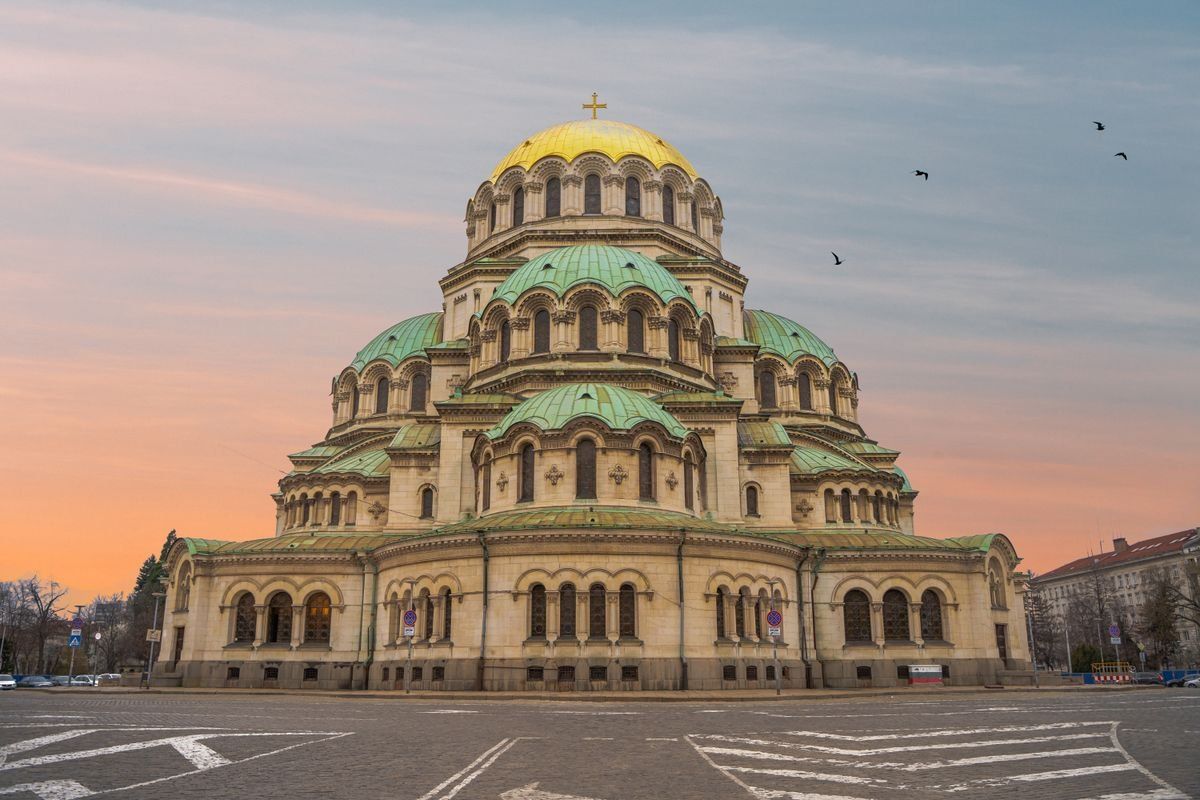
A capital that layers its history instead of hiding it
Sofia doesn't clear its history away to make room for the next one, it builds around it. Walk out of the Serdika metro station and you're standing over an excavated Roman street; a few blocks on, a 4th-century rotunda, a working Ottoman-era mosque and a gold-domed Orthodox cathedral built to honor Russian soldiers all sit within sight of each other, none of it staged for a tour group. The city spent decades as an unglamorous Warsaw Pact capital and has spent the years since quietly becoming one of the EU's best-value, least-crowded ones, helped along in 2026 by the euro finally replacing the lev.
What Sofia has going for it beyond the layered history is scale and setting. The centre is compact enough to walk between the cathedral, Vitosha Boulevard and the National Palace of Culture in twenty minutes, and Vitosha Mountain rises directly at the city's southern edge, close enough that a bus ride and a short hike is a genuine half-day option, not a special excursion. Prices remain some of the lowest of any EU capital: a sit-down dinner with wine rarely tops fifteen euros.
The honest complications
Sofia is not a polished capital in the Vienna or Prague sense. Pavements in older neighbourhoods are uneven, some Soviet-era apartment blocks around the centre are genuinely grim to look at, and the euro changeover that completed on 1 February 2026 means some older machines, small shops and menus may still lag behind the fixed conversion rate for a while. Traffic can be aggressive and marked crossings are not always respected, so cross deliberately. None of this makes Sofia a difficult city, but it is an unfinished, still-modernizing one, and it doesn't pretend otherwise.
A walkable centre, four areas that matter
Sofia rewards staying central. Nearly everything a first-time visitor wants sits within a twenty-minute walk or a short tram ride of Alexander Nevsky Cathedral, and the choice of base comes down to how much street noise and nightlife you want outside your window.
Sredets (Historic Centre)
Sofia's oldest and most central district holds Alexander Nevsky Cathedral, the excavated Serdika Roman ruins, and the pedestrianised stretch of Vitosha Boulevard. Staying here puts you within walking distance of nearly every major sight and the densest concentration of restaurants and cafes in the city.
Vitosha Boulevard
Sofia's main pedestrian street runs south from the National Palace of Culture, lined with cafes, boutiques and mid-range hotels. It overlaps with Sredets in practice and is the easiest single reference point for orienting yourself.
Oborishte
A leafy, residential district of grand 19th and early 20th-century mansions, many now housing embassies. Quieter at night than the centre, with a short walk into Sredets, and popular with repeat visitors who want a calmer base.
Lozenets
A more residential, trendier district south of the centre, known for its cafe scene and proximity to South Park, one of Sofia's largest green spaces. A short tram or short walk connects it to the centre, and it's a good pick for a longer stay wanting a more local feel.
From a historic five-star to a €10 hostel bed near the cathedral
Sofia's hotel scene spans a genuine historic grand hotel, a wave of design-led boutiques on and around Vitosha Boulevard, and one of the best-value hostel scenes of any EU capital. These picks cover the range.
At the top, Grand Hotel Sofia is the city's established five-star address in the historic centre, furnished with original oil paintings and its own art gallery, with the acclaimed Shades of Red restaurant and deep soaking tubs in every room. Sense Hotel Sofia, a Design Hotels member about ten minutes' walk from Borisova Gradina park, adds an indoor pool and a rooftop restaurant with cathedral views.
In the boutique bracket, Hotel Les Fleurs Boutique, designed by Italian architect Francesco Lucchese, sits directly on Vitosha Boulevard with rooms built around individual floral themes, while Rosslyn Central Park Hotel occupies the same street with a panoramic-view breakfast restaurant, both in the €80-140 range.
At the budget end, Hostel Mostel is the pick backpackers mention first: a historic building about ten minutes' walk from Alexander Nevsky Cathedral, with bed, breakfast and a free dinner all included in one low nightly price, dorm beds from around €10.
Banitsa for a euro, kavarma for ten, rakia after both
Sofia eats well and cheaply, with monastery-recipe dining rooms and folk-music taverns sitting alongside a growing wave of modern Bulgarian restaurants that take the same core ingredients somewhere more ambitious.
Banitsa & bakery breakfast
Flaky pastry filled with egg, yogurt and sirene cheese, the standard Bulgarian breakfast sold warm across the city. The bakery counters around the Zhenski Pazar (Ladies' Market), a few minutes north of the centre, sell it fresher and cheaper than anything on Vitosha Boulevard: go before mid-morning.
Traditional Bulgarian, folk-music dining
Manastirska Magernitsa gathers recipes from monasteries across Bulgaria into one menu, served in a folkloric dining room with live music some evenings. Hadjidraganov's Houses, spread across four reconstructed village houses from different regions of the country, pairs a similarly traditional menu with a live band and a genuinely theatrical dining experience.
Modern Bulgarian
Moma Bulgarian Food and Wine reworks the country's classic dishes in a refined, contemporary setting without losing the flavours, and Cosmos, on Lavele Street in the heart of the centre, takes the same repertoire in a more experimental, talked-about direction. Both are worth a reservation on weekend evenings.
Rakia & an evening out
Rakia, fruit brandy usually made from grapes or plums, is offered as a welcome or to open a meal at nearly any traditional restaurant; it's polite to accept at least a small glass. Pair it, as locals do, with a plate of shopska salad before the main course arrives.
A gold-domed cathedral, Roman ruins, a UNESCO church and a mountain
Sofia's sights split naturally into the compact centre and the Boyana district at the foot of Vitosha, with the mountain itself as the natural third act for anyone with an extra half-day.
Alexander Nevsky Cathedral and the centre
Alexander Nevsky Cathedral, one of the largest Eastern Orthodox cathedrals in the world, was built in the early 20th century to honor Russian soldiers who died liberating Bulgaria from Ottoman rule, its gold-plated domes visible across much of the city. The exterior and main interior are free to visit; the attached crypt icon museum (entry around €3) holds one of the country's best collections of Orthodox icons. A short walk away, the excavated Serdika Archaeological Complex, laid out around and beneath the Serdika metro station, puts a genuine Roman street and building foundations on public display, free and open-air.
Boyana Church and the National History Museum
In the Boyana district at the foot of Vitosha, reachable by bus in about 30 minutes, Boyana Church is a UNESCO World Heritage Site whose 10th-to-11th-century frescoes are considered among the finest preserved in Eastern Europe (entry around €5-6, timed visits to protect the paintings). Next door, the National History Museum, Bulgaria's largest, holds more than 650,000 items spanning the Paleolithic to the present, including Thracian gold (entry around €5). The two combine easily into a single half-day out from the centre.
Vitosha Mountain
Vitosha rises directly at Sofia's southern edge, one of the few European capitals with serious hiking this close to downtown. The Golden Bridges, a striking "stone river" of boulders, is a popular, moderate walk; more ambitious hikers continue toward Cherni Vrah, the summit at 2,290 metres, or ride the chairlift partway up. Come prepared for a genuine mountain environment: weather changes fast even in summer.
Vitosha Boulevard and the Ladies' Market
Vitosha Boulevard, the pedestrianised main street running south from the National Palace of Culture, is Sofia's default shopping and cafe strip. For a less curated version of the city, the Zhenski Pazar (Ladies' Market) a few minutes north of the centre is a working produce and bakery market that doubles as one of the best breakfast stops in the city.
One, two or three days, planned street by street
Two full days cover Sofia properly; even one focused day hits the essentials. A third day is really the Rila Monastery day trip, and worth adding if your schedule allows it.
- Morning
Alexander Nevsky Cathedral and the Serdika ruins. The cathedral, the crypt museum, and a banitsa breakfast en route.
- Midday
Vitosha Boulevard. A wander down the pedestrian street, then lunch at Moma or a traditional taverna near the centre.
- Afternoon
Boyana Church and the National History Museum. Combine both in the same half-day out at the foot of Vitosha.
- Evening
Dinner in the centre, at Manastirska Magernitsa or Hadjidraganov's Houses for the folk-music version of the evening.
- Day 1
The one-day route: cathedral, Serdika ruins, Vitosha Boulevard, Boyana Church and the National History Museum.
- Day 2 morning
Vitosha Mountain. Bus out to the trailhead for the Golden Bridges walk, or the chairlift if you'd rather save your legs.
- Day 2 afternoon
Borisova Gradina and the Ladies' Market. Back down to the city for a slow park walk and a browse through the market stalls.
- Day 2 evening
Cosmos. A modern Bulgarian dinner on Lavele Street to close out the trip.
- Days 1-2
The two-day route above, at a gentler pace.
- Day 3
Rila Monastery. A full day south into the mountains: the monastery's striped arcades, its 19th-century frescoes, and the drive back through Rila's forested foothills.
A direct metro line from the runway to the ruins
Sofia Airport sits about 10km east of the centre, and Metro Line 4 runs directly from Terminal 2 to Serdika station, right by the cathedral and the Roman ruins, in about 18 minutes for a single €0.80 ticket, which also covers a transfer to Line 1 at the same station. An official taxi or Bolt costs roughly €8-12; avoid unlicensed drivers approaching arrivals, who can charge several times the fair rate.
The centre itself is easily walkable: the cathedral, Vitosha Boulevard, the National Palace of Culture and the Ladies' Market are all within twenty minutes of each other on foot. For Boyana and Vitosha Mountain, city buses run from the centre in 30 to 45 minutes; trams cover Lozenets and the outer districts. Cash and contactless bank cards both work at metro gates, and the same ticket system covers the whole network.
Best time to visit
Sofia works as a city break year-round since it doesn't depend on beach weather, but May, June, September and early October are the most comfortable: warm without the July-August peaks that can push past 30°C. Winter (December to February) is cold, with highs around 4°C in January, but pairs well with a side trip to Bansko for skiing.
One of the EU's cheapest capital cities
Sofia is noticeably cheaper than any Western European capital and holds its own against other Balkan capitals even after the 2026 euro changeover, since the fixed conversion rate simply relabeled existing prices. The main cost trap is the same as everywhere: eating at the handful of tourist-facing cafes right on Vitosha Boulevard instead of walking a few minutes further into the centre.
- Hostel dorm bed €10-15
- Banitsa and market meals €3-6
- Metro and tram fares
- Free sights: cathedral exterior, Serdika ruins, parks
- Boutique hotel or 3-star €80-140
- Restaurant dinners €10-20/person
- Bolt rides for the Boyana/Vitosha loop
- Museum and church entries
- Grand Hotel Sofia or Sense Hotel €150-220+
- Tasting menus at Moma or Cosmos
- Private Rila Monastery day tour
- Airport transfers over the metro
Safer than most Western capitals, with the usual caveats
Sofia is safe for tourists. Violent crime against visitors is rare, and on the measures that matter most, street robbery and physical assault, the city consistently rates safer than Paris, Rome or London. The practical risks are pickpocketing in crowds and a couple of well-known scams, not violent crime.
The three things that actually catch visitors: pickpocketing, concentrated on Vitosha Boulevard, crowded trams and buses, and around major tourist sites, so keep bags closed and in front of you; the fake police wallet-check scam, where someone claiming to be plainclothes police asks to inspect your wallet for counterfeit currency, real police carry visible ID and never handle your money, so ask to walk to a marked police station instead; and unlicensed taxis at the airport quoting inflated fares, avoidable by using Bolt or the airport's official taxi rank. The area immediately around Sofia's central railway station is best avoided late at night; the historic centre and Vitosha Boulevard are comfortable with normal urban awareness. Sofia is a reasonable choice for solo female travellers, broadly in line with the country's 7.9/10 rating: harassment is less common than in many Western European cities.
Emergency number: 112, EU-standard, with English-speaking operators. Acibadem City Clinic Tokuda Hospital (51B Nikola Vaptsarov Blvd, emergency line +359 2 403 4112) is the main private hospital with English-language support.
A 10th-century monastery, and Bulgaria's oldest city, both under three hours away
Sofia's position in western Bulgaria makes it a strong base for two very different day trips: a mountain monastery to the south, and the country's ancient second city to the southeast.
Rila Monastery
Rila Monastery, founded in the 10th century and rebuilt in its current striped, arcaded form in the 19th century, is Bulgaria's most-visited monastery and a UNESCO World Heritage Site, about 120km and two hours south of Sofia. A shuttle bus departs from behind Alexander Nevsky Cathedral around 10am (roughly €15-20 round trip), organized tours run daily with live narration, and the complex is open 7am-7:30pm year-round. Combine it with Boyana Church on some tour itineraries for a fuller monastery-and-fresco day.
Plovdiv
Plovdiv, one of the oldest continuously inhabited cities in Europe, is a comfortable long day trip by train, though it rewards an overnight more than most day trips on this list. The 1st-century Roman theatre, the Old Town's Revival-era houses, and the Kapana arts district are all within walking distance of Plovdiv's train station. About six trains run daily each way; the earliest departures from Sofia make a full day feasible.
Sofia FAQ
Is Sofia safe for tourists?
Yes. Violent crime against visitors is rare and Sofia consistently rates safer than Paris, Rome or London on that measure. Pickpocketing on Vitosha Boulevard and crowded transport is the main practical risk, not violent crime.
How many days do I need in Sofia?
Two full days covers the city well: one for Alexander Nevsky Cathedral, the centre and Vitosha Boulevard, one for Boyana Church, the National History Museum and Vitosha Mountain. A third day fits the Rila Monastery day trip and is worth adding if you have it.
How much does Sofia cost per day?
Budget travellers manage on €35-50 a day with hostel beds and bakery-and-market meals; mid-range runs €80-140. Sofia is one of the cheapest EU capital cities.
When is the best time to visit Sofia?
May, June, September and early October: warm without the worst summer heat, and the Seven Rila Lakes chairlift running for day trips. Sofia works as a city break year-round since it doesn't depend on beach weather.
What is Boyana Church and is it worth the trip?
A UNESCO World Heritage Site at the foot of Vitosha Mountain with medieval frescoes dating to the 10th-11th centuries, considered some of the finest preserved in Eastern Europe. Yes, it's worth the short trip out, easily paired with the National History Museum next door.
Can I hike Vitosha Mountain from central Sofia?
Yes. Vitosha rises directly at the edge of the city, reachable by bus in under an hour, with trails to the Golden Bridges rock river and the Cherni Vrah summit. It's one of the few European capitals with serious hiking this close to the centre.
How do I get from Sofia airport to the city centre?
Metro Line 4 runs directly from the airport to Serdika station in the centre in about 18 minutes for €0.80, with the same ticket valid for transfers across the network. An official taxi or Bolt costs roughly €8-12.
What is the best area to stay in Sofia?
The historic centre (Sredets) or Vitosha Boulevard for first-timers: central, walkable, and close to the best restaurants. Lozenets is a quieter, more residential alternative a short tram ride from the centre.
Can I do a day trip to Rila Monastery from Sofia?
Yes, easily. Rila Monastery, Bulgaria's most-visited monastery and a UNESCO World Heritage Site, is about two hours south of Sofia by car, shuttle bus or organised tour. A comfortable full-day trip.
Is Uber or Bolt available in Sofia?
Yes, Bolt operates widely across Sofia and is what most residents and visitors use instead of hailing a taxi on the street, which carries a higher risk of overcharging, especially near the airport.
What Stays With You
Sofia does not have Vienna's grandeur or Prague's postcard skyline, and it isn't trying to. What it has is a capital willing to let its layers show all at once: a Roman street under the metro, a mosque that survived a religion ban, a cathedral built to honor an ally's dead soldiers, and a mountain that starts where the last tram stop ends. None of it is arranged for effect, and all of it is oddly compelling once you notice the pattern.
Sit on Vitosha Boulevard on your last evening with a coffee or a rakia, watch a city that finished its long European integration this year go about its business, and understand why so many visitors extend a planned weekend into a week.