
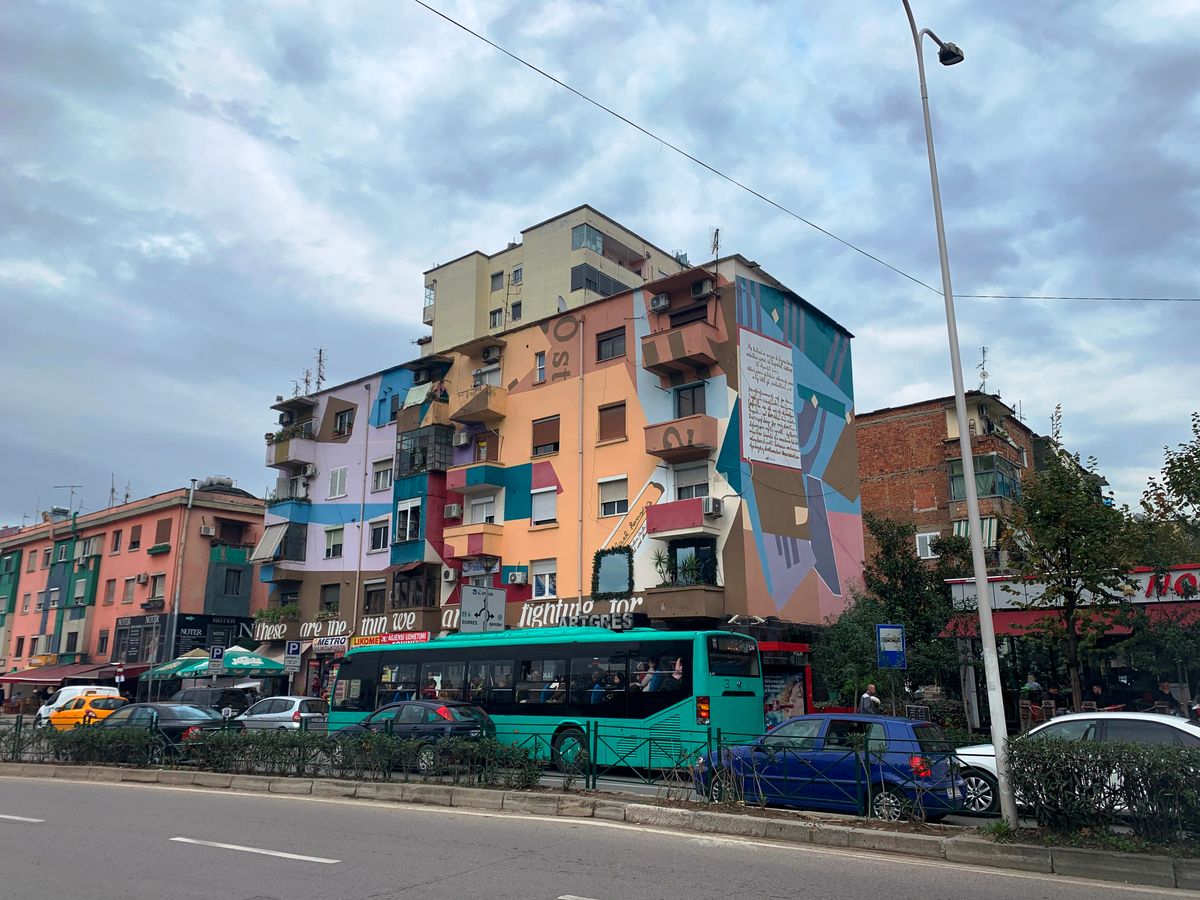
A capital that repainted itself out of a grey decade
Tirana in the 1990s was, by every account, a grim place: crumbling Stalinist blocks, potholed streets, a decade of post-communist chaos. Then a former mayor with an arts background had the city's building facades painted in bright, sometimes clashing colour blocks, and the effect became the city's identity. It is still, underneath the paint, a young capital still working things out: sidewalks that end without warning, traffic that treats lanes as suggestions, construction cranes over half the skyline. None of that stops it from being one of the most enjoyable, least pretentious capitals in Europe to spend two days in.
What Tirana has going for it beyond the colour is scale and price. The centre is compact enough to walk between Skanderbeg Square, Blloku and the New Bazaar in twenty minutes each way, and it is startlingly cheap: a byrek breakfast costs about a euro, a proper sit-down dinner with wine rarely tops fifteen. For a first stop in Albania or a long weekend on its own, it delivers more than its reputation as a mere gateway to the coast suggests.
The honest complications
Tirana is a genuinely unfinished city. Pavements are uneven and sometimes simply absent, drivers do not reliably yield at crossings even where there is a marked crossing, and summer heat (regularly above 32°C in July and August) with limited shade makes midday sightseeing uncomfortable. The National History Museum on Skanderbeg Square, normally the obvious first stop, is closed for renovation until 2028, which changes how the square works as a sightseeing anchor: its exterior mosaic is still visible, but budget your first day around Bunk'Art and the mosque instead. None of this is a reason to skip the city, but it is not a polished, ready-made European capital, and it does not pretend to be.
A small capital, four areas that matter
Tirana rewards staying central. Almost everything a first-time visitor wants sits within a twenty-minute walk of Skanderbeg Square, and the choice of base comes down to how much nightlife noise you want outside your window.
Blloku
Once the walled, guarded residential compound of the communist party elite, off-limits to ordinary Albanians until 1991, Blloku is now the opposite: the densest concentration of cafes, cocktail bars and restaurants in the country, and the neighbourhood most visitors end up basing themselves in. Daytime is café culture and slow coffees; night brings the raki bars and the crowds. Expect noise on weekend nights if your room faces the main streets.
Skanderbeg Square & the Boulevard
The formal centre: the vast square itself, the Et'hem Bey Mosque, the Skanderbeg statue, and the wide Deshmoret e Kombit boulevard running south past the Pyramid toward the university. Staying here trades a little of Blloku's buzz for quiet nights and a shorter walk to Bunk'Art 2 and the boulevard's museums and government buildings.
Pazari i Ri (New Bazaar)
A restored covered and open-air market a few minutes north of Skanderbeg Square, now one of the most photographed corners of the city: produce stalls, flower sellers, small bars and restaurants ringing a colourful courtyard. Come in the morning for the market itself and the freshest byrek; by evening it functions more as a bar and restaurant square.
Around the Grand Park & Artificial Lake
Liqeni i Farkës, Tirana's artificial lake, was flooded into a valley in 1956 to cool the city's cement works and is now Parku i Madh, the capital's biggest green space: shaded promenades, paddleboats in summer, and a lakeside path popular with runners. A twenty-minute walk south of Blloku, and the easiest escape from the traffic without leaving the city.
From five-star towers to a €5 hostel bed in Blloku
Tirana's hotel scene has grown fast alongside the tourism boom, and prices remain low by European capital standards across every bracket. These five picks cover the range, from full-service luxury to the hostels that make the city one of the cheapest capital stops in Europe.
At the top, Rogner Hotel Tirana is the city's established five-star address, centrally located with a swimming pool and an à la carte restaurant, from around €190 a night. Xheko Imperial Luxury Hotel & Spa, about five minutes from Bunk'Art 2, adds an indoor pool, whirlpool baths and a sauna from roughly €140.
In the boutique bracket, Padam Boutique Hotel & Restaurant occupies a 1930s villa near the Pyramid, five minutes from Blloku, and pairs its rooms with one of the city's most elegant dining rooms, while Iliria Boutique Hotel sits directly between Blloku and Skanderbeg Square with a Mediterranean-leaning restaurant and a terrace for evening drinks, both in the €70-110 range.
At the budget end, Trip'n Hostel is the pick locals and repeat visitors mention first: a central, social hostel with a co-working space, sunny terrace and free breakfast, dorm beds from around €10 and privates from €25 to €35.
Byrek for a euro, tavë kosi for ten, raki after both
Tirana eats well and cheaply. The best food is not always at the smartest address: a market stall byrek can beat a restaurant starter, and Blloku's fine-dining rooms genuinely compete with Western European capitals at a third of the price.
Byrek
Flaky pastry filled with spinach and cheese, meat, or tomato, sold by the slice across the city. Petrit's stall at the corner of Rruga Myslym Shyri and Rruga Elbasanit, open from 7am until he sells out around noon, is the local benchmark: the byrek me spinaq costs about 100 lek and the queue moves fast.
Traditional Albanian
Oda, near Pazari i Ri, does old-school Albanian home cooking properly: stuffed peppers, slow-cooked lamb, and a version of tavë kosi that draws locals as much as visitors. For a farm-to-table take on the same repertoire, Mullixhiu in a pine-clad dining room runs a tasting menu of small Albanian plates for around 3,000 lek (about €25), one of the best-value tasting menus in Europe.
Raki & an evening in Blloku
Komiteti Kafe-Muzeum, furnished like a communist-era apartment with mismatched vintage radios and rugs, pours more than twenty-five kinds of raki and is as much a small museum as a bar. It anchors an evening that can move on to Colonial Cocktail Bar, Albania's first dedicated cocktail bar and still one of its best, for something less rustic.
Contemporary & fine dining
Padam, inside its 1930s villa near the Pyramid, is Tirana's most elegant address, and Salt, a large open-kitchen Mediterranean and sushi room, is the pick for something livelier. Both take reservations at weekends.
Bunkers, a mosque, a mountain and a market
Tirana's sights are compact enough to cover in two focused days, with the bunker museums doing more to explain the country than any other single stop in Albania.
Skanderbeg Square and the mosque
Skanderbeg Square, one of the largest public squares in Europe, is the natural starting point, anchored by the equestrian statue of the national hero and ringed by the Opera House, government buildings and the Et'hem Bey Mosque. Completed in 1823 and one of the few mosques to survive Hoxha's religion ban intact, its interior frescoes of bridges, waterfalls and floral motifs are free to see outside prayer times; dress modestly and remove shoes. Note that the National History Museum on the square's north side, with its landmark "The Albanians" mosaic on the facade, is closed for renovation until 2028; the mosaic itself is still visible from outside.
The Bunk'Art museums
With the National History Museum closed, Bunk'Art 2, occupying the bunker beneath the former Ministry of Internal Affairs less than a minute from Skanderbeg Square, is the best short introduction to the Hoxha regime, focused on the police and surveillance state (entry around 900 lek). Bunk'Art 1, a five-storey underground complex on the city's outskirts built to shelter the political and military elite in a nuclear war, covers the fuller sweep of communist-era history and is worth the trip out by taxi or the L11 bus, best combined with the Dajti cable car below since both share the same departure area.
Dajti Ekspres cable car
One of Europe's longer cable car rides climbs from a base station near Bunk'Art 1 to the top of Mount Dajti in about fifteen minutes, opening up the whole city and the plain beyond (return ticket roughly 1,000-1,500 lek, closed Tuesdays). At the top there are hiking trails, a restaurant, and Ballkoni Dajti specifically, worth the ride for the view over Tirana alone.
Pazari i Ri and the Pyramid
The New Bazaar is worth a slow morning browse for its produce stalls and photogenic courtyard, and doubles as one of the best breakfast stops in the city. A ten-minute walk south, the sharply angled concrete Pyramid of Tirana, originally a museum to Hoxha and now reopened as TUMO Tirana, a free technology and creative-arts space for young people, is worth a look from outside even if you don't go in; the exterior steps are climbable for a city view.
One, two or three days, planned street by street
Two full days cover Tirana properly; even one focused day hits the essentials. A third day is really the Krujë day trip, and worth adding if your schedule allows it.
- Morning
Skanderbeg Square and the mosque. The Et'hem Bey Mosque, the square, and a byrek breakfast from a Pazari i Ri stall.
- Midday
Bunk'Art 2. A short walk from the square, then lunch at Oda near the bazaar.
- Afternoon
Blloku. Coffee and a wander through the cafe streets, then the Pyramid on the way back toward the centre.
- Evening
Raki at Komiteti, dinner in Blloku or at Padam near the Pyramid.
- Day 1
The one-day route: Skanderbeg Square, Bunk'Art 2, Blloku, dinner and raki.
- Day 2 morning
Bunk'Art 1 and Dajti. Taxi or the L11 bus out to Bunk'Art 1, then the cable car up Mount Dajti for the view and a coffee at Ballkoni Dajti.
- Day 2 afternoon
Grand Park and the lake. Back down to the city, then a slow walk or paddleboat at Liqeni i Farkës.
- Day 2 evening
Mullixhiu. The tasting menu, then a last round at Colonial Cocktail Bar.
- Days 1-2
The two-day route above, at a gentler pace.
- Day 3
Krujë. A furgon or taxi north to Skanderbeg's mountain stronghold: the castle, the Skanderbeg Museum, and the working Ottoman-era bazaar, back in Tirana by evening.
Compact, walkable, and short on pavements in places
Tirana International Airport, Nënë Tereza (TIA), also known as Rinas, sits about 17km northwest of the centre. The Rina Express shuttle bus runs to Skanderbeg Square in around 30 minutes for about €4 (400 lek), departing roughly hourly; an official airport taxi costs €20-25. Neither Uber nor Bolt operates in Albania as of 2026: local apps Speed Taxi and Merr Taxi cover the same ground in the city and are what most visitors end up using.
The centre itself is walkable, and that is the best way to see it: Skanderbeg Square, Blloku, the New Bazaar and the Pyramid are all within twenty minutes of each other on foot. Pavements are inconsistent and sometimes simply end, so flat, sturdy shoes matter more here than in most European capitals. City buses cover the outskirts and Bunk'Art 1 (the L11 route runs from Skanderbeg Square toward Dajti) for a fare of about 40 lek, cash only, though routes and stops are not always clearly signed for visitors.
Best time to visit
Tirana works as a city break year-round since it doesn't depend on beach weather, but May, June, September and October are the most comfortable: warm without the 32-38°C peaks of July and August, when midday heat and limited shade make sightseeing genuinely uncomfortable. Winter (November to February) is mild by Northern European standards, around 5-14°C, with more rain and fewer crowds at the sights.
One of Europe's cheapest capital cities
Tirana is noticeably cheaper than any Western European capital and cheaper than most Balkan ones. The main cost trap is the same as everywhere: eating at the handful of tourist-facing restaurants right on Skanderbeg Square instead of walking two minutes into Blloku or the bazaar.
- Hostel dorm bed €10-15
- Byrek and market meals €3-6
- Walking plus the occasional bus fare
- Free sights: the square, mosque exterior, Grand Park
- Boutique hotel or 3-star €70-110
- Restaurant dinners €10-20/person
- Taxis for the Bunk'Art/Dajti loop
- Cable car and museum entries
- Rogner or Xheko Imperial €140-190+
- Tasting menus at Padam or Mullixhiu
- Private Krujë day tour
- Airport taxis over the shuttle bus
Safe by capital-city standards, with the usual caveats
Tirana is safe for tourists. Violent crime against visitors is rare, the central areas and Blloku are fine to walk at night with normal urban awareness, and the besa hospitality tradition that defines the country generally holds in the capital too. The practical risks are pickpocketing in crowds and traffic, not violent crime.
The three things that actually catch visitors: pickpocketing, concentrated in the New Bazaar on busy mornings and on crowded city buses, so keep bags closed and in front of you; traffic, since drivers do not reliably stop at marked crossings and pavements sometimes disappear altogether, so cross deliberately and don't assume right of way; and unlicensed taxis at the airport quoting inflated fares, avoidable by using the Rina Express bus or a licensed app. Tirana is a reasonable choice for solo female travellers, broadly in line with the country's 7.8/10 rating: harassment is uncommon in the centre and Blloku, and the cafe culture makes it easy to spend an evening out alone.
Emergency numbers match the rest of Albania: 112 general emergency, 127 ambulance, 128 fire, 129 police, all with English-speaking operators on 112.
Krujë, Skanderbeg's mountain stronghold
Tirana's position in the central lowlands makes it a workable base for a single strong day trip; the Riviera and the UNESCO cities are better tackled as their own stops rather than rushed from the capital.
Krujë
Krujë, the hilltop town from which Skanderbeg held off the Ottomans in the 15th century, sits about an hour north of Tirana. The hilltop castle houses the Skanderbeg Museum, and below it a working Ottoman-era bazaar still sells traditional crafts, qeleshe caps and copperware rather than mass-produced souvenirs. Furgons leave when full from Tirana's northern departure points; a taxi or organised half-day tour is the simpler option if you'd rather not navigate the minibus system.
Tirana FAQ
Is Tirana safe for tourists?
Yes. Violent crime against visitors is rare and Tirana is fine to walk at night in the central and Blloku areas with normal urban awareness. Pickpocketing in the New Bazaar and on crowded buses is the main practical risk, not violent crime.
How many days do I need in Tirana?
Two full days covers the city well: one for Skanderbeg Square, the mosque and the New Bazaar, one for the Bunk'Art museums and Blloku. A third day fits the Krujë day trip and is worth adding if you have it.
How much does Tirana cost per day?
Budget travellers manage on €35-50 a day with hostel beds and byrek-and-market meals; mid-range runs €70-110. Tirana is one of the cheapest capital cities in Europe.
When is the best time to visit Tirana?
May, June, September and October: warm without being scorching, and quieter than the Albanian Riviera in peak summer. Tirana works year-round as a city break since it doesn't depend on beach weather.
What is Blloku?
Once the walled, off-limits residential compound of Albania's communist party leadership, Blloku is now Tirana's cafe, bar and restaurant district and the liveliest few blocks in the city.
Is Bunk'Art worth visiting, and can I still see the National History Museum?
Bunk'Art 1 and Bunk'Art 2 are the best way to understand the Hoxha era and both are open and worth the entry fee. The National History Museum on Skanderbeg Square is closed for renovation until 2028, though its facade mosaic is still visible from the square.
How do I get from Tirana airport to the city centre?
The Rina Express shuttle bus runs from Rinas Airport to Skanderbeg Square in about 30 minutes for roughly €4 (400 lek), departing hourly. An official airport taxi costs €20-25.
What is the best area to stay in Tirana?
Blloku or the streets around Skanderbeg Square for first-timers: central, walkable, and close to the best eating. Blloku is livelier and louder at night; the centre is quieter and a few minutes further from the restaurants.
Can I do a day trip to Krujë from Tirana?
Yes, easily. Krujë, Skanderbeg's mountain stronghold, is about an hour north of Tirana by furgon minibus or taxi, with a hilltop castle, the Skanderbeg Museum, and a working Ottoman-era bazaar. A comfortable half-day trip.
Is Uber or Bolt available in Tirana?
No, neither operates in Albania as of 2026. Local ride-hailing apps such as Speed Taxi and Merr Taxi cover the same ground in Tirana and are what residents and most visitors use instead.
What Stays With You
Tirana does not have Rome's ruins or Vienna's grandeur, and it is not trying to. What it has is a city that spent forty years cut off from the world, came out the other side with almost nothing, and decided to paint every building it had in colours nobody agreed on in advance. The bunker under the ministry that is now a museum, the byrek stall with a line of locals moving fast at 8am, the raki poured in a bar furnished like somebody's grandmother's living room: none of it is staged, and all of it is oddly moving once you notice the pattern.
Sit in Blloku on your last evening with a coffee or a raki, watch the city that repainted itself go about its evening, and understand why so many visitors extend their one planned night into three.