
Explore Albania
Four zones, one small country: the colorful capital, two UNESCO stone cities, the Ionian coast, and mountains the Albanians call accursed. Plus the spots that don't make most guides, and what besa actually asks of you as a guest.
Top Destinations
Don't spend the whole trip in Tirana. The Riviera, Berat, Gjirokastër and the Accursed Mountains are the real reasons Albania has become Europe's most talked-about new destination.
Albania divides naturally into four distinct travel zones: the capital Tirana and the central lowlands, the UNESCO cities of the south (Gjirokastër and Berat), the Albanian Riviera, and the northern mountains. A two-week trip covers all four. A week covers two or three well. The country is small enough, roughly the size of Maryland, that long distances are not the constraint: road quality and the time needed to do each zone justice are.
Tirana
Tirana is one of the most unexpectedly enjoyable capitals in Europe. The city was grey and crumbling in the 1990s; a former mayor commissioned the painting of every building facade in bright colors, and the resulting urban landscape, chaotic, energetic, and covered in murals, is the city's visual signature. Skanderbeg Square is the center, dominated by the National History Museum's enormous Socialist Realist mosaic and the Et'hem Bey mosque. The Blloku district, formerly the exclusive residential zone of communist party leadership, now the city's nightlife and cafe hub, has the best eating in Albania: Oda near the Pazari i Ri market for old-school Albanian home cooking, Piceri Era in Blloku for a livelier version of the same, and Mullixhiu for a farm-to-table take on fërgesë and tavë kosi. For a drink, Komiteti Kafe-Muzeum behind the Pyramid of Tirana serves 25-plus kinds of raki inside a room furnished like a communist-era apartment. The two Bunk'Art museums in converted communist-era nuclear bunkers tell the story of the Hoxha years more honestly than any textbook, and Ballkoni Dajti, the restaurant at the top of the Dajti Express cable car, is worth the ride up for the view over the city alone. Budget two days.
Gjirokastër
Gjirokastër sits on a steep hillside in a southern valley, its stone Ottoman houses stacked above each other like a collapsed bookshelf, a massive citadel on the ridge above. Part of the joint UNESCO World Heritage listing with Berat. Birthplace of Enver Hoxha, which the city observes with a complicated silence, and of the novelist Ismail Kadare, whose novel "Chronicle in Stone" describes the city of his childhood under Italian and German occupation. The bazaar is the center of the old city, buy a pair of qeleshe (white felt traditional caps) and eat byrek at the stalls. The Citadel contains a captured US Air Force plane from the 1957 cold war incident. The city is most beautiful in the morning before the day-trippers arrive from Sarandë.
Berat
Berat, the "City of a Thousand Windows," sits in a river valley in central Albania with two UNESCO-listed neighborhoods: Mangalem on the left bank, where rows of Ottoman houses with many windows climb the hillside in terraces, and Kala, the castle district above. The castle is inhabited, uniquely in the Balkans, people live inside the medieval citadel, and contains several Byzantine churches with intact frescoes attributed to the artist Onufri. Walk up through the Kala at dusk when the Mangalem houses below are lit up, this is when the effect is most affecting.
Dhërmi, Himara & Sarandë
The Albanian Riviera runs 150 kilometers from Vlorë south to Sarandë, with the SH8 coast road hugging steep mountains above the Ionian Sea. The water, turquoise, clear to the bottom at 8 meters, warm from June to October, is the equal of anywhere in the Mediterranean. Dhërmi has the most developed beach infrastructure and small stylish stays like Gogo's Boutique Hotel up in the old village above the beach. Himara is the largest town on the coast, with a quieter, more atmospheric option in Aphrodite's Garden. Borsh has the longest beach with fewer tourists. Sarandë has the best nightlife and the ferry to Corfu. In May, June, September and October the coast is excellent; in July and August it is crowded and prices double.
Valbona & Theth
The Bjeshkët e Namuna, Accursed Mountains, in northern Albania are the country's most dramatic landscape and best hiking. The classic route: ferry across Koman Lake, a van to Valbona village, the full-day hike over the pass to Theth (5 to 8 hours depending on fitness and snow), then a day exploring Theth's waterfall and blood feud lock-in tower. In Valbona, Lazer Çardaku Guesthouse and Hotel Margjeka are both close to the trailhead and well regarded for their family-cooked dinners. In Theth, Guesthouse Skender Selimaj and Molla Guest House are reliable, family-run picks near the village center. Guesthouses charge 20 to 30 euros a night with dinner included. The pass can have snow as late as June and as early as October.
Shkodër
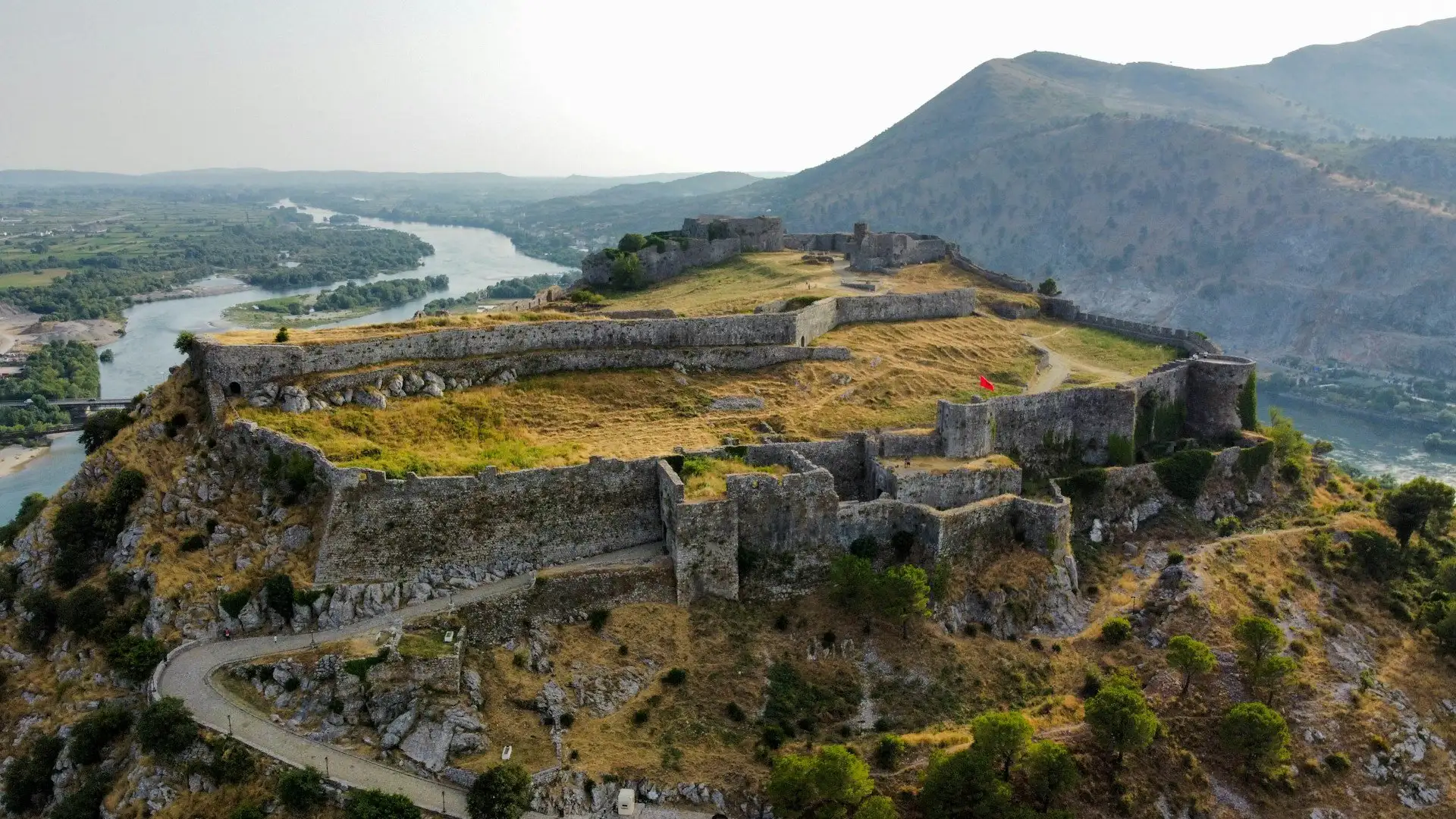
Shkodër, in the northwest on the edge of the lake bordering Montenegro, is the cultural capital of northern Albania and the gateway to the Accursed Mountains. Rozafa Castle above the lake has views over the confluence of two rivers and the lake toward Montenegro that are among the better views in the Balkans. The old city bazaar and Rruga Kolë Idromeno have good cafes. Shkodër is also the base for boat trips on the lake.
Butrint
Butrint is one of the least-known major archaeological sites in the Mediterranean, a UNESCO World Heritage Site on a peninsula in a lagoon near Sarandë, with ruins spanning Greek, Roman, Byzantine and Venetian occupation from the 7th century BCE onward. A Greek theater, Roman baths, an early Christian baptistery with exceptional mosaic floors, and Venetian towers sit in a forested setting on the water. Visit in the morning before the Corfu day-trippers arrive.
Vlorë & Apollonia
Vlorë, where Albanian independence was declared in 1912, has a functional port town character and is the gateway to the Riviera. More compelling is Apollonia, 12 kilometers inland, a Greek colonial city from the 6th century BCE whose ruins sit in olive-grove-covered hills largely to themselves. The monastery of Shen Mëri at the center of the ruins is still in use.
Culture & Etiquette
Albanian culture has a specific concept, besa, that is central to understanding how the country relates to guests. Besa is a code of honor that includes, among other obligations, the absolute duty to protect and provide for a guest in your home. The tradition is ancient, codified in the Kanun (the traditional law code of the northern highlands, attributed to the 15th-century chieftain Lekë Dukagjini), and is still felt as a genuine cultural value rather than a tourist-industry performance.
Albania is a majority-Muslim country but the practice is notably moderate and the country operates secularly in most contexts. Churches, mosques, and Bektashi tekkes coexist in most towns, and the Albanian approach to religion tends toward tolerance of all and strict adherence to none, a pattern reinforced, paradoxically, by the communist-era ban on all religion.
If an Albanian invites you to their home or to share their raki, accept. Besa means your presence as a guest creates obligations for the host that are genuinely felt. Declining repeatedly is rude in a way that transcends the usual tourist-local interaction.
Albanians nod their head downward to mean yes, and upward with a clicking sound to mean no, the opposite of most European conventions. This produces real miscommunications until you know about it.
Cover shoulders and knees. Applies at the Et'hem Bey mosque, the Bektashi tekkes, and the Orthodox churches in Gjirokastër and Berat. Women should carry a scarf for mosques.
Faleminderit (thank you), Mirëdita (good day), Po (yes, with a downward nod), Jo (no, with an upward nod or click). Attempting Albanian produces warmth out of all proportion to the effort.
Albania is largely a cash economy outside Tirana hotels. Get lek from ATMs (Raiffeisen Bank and BKT accept foreign cards well) rather than exchange bureaus.
Albanian road culture is assertive in a way that requires local knowledge to work. Drive defensively and let local drivers do what they do.
Particularly in the north and traditional communities. Ask, and accept a refusal gracefully. In tourist areas like Berat and Gjirokastër's bazaars, norms are more relaxed.
The gjakmarrja (blood feud) tradition of the northern highlands was suppressed under communism but resurfaced in the 1990s. It has declined significantly since, but isolated incidents still occur in rural areas. Not a tourist safety issue, but it explains the lock-in towers (kula) you'll see in Theth.
The Riviera's water and coastline are not "like Greece but cheaper." They are Albanian, in a country with its own history and character.
The SH8 has hairpin bends with significant drops. Passes in the Accursed Mountains can have snow into May and from October. Check conditions before you go.
Iso-Polyphony
Albanian iso-polyphony, a form of traditional polyphonic folk singing in which multiple voices sing independent melodic lines simultaneously, was the first Albanian cultural practice added to UNESCO's Intangible Cultural Heritage list, in 2005. Specific to southern Albania, heard at ceremonies, funerals, and folk festivals.
The Kanun
The Kanun of Lekë Dukagjini, the traditional law code of northern Albania first written down in the 15th century, governed hospitality, property rights, marriage, and conflict resolution for centuries. The besa hospitality code is as defining as the more infamous blood feud provisions.
The Bektashi Order
The World Headquarters of the Bektashi Sufi order relocated from Turkey to Tirana in 1925 when Atatürk dissolved Sufi orders. Their syncretic tradition blends Shia Islam, Christianity and pre-Islamic Balkan traditions, with tekkes scattered through southern Albania.
Ismail Kadare
Born in Gjirokastër in 1936, Kadare is the major Albanian novelist of the 20th century. "Chronicle in Stone," "The General of the Dead Army," and "The Palace of Dreams" are the starting points. Reading one before visiting Gjirokastër changes the city. He died in Paris in 2024.
Food & Drink
Albanian food is Mediterranean with Ottoman and Balkan layers, fresh vegetables, olive oil, grilled meats, dairy from highland sheep and goats, and freshwater fish from the lakes. The best Albanian food is not at tourist-facing restaurants but at family guesthouses in the mountains, market stalls in the old bazaars, and village restaurants in the south where a full lunch for two with wine costs 15 euros.
Byrek
The Albanian street food standard: thin flaky pastry filled with spinach and white cheese, meat and onion, or tomato, baked in large trays and sold by the slice. The quality varies enormously, a good byrek from a busy market stall is one of the best 1-euro food experiences in Europe.
Fërgesë & Tavë Kosi
Fërgesë is a Tirana specialty: tomatoes, cottage cheese and meat or peppers baked in a small clay pot. Tavë kosi, lamb slow-baked with yogurt and eggs until it sets into a creamy crust, is Albania's most internationally recognized dish. Oda near Pazari i Ri does both properly, in a dining room set up like a traditional Albanian sitting room.
Qofte & Grilled Meats
Small spiced meatballs cooked over charcoal, shish kebab, and lamb and goat from the highlands. A full plate with salad, bread and a glass of local wine at a roadside restaurant costs 6 to 8 euros.
Cheese & Dairy
Djathë i bardhë, sheep's milk white cheese similar to feta, appears at every meal. Mountain guesthouses in Valbona and Theth serve fresh cheeses from their own flocks, one of the better food souvenirs to bring home.
Seafood & Lake Fish
The Riviera has excellent fresh fish grilled on terraces above the water. The Ohrid trout, unique to Lake Ohrid, is found around Pogradec. A full grilled fish with salad and local wine costs 12 to 18 euros.
Raki & Wine
Raki, a clear grape or mulberry spirit, is the national drink, offered as a welcome, offered after a meal, offered instead of conversation. A small raki at a bar costs 50 to 80 lek. Albanian Kallmet red wine, from the Shkodër area, is underrated at 5 to 8 euros a bottle.
Quick Questions About Where to Go
The stretch of Ionian coast from Vlorë south to Sarandë, with mountains dropping into turquoise water and isolated pebble coves. Best in May, June, September and October; crowded and pricier in July and August.
The Bjeshkët e Namuna, the high mountain range in northern Albania. The Valbona to Theth trek is the country's most celebrated hike, a full-day crossing over a mountain pass.
Two days is enough for the city itself, byrek, Bunk'Art, Blloku, but don't let it be the whole trip. The Riviera and mountains are the bigger draw.
Start with byrek from a market stall, then tavë kosi and fërgesë at a proper restaurant. Both UNESCO-listed cities, Gjirokastër and Berat, have excellent traditional restaurants in their old bazaars.
Ready to Plan the Trip
Now that you know where to go and what besa asks of you as a guest, the planning page covers when to go, full itineraries, transport, where to stay, budget, and visa rules.