
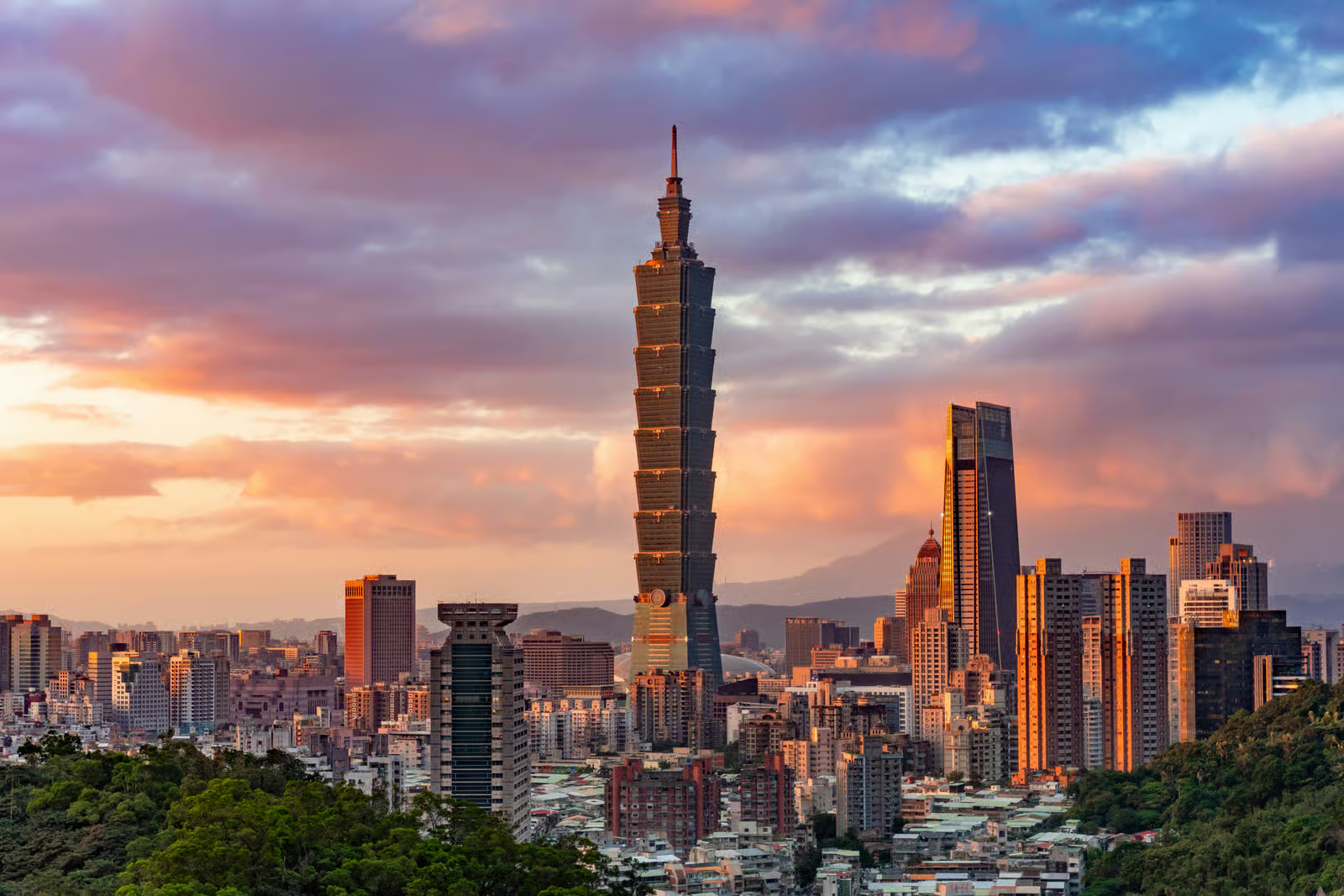
A capital that runs on quiet competence
Taipei sits in a basin ringed by green mountains, the Keelung and Xindian rivers cutting through a city that mixes glass towers, temple courtyards, and low-rise neighbourhoods where laundry still dries on balconies above scooter-lined streets. It's a capital built for actually living in, not performing for cameras, and that unshowiness is exactly what visitors end up loving most: the MRT runs on time to the minute, the night markets are genuine nightly rituals rather than tourist theatre, and a five-minute walk can take you from a designer mall to a centuries-old temple mid-ceremony.
What changed in the last decade is that word got out. Taipei used to be the city travelers passed through on their way to Japan or Southeast Asia; now it draws visitors specifically, though nowhere near the volume Tokyo or Seoul absorb. The tourist infrastructure is excellent, English signage covers the MRT and major sights thoroughly, and the city still feels unmistakably like it belongs to the people who live there.
The honest complications
Summer (June to September) is hot, humid and the peak of typhoon season, capable of shutting down the city for a day with little warning. Scooters are the dominant form of local transport and move in patterns that take a day or two to read; pedestrians need to look both ways even where they technically have right of way. Some of the best food is at small, no-English-menu shops where pointing and smiling does the job, which is part of the charm but takes a beat of getting used to. And a handful of headline sights, the National Palace Museum and Taipei 101 observatory especially, do get genuinely crowded around midday; go early or late.
Six districts that matter
Taipei's MRT makes nearly every neighbourhood a reasonable base, so the choice comes down to atmosphere: skyscrapers and shopping, youth culture and neon, food-street charm, or hot springs and quiet.
Xinyi
Taipei's modern financial and shopping district, anchored by Taipei 101, the tower that was the world's tallest building from 2004 to 2010. Department stores, five-star hotels and the city's most polished restaurants cluster here, alongside the excellent Elephant Mountain (Xiangshan) hiking trail for skyline views without paying for the observatory.
Zhongzheng
Home to Taipei Main Station, where the MRT, THSR and TRA all converge, plus the Chiang Kai-shek Memorial Hall and Bopiliao Historic Block. Central, walkable and quieter at night than Ximending, this is the practical first-timer's base with everything else a short ride away.
Ximending
Taipei's teenage, neon-lit heart: pedestrianized shopping streets, K-pop blasting from storefronts, themed cafes and the city's densest concentration of budget hostels. Just south, the Wanhua district holds Longshan Temple and the Qing-dynasty Bopiliao Historic Block, a genuinely old Taipei two blocks from the newest one.
Da'an
An upscale, tree-lined residential district built around Yongkang Street, the single best few hundred metres of eating in the city, home to Din Tai Fung's flagship and the beef noodle soup that made Yong Kang Beef Noodles a Michelin-listed institution. Quieter and more local than Xinyi, with excellent small hotels.
Shilin
Home to both the National Palace Museum's imperial Chinese collection and the Shilin Night Market, the city's largest and most famous, if also its most tourist-heavy. A short MRT ride from central Taipei rather than a neighbourhood most visitors base themselves in.
Beitou
A hot spring town technically inside city limits, 30 minutes from the centre by MRT, with sulfurous Thermal Valley steam, Japanese colonial-era bathhouses and public and private soaking options. The furthest thing from Ximending's neon, and worth a half or full day.
From tower hotels to Taiwan's excellent hostel scene
Taipei's five-star hotels cluster around Xinyi and Taipei 101, the mid-range is strong in Da'an and Zhongzheng, and Ximending has the city's densest concentration of well-run hostels. These picks span the budget range and each earns its spot.
At the top, Grand Hyatt Taipei in Xinyi sits directly adjacent to Taipei 101, with 850 rooms, an outdoor pool, spa and fitness centre, and rates that swing widely with season, from roughly $70 a night in the shoulder season up past $200 in peak weeks, exceptional value for a five-star this central. Humble House Taipei (from around $195) is the boutique standout, a design-forward property blending contemporary Taiwanese art with genuinely comfortable rooms, also in Xinyi.
In the mid-range, Star Hostel Taipei Main, steps from Taipei Main Station in Zhongzheng, is consistently rated among the city's best-run properties, with private rooms that include their own bathroom and breakfast included for every guest, a rare combination at this price point. For Da'an's food-street access, look for a boutique guesthouse within walking distance of Yongkang Street; several small, well-reviewed properties cluster there.
At the budget end, Meander Taipei Hostel in Ximending is clean, bright and known for a strong backpacker social scene, a genuinely good pick for solo travelers. Ximen WOW Hostel, about 150 metres from Ximen MRT Station's Exit 6, offers loft-style dorm rooms in the same lively district.
Xiaolongbao, beef noodles and eighteen night markets
Taipei's food culture runs on two tracks at once: internationally famous restaurants that still feel like neighbourhood spots, and a night market scene, eighteen markets citywide, that functions as much as social ritual as dinner. Both tracks are cheap by the standards of any comparable capital.
Xiaolongbao at Din Tai Fung
The original Din Tai Fung opened on Yongkang Street in 1958 as a cooking-oil shop turned dumpling counter; the current flagship dine-in venue sits just across the street in a four-storey space that opened in 2020, reached via MRT Exit 5 and about 75 metres of walking. Twelve pork xiaolongbao run around NT$250, and Taipei is consistently the cheapest city in the world to eat here. Expect a queue at peak hours; it moves fast.
Beef noodle soup at Yong Kang Beef Noodles
Yong Kang Beef Noodles, on Jinshan South Road just off Yongkang Street, has been simmering its broth since 1963 and made the Michelin guide's Taipei list in 2020. The beef falls apart, the broth is deep and slow-built, and the noodles are properly chewy. A short walk from Din Tai Fung, making the two an easy combined food stop.
Shilin Night Market
Taipei's largest and most famous night market, reached directly by MRT to Jiantan or Shilin station. Fried chicken cutlets the size of a face, oyster omelets, bubble tea and stinky tofu all crowd the food court and surrounding stalls. It's the most tourist-heavy of the city's eighteen night markets, but the food quality holds up regardless.
Raohe & Ningxia night markets
Raohe, a single long covered street near Ciyou Temple, and Ningxia, smaller and more locally frequented in Datong district, both skew less touristy than Shilin. Ningxia in particular is known among residents as having the city's best concentration of old-school stalls per metre of street.
Towers, temples and a hot spring valley
Taipei rewards a mix of headline sights and unplanned wandering. A few things benefit from timing around the crowds; most of the city is best discovered on foot between them.
Xinyi and the skyline
Taipei 101, the 508-metre tower that held the world's-tallest title from 2004 until Dubai's Burj Khalifa overtook it in 2010, has an observation deck around the 89th floor with 360-degree views over the basin and surrounding mountains; tickets run about NT$600 (roughly $19), and going right at opening or in the last hour before close avoids the worst of the midday queues. For a free alternative view of the tower itself, the Elephant Mountain (Xiangshan) trail, a short, steep climb from Xiangshan MRT station, is Taipei's most photographed skyline viewpoint and costs nothing but a bit of sweat.
The National Palace Museum
One of the world's great collections of imperial Chinese art and artifacts, roughly 700,000 pieces evacuated from Beijing's Forbidden City during China's civil war and now housed in Shilin. Open daily 8:30am to 6:30pm, admission NT$350 (about $11). Give it a genuine half day; the jadeite cabbage and meat-shaped stone are the crowd favourites, but the ceramics and painting galleries reward slower attention and are markedly less crowded.
Longshan Temple and old Wanhua
Longshan Temple, founded in 1738 and one of Taipei's oldest and most active places of worship, sits a few blocks south of Ximending's neon core; admission is free, and early morning is the best time to see it mid-ceremony without the crowds. The adjacent Bopiliao Historic Block preserves a stretch of Qing-dynasty and Japanese-era shophouses, a rare intact fragment of pre-modern Taipei two minutes from the city's youngest, loudest district.
Beitou hot springs
Thirty minutes from the centre by MRT to Xinbeitou station, Beitou is a genuine hot spring town: the milky, sulfurous Thermal Valley, public foot baths at Fuxing and Quanyuan parks, and private and public bathhouses housed in Japanese colonial-era buildings. Easily a half-day trip, and one of the best ways to feel like you've left the city without actually leaving it.
Ximending after dark
Taipei's youth-culture district: pedestrianized shopping streets, themed cafes, street performers and a genuinely dense late-night food scene. Less about specific sights than atmosphere, best experienced as an evening wander rather than a checklist.
One, two or three days, planned by neighbourhood
Three full days covers Taipei properly, and even a single well-planned day hits the essentials. These routes are built around the MRT and sequenced to dodge the worst crowds.
- Morning
Longshan Temple and Ximending. The temple at its quietest, then a wander through Bopiliao Historic Block and Ximending's shopping streets.
- Midday
Yongkang Street. Xiaolongbao at Din Tai Fung, beef noodles at Yong Kang Beef Noodles if there's room left.
- Afternoon
Taipei 101 and Xinyi. The observatory or the free Elephant Mountain hike, then a wander through Xinyi's malls.
- Evening
Shilin Night Market. Dinner in stalls, several small dishes rather than one big one.
- Day 1
The one-day route: Longshan Temple, Ximending, Yongkang Street lunch, Taipei 101, Shilin Night Market.
- Day 2 morning
National Palace Museum at opening. A genuine half day; arrive close to the 8:30am opening to beat the tour groups.
- Day 2 afternoon
Beitou hot springs. MRT to Xinbeitou, Thermal Valley, a soak at a public or private bathhouse.
- Day 2 evening
Raohe or Ningxia night market. A quieter, more local alternative to Shilin.
- Days 1-2
The two-day route above, at a gentler pace.
- Day 3
Jiufen and Shifen. A full-day trip via Ruifang: hillside teahouses and lantern-lit alleys in Jiufen, sky lanterns and Taiwan's broadest waterfall in Shifen. See the Day Trips chapter below for the full route.
One of Asia's best metro systems, plus scooters everywhere
Taipei is flat, MRT-covered and easy to navigate on foot within districts. From Taoyuan International Airport (TPE), the Airport MRT runs directly to Taipei Main Station in roughly 35-50 minutes for about NT$150; a taxi runs longer in traffic and costs more. In the city, get an EasyCard (NT$100 at any MRT station or 7-Eleven/FamilyMart, then load credit): it covers the MRT, city buses, and doubles as payment at convenience stores and some vending machines. MRT fares start around NT$20 and scale with distance.
Scooters are the dominant form of local transport and move in patterns that take newcomers a beat to read; look both ways even where you have the right of way, and don't assume a scooter will stop at a crossing. Taxis are affordable and metered, and rideshare apps work well for late-night trips or luggage-heavy transfers. Bike-share (YouBike, widely available via app or an EasyCard-linked account) is a genuinely good way to cover the riverside paths and flatter districts.
Best time to visit and typhoon season
Taipei has a humid subtropical climate. October to December and March to April are the sweet spots: cooler, drier, with manageable crowds. Summer (June to September) is hot, humid and the peak of typhoon season; storms can shut down transit and close mountain areas with a day or two of notice, so building slack into a summer itinerary is wise. Winter is mild but damp, with more overcast days than genuinely cold ones.
Lunar New Year, on shifting dates each year (usually late January to mid-February), sees mass domestic travel and many small, family-run businesses close for several days. Major sights stay open, but check hours for smaller restaurants and shops if your trip overlaps.
Roughly half the cost of Tokyo for comparable quality
Taipei is noticeably cheaper than Tokyo, Singapore or Hong Kong, especially for food and local transport. The hostel scene is excellent at the budget end, and the mid-range stretches further than in most East Asian capitals.
- Hostel dorm NT$500-900
- Night market meals NT$100-200
- MRT and buses via EasyCard
- Free temples plus one paid sight
- Boutique hotel or B&B NT$2,500-5,000
- Restaurant meals NT$300-600
- MRT plus the occasional taxi
- Museum, observatory, one hot spring visit
- Grand Hyatt or equivalent 5-star
- Fine dining and tasting menus
- Private day trips and guides
- Premium hot spring resort stays
One of Asia's safest capitals, with one real thing to know
Taipei sits within Taiwan's Level 1, Exercise Normal Precautions rating from the US State Department, its lowest advisory tier. Violent crime against tourists is extremely rare, the city is safe to walk at night including for solo women, and the MRT runs safely until close with no notable late-night issues.
The one thing that actually catches visitors: scooters. They move fast, weave through gaps cars wouldn't take, and don't always yield at crossings the way official right-of-way suggests they should. Look both directions before crossing even at marked pedestrian crossings, and give scooters a wide berth when walking near curb lanes. Beyond that, standard city awareness covers everything: keep bags zipped in crowded night markets, and use official taxi ranks or a rideshare app late at night rather than unmarked cars. Emergency numbers are 110 for police and 119 for fire and ambulance.
Jiufen's lantern-lit alleys are the classic Taipei escape
Taipei's position at the north of the island makes it a strong base for a handful of easy day trips, all reachable by public transport without a rental car.
Jiufen & Shifen
Jiufen, a former gold-mining town stacked up a hillside overlooking the sea, is reached by taking the MRT to Zhongxiao Fuxing station, exiting at Exit 1, and boarding bus 1062 (about 1.5 hours). Its narrow, lantern-strung Old Street is genuinely atmospheric in the early evening once the day-trip crowds thin, with teahouses built into the hillside looking out over the coast. To combine it with Shifen, known for its sky lantern releases and Taiwan's broadest waterfall, take a bus from Jiufen to Ruifang train station, then the scenic Pingxi branch line to Shifen; there's no direct bus between the two towns, so both legs route through Ruifang. Doing both in one day is a long but doable circuit if you leave Taipei early.
Yangmingshan National Park
A volcanic national park just north of the city, with hiking trails, hot springs and, in spring, cherry blossoms that draw crowds of their own. A genuinely wild, green counterpoint to the city, reachable directly by MRT and bus without a full-day commitment.
Tamsui (Danshui)
A riverside old town at the end of the Red MRT line, known for its sunset views over the Tamsui River, a historic waterfront lined with Qing-dynasty and Spanish-Dutch colonial forts, and a lively evening food street. An easy half-day trip requiring no transfers beyond the MRT itself.
Taipei FAQ
Is Taipei safe for tourists?
Taipei is one of the safest capital cities in Asia. Violent crime against tourists is extremely rare; the main practical hazard is scooter traffic, not crime. The MRT and streets are safe to use late at night.
How many days do I need in Taipei?
Three full days covers the city well: one for Xinyi and the National Palace Museum, one for Ximending and Longshan Temple, one for Beitou hot springs and Yongkang Street. A fourth day fits the Jiufen and Shifen trip and is worth adding.
How much does Taipei cost per day?
Budget travelers manage on NT$1,400-2,000 a day with hostels and night market meals; mid-range runs NT$3,500-6,000. Taipei is roughly half the cost of Tokyo, Singapore or Hong Kong for comparable quality.
When is the best time to visit Taipei?
October to December and March to April: cooler, drier weather and fewer typhoon risks. Summer (June-September) is hot, humid and the main typhoon season, which can disrupt plans with little notice.
How do I get from Taoyuan Airport to Taipei?
The Airport MRT runs directly from Taoyuan International Airport to Taipei Main Station in about 35-50 minutes for roughly NT$150 with an EasyCard. Taxis cost more and take longer in traffic.
What is the best area to stay in Taipei?
Zhongzheng, around Taipei Main Station, and Da'an for first-timers: central, walkable and well connected by MRT. Xinyi for skyscraper views and shopping. Ximending for nightlife and youth culture on a budget.
Do I need to speak Mandarin in Taipei?
No. English is widely understood in hotels, on MRT signage and in tourist areas. A few phrases, xièxiè (thank you) and nǐ hǎo (hello), are appreciated and go a long way with older residents.
What is the EasyCard and do I need one?
Taipei's reloadable transit card: NT$100 for the card, then load credit. It covers the MRT, buses and many convenience store purchases, and pays for itself after a few rides. Buy one at any MRT station or 7-Eleven.
Is Taipei walkable?
Yes, especially central districts like Zhongzheng, Da'an and Ximending. The city is flat compared to hilly Asian capitals like Hong Kong, and the MRT covers longer hops like Beitou and Shilin easily.
How do I visit Jiufen and Shifen in one day?
Take the MRT to Zhongxiao Fuxing, then bus 1062 to Jiufen (about 1.5 hours). To add Shifen, take a bus from Jiufen to Ruifang train station, then the Pingxi Line to Shifen. There's no direct bus between Jiufen and Shifen, so route through Ruifang both ways.
What Stays With You
Taipei doesn't ask for your attention the way some capitals do. It just keeps being itself, the MRT chime, the incense at Longshan Temple, the queue outside Din Tai Fung that moves faster than it looks, the family running the same night market stall for thirty years, and lets you spend a few days inside it. None of it was arranged for visitors, which is exactly why it holds up.
Take the Elephant Mountain trail up on your last evening, watch the city and Taipei 101 catch the last light together, and understand why the people who've been keep finding reasons to come back.