
Nepal's capital doesn't perform for you, it just lets you in
Kathmandu sits in a bowl-shaped valley at 1,400 meters, ringed by hills that on a clear post-monsoon morning open up to a first, startling wall of Himalayan white in the distance. The city itself is dense, loud and visually chaotic: temples wedged between internet cafes, cows wandering through traffic that mostly, but not always, moves around them, and a living urban fabric that has absorbed Hindu and Buddhist tradition, a monarchy's rise and fall, a civil war, an earthquake and, most recently, a political upheaval, without ever quite losing its own rhythm.
What changed for Kathmandu specifically was the 2025 Gen Z protests, centered here and genuinely disruptive for a few intense days in September. The city has been calm and functioning normally since, tourism included, and the low prices and warmth toward visitors that predate all of it are still exactly what you'll find. Go two streets back from Thamel's tourist strip and you're in a neighbourhood where a full dal bhat costs three dollars and the shopkeepers have been at the same stall for thirty years.
The honest complications
Kathmandu's traffic and air quality are real: horns are constant, pavements are inconsistent, and the pre-monsoon months (March-May) can turn genuinely hazy. The 2015 earthquake's damage is mostly repaired at the major sites but still visible at some smaller temples and outlying spots more than a decade on. And while the city has been stable since the March 2026 election, it is the kind of recently unsettled place worth a quick advisory check before you fly, not because anything is currently wrong, but because that's the sensible thing to do anywhere with 2025 in its very recent history.
Five areas, and where you sleep decides how you experience the valley
Kathmandu's neighbourhoods split roughly between the old Newar city core, the modern tourist and trekking hub, and the calmer diplomatic quarter. The valley's other two historic cities, Patan and Bhaktapur, are close enough to visit as day trips but distinct enough in feel to belong in their own section below.
Thamel
Kathmandu's tourist and trekking-outfitter district since the 1970s, a dense grid of gear shops, guesthouses, rooftop restaurants and bars a short walk from Kathmandu Durbar Square. It is unapologetically touristy and also the single most practical base: everything you need before or after a trek, from a TIMS permit counter to a down jacket rental, is within a few blocks.
Basantapur & the old city
The old royal city around Kathmandu Durbar Square, and the dense market lanes of Ason and Indra Chowk beyond it, are where the working city and the tourist sights overlap most closely. Narrow, crowded and genuinely alive: this is where locals actually shop, not a preserved museum piece.
Durbarmarg & Lazimpat
Wide, tree-lined streets, international restaurants, and Kathmandu's higher-end and international-chain hotels. A ten-to-fifteen-minute taxi from Thamel and the old city, and a calmer choice for travelers who want quiet nights over walkable chaos.
Boudha
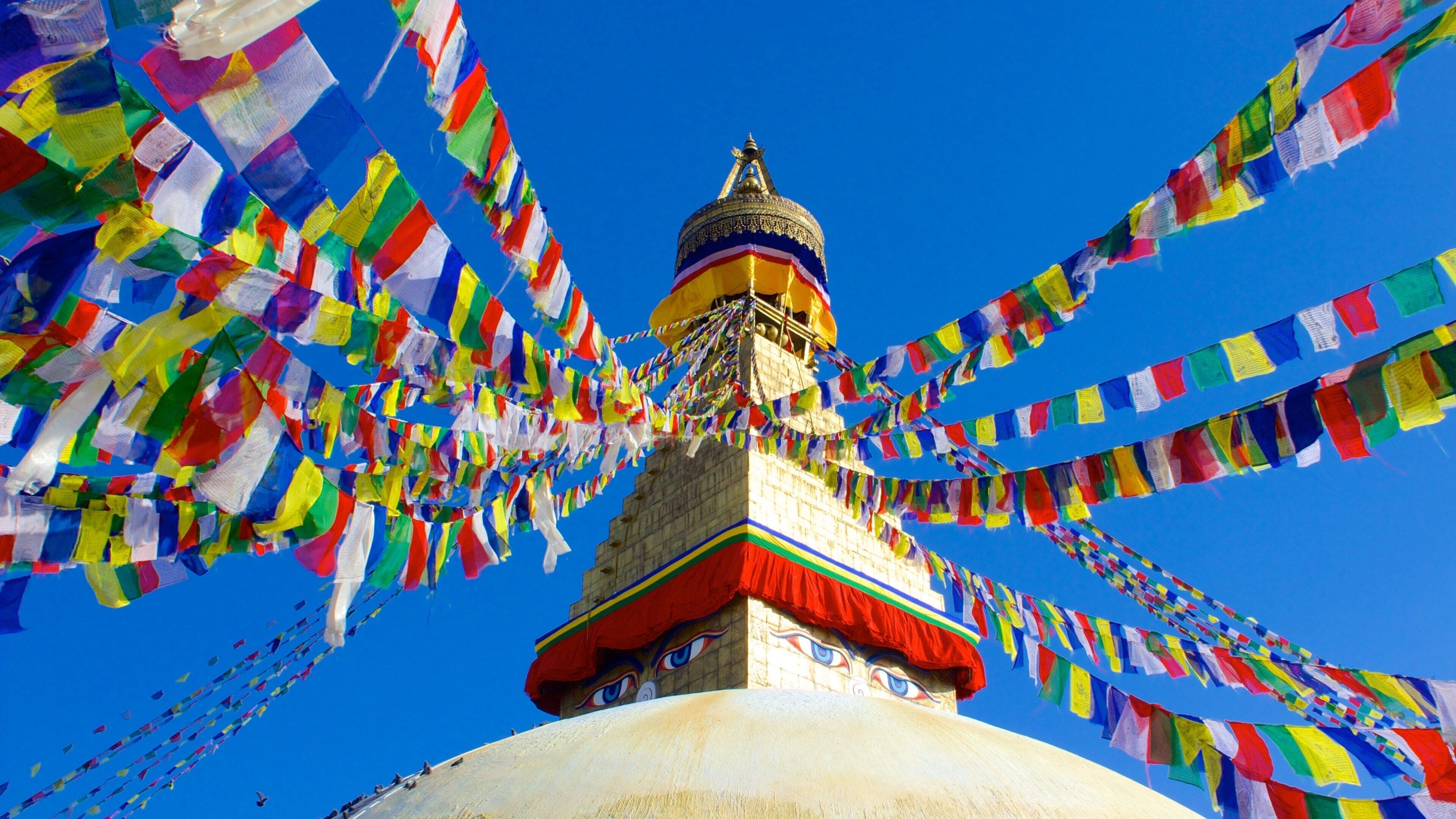
The neighbourhood surrounding the Boudhanath Stupa, with a large Tibetan refugee community, monasteries, and rooftop cafes looking directly down onto the mandala below. A genuinely different atmosphere from Thamel: monks in maroon robes on their circumambulation, prayer wheels turning, and noticeably cleaner air than the city center.
Patan (Lalitpur)
Technically a separate city, Patan sits just across the Bagmati River and has its own UNESCO-listed Durbar Square, arguably more compact and refined than Kathmandu's own, plus a living tradition of metalworking and woodcarving in the surrounding lanes. Close enough for a half-day visit from anywhere in central Kathmandu.
From a rebuilt Newari palace to Thamel's backpacker classics
Kathmandu's accommodation runs from a handful of internationally recognized heritage hotels down to some of the cheapest decent guesthouses in Asia, with Thamel alone holding hundreds of options within a few blocks. These picks cover the range and each earns its place.
At the top, Dwarika's Hotel is Kathmandu's architectural landmark: a property built and furnished around salvaged and hand-carved traditional Newari woodwork, with a serious spa, multiple award-winning restaurants, and a genuine sense of place that no chain property in the city can match, from around $210-350 a night.
In the international-standard bracket, the city's Hyatt and Marriott-affiliated properties around Boudha and Soaltee offer dependable comfort and pools for travelers who want a predictable stay before or after a trek, generally $90-160 a night.
In Thamel itself, the Kathmandu Guest House, the original 1970s overland-trail institution that put Thamel on the map, remains a well-run mid-range choice with a genuinely peaceful garden courtyard behind its busy street frontage, from around $35-60. Hotel Roadhouse Thamel and Hotel Excelsior are solid contemporary boutique options nearby, roughly $30-50, both close to Durbar Marg and the main trekking outfitters.
At the budget end, Thamel's guesthouse density makes independent comparison shopping easy and worthwhile: rooms from roughly $8-20 a night are common in the backstreets a block or two off the main strip, with the same essential convenience and noticeably less noise.
Dal bhat, momo, and a Newari feast worth planning a night around
Kathmandu's food scene runs on dal bhat as the daily default and momo as the constant snack, with Newari cuisine, the Kathmandu Valley's own distinct tradition, as the thing worth a dedicated evening. Thamel has the widest range for travelers, but the best value and some of the best flavor sit a few streets outside it.
Dal Bhat
Lentil soup, rice, vegetable curry and pickle, traditionally with free refills. Thamel House does a well-regarded, more polished sit-down version in a restored traditional building; local eateries just outside Thamel do it just as well for half the price.
Momo
Steamed or fried dumplings, buffalo, chicken or vegetable, with a spiced tomato-sesame achar. The stalls around Ason Bazaar, the old city's produce and spice market, do the version locals actually eat: a plate of ten buff momo runs about NPR 150.
Newari Feast
A full Newari meal, samay baji (beaten rice with an assortment of small dishes), choila (spiced grilled buffalo), and yomari for dessert, is the valley's signature dining experience. Bhojan Griha in Dillibazar, set in a restored 150-year-old Rana-era mansion with live traditional music, is the best-known address; Yala Maya Kendra near Patan Durbar Square is the equivalent choice on that side of the river.
Vegetarian & Vegan
OR2K, a long-running organic vegetarian restaurant in Thamel, remains the reliable choice for travelers avoiding meat, with a Middle Eastern-leaning menu alongside Nepali options and floor-seating dining rooms.
Three ancient sites, a living goddess, and a lot of alleys worth getting lost in
Kathmandu's major sights cluster into a walkable core plus two outlying religious complexes best reached by taxi. This chapter walks through the city roughly the way two or three unhurried days would.
Kathmandu Durbar Square and the old city
Kathmandu Durbar Square (foreigner entry NPR 1,000) is the former royal palace complex, its pagoda temples largely rebuilt since the 2015 earthquake, and the Kumari Ghar beside it houses Nepal's living goddess, who occasionally appears at her carved window. From the square, the market lanes of Ason and Indra Chowk lead through the working old city; give yourself an unplanned hour here rather than a fixed route. The Garden of Dreams, a restored 1920s walled garden two minutes from Thamel's chaos, is the best place in the city center to sit down and do nothing for half an hour.
Swayambhunath, the Monkey Temple
Swayambhunath (entry NPR 200), a hilltop Buddhist stupa with the Buddha's watchful eyes painted on all four sides, is one of the oldest religious sites in the valley and a genuine local pilgrimage spot, not only a tourist attraction. The climb up several hundred steps, past resident macaques, delivers one of the better panoramic views over the Kathmandu Valley on a clear day. Best in the early morning, both for the light and to beat the heat of the climb.
Boudhanath
Boudhanath (entry NPR 400), one of the largest stupas in the world, anchors a neighbourhood with a substantial Tibetan community and a genuinely meditative atmosphere once you're walking the kora, the clockwise circuit around its base, alongside monks and pilgrims spinning prayer wheels. The rooftop cafes ringing the stupa give the best vantage point for a slow coffee overlooking the whole mandala.
Pashupatinath
Pashupatinath (entry NPR 1,000), on the Bagmati River, is one of the most important Hindu temple complexes in the world and an active cremation site; non-Hindus cannot enter the main inner temple but can view the ghats and wider complex respectfully from across the river. This is a real, ongoing religious and funerary site, not a performance, and it's worth visiting with that context in mind rather than as a photo opportunity.
Evenings in Thamel
Thamel's rooftop restaurants and bars fill up after dark, live music venues run traditional and contemporary sets most nights, and the gear-shop windows stay lit late into the evening for last-minute trekking purchases. It is touristy by design and still a genuinely fun place to end a day, especially with other travelers comparing notes on routes and permits.
One, two or three days, planned around the valley's rhythm
Two to three full days covers Kathmandu's essentials properly; even one well-planned day delivers the core sights. These routes are sequenced to dodge the worst midday heat at Swayambhunath and end each day somewhere worth being at dusk.
- Morning
Swayambhunath at opening. Climb before the heat, then a taxi down to Kathmandu Durbar Square.
- Midday
The old city and momo. Wander Ason Bazaar, lunch at a local momo stall, then the Garden of Dreams for a break.
- Afternoon
Boudhanath. A taxi across town for the kora walk and a rooftop coffee overlooking the stupa.
- Evening
Thamel. Dinner and the rooftop bar scene, or a Newari feast at Bhojan Griha if you booked ahead.
- Day 1
The one-day route: Swayambhunath, Kathmandu Durbar Square, Ason Bazaar, Boudhanath, Thamel evening.
- Day 2 morning
Pashupatinath. Visit respectfully, then cross the river to Patan for its own Durbar Square and artisan lanes.
- Day 2 afternoon
Patan Museum and a slow wander through the metalworking and woodcarving side streets.
- Day 2 evening
Yala Maya Kendra for a Newari dinner on the Patan side, or back to Thamel.
- Days 1-2
The two-day route above, at a gentler pace.
- Day 3, option A
Bhaktapur. A half-day trip to the valley's best-preserved medieval city, its own Durbar Square and pottery square.
- Day 3, option B
Nagarkot sunrise. An early drive up for a Himalayan panorama, back in Kathmandu by afternoon.
Walkable in the center, a taxi city everywhere else
Kathmandu's historic core and Thamel are compact enough to walk, though pavements are inconsistent and traffic doesn't reliably yield to pedestrians. From Tribhuvan International Airport, a prepaid taxi to Thamel costs around NPR 900-1,000 ($6-7) and takes 20-40 minutes depending on traffic; use the official prepaid counter inside the terminal rather than touts outside it, who quote inflated fares.
Within the city, metered taxis exist but meters are inconsistently used in practice, so agree a fare before getting in, typically NPR 150-400 for most central trips. Ride-hailing apps like Pathao and InDrive are widely used, cheaper and more transparent than street taxis, and a reasonable default for longer hops to Boudhanath or Patan. Cycle rickshaws cover short distances in the old city at a similar price to walking-distance taxi fares, more for the experience than the efficiency.
Best time to visit and Kathmandu's festival calendar
October-November is Kathmandu's best window: clear post-monsoon skies, comfortable temperatures, and the country's two biggest festivals, Dashain and Tihar. March-April is the second-best stretch, warmer with hazier air. June-September is the monsoon, with heavy afternoon rain and reduced mountain visibility; December-February is cold and dry with the clearest air of the year but chilly nights.
Dashain (September-October) is Nepal's largest festival, with family gatherings, kite flying and many businesses closing for several days. Tihar (October-November), the festival of lights, includes distinctive days honoring dogs, crows and the sibling bond, and Kathmandu's streets fill with oil lamps and marigold garlands after dark. Both are extraordinary to witness and also mean reduced services and packed transport, plan around them deliberately.
One of Asia's most affordable capital cities
Kathmandu is significantly cheaper than most Southeast Asian capitals and among the most affordable cities in South Asia for travelers. The main cost trap is Thamel's tourist-facing restaurants, which charge two to three times the price of an identical meal a few streets away.
- Guesthouse room $8-20
- Local eateries and momo stalls $5-10
- Walking plus the occasional taxi
- Free temple exteriors, one or two paid sites
- Boutique hotel or Kathmandu Guest House-tier stay
- Restaurant meals $10-20
- Ride-hailing app for most trips
- Newari feast, museum entries, a day trip
- Dwarika's or equivalent heritage hotel
- Fine dining and spa treatments
- Private driver throughout
- Everest scenic flight or helicopter day trip
Calm since the 2025 unrest, with a short, practical list
Kathmandu is safe for tourists as of mid-2026. The city was the center of the September 2025 Gen Z protests, which were genuinely disruptive for a few days and led to a change of government, but the situation stabilized quickly, a peaceful election followed in March 2026, and the city has functioned normally since. Violent crime against tourists is rare; the realistic issues are pickpocketing, traffic, and periodic, usually announced political demonstrations.
The things that actually catch visitors: pickpocketing, concentrated in crowded spots like Thamel's evening streets and Ason Bazaar, so keep bags closed and in front of you; traffic, which doesn't reliably yield to pedestrians even at marked crossings, so cross defensively and follow the lead of locals; and taxi fare inflation, especially from tourists arriving at the airport, avoided by using the prepaid counter or a ride-hailing app. Emergency numbers are 100 for police, 102 for ambulance, and 1144 for the tourist police hotline.
The rest of the valley is closer than it looks
Kathmandu's position at the center of its valley makes it an easy base for the region's other historic cities and viewpoints. Four trips are worth a half or full day each, all reachable by taxi or ride-hailing app without a tour.
Bhaktapur
The valley's best-preserved medieval city, largely closed to car traffic in its historic core, with its own Durbar Square, the five-story Nyatapola Temple, and a working pottery square where you can watch clay pots thrown and dried in the sun. Less rebuilt-feeling than Kathmandu's own square after the 2015 earthquake, and worth a half or full day.
Patan (Lalitpur)
Technically its own city just across the Bagmati River, with a compact, refined Durbar Square, the excellent Patan Museum inside the old palace, and a living tradition of metalworking and woodcarving in the surrounding lanes. Easily combined with Pashupatinath, which sits between central Kathmandu and Patan.
Nagarkot
A ridge-top village with one of the most accessible Himalayan sunrise panoramas in Nepal, including Everest on a clear day, without any trekking required. Most visitors go up the evening before and catch the view at dawn, then return to Kathmandu by mid-morning.
Dakshinkali & Chandragiri
Dakshinkali, a Hindu temple known for its animal sacrifice rituals on Tuesdays and Saturdays, is a striking, unfiltered look at living religious practice. The Chandragiri cable car nearby climbs to a hilltop viewpoint over the valley and, on clear days, the Himalayan range beyond it, a faster alternative to Nagarkot if you're short on time.
Kathmandu FAQ
Is Kathmandu safe for tourists?
Yes. Violent crime against tourists is rare; the main concerns are pickpocketing in crowded spots like Thamel and Ason Bazaar, traffic, and periodic political demonstrations that are usually announced and localized. Standard city awareness covers it.
How many days do I need in Kathmandu?
Two to three full days covers the city well: one for Kathmandu Durbar Square and Thamel, one for Swayambhunath, Boudhanath and Pashupatinath, and a third for a Patan or Bhaktapur day trip. Add a day for Nagarkot if you want a Himalayan sunrise without trekking.
How much does Kathmandu cost per day?
Budget travellers manage on $20-35 a day with guesthouses and local eateries; mid-range runs $50-90. Kathmandu is significantly cheaper than most Southeast Asian capitals and among the most affordable cities in South Asia.
When is the best time to visit Kathmandu?
October-November for clear skies and the Dashain and Tihar festivals, March-April for warmer weather. June-September is the monsoon with heavy rain and haze; December-February is cold but clear.
Where should I stay in Kathmandu?
Thamel for first-timers: dense with guesthouses, restaurants and trekking outfitters, everything walkable. Durbarmarg or Lazimpat for a quieter, more upscale base a short taxi ride from the sights.
How do I get from Kathmandu airport to Thamel?
A prepaid taxi from the counter inside Tribhuvan International Airport costs around NPR 900-1,000 (about $6-7) and takes 20-40 minutes depending on traffic. Avoid unofficial touts outside the terminal who quote inflated fares.
Is Kathmandu walkable?
Thamel and the old city core are walkable, though pavements are inconsistent and traffic doesn't reliably yield. Longer hops, like to Boudhanath or Patan, are faster by taxi or ride-hailing app.
Do I need a mask for Kathmandu's air quality?
Air pollution is a genuine issue, especially March-May before the monsoon clears it. A well-fitted mask on visibly hazy days is a reasonable precaution, particularly for anyone with respiratory sensitivity.
Can I use Kathmandu as a base for trekking?
Yes, it's the standard base. Trekking agencies, gear shops and the TIMS permit counter are concentrated in Thamel, and Tribhuvan International Airport has the only flights to Lukla for the Everest region.
What Stays With You
Kathmandu does not clean itself up for visitors, and that is exactly why it works. The city keeps doing what it has always done, prayer flags strung between rooftops, monks circling the stupa at dawn, the same momo stall open for lunch after thirty years, and lets you walk through the middle of it. The Kumari's window, the first sight of white peaks over the hills on a clear morning, the plate of dal bhat that cost less than your coffee back home: none of it was arranged for you, which is why all of it sticks.
Go to Swayambhunath at first light on your last morning, watch the valley wake up below the stupa's painted eyes, and understand why Kathmandu has been pulling travelers off the main tourist trail and into the mountains for fifty years.